

A single 2×6 feels like nothing in the hand. A floor deck of them — joists spanning wall to wall, doubled at every opening, stacked flat for the trailer — is another matter entirely, and the suspension will tell you exactly which side of that line your build sits on.
This guide answers how much does a 2x6x8 weigh and every common length beside it, using only the typical ranges in the chart below, and explains the three things that move a board within them: species, moisture and treatment.
1. At a Glance: 2×6 Weight by Length
The 2×6 is the joist and rafter workhorse of North American framing. It spans farther and carries more than a 2×4, so its weight deserves a careful answer instead of a guess — and the honest answer is a range, not a number. Species, moisture and treatment move any single board up or down, and the table below gives the typical per-length ranges for common framing species, the same ranges shown in the chart. Nothing in this guide uses per-length figures beyond them, because inventing a precise number would make the estimate feel exact while being wrong.
Framing rarely uses one size alone, so read this chart beside its two companion guides: the guide to how much a 2×4 weighs by length, species and moisture covers the stud workhorse, and the guide to how much a 2×8 weighs by length, species and moisture covers the heavier header and floor timber. Together the three charts let you estimate a whole mixed frame — studs, joists and headers — without inventing a single figure the charts do not support.
| Length | Typical weight range | What the range covers |
|---|---|---|
| 8 ft | About 13–18 lbs | Common species, from kiln-dried to greener stock |
| 10 ft | About 16–22 lbs | Common species, from kiln-dried to greener stock |
| 12 ft | About 20–27 lbs | Common species, from kiln-dried to greener stock |
| 16 ft | About 26–36 lbs | Common species, from kiln-dried to greener stock |
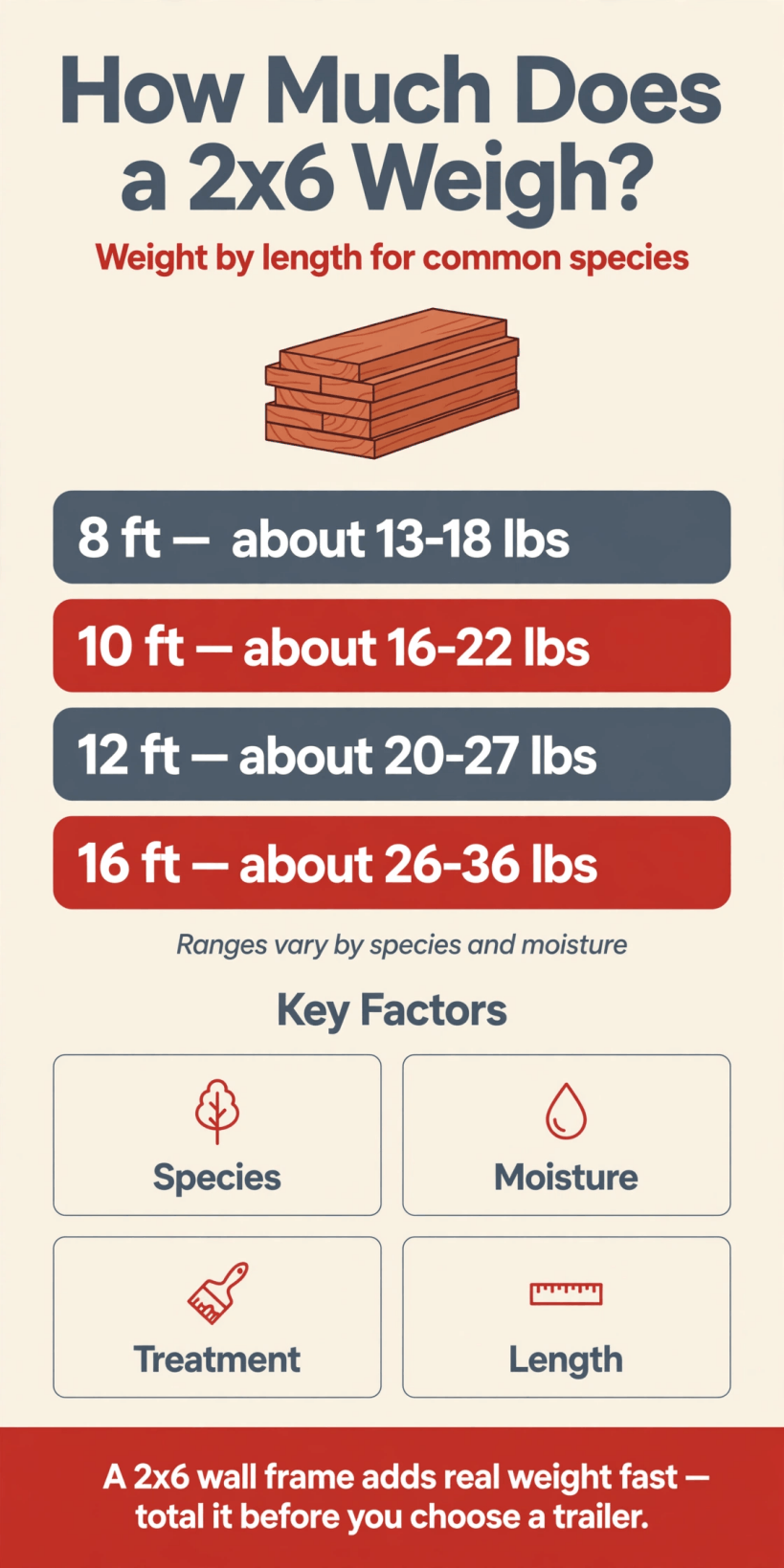
At a glance: a 2×6 runs about 13–18 lbs at 8 ft, 16–22 lbs at 10 ft, 20–27 lbs at 12 ft and 26–36 lbs at 16 ft, varying by species and moisture.
2. Nominal vs Actual Size: Why a 2×6 Is Not 2 by 6 Inches
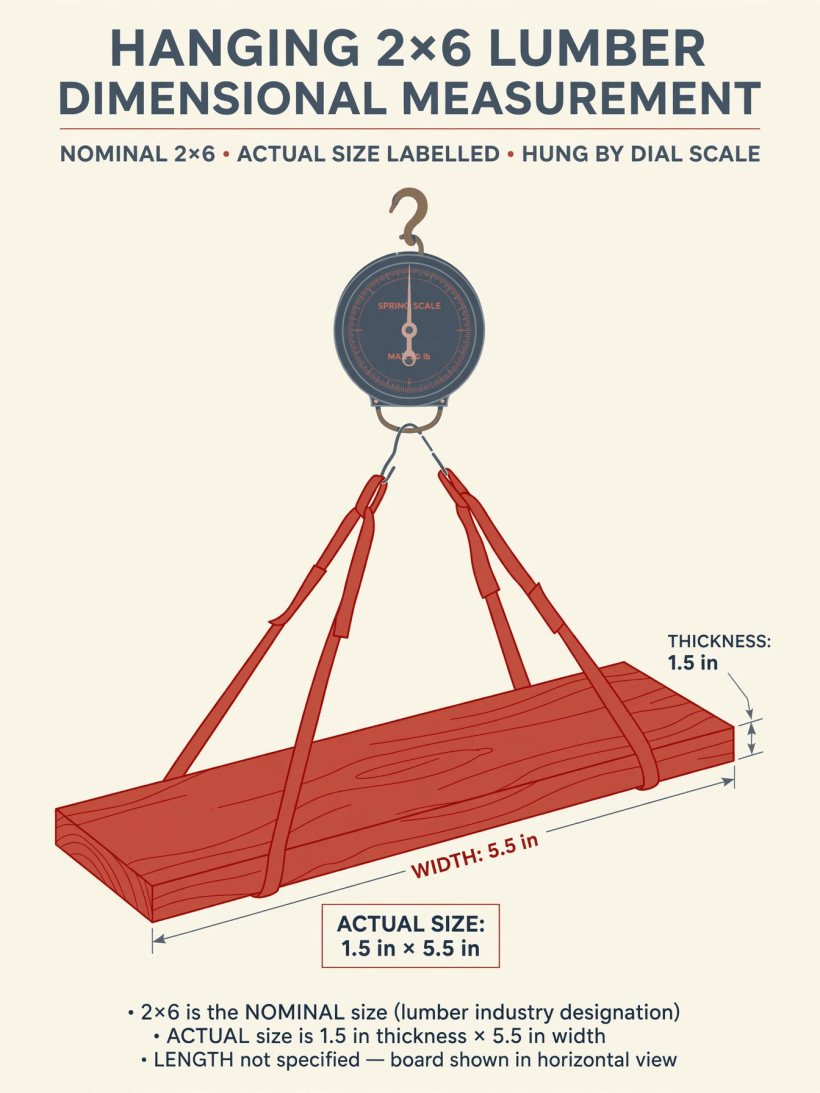
A 2×6 carries a nominal size, the dimension it held as rough-sawn lumber before drying and planing trimmed it down to the finished board you buy. The board on the rack is slimmer in both directions than its name suggests, and every shaving that came off the planer took mass with it. Estimating from the nominal name alone means quietly assuming more timber — and more weight — than the joist actually contains, and across a floor deck that quiet error multiplies into real pounds.
This matters doubly because the 2×6 earns its keep in spanning. Joists and rafters work at the edge of what a softwood member can carry, where the margin between a sound floor and a bouncy one is thinner than it looks. Weight follows the wood that is really there: a planed, dried rectangle of softwood, deeper than a 2×4 but built from the same honest material. Older reclaimed lumber, sawn fuller before modern standards, can be heavier per board — another reason to think in ranges when new and old stock meet on the same project.
3. Species: Why One Board Outweighs Another
Softwood is not one material, and the common framing species prove it on every lift. Trees grown slowly in cold climates lay down tight rings with a high share of dense latewood; trees grown fast in warmer regions lay down lighter, wider earlywood. The same nominal board from those two forests carries a different density in the same cross-section, and your shoulder registers the difference before your eyes do. This is the first reason the chart speaks in bands: two 2x6s of identical length, from different species, legitimately weigh differently.
Species also changes what the weight buys you. Denser stock generally holds fasteners with more grip and feels stiffer under load, while lighter stock is kinder to carry, cut and nail all day. Neither is categorically better; the practical habit is consistency across a single floor or roof, so joists share the same behaviour and the deck feels uniform. Expect any single board at the heavy end of its range to be dense, damp, or both — and the next two sections separate those causes so you can tell which you are holding.
4. Moisture: Kiln-Dried, Green and Everything Between
Water is the heaviest and most temporary ingredient in a board. Freshly sawn green lumber carries the sap and weather of its recent life in its cells, and it can sit at the very top of the chart’s ranges or feel heavier still in the hand. Kiln-dried stock has had that moisture deliberately driven down before sale, which is why two boards of the same species and length can differ so plainly on the rack: one is wood and water, the other is mostly wood. Moisture alone can swing a 2×6 from one end of its range to the other.
Moisture also leaves, and it leaves consequences behind. A green joist framed into a floor dries toward its surroundings over the following seasons, shrinking slightly and shedding water weight as it goes — which is why green framing can twist, cup and open gaps in the deck above it, quite apart from what it weighed on delivery day. For anything on a trailer, the lesson of the 2×8 weight guide and its length and moisture ranges applies at every size: estimate in ranges, build with the driest stock you can reasonably get, and never treat a delivery-day weight as permanent.
5. Pressure Treatment and Weight
Pressure-treated lumber is forced to drink. Preservative is driven deep into the cells under pressure so the board can survive rot and insects in damp service, and freshly treated stock comes out of that process sodden — noticeably heavier than the same board dry. The chart lists treatment among its key factors for exactly this reason: a wet treated 2×6 can sit at the very top of its range and beyond, and across a ground-contact sill, a deck ledger or an outdoor stair, that extra mass is a real load that arrives wet and dries slowly.
Treatment also decides where a board belongs. Treated stock earns its place where moisture and ground contact threaten — sills, ledgers, outdoor framing — and is wasted weight and cost inside a dry, enclosed floor. Some treated boards are kiln-dried again after treatment, and those sit much closer to ordinary kiln-dried weight; the stamp and the heft in your hands tell you which you are holding. When a project mixes both, weigh the plan honestly: untreated joists at chart weight, treated members assumed heavy until they have had time to dry.
6. How Weight Adds Up Across a Whole Floor
Nobody builds with one 2×6. Joists repeat at regular spacing across every floor, rims and blocking fill the edges, and openings gather doubled members around them — so the honest question is never the weight of a board but the weight of boards, plural, spanning the plan. This is where the ranges earn their keep: multiply a per-board range by a joist count and you hold a load range, wide enough to be truthful and narrow enough to plan a trailer trip, a loft deck or a delivery.
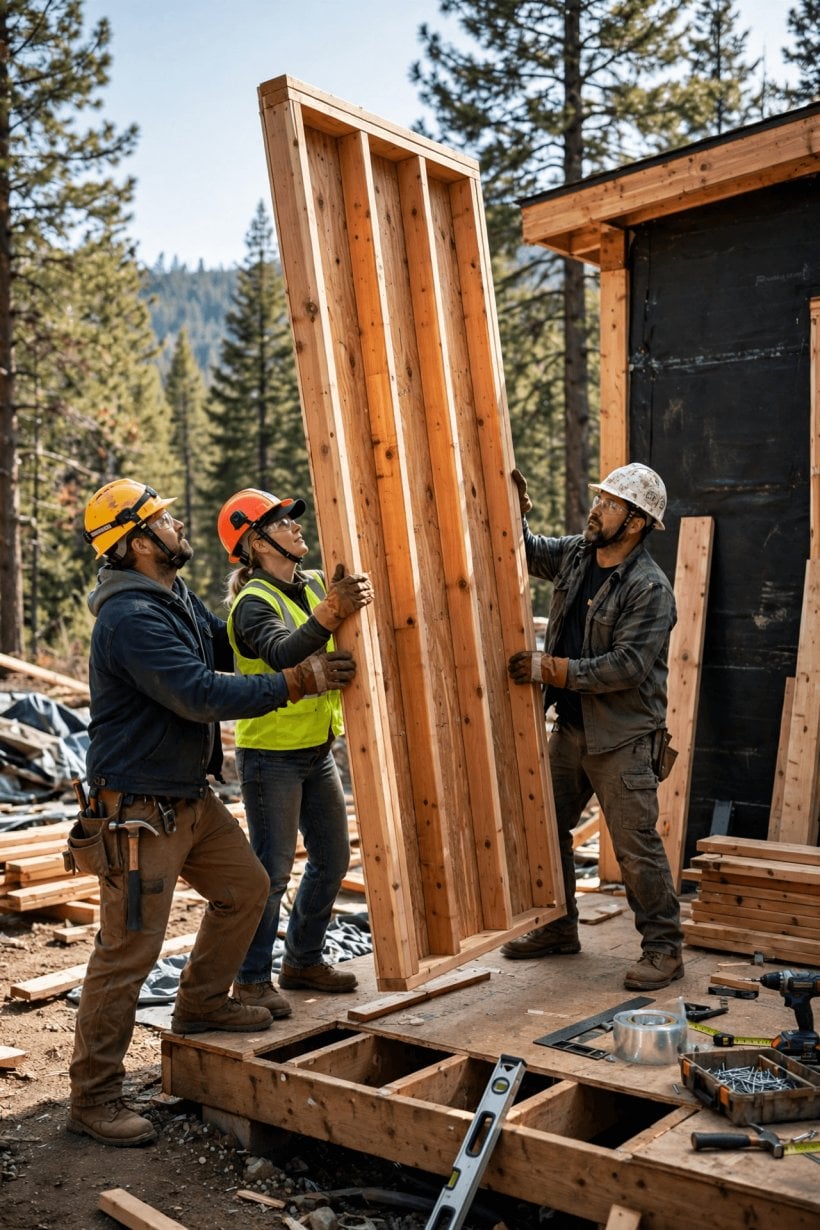
The framing guides on this site work the same way at building scale. Working through how to frame a tiny house on a trailer shows how quickly joists, wall studs and roof members accumulate into the number the trailer actually carries, and how to build a tiny house puts that framing in its proper place — early, structural, and unforgiving of guesses. A 2×6 wall frame adds real weight fast, as the chart itself warns: total it before you choose a trailer, not after.
7. Carrying, Stacking and Transport
Weight is also a handling question, and the 2×6 makes the point sharply. A single kiln-dried board at eight feet is a comfortable two-handed lift; the same board at sixteen feet is a sail that catches wind and a lever that tests wrists, and a green treated one is a deliberate carry with a partner. Plan the path from rack to truck to site before you buy: long joists overhang, bundles concentrate their load in one part of a bed or trailer, and a stack carried piecemeal across a muddy site costs more backs than the same stack placed well once.
Stacking is storage and safety at once. Lumber stacked flat, stickered to breathe and kept off the ground stays straighter and dries evenly; lumber dumped in a heap twists toward the weather, and a twisted joist is a lost joist. On the road, distribute the load over the axle rather than behind it, secure long boards against the surge of braking, and respect what the vehicle is rated to carry — the chart ranges, multiplied by your board count, give you the estimate to check against that rating before the yard loads you, not after.
8. Estimating a Stack or a Project Load
The method is deliberately simple, because simple methods get used. Count the boards by length. Take the chart range for each length. Multiply, add the lengths together, and you hold a low-to-high estimate for the framing package — no other per-length figures are needed, and none should be invented. Then adjust your expectations, not your numbers: a lot known to be green or freshly treated will live near the top of the estimate, and a kiln-dried lot near the bottom.
Worked honestly, this estimate answers the questions that actually arise. Will the trailer make one trip or two? Does the floor package, gathered in one place, stay sensible for the axles beneath it? Should the yard deliver instead? Keep the estimate in ranges all the way to the decision, because a false single number — precise, confident and wrong — is worse than an honest band. If the decision flips depending on where in the range the load falls, that itself is information: choose the safer option, or weigh a sample board at the yard and locate your lot within its range.
9. When Weight Matters: Trailers, Lofts and Load Paths
Most of the time, a 2×6’s weight is trivia. In three situations it becomes design. The first is anything on wheels, where the floor package is spent against a fixed carrying capacity before a single cabinet, tank or mattress is added — the single biggest structural spend on a tiny house trailer. The second is height: loft and mezzanine framing, where every board is lifted overhead and then carried by the walls below for the life of the building. The third is renovation, where new joists add their load to old structure that was never asked to hold it.
In each case the discipline is the same: know the range, know the count, and follow the load path down to the ground or the axle. The layouts in the tiny house floor plans collection reward this thinking, because a plan that places heavy storage, water and finishes over the structure that can carry them is a plan whose framing weight was considered, not discovered. Weight ignored at the drawing stage becomes weight argued with at the building stage, and the building always wins the argument.
10. Buying and Checking Boards at the Yard
Your hands are instruments at the lumber rack. Lift one end of candidate boards of the same length and species: the outlier that feels dramatically heavier is usually the wet one, and wet joists are the ones that twist as they dry under your floor. Sight along each board for bow, crook and twist, check the ends for splits, and favour the driest, straightest stock the rack offers — you are selecting for finished weight and finished straightness at the same time, and both matter in a member that spans.
Buy the floor as a lot where you can, store it flat and covered the moment it lands, and re-check your load estimate against the board count on the invoice rather than the count in your head. If a project grows — an extra span, a heavier deck finish — revisit the companion charts for the 2×4 weight ranges by length, species and moisture before assuming the smaller members behave like the joists. An hour of honest estimating at the yard is the cheapest structural engineering most small projects will ever get.
Final Considerations
A 2×6 weighs about 13–18 lbs at 8 ft, 16–22 lbs at 10 ft, 20–27 lbs at 12 ft and 26–36 lbs at 16 ft — ranges, not promises, because species, moisture and treatment move every board within them. Learn to think in those bands, count your boards honestly, and let the estimate stay a range until the decision is made. Do that, and lumber weight stops being a surprise discovered on a trailer, a loft or a delivery note, and becomes what it should be: one more part of the plan you made on purpose.


0 Comments