
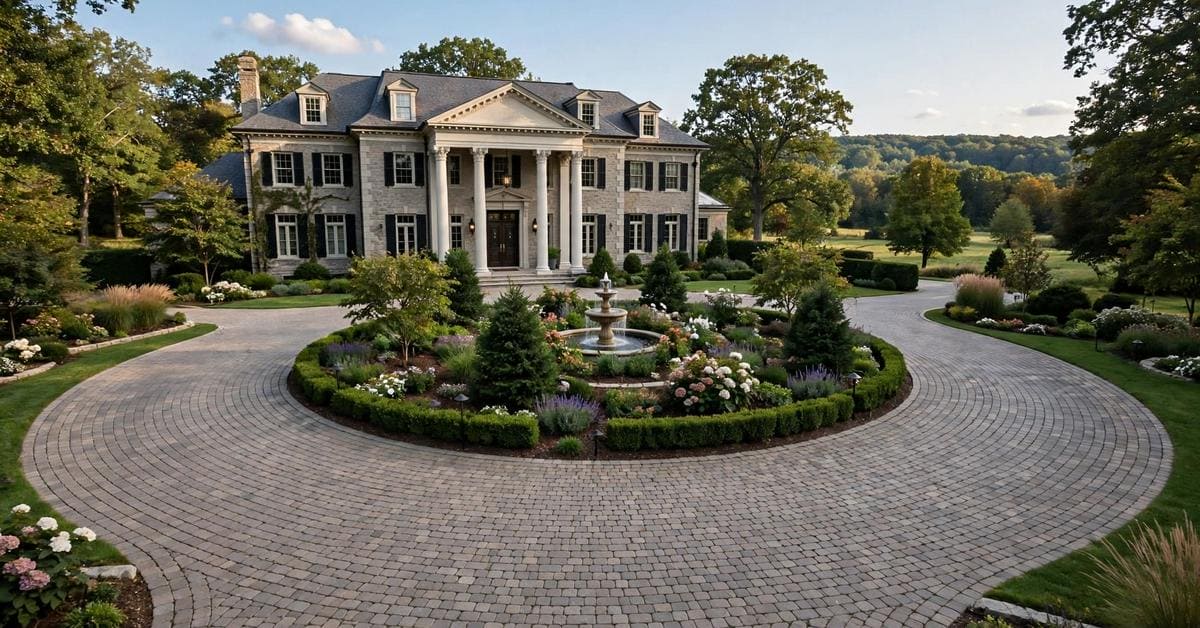
A circular driveway solves a problem and stages an arrival at the same time. Cars flow in and out facing forward, guests are delivered to the front door rather than to a garage wall, and the loop’s centre island gives the front garden a natural place to perform. It asks for room — honestly more room than most plots have — but where the land allows, no other driveway shape gives a house the same sense of occasion.
The seventy-five ideas below cover layouts, island planting, surfaces, edges, lighting and the practical questions of drainage, local rules and cost — all in general terms, with dimensions and rules of thumb deliberately left to your site and your local authority, where they belong.
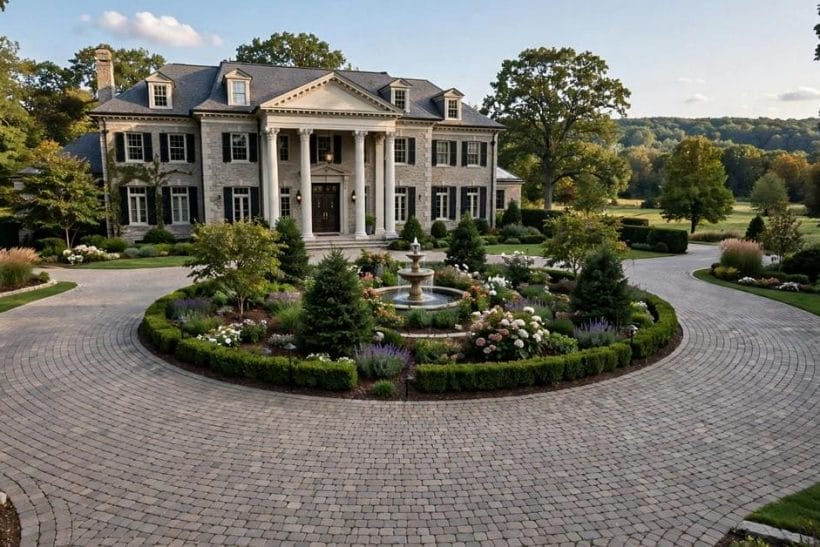
1. Circular Driveways at a Glance
Scope first. This post owns one driveway shape: the circular or loop drive, from full motor-court ovals to modest half-moon sweeps. The wider front-of-house family lives in exterior home ideas, and the arrival sequence continues at black front door ideas. Here, everything serves the loop — how it turns, what it surrounds, and what it is made of.
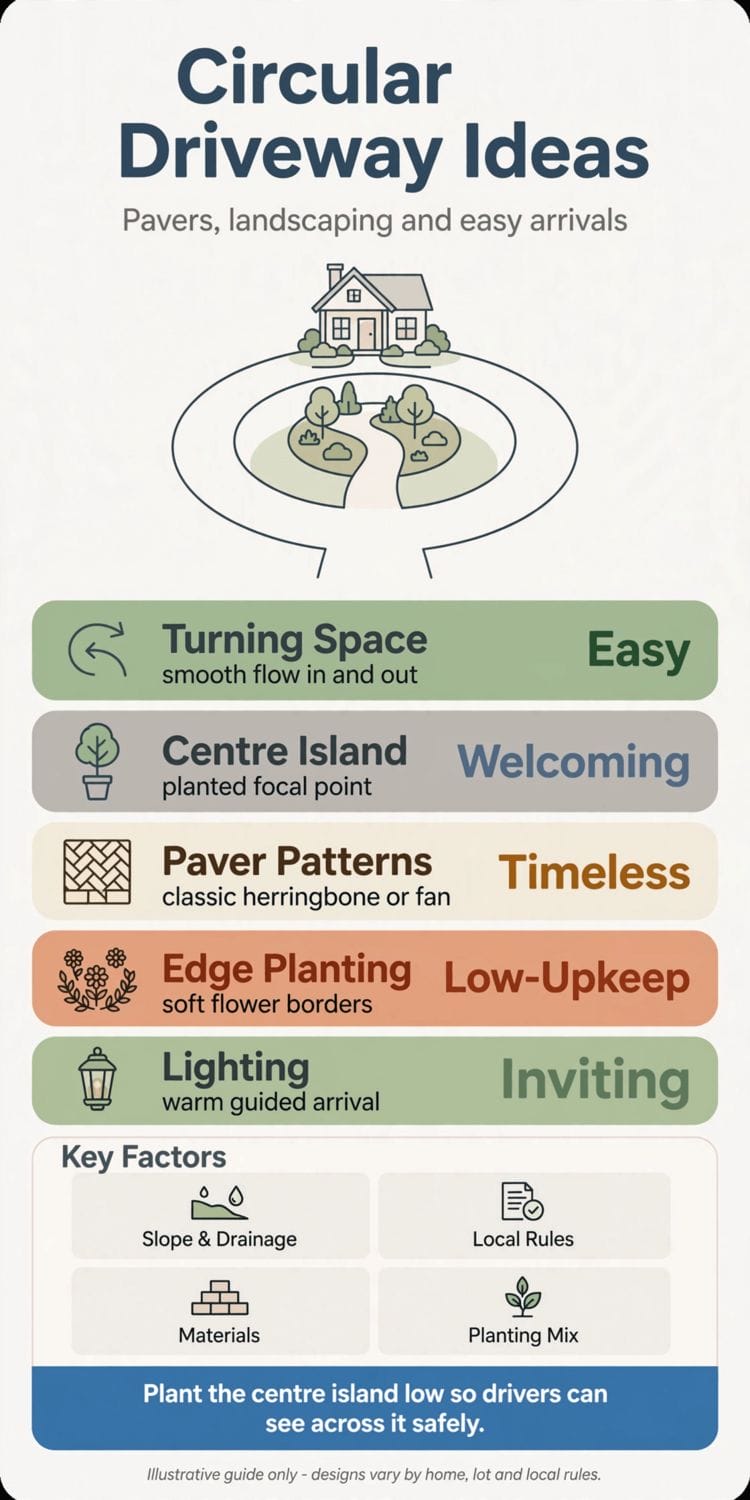
The five elements in the table are the whole design in miniature; the sections that follow take each one in turn.
| Element | Character | What it means |
|---|---|---|
| Turning Space | Easy | Smooth flow in and out, always facing forward |
| Centre Island | Welcoming | A planted focal point at the loop’s heart |
| Paver Patterns | Timeless | Classic herringbone or fan patterns underwheel |
| Edge Planting | Low-Upkeep | Soft flower borders framing the drive |
| Lighting | Inviting | A warm, guided arrival after dark |
2. Loop Layouts: Full Circles, Teardrops and Half-Moon Sweeps
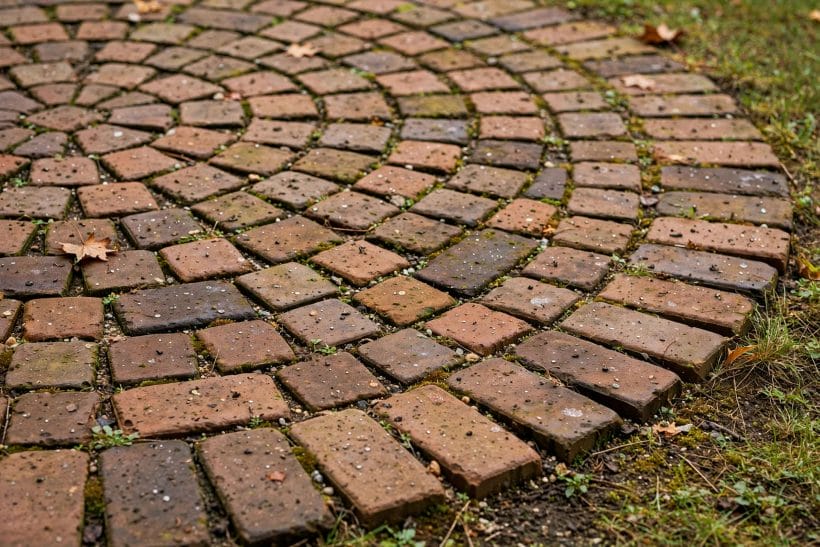
1. The full oval motor court
The grandest form: a complete oval or circle of drive in front of the house, wide enough for cars to pass and park along its edge. It turns the whole forecourt into a courtyard and suits houses with the frontage — and the front door — to justify the ceremony.
2. The true circle
A perfect circle is the purest geometry and the most demanding: the island becomes a round garden room, the kerb line a single confident curve. Circular loops ask for a level plot and reward it with a front garden that reads as designed from the air.
3. The teardrop loop
Pointed at the street end and round at the house, the teardrop gives one entrance instead of two — simpler kerbs, simpler permissions, and a narrower bite from the plot — while keeping the full forward-facing exit that makes loops worthwhile.
4. The half-moon sweep
Half a loop: in one gate, out the other, with a crescent of drive rather than a full island. It is the circular idea at its most economical and the one most suburban plots can honestly fit without sacrificing the whole front garden.
5. The offset loop
Not every loop must centre on the front door. Offsetting the circle toward one side keeps a mature tree, a view or a garden room intact on the other, and an asymmetric arrival can suit informal, landscape-led houses better than formality would.
6. Two entrances, one flow
Full loops use two kerb crossings, and the traffic logic should be one-way in the mind from the start: enter at the far side, sweep past the door, leave at the near side. Marking the flow with planting and light keeps guests from improvising.
7. A loop with a parking court
Widen one arc of the loop into a small court and guests gain somewhere to leave cars without blocking the flow. The widening reads as a deliberate bay when its edge echoes the loop’s curve and its surface matches.
8. The loop on a corner plot
Corner plots are the loop’s natural home: entrances on two different streets, or one entrance and generous frontage on both. The island can grow larger and the planting bolder, since the drive borrows space from two frontages instead of one.
9. Symmetry with the house
A loop centred on the front door of a symmetrical house — the arrangement in this post’s feature image — is the classical composition: drive, island and door on one axis. Pale facades like those in white exterior home ideas take the formality especially well.
Before the layouts, one measure of honesty: a working loop needs its turning area kept genuinely clear — the geometry fails the first time a hedge, a parked car or an optimistic island shrinks the sweep below what a family car can comfortably turn through. Sketch the loop at full size on the plot, drive the line in a real car if you can, and let the island be what is left, not what the catalogue promised.
3. The Centre Island: Planting and Focal Points
10. The low planted island
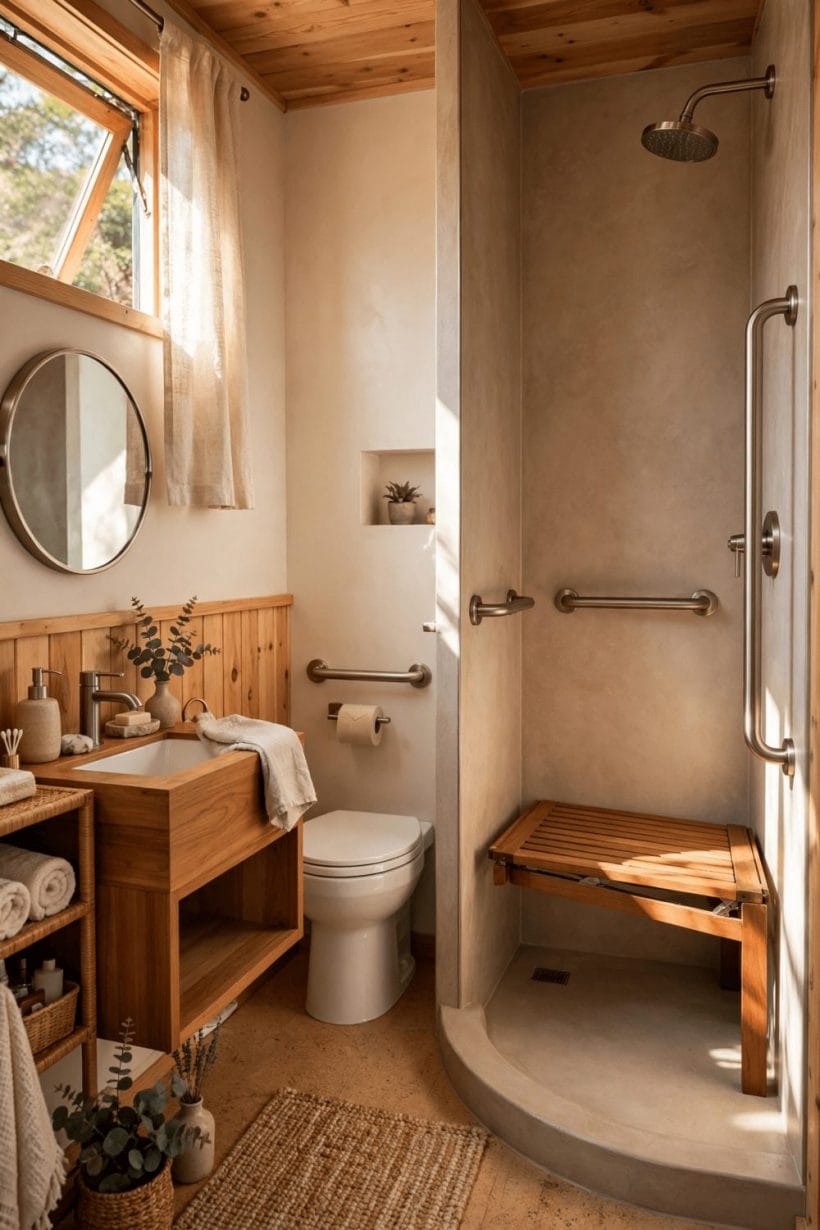
The golden rule of the island: plant it low, so drivers can see across it safely — the tip this post’s infographic is built on. Low mounds of shrubs, grasses and groundcover give the loop its green heart without hiding a child, a dog or an oncoming bumper.
11. A single specimen tree
One tree, centred, is the island’s classic crown — a small ornamental or a clipped standard whose canopy sits above sightlines while its bare trunk crosses them harmlessly. It marks the seasons for every arrival and gives birds the front garden’s best address.
12. The fountain island
A small fountain or water bowl at the centre turns arrival into an event and masks street noise with moving water. Keep the basin’s edge low and the planting around it lower, and let the sound arrive before the sight does.
13. The lawn island
The quietest treatment: a simple oval of immaculate lawn, perhaps with a single stone or a sundial at its centre. On formal houses the restraint is the elegance — a green carpet the drive frames like a picture.
14. The flowering island
For gardeners, the island is a ready-made island bed: roses, lavender and bulbs in succession, ringed by a low evergreen edge that holds the shape in winter. It is the most-photographed part of many loop-fronted houses, and the most work — plant it knowingly.
15. The sculptural island
A single piece of garden sculpture, a clipped cone, or a group of standing stones gives contemporary houses their focal point without a flower to deadhead. Against gravel or plain paving, one strong object outperforms a dozen weak ones.
16. The gravel island
In dry gardens the island can be gravelled and planted sparsely — grasses, Mediterranean shrubs, a single olive-style tree — in the xeric manner. It needs almost no water, never muddies the drive’s edge, and suits pale stone houses beautifully.
17. Island edging that survives tyres
Whatever grows on the island, its edge takes the knocks: a raised kerb, a ring of setts, or a steel edge that shrugs off the occasional tyre. Design the edge as armour first and ornament second, and the planting behind it will live to old age.
18. Seasonal rotation
Because the island is small and seen daily, it repays seasonal attention: bulbs under the shrubs for spring, a summer bedding change at the centre, seedheads and grasses left standing for winter structure. The loop gives every season a stage.
4. Paver Patterns and Paved Surfaces
19. Herringbone block paving
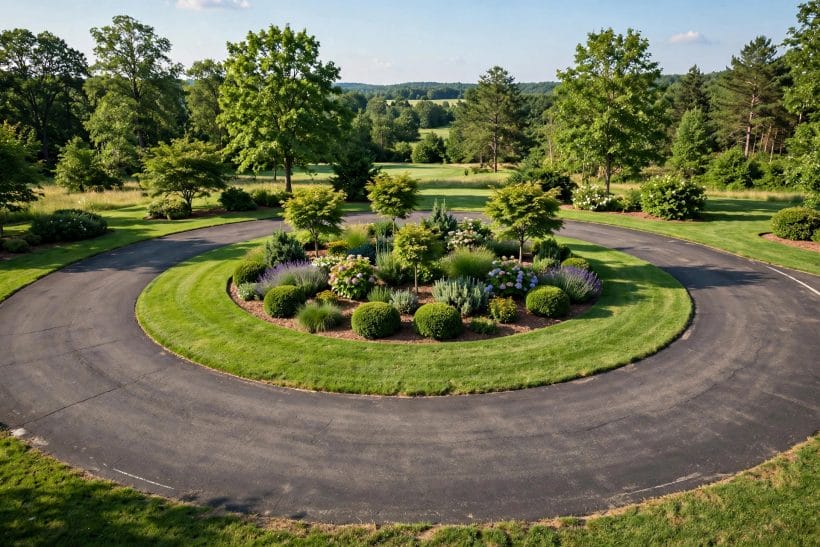
The classic loop surface: small blocks in herringbone, a pattern that locks together under turning wheels and follows curves gracefully. Its fine scale flatters the loop’s geometry and repairs invisibly — lift, re-bed, relay — if a section ever settles.
20. Fan and radial patterns
On a true circle, radial patterns — fans and sunbursts worked outward from the island — turn the geometry into the decoration. They demand a setter who enjoys mathematics, and they make the drive itself the front garden’s largest ornament.
21. A contrasting kerb ring
One or two courses of darker blocks around both edges of the loop define the drive against lawn and island. The ring is the cheapest formality there is: it sharpens everything, guides drivers at dusk, and makes sweeping and edging lines obvious.
22. Setts and cobble character
Stone setts give a loop the carriage-drive character of an older house — texture, gentle noise under tyres, and a surface that ages into its setting. Modern sawn setts keep the look with a smoother, more even ride.
23. Permeable block paving
Where local rules favour drainage-friendly surfaces, permeable block systems let rain pass between wider joints into the base below. On a loop — a large paved area by any measure — the drainage conversation in §10 starts with choices like this one.
24. Mixing paver tones
Two or three closely related tones blended across the field soften a big paved loop and hide the marks of use. Avoid checkerboards and loud contrasts underwheel; the island planting should be the colour event, not the drive.
25. The island apron
A wider apron of paving where the loop passes the front door — a standing place for passengers, prams and deliveries — keeps heels and luggage off the kerb edge and gives the doorway its own paved threshold within the loop.
26. Paving up to a porch
Where the loop meets a porch, let the paving run unbroken to the step so the arrival reads as one surface; the porch and door ideas in wooden porch ideas show how the threshold moment completes the composition.
27. Repair-friendly choices
Unit paving’s quiet virtue is repairability: a stained or settled patch can be lifted and relaid without a trace. Keep a small store of spare blocks from the original batch — dye lots differ, and future-you will be grateful.
5. Gravel, Concrete, Asphalt and Stone Surfaces
28. Loose gravel, the country classic
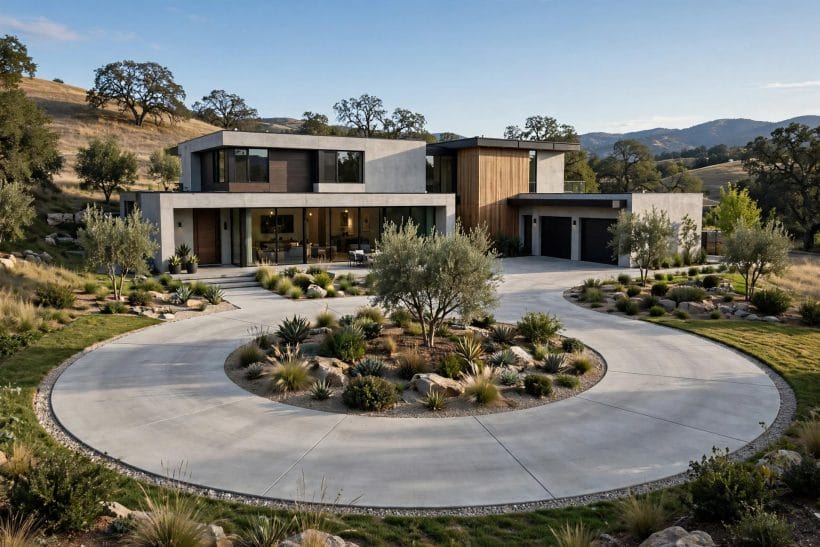
Gravel is the loop’s oldest surface: cheap to lay, kind to drainage, and honest about its nature — it crunches, it migrates, it needs raking and the odd top-up. On rural and informal houses its softness is exactly the point.
29. Stabilised and resin-bound gravel
Modern gravel systems — grids that hold loose stone, or resin that binds it into a firm, porous crust — keep gravel’s look while taming its wander. For a loop, where turning wheels scuff hardest, the stabilised options earn serious consideration.
30. Plain concrete, well finished
Concrete gives the loop a calm, architectural plane: brushed for grip, edged with a band of setts or brick to relieve the grey. It suits contemporary houses and the strong colour statements of black exterior home ideas, where the drive should whisper.
31. Exposed aggregate concrete
Washing the surface of fresh concrete to reveal its stone aggregate gives a pebbly, light-catching finish midway between concrete and gravel in character — durable, grippy, and forgiving of the stains drives inevitably collect.
32. Asphalt with a dressed edge
Plain asphalt is the budget surface, and on a loop it shows its economy — unless it is dressed: a sett or brick edge, a gravel-dressed top course, and planting pressed close. The edge makes the asphalt read as a choice rather than a default.
33. Natural stone slabs and flags
Large stone flags give a loop a manor-house gravity and suit the masonry conversation of brick and stone combination ideas. They ask for a serious base and a serious budget, and they outlast both arguments.
34. Grass-crete and green loops
Cellular systems that let grass grow through a load-bearing grid produce a loop that is half lawn, half drive — the greenest arrival of all, suited to occasional-use loops and houses that want the forecourt to stay garden first.
35. Two-material loops
A wheel-track design — two paved bands for the tyres within a gravel or grass field — cuts cost and paving area while keeping the loop’s shape legible. It suits long sweeps and informal houses, and reads as a deliberate design, not a compromise.
36. Colour of the surface
Whatever the material, its colour sets the forecourt’s temperature: pale surfaces brighten and enlarge, dark ones ground the house and show dust, warm gravels flatter brick and stone. Sample the surface against the facade in daylight before committing the whole loop.
6. Edges, Borders and Kerbs
37. Raised kerbs
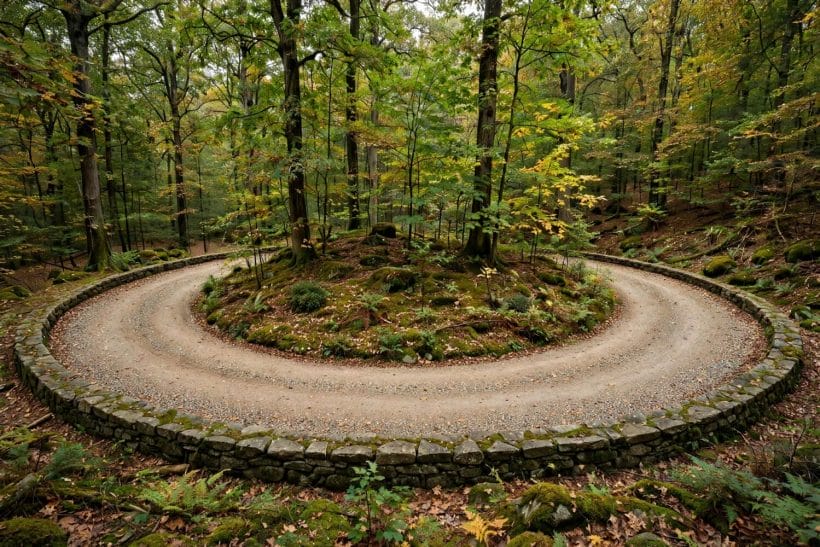
A raised kerb is the loop’s bodyguard: it keeps tyres off the island, soil off the drive, and the geometry crisp for decades. Stone or concrete kerbs with a gentle profile suit formal loops; a low chamfered kerb keeps the welcome soft.
38. Flush metal edging
Where the look should be minimal, a flush steel or aluminium edge holds gravel and soil in a line too fine to notice — the contemporary answer that lets lawn and drive meet without a visible seam of authority.
39. Brick soldier courses
A soldier course of bricks — upright, shoulder to shoulder — edges a loop with the house’s own material when the facade is brick. It weathers with the building and ties drive to architecture in a single line.
40. The hedge edge
A low, clipped hedge along the island’s kerb doubles the green line and softens the drive’s engineering. Box alternatives and other compact shrubs do the duty; the hedge needs the kerb behind it as armour against stray wheels, per §3.
41. Generous corner radii
Where the loop meets the street and the garage court, generosity is kindness: wide, forgiving curves rather than tight corners that invite tyre-scuffed kerbs and clipped planting. Design the turns for the least confident driver who will ever visit.
42. Threshold bands
A band of contrasting setts across the drive at the entrance and at the front door marks the loop’s two ceremonial moments — arrival at the property, arrival at the house — and slows drivers at exactly the right places.
43. Keeping edges clean
Loops collect leaves and soil along their kerbs more than straight drives do, the curve acting as a gutter. Edges detailed with a slight fall to a drainage point — and swept on a rhythm — keep the geometry looking drawn rather than grown over.
44. Lighting set into the edge
The kerb line is where §8’s lighting naturally lives: small markers following the curve make the loop legible at night without a single tall lamp. Edge and light designed together is the difference between a lit drive and a glowing composition.
45. The island as a room edge
Treat the island’s edge as you would a garden room’s: a defined boundary — kerb, hedge, low wall in miniature — that makes the planting inside feel kept. Loops fail visually when the island simply fades into grass at its rim.
7. Planting Around the Loop
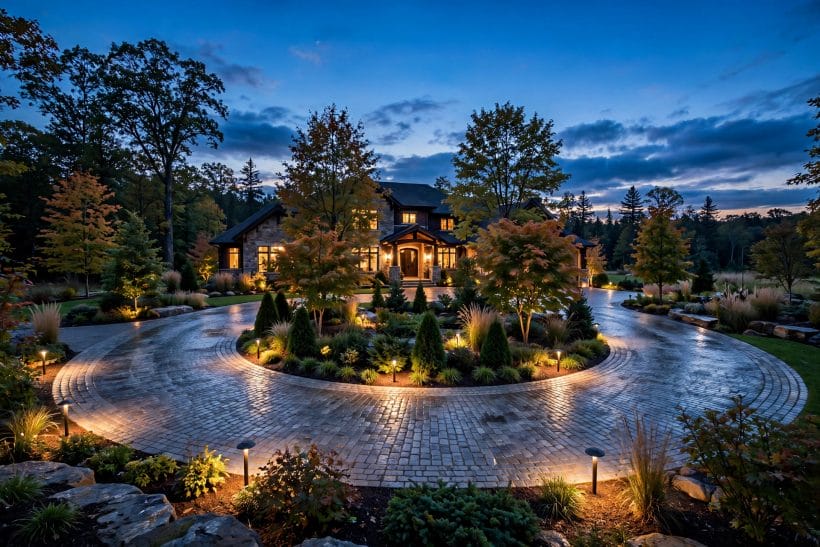
46. Flower borders outside the loop
The drive’s outer edge, against the front garden, takes the soft flower borders of the infographic’s promise: roses, perennials and bulbs that make the arrival a passage through the garden rather than across a car park.
47. Evergreen structure
Loops are seen in January as often as June: an evergreen skeleton — clipped shrubs, hedges, a conifer or two — holds the composition when the flowers retire. Build the bones first and hang the seasons on them.
48. Ornamental grasses for movement
Grasses soften the loop’s hard geometry with motion and catch low sun beautifully along a drive’s edge. Cut back once a year, they are among the lowest-effort spectacles a forecourt can grow.
49. Fragrance at the door arc
Where the loop passes the front door, plant for noses: lavender, rosemary, scented roses near the standing place, so arrival smells as good as it looks. Fragrance is the cheapest luxury in the whole design.
50. Trees beyond the island
Frame the loop with trees planted outside its sweep — a pair flanking the entrance, a specimen closing a view — remembering that canopies will grow over the drive and roots under it. Space and species are a conversation for the nursery and the long term.
51. Shade-tolerant planting under canopies
Where trees shade the loop’s edges, plant the shade guild — ferns, hostas, hellebores and groundcovers — rather than fighting for flowers that will never thrive. A green, calm edge beats a struggling bright one.
52. Screening the street
Between loop and road, planting can filter the world’s noise: a loose hedge or a belt of shrubs at the boundary keeps the forecourt feeling private without a wall’s severity — and keeps headlights from sweeping the house.
53. Lawns that meet the kerb
Where lawn meets the loop, a mowing edge — a flat band of setts or bricks at grass level — keeps the border crisp and the mower off the kerb. It is a small detail that decides whether the whole forecourt looks maintained.
54. Planting for sightlines
End where §3 began: everything near the loop obeys the driver’s eye. Keep planting low at junctions and exits, step it taller with distance from the kerb, and walk the sightlines yourself before the plants go in.
8. Lighting the Arrival
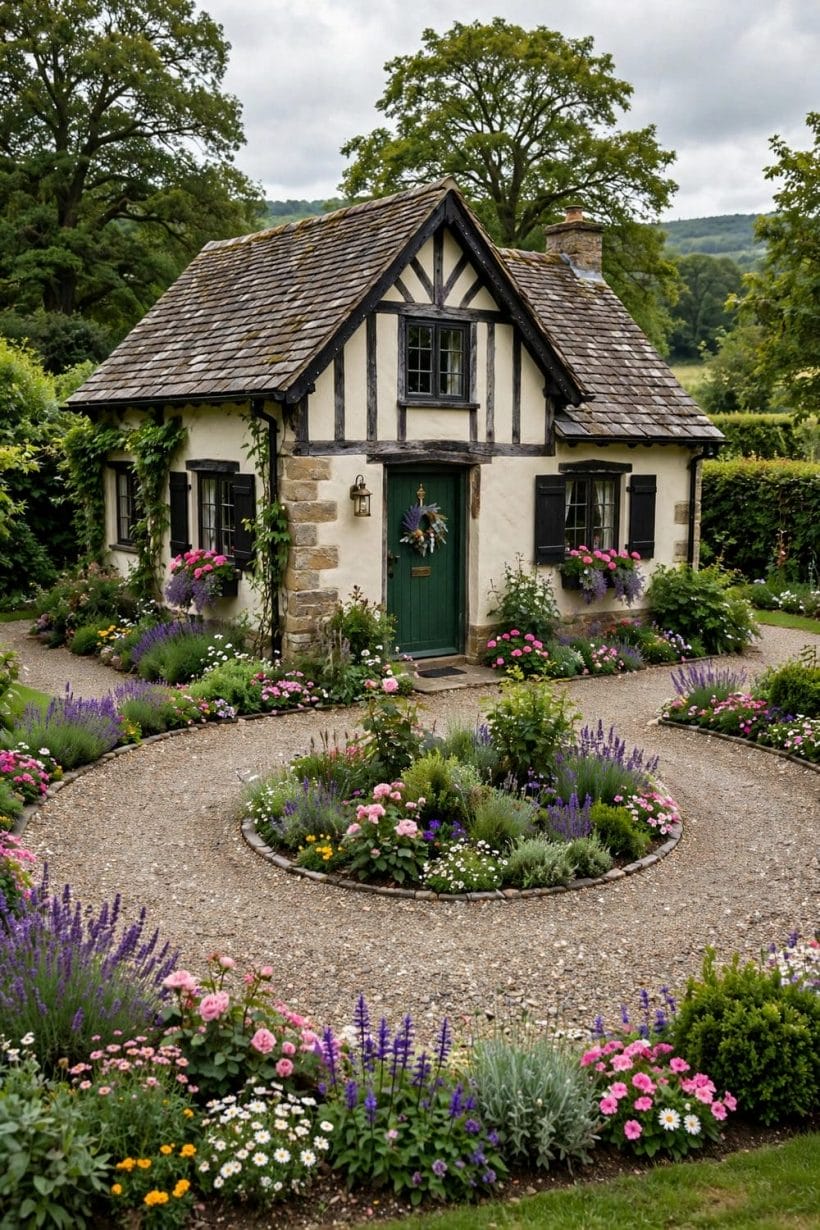
55. Low marker lights along the curve
Small, low fittings spaced along the kerb turn the loop into a ribbon of light after dark — guidance without glare, and the single most effective night-time upgrade a circular drive can receive.
56. The island lit as a jewel
One or two uplights in the island — into the specimen tree’s canopy or across the fountain — give the night arrival its focal point and reflect softly off the surrounding paving. The island earns its keep twice: by day in flowers, by night in light.
57. The door washed warm
The loop delivers people to a door; light should be waiting there. A warm wash over the porch and door — the threshold treated in wooden porch ideas — completes the journey the drive began at the street.
58. Bollards versus markers
Bollards give pools of light and a daytime presence; flush markers disappear by day and draw lines by night. Formal loops carry bollards well; minimal and rural loops usually prefer the markers’ discretion.
59. Lighting the entrance from the street
The gates or entrance piers deserve their own light — a lantern on each pier is the classic — so the loop announces itself to arriving guests before they turn in, and the house number reads clearly for everyone else.
60. Avoiding glare for drivers
Every fitting near a drive must be aimed with the driver in mind: light on the surface and the planting, never into eyes at windscreen height. Shielded, downward fittings are the rule; a dazzling loop is a badly lit one.
61. Solar and wired, honestly
Solar markers are easy and adequate for gentle guidance in sunny plots; wired systems give the brightness, reliability and control that a principal entrance deserves. Many loops mix them — wired at the island and door, solar along the far arc.
62. Timers and sensors
Arrival lighting should work without being asked: dusk sensors or timers for the composition, motion sensing for the working brightness. Guests should never cross a dark forecourt because the house forgot to switch on.
63. Light temperature as a material
Warm light flatters brick, stone, gravel and faces; cold light flattens them. Choose one warm temperature across every fitting on the loop so the forecourt reads as a single room after dark — because at night, that is what lighting makes it.
9. Gates, Front Doors and the House Match
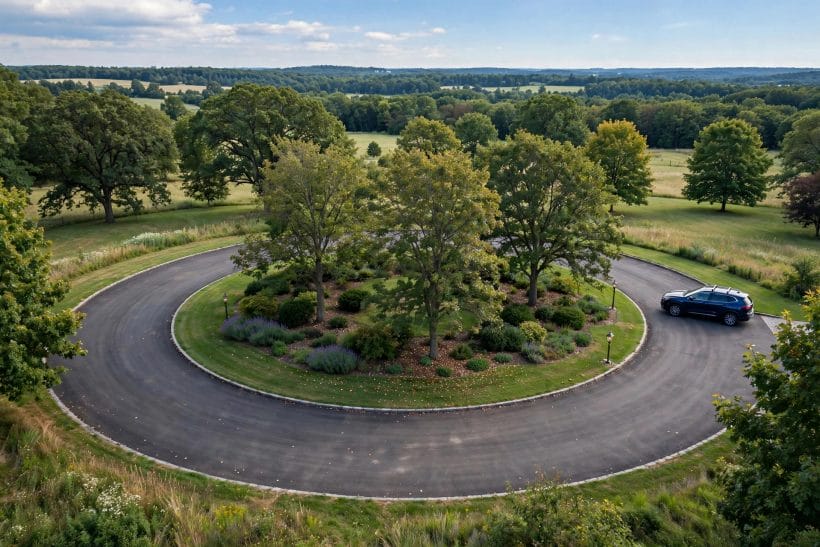
64. Entrance piers
Stone or brick piers at each entrance give the loop its doorposts — a place for lanterns, the house name and the sense of crossing a threshold. Build them in the house’s materials and the drive belongs to the architecture from the street.
65. Gates, open or closed
Gates on a loop are a choreography question: two entrances mean two gates, and most loop owners leave them open or automate them. Timber for warmth, iron for formality — and sightlines at the exit kept clear either way, per §7’s rule.
66. The front door as the destination
Everything in this post funnels to one moment: the car stops, the door opens. Give that arc of the loop its best surface, its nearest planting and its warmest light — and a door worth arriving at, as black front door ideas argues in full.
67. Matching materials to the facade
The loop reads as the house’s apron: brick drives for brick houses, stone for stone, gravel for the informal and rural. A surface that echoes the facade’s palette ties forecourt and building into one composition before a single plant is considered.
68. The garage relationship
Where a garage stands apart, the loop can serve it with a spur — or bypass it entirely, keeping the ceremonial circle for people and the working drive for cars. Decide which story the forecourt tells: arrival, utility, or an honest mixture of both.
69. Visitor parking manners
Loops invite guests to park on them; design where that leaves the flow. A slightly widened arc near the door, per §2, keeps a parked guest from blocking the exit — hospitality engineered into the geometry.
70. Winter and wet-weather manners
The loop’s standing place should be its best-drained, best-lit arc, with a surface that grips when wet or icy. Arrival in February rain is the design’s true test; plan the door arc for it.
71. House numbers and names
A loop house is found by its entrance: put the number or name on the pier, lit per §8, in a style that matches the door furniture. Deliveries and guests alike will thank the clarity every single day.
72. The view from the door
Finally, stand in the doorway and look out: the loop should present its island like a picture — planting composed, surface calm, the street screened. The arrival works in both directions, and the residents get the outward view a thousand times for every guest’s arrival.
10. Drainage, Local Rules and Costs in Practical Terms
73. Water has to go somewhere
A loop is a large roof at ground level: rain that falls on it must be collected, soaked away or drained to where rules allow. Falls across the surface, permeable materials per §4, and soakaways or channels where the ground needs help — drainage is designed with the loop, not after it, and the island must never become the pond.
74. Rules, crossings and permissions
New or widened kerb crossings, work near the highway, and drainage connections are regulated almost everywhere, and front-garden paving rules exist in many places too. Check the requirements with your local authority before design hardens into drawings — the loop’s two entrances make this conversation doubly worth having early.
75. What drives the cost
Cost follows area, groundworks and material: the excavation and base a loop needs over its full sweep, the surface chosen from §4 and §5, kerbs and edges, drainage, lighting and the island’s planting. Gravel over a sound base is the economy end; stone setts on a deep base with full lighting are the other. Get like-for-like quotes on the same layout and the same build-up — and remember that the island, being small, is where a modest extra spend shows the most.
Final Considerations
A circular driveway is a garden, a road and a welcome composed in one curve. Get the geometry generous, the island low and planted with intent, the surface honest to the house, and the drainage and rules settled before the first kerb is laid — and the loop will repay you at every arrival, in every season, for as long as the house stands. Plant the centre island low so drivers can see across it safely, and let the rest of the design be as grand or as quiet as your house prefers.


0 Comments