
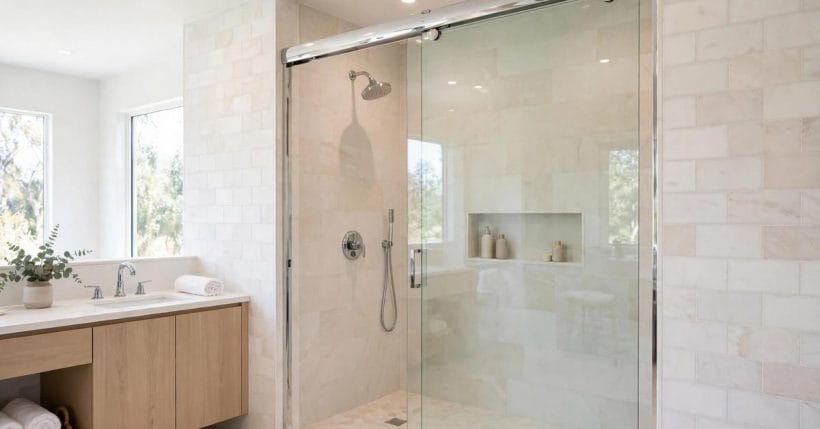
A sliding shower door asks nothing of the room around it. No swing to clear, no arc to plan around the basin or the towel rail — the panel simply travels along its track and the bathroom keeps every centimetre it has. For small rooms it is often the only door that truly works; for large ones, it is the calmest.
These 75 ideas stay strictly on the door and its hardware: frameless and framed sliders, bypass and barn-style panels, glass finishes, tracks and the care that keeps them gliding. Layouts, colours and practical details — with the wider bathroom kept where it belongs, in the links.
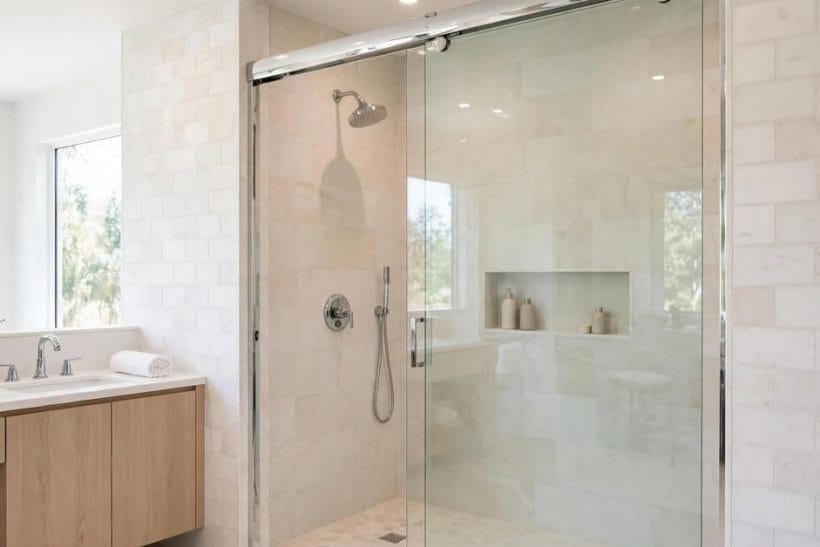
1. Sliding Shower Doors at a Glance
Scope first. This post owns one fixture: the sliding shower door. It sits inside the wider bathroom ideas family and splits cleanly from its nearest neighbour — open shower ideas cover the doorless, walk-in layout, while everything here assumes a door that slides, because the door is the point.
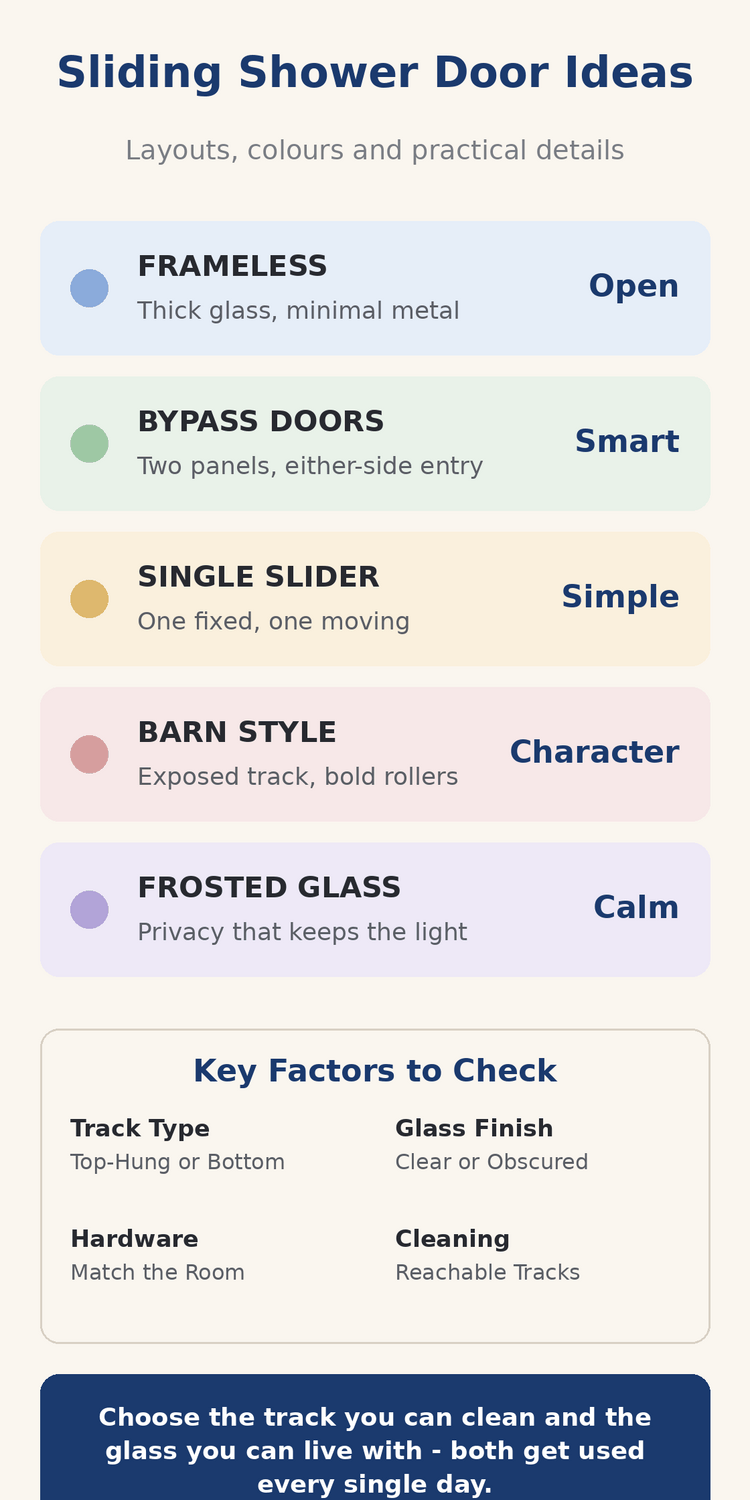
The five families in the table organise the 75 ideas that follow. Choose the family first; the finish and hardware choices inside it are the easy part.
| Family | Character | What it means |
|---|---|---|
| Frameless | Minimal | Thick glass, minimal metal — the door nearly disappears |
| Bypass | Space-Smart | Two panels sliding past each other, entry from either side |
| Single Slider | Simple | One fixed panel, one moving — the classic alcove answer |
| Barn Style | Character | Exposed top track and bold hardware, borrowed from barn doors |
| Frosted Glass | Private | Obscured panes that borrow light and keep privacy |
2. Frameless Sliding Doors
1. Full frameless with a slim top rail
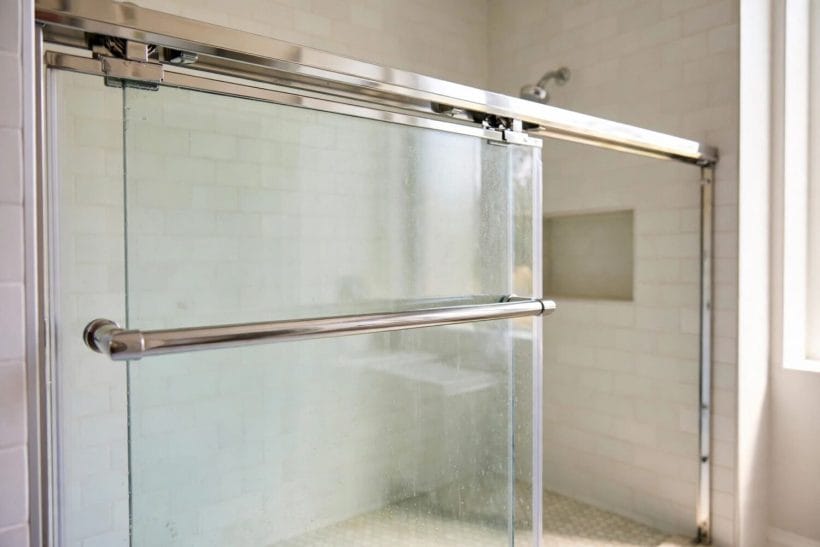
The benchmark look: thick glass panels hung from a single polished rail, nothing else visible. It suits bathrooms that want the shower to read as part of the room rather than a box inside it. Soft-close bumpers at the meeting stile finish the job properly, letting the panel settle against its seal instead of clicking against the frame every single morning.
2. Frameless slider over a low threshold
Pair the frameless panel with the lowest practical threshold and the entry feels step-free without going fully open-plan. The small lip still contains spray far better than a curtain or a gap.
3. Frameless corner slider
Two frameless panels meeting at a corner, one sliding, open up a square enclosure without a door swing in either direction. Corner posts nearly vanish, keeping tiled corners on show. The rail reads as a deliberate line across the glass, and at eye level it doubles as the visual handle that a minimalist scheme refuses to add anywhere else.
4. Floor-to-ceiling frameless glass
Running the glass to the ceiling turns the shower into a steam-friendly room of its own. Specify ventilation for the room beyond it — enclosed steam needs somewhere to go afterwards.
5. Frameless slider with a towel bar handle
A long horizontal bar does two jobs: handle for the sliding panel, rail for the towel you want warm and close. In small bathrooms this double duty earns its keep daily. Where the bathroom is tiled to the ceiling, the absence of frame lets the tile pattern run uninterrupted — the door becomes weather rather than furniture.
6. Frameless with black edge trim
A fine black edge around clear frameless glass borrows the grid look of steel-framed doors at a fraction of the visual weight. It pairs naturally with black taps and a matching track.
7. Frameless slider in a wet-room corner
Where the whole floor is tanked and drained, one frameless slider is often the only division needed. The panel contains the spray zone while the room stays open and step-free around it. A single deep tone on the metalwork, repeated on the tap and the mirror frame, turns separate purchases into what reads as one designed set.
8. Double frameless sliders on a wide opening
Wide enclosures can take two frameless panels sliding to opposite ends, opening the middle like doors to a room. It is a generous solution that keeps the frameless language intact. A frameless corner keeps both walls of glass honest; the junction is one polished edge meeting another, and the whole room feels larger from the doorway.
9. Frameless with soft-close travel
Soft-close runners bring the panel to rest without the glass-on-metal clunk. A small mechanism, but in a quiet morning bathroom it changes how expensive the whole enclosure feels.
3. Semi-Framed and Framed Sliders
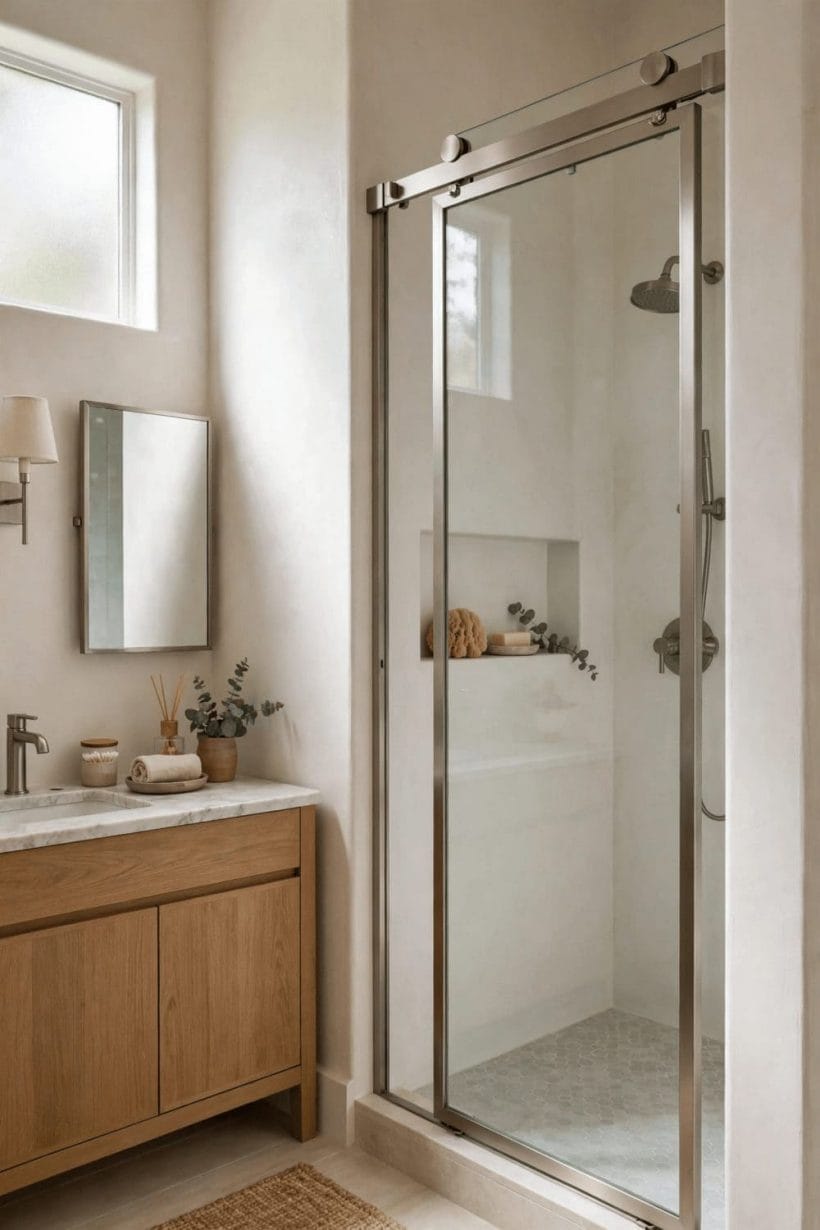
10. Classic framed bypass in polished chrome
The traditional framed slider: slim aluminium sections, chrome bright as the day it was fitted. It remains the benchmark for rental bathrooms and family homes where robustness outranks minimalism. The handle matters at this scale too: a long bar gives wet hands a certain grip, where a small knob in the same finish can feel mean.
11. Semi-framed with a frameless door edge
Frames where structure needs them, glass edges left clean where eyes land. Semi-framed doors are the honest middle path — most of the frameless look, most of the framed price sense.
12. Framed slider in brushed nickel
Brushed finishes forgive water spots and fingerprints far better than mirror chrome. In hard-water homes a brushed framed slider looks newer for longer with half the polishing. The overlap of the two panels is where the water test happens — a gentle spray aimed at the meeting point tells you more than any brochure promise.
13. Matt black framed grid slider
Black framing divided into a soft grid gives the industrial look with sliding practicality. Keep the divisions simple — the grid is a frame pattern, not a leaded window.
14. Framed slider with frosted lower band
A frosted band at sitting and standing eye-lines adds privacy while clear glass above keeps the room light. Framed construction makes the two-zone glass straightforward to specify. Over a bath, both panels moving means the taps stay reachable from outside the tub, a small mercy on the mornings the shower is run for someone else.
15. Slim-framed slider for narrow alcoves
Narrow openings benefit from frames engineered thin: every millimetre of frame is a millimetre off the entry. Slim-framed sliders are the alcove specialist’s default for good reason.
16. Framed corner entry slider
Two framed panels meeting at the corner, sliding apart diagonally, give the widest possible entry into a square shower. A classic solution that still beats most newcomers for small ensuites.
17. Gold-tone framed slider
Warm metallic framing — brushed brass and soft gold tones — turns the enclosure into the room’s jewellery. Pair with warm lighting and the finish deepens rather than glitters. The fixed panel takes the brunt of the spray; give it the easy-clean coating if one is offered and let the moving panel stay untreated.
18. Framed slider with integrated splash guards
Bottom seals and splash deflectors designed into the frame keep water where it belongs at the track line. Nobody photographs them, and every owner appreciates them in the first week.
4. Bypass and Double Sliding Doors
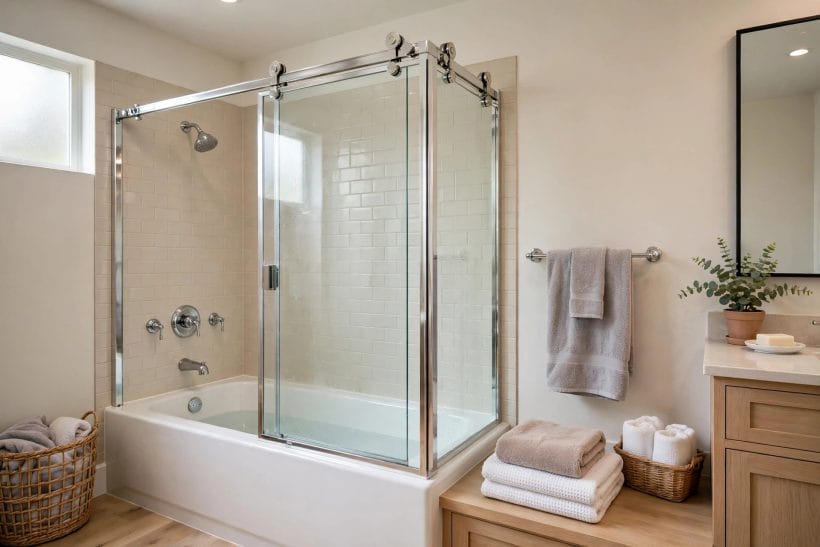
19. Classic two-panel bypass over a bath
The bath-shower’s best friend: two panels, each sliding behind the other, so entry is wherever you stand. It keeps bath water in and shower spray contained without a curtain’s billow. In an en-suite the barn slider’s soft rumble becomes part of the room’s acoustics, so choose quiet rollers if a partner’s sleep matters to the household.
20. Bypass doors with entry from either end
On a long enclosure, bypass panels let two people use the shower zone from opposite ends. In family bathrooms that flexibility quietly ends the morning negotiation.
21. Three-panel bypass for wide openings
Three narrower panels stack to one side, opening two-thirds of a wide frontage. Easier handling than two very wide panels, and the stack reads as a deliberate design line. Frosted glass keeps its dignity at night as well, silhouetting nothing under bright bathroom lighting when the rest of the house is dark.
22. Bypass with one fixed favourite
Fix the panel nearest the controls and slide the other: the shower starts from dry feet every time. Small ergonomic decisions like this are what good bypass layouts are made of. Ribbed glass catches the light in long lines, which suits the geometry of a rail-and-panel door far better than a random texture ever would.
23. Bypass sliders in textured glass
Reeded or raindrop textures on bypass panels blur movement and water marks alike. The enclosure feels private even with the bathroom door open to a bright landing.
24. Low-profile track bypass
Tracks engineered shallow keep the threshold step minimal and the cleaning simple. Where feet are unsteady or children are small, the low track is the kind choice as well as the neat one. A discreet threshold strip beneath a bottom track earns its keep in family bathrooms, where bath toys and water arrive together and aim for the gap.
25. Bypass with contrasting panel tints
One clear panel, one softly tinted or smoked: the pair gains depth, and the tinted side gives modesty without full frosting. An easy way to make a standard enclosure feel designed.
26. Centre-opening bypass pair
Panels that part in the middle feel ceremonial in a main bathroom — a proper entrance rather than a gap. Works best on wider enclosures where each panel still travels fully.
27. Bypass doors with quiet rollers
Roller quality is the difference between a glide and a rattle. Quality bypass hardware runs on sealed bearings that shrug off limescale and steam — the upgrade nobody sees and everybody hears. Corner entry keeps the towels outside the splash zone on both walls, which is why this layout survives contact with real mornings so well.
5. Single Sliding Panels
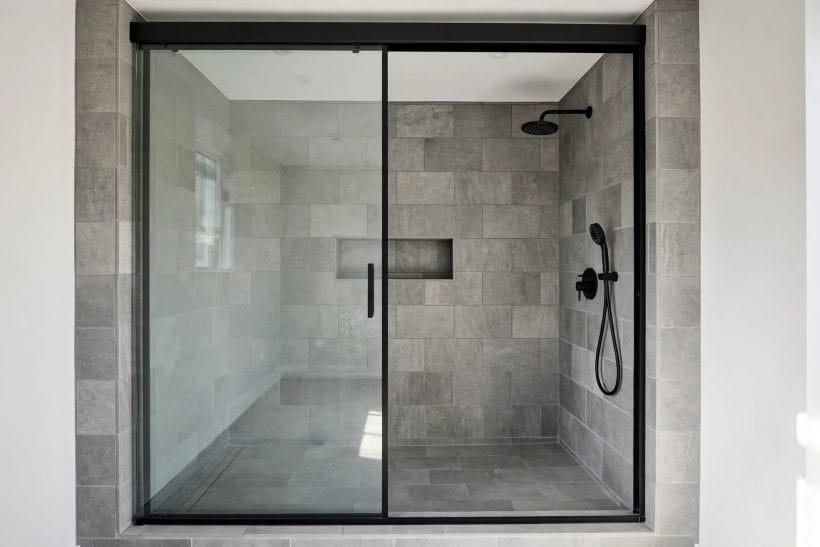
28. One fixed, one sliding: the alcove classic
The standard answer for a three-wall alcove — half the opening fixed, half travelling. It is the most specified sliding arrangement in existence because it simply fits how showers are used.
29. Single slider sliding behind a fixed panel
Reversing the overlap so the moving panel parks behind the fixed one hides the track line and gives the front a single uninterrupted sheet of glass when closed.
30. Single slider with a wide entry
On a generous opening, one large moving panel creates an entry wide enough for assisted showering and easy cleaning access alike — practicality that reads as luxury. A niche at the entry end keeps bottles off the floor the door overruns — the layout and the storage designed as a single thought.
31. Single panel over a walk-in tray
A single slider across a low walk-in tray keeps the open feel of a wet room with a door’s splash control. A good compromise where a full enclosure feels heavy.
32. Single slider with return panel
Adding a fixed return at right angles completes an L-shaped enclosure with one moving part. Fewer moving panels means fewer tracks to clean and fewer seals to renew.
33. Single slider in smoked glass
Smoked or grey-tinted glass gives a single panel presence against pale tiles and hides water spotting elegantly. Keep the rest of the room light so the tint reads deliberate. Glass thickness is the sound of quality: a heavier panel closes with a hush that thin glass, however carefully fitted, cannot quite imitate.
34. Single slider with offset handle
Placing the handle toward the opening edge, rather than centred, shortens the reach and the arc of the swing-less pull. A small detail that daily hands notice immediately. Test the glide with the shower running if the showroom allows it — the water’s weight on the glass is the load those rollers actually carry at home.
35. Single slider with magnetic closing
A magnetic meeting strip pulls the panel the last few millimetres home and holds it there against stray spray. It also gives the satisfying, quiet click of a well-made door.
36. Tall single slider for high ceilings
Full-height single panels suit tall rooms where a standard door would leave an awkward glass gap above. The proportions stay calm and the steam stays in. On a bath installation the seal along the tub rim is the whole game; check it first here, where standing water tests it daily.
6. Barn-Style Sliding Shower Doors
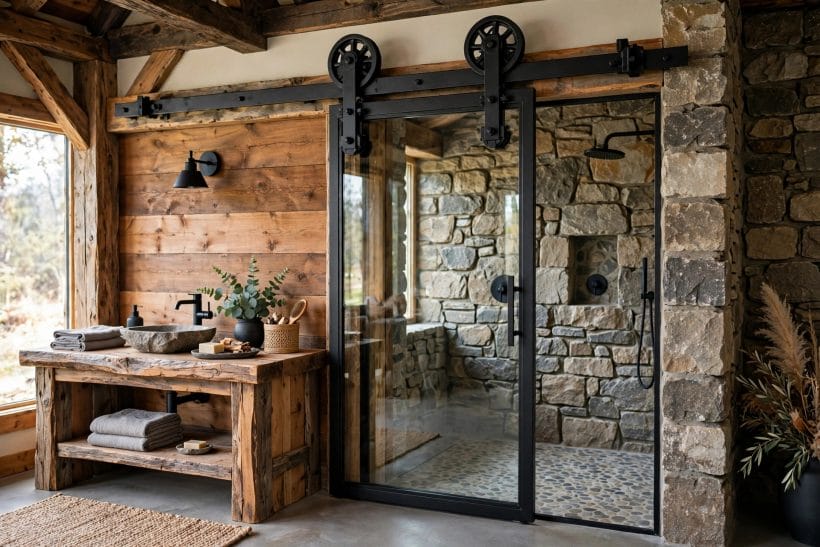
37. Exposed top track in matt black
The barn-door signature: a bold horizontal rail above the opening, wheels visible, glass hanging below. In an otherwise soft bathroom it provides the one strong line the room needs.
38. Barn slider with oversized rollers
Large exposed wheels are the style’s jewellery. Beyond looks, big rollers travel smoothly and shrug off the slight misalignments that make small concealed rollers grumble.
39. Barn-style door in a rustic bathroom
Timber vanities, stone tiles and a barn slider belong together — the door brings the farmhouse note without a single themed accessory. Keep hardware black and glass clear for restraint. Textured glass hides the out-of-focus shapes of bottles and rails behind it, buying visual calm at the price of a little light.
40. Barn slider with a ladder-pull handle
A long vertical ladder pull echoes the exposed track and gives wet hands a generous grip. It is also the easiest handle style for children and older hands to use well.
41. Polished steel barn hardware
The same barn format in bright steel turns industrial into contemporary. It suits concrete-look tiles and monochrome rooms where black hardware would disappear into shadow.
42. Barn door sliding outside the enclosure
Barn sliders can travel along the bathroom wall outside the shower opening, saving every millimetre inside the enclosure. Plan the parking wall space first — the panel needs a home. In hard-water homes polished finishes argue weekly with the tap; brushed metal simply declines the argument and looks the same either way.
43. Double barn sliders meeting in the middle
Two barn panels on one long rail, meeting at the centre, make an entrance of a wide shower. The symmetry is formal; the exposed hardware keeps it relaxed.
44. Barn slider with frosted glass
Frosted glass on a barn frame softens the industrial edge and adds privacy — a good pairing for ensuites that open off bedrooms, where silhouettes matter at night.
45. Compact barn slider for small ensuites
Short-rail barn systems exist for modest openings and bring the style to small rooms intact. The exposed track actually helps here: nothing is hidden inside a wall or ceiling. One rail, one line of towel bars, one row of hooks: keeping the metals matched across the room is cheaper than replacing any of them later.
7. Glass Finishes: Clear, Frosted and Textured
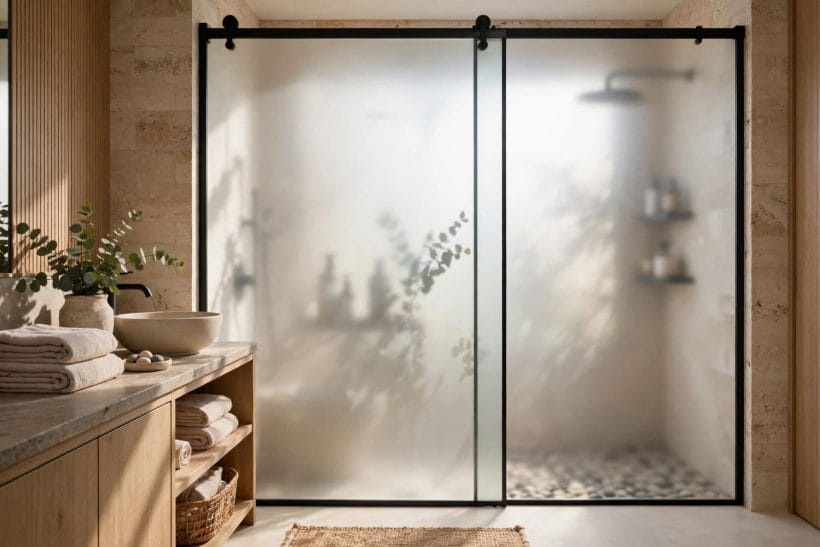
46. Clear glass for the open feel
Clear sliders keep sightlines through the room — the safest choice where tiles or a granite bathroom countertop deserve to be seen, and where the bathroom is used by one person at a time. Black against warm whites is forgiving, while black against blue-white tiles can feel cold; judge the pairing under the bathroom’s own light bulb before committing.
47. Full frost for shared bathrooms
Complete frosting lets the shower run while the bathroom stays in general use — the classic family solution. Light still passes; only detail is lost.
48. Frosted band at eye level
A horizontal obscured band keeps heads and feet clear and privacy where it counts. It is also a design line that can align with a tile border or shelf height. Blues sit comfortably with chrome and white; if the tiles ever change their minds, the glass and the hardware will not need to change with them.
49. Reeded glass sliders
Vertical reeding bends light into soft stripes and hides water marks better than any other finish. On sliding panels the reeds emphasise the direction of travel beautifully.
50. Raindrop and hammered textures
Pebble and raindrop textures read organic against stone and timber, and are the most forgiving finishes in hard-water areas. Their sparkle under downlights is a genuine pleasure.
51. Satin-etched designs
Etched patterns — soft geometrics, botanical lines — personalise a slider without a single accessory. Keep the motif large and quiet; bathroom glass is a background, not a poster. A heated rail outside the enclosure keeps the towel truly dry, while inside the steam’s reach it merely stays warm and damp.
52. Smoked and bronze tints
Tinted sliders warm or cool a room’s light and pair with the metal finishes around them — bronze with brass hardware, smoke with black or chrome. Sample against your tiles first.
53. Mirror-effect sliding panels
A mirrored slider doubles as the bathroom’s largest mirror and bounces light into dark corners. Best where the room lacks a good mirror wall; keep expectations of steam in mind.
54. Gradient fade glass
Glass that fades from frosted at the base to clear at the top gives privacy where bodies are and light where eyes are. A subtle, modern answer for ensuites and guest bathrooms alike. The blind or shutters at the window deserve the same thought — privacy glass on the door paired with an overlooked window makes an odd couple.
8. Hardware, Tracks and Finishes
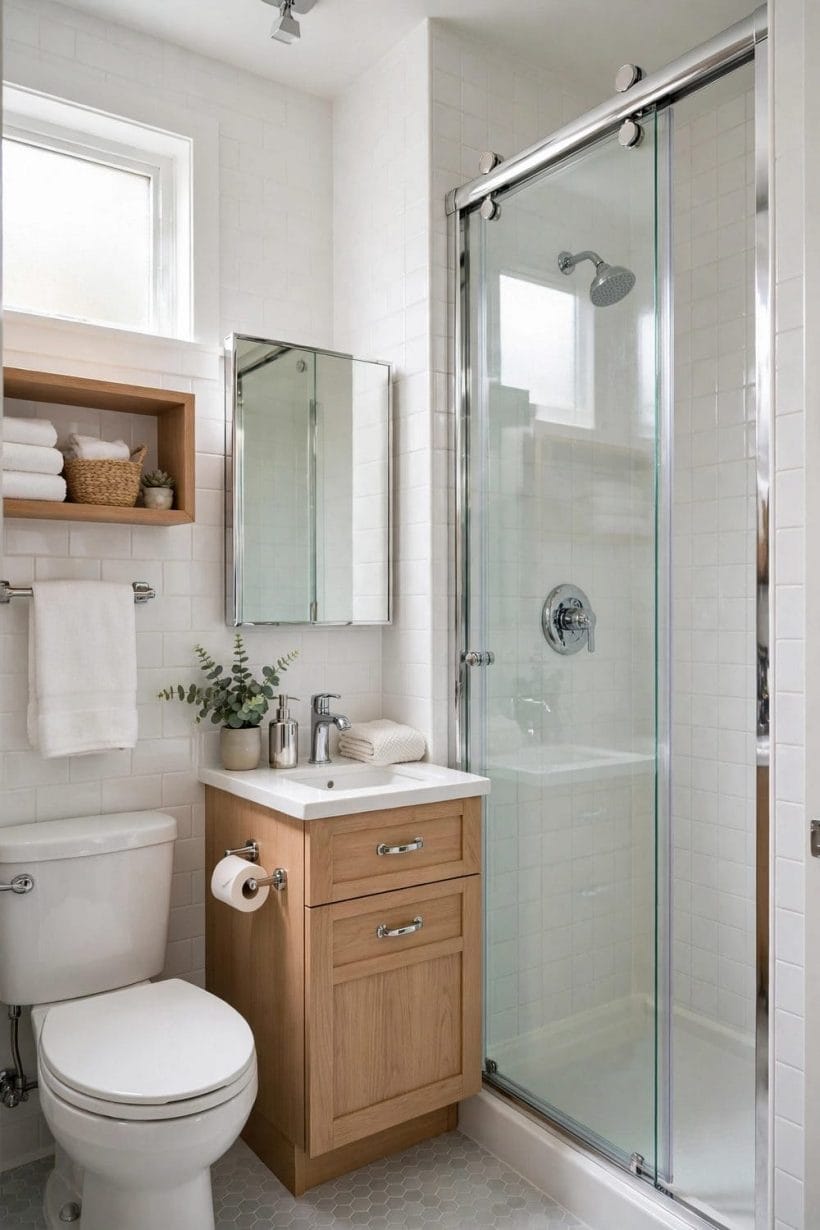
55. Top-hung tracks for clean floors
Hanging the panels from above leaves the threshold free of channels that collect water and grit. The floor line stays clean, mopping is simple, and bare feet approve.
56. Bottom tracks with drainage thinking
Where bottom tracks are used, choose profiles with drainage falls and lift-out rollers. A track designed to be cleaned will be; a sealed one becomes a science project.
57. Chrome hardware, timeless and bright
Chrome remains the default because it matches almost every tap ever made. On sliders it keeps the metal story consistent from track to handle to shower valve. Ventilation is the quiet partner of every door on this list: glass stays clear only in a room whose air is changed, so the fan is part of this idea.
58. Brushed brass and warm metals
Warm hardware against cool glass and stone is the current classic. On sliding doors the long rails give warm metals the stage they need — two straight lines of quiet luxury. The open walk-in and this closed door solve the same problem from opposite ends; the hybrid here borrows the best of both and splashes neither.
59. Handles that double as towel rails
Bar handles at towel height, sized for a folded towel, remove the need for a separate rail near the shower. In a run of black and white tile bathroom ideas, that clean wall space is worth having.
60. Minimal knob pulls
Some sliders need only a finger pull or a small knob — the glass does the talking. Minimal hardware suits frameless doors where every fitting is on display. Pattern dates faster than plain finishes do; keep the pattern on the replaceable textiles and let the glass itself stay clear and calm.
61. Anti-limescale glass coatings
Factory coatings that shed water and resist scale genuinely reduce cleaning on sliders, whose large flat panes show every mark. They are a specification choice, made at order, not after.
62. Safety glass as the baseline
Toughened safety glass is the non-negotiable in every idea here — it is what shower doors are made from, specified as standard. If a quote is vague about it, the quote is the problem.
63. Soft-close and anti-jump hardware
Soft-close dampers, anti-jump blocks and covered rollers are the invisible specification of a good slider. Ask for them by name; the price difference is small, the daily difference is not. Over the years the top-hung panel’s rollers carry its whole weight; quality there is invisible every day and decisive eventually.
9. Small Bathrooms and Tight Layouts
64. Sliding instead of swinging, always
The founding idea of this whole list: where a hinged door would strike the basin, the toilet or the towel rail, a slider simply does not. The small shower ideas in this series make the same point from the shower’s side.
65. Slider across a bath in a compact room
In the smallest full bathrooms, a bypass slider over the bath is usually the single best upgrade — real shower containment, zero floor space taken, no curtain clinging to anyone.
66. Corner sliders that free the room’s centre
Corner enclosures with sliding panels leave the middle of a small bathroom open for dressing and drying — space a hinged corner door would claim twice a day. The meeting stile is the leak that was designed in; a magnetic or brush seal fitted there is the difference between a dry floor and a daily mop.
67. Sliding door plus wall-hung everything
Pair the slider with wall-hung basin and toilet and a small bathroom gains continuous floor on every side. The room reads larger because, functionally, it is.
68. Below-grade and awkward rooms
Ensuites in converted spaces — the territory of basement bathroom ideas — often have doors fighting stairs, slopes and ducts. Sliders tolerate these rooms gracefully, travelling along the one straight wall every room has.
69. Clear glass to borrow visual space
In tight rooms, clear sliders let the eye travel to the far wall, borrowing the shower’s footprint for the room’s sense of size. Frost only if the household truly needs it. Children test every claim a door makes, daily and without mercy; the system that survives them unbothered has earned its place on this list honestly.
70. Sliding panel as the room divider
In a combined bathroom-dressing layout, one long slider can divide shower from room entirely, parking open during the day. It is architecture, not just a door, at that scale. Small hands aim for the handle and miss onto the glass; a door that wipes clean in a single pass is a kindness to whoever cleans it.
71. Narrow sliders for cloakroom showers
Short panels on short tracks serve the smallest shower rooms — a downstairs cloakroom converted with a shower tray. Proportion the hardware down too; delicate tracks suit delicate rooms.
72. Keep the parking wall in mind
Every slider parks somewhere. Checking what the open panel covers — a window, a radiator, the light switch — is the five-minute thought that saves the finished room from daily annoyance. A squeegee living on a hook inside the shower actually gets used; one stored away in a cupboard is only a theory. Plan the hook.
10. Care, Seals and Practical Details
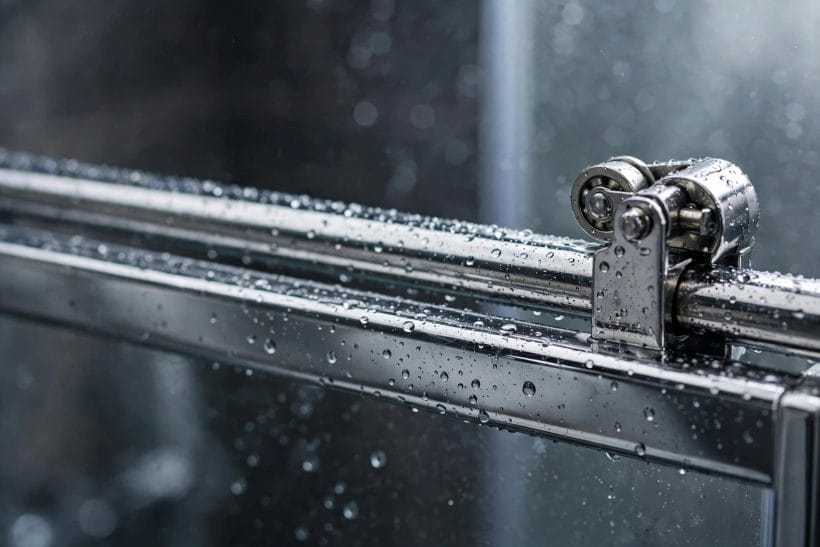
73. Seals and sweeps, renewed on schedule
The clear seals along panel edges and the sweep at the base are wear items with a finite life. They are inexpensive and replaceable — the trick is noticing them yearly rather than after the first puddle.
74. A squeegee habit, not a cleaning regime
Thirty seconds with a squeegee after the last shower keeps any glass in this list presentable and delays deep cleans for months. It is the whole maintenance secret of frameless sliders.
75. Costs in practical terms
Stated generally, as this series always states them: framed sliders cost least, frameless and barn systems more, and hardware quality moves the price more honestly than glass size. The expensive mistake is not the door — it is the cheap track under a good one. Spend first where hands and water meet the door every day — rollers, seals and handles — and let the decorative choices follow the budget that remains.
Final Considerations
A sliding shower door succeeds when three things line up: the right family for the opening, hardware specified like it matters — because it does — and a track you can keep clean without thinking about it. Choose on those terms, in that order, and the door will glide quietly for years while the bathroom keeps every centimetre of space the slider saved it. That, in the end, is the whole idea — all seventy-five of them.

0 Comments