

How much does a tiny house cost in 2026? The real answer spans from $30,000 DIY builds to $200,000+ luxury models — and understanding what drives the price is the key to budgeting correctly. This complete price breakdown covers every cost category, build method, and hidden expense so you can plan with confidence.
Whether you’re dreaming of a weekend cabin or a full-time tiny home, knowing the true costs upfront prevents the budget surprises that derail so many builds. For financing options, see tiny house financing guide.
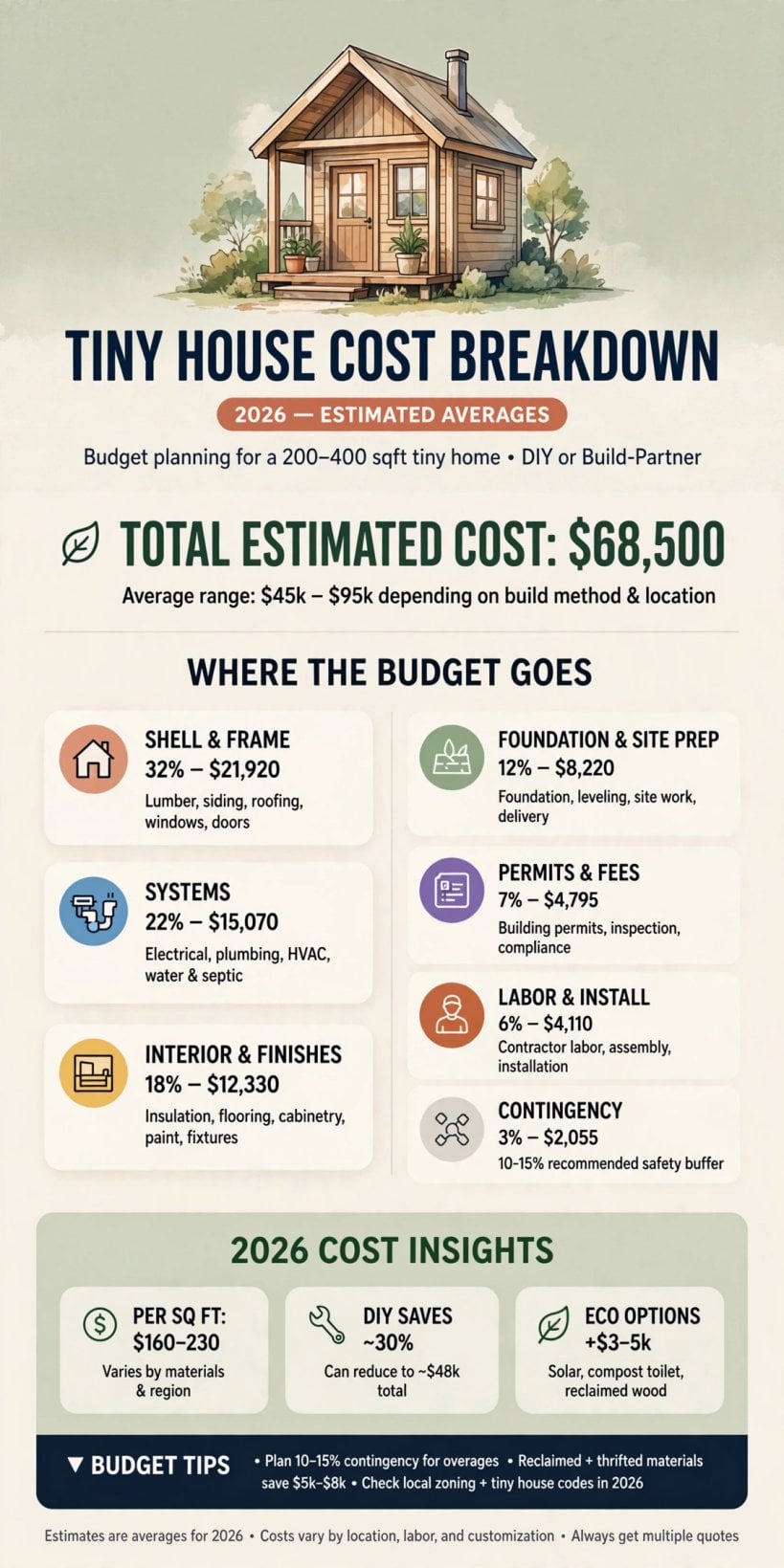
2026 Tiny House Cost Overview
DIY build (THOW): $30,000–$60,000. You supply the labor; materials and trailer are the main costs. Timeline: 6–18 months of weekends. Best for: skilled builders with time.
Builder THOW (new): $80,000–$150,000. Professional construction, warranties, faster delivery (3–6 months). Best for: full-time living with quality assurance.
Luxury/custom THOW: $150,000–$250,000+. Premium finishes, custom design, high-end systems. Best for: those who want tiny living without compromise.
Foundation tiny house: $100,000–$250,000 (excluding land). Conventional construction at small scale — higher per-square-foot costs but appreciates like real estate.
Used THOW: $40,000–$100,000. Significant savings, immediate availability. Best for: budget-conscious buyers who inspect carefully.
Cost Breakdown: Where the Money Goes
Trailer/foundation (15–20%): Tiny house trailer: $5,000–$12,000. Foundation (pier, slab, or crawlspace): $5,000–$15,000. Don’t skimp — this is literally what everything sits on.
Framing and shell (20–25%): Lumber, sheathing, roofing, siding, windows, doors: $12,000–$25,000. The weather-tight shell is your biggest single material cost.
Systems (15–20%): Electrical ($3,000–$8,000), plumbing ($2,000–$6,000), HVAC ($2,000–$5,000), water heater ($800–$2,500). Professional installation recommended for electrical and plumbing.
Interior finishes (20–25%): Insulation, drywall/paneling, flooring, kitchen, bathroom, fixtures: $12,000–$30,000. This is where DIY saves most — labor is the expensive part of finishes.
Appliances and furnishings (5–10%): Compact appliances, Murphy bed/convertible furniture, storage solutions: $3,000–$10,000. Tiny-specific items cost more than conventional equivalents.
Soft costs (10–15%): Plans, permits, delivery, tools, contingency: $5,000–$15,000. The contingency alone should be 10% — surprises are guaranteed.
DIY vs. Builder: True Cost Comparison
DIY real costs: Materials $30,000–$50,000 + trailer $5,000–$10,000 + tools $2,000–$5,000 + permits $1,000–$3,000 = $38,000–$68,000 out of pocket. Hidden costs: your time (500–1,000 hours), mistakes and rework (10–20% of materials), and delayed occupancy (rent paid while building).
Builder real costs: $80,000–$150,000 all-in. Hidden costs: fewer. Delivery ($2,000–$5,000), site prep ($3,000–$10,000), and utility hookups ($2,000–$8,000) are often excluded — ask explicitly.
Break-even analysis: If your time is worth $30/hour, 750 DIY hours = $22,500 in opportunity cost. DIY “savings” vs. a $100,000 builder: $100,000 − $53,000 (materials) − $22,500 (time) = $24,500 real savings. Worth it if you enjoy building; questionable if you don’t.
Hidden Costs Most People Miss
Land: Purchase ($20,000–$200,000+) or rent ($200–$800/month). The #1 overlooked cost. A “cheap” $50,000 THOW on $500/month rented land costs $6,000/year in land alone.
Site preparation: Clearing, grading, gravel pad, driveway: $3,000–$15,000. Remote land is cheap to buy and expensive to develop.
Utility connections: Well ($5,000–$15,000), septic ($8,000–$25,000), electrical hookup ($2,000–$10,000), internet ($0–$5,000 for Starlink + setup). Off-grid alternatives have their own costs (solar: $8,000–$20,000).
Permits and fees: Building permits ($500–$3,000), impact fees ($0–$10,000+), plan review, inspections. Research your jurisdiction early — fees vary wildly.
Insurance: THOW insurance ($800–$1,500/year), builder’s risk during construction ($500–$1,500). Often forgotten until move-in.
Delivery and setup: THOW delivery ($2,000–$8,000 depending on distance), crane if needed ($1,500–$3,000), leveling and tie-downs ($500–$2,000).
Cost by Tiny House Type
THOW (tiny house on wheels): $60,000–$150,000 typical. The most popular option. Mobile, but land costs are separate and ongoing.
Foundation tiny house: $120,000–$250,000 including modest land. Higher upfront, but appreciates and eliminates land rent uncertainty.
Container tiny house: $50,000–$120,000. Container ($3,000–$6,000) is cheap; conversion is not. Insulation and structural mods eat the savings.
Prefab/modular tiny: $70,000–$180,000. Factory efficiency meets tiny design. Faster than site-built, quality-controlled, but delivery and crane add costs.
Park model: $70,000–$130,000. Spacious (400 sq ft), not truly mobile. Great value per square foot if you don’t need to move it.
Regional Cost Variations
High-cost areas (California, Pacific Northwest, Northeast): Add 20–30% to builder prices. Labor, permits, and land are all expensive. DIY saves more here (your labor replaces expensive contractor labor).
Low-cost areas (Southeast, Midwest, rural Texas): Subtract 10–20%. Cheaper labor, simpler permits, affordable land. Builder THOWs from these regions can be excellent values (factor in delivery costs).
International note: Costs vary enormously by country. This guide uses US figures — adjust for local material costs, labor rates, and regulatory requirements.
Financing Costs to Factor In
Cash: No financing cost, maximum flexibility. If you can save and pay cash, it’s the cheapest path.
Personal loans: 8–15% APR, 3–7 year terms. On $80,000 at 10% for 5 years: $1,700/month, $22,000 in total interest. Expensive but accessible.
RV loans: 6–10% APR, up to 15-year terms. On $100,000 at 8% for 12 years: $1,080/month, $55,000 in total interest. Lower payments, much higher total cost.
Construction loans: 7–12% APR, interest-only during build, then refinance. Complex but appropriate for foundation builds.
Total cost of financing: Always calculate the all-in cost (principal + interest), not just the monthly payment. A “cheap” monthly payment over 15 years can double your total cost.
Ongoing Costs After Move-In
Land (rent or taxes): $200–$800/month rent, or $100–$400/month property tax on owned land. The largest ongoing cost by far.
Utilities: $100–$250/month (electric, water, internet, propane). Tiny houses use less, but base charges and minimums limit savings.
Insurance: $70–$125/month. Don’t skip it — a total loss without insurance is financially devastating.
Maintenance: Budget $100–$200/month (1–2% of value annually). Roofs, seals, systems, and finishes all need attention.
Total monthly: $470–$1,375/month all-in (excluding mortgage). Compare to your current housing costs — the savings are usually dramatic.
Money-Saving Strategies That Actually Work
Salvaged materials: Reclaimed lumber, Habitat for Humanity ReStores, demolition salvage, and Craigslist/Facebook Marketplace. Savings: 30–50% on lumber, fixtures, and finishes. Caveat: factor in time (sourcing, de-nailing, milling) and quality control (inspect for rot, pests, lead paint).
Owner-builder with pro help: DIY what you can (framing, insulation, finishes), hire pros for what you shouldn’t (electrical panel, plumbing rough-in, roofing). This hybrid approach captures most DIY savings while avoiding dangerous mistakes. Budget: 60–70% of full builder cost.
Shell + finish yourself: Buy a weather-tight shell from a builder ($30,000–$50,000), complete the interior yourself. You skip the hardest parts (trailer, framing, roofing) and save on finishes (the most labor-intensive phase). Popular middle path.
Simplify the design: Every bump-out, dormer, and custom angle adds cost. A simple rectangular design with a shed roof is dramatically cheaper to build than a complex one — and often looks better. Complexity is the enemy of budget.
Phase the build: Build the essential house now, add the deck, upgraded finishes, or solar later. Phasing spreads costs over time and lets you live in the house while improving it. Just ensure the core is complete and livable.
What NOT to Skimp On
The trailer: A cheap or undersized trailer is a safety hazard and a resale disaster. Buy a purpose-built tiny house trailer from a reputable manufacturer. This is non-negotiable.
Waterproofing: Roofing, flashing, house wrap, and window/door sealing. Water intrusion destroys tiny houses faster than anything. Spend generously here — every dollar prevents ten in repairs.
Electrical safety: Proper panel, GFCI/AFCI protection, correct wire sizing. Electrical fires don’t care about your budget. If you’re not qualified, hire an electrician for at least the panel and rough-in.
Structural integrity: Proper framing, hurricane ties, and load calculations (especially for lofts and roof decks). A tiny house that moves (THOW) experiences forces that stationary houses don’t — engineer accordingly.
Ventilation: Tiny houses trap moisture. Proper bathroom/kitchen exhaust, whole-house ventilation, and vapor barrier strategy prevent mold. Skimping here creates health hazards and expensive remediation.
Sample Budgets: Three Realistic Scenarios
Budget DIY ($45,000 all-in): Used trailer $4,000 + salvaged/new materials $25,000 + systems (DIY with pro electrical) $8,000 + finishes (budget) $5,000 + permits/tools/contingency $3,000. Land: rented ($400/month). Timeline: 12 months weekends. Result: functional, modest tiny house.
Mid-range builder ($125,000 all-in): Builder THOW $95,000 + delivery $3,000 + site prep $8,000 + utility hookups $6,000 + insurance/permits $3,000 + contingency $10,000. Land: leased in community ($500/month). Timeline: 4 months. Result: quality, warrantied, move-in ready.
Premium foundation ($210,000 all-in): Foundation tiny house $150,000 + modest land $40,000 + site development $12,000 + permits/fees $5,000 + contingency $3,000. Timeline: 8 months. Result: appreciating real estate, maximum comfort.
Cost Traps and How to Avoid Them
Scope creep: “While we’re at it, let’s add…” — the five most expensive words in construction. Every upgrade has a cost; every “small change” disrupts the schedule. Lock your design before building. Changes during construction cost 3–5x more than changes on paper.
Underestimating labor: DIYers routinely underestimate build time by 50%. A “6-month” build becomes 12 months. During those extra 6 months, you’re paying rent somewhere else — that “free” labor isn’t free. Budget time realistically (then add 30%).
Cheap tools: A $50 circular saw that can’t cut straight wastes more in materials than a $200 saw costs. Buy quality tools for critical tasks (or rent them). Good tools pay for themselves in speed and accuracy.
No contingency: Building without a 10% contingency is gambling. Something WILL go wrong — a material price spike, a code requirement you missed, a mistake that needs rework. The contingency isn’t pessimism; it’s realism.
Ignoring resale: Hyper-personal choices (that purple bathroom, the built-in reptile enclosure) feel great now and cost you at resale. If there’s any chance you’ll sell, keep major choices broadly appealing. Your taste isn’t everyone’s taste.
Financing mistakes: High-interest debt for a depreciating asset is dangerous. If you’re borrowing at 12%+ for a THOW, the interest can exceed the depreciation — you’re losing on both ends. Save longer, borrow less, or buy used.
Tracking Your Budget During the Build
Use a spreadsheet from day one: Every purchase logged, categorized, and compared to budget. Free templates exist specifically for tiny house builds. The builders who track spending stay on budget; those who “keep it in their head” don’t.
Weekly budget reviews: 15 minutes every Sunday: what did we spend, what’s committed, what’s remaining? Catching a $500 overrun in week 3 is fixable; discovering a $5,000 overrun in month 8 is a crisis.
The envelope method: Allocate fixed amounts per category (framing, systems, finishes). When a category is empty, you’re done spending there — find creative solutions instead of raiding other categories. Constraints breed creativity.
Separate wants from needs: Maintain two lists. Needs get funded first; wants get funded if money remains. That $800 designer faucet is a want. The $200 functional faucet is a need. Be honest about which is which.
Price Red Flags: When a Cheap Tiny House Isn’t
A price far below comparable homes, with no clear reason: The usual explanations are that the “house” is really an unfinished shell, that structural corners have been cut where you can’t see them, or that the listing itself is a scam built on stolen photos. A genuine bargain can explain itself; a suspicious one can’t.
Vague inclusions: “Turnkey” should mean a specific, itemised list — which appliances, whether delivery and setup are included, skirting, steps, hookups. A builder who won’t itemise is usually hiding where the true total lands.
Full payment demanded upfront: Legitimate builders work on a deposit followed by payments tied to build milestones. Anyone asking for the entire price before starting is a risk, whatever the discount offered.
No verifiable past buyers: Ask for references and actually call them. Check how long the company has existed. The tiny house world has seen builders fail mid-order, taking deposits with them — a track record you can verify is part of what you’re paying for.
Too-good financing: “Everyone approved, no credit check” offers usually hide severe rates or rent-to-own traps. Judge any finance offer by the total you will pay over the full term, never by the monthly payment alone.
The Pre-Purchase Checklist
Before you pay anything: Verify the builder’s business licence and how long they have operated. Read every review you can find, including the bad ones. Call at least two past buyers and ask three questions: was it on time, was it on budget, and how has warranty service been?
Before you sign: Get the itemised inclusions list, a payment schedule tied to milestones, a delivery timeline, the warranty terms in writing, and the cancellation terms — know exactly what you lose if you walk away.
Before delivery, or before buying used: Arrange an independent inspection — at the builder’s shop for a new home if you can, and always for a used one. On a used home, check the title for liens, verify the trailer’s identification, and test every system: water, electrical, heating, appliances. On a new build, ask for photos of the trailer, framing, insulation and systems before the walls close.
Before placing it: Confirm your land or parking arrangement in writing. Then check the physical delivery itself: can a truck and trailer actually reach the spot — clearances, turning space, overhead wires? Measure twice, deliver once.
After the purchase: The running costs are a budget of their own — see monthly cost of living in a tiny house. And for the full ownership picture — purchase, land, setup and a decade of operating costs added together — see how much do tiny houses cost in total.
Frequently Asked Questions
What is the cheapest way to get a tiny house?
DIY build with salvaged materials: $20,000–$35,000 possible for skilled builders who source reclaimed lumber, used windows, and discounted fixtures. But factor in 500–1,000 hours of labor. The second-cheapest: buying used ($40,000–$70,000 for decent THOWs). Never buy the cheapest listing without thorough inspection — cheap tiny houses are cheap for reasons.
How much does it cost per square foot?
Tiny houses: $200–$400/sq ft (vs. $150–$250 for conventional homes). Higher per-square-foot because: fixed costs (kitchen, bathroom, systems) are spread over fewer square feet, tiny-specific components cost more, and custom work is common. Don’t let per-square-foot pricing scare you — total cost is what matters.
Are tiny houses worth the cost?
Compare total housing costs over 10 years: tiny house ($80,000 purchase + $500/month ongoing = $140,000) vs. renting ($1,500/month = $180,000) vs. conventional home ($300,000 + $1,000/month = $420,000). Tiny houses win decisively on total cost — even before considering lifestyle benefits.
What hidden costs surprise tiny house buyers most?
Land costs (purchase or rent), site development (utilities, grading, access), delivery fees, permit/impact fees, and insurance. Together these can add $20,000–$50,000 beyond the house price. Budget them from day one — they’re not optional.
How much should I budget for a full-time tiny house in 2026?
Realistic all-in budget: $100,000–$180,000 (house + land costs + site development + contingency). This gets a quality builder THOW or modest foundation tiny house, properly sited and connected. Under $80,000 all-in requires DIY, used, or significant compromises.
Final Considerations
How much does a tiny house cost in 2026? Anywhere from $30,000 to $250,000+ — but the number that matters is YOUR all-in cost: house + land + site + utilities + contingency. The buyers who thrive are the ones who budget honestly, including the unglamorous costs (permits, delivery, insurance) that others forget. The buyers who struggle are the ones who fixate on the sticker price and get blindsided by everything else. Tiny houses remain one of the most affordable paths to homeownership and financial freedom — but only when you count all the costs. Do your homework, build in a 10% contingency, and remember: the cheapest tiny house is the one you can actually afford to finish, site, and live in. Plan for the full picture, and the price will be right.

3 Comments