

A tiny house is small, but the land it needs is not just the size of the house. When people first ask about how much land for tiny house living they really need, they usually picture the footprint of the home and stop there, yet the footprint is often the smallest claim on the plot. Around the house you also need legal breathing room from the boundaries, space for water and sewage systems, a way to get the house and everyday vehicles in and out, room to reach utilities, and enough usable ground left over that the home is pleasant to live in rather than simply parked.
The right answer therefore depends on how the home will be served and what your local rules require, and those rules vary from place to place, so this guide will not hand you a universal plot size. Instead it works through the claim each system and rule makes on your land, one attribute at a time, so you can add them up for your own situation. A plot that works beautifully with a sewer connection and a shared driveway may be far too small once a septic system, a reserve area, and setbacks all need their share, and understanding that arithmetic before you buy is what this guide is for.
Quick Answers at a Glance
| Question | Short Answer |
|---|---|
| Is the land needed just the size of the house? | No. Setbacks, systems for water and sewage, access, and everyday living space usually claim far more ground than the house itself. |
| What are setbacks? | Distances a home must sit from boundaries and other features. They are set locally, vary by area, and must be checked with your city or county. |
| Does a septic system change the answer? | Yes. A septic system needs its own suitable ground, plus a protected reserve area for a future replacement, on many plots. |
| Why does access matter? | The house, delivery vehicles, and emergency and service vehicles all need a workable way in, and a driveway takes real space. |
| Do utilities affect plot size? | They can. Distance from water, power, and sewer connections affects cost and layout, and off-grid systems need ground of their own. |
| Should you plan for the future? | Yes. Parking, a garden, storage, a possible second structure, or room to manoeuvre all argue for more than the bare minimum. |
| What is the safest way to size a plot? | Sketch the house, setbacks, systems, and access onto the actual plot shape, and confirm the local rules before you commit. |
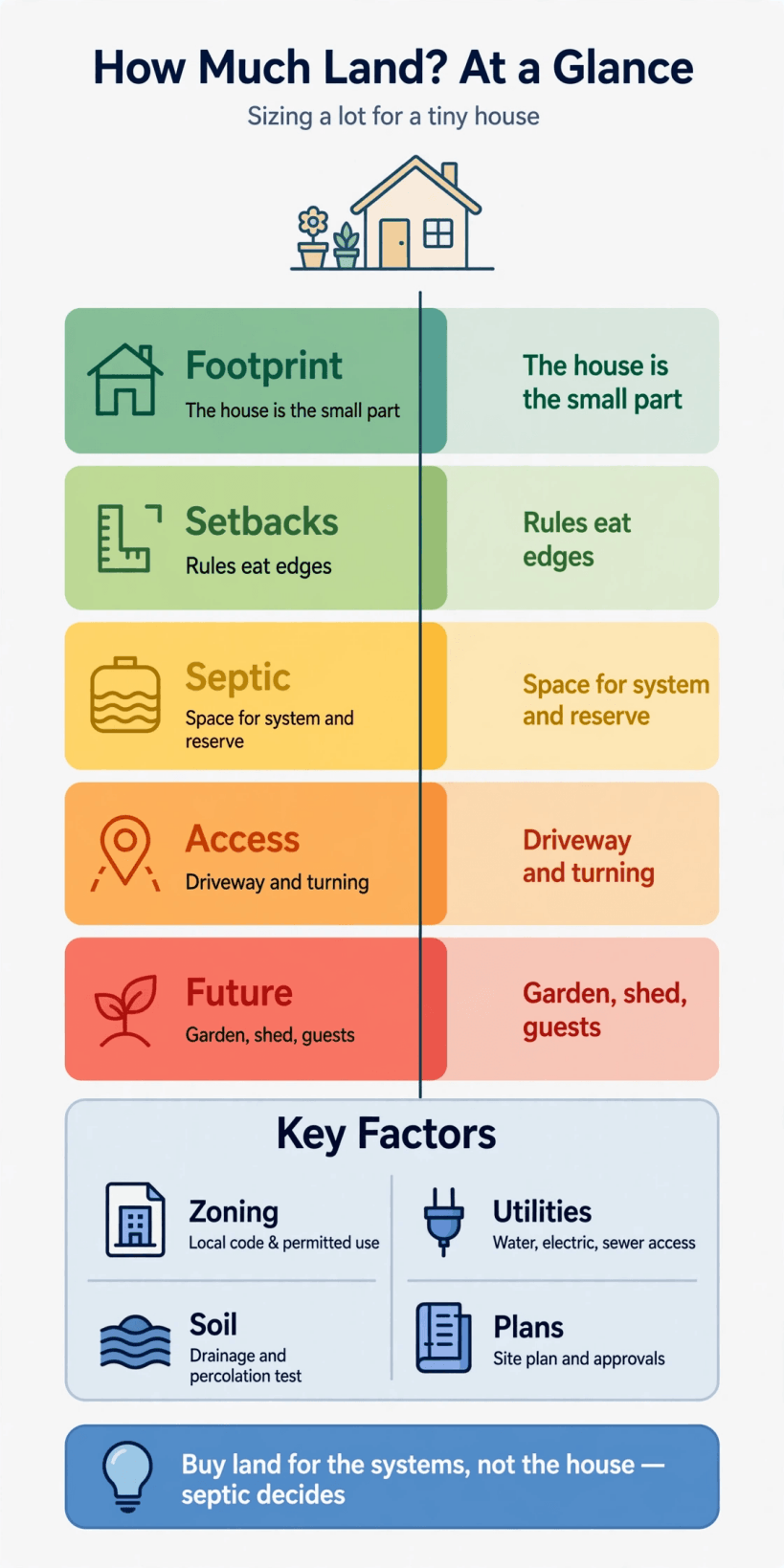
1. The House Footprint Is the Smallest Part of the Answer
Start with the house itself, because it is the one measurement you know exactly. Whether your tiny house is a compact unit on wheels or a small cottage on a foundation, the ground it physically covers is modest, and on paper that can make almost any plot look generous. The trap is that a house is not a tent: it cannot be pitched into whatever corner happens to be free. It needs a level, stable place to sit, room around it for the delivery or the build, space to connect services, and safe clearance so you can maintain walls, roofs, and wheels over the years without climbing onto a neighbour’s land.
So treat the footprint as the first layer of a plan, not the plan itself. Draw the house to scale on a sketch of any plot you are considering, then keep drawing. Add the working space around it, the path the house takes to reach its spot, and the ground its systems will occupy. Buyers are often surprised how quickly a plot that looked twice the size of the house becomes fully committed once those layers are honest. Our step-by-step guide to how to prepare your land for a tiny house walks through turning that sketch into a prepared site, from clearing and levelling to getting services ready for the day the house arrives.
2. Setbacks: The Invisible Frame Around Every Plot
Setbacks are the distances your local rules require between a home and the edges of its plot, and often between the home and features such as roads, water, or neighbouring structures as well. They exist for fire safety, privacy, access, and drainage, and in practice they shrink every plot: the buildable area is the ground left inside the frame the setbacks draw, not the full area on the deed. Two plots with identical total size can offer very different buildable areas if one is long and narrow, because setbacks eat a larger share of a narrow plot from both sides.
There is no universal setback figure anyone can quote you responsibly, because these distances are set by your city, county, or local authority and they differ by zone and by the type of structure. The only safe method is to ask the local planning office what applies to the exact plot, and to ask before you buy, ideally in writing. That conversation also reveals whether a tiny house is treated as a dwelling, an accessory unit, or a vehicle in that area, which changes everything else. Our guide to zoning laws for tiny houses and talking to officials explains how to approach those offices and which questions get you useful, recordable answers rather than vague reassurance.
3. Room for the Systems That Serve the House
A house needs more than a place to stand; it needs the systems that make it liveable, and several of those systems live outside the walls. Water has to arrive, from a connection or a well. Sewage has to go somewhere lawful. Power has to reach the home, from a line, from solar equipment with its own clear patch of sky and ground, or from a combination. Fuel storage, a heat pump unit, a water tank, or a battery shed may each want a safe, reachable spot. None of these needs a huge area on its own, but together they claim a ring of working ground around the house that a bare footprint calculation ignores.
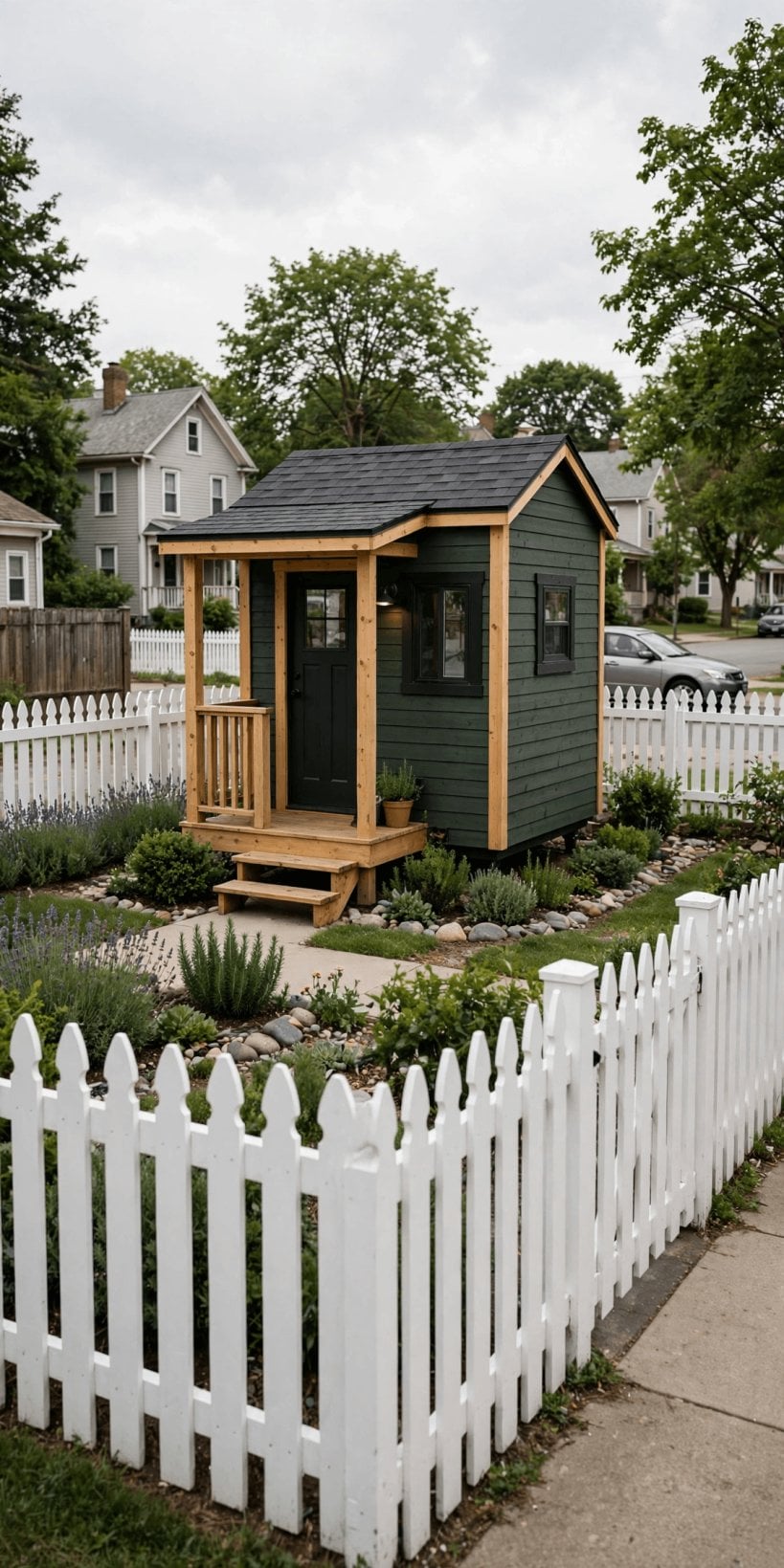
Plan those systems as part of the plot, not as an afterthought squeezed into leftovers. Lines and pipes are cheapest and easiest to maintain when their runs are short, straight, and reachable, and equipment lasts longer when it is not wedged into a damp corner. Think about how a service vehicle or a future repair would reach each system, and keep access to them clear in your sketch. Our complete guide to tiny house utilities, power, water, and off-grid sewage compares the main options for each service, which is the knowledge you need before you can honestly judge whether a particular plot can host the combination you have in mind.
4. Septic Space — and the Reserve Area You Must Protect
If the plot is not served by a public sewer, a septic system is usually the largest single land claim after the house itself. A septic arrangement needs suitable ground for its tank and its drainage area, soil that drains at a workable rate, and separation from wells, water, and boundaries, with the exact requirements set and checked locally. Just as importantly, many areas expect a reserve area: a second patch of suitable ground, kept clear and unbuilt, held in case the first drainage area ever needs to be replaced. That reserve cannot hold your driveway, your shed, or your garden structures, so it removes a real piece of the plot from everyday use.
This is why a plot can pass every other test and still fail. The house fits, the setbacks work, the driveway reaches — but the only well-drained ground is exactly where the house was meant to sit, and there is no second patch for a reserve. Before you rely on a septic solution, have the soil and the layout assessed by the people your local authority recognises, and mark both the system area and the reserve on your sketch in a colour you are not allowed to spend on anything else. If a seller cannot tell you whether a plot has ever been assessed for sewage disposal, treat that unknown as a risk to price in, not a detail to discover after the sale.
5. Wells, Water Lines, and Separation Distances
Water supply makes its own claim, and it interacts with sewage in ways that shape the whole layout. A plot on a public water line mostly needs a sensible route for the connection. A plot relying on a well needs a drillable spot, access for the drilling equipment, and — critically — separation between the well and anything that could contaminate it, above all the sewage system. Those separation requirements are set locally and checked locally, so again there is no number in this guide to copy onto your plan; there is only the discipline of asking, measuring, and drawing what you are told.
On a small plot this separation puzzle is often the real size test. The well wants to be away from the septic area, the septic area wants suitable soil, the house wants to be within a sensible pipe run of both, and the setbacks frame all three. Sketch them as circles of influence rather than points and you will see some plots solve the puzzle elegantly while others, only slightly smaller or awkwardly shaped, cannot solve it at all. That is the practical reason two buyers can look at the same plot and disagree about whether it is big enough: they are imagining different systems. Fix your systems first, then judge the land against them, and revisit where to buy tiny house lots for how these checks fit into the wider search for ground.
6. Access and Driveway: Getting the House On and Services In
Land you cannot reach is land you cannot use, and access claims more space than most first-time buyers expect. A tiny house on wheels has to be towed onto the plot and manoeuvred into position, which takes a route with workable width, turning room, and ground or a track that can carry the weight in ordinary weather. A house built or placed on a foundation needs deliveries of materials or of the home itself, plus construction access. After moving in, the same route serves your car, fuel and water deliveries where relevant, sewage pump-out or servicing if you use them, and — the case nobody likes to plan for — emergency vehicles.
A driveway is therefore not a strip of gravel to add if money remains; it is a core part of how much land the home consumes, and on a sloping or wet plot building a durable one is real work. Allow for parking and turning as well as the drive itself, because a car that can arrive but cannot turn round will reverse out onto the road for years. Consider who else uses the access: shared drives and rights of way can be perfectly workable, but their terms belong in your purchase checks, not in a handshake. If the only access crosses ground that floods, freezes, or belongs to someone else without a clear agreement, the plot’s usable size is smaller than its map size, whatever the paperwork says.
7. How Distance From Utilities Changes the Land You Need
Where a plot sits relative to existing services changes both its cost and its layout. A plot beside a road with water, power, and sewer already passing is simple: short connections, modest trenches, and the house can sit where setbacks and ground suit it best. A plot far from those services asks a different question on each one. Extending lines a long way is usually possible but increasingly expensive per step, and at some point off-grid or self-contained systems become the sensible comparison — each of which, as earlier sections showed, claims land of its own for panels, tanks, or a septic field.
This is why the cheapest plot on a listing site is so often not the cheapest place to live. Price the connections, or the alternative systems, into the same spreadsheet as the land itself, using our breakdown of the true cost of tiny houses to keep the hidden items visible. Distance also affects the everyday: a long private driveway to maintain, a longer walk for bins and post, and services that take longer to reach you when something fails. None of that argues against rural land — for many tiny house owners it is the entire point — but it does mean the land you need includes room to be self-reliant, not just room to park the house.
8. Slope, Drainage, and Ground That Has to Stay Usable
Not all square metres are equal, and a plot’s usable land is what remains after slope, drainage, and wet ground have had their say. A steep plot may offer plenty of area and very few places a house can actually sit without major groundworks, retaining structures, and drainage management. A flat plot that holds water can be worse: the house pad, the septic area, and the driveway can all be competing for the same slightly higher corner, and the rest turns to mud exactly when vehicles need it most. Trees, rock, and protected features can remove further patches from play, sometimes by rule and sometimes simply by practicality.
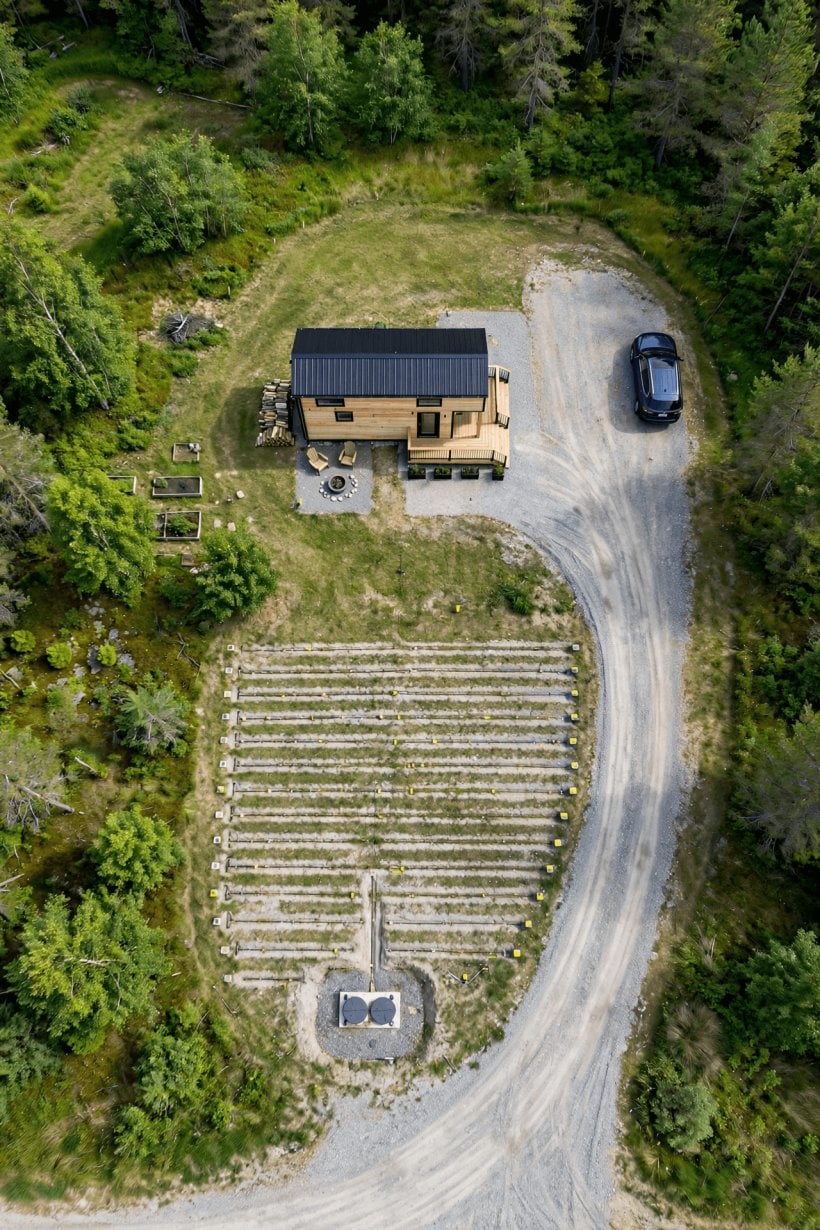
Visit any serious candidate plot more than once and in more than one weather if you can, and always ask where water goes when it rains hard. Look for the high, dry, level-ish ground and measure the plot by how much of that it contains, not by the total on the listing. Modest groundworks — a proper pad, simple drainage, a well-built drive surface — can rescue marginal ground, and our land preparation guide linked earlier covers what that work involves. But groundworks cost money and sometimes need permission, so a plot that needs a lot of them is effectively smaller and dearer than it looks, and your land budget should say so honestly before you offer on it.
9. Space for How You Will Actually Live Outdoors
Tiny house living leans on the outdoors more than conventional living does, and the land has to hold the overflow of a small interior. A deck or patio becomes a second room. Storage for tools, bikes, fuel, and seasonal things needs a shed or a planned corner, because it will not fit inside. Many owners grow food, keep a small workshop area, hang laundry, park a second vehicle, or simply want privacy planting between themselves and the road. Each of those is a modest claim, but together they are the difference between a home that feels generous and one that feels like a vehicle stored on a plot.
Be honest about your own habits when you size this layer. A minimalist who travels for work may need little more than the house, its systems, and a parking space, and for that owner a genuinely small plot, well chosen, can be perfect and cheap to keep. A couple working from home, with a dog, a garden, and hobbies that involve equipment, will feel squeezed on the same ground within a season. There is no virtue in buying the smallest plot you can legally occupy; there is virtue in buying the smallest plot that holds your actual life without daily friction. Sketch your outdoor life onto the plan with the same seriousness as the septic field, because unlike the septic field, you will use it every single day.
10. Planning for Future Uses Without Buying More Than You Need
Finally, look a few years ahead, because land is the one part of a tiny house project that is hardest to change later. Plans evolve: a partner moves in, a home office becomes essential, an ageing parent or an adult child needs a space, or the tiny house becomes the first stage of a larger homestead with outbuildings and planting. A plot with a little well-placed spare ground absorbs those changes; a plot bought to the exact minimum tends to punish them. Spare ground near the house, on the usable side of the plot, is worth far more than spare ground stranded across a slope or a wet corner.
The counterweight is cost and upkeep. More land usually means a higher price, more fencing and maintenance, and in some areas higher ongoing charges, and it can tempt owners into projects their time cannot support. It also interacts with finance and insurance more than people expect: how the land and home are owned, valued, and covered all belong in the same early research, which is why our guides to how to finance a tiny house and the tiny house insurance guide for wheels versus foundation repay reading before you settle on a budget. The sweet spot for most owners is a plot that covers today’s systems and life with room to spare in the right places — not the biggest plot available, and never the smallest one that merely passes on paper.
Final Considerations
So, how much land do you need? Add it up the way this guide has laid it out: the house and its working space, inside a frame of locally confirmed setbacks, plus the ground for water and sewage — including a protected septic reserve where that applies — plus an access route and driveway that genuinely work, plus the usable outdoor space your daily life requires, plus a modest allowance for a future you can describe. The total that falls out of that honest sum is your answer, and it will differ from your neighbour’s answer for entirely good reasons.
Before you buy, turn that sum into a sketch on the real plot shape, confirm the local rules with the local office rather than with the seller, and have sewage and water feasibility checked by people whose assessments your authority accepts. A plot that survives those tests is big enough at almost any headline size, and a plot that fails them is too small at any price. Buy the land your systems and your life actually need, and the tiny house on it will feel like a home from the first night rather than a compromise you explain to visitors.


0 Comments