

The cheap tiny house — built for $10,000, $20,000 or $30,000 — is the tiny house movement’s origin story: no mortgage, no contractor’s invoice, just a simple design, salvaged materials and your own two hands. This guide covers the strategies, the savings and the affordable build that actually works.
How to Make a Cheap Tiny House: At a Glance
Knowing how to make a cheap tiny house is really knowing where a build’s money goes — and refusing to spend it where it buys nothing. This guide follows the cheap build in its real order: the philosophy and the biggest savings, the simple shell and its honestly sourced materials, the DIY labor that replaces the contractor, minimal systems, the full $20,000 budget breakdown, the trailer, the land and the permits, the mistakes and the ten commandments, the timeline and the phasing, finishes that look expensive, the help network, salvage — and the freedom the finished house pays back.
| Topic | What It Covers | Key Fact or Figure |
|---|---|---|
| 1. The Philosophy and the Biggest Savings | Spend less, design simple, save the labor | DIY labor saves 50% |
| 2. The Shell and the Materials | The rectangle, the shed roof, salvaged and standard sizes | The rectangle is the cheapest shape |
| 3. DIY Labor, Tools and Skills | Your hands, borrowed tools, skills kept forever | Borrowed tools are free |
| 4. Systems and Insulation | Simple electric, compact PEX plumbing, fiberglass first | PEX is the forgiving plumbing |
| 5. The $20,000 Budget Breakdown | Every dollar assigned, contingency included | Trailer $3,000 · contingency $3,500 |
| 6. The Trailer, the Land and the Permits | The foundation deal, the land options, the legal route | Used trailer $2,000–$4,000 |
| 7. Mistakes and the 10 Commandments | The budget discipline that prevents the spiral | Never cut safety |
| 8. The Timeline and Phasing the Build | Weekends or full-time; weather-tight, livable, finished | Weekends: 6–12 months |
| 9. Finishes and the Help Network | Paint and pine; friends, community and hired pros | Paint: the $50 transformation |
| 10. Salvage, the $10,000 Challenge and the Payoff | The hunt, the proof, the mortgage-free freedom | True DIY builds: $10,000–$30,000 |
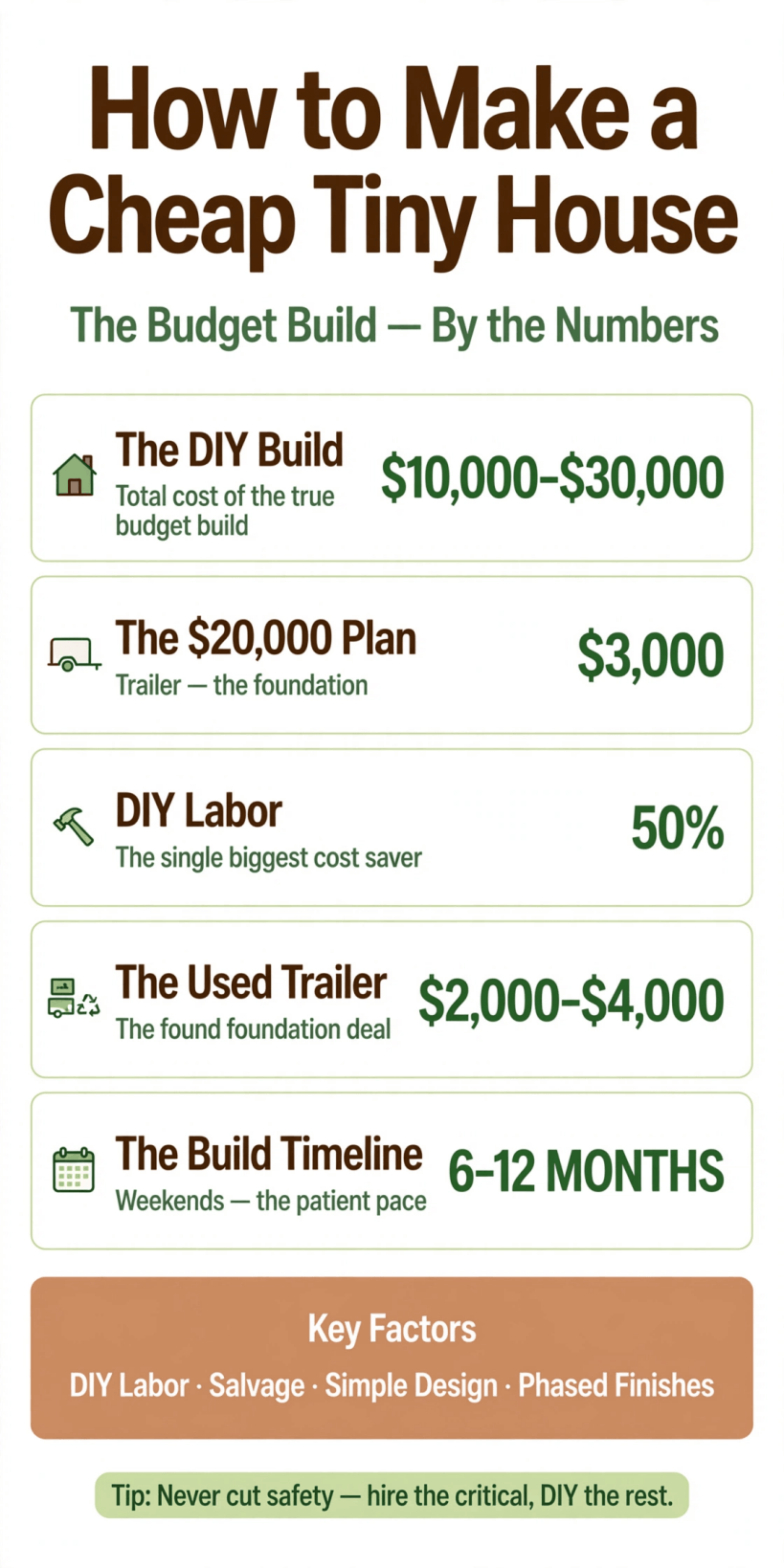
The cheap build by the numbers: a true DIY budget build at $10,000–$30,000, DIY labor saving 50% of a conventional build’s cost, a used trailer at $2,000–$4,000 — and a timeline measured in patient weekends.
1. The Cheap Tiny Philosophy and the Biggest Savings
The philosophy comes first, because every cheap build that succeeds is cheap on purpose. Spend less and the spending itself is what gets freed — money not poured into the house stays available for the life the house was built to enable. Do the labor yourself and the labor is the saving, the single largest one available. Keep the design simple and simple is what makes it affordable: every complication is a cost wearing a disguise. The rule underneath the whole guide is that the cheap is the intentional — the designed. Cheap here is not an accident or an apology; it is the movement’s origin story, the way the first tiny houses were always built.
The biggest savings stack, and they are planned rather than found. The labor is the DIY — worth 50% of a conventional build’s cost. The shell is the simple — the rectangle. The systems are the minimal — the affordable. The finishes are the basic — and, done with care, the beautiful. Asked for the single biggest cost saver, the original’s answer is unambiguous: the DIY labor — half the cost of the conventional build. The second is the simple design; the third is the salvaged materials. The labor is the king — which is why the sections that follow keep returning to your own hands.
2. The Shell: Keep It Simple, and Materials: The Cheap Sources
The shell is where the shape of the money is decided. The rectangle is the cheapest shape — straight walls, standard cuts, no geometry tax. The shed roof is the single slope — the simple roof, one plane to frame, flash and shingle. And the size rule runs in one direction: the smaller, the cheaper, because every added foot is framed, sheathed, heated and paid for. The rule: simple shells are the affordable ones, and the savings begin on the drawing before a single board is bought. The roof itself is framed step by step in our guide to how to frame a shed roof tiny house.
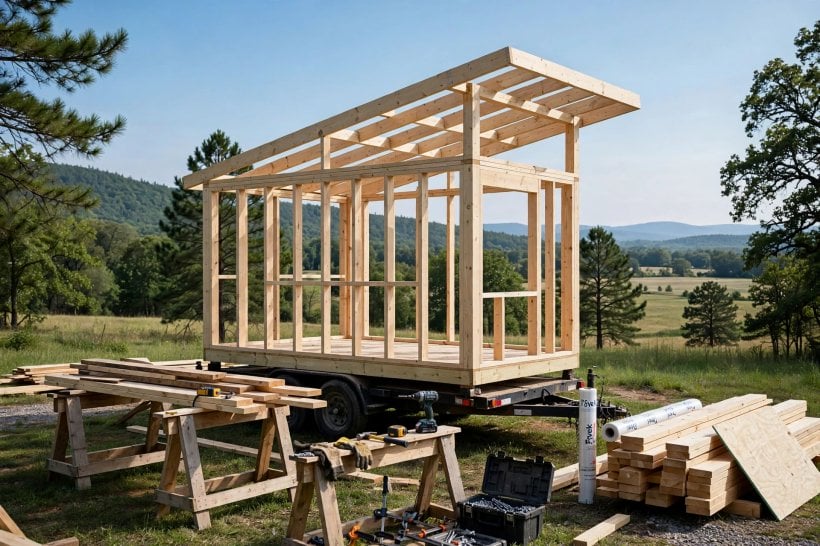
Materials follow the same discipline, sourced three ways. The reclaimed is the salvaged — and it brings the character no new board can buy. The surplus is the discounted — the found, other people’s over-orders and discontinued lines at a fraction of the shelf price. The standard is the sizes — the uncut: design around the dimensions lumber and sheet goods already come in, and the offcuts (and the waste bill) shrink together. The rule: cheap materials are the sourced — hunted, not merely bought. Where the hunting itself is organised — the yards, the stores, the listings — is the salvage guide in section 10.
3. The DIY Labor, the Tools and the Skills You’ll Learn
The DIY labor is the biggest saving because it replaces the build’s most expensive line item: other people’s hours. The framing is the learned — and then the done, stud by stud. The finishing is the patient — and patience is what makes it beautiful where rushed work would show. The help is the friends — the pizza: the classic currency of the raising weekend, labour recruited with food and gratitude. The rule stands at the centre of the whole cheap method: the DIY is the biggest saving. Framing the house on its trailer is taught end to end in our guide to how to frame a tiny house on a trailer.

The tools obey the same economy. The borrowed are the free — the asked: most tools a build needs for one weekend already exist in a neighbour’s garage. The bought-used are the cheap — and the resold afterwards, so their true cost is the small difference. The kit stays the minimal — the needed, not the wanted. And the skills are the dividend that never stops paying: the framing, the first learned; the wiring, the careful and the taught; the plumbing, the PEX — the forgiving. The truth the original leaves you with: the skills are the kept — the forever, long after the build’s receipts fade.
4. Systems on a Budget and Insulation on a Budget
Systems stay minimal because every system is bought, installed and one day maintained. The electric is the simple — the minimal, a small load served by a small, honest layout. The plumbing is the compact — the PEX, short runs gathered in one wet wall rather than chased through the whole house. The heat is the wood stove or the mini-split — the two answers the original names, one rustic and one electric. The rule: simple systems are the affordable systems, in the buying and in the living. The pipe choice itself is compared in depth in our guide to tiny house plumbing: PEX vs copper.
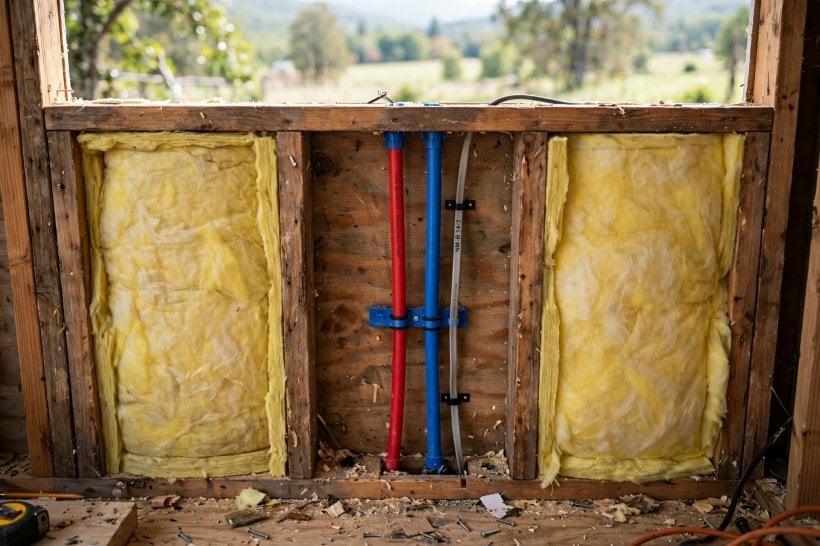
Insulation gets the same treatment, because comfort is not where the cheap build is allowed to feel cheap. The fiberglass is the cheapest — and the effective, the batt that fills the standard stud bay the simple shell provides. The rigid foam is the R-value play — the board that earns its place where thickness is scarce. The rule: the insulated is the comfortable — always. A cheap house that is cold is not a saving; it is a slow refund of everything the build achieved. At the opposite end of the insulation budget sits the premium option, examined in our guide to vacuum insulated panels explained.
5. The $20,000 Budget Breakdown
The original prices the whole build as one worked example: the $20,000 budget, broken down line by line. The trailer takes $3,000 — the foundation. The framing takes $2,500 — the lumber. The shell takes $3,000 — the weather-tight. The systems take $4,000 — the electric and the plumbing. The interior takes $4,000 — the finished. And the contingency takes $3,500 — the wise, the line that expects the surprises so the surprises do not end the build. The total is the $20,000 — the home.
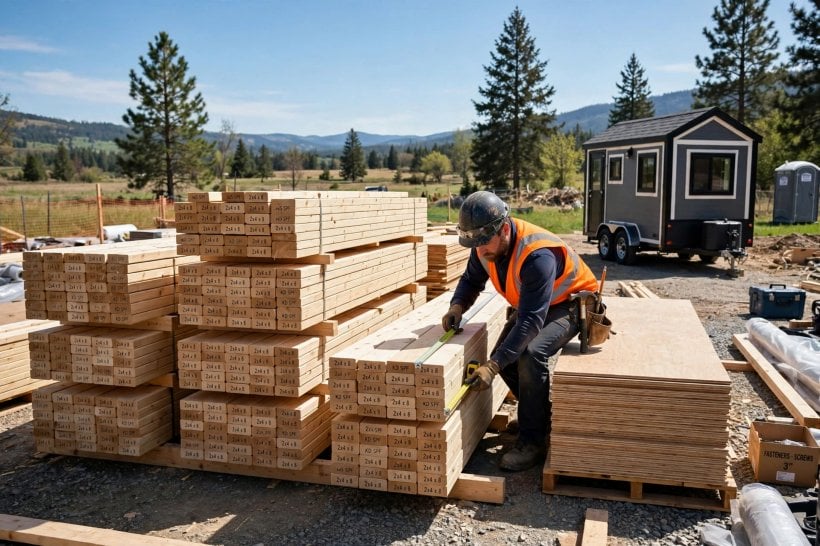
That breakdown answers the cost question the FAQ asks directly. How much does a cheap tiny house cost? $10,000–$30,000 for the true DIY budget build — the shell at $5,000–$10,000, the systems at $3,000–$8,000, the finishes at $2,000–$10,000. The range is wide because the levers are yours: the labour you donate, the materials you salvage, the finishes you phase. The cheap is the DIY — the breakdown is what the DIY looks like when it is written down. A kindred worked example, built around the frame itself, is our guide to how to build a timber frame cabin on a budget.
6. The Trailer: The Foundation Deal, the Land Question and Permits on a Budget
The trailer is the foundation, and it is bought like one. The used trailer is the found deal — $2,000–$4,000. The new trailer is the warranted one — $5,000–$7,000. Either way, the rating is the weight — the matched: the trailer’s capacity must carry the house the design promises, with margin. The rule: the trailer is the foundation — get it right. What the market offers, region by region, is surveyed in our guide to tiny house trailers for sale in Texas.
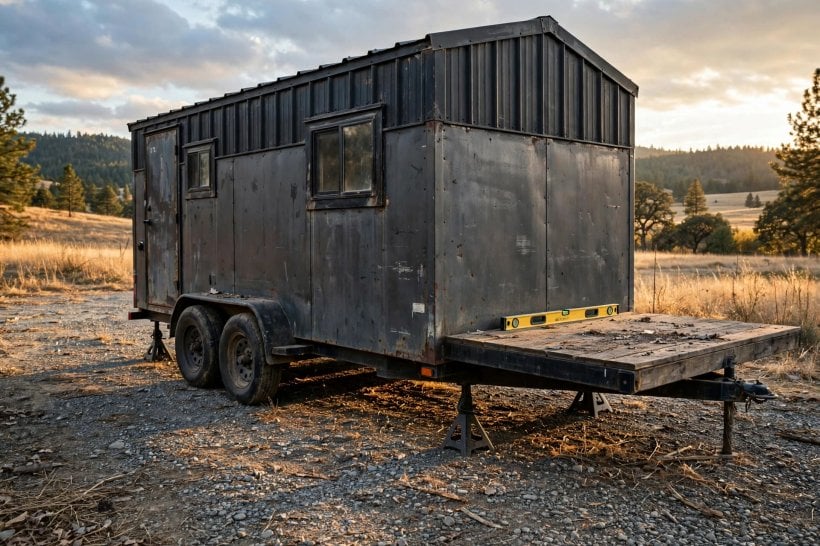
The land is budgeted separately, and the original keeps the options in price order. The lease is the cheap — the flexible. The family land is the free — the asked. The owned land is the later — the phased, bought when the house exists and the budget recovers. The rule: the land is the separate — the budgeted. Permits follow the same long view: the researched — the required, the known; the tiny house on wheels — the gray, the navigated. The rule closes the section: the legal is the cheap — in the long run, because the fine, the forced move and the uninsurable house are the expensive outcomes pretending to be savings.
7. Cheap Build Mistakes to Avoid and the 10 Commandments
Three mistakes account for nearly every cheap build that stops being cheap. The no-budget build is the overspent — the untracked: money leaks from a build nobody is counting. The safety-cut is the dangerous — the never: the one saving that is not a saving at all. And the scope-creep is the expensive — the undisciplined, the build that keeps agreeing to become a bigger build. The rule presides over all three: the budget is the boss — the respected.
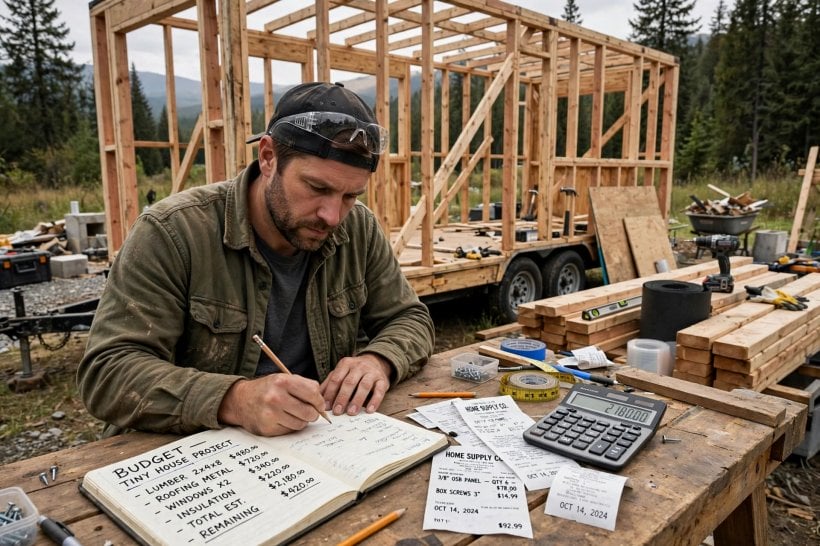
The ten commandments of the cheap tiny compress the discipline: budget the every dollar; DIY the maximum; salvage the materials; simplify the design; standardize the sizes; minimize the systems; phase the finishes; track the spending; never cut safety; enjoy the build. Two of the FAQ’s answers live inside them. How do you keep build costs from spiraling? The written budget, the weekly tracking, the scope discipline, the phased finishes — the spiral is the undisciplined, and the budget is the boss. And is a cheap tiny house safe? Yes — when the structure, the electric and the plumbing are done right. The cheap never cuts the safety: the structure and the systems are the non-negotiable.
8. The Cheap Build Timeline and Phasing the Build
The cheap build trades time for money, and the original prices the trade honestly. Built on weekends, the build runs 6–12 months — the patient. Built full-time, it runs 2–3 months — the focused. The truth: the cheap takes the time. That is the FAQ’s answer to how long a cheap tiny build takes, word for word in substance: the weekends at 6–12 months, the full-time at 2–3 months — the patient builder wins, because patience is the currency the discount is paid in.
Phasing is how the timeline and the cash flow are made to agree. The weather-tight comes first — the priority, the shell closed against the sky. The livable comes second — the moved-in, the systems and the basics that turn a shell into a home. The finished comes third — the polished, the details completed as money allows. The rule: the phased is the affordable — the cash-flowed. A build phased this way never waits for a lump sum; it advances every payday, and the house can shelter its own builder while the last phase is still being earned.
9. Finishes That Look Expensive and the Help Network
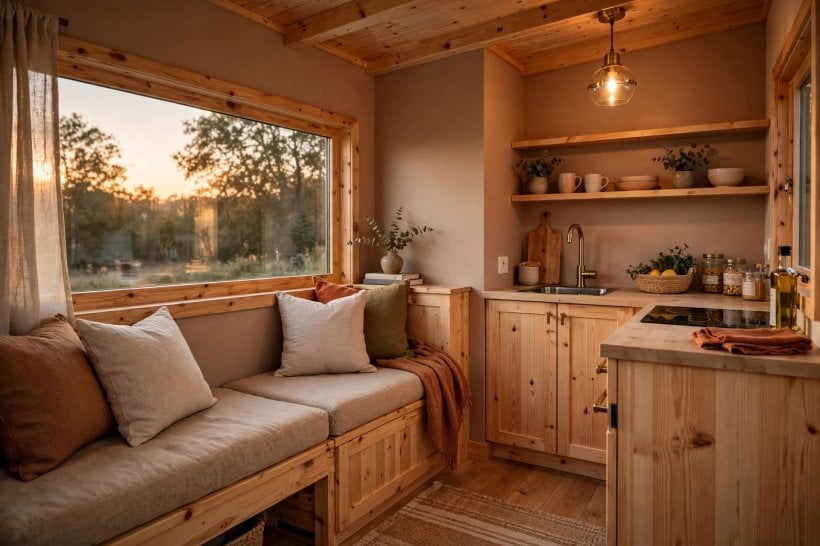
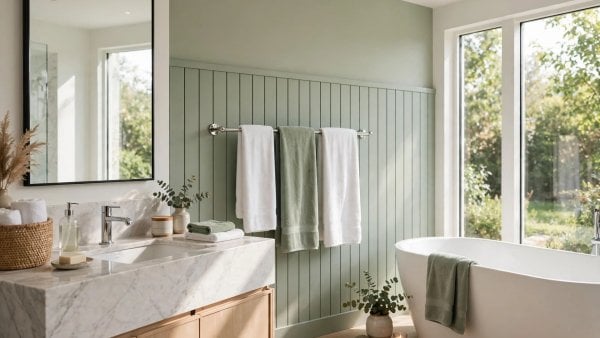
The finished cheap house is not supposed to look cheap, and the original’s finishes are chosen to prove it. The paint is the $50 — the transformed, the single cheapest total change a room can receive. The pine is the cheap — the beautiful, the honest softwood that varnishes up like it costs more. The details are the small — the rich: trim, handles and edges finished like someone cared, because someone did. The truth: the cheap looks rich — the finished. The wider finishing framework lives in our tiny house and small-space interior design hub.
No cheap build is a solo act, and the help network has three rings. The friends are the pizza — the recruited, there for the raising and the roof day. The community is the tiny — the experienced, the builders who have already made your mistakes and will happily name them. The pros are the hired — the critical, brought in precisely where the work leaves DIY territory. The rule: the help is the asked — the received. Which raises the FAQ’s sharpest question: what should you never DIY to save money? The structural engineering, the gas lines, the complex electric — the licensed-when-required. The cheap never risks the safety: hire the critical, DIY the rest.
10. The Salvage Guide, the $10,000 Challenge and the Cheap Tiny Payoff
Salvage is where the materials budget goes to be hunted down. The ReStores — the Habitat for Humanity treasure, priced to move. The demolitions — the asked, the given: the house coming down is a warehouse giving its contents away. The online listings — the free, the watched, the curbs and classifieds checked like a habit. The truth: the salvage is the hunt — the rewarded. That is also the FAQ’s answer to where cheap building materials are found: the salvage yards, the Habitat ReStores, the Craigslist free listings, the demolition sites, the friends’ leftovers. The cheap materials are the hunted.
The $10,000 challenge is the proof the method works at its limit. The builds are the documented — the proven, not folklore. The result is the spartan — the accepted, the proud: fewer finishes, minimal systems, everything essential and nothing apologetic. Can you build a tiny house for $10,000? The FAQ answers yes — the simple shell, the salvaged materials, the all-DIY labor, the minimal systems. The $10,000 tiny is the spartan and the proud. And if building is not your route at all, the same FAQ ranks the alternatives: the cheapest way to get a tiny house is the DIY build with salvaged materials; the used purchase is second — often yes, the depreciated tiny at half price is the smart buy when it is sound, after inspecting the structure, the roof and the systems; the shell finished by you is third. The cheapest is the hands-on.
Then the payoff, which is the point of every saved dollar. The freedom is the mortgage-free — the lived: the monthly cost falls to the minimal, and the math is the freedom. The pride is the built — the owned. The skills are the learned — the kept. Around those three the original gathers its closing celebrations — the housewarming where the friends are thanked and the pizza repaid, the first night on the floor of a home that is finally home, the last nail stepped back from and admired, the welcome mat placed at a proud address — and hands the whole thing on: the builder’s legacy is the taught, the stories that inspire the next builder the way the hammer’s daily song inspired this one. The full design journey behind the finished house is gathered in our guide to tiny house design: plans, layouts and 3D ideas.
Final Considerations
Learning how to make a cheap tiny house is learning a discipline, not finding a discount: donate the labor, simplify the design, salvage the materials, phase the finishes — and never cut the safety that makes the cheap house a sound one. The cheap tiny house is the movement’s heart: the affordable freedom, the DIY pride, the simple beauty. Build it cheap, build it right, build it yours.

1 Comment