

Texas is tiny-house-trailer country: the builders cluster here, the land is cheap, the unincorporated counties ask few questions, and the deals start at $10,000. Whether you want a $25,000 budget new build or a used micro tiny for cash, this is the state where the trailer market is widest — and this guide walks the whole purchase, from prices and listings to inspection and delivery day.
Tiny House Trailers for Sale in Texas: At a Glance
Tiny house trailers for sale in Texas span the widest range in the country — from a $10,000 used micro tiny to an $89,500 NOAH-certified custom — because Texas combines dense builder competition, cheap rural land and permissive unincorporated counties. This guide follows the purchase in the order a buyer meets it: the price bands and what each buys, the real listings that prove the market, the builders worth touring, the trailer hardware underneath every house, zoning and financing realities, transport and setup, the buying process with its inspection checklist, the $10,000 reality check and the NOAH standard, and finally park models, rival states and the Texas life the trailer buys you.
| Topic | What It Covers | Key Fact or Figure |
|---|---|---|
| 1. Texas Prices | The four price bands, budget new to certified custom | The full spectrum runs $10,000 to $90,000+ |
| 2. Real Listings | Actual Texas adverts, from Livingston to McKinney | A 2023 14×8 custom listed at $10,000 OBO |
| 3. Texas Builders | USA Home Hub, Tiny House Cottages, RRC Rockwall | Budget new starts at $25,000 |
| 4. The Trailer Itself | VIN title, triple axles, GVWR and the hitch | GVWR rated at 14,000 lbs; 2-5/16 inch hitch |
| 5. Zoning Reality | Unincorporated freedom, city rules, RV parks | THOWs are titled as vehicles with a VIN |
| 6. Financing | Builder in-house deals, RV loans and cash | RV loans on certified units run 6–10% |
| 7. Transport and Setup | Delivery quotes, levelling, hookups, delivery day | Get the delivery quote before you budget |
| 8. Buying Process | Tour, inspect, finance, place — plus negotiating | Inspect the trailer first, the house second |
| 9. $10,000 Tiny and NOAH | The cheapest deal reality-checked; the standard | NOAH builds are engineered for 140 mph wind |
| 10. Park Models and Beyond | Wider park models, rival states, the Texas life | Park models run 9–15 ft wide, $35,000–$75,000 |
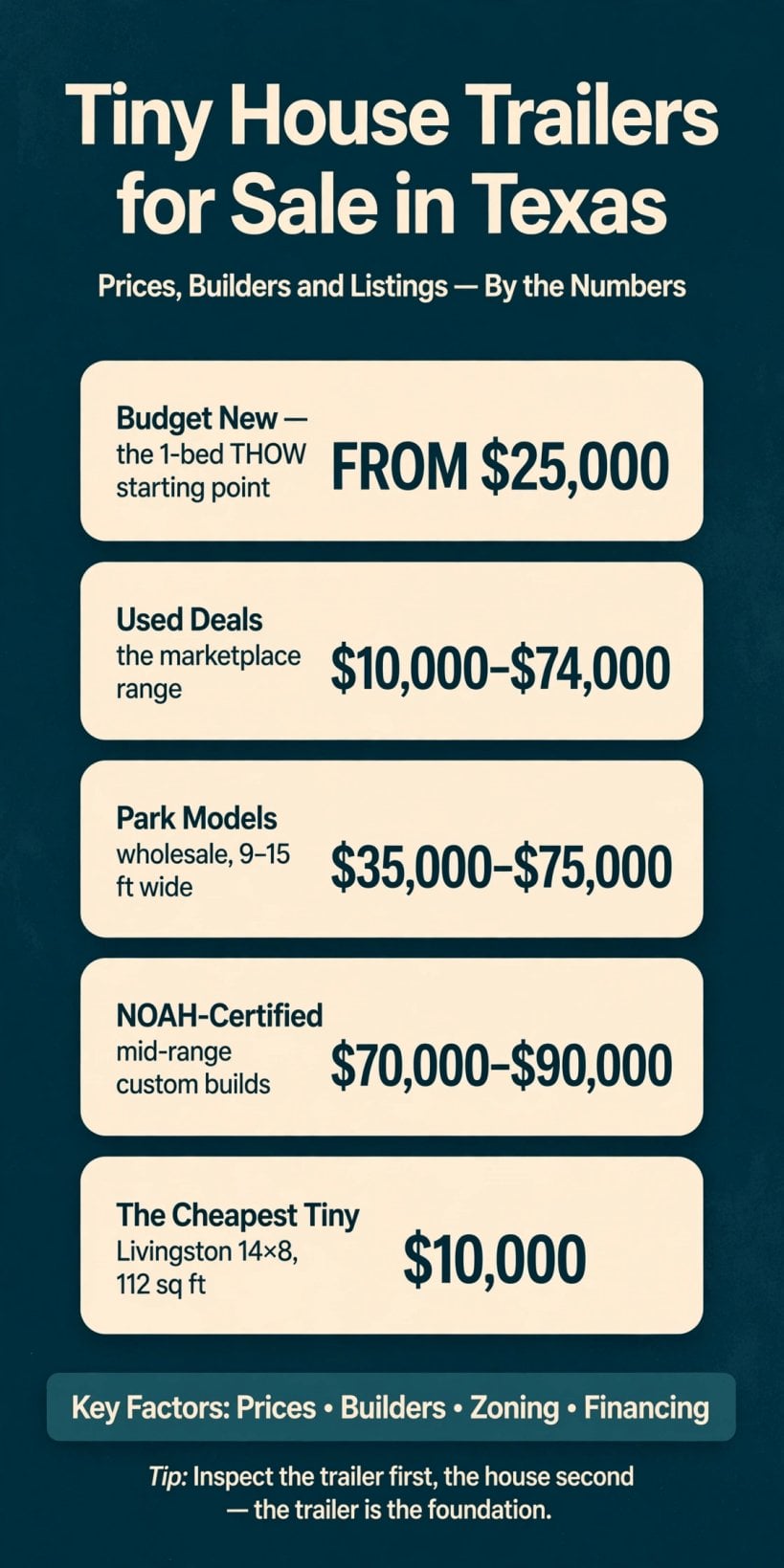
Texas trailer prices by the numbers: budget new from $25,000, used deals at $10,000–$74,000, wholesale park models at $35,000–$75,000, NOAH-certified customs at $70,000–$90,000 — and the cheapest tiny of all, a 14×8 in Livingston, at $10,000.
1. Texas Tiny Trailer Prices: The Four Bands
Every Texas search starts with the same shock: how wide the range is. The full spectrum runs from $10,000 to $90,000 and beyond, and it sorts into four bands a buyer can actually shop by. Budget new starts at $25,000 — that is the one-bedroom tiny house on wheels, simply finished, from the affordable end of the builder market. The wholesale band runs $35,000–$75,000 and is dominated by park models: wider, settled builds sold at volume prices. The mid-range, $70,000–$90,000, is where the NOAH-certified customs live — inspected, engineered, financeable houses that happen to sit on trailers.
Underneath all of it sits the used market at $10,000–$74,000, the marketplace where the famous Texas deals hide. The honest way to read the bands is as a ladder of certainty: the less you pay, the more the diligence is on you; the more you pay, the more the builder, the certification and the warranty carry the risk instead. None of the bands is the “wrong” one — a watchful buyer does well at $10,000 and a busy buyer does well at $89,500 — but each band demands a different kind of shopping, which the next sections take in order. For the national picture these Texas bands sit inside, our guide to how much tiny houses cost breaks down pricing across types and states.
2. Real Listings: What Texas Sellers Are Asking
Listings prove what price bands only promise, and the Texas market’s three signature adverts show the whole spectrum in miniature. At the bottom: a 2023 custom in Livingston, 14×8 feet and 112 sq ft, listed at $10,000 or best offer — the cheapest tiny in America, a pre-owned micro house priced like a used car. At the top: a 2025 custom in McKinney, 24 feet long and NOAH certified, at $89,500 — the certified premium, priced like the engineered product it is. Between them: a 230 sq ft tiny house on wheels in Orange Grove at $74,000, the roomy used buy.

The lesson of the three is that the deals are real — this is the Texas used market working exactly as advertised, with genuine sellers at every rung. The same breadth shows up wherever Texans list: builders’ own yards, the Tiny House Marketplace and RV Trader, all carrying tiny house trailers for sale in Texas at prices other states rarely match. The shopping routes themselves — marketplaces, builder-direct and private listings — are compared in our guide to where to buy a tiny house on wheels, and the homes-only view (without the trailer focus) is gathered in our roundup of tiny houses for sale in Texas. Note the original’s own caution, which this guide repeats: prices and availability change, so verify every listing directly before you travel.
3. Texas Builders: Tour Them All
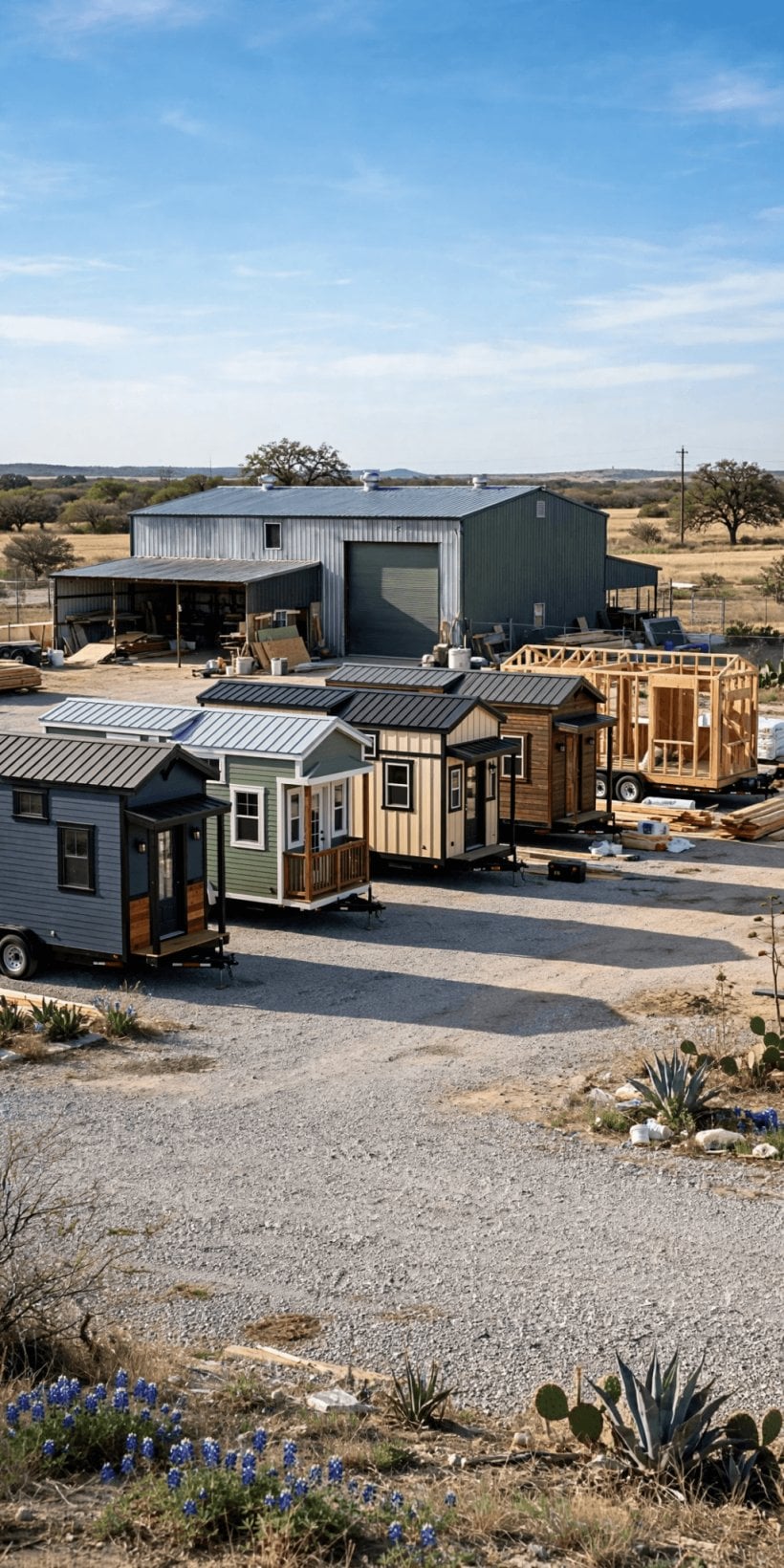
Texas builder density is itself an advantage: nowhere else can a buyer tour this many shops in this short a drive, and touring is the advice that runs through the whole original guide. The named three map neatly onto the price bands. USA Home Hub is the affordable start — the $25,000 budget new build. Tiny House Cottages works the wholesale range, $35,000–$75,000, specialising in park models. RRC Rockwall is the park-model display yard, the place to walk through wide models and feel the difference the extra feet make. Around them stand the many Texas custom shops, where the NOAH-certified, made-to-order end of the market is built.
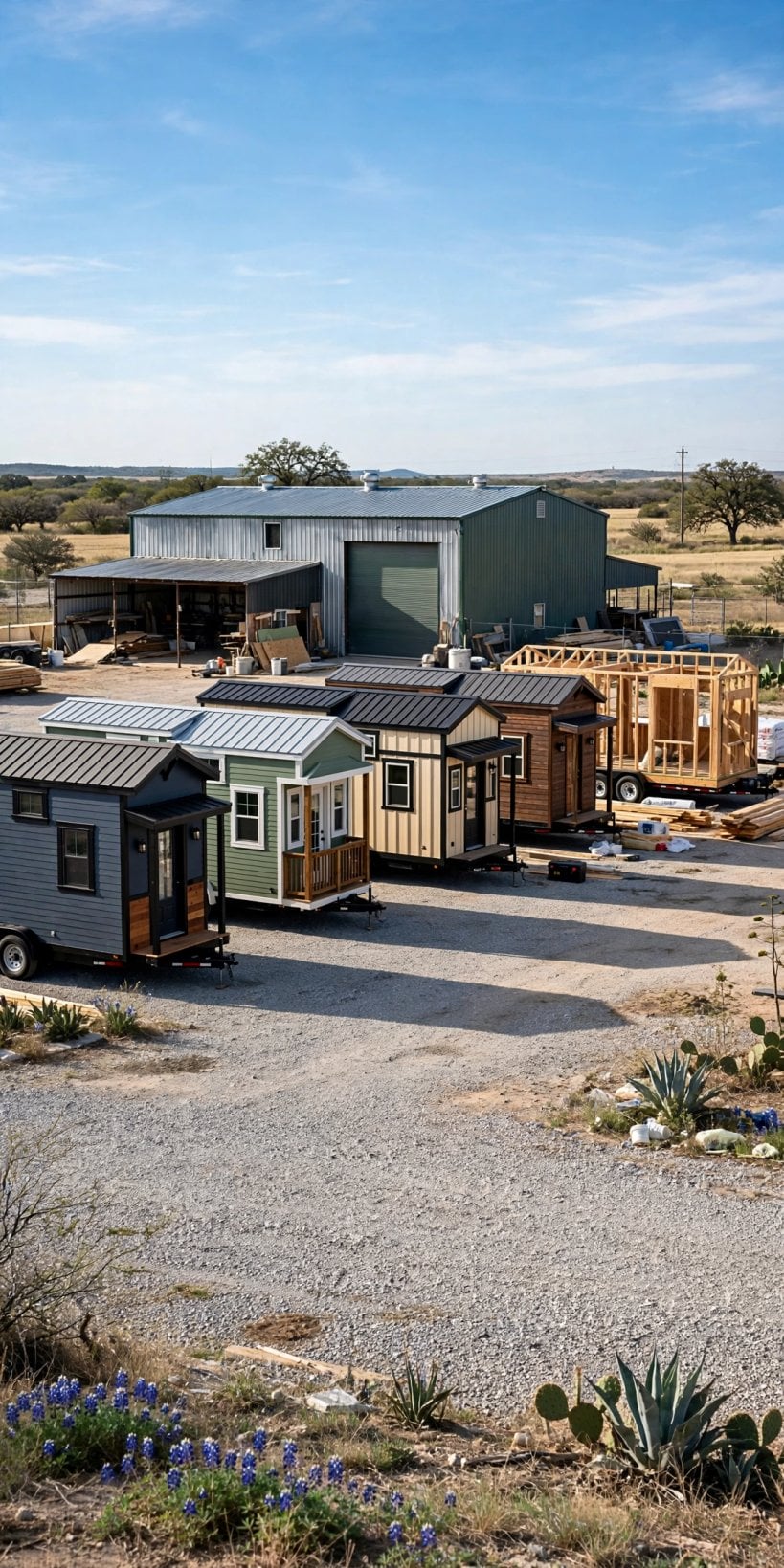
Which builder is “best” depends entirely on the budget you bring: the $25,000 answer, the wholesale answer and the certified-custom answer are three different shops. That is why the tour matters more than the brochure. Stand inside the builds, open the cabinets, bounce on the floors, ask who certifies the work and who services it — then let the density do its work, because a builder who knows you are touring his competitors prices and finishes accordingly. Texas competition is the buyer’s quiet discount, available on every lot in the state.
4. The Trailer Itself: What You’re Actually Buying
Underneath every tiny house in this guide sits the thing that makes it legally and physically mobile: the trailer. Start with the VIN. A tiny house on wheels is titled as a vehicle, and that title — with its vehicle identification number, clear and in the seller’s name — is the document the whole purchase stands on. No clear VIN title, no deal; it is the first check in the inspection section below, and it belongs here too because it defines what the asset is.
The hardware spec of a serious Texas tiny is equally consistent: triple axles to carry the heavy load, a GVWR rated at 14,000 lbs, and the standard 2-5/16 inch ball hitch at the front. Read those numbers as the house’s foundation specification, because that is what they are — a tiny house is a building that must also survive highway towing, and the trailer is the foundation it travels on. The original’s rule deserves its own line, because everything in the inspection checklist flows from it: the trailer is the foundation — inspect it like one.
5. Texas Zoning Reality: Freedom, With Footnotes
Texas’s reputation rests on a real foundation: in unincorporated areas — land outside city limits — the rules are permissive, and a tiny house on wheels can simply be placed and lived in. Add cheap rural land in abundance and the combination is the Texas advantage in its purest form. RV parks provide the second, always-available placement route: THOWs are welcome there by design, since they are titled as vehicles, and parks and tiny communities across the state take them as residents.
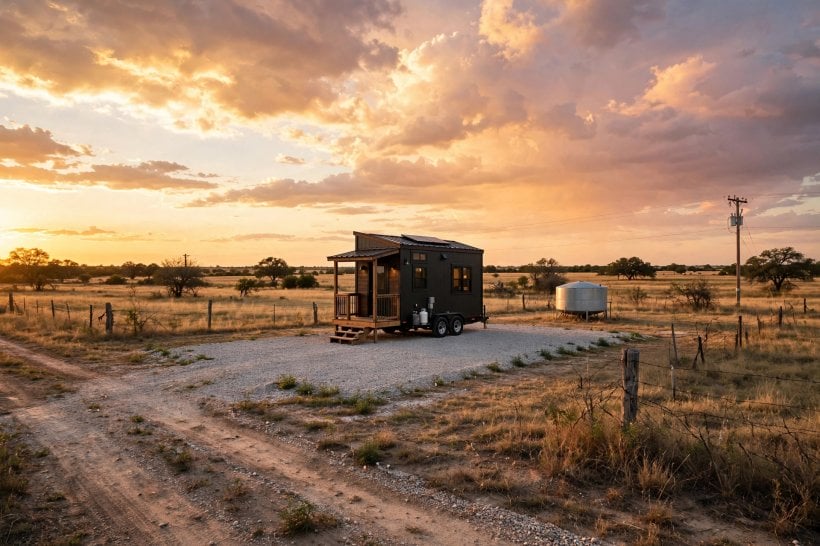
The footnotes matter, though. Cities vary — each municipality sets its own position, so a trailer that is legal twenty minutes outside town may not be legal inside it, and the check has to be made for the specific address, not the state. The general answer to “are they legal in Texas?” is yes — Texas is among the most tiny-friendly states in the country, and full-time living in a THOW is a proven, ordinary life here — but the specific answer is always local. Our guide to where you can live in a tiny home works through placement law state by state, and the Texas section of that map is the friendliest reading on it.
6. Financing a Texas Tiny Trailer
Three money routes cover nearly every Texas purchase. Builder in-house financing is the first: the shops that build them will often carry the note themselves, which keeps the deal inside one roof. RV loans are the second, available for certified units — the certification is what lets a lender treat the tiny like the vehicle it is titled as — at rates of 6–10%. Cash is the third and, at Texas prices, the most common: the $10,000–$25,000 end of the market is routinely a cash transaction, and the $10,000 cash deal is the simplest purchase in the whole guide.
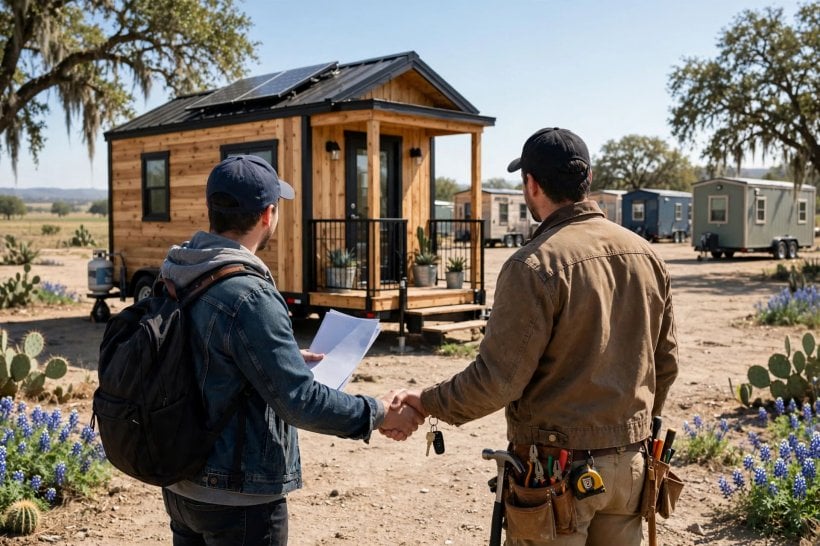
Speed follows the money. A used cash purchase closes in days to weeks; a new build takes weeks to months, because the house has to be built before it can be financed and delivered. Cash is also negotiating power, as the process section shows — the seller of a $10,000 micro tiny hears a cash offer differently from a financed one. Whichever route you take, verify the financing before the tour-and-inspect stage, not after: the full sequence, from first budget to final paperwork, is laid out in our step-by-step guide to how to buy a tiny house.
7. Transport, Setup and Delivery Day
A tiny house on wheels is mobile, but moving one is a service, not an errand. Delivery is at the buyer’s expense and priced by quote — distance, size and route all feed the number — which produces the original’s standing advice: get the delivery quote first, and budget it before the purchase price is final, not after. Texas-wide moves are routine for the hauliers who do this work, and a trailer-built house can be re-moved later the same way, which is the mobility the whole format promises.
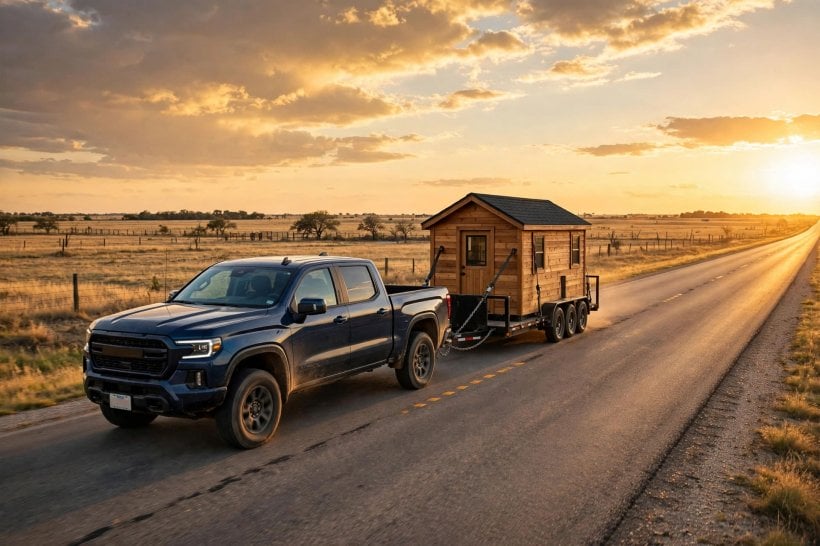
Delivery day itself runs on preparation. The route is planned and cleared in advance — gates, turns and overhead lines checked against a house on a trailer, not a car. The site is levelled and prepared before the truck arrives. Then the move happens, the house is placed, levelled on its stands and hooked up, and the trailer that travelled the highway becomes a house that sits still. Do the route and site work early and delivery day is a pleasure; skip it and the most expensive day of the purchase becomes the most stressful.
8. How to Buy: Process, Inspection and Negotiating
The process compresses to six honest steps. Set the budget inside the $10,000–$90,000 range. Decide new versus used — warranty versus deal. Tour the builders. Inspect the used candidates thoroughly. Verify the financing. And settle the placement — land or park — before the house arrives. Two of those steps carry the whole risk of the purchase, and the first is inspection. The used-trailer checklist runs: frame first — rust and welds, the foundation itself; axles — bearings and tires, the rolling gear; water — intrusion and mold, the dealbreakers; roof — the seals; systems — electrical and plumbing, tested, not assumed; and title — the VIN, clear. The rule that orders the list: inspect the trailer first, the house second.
Negotiating is the last step, and Texas gives the buyer real cards. Work from marketplace comps so the asking price is argued against evidence. Remember the season: summer heat is the buyer’s season, when sellers sweat in both senses. Cash talks, especially at the $10,000 end. Ask for the package — delivery bundled into the deal can be worth more than a small price cut — and if you are also weighing a plot to put it on, our guide to a tiny house for sale with land covers the combined purchase. And keep the walk-away discipline: in a market this wide, the deal you refuse is rarely the last one. The final checklist before signing simply gathers it all — budget honest, new-versus-used decided, builder toured and trusted, inspection trailer-first and thorough, title clear, placement legal — and then the Texas tiny is yours.
9. The $10,000 Tiny, Reality-Checked — and the NOAH Standard
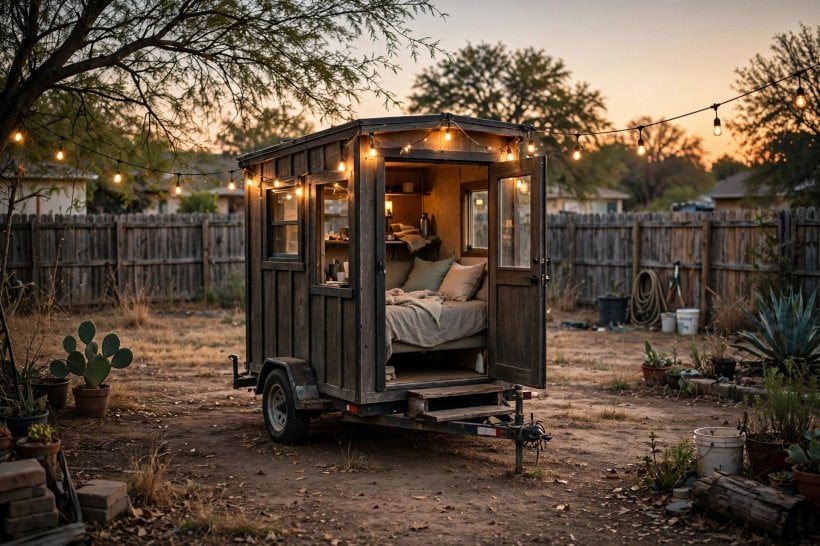
The Livingston listing deserves its own examination, because $10,000 tiny houses attract both dreamers and sceptics. What it is: a 14×8 custom, 112 sq ft — a micro house, honestly sized. Its condition: a 2023 pre-owned unit, to be inspected like any used buy. The trade it asks: compact living, down to a pull-out sofa doing double duty as the bed. The verdict of the original guide stands: the deal is real — Texas really does deliver the cheapest tiny in America — and the lesson is about the buyer, not the house: the deals exist, for the watchful.
At the other end of the market stands the standard that justifies the premium: NOAH certification. It is an inspection regime — the certified house has been checked as it was built — and its benefits are practical, not decorative: financing and insurance accept certified units, which is why the RV-loan route in Section 6 exists at all. The builds themselves are engineered, rated for 140 mph wind. Certification costs a premium, and the original’s advice is blunt: prefer certified — the protection is worth it, in loan access, in insurability, and in a structure proven against the Texas sky.
10. Park Models, Rival States and the Texas Life
One format straddles the bands and deserves its own word: the park model. Wider than a travel-format tiny — 9–15 feet across — priced in the wholesale $35,000–$75,000 range, and placed in parks and tiny communities rather than towed from spot to spot. The trade is explicit: less mobility, in exchange for room. For community living — the village life, neighbours included — the park model is often the best buy in this entire guide, and the communities themselves are a national movement, as our guide to tiny house communities in Florida shows from the village state itself.
Against rival states, Texas’s claim is narrow and strong: the cheapest, the freest — the value state. Colorado answers with builders and mountains at a premium, as our buyer’s guide to tiny houses for sale in Colorado with land lays out; Florida offers the mature villages; Oregon the progressive, green scene. For price and freedom, though, the original verdict holds: no state delivers the tiny trailer cheaper or freer. What the trailer buys is the lifestyle underneath the spreadsheets — acres instead of a yard, the big sky, the unincorporated independence, and a community of tiny Texans who found the same door. The first year tests it honestly: the summer heat is real, the systems get learned and mastered, the land gets improved into a homestead — and the verdict of those who stay is that the freedom is worth it. The trailer also works off-grid by nature — Texas sun for solar, catchment or hauled water, West Texas remoteness for those who want the ultimate version, all detailed in our guide to how to live off-grid in a tiny house — and it can even pay: Hill Country short-term rentals around $150 a night, long-term lets around $800 a month, on a $25,000 buy-in, with the numbers checked first, as investors should. The 2030 outlook the original sketches is steady: prices stable and affordable, builders growing and competitive, zoning friendlier on momentum. Texas tiny grows.
Final Considerations
Texas delivers the tiny dream cheapest: used trailers from $10,000, budget new from $25,000, certified customs under $90,000, on cheap land under permissive unincorporated skies. Buy it the Texas way — tour the builders, inspect the trailer before the house, verify the title and the financing, quote the delivery before you sign — and whether your trailer is the Livingston micro or the McKinney custom, it will be yours in the freest tiny market in America. The trailers are waiting; come and see.


2 Comments