

Mid-century — the clean lines, the warm woods, the tapered legs, the optimism of the atomic age — was made for the tiny house. This guide covers the style room by room: the palette and the pieces, the lighting and the textiles, the commandments and the mistakes — and the small space that the era itself perfected.
Mid-Century Modern: At a Glance
Mid-century modern succeeds in a tiny house because the era designed for exactly this: compact rooms, leggy furniture that lets the floor show, warm wood doing the work of ornament, and one bold piece carrying a whole room. This guide follows the style in its real order — why the era loves the tiny, the palette, the iconic pieces and the living room, the working rooms, light and pattern, the commandments and materials, the budget way in, starting and styling, the payoff, and the legacy the tiny house now keeps.
| Topic | What It Covers | Key Fact or Figure |
|---|---|---|
| 1. Why the Era Loves the Tiny | Clean lines, compact scale and warm woods | Furniture designed for the smaller post-war home |
| 2. The Palette | Teak and walnut, earthy pops, warm neutrals | The palette warms the modern |
| 3. Iconic Pieces and the Living Room | The one statement chair, the credenza, the low sofa | One iconic piece is enough |
| 4. The Kitchen and the Bedroom | Flat-front cabinets, one retro color, the low platform bed | The rooms rest horizontal |
| 5. Lighting, Textiles and Art | Sputnik, arc and globe lights; barkcloth, shag, geometry | The lighting is the jewelry of the era |
| 6. Commandments, Materials and Mistakes | The ten rules; teak, walnut, fiberglass and brass | Edit ruthlessly — never a theme park |
| 7. Budget, Dining, Office and Bath | Thrifted, reproduction and DIY; tulip table, floating desk | The look is achievable at every budget |
| 8. Starting, Plants and Shelves | Palette first, one icon, then light; era plants, edited shelves | The start is the edited |
| 9. Payoff, Exterior and the Atomic Spirit | Timeless, warm, effortless; breeze-block outside | The style that never really left |
| 10. The Legacy at Home | Collecting, refinishing, the corners and the rituals | The tiny is the era’s heir |
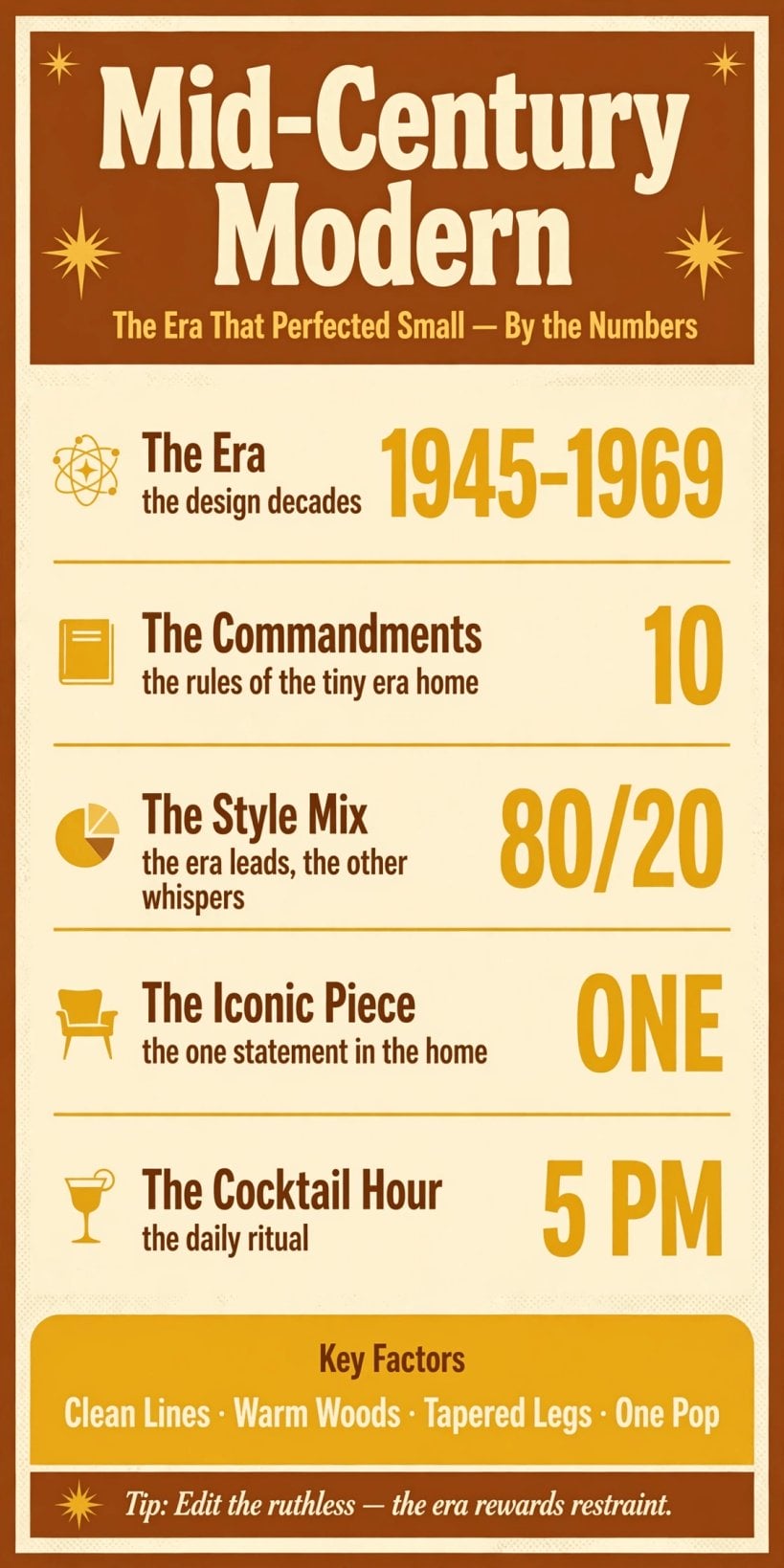
The era by the numbers: the 1945–1969 design decades, 10 commandments, an 80/20 mix when other styles join in, one iconic piece per home — and the 5 PM ritual that closes the day.
1. Why Mid-Century Loves the Tiny
Three qualities make the era and the tiny house natural partners. The lines are clean — the uncluttered: nothing in the room that does not earn its place, which is the first rule of small living anyway. The scale is compact — the designed: furniture sized for real rooms rather than showrooms. And the woods are warm — the teak above all — so a small interior feels rich instead of merely small. The rule underneath all three: mid-century was the small, perfected.
What is the style, exactly? The FAQ’s answer dates it: the design era (roughly 1945–1969) — clean lines, organic shapes, warm woods and functional beauty, the optimistic modernism that made the small beautiful. And can it really work in a tiny house? Perfectly — the era’s furniture was designed for the smaller post-war home. The compact scale, the leggy lightness, the multi-use pieces: the era and the tiny are natural partners, which is why the whole-home framework in our tiny house and small-space interior design hub treats it as a first-choice style for small footprints.
2. The Mid-Century Palette
The palette is built in three layers. The woods lead — teak and walnut, the warm base that covers the big surfaces and most of the furniture. The pops follow — mustard and orange, the earthy sparks struck once or twice and never everywhere. And the neutrals ground it — the warm whites and grays that keep the wood from heaviness. The rule: the palette warms the modern — warmth first, and the modern comes from the lines, not from cold color.

The color question is answered by those same layers. What colors define the style? The warm woods (teak, walnut), the earthy pops (mustard, burnt orange, olive), and the crisp neutrals (white, warm gray). The palette is the warm modern — wood for the field, one or two earthy notes for energy, and neutrals to let both breathe. The stripped-back end of that discipline, where the field does nearly all the work, is explored in our guide to minimal interior design ideas for tiny houses.
3. Iconic Pieces and the Living Room
The era is bought — or hunted — one icon at a time. The lounge chair is the one, the statement: the single piece the room is built around. The credenza is the storage, the beautiful: the long, low cabinet that hides a tiny house’s clutter behind sliding doors. And the tapered legs are the airy, the lifted: furniture raised on slim legs so the floor runs underneath and the room reads bigger. The rule: the one iconic is enough — a tiny room needs a hero, not a cast.
The living room arranges those pieces low and horizontal. The sofa is the low — the horizontal, a long low line that keeps sightlines open under a small ceiling. The starburst is the clock — the mirror, the era’s signature burst hung where the room gathers. The rule: the living is the era, lived — the room where the style stops being a look and becomes the evening. What makes a piece of furniture belong to the era at all? The FAQ’s checklist: the clean lines, the tapered legs, the organic shapes, the warm woods, the functional form — the era’s signature is the beautiful useful. Seating scaled this carefully is chosen the way our guide to living room interior design ideas for tiny houses chooses all of it — sized to the space first.
4. The Kitchen and the Bedroom
The kitchen keeps the era crisp. The cabinets are clean — the flat-front, the handleless, doors with no molding to catch the eye or the dust. The color is the one — the retro, a single period note struck on one door, one appliance or one wall while the rest stays wood and neutral. The rule: the kitchen is the crisp era — the working room, kept as uncluttered as the living room it faces.
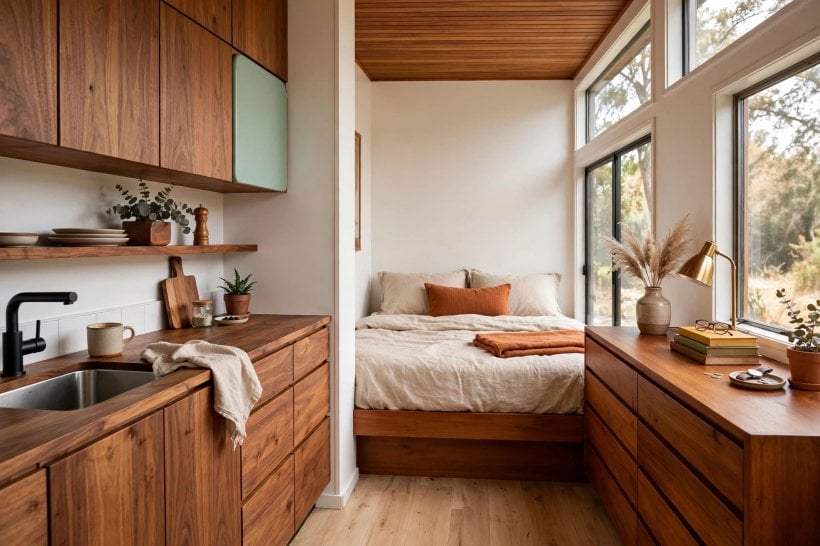
The bedroom rests on the same horizontal line. The platform is the low — the bed, a frame that hugs the floor and leaves the wall above it calm. The dresser is the long — the low, storage stretched sideways instead of stacked upward. The rule: the bedroom rests horizontal — low furniture, long lines, and nothing tall competing with sleep.
5. Lighting, Textiles and Art
The lighting is the jewelry of the era, and three pieces carry it. The sputnik is the chandelier — the star, the burst of rods and bulbs that turns a small ceiling into a sky. The arc is the floor — the drama, a lamp that leans over the seating like a streetlight over a café table. The globe is the pendant — the soft, a milky sphere that flatters everything under it. The rule: light the statement — in a tiny room, one great light fitting does the decorating for a whole corner.
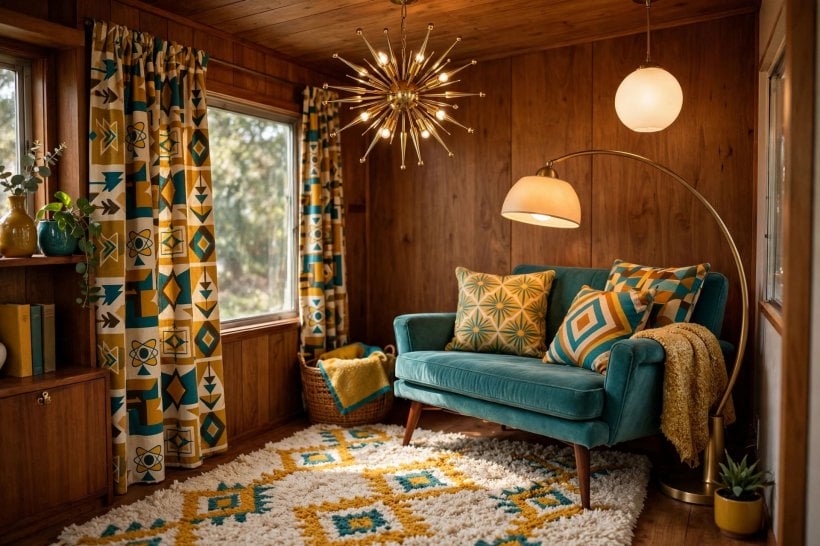
The textiles carry the pattern the furniture refuses. The barkcloth is the curtains — the pattern, atomic prints at the window. The shag is the rug — the texture, depth underfoot that makes a low room feel layered. The geometry is the cushions — the pop, small repeatable notes of the palette. The rule: the textiles pattern the modern — pattern lives in the soft things, where it can change with the season. The art follows the same restraint: the abstract is the one — the large, a single big canvas instead of a gallery of small ones; the starburst returns as the mirror — the clock. The rule: the art abstracts the era. The quiet end of this styling — one piece, generously sized — is shared with the calm homes in our guide to zen interior design ideas for tiny houses.
6. The 10 Commandments, the Materials and the Mistakes
The ten commandments of the mid-century tiny compress the whole method: choose the clean lines; warm with the woods; pop the one color; lift with the legs; light the statement; keep the one iconic; mix the old and new; pattern the textiles; edit the ruthless; live the era. Less a checklist than a temperament — warm, edited and lived-in.
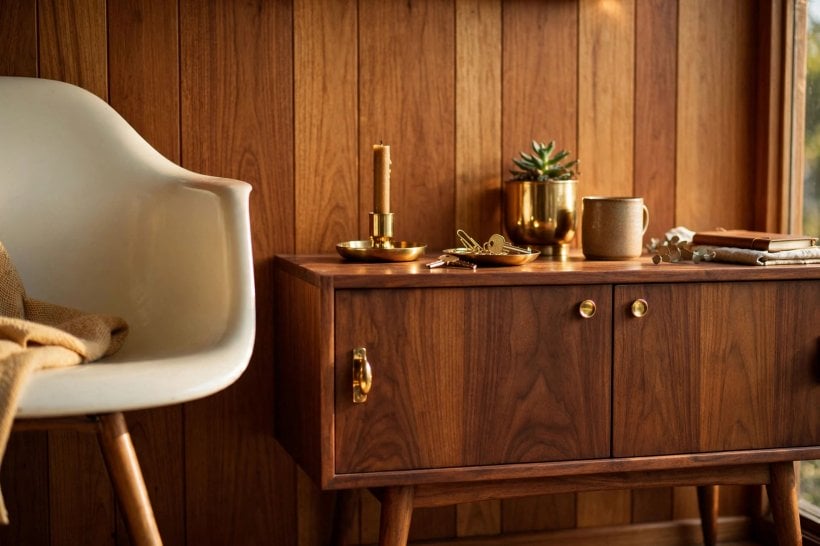
The materials are the commandments made touchable. Teak is the warm — the classic. Walnut is the rich — the deep. Fiberglass is the molded — the iconic, the shell chair’s smooth curve. Brass is the accents — the gleam, struck small and bright. The rule: the materials warm the modern. And the mistakes are the commandments broken: the theme park — the all-era, the unlived, a room that imitates instead of lives; the dark woods — the heavy, the unbalanced, wood on every surface until the warmth turns to weight; the cluttered — the collected, the unedited. The rule: the era inspires — it does not imitate.
7. The Budget Mid-Century, the Dining, the Office and the Bath
The budget way in has three doors. The thrift is the hunted — the found, real pieces at real-person prices. The reproduction is the affordable — the good, the era’s shapes remade honestly. The DIY is the refinished — the loved, a tired find brought back with oil and patience. The truth: the look is the achievable, at every budget — which is also the FAQ’s answer on cost: the originals are expensive; the look isn’t. Reproductions, vintage finds and DIY carry the style at every budget, the same spirit as building small for less in our guide to how to make a cheap tiny house. And where do you find the furniture? The vintage (the hunted), the reproduction (the affordable), the inspired (the new) — one true piece plus the inspired rest is the mix that works.
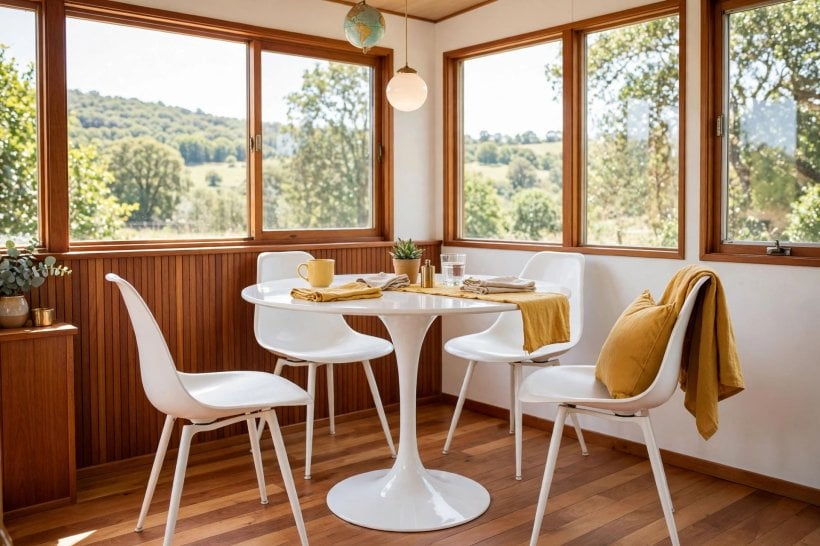
The dining corner is the era at its most sculptural. The round is the table — the tulip, a single pedestal that leaves legroom on every side. The molded is the chairs — the stacked, seats that store by piling when the party grows. The rule: the dining is the sculptural era. The home office works just as lightly: the desk is the simple — the floating, a slab on the wall with nothing under it; the chair is the molded — the comfortable. The rule: the office works beautiful. And the bathroom keeps the crisp thread: the tile is the geometric — the retro; the vanity is the floating — the wood. The rule: the bath is the crisp era.
8. How to Start, Plants of the Era and the Styled Shelves
Starting is a sequence, and the FAQ gives it plainly: the palette first (the warm woods, the one pop), the one iconic piece, the lighting. The start is the edited — the era rewards restraint, so buy in that order and stop often to look. Mixing the era with other styles obeys one ratio: the 80/20 — the era dominant, the other accented — held together by a shared palette and one bridge piece. The mix works when the mid-century leads and the other whispers. The whole journey from first palette to finished rooms is mapped in our guide to home designing ideas for a tiny house.
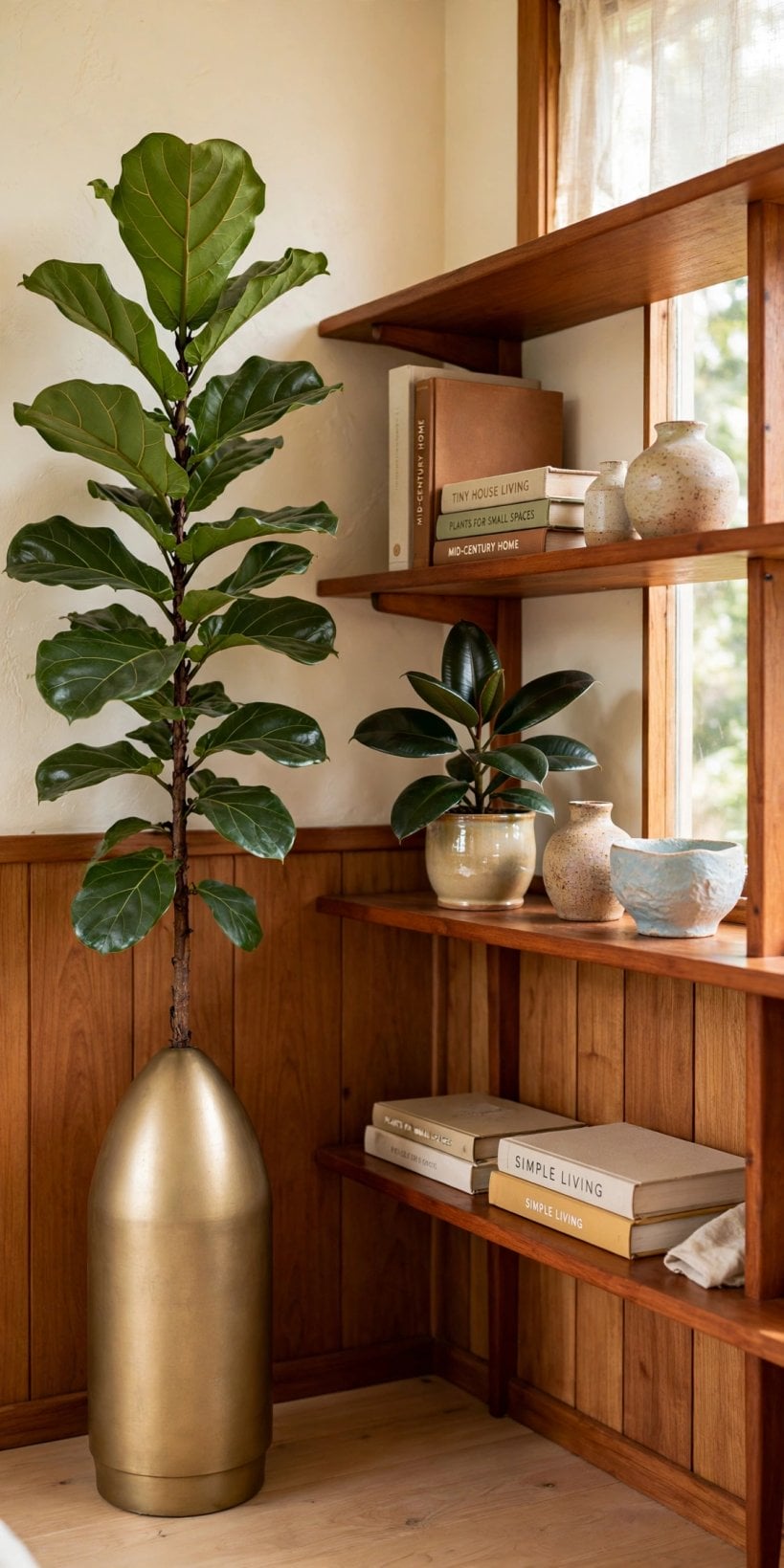
The plants complete the era. The fiddle-leaf is the tall — the statement, one big green gesture in the corner. The rubber plant is the glossy — the classic. The planters are the bullet — the iconic, the era’s own pots on their stands. The truth: the plants complete the era. The shelves beside them are styled, not stored: the books are the curated — the spines, edited like everything else; the objects are the few — the loved. The rule: the shelves style the edited.
9. The Payoff, the Exterior and the Atomic Age Spirit
The payoff is threefold. The timeless: the never-dated — the classic. The warm: the modern — the livable. The cool: the effortless — the era. The truth: the payoff is the timeless, lived. Which answers the popularity question directly: is the style still popular? The timeless never fades — it has been “back” for decades because it never really left. The classic is the safe: the style that endures, and the whole-home interior that results is designed room by room in our tiny house interior design ideas: the complete whole-home design guide.
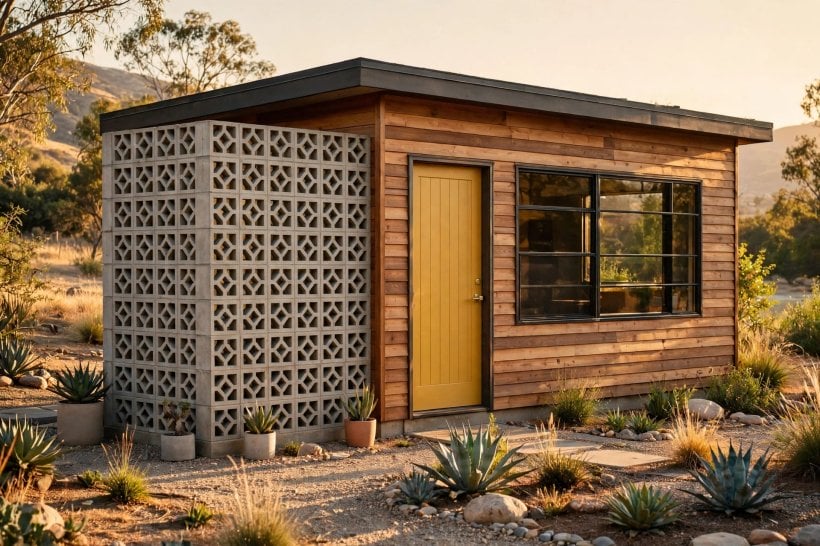
The exterior echoes the interior. The clean is the lines — the continued, the same uncluttered horizontal running outside. The breeze-block is the pattern — the iconic, geometry in concrete at the garden wall. The truth: the exterior echoes the interior. Underneath it all sits the atomic age spirit: the optimism — the future, believed; the space race — the inspired. The truth: the spirit is the joy of the era, and a tiny house, which is itself an optimistic object, wears it honestly.
10. The Legacy: Collecting, Refinishing and the Era at Home
The legacy is simple: the influence is the everywhere — the lasting; and the tiny is the heir — the perfect. The truth: the legacy lives, tiny. Collecting is how the heir gathers its inheritance: the hunt — the thrifts, the estates; the eye — the trained, the lines; the patience — the waited, the found. The truth: the collecting is the joy of the hunt. Refinishing makes the finds yours: the teak — the oiled, the revived; the walnut — the polished, the glowing. The truth: the refinished is the loved, twice. And spotting the real thing among the copies? The FAQ’s field guide: the lines (clean, tapered), the woods (teak, walnut), the joinery (dovetailed), the labels (stamped). The eye learns — the hunt teaches.
At home, the era survives as ritual. The cocktail corner: the bar cart — the brass, the rolling; the ritual — the 5pm, the era. The vinyl corner: the turntable — the spinning, the warm; the console — the stereo, the furniture. The dinner party: the fondue — the bubbling, the era; the conversation — the flowing, the warm. The goodnight: the lamp — the dimmed, the globe; the chair — the sat in, the loved. The Mad Men moment: the poured — the old-fashioned, the stirred; the sat — the lounge, the deep. The Eames moment: the molded — the plywood, the leather; the sat — the deep, the designed. The starburst clock: the hung — the wall, the star; the ticked — the time, the era. The final touch: the placed — the last, the perfect; the stepped back — the admired, the era. The room that hosts those evenings — the screen, the sound, the perfect seat — is designed in our guide to tiny house home theater design.
The era endures because the decades passed and the style remained — and because the tiny house took it in. The decades: the passed — the style. The tiny: the heir — the living. The truth: the era endures, tiny.
Final Considerations
Mid-century modern and the tiny house are the perfect match — the era that made small beautiful, the home that lives it. The clean lines, the warm woods, the one great chair. Live the atomic age, tiny.

0 Comments