
The soft layer underfoot decides how a lounge feels before a single cushion is plumped.
Here are 75 ideas for getting it right: colours that calm or lift, piles matched to real life, patterns with a purpose, and layering tricks that finish a room. Work through the groups that match your dilemma.
1. At a Glance: Choosing the Soft Layer Well
Most living room carpet dilemmas come down to four questions. What colour will still please you in five winters? Which pile suits the feet, paws and furniture it must carry? Does the room want pattern, or will texture do the talking more quietly? And should the soft layer be one fitted carpet wall to wall, a large rug, or layers of both? Answer those, and the details in this guide fall into place.
The table gives the short version. After it, seventy-five numbered ideas explore colour, pile, pattern, sizing, layering, materials and care, styling pairings, and the special cases of small rooms and rentals. A fitted carpet and a generous rug solve many of the same problems in different ways, so most ideas work for either — read “soft layer” wherever your own plan needs it.
| Decision | Quick Guidance |
|---|---|
| Colour | Mid-tones hide daily life best; test samples in your own light, morning and evening. |
| Pile | Short and dense for busy rooms and castors; deeper pile where bare feet and quiet matter most. |
| Pattern | Small, low-contrast patterns disguise marks; large patterns need large rooms and plain furniture. |
| Size | For rugs: front legs of all seating on the rug, or go bigger. For fitted: one unbroken field calms the room. |
| Layering | A rug over fitted carpet adds zone definition and lets you change the look without refitting. |
| Care | Choose for the cleaning you will actually do, and check guidance for any heating beneath the floor. |
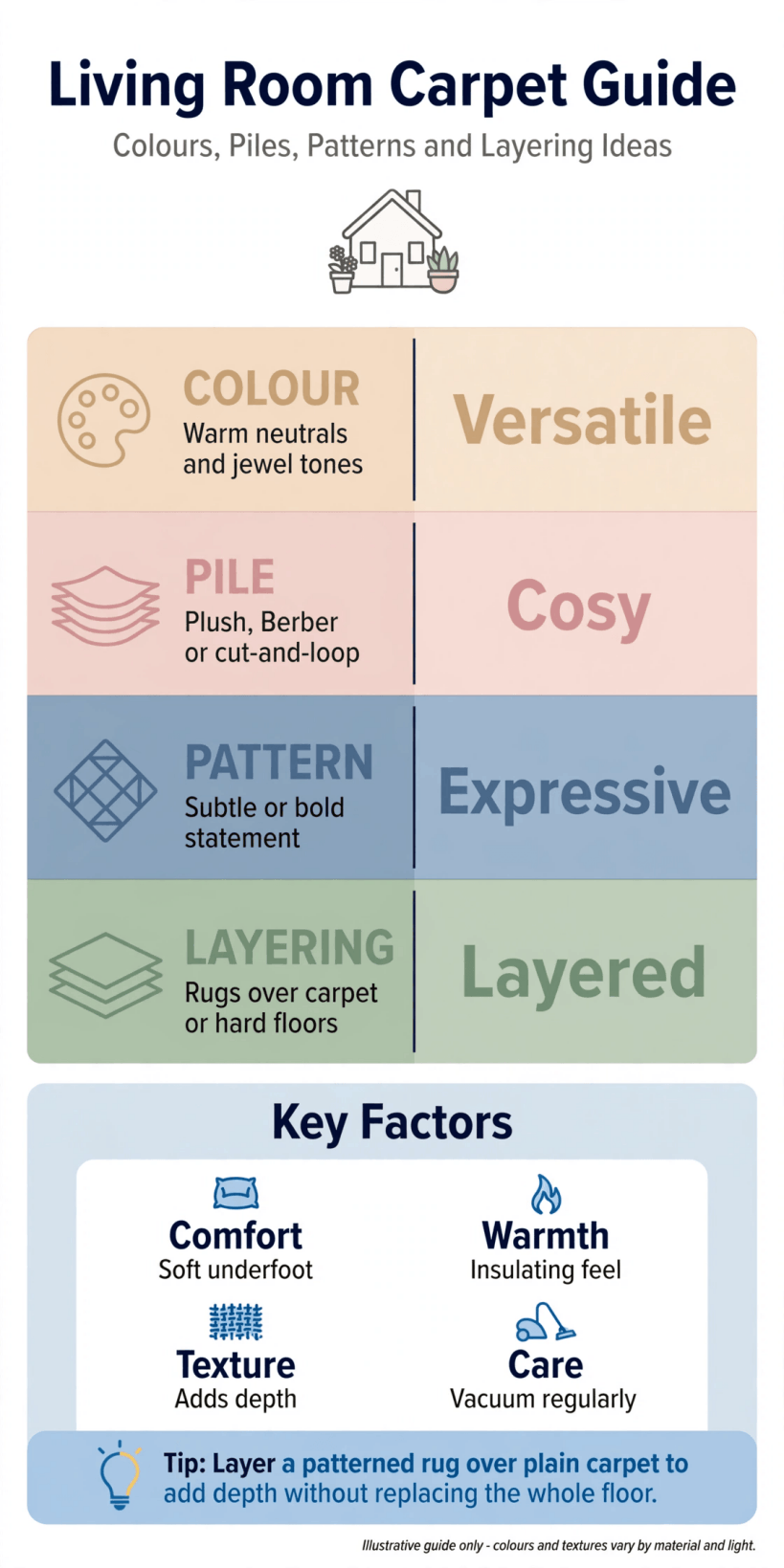
The soft-layer decisions at a glance: colour, pile, pattern, size, layering and care.
2. Colours That Calm, Lift or Ground (Ideas 1–10)
Colour is the decision you will live with longest, because the floor is the largest single surface in the room after the walls. Work from your light: north-facing rooms cool every shade, while strong sun bleaches and warms. Borrow tones from the palette you already own — sofa, curtains, timber — and use our notes on tiny house interior paint colours for how shades shift between daylight and lamplight.
Idea 1: Warm greige as the safe harbour
Between grey and beige sits the tone that flatters most furniture and hides most dust. It is the colour least likely to date, and it lets cushions carry the fashion.
Idea 2: Pale stone to lift a dark room
In a room short on daylight, a pale, warm stone shade bounces what light there is and makes the walls feel further away. Pair it with disciplined shoe habits.
Idea 3: Deep charcoal for drama
A dark floor grounds pale walls and light sofas beautifully. It shows lint more honestly than mid-tones, so choose it with a vacuum you actually enjoy using.
Idea 4: Soft sage underfoot
Muted green is restful, forgiving and quietly distinctive. It pairs with natural timber, cream upholstery and brass better than almost any other coloured option.
Idea 5: Dusty blue for calm
A greyed blue reads as a neutral in large areas and cools a sun-drenched room. It is especially kind to warm wood tones, which glow against it.
Idea 6: Terracotta warmth in small doses
A clay-toned rug rather than a full fitted field gives Mediterranean warmth you can lift away. It loves cream walls, black accents and plenty of plants.
Idea 7: The two-tone fleck
A subtle fleck of two or three fibres is the hardest-working colour trick in the guide: crumbs, pet hair and lint all disappear into the mix between cleans.
Idea 8: Match the floor tone to the sofa
Tone-on-tone — floor a shade deeper than the sofa — makes a small lounge feel larger and calmer, because the biggest pieces stop arguing with each other.
Idea 9: A border effect in fitted carpet
If you fit wall to wall, ask about a plain border with a subtly different centre, or achieve it with a large rug laid over. The room gains architecture without furniture.
Idea 10: Sample at skirting height, in both lights
Lay large samples flat where wall meets floor and live with them for two days. Colour underfoot reads darker than the same shade in your hand — always.
3. Piles and Textures for Real Life (Ideas 11–19)
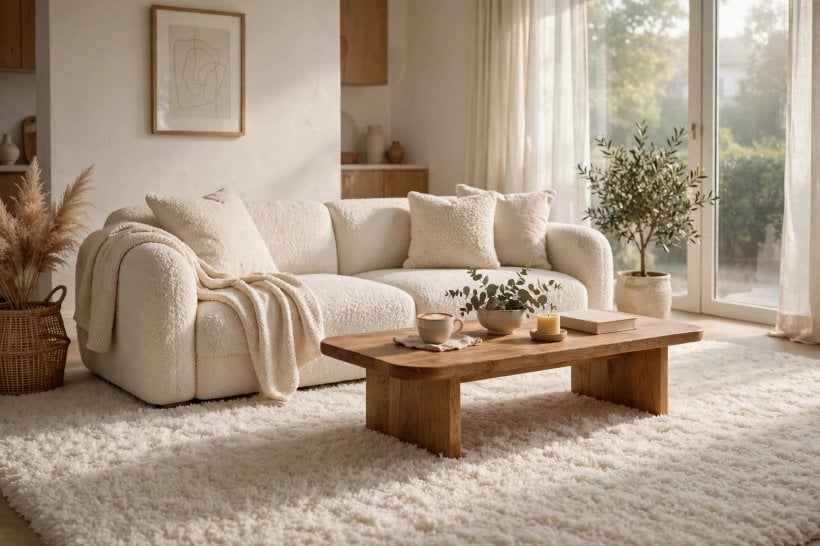
Pile is how a carpet feels at 7 a.m. in bare feet and how it survives at 7 p.m. with the dog in from the garden. Dense, short piles are the workhorses: easier to clean, kinder to furniture legs and castors, and slower to show traffic lanes. Deep piles are the luxury: quieter, warmer, more forgiving to dropped remotes. Choose by household, not by showroom squish.
Idea 11: Twist pile for the family room
Twisted fibres spring back, shrug off footprints and vacuum beautifully. If one pile must do everything in a busy home, it is usually this one.
Idea 12: Loop pile for texture without pattern
Loops give a tailored, almost woven look and hide a multitude of marks. Keep them away from cats who treat loops as a scratching invitation.
Idea 13: A plush pile for the quiet lounge
Where the room is for reading, films and bare feet, a deeper plush pile earns its keep in comfort and sound softness. It will show footprints; call it patina.
Idea 14: Saxony for a formal finish
A smooth, dense, slightly longer pile gives a dressed-up, hotel-like surface. Lovely in adult sitting rooms, less so under toy cars and dining chairs.
Idea 15: Frieze to hide everything
Highly twisted, slightly shaggy fibres scatter light and camouflage crumbs and hair superbly. The casual look suits relaxed, family-first rooms best.
Idea 16: Flatweave for the allergy-aware
A very low, tight weave traps less dust and cleans thoroughly. As a rug over hard floors it also slides less and sits better under doors.
Idea 17: Mix piles across layers
A short-pile fitted carpet with a deeper-pile rug on top gives practicality below and luxury where feet actually land. The contrast itself becomes a design feature.
Idea 18: Feel it with shoes off and on
Test samples the way the room is used: stocking feet for feel, outdoor shoes for grit behaviour, and a chair leg pressed hard for dent recovery.
Idea 19: Dense beats deep for longevity
When comparing two samples, bend them: if you can see the backing easily, the pile is sparse and will tire early. Density is the quiet predictor of lifespan.
4. Patterns With a Purpose (Ideas 20–28)
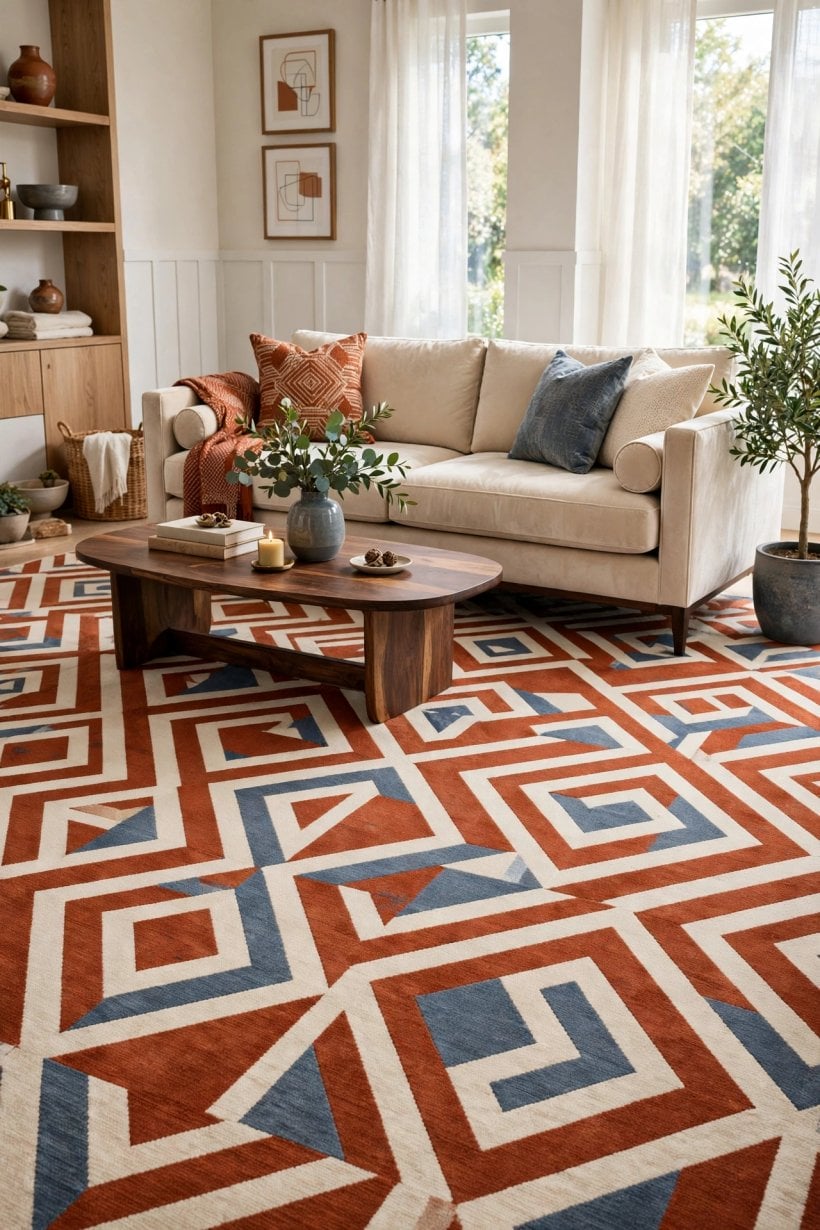
Pattern is camouflage and character in one. The busier the household, the more a small, low-contrast pattern earns its place, hiding the evidence between cleans. Large patterns are a different tool: they set the room’s whole personality, so the furniture must be prepared to play supporting roles.
Idea 20: Tiny fleck, tonal pattern
The hardest-working pattern is barely a pattern: two tones, small scale, no direction. It forgives spills, hair and the mysterious grit that appears by Friday.
Idea 21: Herringbone in carpet form
A woven herringbone reads classic and tailored, echoing parquet without the hard surface. It suits hallways-into-lounges and rooms with simple, modern furniture.
Idea 22: A gentle stripe to lengthen
Run a soft stripe along the room’s length and the eye travels further. Keep the contrast low unless you want the floor to star.
Idea 23: Vintage-look rug, faded on purpose
Distressed traditional designs hide wear because wear is part of the design. They also bridge old houses and new sofas with unusual grace.
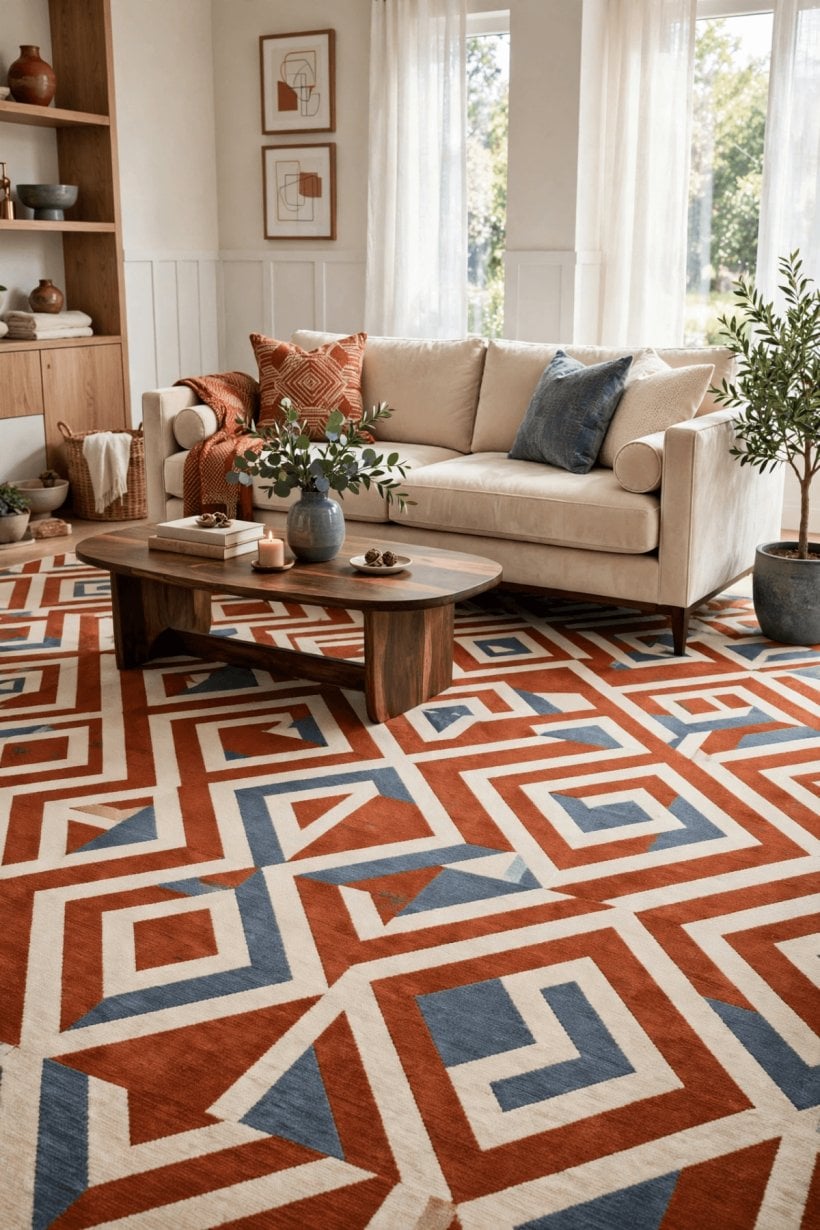
Idea 24: Geometric for modern rooms
A crisp, large-scale geometric needs plain upholstery and tidy styling around it. In return it gives a contemporary room its entire identity.
Idea 25: Botanical in the rug only
Leafy, organic patterns bring the garden in while staying changeable. On a rug rather than wall to wall, the commitment stays proportionate.
Idea 26: Plain carpet, patterned cushions
The reverse strategy: keep the expensive surface quiet and let cheap, changeable textiles carry pattern. Most rooms are happier this way round.
Idea 27: Check the repeat at your room’s size
Ask how the pattern repeats and picture it across your floor, not on a sample board. A motif that sings at one metre can shout at twelve.
Idea 28: Direction matters
Pile has a nap, and patterns have a flow. Decide which way both run before fitting day, especially where the lounge meets a hallway runner.
5. Size, Placement and Fitting Choices (Ideas 29–37)
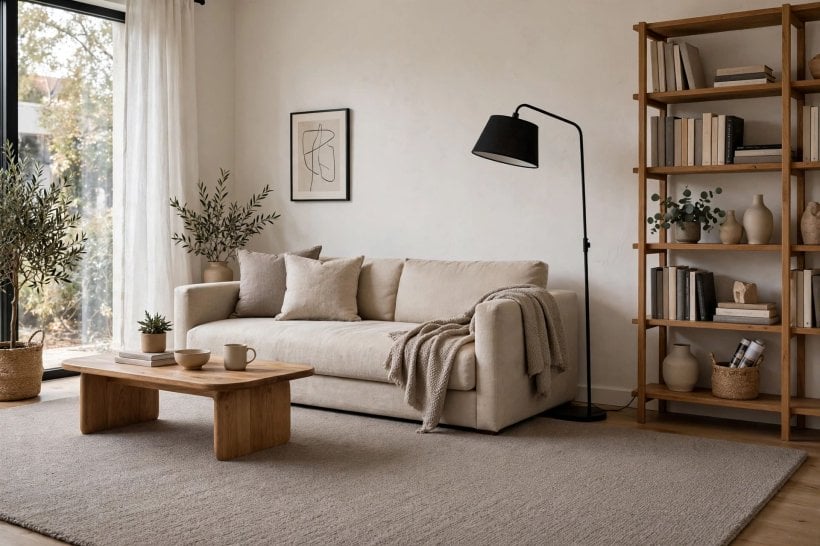
Whether you fit wall to wall or lay a rug, proportion decides success. A too-small rug makes good furniture look stranded; a well-judged one gathers the room. The layout thinking in our tiny house and small-space interior design guide applies at any scale: define the seating island first, then size the soft layer to serve it.
Idea 29: Front legs on, always
For rugs, the minimum graceful rule is every seat’s front legs on the rug. It links the furniture into one group and stops the rug reading as a mat.
Idea 30: Or go all legs on
In a large room, a rug that takes all four legs of everything, with a border of floor beyond, looks generous and deliberate. Measure twice; this is the expensive mistake.
Idea 31: Leave a frame of floor
A consistent margin of hard floor around a rug — or around the room with fitted carpet and a rug — acts like the mount around a picture. Even margins calm the eye.
Idea 32: Wall to wall for calm and warmth
Fitted carpet’s great gifts are acoustic softness, underfoot warmth and visual quiet. In open-plan lounges it also absorbs the clatter that hard floors amplify.
Idea 33: Rug over hard floor for flexibility
A rug can move house, swap rooms or change with the seasons. For renters and the commitment-shy, it is the soft layer with an exit strategy.
Idea 34: Mind the door swing
Measure pile height plus underlay against every door that opens into the room. A carpet that a door cannot clear will be trimmed, planed or regretted.
Idea 35: The hearth and radiator check
Keep pile sensible near heat sources and follow the maker’s guidance for stoves and fires. Fitted edges at a hearth should be finished with proper trims, not hope.
Idea 36: Join lines where furniture hides them
Wide rooms may need a seam. Place it under the sofa line or along the least-walked edge, and agree its position with the fitter before the day.
Idea 37: Underlay is half the feel
Good underlay makes a modest carpet feel richer, insulates, and extends life. Budget for it as part of the floor, not as an optional extra.
6. Layering: The Designer’s Shortcut (Ideas 38–46)
Layering — a rug over a fitted carpet, or a small rug over a larger flat one — is how stylists add zone definition, pattern and seasonal change without touching the base floor. It is also forgiving: if a layer tires you, lift it. The storage-minded tricks in our tiny house organization strategies share the spirit: build the calm base once, then adjust the top layer as life changes.
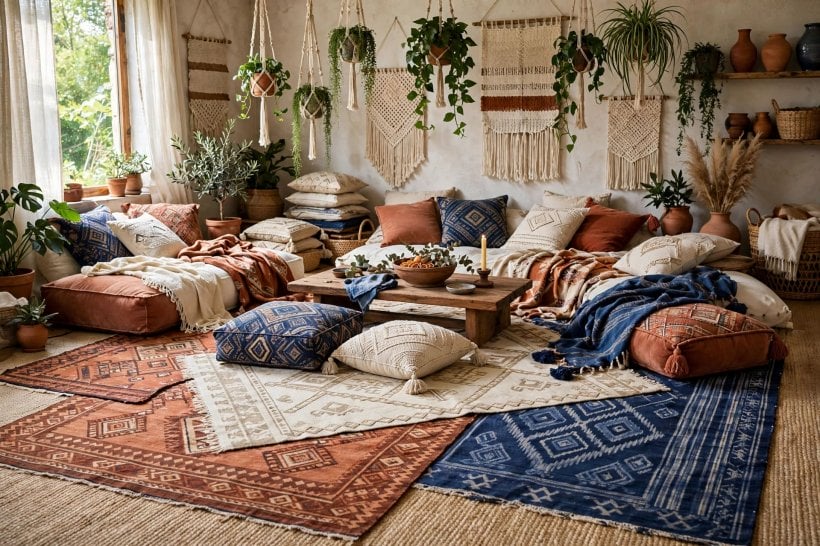
Idea 38: Rug over fitted carpet to zone the sofa
In a big open lounge, one contrasting rug under the seating group draws the room’s map. Keep its pile compatible so the pair sits flat and safe.
Idea 39: Natural fibre base, soft top
A large jute or sisal-look flat layer with a smaller wool-feel rug centred on top gives texture, border and comfort in one composition.
Idea 40: The vintage-over-plain classic
A faded traditional rug over a plain neutral base is the most forgiving layered look: elegant, mark-hiding and endlessly adjustable by rotation.
Idea 41: Anchor the layers
Layers creep. Use a quality anti-slip underlay between them and keep the top rug’s edges out of the main walking line to prevent curls and trips.
Idea 42: A sheepskin where feet land
One small, deep, soft layer beside the sofa or reading chair delivers luxury exactly at the point of contact, for a fraction of a full deep pile.
Idea 43: Seasonal top layers
Swap a light flatweave for a deep warm rug as the seasons turn. Store the off-duty layer rolled, clean and dry — under a bed is the classic spot.
Idea 44: Layer to protect a pale base
Love a pale fitted carpet but live with muddy paws? A darker, washable-friendly rug along the traffic path takes the punishment and lifts out for cleaning.
Idea 45: Define the play zone
A bright, tough top layer marks where toys live in a shared lounge. When it lifts away in the evening, the adult room returns in seconds.
Idea 46: Keep total height in check
Two layers plus underlay add up. Check doors, thresholds and trip risk at the room’s edges before falling for a triple-decker combination.
7. Materials, Care and Practical Checks (Ideas 47–55)
The best-looking choice fails if its care routine does not match your life. Read the maker’s cleaning guidance before buying, think honestly about shoes, pets and red wine, and check anything heat-related: if the home has or may gain underfloor heating, confirm compatibility with the carpet and underlay makers first — our guide to underfloor heating in tiny houses explains why the pairing deserves that early question.
Idea 47: Wool for resilience and feel
Wool is naturally springy, flame-resistant and kind underfoot, and it hides soil in its fibres. It is the traditional quality choice where budget allows.
Idea 48: Wool blends for busy homes
A blend with a hard-wearing synthetic fibre keeps much of wool’s character with extra toughness in traffic lanes. A sensible middle path for family lounges.
Idea 49: Modern synthetics for stain battles
Today’s synthetic piles are soft, colourfast and forgiving of spills when cleaned promptly. For playrooms-that-are-also-lounges, they are often the honest answer.
Idea 50: A doormat strategy protects everything
The cheapest carpet care is a serious mat at every outside door and a shoes-off habit the household can keep. Grit is pile’s worst enemy.
Idea 51: Vacuum little and often
Frequent light vacuuming lifts grit before it grinds. Use the beater setting the maker recommends for your pile type, and slow down on the traffic lanes.
Idea 52: Blot, never scrub
Spills: lift solids, blot liquids with a clean cloth, work from the edge inward, and test any cleaner somewhere hidden first. Patience now prevents the permanent halo.
Idea 53: Rotate rugs, rest the pile
Turn rugs twice a year to even out light and traffic, and lift heavy furniture occasionally with protector pads moved to fresh spots.
Idea 54: Professional clean on a rhythm
A periodic deep clean revives colour and pile in a way home machines rarely match. Ask what method the maker approves before booking anyone.
Idea 55: Keep an offcut
Store a labelled offcut or spare rug tile somewhere dry. Future repairs, stain tests and colour matching all become easier with the real material to hand.
8. Style Pairings: Sofas, Curtains and Timber (Ideas 56–65)
A carpet never performs alone. Its partners are the sofa fabric, the curtains, the timber tones and the metal accents, and the happiest rooms repeat a couple of textures or tones across them. The collected approach in these tiny house decorating ideas — fewer, better pieces with air around them — keeps the floor’s role clear: foundation, not competition.
Idea 56: Velvet sofa, quiet floor
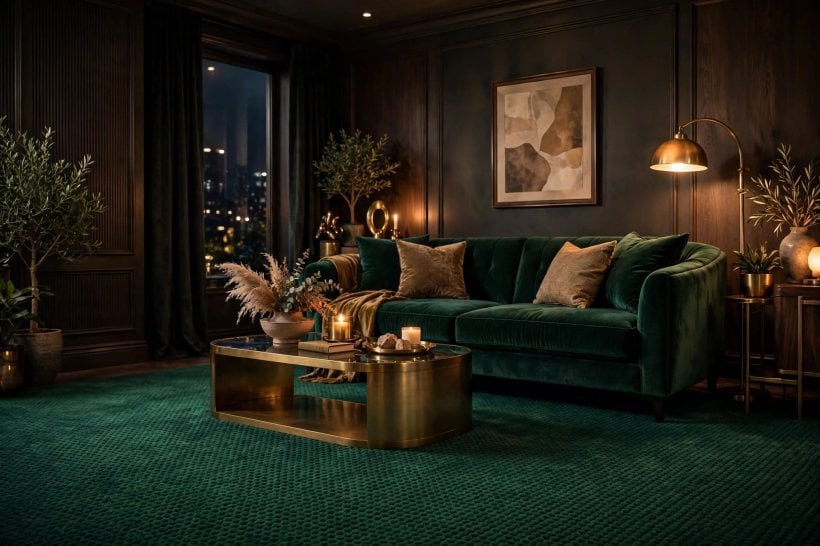
Rich upholstery wants a calm base. A plain or finely flecked carpet lets a velvet sofa glow without the room turning theatrical.
Idea 57: Leather with a woven texture
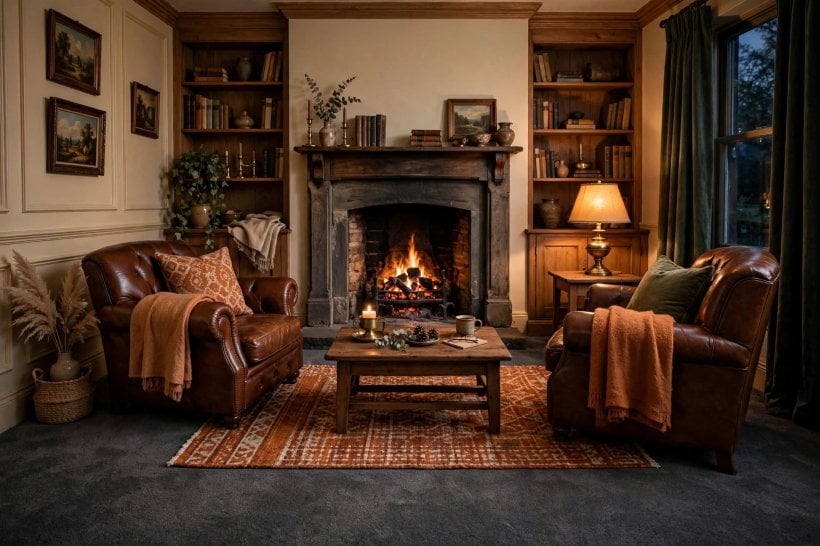
Smooth leather loves the contrast of a looped or woven-look pile. The pairing reads warm, tailored and pleasingly grown-up.
Idea 58: Linen curtains, natural floor
Soft, slubby curtains and a natural-fibre-look carpet share a relaxed language. Add cushions in the same family and the room exhales.
Idea 59: Dark timber, mid-tone floor
Very dark furniture on a very dark floor disappears; on a pale floor it can float. A mid-tone carpet mediates, grounding pieces without swallowing them.
Idea 60: Pale Scandi palette
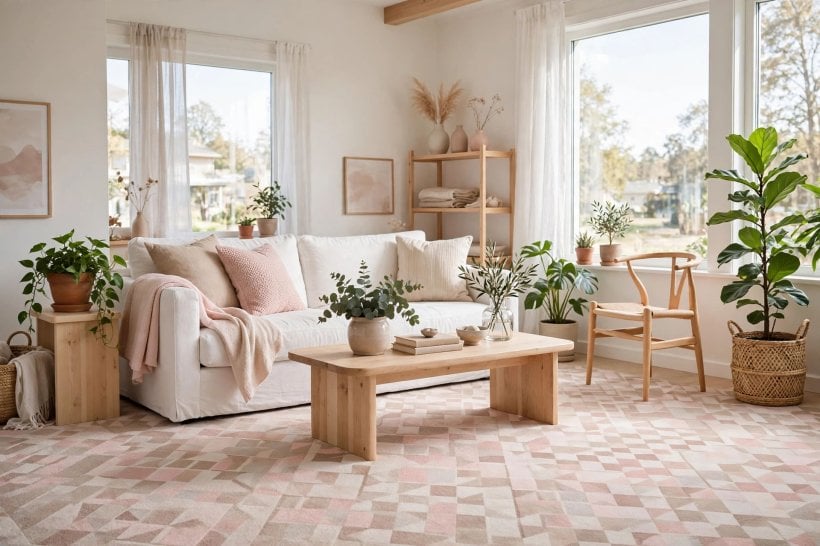
Light wood, white walls and a pale, textured carpet make the serene northern formula. Warmth comes from texture and timber, not colour.
Idea 61: Rich walls, neutral floor
If the walls go deep — ink, forest, oxblood — let the floor be the peacemaker in a warm neutral with a forgiving fleck.
Idea 62: Patterned sofa, plain carpet
A floral or checked sofa is a commitment; honour it with a quiet floor and plain cushions that pick out one of its colours.
Idea 63: Metallics in small echoes
Brass or black accents in lamp bases and handles can echo a carpet’s warm or cool undertone. Small repetitions, big cohesion.
Idea 64: Books and art set the accent
Choose the carpet neutral, then let the room’s books, art and plants supply the colour story above it. The floor stays timeless while tastes evolve.
Idea 65: The fireplace test
Stand at the hearth — often the room’s true focal point — and check the carpet’s tone against the surround and the sofa together. If the triangle works, the room works.
9. Small Rooms, Rentals and Tight Budgets (Ideas 66–75)
Constraints sharpen choices. Small lounges need light tones and low piles that do not eat visual height; rentals need soft layers that leave with you; tight budgets need the money spent where feet and eyes actually go. The principles behind smart tiny house design ideas — multi-tasking pieces, honest measurements, no filler — serve carpet choices just as well.
Idea 66: One light rug, wall to nearly wall
In a small lounge, a single pale rug that almost reaches the skirting makes the floor plan feel bigger than broken-up smaller pieces ever will.
Idea 67: Low pile keeps small rooms airy
Short piles read as more floor and less furnishing. They also let doors swing and robot vacuums roam, which small homes appreciate daily.
Idea 68: Renters: rug plus serious underlay
A good rug on quality underlay over a landlord’s floor gives warmth and sound control with zero permanent change — and both pieces move with you.
Idea 69: Check the lease before fitting
If you rent and dream of fitted carpet, get written permission first and clarify reinstatement. A beautiful floor is not worth a deposit dispute.
Idea 70: Budget goes underfoot first
Spend on the area inside the seating group, where every foot lands, and choose simpler treatments for the room’s rarely walked edges.
Idea 71: Remnants and end-of-roll finds
Quality remnants can carpet a small lounge for a fraction of list price. Measure precisely, stay flexible on shade, and the bargain is real.
Idea 72: One great rug beats three cheap ones
A single well-made rug in the right size outlasts and out-looks a scatter of bargains. Fewer, better: the small-home rule applies to floors too.
Idea 73: Pale but flecked for real life
Small room, pale carpet, busy life? The fleck is your friend — light in tone, forgiving in behaviour, and available in almost every range.
Idea 74: Borrow visual space from the hallway
Run a related runner in the hall beyond the lounge door. The eye reads the two as one longer space, and both areas feel more generous.
Idea 75: Photograph before you commit
Tape the rug’s outline on the floor, or lay samples for the fitted option, and photograph from the doorway. Live with the picture for a day before ordering.
10. Choosing and Fitting: A Simple Order of Work
When your living room carpet decision is near, slow the last steps down. Measure the room properly — alcoves, hearth, bay — and let the retailer or fitter verify before cutting anything. Confirm the full picture in writing: carpet, underlay, trims, fitting, moving of furniture, disposal of the old floor. Qualitative budgeting beats a guessed figure: know which lines are fixed, which are optional, and keep a small contingency for the subfloor surprise that older homes love to hide.
On fitting day, clear the room fully, photograph the empty floor, and agree seam positions and pile direction before work starts. Afterwards, keep the paperwork, the care notes and a labelled offcut together. Then give the room a week: piles settle, colours settle, and your eye adjusts. For the wider canvas this floor sits in, browse our favourite tiny house interior design ideas — a well-chosen soft layer is the quiet foundation under every one of them.
Final Considerations
Colour for your light, pile for your life, pattern for your household’s honesty, and size for your furniture: those four choices, made calmly, matter more than any brand or trend. Whether the answer is wall-to-wall calm, one generous rug, or layers of both, choose the soft layer you will enjoy maintaining. The best carpet is the one that still makes you glad at the hundredth barefoot crossing, not just the first.


0 Comments