
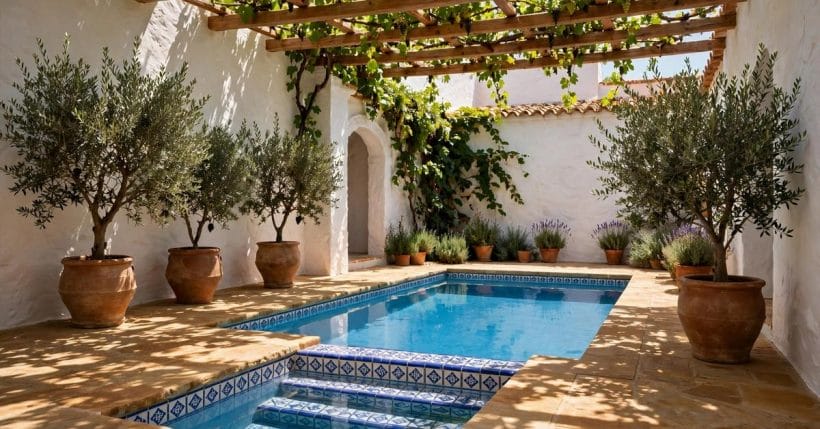
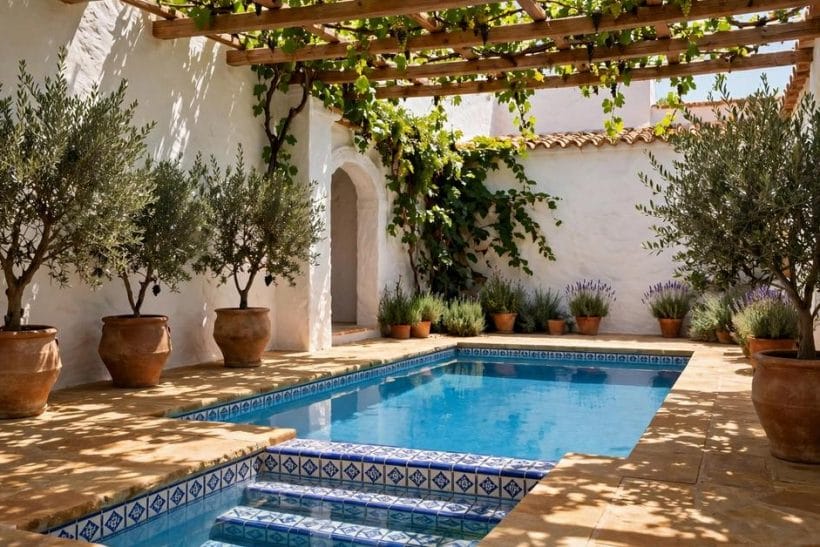
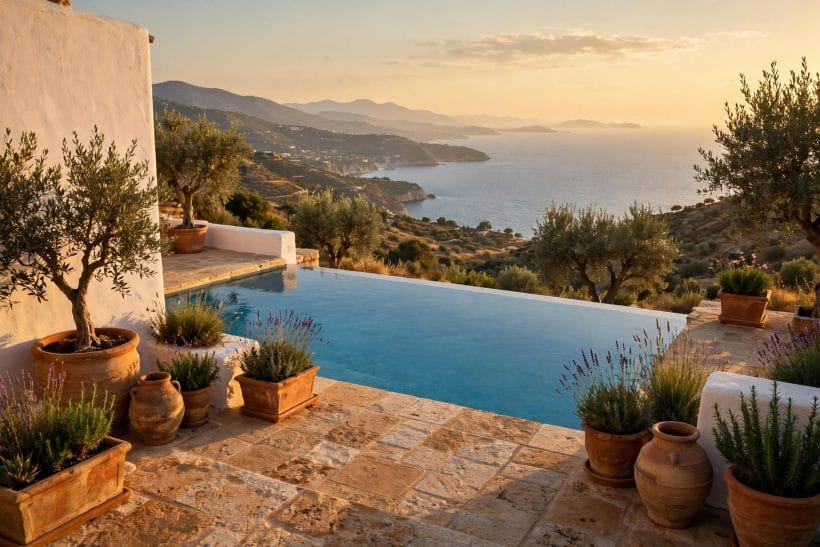
There is a particular kind of pool that does not need a sign to announce itself. Blue water, warm stone, terracotta pots, a pergola throwing striped shade, olive leaves moving over a whitewashed wall — the Mediterranean pool is less a swimming pool than a courtyard that happens to hold water, and its ideas travel well beyond the Mediterranean itself.
Here are 75 Mediterranean pool ideas, grouped by what makes them work: water, stone, shade, planting, edges, light, furniture, details, courtyards and evenings. Pool and electrical work belongs to qualified professionals throughout; these ideas are about design, not construction.
1. Water First: Colour, Calm and Shape
The water is the centre of every Mediterranean pool, and its colour, calm and shape set the whole garden’s tone. A pool that gets the water right can carry simpler surroundings; a pool that gets it wrong needs decoration to compensate. These first ideas shape the water itself.
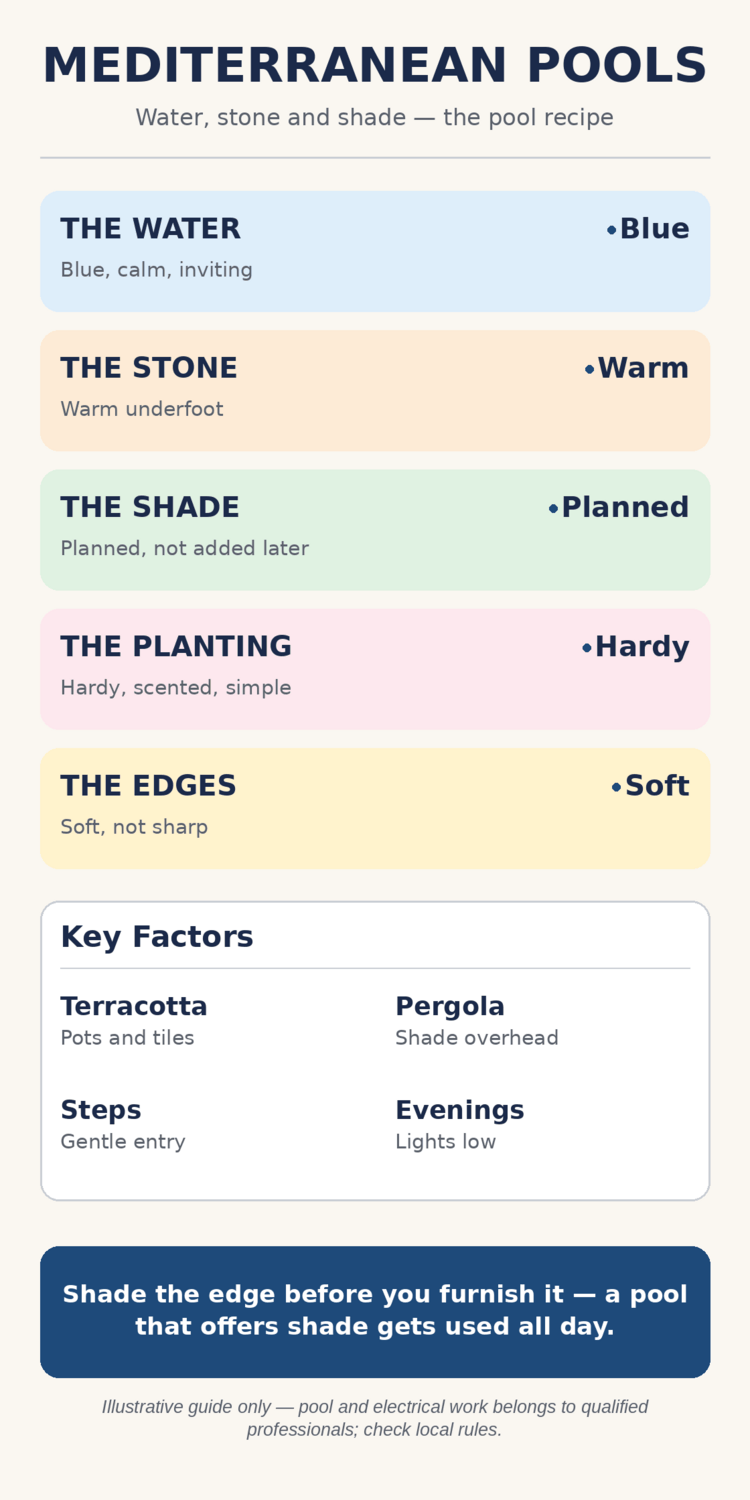
| Element | Mediterranean cue |
|---|---|
| Water | Blue, calm, inviting |
| Stone | Warm underfoot |
| Shade | Planned, not added later |
| Planting | Hardy, scented, simple |
| Edges | Soft, not sharp |
1. Deep blue water
Choose a deep blue finish for the pool interior so the water reads as Mediterranean blue even on a cloudy day, rather than pale and washed out. The interior colour does more for the water’s appearance than any accessory, and it should be chosen in daylight against the terrace stone, not from a small sample indoors.
2. A still surface
Keep the water as calm as the design allows, with gentle circulation rather than aggressive jets, so the surface mirrors sky and walls. A still pool doubles the garden visually, reflecting pergolas, trees and whitewash, while a constantly disturbed surface breaks that reflection and feels restless.
3. A rectangular classic
Build the pool as a simple rectangle — the classic Mediterranean form — which suits courtyards, terraces and long narrow gardens alike. The rectangle’s honesty is its virtue: it sits calmly against walls and paths, frames the water cleanly, and leaves the decoration to planting, stone and shade.
4. A kidney curve
Soften the rectangle into a gentle kidney or freeform curve where the garden is organic and the pool should feel discovered rather than imposed. Curves suit gardens with mature trees and winding paths, where a rigid rectangle would fight the landscape instead of joining it.
5. A narrow lap lane
Run a slim lap lane along one garden edge, Mediterranean in its simplicity, for gardens where swimming matters as much as lounging. A lap lane needs length more than width, so it fits narrow plots well, and its straight lines echo the region’s courtyard pools and irrigation channels.
6. A shallow shelf
Add a shallow lounging shelf at one end, where chairs can sit in the water and the pool gains a social zone without a separate feature. The shelf turns the pool’s edge into a gathering place, letting non-swimmers join the water and giving children a safe, shallow area to play.
7. A raised rim
Raise the pool’s rim slightly above the terrace so the waterline becomes a visible design line and the pool reads as a courtyard basin. A raised rim also gives swimmers a place to sit at the water’s edge and keeps terrace debris from washing into the pool.
8. A dark bottom
Consider a darker interior finish that deepens the water’s colour and makes the pool feel like a shaded cove rather than a bright tank. Dark finishes absorb light rather than reflecting it, so the water looks deeper and more mysterious, though they also show debris sooner and need regular cleaning.
2. Stone and Tile: Warmth Underfoot
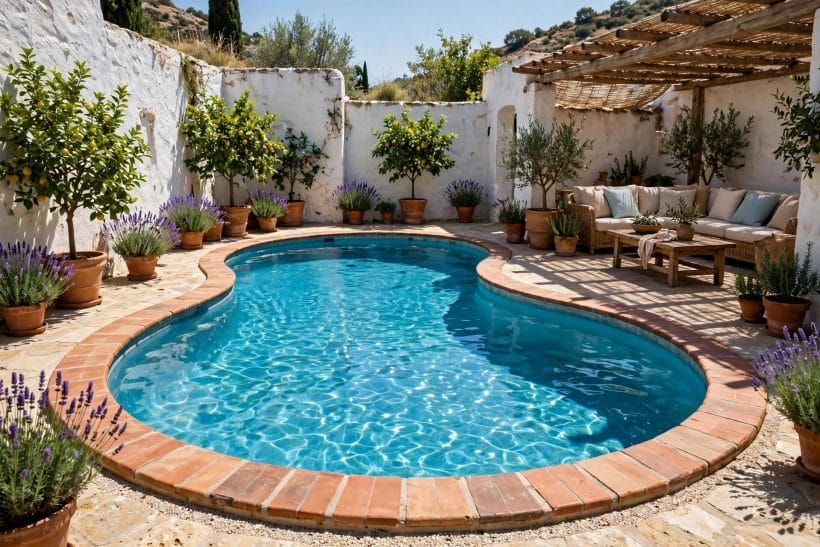
Stone is the Mediterranean pool’s second material, and it should feel warm underfoot, look aged rather than new, and tie the pool to the house and garden walls. The wrong stone — too pale, too slick, too uniform — can undo the warmest water.
9. Warm limestone coping
Edge the pool with warm limestone coping, its soft tone and natural variation setting the palette for the whole terrace. Limestone stays cooler underfoot than darker stone in strong sun, and its surface grips well when wet, which matters on a pool edge.
10. Terracotta tiles
Lay terracotta tiles on the terrace and steps, their earthy red grounding the blue water and echoing the region’s roofs and pots. Terracotta ages gracefully, developing variation that suits the style, but it needs sealing and care in wet areas to avoid staining.
11. Handmade-look tiles
Choose tiles with slight variation in tone and glaze, so the surfaces feel crafted rather than factory-perfect. Uniform tiles can look sterile beside water and planting, while varied tiles catch light differently across the day and keep the terrace visually alive.
12. A patterned tile band
Run a patterned tile band along the waterline, a traditional Mediterranean detail that turns the pool’s edge into decoration. The band should be bold enough to read from the terrace but restrained enough not to fight the water’s colour.
13. Mosaic steps
Tile the pool steps in mosaic, giving the entry a jewel-like quality and a safe, textured footing. Mosaic’s small pieces grip better than large smooth tiles when wet, and their colour can carry the pool’s accent tone down into the water.
14. Stone pavers, loosely jointed
Lay stone pavers with soft joints rather than tight grout lines, so the terrace reads as garden rather than patio. Loose joints drain better, allow planting to creep between stones, and forgive the slight movement that rigid joints would crack under.
15. A stone bench wall
Build a low stone wall as a bench along one pool edge, doubling as seating and as the garden’s retaining structure. A bench wall gives watchers somewhere to sit at water level and gives the pool a finished, architectural edge.
16. Pebble insets
Set pebble insets into the terrace near the water, a textural detail that marks the transition from dry garden to pool zone. Pebbles also massage bare feet and provide a naturally non-slip surface where the terrace meets the pool.
3. Shade: Pergolas, Vines and Canvas
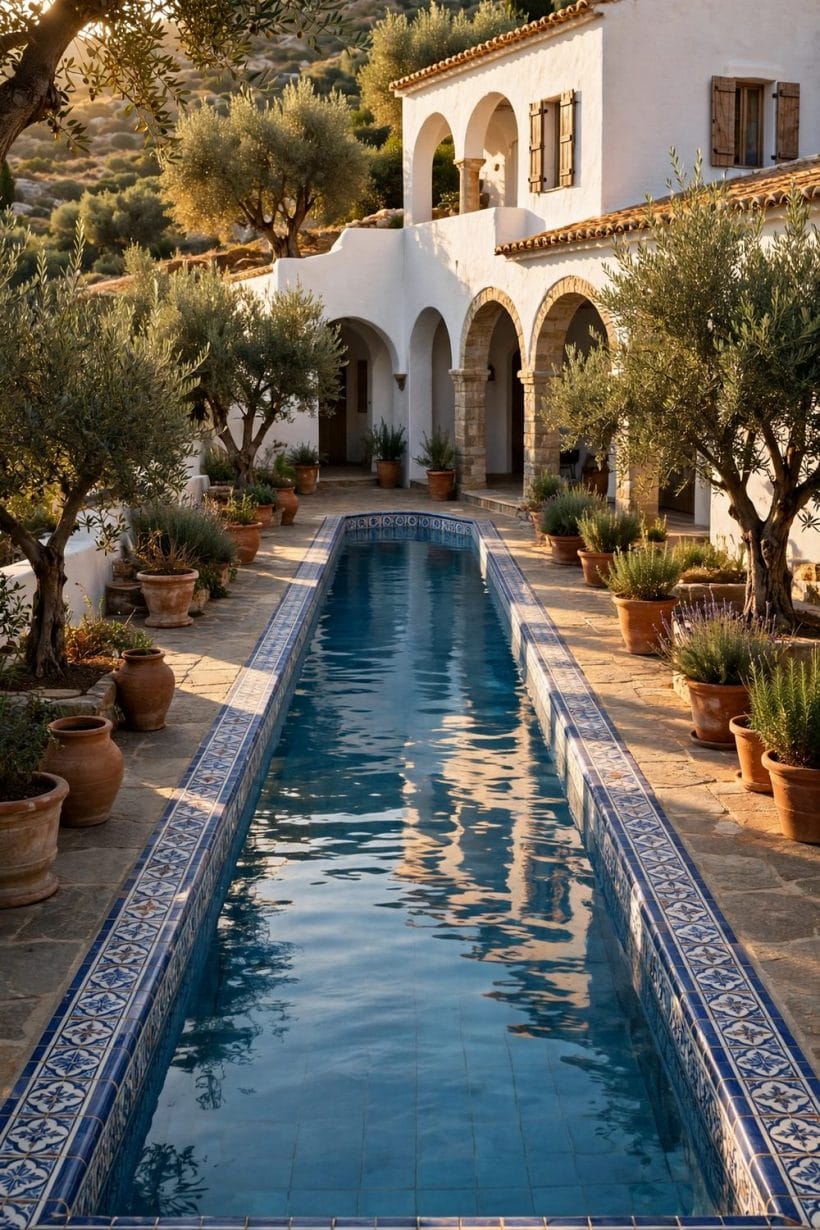
Shade is not an accessory for a Mediterranean pool — it is part of the design, planned before furniture, so the pool can be used through the heat of the day. A pool without shade is a pool used only in the morning and evening.
17. A vine-covered pergola
Grow vines over a pergola beside the pool, so shade arrives as dappled green light rather than solid shadow. Grape vines are the traditional choice, giving fruit as well as shade, but any vigorous climber suited to your climate will do the same work.
18. A wooden pergola, simply built
Build the pergola from plain timber posts and beams, letting its simplicity suit the stone and water rather than competing with them. A pergola that tries too hard — ornate brackets, fussy detailing — fights the pool’s calm, while a plain one frames it.
19. A shaded dining terrace
Place the dining table under the pergola, so meals happen in shade with the pool as the view. Dining in shade beside water is the Mediterranean pool garden’s central pleasure, and it deserves the best-shaded spot, not a leftover corner.
20. Canvas sails
Stretch canvas shade sails over part of the terrace, their soft curves echoing the pool’s water and the garden’s walls. Sails suit gardens where a permanent structure would be too heavy, and their fabric can be taken down in storm seasons.
21. A retractable canopy
Fit a retractable canopy over the lounging area, so shade can be adjusted through the day without a permanent roof. Retractable shade suits changeable climates, where morning sun is welcome and midday sun is not.
22. Umbrellas in terracotta
Choose large umbrellas in warm, earthy tones that sit in terracotta bases and read as part of the garden, not as beach gear. Umbrellas should be heavy enough to stay put in a breeze and large enough to shade a lounger fully.
23. Shade over the shallow end
Shade the pool’s shallow end or shelf, so children and loungers can enjoy the water out of direct sun. Shading the shallow end extends the hours the pool’s social zone is comfortable, especially for families.
24. An arched loggia
Build an arched loggia along one pool side, giving deep, permanent shade and the garden’s most architectural feature. A loggia turns the pool’s edge into a room, open to the water on one side and sheltered on the other.
4. Planting: Olives, Citrus and Scent
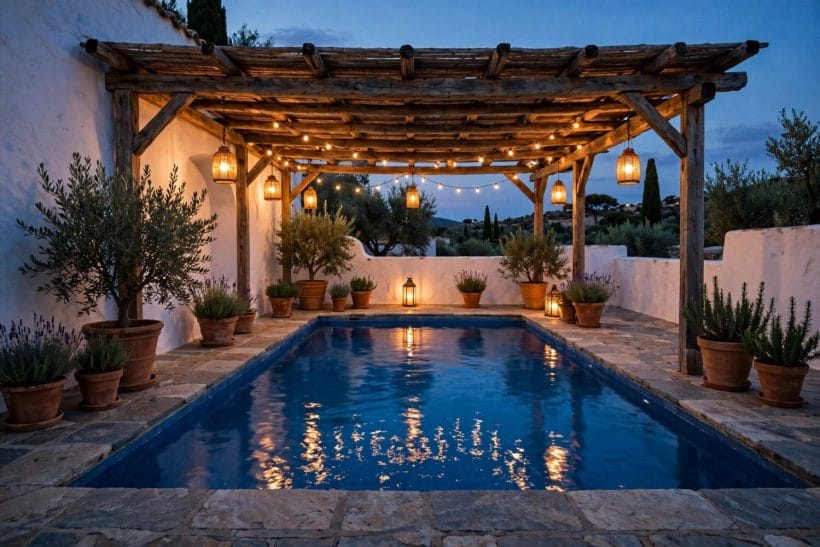
Mediterranean planting is hardy, scented and simple — plants that thrive in sun, tolerate dry spells and smell good when brushed against. Planting near a pool must also tolerate splashes and not drop excessive debris into the water.
25. Olive trees in pots
Plant olive trees in large terracotta pots around the pool, their silver-green leaves moving against whitewashed walls. Potted olives can be moved to shelter in hard winters and positioned to frame views, making them the most flexible trees in the pool garden.
26. A citrus tree by the terrace
Place a lemon or orange tree where its scent reaches the loungers and its fruit becomes part of the table. Citrus beside a pool is both decoration and pantry, and its glossy leaves stay green through the seasons.
27. Lavender edging
Edge paths and beds with lavender, so every walk to the pool passes through scent. Lavender tolerates heat, drought and poor soil, and its purple flowers echo the pool’s blue without competing with it.
28. Rosemary hedges
Grow rosemary as a low hedge, fragrant, evergreen and useful in the kitchen beside the pool. Rosemary hedges define beds and paths while staying low enough not to block views of the water.
29. Agave accents
Use agave or aloe as sculptural accents in gravel beds, their bold forms contrasting with soft planting. Agaves need sharp drainage and full sun, and their architectural shapes suit the pool’s stone and terracotta.
30. Climbing jasmine
Grow jasmine over the pergola or a wall, so evenings around the pool carry its perfume. Jasmine’s evening scent is the pool garden’s most memorable quality, and it costs nothing more than a climber and patience.
31. Potted geraniums
Fill terracotta pots with geraniums in warm reds and pinks, the classic Mediterranean pot plant, grouped by the steps. Geraniums flower for months, tolerate heat, and their colour lifts stone and whitewash alike.
32. Gravel beds, not lawn
Replace thirsty lawn near the pool with gravel beds and drought-tolerant planting, which suits the climate the style comes from. Gravel drains well, keeps feet clean on the way to the pool, and reduces the maintenance the garden demands.
5. Edges and Entries: Steps, Shelves and Beaches
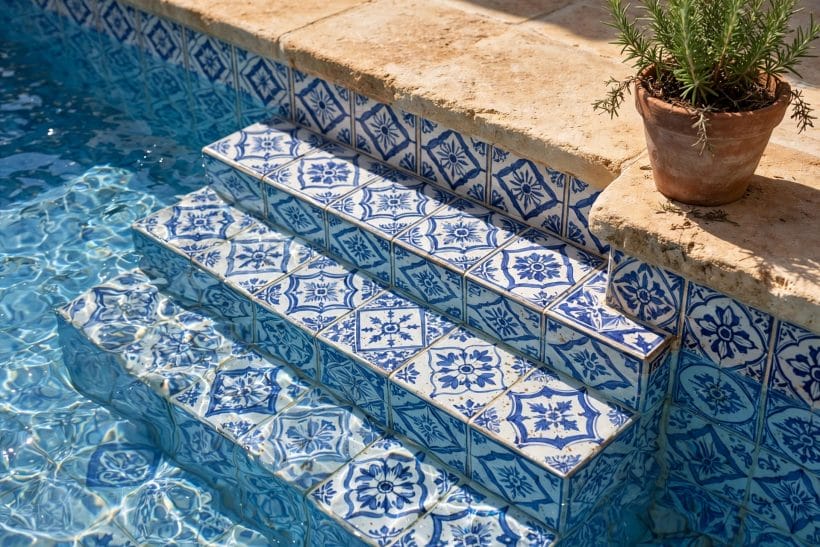
How you enter the water shapes how the pool feels. Gentle entries, wide steps and soft edges invite lingering; steep ladders and sharp rims do the opposite. Design the entry as carefully as the water itself.
33. Wide, gentle steps
Build wide steps into the shallow end, so entering the pool feels like walking into the garden rather than climbing down. Wide steps also serve as seating, letting swimmers sit at the water’s edge with feet in the pool.
34. A beach entry
Slope one end of the pool gently like a beach, giving toddlers and loungers a gradual way into the water. Beach entries suit family pools and accessible designs, though they need more space than a stepped entry.
35. A tiled ledge seat
Add a submerged ledge seat along one wall, where swimmers can sit half in the water and talk. Ledge seats turn the pool’s edge into a social space and give less confident swimmers a secure place to rest.
36. Rounded coping stones
Choose coping stones with rounded profiles, comfortable to sit on and kind to bare feet. Sharp coping edges catch skin and swimwear, while rounded stones invite sitting and dangling feet.
37. A handrail in disguise
Fit a handrail that matches the pool’s metalwork, so support is present without looking institutional. A well-chosen handrail in bronze, iron or matching stone-tone disappears into the design while helping everyone enter safely.
38. A second, private entry
Add a second entry near the house end, so the pool can be reached from the terrace without crossing the whole garden. A second entry also helps at parties, when the pool is approached from more than one direction.
39. Stepping stones to the water
Lay stepping stones from the terrace to the pool’s edge, slowing the approach and marking the water as a destination. Stepping stones create a small ritual of arrival that suits the courtyard character.
40. A low wall to lean on
Build a low wall at the deep end, giving watchers a place to lean and the pool a finished backdrop. The wall also stops the eye at the pool’s far edge, framing the water as a picture.
6. Walls and Courtyards: Enclosure That Welcomes
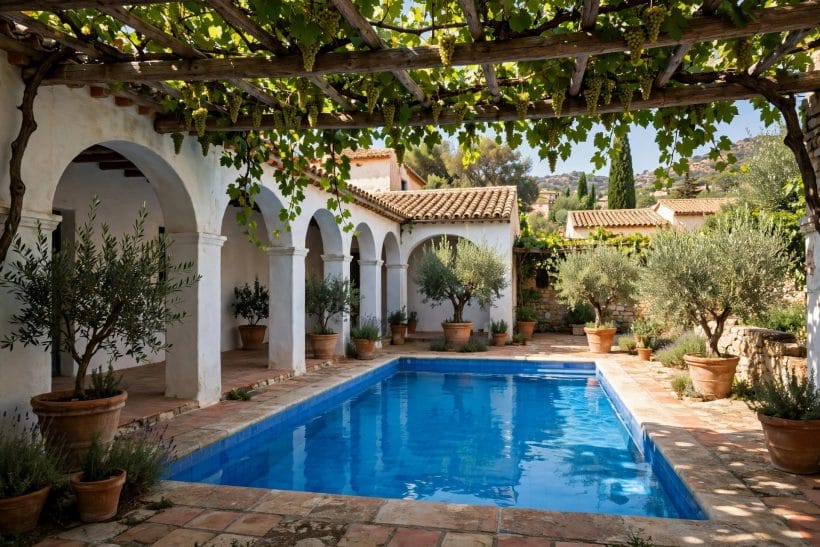
The Mediterranean pool often sits in a courtyard, enclosed by walls that give privacy, block wind and turn the garden into an outdoor room. Enclosure is what separates a courtyard pool from a pool in an open garden.
41. Whitewashed walls
Whitewash the courtyard walls, so the garden feels bright, the water’s blue deepens by contrast, and the space stays cool to the eye. Whitewash also reflects light into shaded corners and gives the courtyard its unmistakable Mediterranean brightness.
42. A single archway
Cut a single archway in the courtyard wall as the pool’s entrance, making arrival feel like entering a different place. One archway, well proportioned, beats several openings that fragment the wall and dilute the sense of enclosure.
43. A wall fountain
Mount a wall fountain where water trickles into a small basin, adding sound and movement even when the pool is still. The fountain’s sound masks street noise and gives the courtyard its own quiet music.
44. Niches for pots
Build niches into the courtyard walls for pots and lanterns, so the walls themselves become display. Niches suit thick courtyard walls and give small plants and lights a sheltered home.
45. A tiled mural panel
Set a tiled mural panel into one wall, a traditional decorative focus that gives the courtyard its artwork. A single panel, chosen for its colours rather than its size, anchors the courtyard without overwhelming it.
46. Climbing vines on walls
Let vines climb the courtyard walls, softening their lines and cooling the enclosed space. Vines also attract birds and scent the courtyard, though they need pruning to keep them off coping and gutters.
47. A gate, not a gap
Close the courtyard with a gate rather than an open gap, so the pool garden feels private and complete. A gate also keeps children and pets safely within the courtyard, which matters for any family pool.
7. Furniture: Loungers, Tables and Daybeds
Pool furniture should invite long stays: comfortable, weather-tolerant and arranged for conversation as much as for sunbathing. Furniture placed for photographs rather than for sitting will sit empty.
48. Wooden loungers
Choose wooden loungers with thick cushions, their natural material suiting stone and terracotta better than bright plastic. Wood weathers gracefully beside a pool, and its warmth under bare skin suits the Mediterranean palette.
49. A shaded daybed
Place a daybed under the pergola or loggia, the pool garden’s luxury seat for reading and afternoon rest. A daybed turns the pool garden from a swimming place into a living place, used long after swimming ends.
50. A low stone table
Set a low stone table between loungers for drinks and books, its weight anchoring the seating group. Stone tables survive weather and splashes without complaint, and their cool surface suits hot days.
51. A dining set for long lunches
Choose a dining set large enough for long lunches, placed where shade and pool views meet. Mediterranean pool gardens are built around shared meals, so the dining set deserves the garden’s best position.
52. Hammock between trees
Hang a hammock between two trees or posts, the simplest seat in the garden and often the most used. A hammock needs strong fixings and a little space to swing, but it repays both with the garden’s most relaxed seat.
53. Cushions in warm tones
Dress furniture with cushions in warm terracotta, ochre and faded blue, tying seating to the pool’s palette. Cushion covers should be removable and washable, since pool seating collects sun, water and sunscreen.
54. Storage near the pool
Provide a storage bench or chest near the pool for cushions and towels, so the terrace stays tidy after swimming. Storage that is easy to open with wet hands gets used; storage that fights its lid does not.
8. Light After Dark: Lanterns, Uplights and Glow
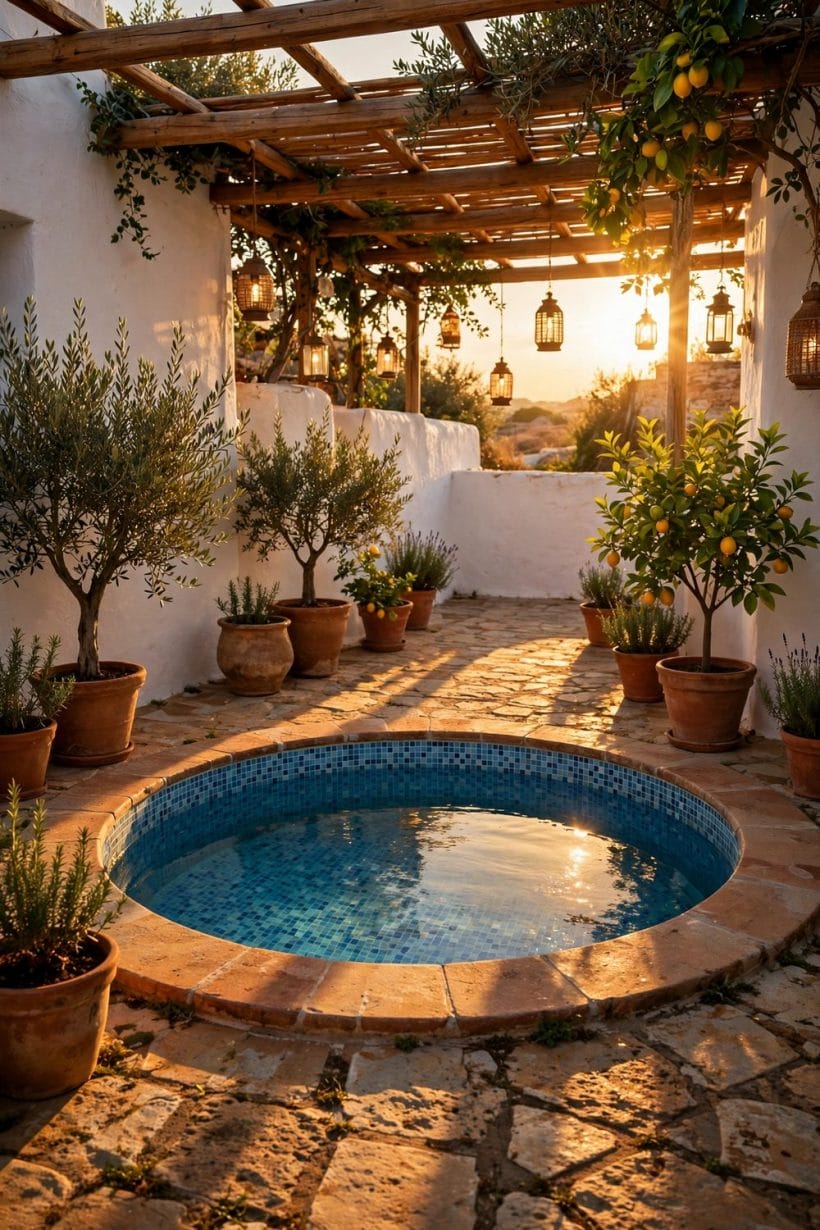
Mediterranean pools come alive in the evening, when low light, warm walls and still water turn the garden into a different room. Evening lighting deserves a plan of its own, and electrical work belongs to a professional.
55. Lanterns on walls
Hang lanterns on courtyard walls, their warm flames or bulbs echoing the region’s evening light. Lanterns suit courtyards because their light stays low and local, flattering walls and water without flooding the garden.
56. Uplights for olive trees
Uplight olive trees from below, so their silver leaves glow against the night walls. Uplighting turns the garden’s planting into evening sculpture and gives the courtyard depth after dark.
57. Underwater glow
Light the pool from within, so the water glows blue after dark and the pool becomes the garden’s lantern. Underwater lighting should be specified with the pool’s builder and electrician, since it involves water, power and safety together.
58. String lights over the terrace
String lights across the dining terrace, their soft points of light making evening meals feel festive. String lights should be hung high enough to clear heads and secured against wind, not draped loosely.
59. Candles on the table
Set candles on the dining table and low walls, the simplest evening light and the most atmospheric. Candles need stable holders and shelter from wind, and they should never be left burning unattended near planting or fabric.
60. Path lights, low and warm
Light paths with low, warm fixtures that guide feet without flooding the garden with brightness. Low path lights keep the night garden dark enough for stars while making every step safe.
61. A fire bowl
Place a fire bowl near the seating area, its flame extending pool evenings into cooler nights. A fire bowl needs a safe surface, clear space around it, and respect for local rules on open flames.
62. Moonlight planting
Plant white-flowering and silver-leaved plants that catch moonlight, so the garden glows even without electric light. Moonlight planting is the cheapest evening lighting there is, and it never needs a bulb.
9. Details: Spouts, Basins and Small Luxuries
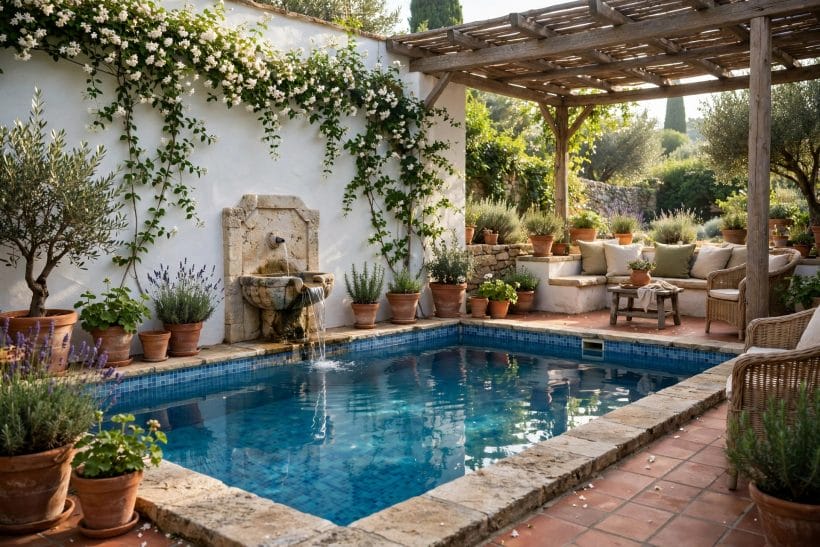
Small details carry the Mediterranean character: a spout, a basin, a tiled step, a scented corner. They cost little and are remembered most, because they are the details guests touch and use.
63. A lion-head spout
Add a spout — traditional or plain — pouring a thin stream into the pool, giving the water movement and sound. A spout’s stream also aerates the water gently and gives the pool a focal point even when nobody swims.
64. A foot-washing basin
Place a small basin near the pool entry for rinsing feet, a practical Mediterranean courtesy that keeps the terrace clean. A basin by the entry saves the house’s floors and the pool’s filter from tracked-in dirt.
65. A cold-water tap
Fit an outdoor tap near the seating area for drinks, rinsing and watering pots without going indoors. An outdoor tap should be frost-proof or drainable where winters are cold, and its position should suit hoses as well as glasses.
66. A tiled house number
Set a tiled number or name plaque by the courtyard gate, a small crafted detail that welcomes visitors. Tiled plaques suit the courtyard style and survive weather better than painted signs.
67. Terracotta saucers as trays
Use large terracotta saucers as trays for candles and glasses, echoing the garden’s pots in miniature. Saucer trays are cheap, beautiful and easily replaced, and they tie the table to the garden’s material palette.
68. A herb pot by the kitchen door
Keep a herb pot by the nearest door, so cooking beside the pool starts with a step outside rather than a trip indoors. Herbs by the door get used because they are seen; herbs at the garden’s far end get forgotten.
69. A weatherproof speaker, discreet
Place a discreet outdoor speaker among the planting, so music joins the garden without visible technology. Speakers should be weatherproof, positioned to cover seating without blasting neighbours, and wired or paired with care.
10. Evenings and Seasons: Using the Pool All Year
A Mediterranean pool garden earns its keep beyond summer: spring planting, autumn light and mild winter days all have their own pleasures. Designing for more than one season is what separates a pool garden from a summer-only feature.
70. Spring planting days
Plan spring planting around the pool, when new growth and first swims arrive together. Spring is the time to refresh pots, divide perennials and set the garden’s tone for the swimming season ahead.
71. Autumn evening swims
Keep the pool open into autumn, when warm water and cool air make evening swims at their most pleasant. Autumn light is lower and warmer, and it flatters stone, water and planting alike.
72. A winter cover that looks good
Choose a winter cover in a tone that suits the terrace, so the pool looks cared for even when closed. A cover that matches the garden reads as part of the design, while a garish one advertises neglect.
73. Citrus harvest table
Set the terrace table for a citrus harvest meal, using the garden’s own fruit as both food and decoration. A harvest table turns the pool garden’s planting into a celebration and gives autumn its own occasion.
74. A poolside reading corner
Keep a shaded reading corner furnished year-round, so the pool garden is used even on days nobody swims. A reading corner needs only a chair, shade and a small table, but it keeps the garden inhabited through every season.
75. The pool as courtyard heart
Treat the pool as the courtyard’s heart in every season — water, stone, shade and scent arranged so the garden always has a centre. A pool garden designed around its centre stays beautiful when the pool is closed, covered or simply quiet.
For the gardens and rooms around the pool, the same Mediterranean restraint serves well: false ceiling design for the shaded rooms that open onto the terrace, asian landscaping ideas for a contrasting garden style, and exterior entryway ideas for the approach to the house itself.
Final Considerations
Seventy-five ideas, one discipline: water kept blue and calm, stone kept warm, shade planned before furniture, planting hardy and scented, edges soft, and evenings lit low. A Mediterranean pool is not a checklist of expensive features — it is a courtyard attitude, and it works in any climate where sun, stone and water are allowed to do their quiet work together. The ideas above are deliberately mixable: take the water colour from one, the shade structure from another, the planting palette from a third, and the result is still coherent, because every idea answers to the same courtyard logic rather than to a passing trend. That coherence is what makes a Mediterranean pool feel settled on its first summer rather than assembled over several, and it is why the style survives translation to gardens far from the sea it was named for.
More on the outdoor rooms around it: she shed ideas for the garden room beyond the pool, interior design ideas for the palette that flows indoors, and tiny house porch ideas for small outdoor rooms with the same shade-first logic.

0 Comments