

A small wardrobe does not have to mean creased shirts, shoes in a pile and a daily hunt for a belt. With the right layout, a mens small closet can hold a full working wardrobe in a footprint no bigger than a doorway, and every item stays visible. These 75 ideas start with layout, then move through storage and the practical details that keep a compact closet calm, tidy and genuinely easy to use every morning.
1. At a Glance: Layouts Compared
Before buying a single rail or box, compare the main layouts honestly. A reach-in suits most bedrooms, a compact walk-in trades floor space for access on several walls, and a wardrobe wall works where no closet exists at all. The table below sums up the mens small closet layouts covered in this guide, so you can match the plan to your room, your clothes and the way you actually get dressed each day.
| Layout | Best for | Hanging space | Storage style | Watch out for |
|---|---|---|---|---|
| Reach-in, one wall | Most bedrooms | One or two rails | Long shelf above the rail | Dead corners at both ends |
| Compact walk-in | Alcoves and spare corners | Two or three walls | Mix of rails, shelves and drawers | Door swing eating floor space |
| L-shaped reach-in | Corner closets | Two rails at right angles | Corner shelves or a tower | Overlapping clothes in the corner |
| Wardrobe wall | Rentals and studios | Freestanding rail | Baskets, boxes and a dresser | Dust settling on open clothes |
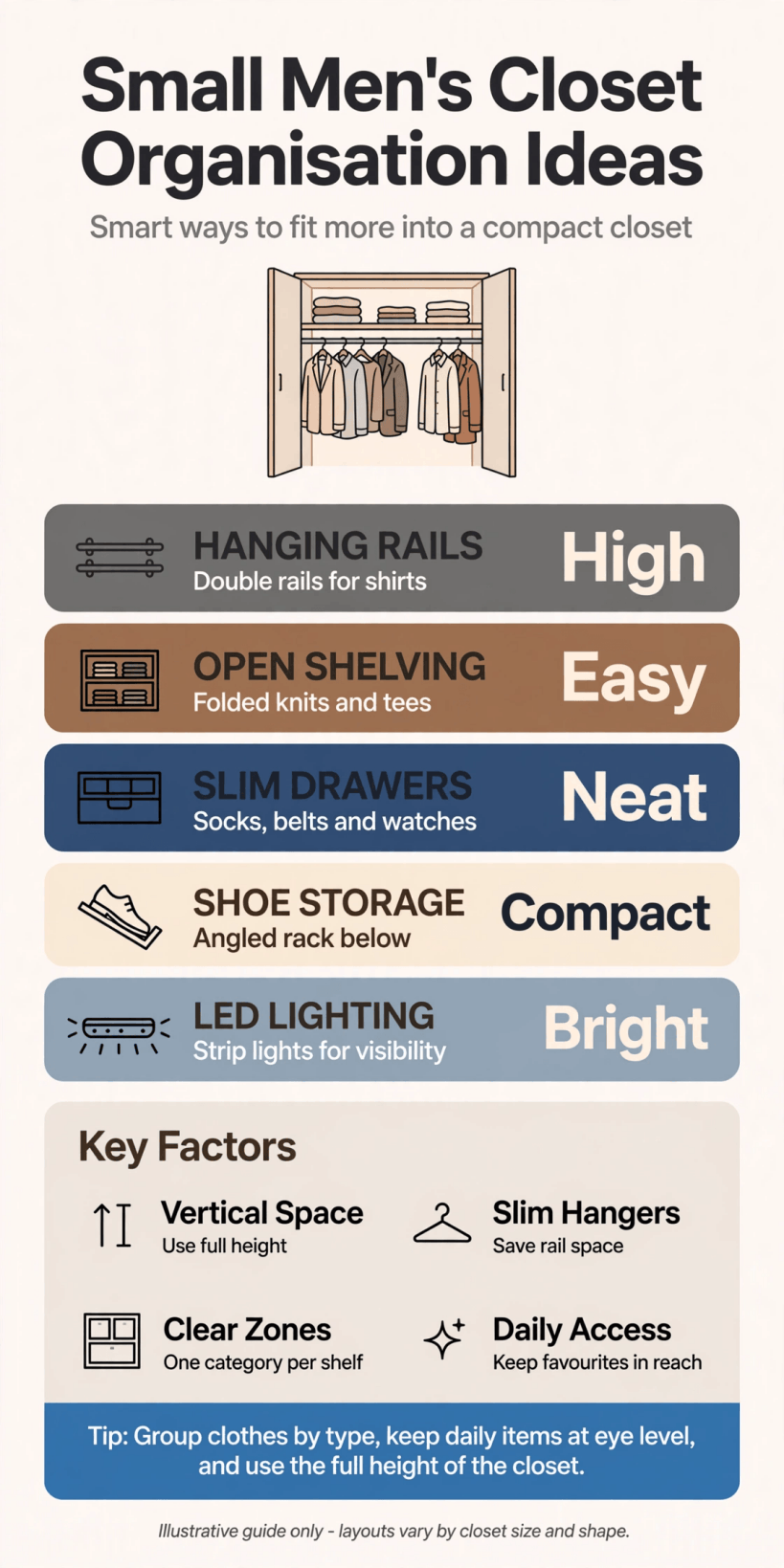
The main layout options at a glance — measure your space first, then choose the arrangement that fits the wardrobe you really own.
2. Measure First: The Numbers That Decide Everything
Every good closet starts with a tape measure, not a shopping list. Note the width, depth and ceiling height, then measure the clothes themselves: a row of shirts on hangers needs depth so sleeves are not crushed against the door, and long coats need clear hanging height below them. Closet planning sits naturally alongside wider tiny house bedroom ideas, because in a small room the wardrobe, the bed and the walkway all compete for the same few feet.
Count what you own before you design anything. Lay out shirts, trousers, jackets, shoes and folded knitwear in rough groups and count them. Most men wear a smaller core wardrobe than they store, so design for the clothes in regular rotation and give the rarely worn pieces a shelf or a box rather than prime rail space at eye level.
- Measure width, depth and height in three places, and plan around the smallest figure.
- Allow enough depth for hangers to swing without brushing the door or wall.
- Keep long coats and suits in one tall section with nothing stored beneath them.
- Count shirts, trousers and jackets honestly before choosing rail lengths.
- Mark studs and sockets so shelves and rails are fixed into something solid.
- Leave a hand’s width of breathing room at each end of every rail.
- Check the door swing or curtain track before placing drawers behind it.
- Photograph the empty closet with measurements noted, and keep it on your phone.
3. Single-Rail Layouts That Earn Their Keep
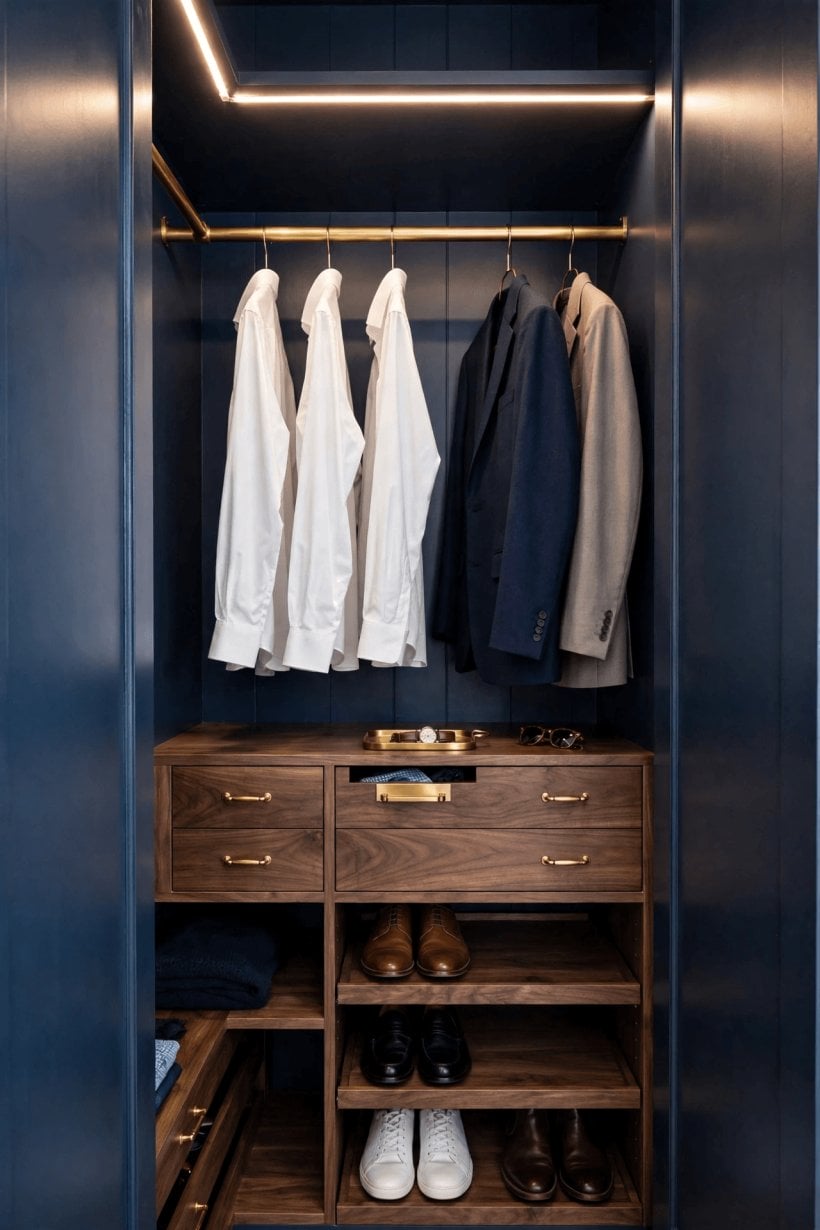
A single rail with a shelf above it is the simplest layout of all, and for a small wardrobe it is often the best. One rail keeps everything visible in a single scan, the shelf above swallows boxes and out-of-season pieces, and the floor below stays clear for shoes. It is the arrangement behind many bedroom interior design ideas for tiny houses, where one well-planned wall has to do the work of a whole dressing room.
Arrange the rail in the order you dress: shirts together, then trousers, then jackets, so getting ready becomes a walk along the rail rather than a search. Keep the most-worn items in the centre, where the door opening is widest, and push occasion wear towards the ends where access is tighter and matters less.
- Run one full-width rail and resist the urge to add a second crowded one.
- Group clothes by type along the rail in the order you put them on.
- Keep daily workwear in the centre and formal wear at the quieter ends.
- Use slim, matching hangers so shirts sit evenly and take less room.
- Add one long shelf above the rail for boxes, hats and holdalls.
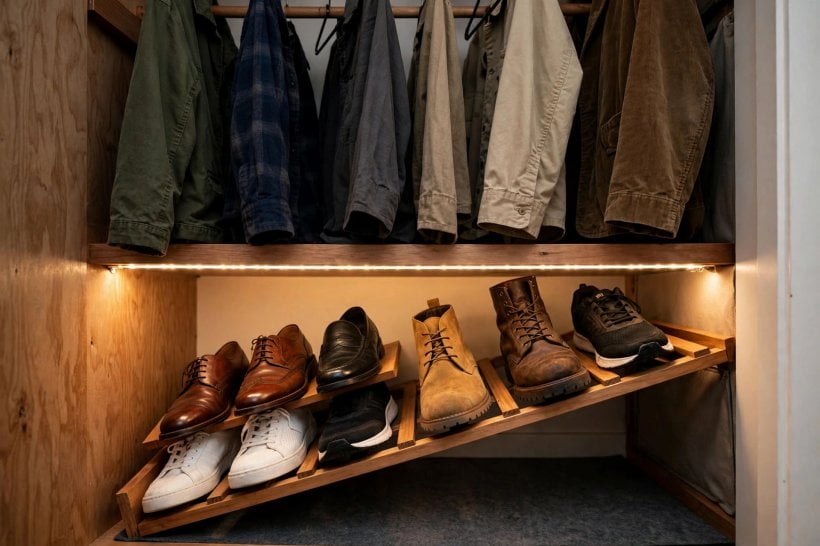
- Fit a low shoe rack on the floor instead of scattering pairs underneath.
- Hang a small hook strip inside the door for tomorrow’s outfit.
- Leave the last short stretch of rail empty for guests or new purchases.
4. Double-Hang Sections for Shirts and Trousers
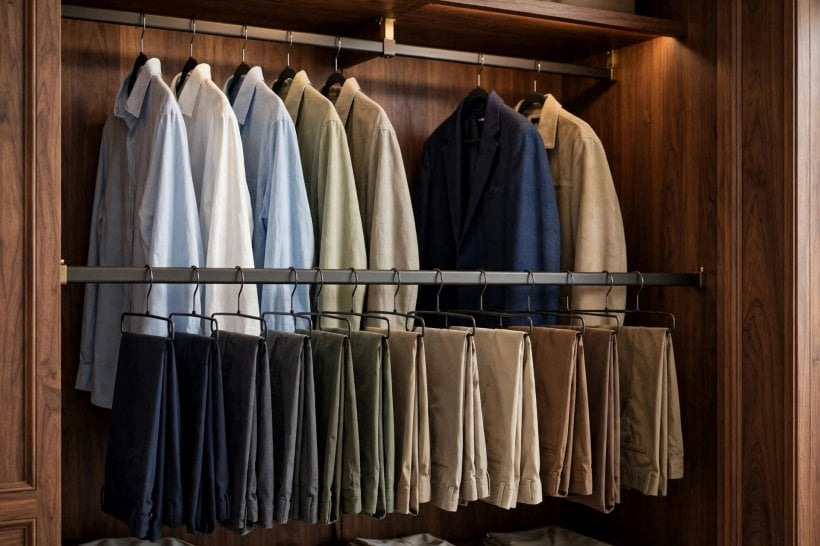
Where ceiling height allows, splitting part of the closet into two stacked rails roughly doubles the hanging space for short items. Shirts, folded-over trousers, jackets and shorts all hang happily in a half-height section, so convert half or two-thirds of the width to double hang and keep a single tall section for coats, suits and anything long.
Put the rail you use most at the top only if you can reach it comfortably; many men prefer everyday shirts on the lower rail where they are easiest to grab, with less-used pieces above. Keep the two levels visually separate — shirts above, trousers below, for example — so a half-awake brain can find things without thinking.
- Convert half the width to double hang and keep one tall section for coats.
- Hang shirts on one level and trousers on the other, never mixed together.
- Fold trousers over padded hangers to stop crease lines across the knee.
- Leave a small gap between garments so fabric can breathe and stay fresh.
- Use the top rail for this week’s rotation and the lower for the rest.
- Clip hangers work well for shorts, jeans and casual trousers in summer.
- Keep suits in breathable garment bags on the tall section, not squeezed in.
- Measure your longest shirt before fixing the lower rail height permanently.
5. Shelves Above and Below: Storage That Works Hard
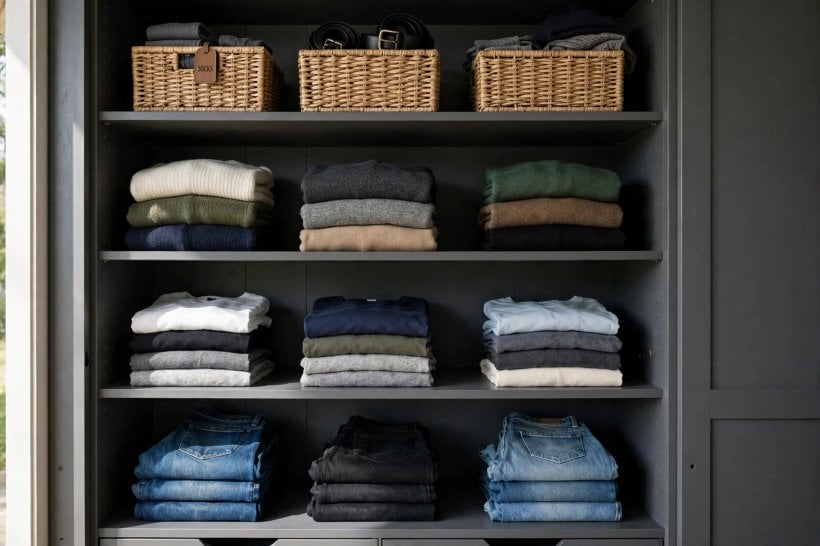
Shelves are where small closets win or lose. The long shelf above the rail is prime space for things used weekly, while very high shelves suit luggage and seasonal boxes. Below hanging clothes, one or two low shelves turn wasted floor space into a tidy home for shoes, gym kit and folded knitwear that should never hang and stretch.
Keep folded stacks low — three or four jumpers at most — so piles stay stable and you can see every item without digging. Shelf dividers or simple bookend-style separators stop stacks leaning into each other, and a label on each shelf edge sounds fussy until the first busy morning it saves you from unfolding everything.
- Divide the top shelf into zones with boxes rather than one long jumble.
- Fold knitwear and store it flat so shoulders never stretch on hangers.
- Keep folded stacks to four items high so nothing topples or hides.
- Use clear or labelled boxes for belts, gloves, scarves and caps.
- Store heavy items low and light, bulky items such as duvets up high.
- Add shelf dividers to keep T-shirt piles upright and separate.
- Reserve one shelf for the laundry-in-waiting basket to contain mess.
- Wipe shelves monthly; dust gathers fastest exactly where clothes sit longest.
6. Drawers, Baskets and Dividers for Small Pieces
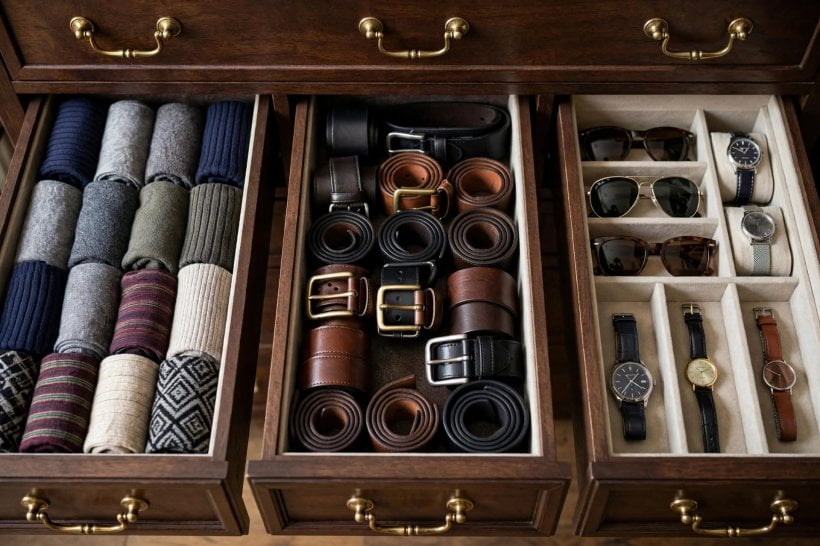
Underwear, socks, ties, belts and watches are the items that make small closets feel chaotic, because they are numerous, small and easy to scatter. A narrow chest of drawers inside the closet, or a stack of baskets on a shelf, gives each category a boundary. The same containment logic drives good tiny house bathroom ideas: small things behave when every one of them has a defined home.
Drawer dividers earn their keep here. A simple grid turns one deep drawer into separate cells for socks, underwear and accessories, and a shallow tray keeps watches, cufflinks and sunglasses visible at a glance. If drawers are not possible, fabric baskets on a low shelf do the same job and can be lifted out whole on laundry day.
- Give socks, underwear and ties one divided drawer or basket each.
- Roll T-shirts and store them in rows so every colour stays visible.
- Keep a shallow tray for watch, wallet, keys and sunglasses by the door.
- Hang belts and ties on a pull-out rack or the back of the door.
- Use small pouches for cufflinks, collar stays and spare buttons.
- Store gym clothes in their own ventilated basket, ready to grab whole.
- Put a small laundry bag inside the closet to catch worn items daily.
- Keep one empty basket as overflow so new items never start a pile.
7. Doors, Curtains and Open Fronts
The front of the closet matters more in a small room than the inside. Hinged doors need clear swing space that a compact bedroom rarely has; sliding doors, bifolds or a simple curtain all close the wardrobe without stealing floor area. An open front costs nothing and keeps everything visible, which suits men who would rather see their clothes than remember them.
Each option has a trade-off. Sliders hide half the closet at a time, curtains can look soft but offer no structure, and open fronts collect dust. The relaxed, room-first thinking behind many tiny house living room ideas applies here too: choose the front that suits how the whole room is used, not just the wardrobe itself.
- Swap hinged doors for sliders where bed or desk blocks the swing.
- Try a curtain on a ceiling track for the softest, cheapest closure.
- Go open-front in a dressing corner and dust shelves a little more often.
- Mirror one sliding panel to add light and a full-length check.
- Match curtain or door colour to the wall so the closet visually recedes.
- Fit soft-close runners so early-morning dressing stays quiet.
- Keep the floor line in front of the closet completely clear of clutter.
- Add a door-back organiser for shoes or accessories if the door allows.
8. Lighting, Colour and the Details That Make It Feel Bigger
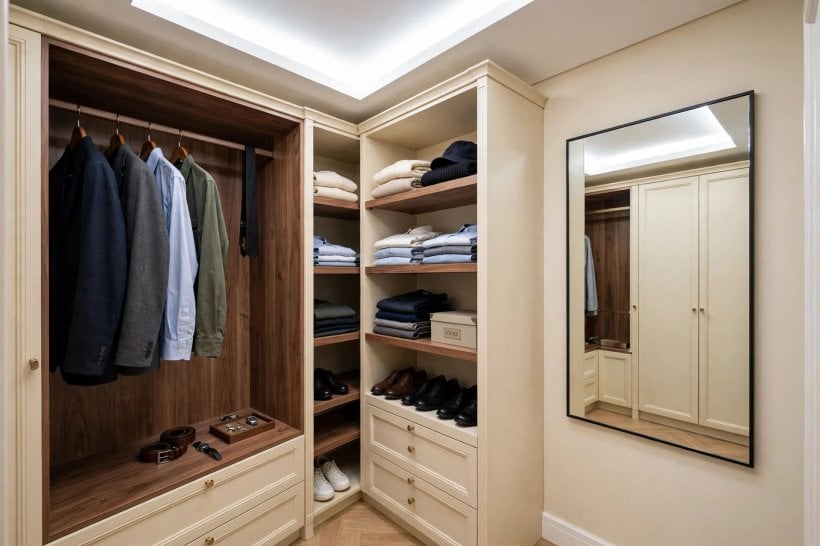
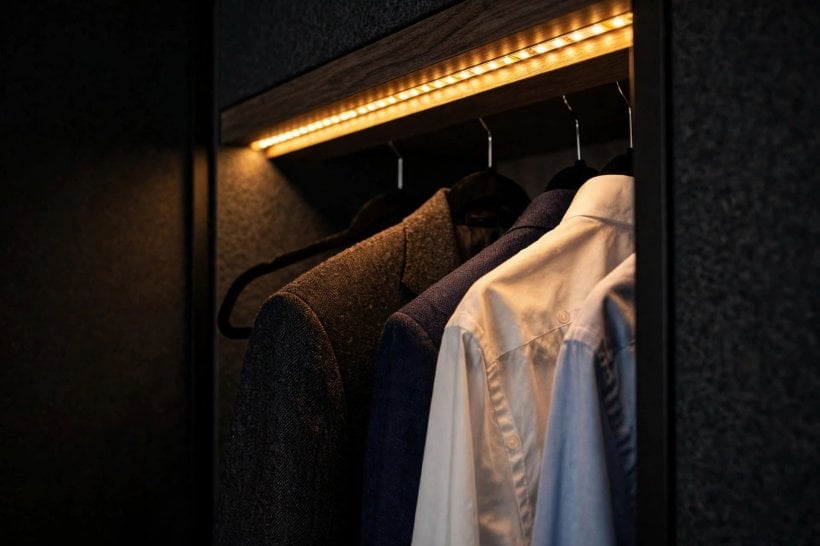
Most small closets fail on light, not space. A single warm bulb at the top of the room leaves the closet interior in shadow, so dark clothes all look alike and matching becomes guesswork. A battery or rechargeable light strip under the top shelf changes everything for very little money, and it switches on exactly where your eyes need help.
Colour works just as hard. Pale walls inside the closet bounce light back onto clothes, and slim hangers in one colour calm the visual noise. These are the same principles that make colorful tiny house interior ideas feel deliberate rather than cramped: a restful background, a few confident accents, and nothing competing for attention.
- Stick a rechargeable light strip under the shelf above the rail.
- Paint the closet interior a pale, warm shade to bounce light around.
- Use one hanger style and colour throughout for instant visual calm.
- Add a small mirror inside the door for ties, collars and final checks.
- Keep a pocket lint roller and spare buttons in a door pouch.
- Choose daylight-balanced bulbs so navy and black are easy to tell apart.
- Scent the space lightly with cedar blocks rather than sprays on fabric.
- Stand shoes on a light-coloured rack so pairs read clearly at a glance.
9. Seasonal Rotation and a Simple Maintenance Routine
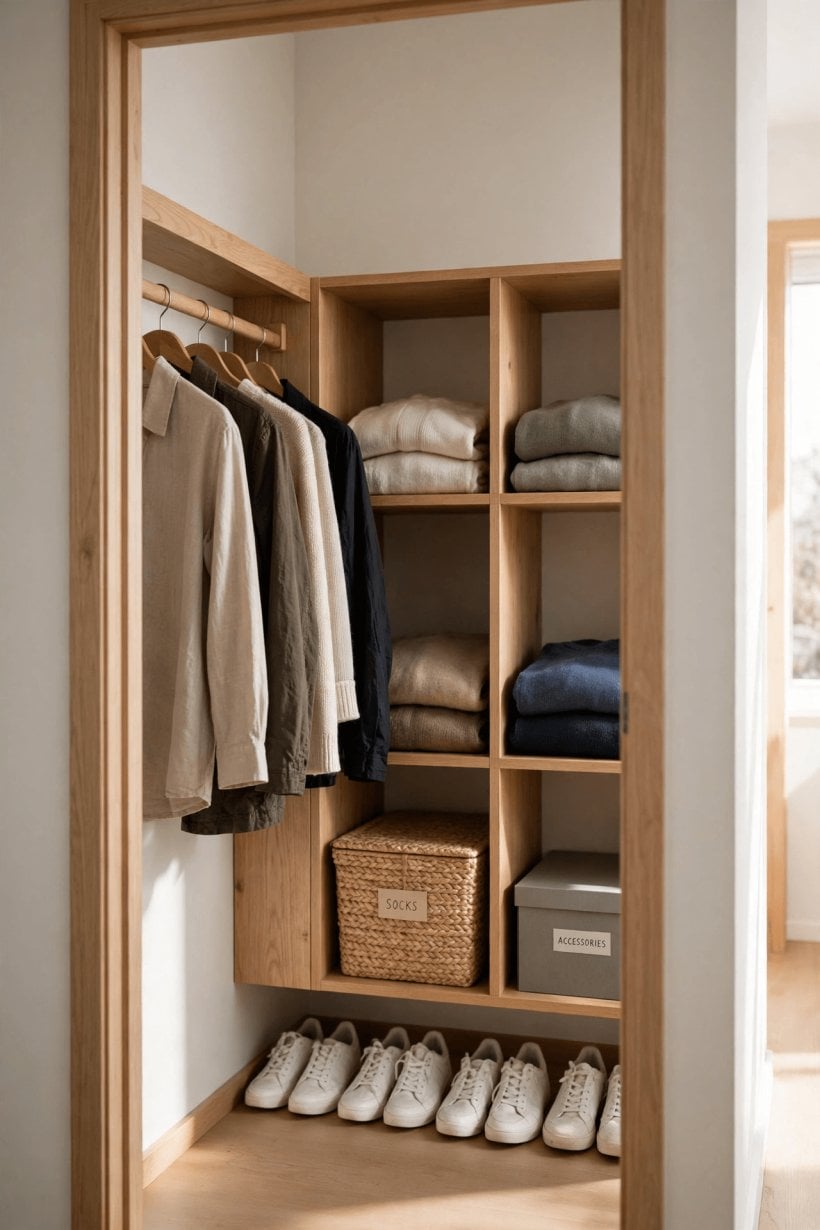
A small closet only works if it is edited. Twice a year, swap the wardrobe with the seasons: heavy coats and boots move to the top shelf, a storage box or under the bed, and the incoming season takes the prime rail space. Rotation keeps the working wardrobe lean, and it forces a regular reckoning with clothes that no longer fit, suit your life or earn their space.
Between rotations, ten minutes a month is enough. Return strays to their zones, straighten stacks, wipe the top shelf and check the light still works. Men who built their storage from scratch — like those following guides on how to build your own tiny house — tend to maintain it better, because every shelf was a deliberate decision rather than an accident.
- Rotate seasonal clothes twice a year without exception or delay.
- Store off-season pieces clean, in labelled boxes, on the highest shelf.
- Apply a one-in, one-out rule to keep total volume permanently stable.
- Donate or sell anything unworn for a full year at each rotation.
- Keep a small repair kit for buttons and loose hems inside the closet.
- Air suits and coats on a hook outside the closet after wearing them.
- Refresh cedar or lavender at each rotation to protect stored wool.
- End every month with a ten-minute straighten of rails and shelves.
10. Budget Tiers: Good, Better, Best
A better closet does not require a fitted-wardrobe budget. The good tier is pure reorganisation: a ruthless edit, matching hangers, labelled boxes and a light strip. The better tier adds hardware — a second rail, shelf dividers, a pull-out belt rack and a narrow drawer unit. The best tier is a planned system with measured rails, drawers and doors fitted to the exact space, of the kind you see in well-finished tiny barn house interiors, where storage is built into the architecture itself.
Spend in that order and stop when the closet works. Most men find the better tier solves everything: once rails, shelves and small storage are right, extra spending buys looks rather than function. Save the fitted budget for the day you renovate the room itself, and let the layout you have tested guide the design.
- Good tier: edit hard, unify hangers, label boxes, add one light strip.
- Better tier: fit a second rail and shelf dividers where heights allow.
- Better tier: add a narrow drawer unit or basket tower for small pieces.
- Better tier: swap the door for sliders or a curtain to free floor space.
- Best tier: commission measured, fitted storage only after testing a layout.
- Best tier: integrate lighting and a mirror into the fitted design.
- At every tier, buy hardware rated for the full weight of winter clothes.
- Photograph the finished closet; it is your template for keeping it tidy.
- Keep receipts and rail measurements together for painless future changes.
- Review the layout after three months and adjust one thing at a time.
- Stop spending when mornings feel easy — that is the real finish line.
Final Considerations
A small closet rewards honesty and routine far more than money. Measure properly, choose the simplest layout that fits your clothes, give small items strict boundaries, and light the space so you can actually see what you own. Rotate with the seasons, keep one-in-one-out, and the 75 ideas above will shrink into a handful of habits that keep a compact wardrobe working quietly in the background of your day — which is exactly what good storage is supposed to do.



0 Comments