

Every tiny house eventually meets its second buyer, and almost nothing about that meeting works the way house sales work. There is no multiple listing service for tiny houses, no standard appraisal method, no lender standing by with a comparable-sales printout, and — for the majority of units that sit on wheels — no real estate transaction at all in the legal sense: what changes hands is a titled vehicle with an unusually elaborate interior. Sellers discover this when the asking price they derived from build cost meets a buyer pool that prices the unit against used RVs. Buyers discover it when the perfect resale turns out to have a title in someone else’s name and a value no lender will recognise. Tiny house sales therefore reward participants who learn the market’s actual mechanics — how value is set, where listings live, and which paperwork makes a sale real.
This guide explains the resale market from the inside. It maps how the market is structured, confronts depreciation honestly, shows how title type sets the value ceiling, walks through listing channels and pricing without comparable sales, and details the sale process — viewings, offers, deposits, transport and the paper chain — before closing with negotiation from both sides. The short version: a tiny house resells at the value its documentation supports, in the channel its classification allows, to a buyer whose financing was arranged before the viewing. Everything else is decoration.
1. Tiny House Sales at a Glance
The table below answers the questions resale buyers and sellers ask first. Watch the pattern: value questions are answered by classification and documents, process questions by preparation, and almost nothing is answered by the original build cost.
| Question | Resale market in brief |
|---|---|
| How is the resale market organised? | Informally. There is no central listing service or sold-price registry for tiny houses; resales move through specialist marketplaces, general classifieds and marketplaces, dealer and builder used inventory, communities and word of mouth. |
| Do tiny houses hold their value? | It depends on classification. Wheeled units behave like vehicles and depreciate, fastest in the early years; foundation homes on owned land behave like small houses and follow their local property market. Condition and documentation move individual outcomes widely in both cases. |
| What sets the value of a used tiny house? | Title type and certification first, then condition, age, builder reputation, included land or placement rights, and the size of the realistic buyer pool — which is itself set by how the unit can be financed and where it can legally sit. |
| Where are resales listed? | On tiny-house-specific marketplaces and listing groups, general online marketplaces and classifieds, through builders and dealers taking trade-ins or selling used stock, and inside tiny-house communities where units change hands with their lots. |
| How are they usually priced? | By the seller’s anchor — original cost, remaining loan, or a similar unit seen advertised — corrected slowly by time on market. Documented, certified units in financeable classifications price highest and sell fastest. |
| What paperwork completes a sale? | For wheeled units: title transfer, bill of sale, lien release where applicable, and registration by the buyer. For foundation homes: a normal property conveyance for the house and land, or a personal-property sale where the house alone is sold for removal. |
| What kills resale deals? | Title defects, unfinanceable classifications, transport costs nobody budgeted, placement the buyer cannot legally use, and condition surprises an inspection would have priced at viewing stage instead of at the point of collapse. |
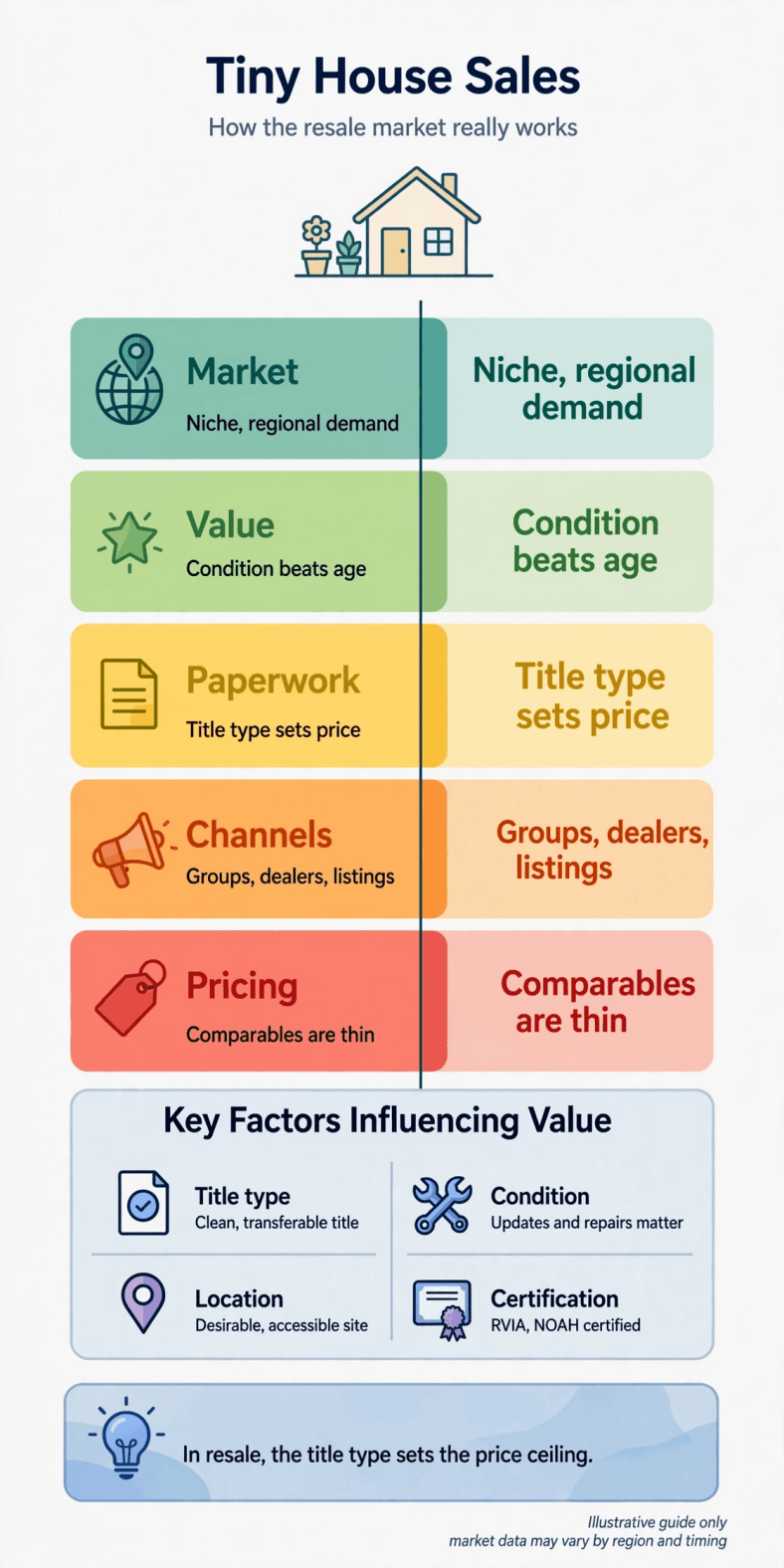
Infographic: resale value follows the title — RV, manufactured or real property — and the paperwork behind it.
2. How the Resale Market Is Structured: No MLS, No Centre
Conventional housing sells inside an institution: licensed agents, a listing service recording every offer and outcome, appraisers working from registered comparable sales, and lenders whose products assume all of it exists. Tiny house resale has none of these layers. Listings are scattered across specialist and general channels with no shared format, asking prices are rarely accompanied by sold outcomes, and the same unit can be — and often is — advertised in three places at three prices. The market is real, active and growing, but it is a bazaar, not an exchange, and both sides’ strategies should be set accordingly.
Thinness is the structural fact that follows. For any given unit — this size, this classification, this region, this month — the realistic buyer pool is small, geographically scattered and financing-constrained (Section 7 of our micro homes guide and the financing discussion below explain why). A thin market does not mean a bad market; it means prices are discovered by negotiation over time rather than quoted by an index, time-on-market is measured in months more often than weekends, and the spread between the best and worst outcome for the same unit is wide — which is precisely why preparation, documentation and pricing discipline pay so disproportionately here.
The cast is correspondingly mixed. Sellers are mostly private owners exiting a life stage, plus builders and dealers moving demonstrators, trade-ins and the occasional repossession. Buyers range from first-timers comparing against new builds, to downsizers and landowners adding a unit, to park and community operators buying stock. Each arrives with different financing, different time horizons and different ideas of what the unit is — and the listing that speaks clearly to all of them, classification and paperwork up front, starts every negotiation two steps ahead.
3. Depreciation Reality: Vehicles Depreciate, Houses Behave Differently
Here is the fact the resale market is built on: a tiny house on wheels is, financially, a vehicle, and vehicles depreciate. The steepest value loss comes early — the premium a first buyer paid for a new, custom, warrantied build does not transfer to the second buyer, who is purchasing a used unit with unknown history — and decline continues with age, mileage-equivalent wear, and the condition of the trailer and systems underneath the interior. Quality builders, certification and documented maintenance flatten the curve; they do not reverse its direction. Sellers who price a three-year-old wheeled unit at its build cost are not testing the market, they are declining to join it, and their listings age in public while documented units priced to the curve sell around them.
Foundation tiny houses live in a different economy. A code-built small house on owned land is real property: its resale value is the land value plus the value the local market assigns to a small dwelling on it, moving with that market rather than with a depreciation schedule. Such homes can hold or gain value — and can also be illiquid in thin rural markets or where the small size narrows the buyer pool — but the mechanism is property logic, not vehicle logic. Manufactured and modular units sit between: titled and financed as manufactured housing, valued by that market’s appraisals and the condition of the placement beneath them.
The honest summary for owners is two-part. First, expect a wheeled tiny house to be worth meaningfully less than it cost, with the gap set by age, condition and documents rather than by hope; treat any better outcome as a pleasant outcome, not an entitlement. Second, recognise what slows the loss: recognised builders, RVIA certification and why it matters, service records, quality trailers, and interiors that age gracefully. Depreciation is not a reason to avoid buying; it is a reason to buy used at the curve’s flat end, or to buy new with eyes open and a long holding horizon — the two strategies this market consistently rewards.

Pin it: wheels depreciate like vehicles; foundations follow the property market.
4. Title Type Sets Value: RV vs Manufactured vs Real Property
If one variable could be printed on every resale listing, it should be the title type, because it caps everything else. An RV-titled tiny house sells into the vehicle economy: buyers compare against used RVs and park models, lenders offer vehicle-style financing to those who qualify, insurers price it as a vehicle, and placement depends on RV rules. Within that economy, certification, brand and condition differentiate; outside it, the unit cannot borrow the housing economy’s higher values no matter how residential its interior looks. Sellers who understand this price into the right comparison set and sell; sellers who price an RV-titled unit against foundation cottages wait.
Manufactured title (HUD-code) units trade in the manufactured-housing economy: their own lenders, appraisals and buyer pool, with value sensitive to whether the home sits on owned land, in a community on a rented lot, and in what condition the running gear and set-up remain. Real-property homes — foundation-built, or manufactured units legally converted to real property with land — access the full housing economy described in Section 3, including mortgage financing for buyers, which enlarges the pool and supports the price more than any single feature of the house itself.
Untitled and informally documented units form the market’s basement. A home-built wheeled unit may be excellent and still sell at a steep discount purely because the buyer inherits the titling problem: how to register a tiny house as an RV is a solvable project in many jurisdictions, but the solving takes time, fees and uncertainty that a rational buyer prices off the offer — or walks away from, which is the same discount taken in full. The lesson generalises beyond titles: every missing document is a price reduction wearing a disguise, and sellers recover more value by curing paperwork before listing than by any cosmetic improvement of equivalent cost.
5. Where Resales Are Listed and How Long They Take
Resale listings concentrate where the audience already is. Tiny-house-specific marketplaces and listing communities offer the most informed traffic — buyers there search by classification, size and region, and listings carry the fields this market actually prices. Our search guide, tiny homes for sale near me, explains how those channels organise local inventory. General marketplaces and classifieds add raw reach at the cost of naive enquiries; builders and dealers add a smaller, curated channel — used stock, demonstrators and trade-ins — with the paperwork standards of a business seller and, often, some warranty or inspection behind the unit.
Communities are the quiet channel. In tiny-house villages, RV parks that host long-term units and manufactured-home communities, resales frequently transfer with a lot position or an approved tenancy — a placement right that is itself a large part of the value (Section 4’s logic in reverse: legal placement is scarce, so a unit that includes it sells into a premium). These sales may never reach a public listing, which rewards buyers who register interest with communities directly and sellers who notify theirs before advertising widely.
Time-on-market deserves honest expectations. A well-documented, realistically priced unit in a financeable classification, within reach of a population centre, can sell in weeks. The same quality of unit at an aspirational price, in a remote location, in an unfinanceable classification, can sit for seasons — not because it is unwanted, but because the intersection of buyers who want it, can pay for it and can legally place it is genuinely small. Sellers should plan the campaign (channels, season, price steps) rather than the announcement, and buyers should read a long-listed unit’s history as information: time is the market’s review, and it is usually about price and paperwork, not about the house.
6. Pricing a Used Tiny House Without Comparable Sales
Pricing without a comparable-sales registry is an exercise in triangulation. Start from the replacement anchor: what the equivalent new unit costs today, from a builder’s current pricing for a like specification, less a realistic allowance for the value a new unit carries that a used one does not (warranty, freshness, customisation to the first buyer’s taste). Cross-check against the classification floor: what similar-classified vehicles or manufactured units of like age and size actually sell for in the general channels — asking prices of sold-where-visible listings, dealer used pricing, and RV value guides where the classification fits them. Then adjust for the specific unit with the discipline of Section 7: condition findings, documentation completeness, included equipment, placement rights, and the transport distance to the likely buyer pool.
Two anchors to refuse: the seller’s build cost (a sunk number the market never agreed to) and the outstanding loan balance (a fact about the seller’s financing, not about the house). Both produce the market’s signature artefact — the listing priced at a memory, reduced in public steps across months, training buyers to wait for the next cut. The true cost of tiny houses, prefab vs DIY helps buyers rebuild a unit’s original cost structure honestly, which is the right starting point for both sides: cost explains what a thing is, while the market decides what it is worth, and confusing the two is the resale market’s most expensive habit.
Practical pricing follows: choose the number the triangulation supports, list once at that number with complete documentation, and define in advance the evidence that would justify a change — enquiry quality, viewing conversion, comparable listings’ movement — rather than the calendar. Buyers, symmetrically, should build their own triangulation before viewing and negotiate from it. In a market without published outcomes, the party with the better private evidence wins the negotiation more often than the party with the stronger personality.
7. Condition, Certification and Documentation Premiums
Condition is where resale value is physically kept or lost, and tiny houses have their own failure geography: water ingress at roof penetrations and window corners, floor and wall moisture in bathrooms and under sinks, trailer rust and tyre age on wheeled units, appliance and heating-system age everywhere. Our inspection walkthrough, how to inspect a used tiny home before buying, details the checks; for sellers, the same list read backwards is a pre-listing programme. The economics are asymmetric in the seller’s favour: the known defects buyers discount most heavily are mostly cheap to cure (seals, tyres, servicing, minor repairs), while uncured they are priced by buyers as unknowns — and unknowns are always priced as worst cases.
Certification is a transferable asset in a way condition is not. An RVIA or equivalent certification, a HUD label, modular documentation — these survive the sale, satisfy lenders and insurers the seller will never meet, and convert the buyer’s largest uncertainty (what is this thing, legally?) into a fact. Original build documentation compounds it: plans, manuals, appliance documents, the builder’s identity and contactability, service and repair records, weight tickets, title history. Market veterans call this the folder, and in private sales the folder is worth a measurable premium because it is the only due diligence the buyer gets.
Sellers should assemble the folder before listing and photograph its key pages into the advertisement; buyers should ask for it before travelling, and treat its absence as a finding, not a neutral gap. Two units identical in condition separate by their paperwork alone: the documented one attracts financed buyers (a larger pool), insures cleanly, and resells again on the same documentation. That compounding is why this guide keeps returning to paper — in the resale market, documentation is not administration. It is specification.
8. The Sale Process: Viewings, Offers, Deposits and Transport
A tiny house sale runs in the same phases as any vehicle or property sale, compressed and informal — which is exactly why writing each phase down matters. Enquiry and viewing: buyers inspect against Section 7’s list, sellers disclose known defects in writing; both behaviours predict a closing. Offer: a written figure with conditions stated — inspection, financing, placement confirmation, transport arrangements — and a date, because an oral understanding about a movable asset is a misunderstanding with a deposit attached. Agreement: a written contract or bill-of-sale framework naming the unit by its identifiers, the price, what is included, who moves it, when risk passes, and what happens to the deposit if a condition fails.
Deposits and payment are where informality draws blood. Use traceable payment, size the deposit to the commitment rather than to trust, and hold larger balances against the documents they depend on: title sighted before deposit, title transferred with final payment, keys and unit released against cleared funds. Buyers arranging finance should sequence honestly — how to finance a tiny house sets out the products a used unit can realistically use — and sellers are entitled to proof of funds or pre-approval before taking a unit off the market, a step skipped surprisingly often because the amounts feel informal.
Transport closes the process and deserves its own line in the contract. A wheeled unit must be collected or delivered by someone, on a date, by a route, at a cost — our tiny house moving guide and its transport costs shows why that figure belongs in the negotiation rather than in the buyer’s first week of ownership. Sellers should state the unit’s towing requirements factually; buyers should confirm their vehicle or contractor before completion, insure from the moment risk passes (tiny house insurance for wheels vs foundation covers both classifications), and plan the first tow in daylight, in weather, with the manual in the cab. The sales that sour at the kerb are remembered by both sides; the paperwork that prevents it is two paragraphs long.

Pin it: title sighted before deposit, balance against transfer, transport in the contract.
9. Paperwork: Title Transfer, Bills of Sale and Liens
The legal core of a wheeled tiny house sale is a vehicle transfer, and it should be executed with vehicle discipline. The title must be in the seller’s name, free of undisclosed liens, with the unit’s VIN or serial matching the physical plate; a title in a previous owner’s name (an open or jumped title) is a defect to be cured by the seller before sale, not inherited by the buyer at a discount unless the discount honestly prices the risk and the jurisdiction’s cure process is understood. Lien releases accompany payoff situations in writing. The bill of sale records parties, identifiers, price, date, included equipment and any conditions — the single document that later proves what was actually agreed.
Foundation and manufactured sales follow their own tracks. A foundation home sold with land is a conveyancing exercise indistinguishable from any small house sale: deed, disclosures as local law provides, and closing through the usual professionals. A manufactured home may transfer by title, by deed where it has been converted to real property, or by both in sequence — a detail buyers must verify rather than assume, since a deed to land alone does not transfer a titled home standing on it. A foundation home sold for removal (house only, land excluded) is a personal-property sale plus a moving contract, with permits for the move and a foundation left behind to be dealt with in the price.
After completion, the unglamorous tail matters: buyer registers and titles promptly, seller notifies their insurer and, where the system provides, files a release of liability; both keep copies of everything. Sales that skip the tail generate the market’s folklore — fines arriving at a seller for a buyer’s unregistered unit, a buyer unable to title a home two owners later. Paperwork is the resale market’s memory; write it as if a stranger will rely on it, because one will.
10. Negotiation From Both Sides of the Table
Negotiation in a thin, undocumented market is an evidence contest, and Section 6’s triangulation is the ammunition for both sides. Sellers negotiate best from completeness: the folder open on the table, condition findings already priced, transport and placement facts stated — a posture that converts buyer scepticism into arithmetic. The seller’s genuine levers are patience (a correctly priced documented unit in a thin market is a waiting asset, not a wasting one), flexibility on the movable terms (collection timing, included equipment, delivery assistance) rather than on price alone, and the discipline to decline theatrical offers without closing the door on the bidder’s second, serious one.
Buyers negotiate best from alternatives and readiness. Cash or confirmed financing, a priced transport plan and a placement already confirmed give a buyer the one thing sellers in slow markets value over small price differences: certainty of completion. Findings-based adjustments — inspection items with quotes attached, documentation gaps with cure costs — are respected because they are verifiable; global discounts demanded without findings are correctly read as sport. And both sides should remember the thin market’s arithmetic: the next equivalent unit, or the next qualified buyer, may be months away, which makes a fair agreement today worth more than a theoretical better one in a season neither party can schedule.
What neither side should negotiate away is the written record. Price concessions traded for skipped inspections, deposits without receipts, titles to follow by post — these are not flexibility, they are the conversion of a small price gain into an uncapped legal exposure, in the market segment least able to absorb it. The resale market’s experienced hands are recognisable by a single trait: they are boring on paper and interesting only in their houses. Imitate them.
Final Considerations
Tiny house resale works — units change hands constantly, at prices both sides accept — but it works on vehicle-and-paperwork logic, not on house-sale habit. Sellers who classify honestly, document completely, price from triangulation and write the process down sell into the strongest pool this thin market offers. Buyers who inspect in the right order, verify title before money, and price transport and placement into the offer buy the unit that was actually advertised. Meet in that posture and a tiny house sale is what it should be: a small home beginning its second life with its value, and its paperwork, intact.