
Power is the invisible system that decides whether a tiny house feels like a home or a campsite, and the choice of solar vs grid power tiny house owners face is really a choice about where your electricity comes from for the next twenty years. Grid power is the utility’s product: a meter, a monthly bill, and effectively unlimited electricity delivered down a wire. Solar power is your own small power station: panels on the roof, a battery bank in the cupboard, and an inverter quietly turning sunlight into the electricity your life runs on. Both will light the same lamps and charge the same laptops — the differences live in the costs, the constraints and the kind of freedom each one buys.
This comparison breaks the money down honestly — upfront, monthly and long-term — and then looks past the money at winter reliability, battery replacement, permits, and the off-grid independence that never appears on a spreadsheet. There are no invented tariffs or payback promises here, because electricity prices, connection fees and sunshine hours are local numbers. Instead, costs are framed the way they behave in practice, the hybrid route gets its own section, and anything you must price locally is flagged as a check to run before you decide.
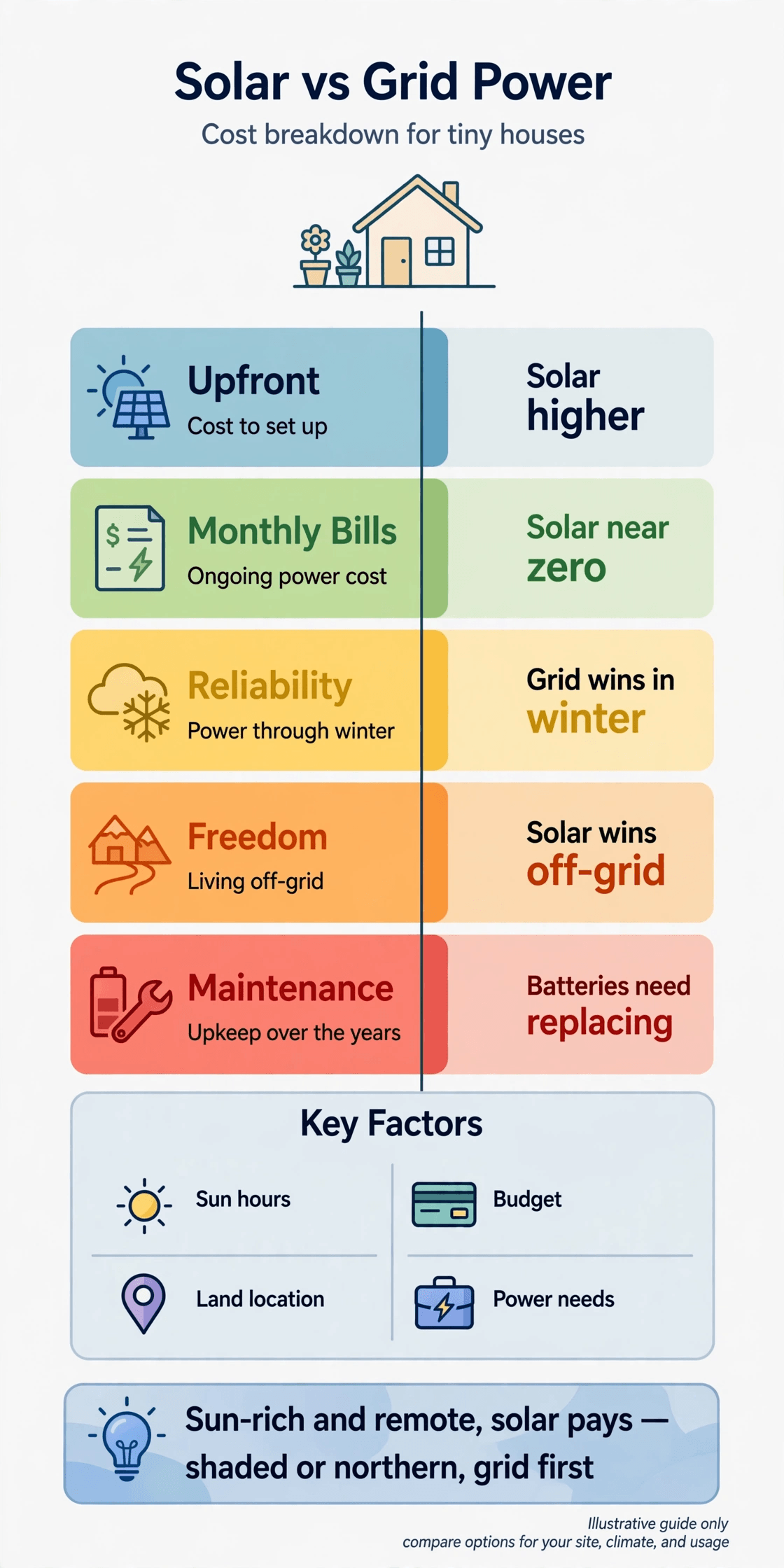
Solar vs Grid Power Tiny House at a Glance
| Criterion | Solar Power (Off-Grid) | Grid Power |
|---|---|---|
| Upfront cost pattern | Panels, battery bank, inverter and charge control — a significant system purchase, sized to your loads | Connection fee, trenching or poles, meter and internal wiring — varies hugely with distance to the nearest line |
| Monthly cost | No electricity bill; costs shift to maintenance and eventual battery replacement | A predictable monthly bill: standing charge plus whatever you use, which in a tiny house is usually modest |
| Winter reliability | The hard season: short days and weather cut generation exactly when heating and lighting loads rise | Consistent year-round, apart from storm outages that affect everyone on the line |
| Freedom and placement | Total: any sunny plot, no utility negotiation, no trenching across a field | Tied to serviced land or to the cost of bringing service to unserviced land |
| Capacity | Capped by your system — heavy loads (electric heating, big air conditioning) need discipline or a bigger bank | Effectively uncapped for tiny-house purposes; run what you like, when you like |
| Maintenance | Yours: panel cleaning, battery care and monitoring, component replacement over the years | The utility’s problem up to the meter; inside the house, ordinary electrical upkeep only |
| Best for | Remote or unserviced land, mobile homes, and owners who value independence over capacity | Serviced plots, permanent homes, heavy electrical loads and anyone who wants power to be boring |
1. The Two Power Routes Explained: Making Your Own vs Buying It In
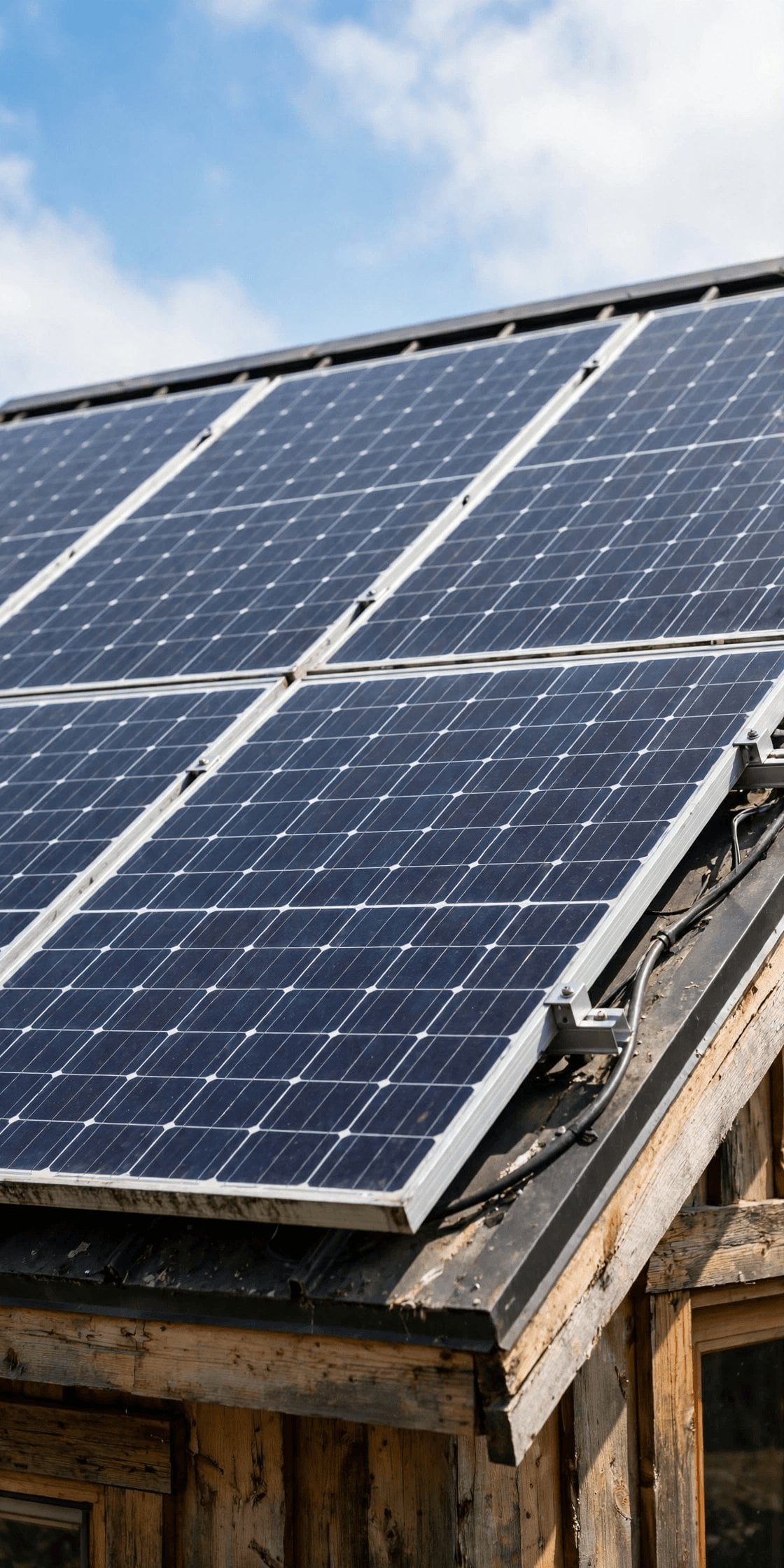
A solar setup for a tiny house has four working parts. Panels generate direct-current electricity whenever light falls on them. A charge controller manages that flow into a battery bank, which stores energy for the evening, the night and the cloudy days. An inverter converts stored DC into the ordinary AC electricity your sockets deliver. Everything you use must first be generated and stored by this chain — which is why solar living begins with an energy budget rather than an appliance catalogue. Our guide to solar panel kits for tiny homes and how to size a battery bank walks through that chain component by component.
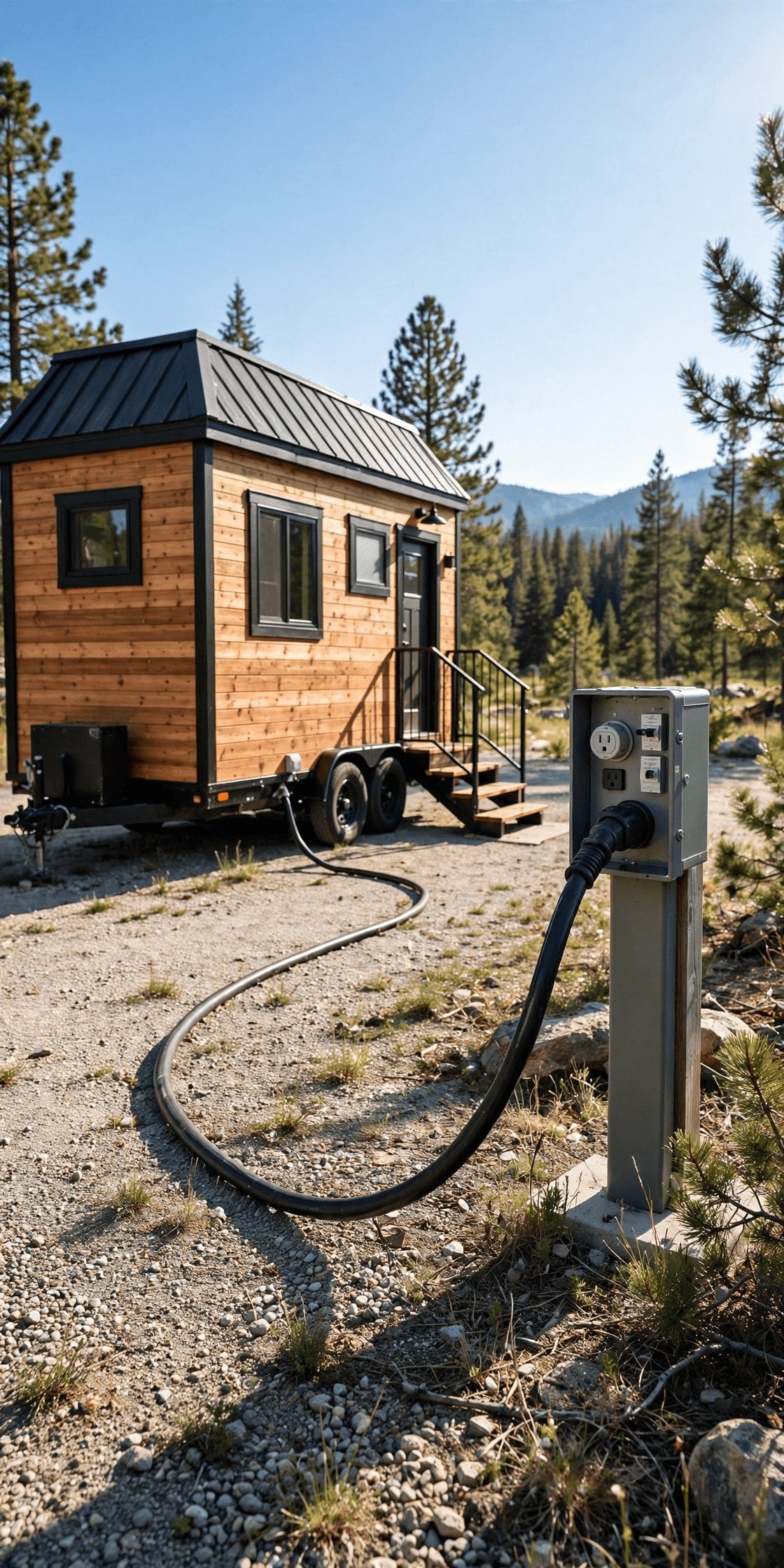
Grid power inverts the logic: generation and storage happen somewhere else, at utility scale, and your house simply draws what it needs through a meter. For a tiny house, the connection itself can be as simple as a hookup pedestal in a park or as involved as a new service drop, trench and meter base on raw land. Either way, once connected, electricity behaves the way it does in any house — which is precisely grid power’s appeal. Our overview of tiny house utilities sets both routes in context alongside water and sewage, because in practice the three decisions are usually made together, plot by plot.
2. Upfront Cost: Panels, Batteries and Inverters vs Connection and Wiring
Solar’s upfront cost is a system price, and its shape is consistent: the battery bank is commonly the largest single element, followed by panels, the inverter-charger, mounting hardware, cabling and the safety gear a proper installation needs. A modest system sized for lights, devices, a fridge and water pumping in an efficient tiny house sits at the accessible end of the market; a system asked to run electric heating, air conditioning and a full-size laundry sits at a very different one. The honest way to shop is to size from your load list first — section 4 — and price the system that list demands, rather than starting from a kit and hoping your life fits inside it.
Grid connection costs are the opposite shape: trivial in one situation, enormous in another. On a serviced plot, in a park, or beside an existing supply, connection can mean little more than an electrician’s visit, a meter arrangement and the utility’s standard fee. On raw land far from the nearest line, it can mean trenching or poles across a long distance at a per-metre price that turns “cheap” grid power into the most expensive option on the table — sometimes rivaling the land itself. This is why no universal winner exists in this section: the distance from your plot to the nearest transformer is a bigger cost factor than any equipment choice. Our guides to the true cost of tiny houses and how to prepare land for a tiny house both treat utility connection as a first-order budget line for exactly this reason. Price your actual connection before romanticising either route.
3. Monthly Bills and the Long View of Ongoing Costs
Once installed, the monthly picture reverses. Solar sends no bill. Your ongoing costs are the quiet ones: an occasional replacement component, distilled water for some battery chemistries, cleaning materials, and the eventual battery replacement covered in section 7. Grid power sends a bill every month for as long as you live there — but for a tiny house it is usually a small one, because a small, well-insulated home with efficient appliances simply does not use much electricity by household standards. The standing charge — the fixed daily fee for being connected at all — can form a surprisingly large share of a tiny bill, which is worth knowing before assuming grid power is the expensive habit.
Payback arguments deserve suspicion in both directions. Solar advocates sometimes compare system cost against a conventional house’s electricity bill, which a tiny house will never generate; grid advocates sometimes ignore the connection quote that made their “cheap” power expensive. The clean way to compare is over your expected years in the home: connection cost plus the stream of small monthly bills, versus system cost plus battery replacements on their realistic cycle. Neither total is knowable without your local tariff, your local connection quote and your honest usage estimate — which is why this article gives you the structure and leaves the arithmetic to your numbers.
4. How Much Power a Tiny House Actually Uses: Sizing Honestly
Every solar disappointment and every grid surprise starts in the same place: a wrong guess about consumption. A tiny house’s efficient core — LED lighting, a modern small fridge, device charging, a water pump, a laptop or two — sips electricity, and a modest system or a small monthly bill covers it easily. The loads that change the story are the thermal ones: electric space heating, electric water heating, electric cooking, air conditioning and laundry machines. Heat from electricity is where budgets go to be humbled, on either system.
This is why many tiny houses split their energy by fuel: propane or wood for the heavy thermal work, electricity for everything else. Our comparison of propane vs electric in tiny houses works through that split in detail, including how to calculate your real energy demand before sizing anything. Appliance choice matters just as much at the small end — our guide to the best compact kitchen appliances for tiny houses covers the efficient end of the market. Do the load audit before pricing either power route. On solar, it sets the system size; on grid, it tells you whether your bill will be trivial or merely small; in both cases, it is the most valuable hour of the whole project.
5. Winter Reliability: Short Days, Snow and Storms
Winter is solar’s examination season, and honest owners say so. Generation falls with the short days and low sun just as lighting hours lengthen and heating loads climb; a run of overcast days draws the battery down; snow can cover roof panels until it slides or is cleared. A well-designed system handles this with margin — a bank sized for several grey days, panels tilted to shed snow and catch low sun, and loads managed with discipline. An undersized system handles it with a generator, which is why so many off-grid tiny houses quietly keep one as backup. None of this is failure; it is the physics of the route, planned for or suffered through.
Grid power’s winter story is simpler: the same supply as July, unaffected by your latitude’s mood. Its weakness is different — the storm, the fallen branch, the ice on the line — outages that arrive without asking and end when the utility’s crews reach you, which on a rural line can take a while. Our notes on tiny house living in cold climates cover keeping a small home safe and warm through that season, and our guide to how to heat a tiny house compares the heating systems whose electricity appetite decides how much winter reliability you actually need. The fair summary: solar’s winter is a design problem you solve once; the grid’s winter is an outage risk you share with everyone.
6. Off-Grid Freedom: Land, Independence and Mobility
Solar’s most valuable product is not electricity — it is address independence. A solar tiny house can live on the unserviced plot the grid cannot reach without a five-figure trench: the view at the end of the track, the family land with no meter, the cheap acreage everyone else passed over because power was “too far away”. It also pairs naturally with a wheeled home, moving when the home moves, and it shrugs off utility outages entirely — your lights stay on while the neighbourhood’s go out, a satisfaction owners describe with unreasonable smugness.
The freedom has a price list, and it is section 4’s list: capacity discipline. Off-grid living means knowing what your system can run simultaneously, watching the battery gauge the way sailors watch the weather, and accepting that some appliance habits from grid life do not survive the move. For many owners that awareness is a feature — a closer relationship with the energy their life uses — and portable off-grid power stations can add a flexible buffer for tools, guests or backup. Grid power offers the opposite freedom: freedom from thinking about electricity at all. Both are real freedoms. The comparison goes wrong only when a buyer expects to get both from the same wire.
7. Batteries: Lifespan, Replacement and Maintenance
The battery bank is solar’s subscription — the one component with a definite lifespan that will ask for replacement money during your ownership. How long that takes depends on chemistry and treatment. Traditional lead-acid banks are cheaper to buy and shorter-lived, need their charge kept up and their water checked, and dislike being deeply discharged. Lithium iron phosphate banks cost more upfront, tolerate deep cycling far better, ask for almost no routine care, and commonly serve far longer — which is why most new tiny-house systems choose them despite the sticker. Either way, the bank is a consumable on a long cycle, and a budget that ignores its replacement year is a fantasy budget.
Grid power has no equivalent line item — the utility maintains its infrastructure and spreads the cost through the tariff, which is part of what your monthly bill buys. Solar owners can soften the battery reality with behaviour: sizing the bank generously so cycles stay shallow, keeping lithium banks within their comfortable temperature and charge ranges, and monitoring state of charge rather than guessing. When replacement day comes, prices and chemistries will have moved on — usually in the owner’s favour, historically — and the rest of the system, panels especially, typically has years of life left. Treat the bank as the roof of the system: a major component with a known lifespan, planned for from the start.
8. The Hybrid Route: Grid-Tied Solar and the Best-of-Both Answer
For a great many tiny houses, the honest winner of this comparison is neither contestant. A hybrid setup connects the home to the grid and adds solar panels — with or without a battery — so the two sources cover each other’s weaknesses. Solar carries the daytime and much of the annual load, trimming the monthly bill; the grid absorbs winter, heavy loads and every moment the panels cannot. Add a modest battery and the system also rides through outages, keeping the fridge, lights and pump alive while the street goes dark. It is not the cheapest option upfront, but it is frequently the cheapest option per unit of worry.
Hybrids also phase beautifully. Connect to the grid now, add panels when the budget recovers, add the battery when an outage annoys you enough — each step is independent. Designing the house for that future helps: our roundup of solar-ready tiny house layouts shows how roof angle, orientation and plant-room space are planned in from the start so panels and batteries arrive as upgrades rather than surgery. A wheeled hybrid variant exists too — shore power at the pitch, solar for the road and the off-grid weeks between pitches. If your land is serviced and your plans are settled, start the decision here and make the pure options argue their way past it.
9. Permits, Inspections and Selling Power Back
Grid work is regulated work, on both routes. A new grid connection involves the utility’s process, permitted wiring and inspection to code — unglamorous, standardised, and an asset at resale because everything is documented. Grid-tied solar adds the utility’s interconnection agreement on top: the system must shut down safely during outages to protect line workers, the meter may be changed for a bidirectional one, and whether you are paid, credited or neither for power you export depends entirely on your local net-metering rules — check them before counting export income in any payback sum, because policies differ by state and utility and they change.
Pure off-grid solar sits lighter on paperwork in many places, but “lighter” is not “none”: electrical work in a dwelling still answers to code in most jurisdictions, insurers take an interest in battery installations, and a wheeled home’s electrical certification can matter for parks and policies. The reliable approach is the one this series always lands on: ask the local building and electrical officials what applies to your specific setup, and read our guide to zoning laws for tiny houses for how those conversations usually go. Documentation is value — permits and inspection records for a grid or hybrid system, manuals and receipts for an off-grid one.
10. Resale, Rental and What the Next Owner Wants
Power systems follow the house into its next life, and buyers read them quickly. A grid-connected tiny house on its own land is the simplest sale in this whole comparison: the system is invisible, standard, and every buyer’s lender and insurer already understand it. A documented solar or hybrid system can be a genuine asset in the off-grid and eco-minded market — a working, well-kept installation saves the next owner the entire setup cost — but an ageing, undocumented battery bank reads as a liability, and some buyers will price a replacement into their offer on the spot.
Rental tilts further toward boring. Guests do not want a battery briefing; short-stay platforms and local rules assume ordinary utilities, as our guide on how to rent your tiny house on Airbnb explains. A grid or hybrid home rents itself; an off-grid solar rental needs load instructions and a host willing to support them. If you are buying a used tiny house with a solar system, our checklist for how to inspect a used tiny home before buying covers the questions — battery age and chemistry, panel condition, inverter history — that separate an asset from a project. Whichever route you build, keep the paperwork: in power systems, documentation is half the resale value.
Final Considerations
So, who should pick which? Choose solar if your land is unserviced or far from a line, if your home is on wheels or your life may move, if your electrical loads are modest and mostly non-thermal, and if independence — from bills, from outages, from utilities altogether — is something you will actively enjoy rather than merely endure. Choose grid power if your plot is serviced or cheaply connectable, if you want heavy appliances and electric heating without a second thought, if the home will be rented or sold into the conventional market, and if you want electricity to be the one system in the house you never think about. And give the hybrid a serious look if your land is serviced but your instincts are solar: for settled tiny houses, it is very often the answer the pure comparison was pointing at all along.
Three checks before you commit. First, get the real grid number: a written connection quote for your actual plot, because that single figure decides more comparisons than any panel price. Second, do the load audit from section 4 and size a solar system against your worst winter week, not your best summer day. Third, price both routes over your realistic years in the home — connection plus bills, or system plus one battery replacement — using your local tariff, not a national average from the internet. Power is the system your tiny house will use every single day. Choose the route whose costs, chores and freedoms match the life you are actually going to live inside it.


0 Comments