

A modern living room earns its calm the hard way: nothing in it is accidental, nothing is there to fill a gap, and every object has passed the same quiet test — does it work, and does it deserve the space?
These 75 modern living room ideas stay inside the modern lane: clean lines, honest materials, restrained colour and layouts with air in them, from the first plan to the last lamp.
1. Modern Living Room Ideas at a Glance
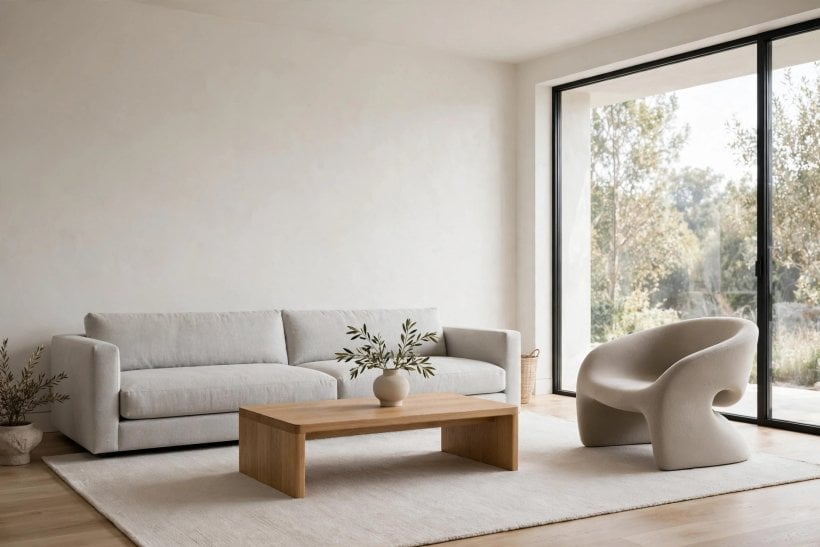
The central entity is the living room in its modern form: a shared living space built on simple geometry, uncluttered surfaces and materials shown as themselves — timber as timber, stone as stone, metal as metal. Its attributes are layout, seating, colour, material, light and storage, and the modern discipline is subtraction: each attribute is resolved plainly, then everything that adds nothing is removed.
| What defines the modern style? | Clean lines, low and simple furniture forms, a restrained palette, natural materials and clear surfaces. Ornament comes from proportion and texture, never from applied decoration. |
| Where do I start? | With the layout and the sofa. Fix the room’s geometry first; colour, lighting and objects all hang off where people sit and how they move. |
| How do I stop it feeling cold? | Warmth in a modern room comes from texture and tone, not clutter: real timber, wool, linen, boucle and warm-white light layered over the calm base. |
| What colours work? | Warm whites, soft greys, charcoal, black accents and one measured colour at a time, carried by the largest soft pieces rather than scattered in accessories. |
| What is the biggest mistake? | Buying the look piece by piece. A modern room is a system; unmatched impulse purchases break its lines faster than any single wrong colour. |
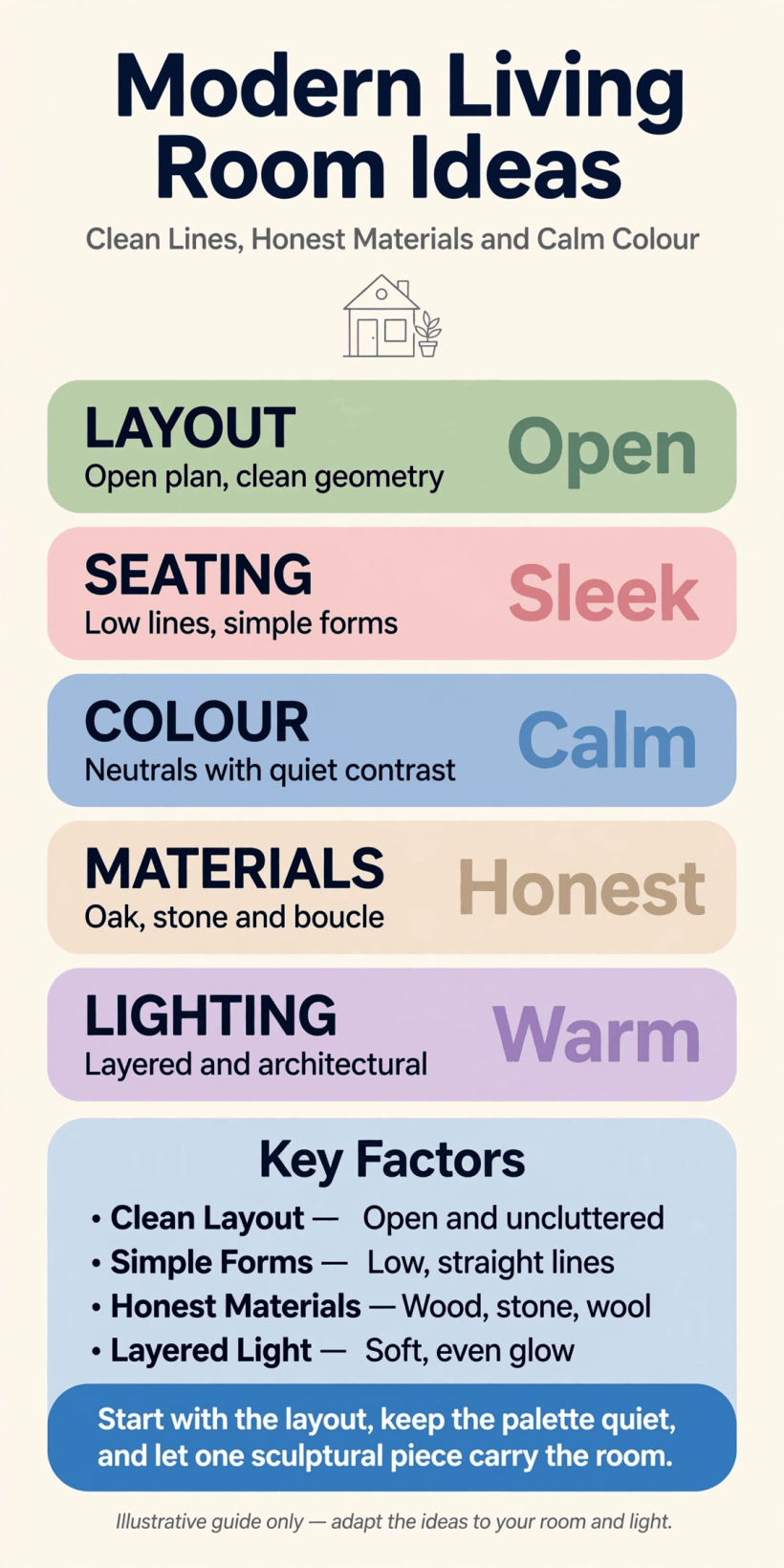
At a glance: simple geometry first, low seating as the anchor, a restrained palette, honest materials, hidden storage, and texture doing the warming.
2. Layouts: Open Plans and Clean Geometry
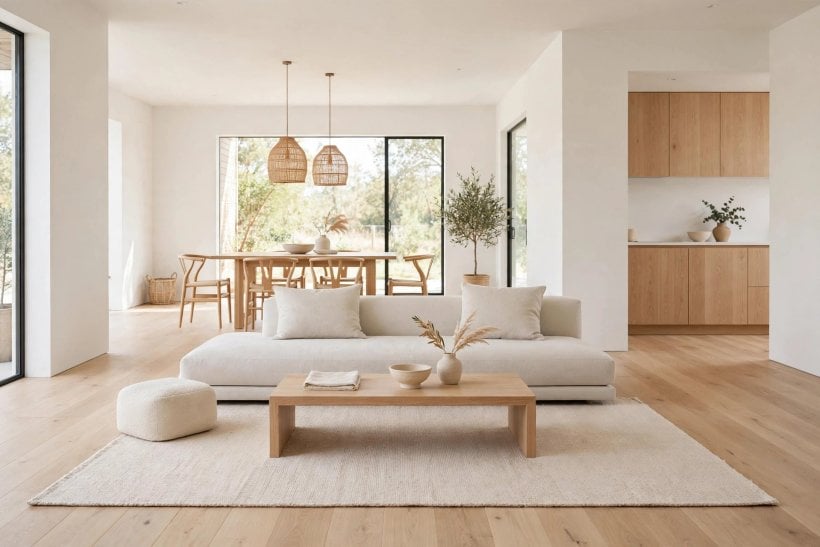
Modern layouts begin from the room’s geometry: straight sightlines, furniture aligned to the architecture, and space left deliberately empty. This post is the modern-style companion to the living room ideas pillar, which covers the room in full; here, every layout decision is filtered through the modern lane only.
1. Align the Furniture to the Room’s Geometry
Sofas, rugs and shelving should echo the room’s own lines — parallel to walls, centred on openings, squared to the fireplace or window wall. Alignment is the cheapest modern effect there is: it costs nothing and calms everything.
2. Keep the Sightlines Long
Modern rooms read from end to end. Keep tall pieces at the edges and low pieces in the middle so the eye travels the full length of the room without hitting a wall of furniture.
3. Leave Breathing Space Around Every Piece
Air is a material in modern design. A gap between sofa and wall, a margin around the rug, an empty stretch of floor — these pauses are what separate modern calm from a showroom squeeze.
4. Float the Seating Group in Open Plans
In an open plan, anchor the living zone on a large rug and float the sofa with its back to the dining or kitchen zone. The group becomes a room within the room, defined by furniture rather than partitions.
5. Give the Room One Focal Line
Choose the axis the room organises around — a window wall, a fireplace, a media wall — and arrange everything in deference to it. Two competing focal points is the fastest way to make a modern room feel restless.
6. Use a Single Large Rug to Hold the Group
One generous rug under the whole seating group reads as a single calm field. Multiple small rugs chop the floor into patches and fight the clean geometry the style depends on.
7. Keep Walkways Straight and Wide
Modern circulation is direct: door to sofa, sofa to kitchen, no diagonal weaving around obstacles. Map the routes first and let no coffee table, plant or pouffe drift into them.
8. Zone with Level and Light, Not Screens
In open plans, separate zones with a change of rug, a pendant line or a low console rather than dividers. The space stays one room; the zones still read clearly.
9. Put the Television on the Wall Plane
A wall-mounted screen flush with the wall plane keeps the room’s lines unbroken. Stands, towers of equipment and visible cable runs are visual clutter the modern scheme cannot absorb.
10. Let Windows Stay Bare or Simply Dressed
Modern window treatment is a single plane: a linen sheer, a plain roller, curtains hung flat and full-height. Swags, pelmets and layered drapes belong to other styles.
11. Plan the Layout on Paper Before Anything Moves
Draw the room to scale, cut the furniture footprints out of paper and live with the arrangement for a day. Modern rooms punish improvisation; the plan is where mistakes are free.
3. Sofas and Seating: Low Lines and Simple Forms
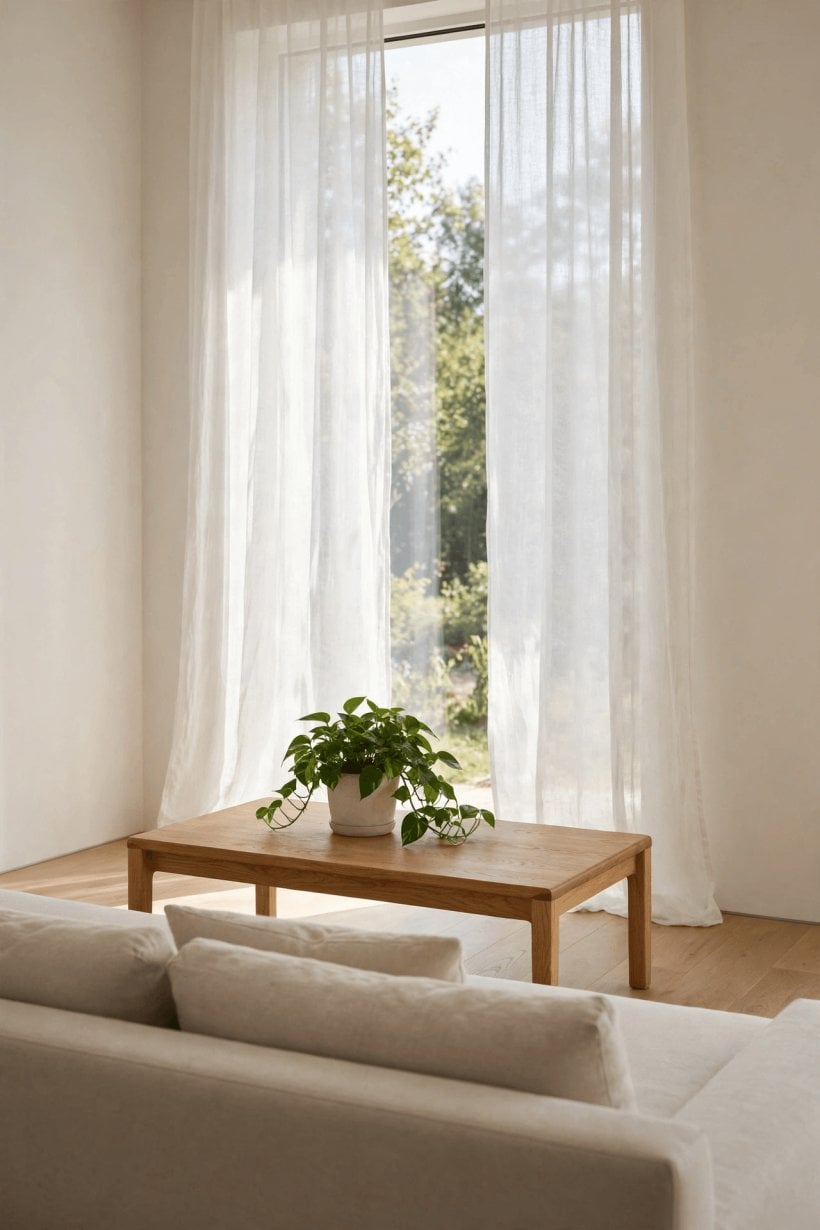
Modern seating is low, wide and simply built: square arms, plain cushions, legs that show. The worked examples in these modern living room interior design ideas for tiny houses prove the forms scale down as gracefully as they scale up.
12. Choose a Low-Profile Sofa
A low back keeps the room’s horizontal lines long and lets light and sight pass over the seating. It is the single most recognisable modern furniture decision, and it suits rooms with ordinary ceiling heights best.
13. Keep Arms Slim or Skip Them
Wide padded arms eat seat width and visual calm. Slim track arms — or an armless end on a sectional — give more sitting room in the same footprint and keep the silhouette crisp.
14. Pick One Sectional Shape and Commit
An L-shaped sectional suits a corner; a straight sofa with a chaise suits a wall. What matters is one decisive shape, not a gathering of unmatched seats hoping to become a group.
15. Use Two Sculptural Chairs, Not a Suite
Matching three-piece suites flatten a modern room. Two chairs with real form — a moulded shell, a bent-ply frame, a swivel base — give the room its sculpture and its personality.
16. Keep Cushions Plain and Few
Two or three cushions in the scheme’s tones, no fringe, no pattern pile-up. In a modern room the sofa’s own form is the decoration; cushions are punctuation, not a paragraph.
17. Choose Upholstery with a Flat, Honest Weave
Boucle, tight wool weaves, plain linen and leather show their material honestly and wear their age well. Shiny synthetics and busy prints fight the style from the first day.
18. Add One Bench or Daybed Form
A flat bench seat under a window or behind the sofa adds the long horizontal line modern rooms love, and works as overflow seating, a book rest and a visual pause in one.
19. Keep Legs Visible and Furniture Raised
Seats raised on slim legs let the floor run underneath, which makes the room feel larger and the cleaning easier. Skirted bases and floor-dragging upholstery belong to traditional rooms.
20. Let One Seat Be the Sculpture
Every modern room deserves one piece chosen purely for form — the chair guests ask about. Keep it singular: two sculptures compete, one composes.
21. Size Seating to the Household, Honestly
Count the people who actually sit here nightly and seat them well, rather than squeezing in seats for hypothetical crowds. Modern rooms fail by excess more often than by shortage.
22. Test Seat Height Against the Coffee Table
The table should sit level with or just below the seat cushion. A mismatch of a few centimetres is felt every single evening, in every reached-for cup.
4. Colour: Neutrals, Contrast and Restraint
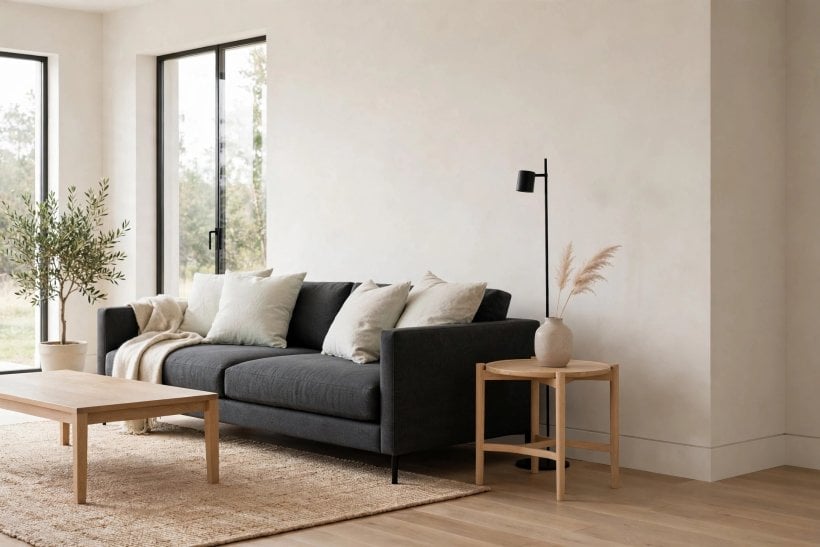
Modern colour is a short list used with confidence: warm white, stone, grey, charcoal, black — and one real colour when the room asks for it. The testing discipline in this guide to tiny house interior paint colors applies at any scale: judge colour on the wall, in the room’s own light.
23. Build the Base from Warm Neutrals
Warm white and pale stone on the walls keep a modern room calm without the blue chill of brilliant white. The warmth should live in the undertone, felt rather than noticed.
24. Use Charcoal and Black as the Accent Line
Black is modern colour’s full stop: picture frames, lamp stems, a side table, the screen’s surround. Small black elements sharpen every pale scheme and give the eye its resting points.
25. Carry One Real Colour on the Largest Soft Piece
When a modern room takes a colour — deep green, ochre, ink blue — let the sofa or the rug carry it alone. A single confident field of colour reads as design; scattered repeats read as shopping.
26. Keep the Palette to Three Tones Plus Wood
Count them: wall tone, main upholstery tone, accent tone, and the timber’s natural colour. A fourth tone needs a reason; a fifth is the scheme dissolving.
27. Match Colour Temperature Across the Room
Warm greys with warm whites, cool greys with cool. Mixed temperatures make a restrained palette look accidentally mismatched, which restraint cannot afford.
28. Paint the Ceiling the Same White as the Walls
One continuous pale plane overhead keeps the modern box clean and the ceiling feeling higher. Contrasting ceiling colours chop the room’s geometry at exactly the wrong line.
29. Use One Dark Wall Only Where the Light Earns It
A single deep wall behind the sofa can ground a bright room. In a dim room the same wall swallows the light; test with a large painted sheet before committing.
30. Let the Floor Set the Scheme’s Floor Tone
Pale oak floors want pale, warm schemes; dark floors can carry charcoal and contrast. Colour chosen against a white sample card, ignoring the floor, fails on arrival.
31. Keep Woodwork Minimal and Colour-Matched
Slim skirting painted to disappear into the wall preserves the clean plane. Heavy architraves in contrasting gloss belong to period styles and break modern lines.
32. Introduce Pattern Only as Texture
A woven throw’s slub, a rug’s low relief, stone’s veining — pattern at the scale of touch, not of print. Graphic prints date a modern room faster than anything else in it.
33. Repeat the Accent Exactly Twice
The charcoal in the frames and the lamp, the green in the sofa and one cushion: twice is a decision, three times is a theme, once is an accident.
5. Materials and Texture: Honest Surfaces
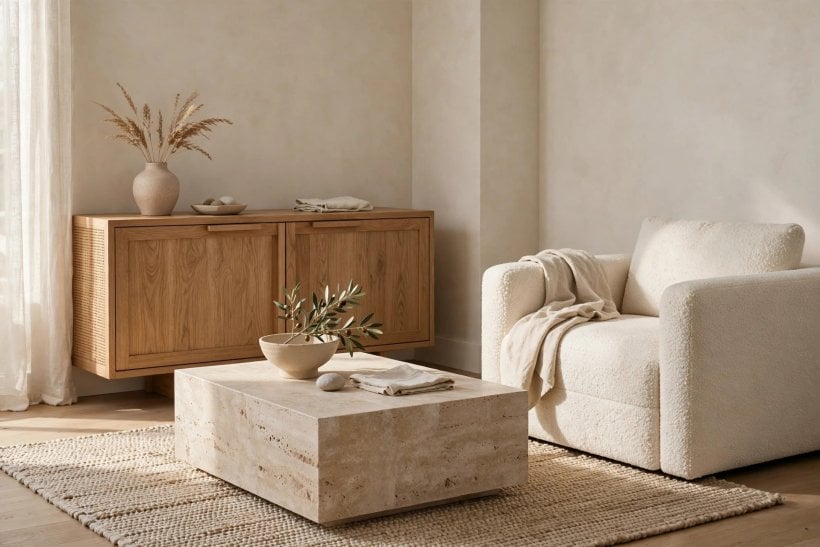
A modern room with everything smooth feels like a lobby. The style’s richness is tactile: grain, weave, veining and the matte finish of real materials, layered until the calm scheme has something for the hand as well as the eye.
34. Let Real Timber Be the Warmth
Oak, walnut or ash — one timber tone, used in the floor, the table and the shelving, warms the whole scheme. Mixed wood tones in a restrained room read as accidents, so choose the family and stay in it.
35. Use Stone or Its Honest Imitations Plainly
A stone hearth, a marble-topped side table, a concrete-look floor: hard surfaces balance the soft seating. Keep pieces simple in form so the material itself provides the interest.
36. Add Boucle or Wool Where Hands Land
The chair’s upholstery, the throw, the rug underfoot — texture belongs where the body touches the room. A single boucle chair can carry the whole scheme’s softness.
37. Keep Metal Finishes to One Family
Blackened steel, brushed nickel or brass — pick one and let lamp stems, handles and frames agree. Mixed metals are a traditional-room pleasure; modern rooms take their richness elsewhere.
38. Choose a Rug with Substance, Not Pattern
A deep-pile or flat-woven rug in a single tone anchors the group and softens the room’s acoustics. Its job is weight and quiet, not decoration.
39. Show Joinery, Hide Fixings
Modern furniture shows how it is made — a clean mitre, an honest frame — and hides how it is fixed. Visible brackets, cable clips and screw heads are small fractures in the calm.
40. Prefer Matte Finishes Throughout
Matte paint, satin timber, unpolished stone. Gloss and high shine bounce hard highlights around a room and fight the soft, even light the style is built on.
41. Bring One Piece of Glass or Acrylic
A glass-topped table or an acrylic side piece keeps sightlines open in the middle of the seating group, where a solid block would stop the eye and shrink the room.
42. Layer Three Textures in Every View
Stand in the doorway and count: smooth wall, woven seat, grain of timber — three textures minimum in each sightline. Fewer and the room feels unfinished; the count is the modern substitute for ornament.
43. Let Plants Be the Only Ornament
One architectural plant — a fig, an olive, a tall grass — in a plain pot gives the room life without objects. A crowd of small plants on every surface is clutter wearing green.
44. Keep Surfaces Two-Thirds Empty
The coffee table holds a book stack and one object; the shelf holds books and air. Empty surface is not wasted space in a modern room — it is the style’s main luxury.
6. Lighting: Architectural and Layered
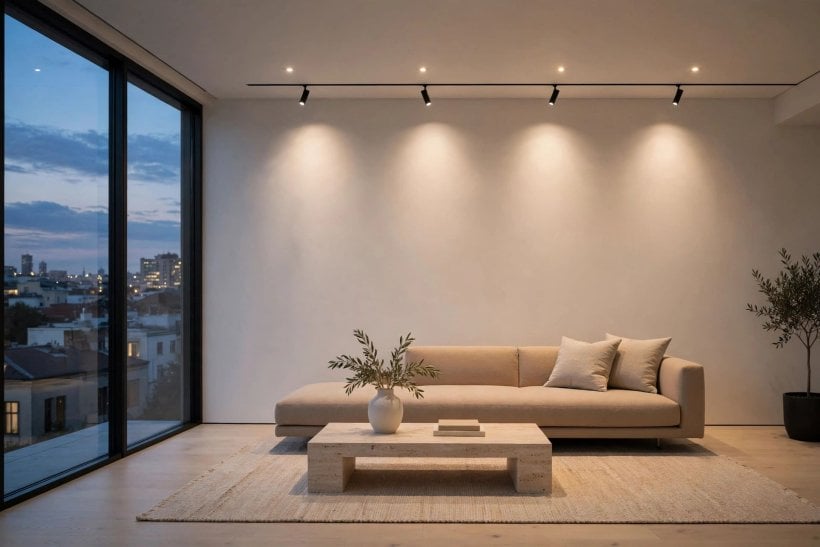
Modern lighting is planned like architecture: even washes, aimed accents and no visible fuss. It still obeys the layering rule — ambient, task, accent — but every fitting is chosen to disappear into the room’s lines or to stand as deliberate sculpture.
45. Wash Walls, Not Ceilings
Light aimed down a wall plane makes a room feel larger and calmer than light sprayed from the centre. Wall-washing is the modern room’s default evening condition.
46. Use Recessed or Track Fittings for the Ambient Layer
Plain recessed downlights or a slim track keep the ceiling clean. One decorative pendant over the coffee table zone is the exception that proves the discipline.
47. Put Every Circuit on a Dimmer
A modern room at full brightness is a waiting room. Dimming is what turns the day’s clean box into the evening’s calm one, and it should be settable from the sofa.
48. Add One Arc or Floor Lamp as Sculpture
An arc lamp over the reading chair gives task light and the room’s second sculptural moment. Choose it once, choose it well, and let nothing else compete at that scale.
49. Light the Shelves and the Art
Small aimed spots or strip lights inside shelving turn storage into display and give the room its low evening glow without a single table lamp.
50. Keep Light Temperature Warm and Consistent
Warm-white bulbs throughout, matched across every fitting. One cool-white bulb in a warm scheme reads as a mistake every time it is switched on.
51. Hide the Light Source, Show the Effect
Coves, pelmet strips and shaded fittings keep bulbs out of sightlines. Bare bulbs are an industrial style choice; in a modern room they are glare.
52. Use the Window Light as a Layer Too
Sheers soften daylight into the room’s ambient wash. Plan seating to use it: the reading chair belongs where the daylight already falls.
53. Give the Media Wall Its Own Low Light
A soft bias light behind the screen or a low lamp at its side keeps film-watching easy on the eyes and stops the black rectangle dominating the dark room.
54. Repeat One Fitting Shape, Not Five
Same family for the pendant, the floor lamp’s head, the shelf spots. Repetition of form is what makes a lighting scheme look designed rather than accumulated.
55. Plan Sockets on the Furniture Plan
Lamp positions are furniture positions. Sketch both together so no cable ever crosses a walkway or climbs a wall in public view.
7. Storage and Media: Everything Hidden, Nothing Cluttered
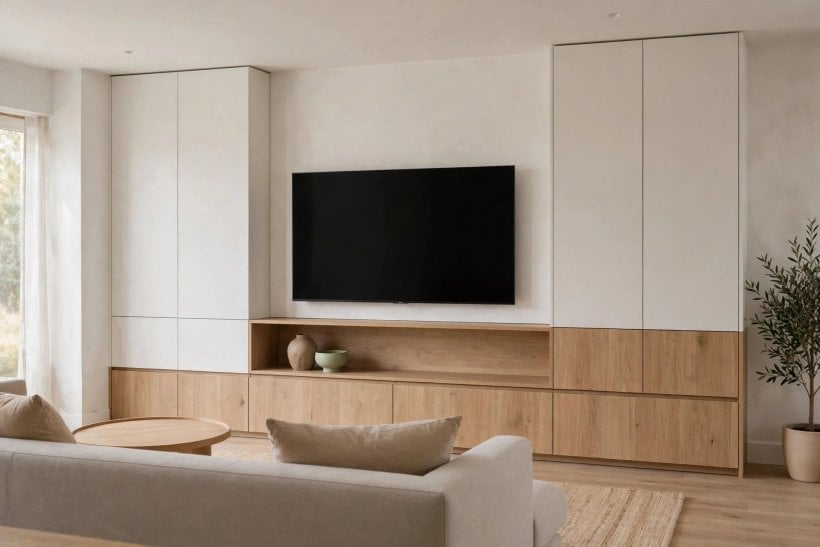
Modern calm survives contact with real life only if storage is designed as seriously as seating. The rule is closed storage for the machinery of life, open display for almost nothing — the discipline detailed further in these tiny living room ideas, where every object must earn its place twice over.
56. Build One Full Media and Storage Wall
A single wall of handleless, flush cabinetry absorbs the screen, the equipment, the games, the chargers and the clutter in one calm plane. It is the modern room’s hardest-working purchase.
57. Keep Doors Flush and Handles Off
Push-latch or integrated pulls keep the storage wall reading as architecture, not furniture. Every visible handle is a small interruption the style would rather not have.
58. Leave Exactly One Open Shelf
One shelf for the current books and a single object gives the wall life without breaking it. Everything else the household owns goes behind doors.
59. Run Every Cable Inside the Wall or the Furniture
Plan conduit and access panels when the media wall is built. A modern room with a cable hanging from the screen is a modern room unfinished.
60. Store the Everyday Small Things in Drawers, Not Bowls
Remotes, chargers, coasters, the dog’s lead: each gets a drawer or a lidded box inside the storage wall. Bowls of miscellany on surfaces are clutter with good PR.
61. Choose a Closed Coffee Table or Ottoman
Lift-top tables and storage ottomans hide blankets and board games at the centre of the room, where open shelves would show them to everyone, always.
62. Keep Books Edited and Horizontal
Short horizontal stacks read as calm; tall crowded shelves read as storage. Keep the books the household loves and let the rest live elsewhere.
63. Give Children’s Things a Lidded Home in the Room
Toys will live in the living room whatever the plan says. A closed bench or basket-with-lid inside the scheme keeps evenings adult without a nightly eviction.
64. Float the Storage, Show the Floor
Wall-hung cabinetry with the floor running beneath keeps the room light and the cleaning simple, and matches the raised-legs seating across the room.
65. Audit the Room Monthly with a Photograph
Take a photo from the doorway. Clutter invisible to the daily eye jumps out of a picture; remove one thing per audit and the room stays modern by itself.
8. Modern Style in Small and Tiny Living Rooms
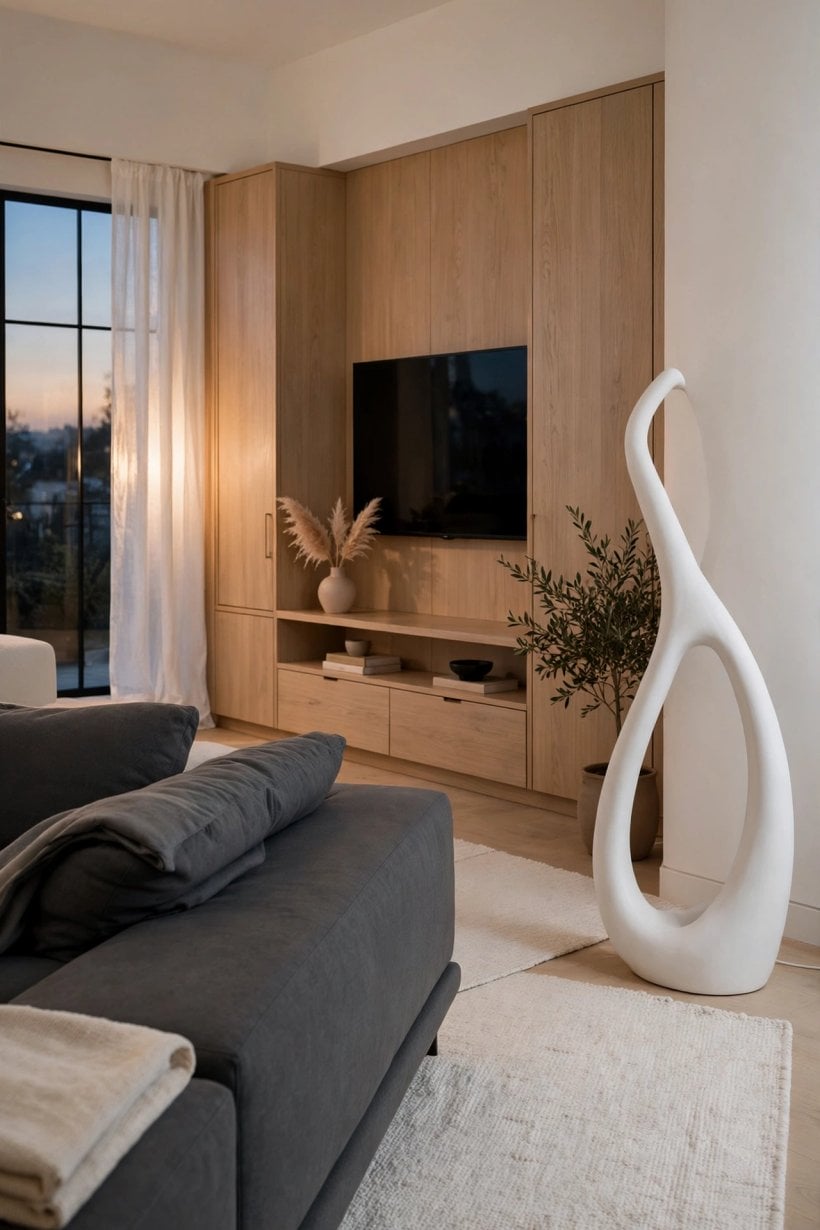
Modern discipline is a small room’s best friend: fewer pieces, cleaner lines, hidden storage. The full small-room method is set out in these small living room ideas and in this guide to how to decorate a tiny living room; the modern-specific rules follow.
66. Shrink the Sofa, Keep the Lines
A compact two-seater with the same low profile and slim arms keeps the style intact at small scale. A big sofa in a tiny room is not modern; it is just big.
67. Use One Rug, One Palette, One Statement
Small modern rooms take a single decision in each category. Multiplicity is what small rooms cannot store, visually or physically.
68. Choose Glass or Open Bases for Tables
See-through and leggy tables keep the floor visible, and visible floor is what makes a small room read as a room rather than a furnishing store.
69. Take the Storage Wall to the Ceiling
In a small room the storage wall earns its height: full-height cabinetry swallows the clutter that would otherwise live on every surface.
70. Mount Everything That Can Be Mounted
Screen on the wall, lamps on the wall, shelves on the wall. Every piece lifted off the floor returns floor to the room.
71. Keep the Walkway Ruthlessly Clear
One route through the room, defended absolutely. In a small modern room the walkway is the luxury space; do not furnish it.
72. Use Mirrors as Plain Planes
A large frameless mirror doubles light and depth without adding an object. Ornate frames import a different style; the plain plane is the modern way.
73. Let Curtains Run Full Height
Floor-length plain curtains hung at the ceiling line stretch a small room’s height and keep its lines vertical and clean.
74. Fold, Nest and Stack the Occasional Pieces
Nesting tables and folding chairs appear for guests and vanish after. Permanent furniture for occasional use is the small room’s classic waste.
75. Keep One Generous Thing
One big plant, one real armchair, one large artwork — a single generous gesture stops a small modern room feeling mean. Restraint is not the same as miniaturising everything.
9. Checks and Mistakes: Before You Buy the Sofa
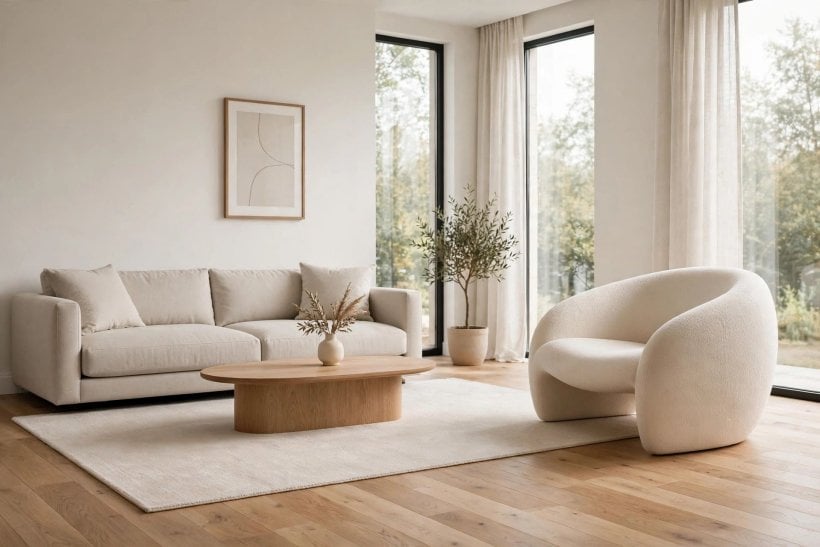
The modern room’s expensive mistakes are consistent: a sofa bought for its photograph rather than the room’s measurements; five greys that fight at different temperatures; storage planned after the furniture; and accessories added weekly until the calm is gone. The paint-testing discipline in this look at living room paint in a tiny house — test on the real wall, in the real light — generalises to every modern purchase.
Run the checks in order: room measured, furniture footprints taped on the floor and lived around for a day; the palette counted — three tones plus timber, no more; delivery route measured for the sofa; lighting circuits and socket positions marked before any decorating. Modern rooms are unforgiving of impulse, which is exactly why an hour of checking buys years of calm.
10. Costs and Pulling It Together
Modern living room money divides into three bands. The anchor band — sofa, rug, storage wall — is where the budget belongs, because these pieces are the room’s architecture and are used every day. The structure band — lighting, paint, window treatment — is mid-priced and long-lived, worth planning carefully rather than buying fast. The object band — cushions, books, the single plant — is where restraint is free: a modern room needs almost nothing here, and what it has can change in an afternoon.
Pull the room together in the order this guide opened: geometry first, anchors second, palette third, texture and light last. Hold the modern lane — clean lines, honest materials, surfaces kept clear — and let warmth come from timber, wool and lamplight rather than from more things. A modern room built that way does not date; it simply stays calm while the household’s life changes around it.
One last discipline holds the whole scheme together: buy in the room’s order, not the shops’. When the anchor pieces are right and the palette is counted, every later purchase has a test to pass — does it keep the lines, match the tones and earn its surface? Pieces that pass can be added for years without the room ever losing its calm.
Final Considerations
A modern room is calm you can measure: in clear surfaces, straight lines and nothing present without a reason. The style asks more discipline than money — the discipline to stop adding, to hide the machinery, and to let a few good materials carry the whole room.
Start with the geometry, spend on the anchors, and defend the empty space like it is furniture. Do that, and these ideas stop being a style and become the room the household breathes in, every evening, without noticing why it feels so easy.

0 Comments