
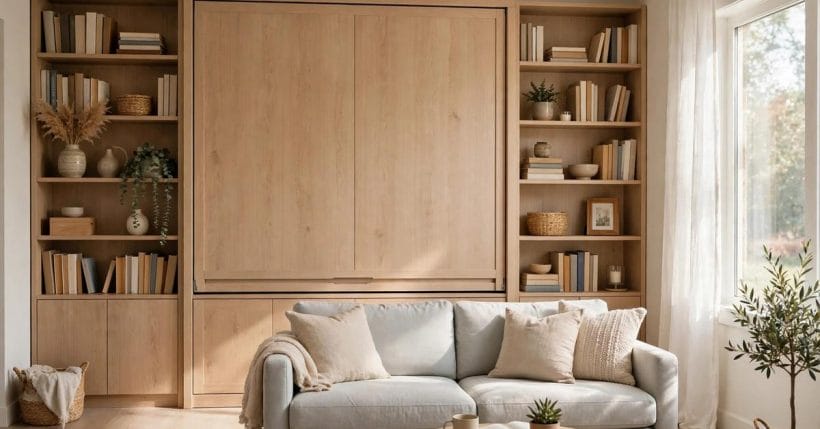
A wall bed that folds away when it is not needed can change the whole feeling of a small room. By day the room is open for living, working or welcoming guests. By night the same floor becomes a proper sleeping place, with a real mattress and proper bedding rather than a sofa pressed into service. That double life is the heart of murphy bed ideas, and it is why the form suits guest rooms, studios, home offices and tiny houses so well. The bed does not ask the room to be bigger. It asks the room to be smarter about how its floor is used, and it rewards that thinking with space that feels generous even when the footprint stays modest.
This guide looks at the wall-bed form on its own terms: the cabinet, the layouts it suits, the colours and finishes that help it blend in, and the practical questions worth settling before anything is ordered. It is a survey of looks and layouts, not a fitting manual. Fixing a wall bed to a wall is structural work, and it belongs to a qualified professional who can judge the wall, the fixing and the local rules that apply. What follows describes what to look for, what to discuss with that professional, and how to live comfortably with the bed once it is in place.
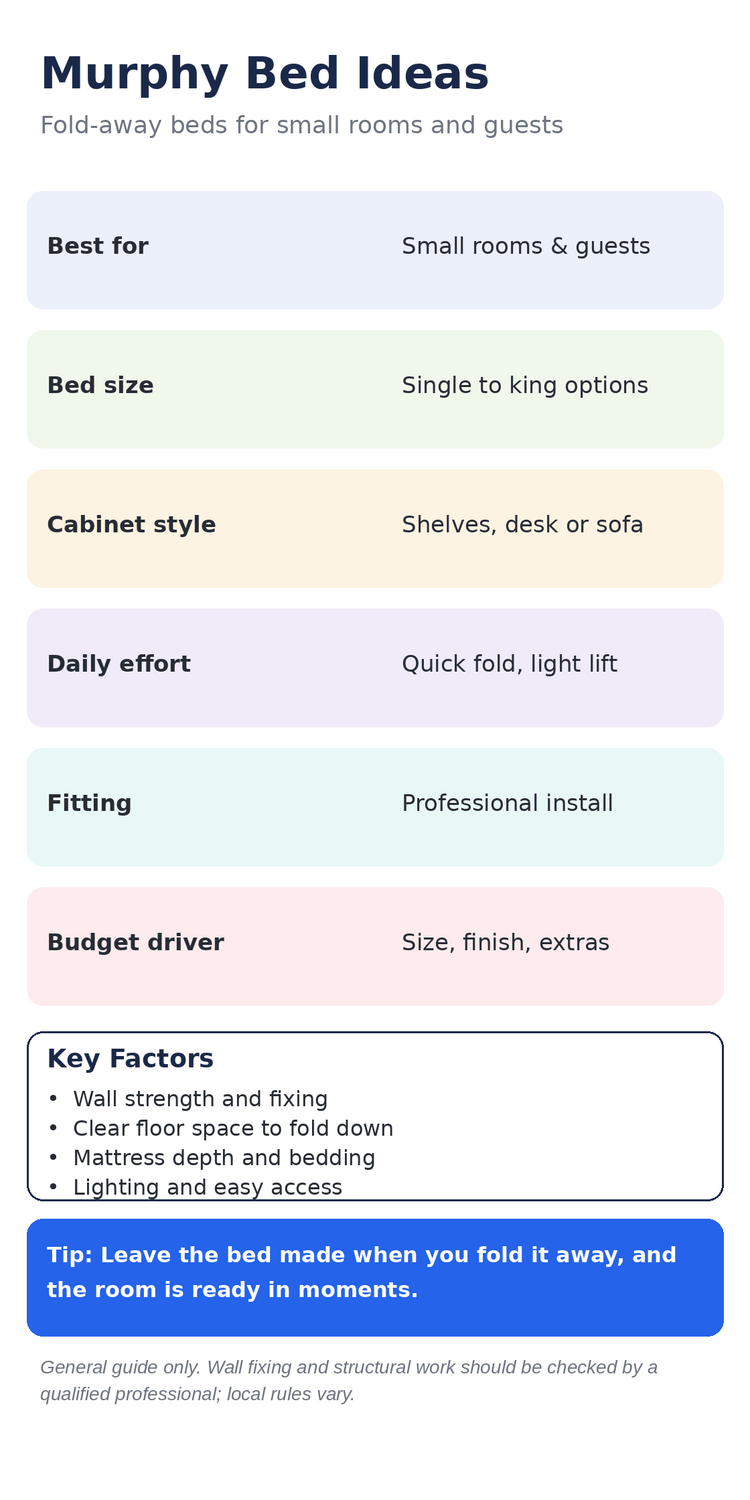
| Item | What it is |
|---|---|
| Why a Fold-Away Bed Changes a Small Room | Most small rooms suffer from a single problem: the bed takes up the floor all day, even though it is only slept in at night. |
| The Cabinet as the Room's Main Furniture | When a wall bed is folded up, what the room actually shows is a cabinet. |
| Guest Rooms That Work Twice as Hard | A guest room is the natural home for a wall bed, because guests need a comfortable bed but rarely need a bedroom standing empty between visits. |
| Desk and Sofa Combinations | Some wall beds share their cabinet with a desk or sit above a sofa, and these combinations suit rooms where every piece of furniture must do more than one job. |
| Colours and Finishes That Blend In | A wall bed cabinet covers a large stretch of wall, so its colour sets much of the room's mood. |
| Bedding, Lighting and Everyday Comfort | A wall bed is only as good as the night's sleep it gives, and that depends on details that are easy to overlook while admiring the cabinet. |
| Planning the Floor Space Around the Bed | The floor in front of a wall bed is working space, and it needs to stay clear enough for the bed to come down comfortably. |
| Costs in General Terms | Wall bed costs vary widely, and the honest way to think about them is through the drivers that push a project up or down rather than through any single figure. |
| Small Rooms, Studios and Tiny Houses | In studios and tiny houses, a wall bed is often the difference between a home that feels cramped and one that feels flexible. |
1. Why a Fold-Away Bed Changes a Small Room
Most small rooms suffer from a single problem: the bed takes up the floor all day, even though it is only slept in at night. A fold-away bed reverses that bargain. When it is folded up, the middle of the room is free for a desk, a dining table, a play area or simply for moving around without squeezing past furniture. When it is folded down, the room becomes a bedroom again, with a full sleeping surface and room to get in and out from either side where the layout allows. The change is not about owning less. It is about letting one room honestly serve two purposes instead of serving one purpose badly and the other not at all.
The effect is most obvious in rooms that must earn their keep. A spare room that hosts guests a few weekends a year can spend the rest of its life as an office, a reading room or a hobby space. A studio apartment can feel like a living room in the evening and a bedroom at night without either mood feeling like a compromise. For a look at how sleeping areas are arranged in compact homes, tiny house bedroom design shows the same thinking at work: the bed is planned as part of the room, not dropped into whatever space is left over. That planning is what separates a wall bed that feels clever from one that feels like an afterthought.
2. The Cabinet as the Room’s Main Furniture
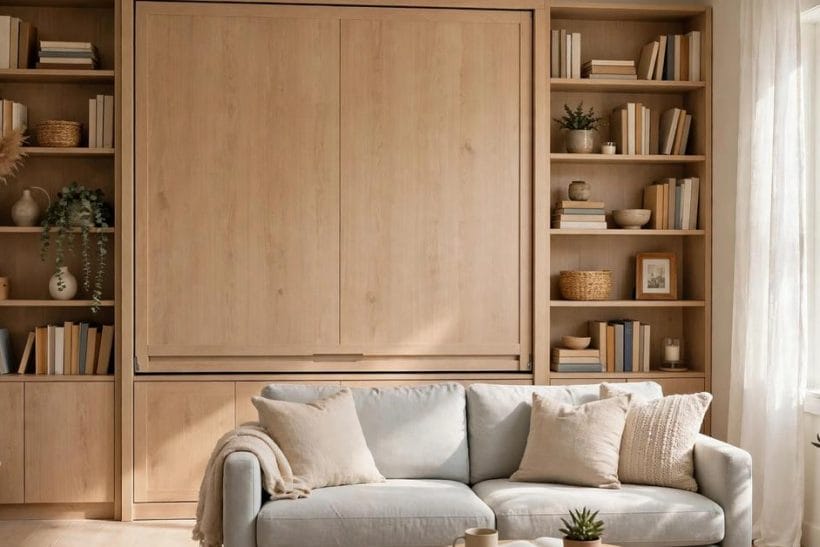
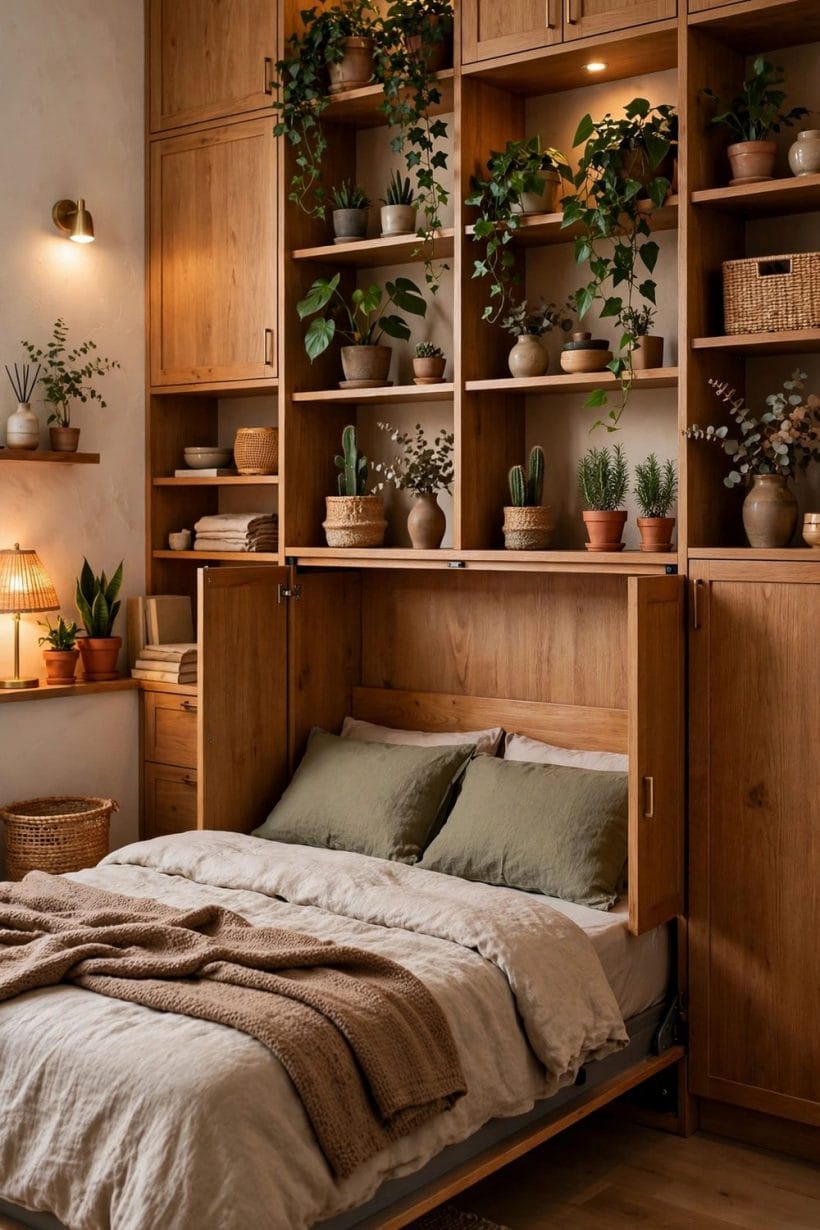
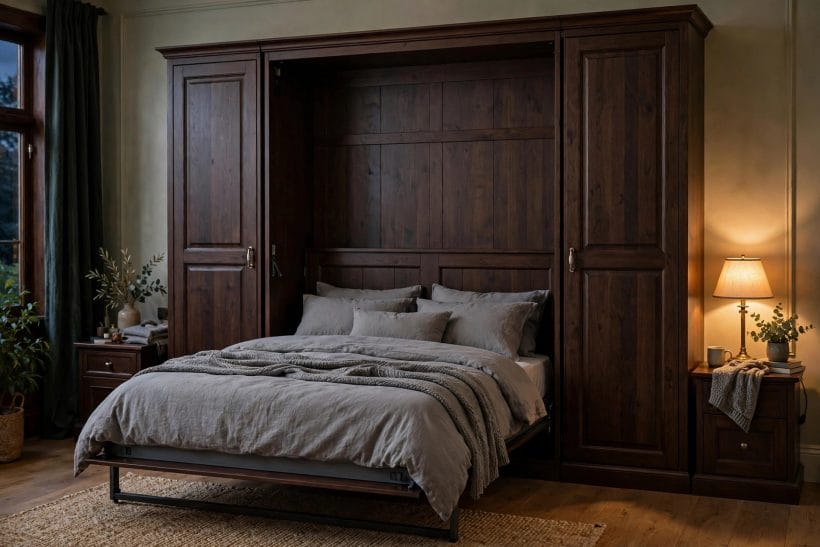
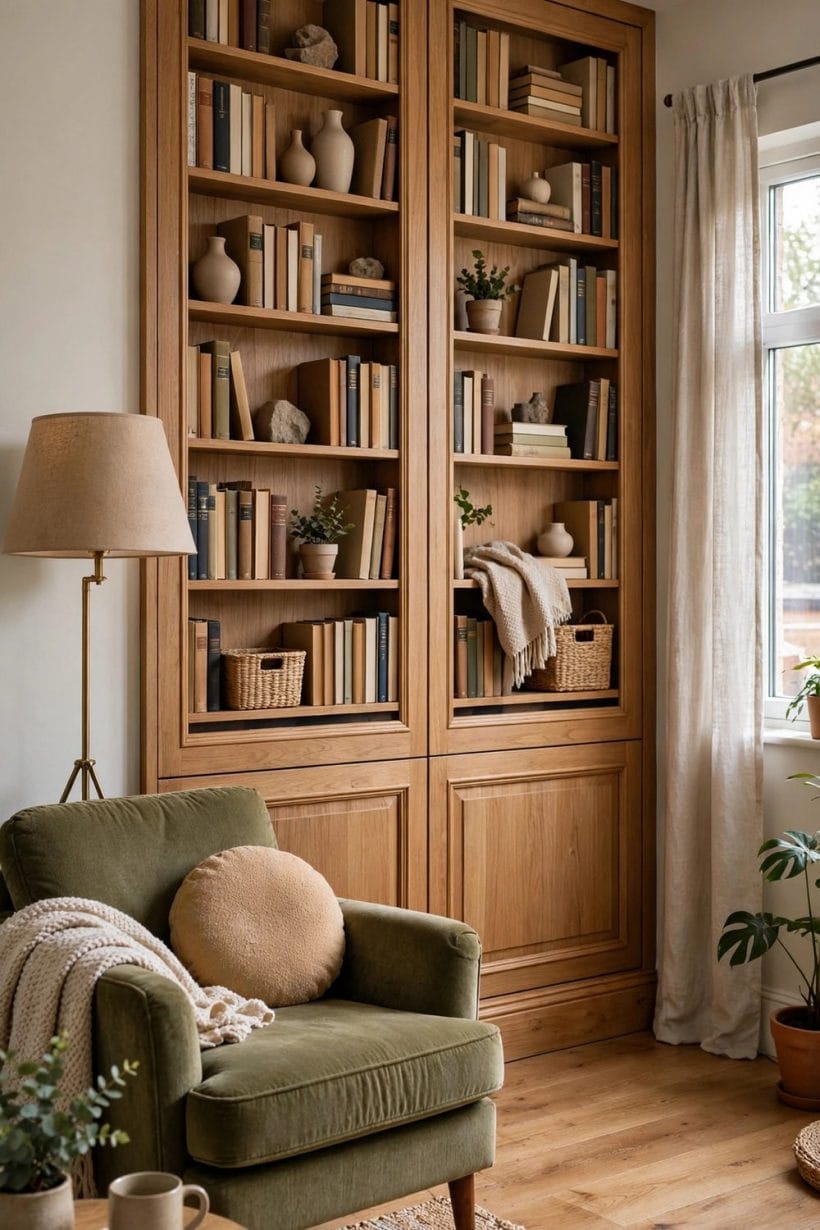
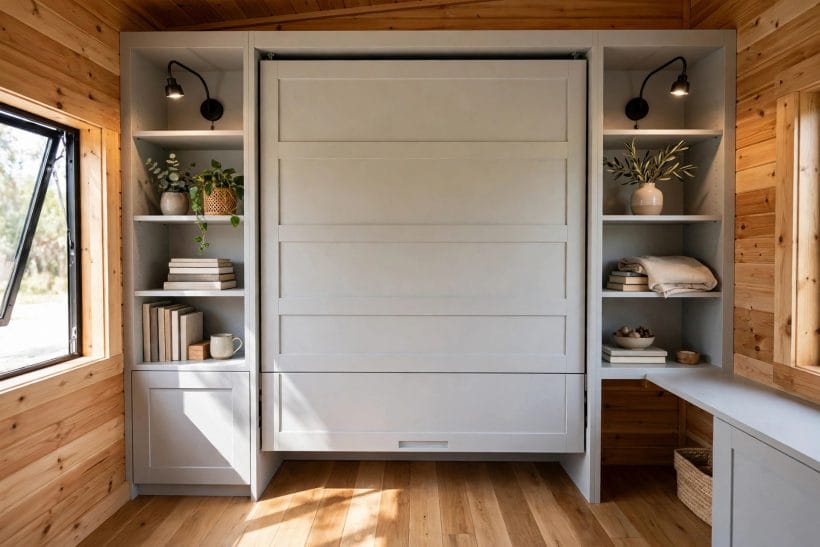
When a wall bed is folded up, what the room actually shows is a cabinet. That cabinet becomes the largest piece of furniture in the room, so it deserves the same attention as any wardrobe or bookcase. A well-chosen cabinet looks deliberate: its doors line up with the shelves beside it, its handles match the rest of the room, and its proportions suit the wall rather than overwhelming it. Shelving on either side softens the bulk and gives the room somewhere for books, plants and everyday objects, so the wall reads as a fitted piece of joinery rather than a single oversized box.
Cabinet depth matters to how the room feels when the bed is away. A shallow-looking front keeps the room feeling open, while deeper side storage can swallow bedding, pillows and seasonal blankets without a separate cupboard. Doors that sit flush when closed give a calm, tidy wall, while panelled or shaker-style doors suit rooms with a more traditional character. Whatever the style, the cabinet should be chosen for the room it will live in, not for a showroom. Measure the wall, note where doors swing, where radiators and sockets sit, and how the light falls across the wall through the day, and let those plain facts narrow the choice.
3. Guest Rooms That Work Twice as Hard
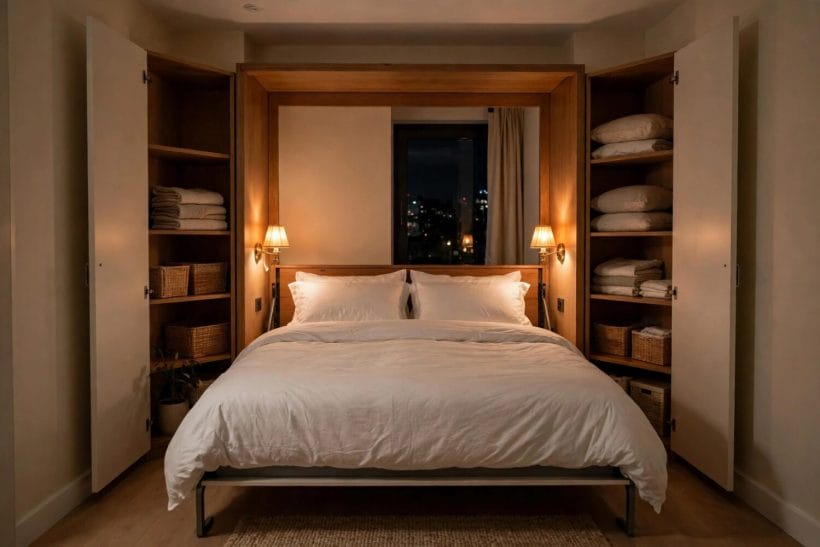
A guest room is the natural home for a wall bed, because guests need a comfortable bed but rarely need a bedroom standing empty between visits. With the bed folded away, the room can be an office during the week, a sewing or craft room, a quiet reading corner or a place for children to play. Guests still arrive to a real bed with proper bedding, and hosts still keep a useful room for the rest of the year. The arrangement works best when the room is dressed for both lives: a desk that stays usable, a chair that stays put, and storage that does not have to be emptied every time the bed comes down.
Comfort for guests comes from the same details as comfort anywhere else: a mattress that suits most sleepers, bedding that is easy to change, a light within reach of the bed, and somewhere to put a glass of water and a phone overnight. Side shelves or a small ledge beside the folded-down bed can carry those things without extra furniture being dragged in. It also helps to keep a clear, simple routine for opening and closing the bed, agreed with the household, so guests are never left guessing. A guest room arranged this way is generous without being wasteful, and it stays welcoming because it stays used.
4. Desk and Sofa Combinations
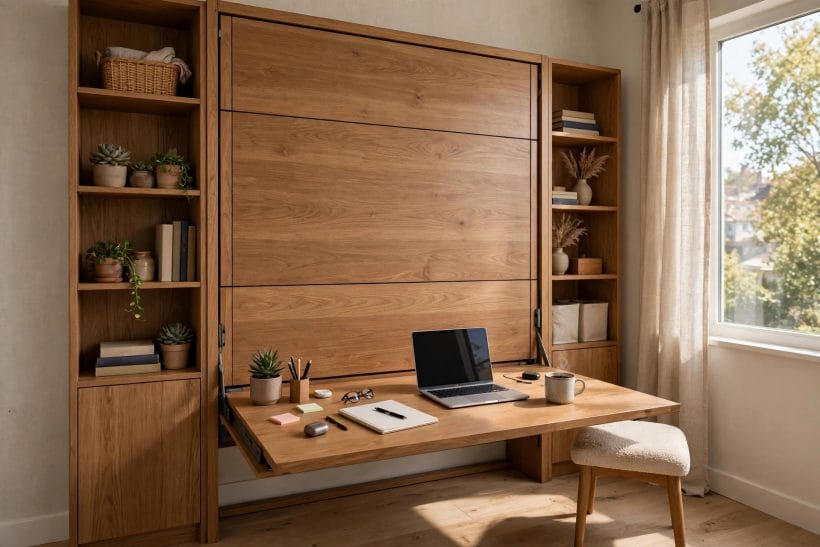
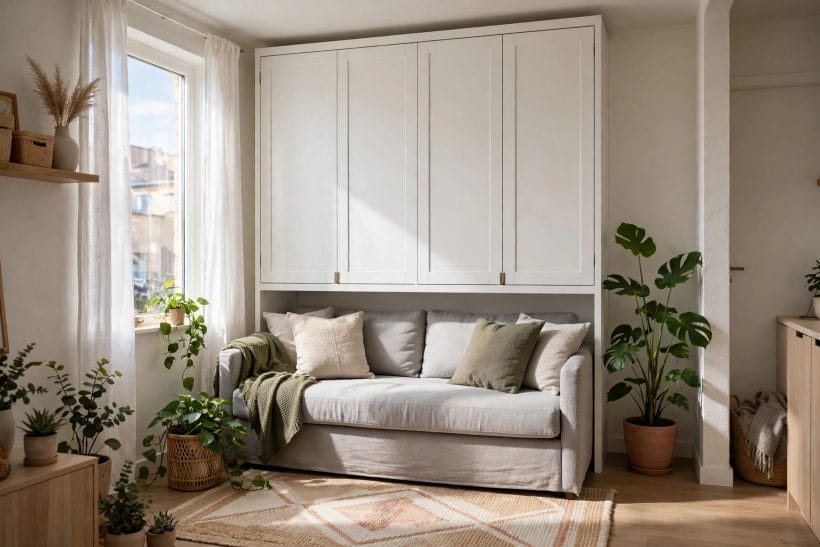
Some wall beds share their cabinet with a desk or sit above a sofa, and these combinations suit rooms where every piece of furniture must do more than one job. A desk that folds down from the cabinet front gives a home office a proper working surface by day and a bedroom by night, without the room having to choose between the two. A sofa beneath the cabinet gives a living room its seating by day, with the bed folding down over or in front of it when night comes. Both arrangements ask for honest thinking about daily habits: if the desk is buried under papers every evening, or the sofa is piled with laundry, the changeover becomes a chore and the bed stops being used.
The combination that works is usually the one that matches the household’s real routine. A person who works from home and hosts guests occasionally may value the desk more than the sofa. A household whose living room doubles as the only guest space may value the sofa more. Convertible furniture in tiny houses follows the same logic, with each piece earning its place by serving two genuine needs rather than two imagined ones. Before settling on a combination, picture an ordinary Tuesday evening: what is on the desk, who is on the sofa, and how much clearing away feels reasonable before bed. The honest answer points to the right pairing.
5. Colours and Finishes That Blend In
A wall bed cabinet covers a large stretch of wall, so its colour sets much of the room’s mood. Light woods and painted finishes in soft whites, pale greys and warm off-whites help the cabinet recede, which suits small rooms that need to feel airy. Mid-tone woods bring warmth and suit rooms with wooden floors and natural textures. Dark woods can look handsome and grounded, especially in larger rooms or in rooms with deep, cosy colour schemes, but they draw the eye, so they suit a cabinet that is meant to be a feature rather than a quiet background.
The finish should be chosen alongside the room’s existing furniture rather than in isolation. If the room already has oak floors and pale walls, a cabinet in a similar oak tone will sit quietly. If the room is painted in a strong colour, a cabinet painted to match the walls can almost disappear, leaving the room feeling larger than it is. Handles, hinges and trims are small details with an outsized effect: simple, quiet hardware keeps the cabinet looking like fitted furniture, while heavier hardware turns it into a statement. Samples viewed in the room’s own light, at different times of day, are worth more than any showroom impression.
6. Bedding, Lighting and Everyday Comfort
A wall bed is only as good as the night’s sleep it gives, and that depends on details that are easy to overlook while admiring the cabinet. The mattress should be one that suits the people who will sleep on it, and bedding should be simple enough to stay on the bed when it folds away, so making the bed is not a nightly production. Pillows need a home too, whether that is on the bed itself or in the side storage, so they are not balanced on chairs or the floor. These small comforts decide whether the bed is used gladly or only when there is no alternative.
Lighting matters just as much. A wall bed needs a light that works when the bed is down, ideally one that can be switched on without getting up, and a soft light for reading that does not glare across the room. If the cabinet includes reading lights or if wall lights sit beside the bed, the sleeping arrangement feels finished rather than improvised. Storage for bedding, thought through at the start, keeps the whole arrangement calm: a place for the spare set, a place for the pillows, and a place for the things that live beside a bed overnight. For more on keeping small sleeping spaces orderly, small-space storage covers the same habits in compact homes generally, and the same principles apply here.
7. Planning the Floor Space Around the Bed
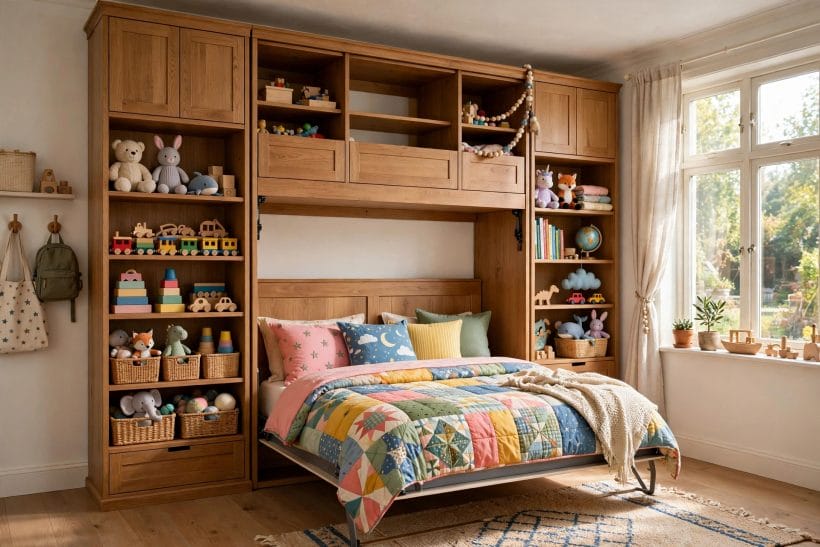
The floor in front of a wall bed is working space, and it needs to stay clear enough for the bed to come down comfortably. That means thinking about rugs, coffee tables, toy boxes and anything else that lives in the middle of the room. A rug that slides easily, a light table that moves without a struggle, and a clear path to the bed all make the nightly routine pleasant rather than awkward. The room does not need to be empty. It needs its everyday objects to have homes that are not in the bed’s way, so the changeover takes moments rather than a rearrangement of the whole room.
It also helps to plan where people will walk once the bed is down. Can someone get to the door without climbing over the bed? Is there space to stand and dress in the morning? Can the wardrobe or bathroom be reached without squeezing past the foot of the bed? These are the questions that separate a wall bed that works on paper from one that works at midnight. Sketching the room with the bed down, even roughly, and living with that sketch for a few days before committing, can reveal problems that a showroom visit never shows. Tiny house floor plans are a useful reference here, because they are drawn around exactly this kind of honest circulation thinking.
8. Costs in General Terms
Wall bed costs vary widely, and the honest way to think about them is through the drivers that push a project up or down rather than through any single figure. Bed size is one driver, since a larger sleeping surface means a larger cabinet and more material. Finish is another: painted finishes, natural woods and higher-grade joinery sit at different points of the range, and side storage, desks, sofas and lighting all add to the scope. The wall itself matters too, since the fixing work and any preparation the wall needs depend on its construction and condition, which only a professional on site can judge.
Professional fitting is a further part of the overall outlay, and it is not a place to cut corners. A wall bed is heavy, it moves, and it is fixed to a wall that must carry it safely for years, so the fitting should be priced as skilled work and judged on the fitter’s experience with this kind of furniture rather than on speed alone. Beyond fitting, allow for the mattress, the bedding and any finishing touches such as painting or lighting changes, which are easy to forget when the cabinet itself is the focus. Collecting a few local quotes, each covering the same scope, gives a far truer picture than any general guide can, and local suppliers and fitters are the right people to ask.
9. Small Rooms, Studios and Tiny Houses
In studios and tiny houses, a wall bed is often the difference between a home that feels cramped and one that feels flexible. A studio that folds its bed away gains a living room by day, and a tiny house that does the same gains floor for cooking, working or simply stretching out. The same cabinet thinking applies, but the stakes are higher because the room is smaller and every surface is closer at hand. Finishes that match the rest of the tiny interior help the cabinet read as part of the home rather than as an intrusion, and storage built into the sides keeps the limited cupboard space free for other things.
Studios and tiny houses also teach a useful lesson about honesty in layout. A wall bed works in these homes only when the daily routine is honest: if the bed must be folded away every morning for the home to function, the household has to be happy with that routine for years, not just for a week. Bedroom ideas for tiny houses show how other sleeping arrangements compare, and loft sleeping areas offer a different answer to the same question for homes with height to spare. Comparing those options before committing is worthwhile, because the best wall bed is the one that suits the household’s real days, not just its floor plan.
10. Choosing With a Professional’s Advice
Choosing a wall bed well means bringing a professional into the conversation early, before the cabinet is ordered. A qualified fitter or joiner can look at the wall, discuss what fixing it will need, and flag anything about the room that affects the choice, from skirting and sockets to door swings and ceiling height. That early conversation also settles practical questions about delivery, assembly and aftercare, and it gives the household a clear sense of what the fitting day will involve. It is far easier to adjust a plan on paper than to adjust a cabinet that has already been made.
When comparing options, judge them on the same grounds: the quality of the cabinet and its moving parts, the suitability of the size for the room, the storage that comes with it, and the experience of the people who will fit it. Ask about guarantees, about what happens if a part wears, and about how the bed should be looked after over the years. A wall bed is a long-term piece of furniture, and the cheapest option on the day is not always the best value over its life. For the room around it, small living room ideas can help with seating, lighting and layout once the bed itself is settled, so the finished room feels considered as a whole rather than assembled around a single piece.
Final Considerations
A wall bed earns its place when it gives a room two honest lives without making either one feel second-rate. The best arrangements share a few qualities: a cabinet that suits the room, a bed that sleeps well, storage that keeps bedding and pillows close at hand, and floor space that stays clear enough for the bed to come down without a struggle. They also share a boundary that matters: the fixing is professional work, discussed with someone qualified, and the household’s job is to choose well and live with the bed comfortably, not to fit it themselves. That division keeps the project safe and keeps the room pleasant to use.
For anyone weighing the idea, the most useful next step is simple: spend a few days noticing how the room is really used, sketch the room with the bed down, and talk to a local professional about the wall and the options that suit it. Those three habits cost nothing and prevent most disappointments. Done that way, murphy bed ideas stop being a clever trick and become what they should be: a practical, comfortable way to let a small room live larger than its walls suggest, with a proper bed waiting whenever the day is done.


0 Comments