
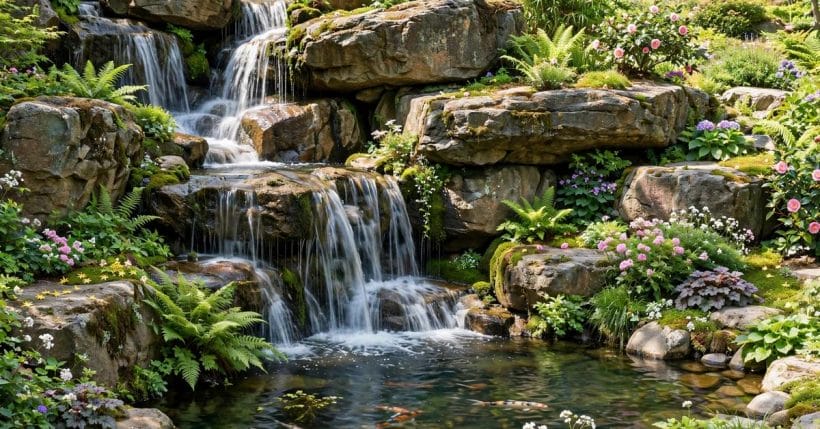
Moving water is the garden’s oldest special effect. A waterfall gives a plot a voice, a focal point and a reason to sit down — hiding the street’s noise behind its own.
These seventy-five ideas cover waterfall design in all its garden forms: rock cascades, disappearing falls, modern blades and stream-fed drops, with the stone, planting and quiet engineering that make falling water behave.
1. Waterfall Ideas at a Glance
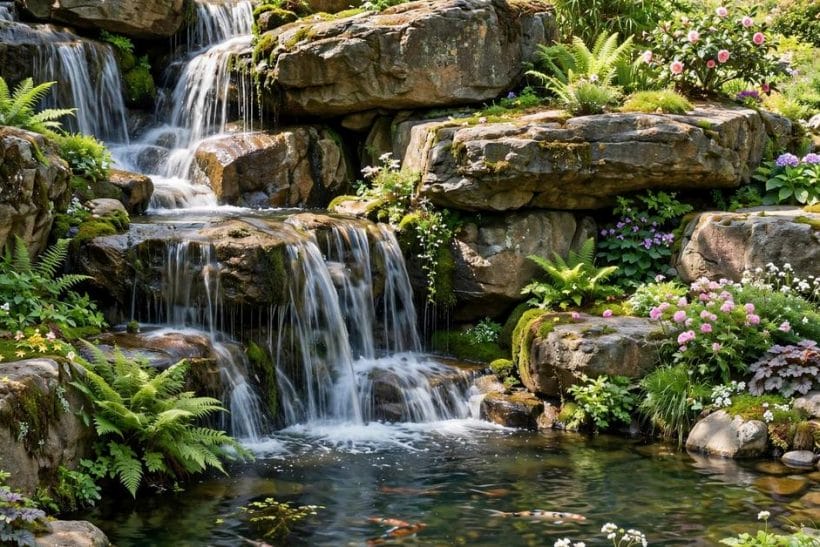
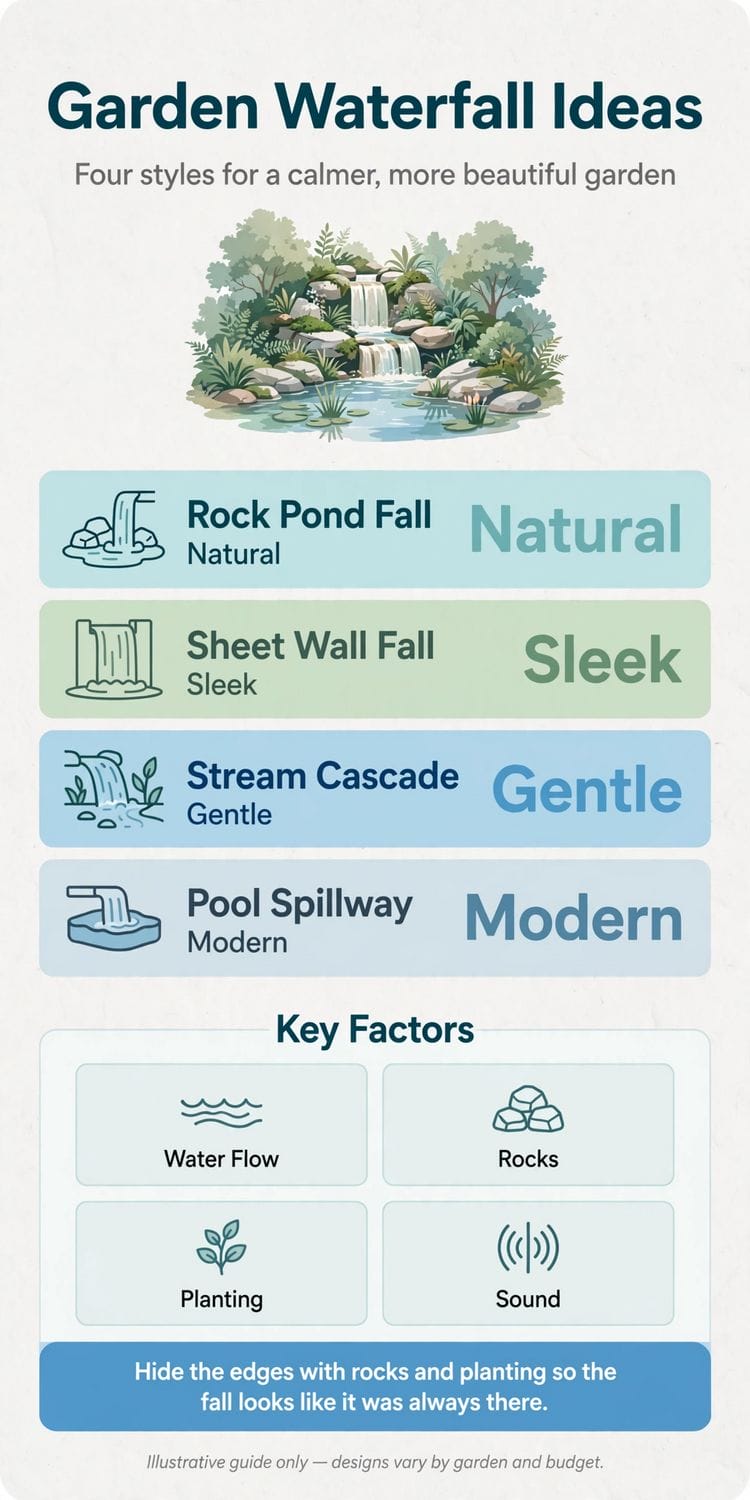
A garden waterfall is a designed drop of recirculated water — over rock, a blade, a spillway or a stream’s weir — falling into a pond, a basin or a hidden reservoir. Its design is three crafts at once: the shaping of the fall itself, the stonework that carries it, and the hidden pump and liner work that keeps it running. It is the moving heart of the wider family of pond ideas, but the two are designed differently: a pond is a place, a waterfall is an event — and this post is about the event.
| Question | Short answer |
|---|---|
| What does a waterfall need to work? | A drop, a lip that shapes the sheet of water, a basin or pond below, and a pump quietly returning the water to the top |
| What is the easiest falls to live with? | The pondless or disappearing falls — no open water, a hidden reservoir, and the simplest upkeep |
| What sets the falls’ character? | The lip stone and the drop: a smooth lip pours a glassy sheet, a rough one breaks the water into sparkle and sound |
| Is a waterfall safe around children? | Open water always needs watching; pondless falls remove the standing water and are the cautious choice |
| What goes wrong most often? | Leaks at the edges and a badly set lip — the water finds every shortcut the builder left it |
2. Rock Cascades: The Natural Falls
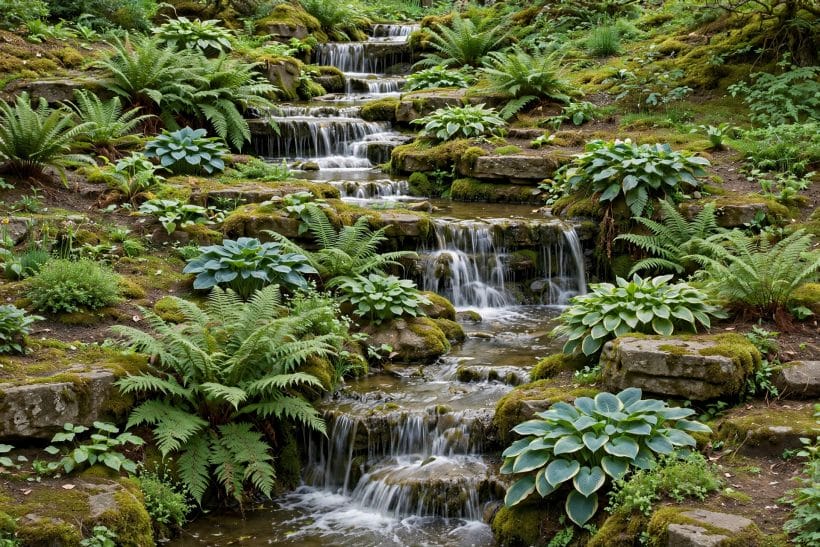
The rock cascade is the waterfall in its garden clothes: water persuaded over stone so persuasively that visitors look for the spring. It pairs naturally with pools and ponds — the small pool with a rock falls at its head is a resort in miniature.
1. Pour a single drop into the pond
One clean fall from a rocky lip into open water: the simplest cascade and the most musical. A single drop concentrates the design on two things — the lip’s shape and the plunge pool’s depth of welcome.
2. Step the cascade over boulders
A staircase of stone, the water descending in stages, resting in each tread’s hollow before spilling on. Stepped falls suit long drops, soften the sound into chapters, and give birds a bath on every floor.
3. Build the falls into the garden’s own slope
A slope is a waterfall asking to happen. Cut the channel into the bank, stone its edges, and let the falls take the route water always wanted — the most convincing cascades follow the land’s own argument.
4. Split the falls around a boulder
Two channels parting around one great stone and rejoining below: the twin falls doubles the music and gives the rockwork a hero. The dividing stone takes the planting pocket, the fern, the spotlight.
5. Pour a curtain over a flat lip
A level, smooth lip stone pours an unbroken curtain — glassy, even, hypnotic. Curtain falls are the formal soul inside the natural style, and they expose every flaw in the lip’s level.
6. Shade a mossy woodland falls
In a shaded corner the falls turns woodland: mossy stone, ferns, a dark pool. Low light forgives simple rockwork and rewards the sound — a small fall in shade carries like a bell.
7. Lay a dry-stone falls in the cottage manner
Unmortared stone, carefully stacked, water threading through its joints: the cottage cascade, soft-edged and planted in every crevice. It settles and shifts like all dry work, and its ageing is its beauty.
8. Set the falls at the pond’s inlet
The classic pairing: the falls pours in at the pond’s head, the water circulates, the surface stays alive. Falling water and still water are each other’s best frame — design them together from the first sketch.
9. Make a boulder group the falls and the focal point
In a flat garden, a composed group of great stones with water falling among them becomes the view from every window. The falls is the excuse; the rockwork is the sculpture; the garden arranges itself around both.
10. Begin the falls in a raised rockery
A rockery built up at the garden’s end gives the falls its height without a hillside: water issues from the rocks as if from a spring line, and the rockery’s planting hides the machinery of the miracle.
11. Run a cascade down a retaining wall’s face
Where the garden is held by a wall, let the water fall down its face in a stony channel — the wall becomes the falls’ cliff, and the drop is the tallest the garden can offer.
3. Pondless and Disappearing Waterfalls: The Cautious Falls
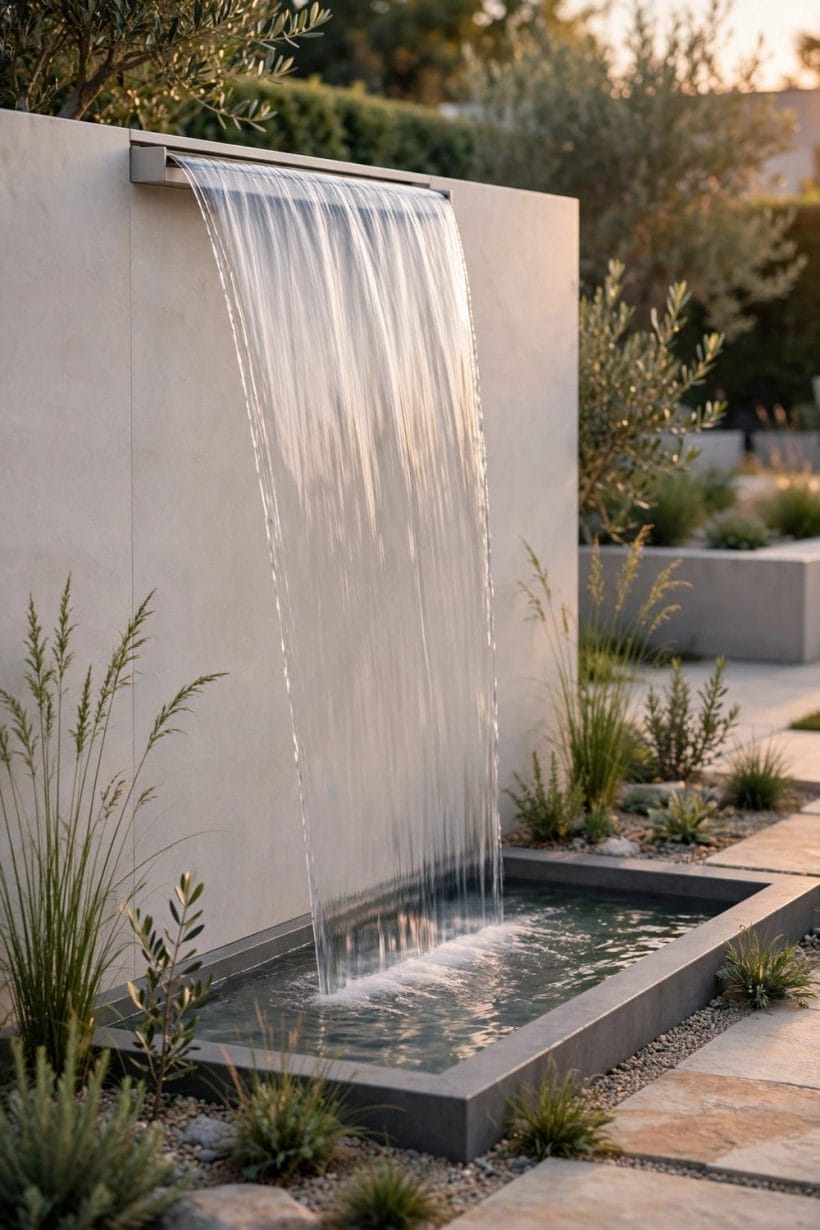
The disappearing falls pours into a hidden reservoir under gravel or grille — all of the water’s theatre, none of its standing water. It is the falls for small gardens, front gardens and households that would rather not fence a pond.
12. Vanish the falls into a gravel basin
The signature pondless design: water falls over rock and disappears through a bed of pebbles into a buried tank. From above, a dry stream bed with a living spring; from the seats, pure waterfall.
13. Cascade down a short slope to a hidden sump
A run of little falls down a stony slope, each drop vanishing at the foot into the hidden reservoir. The slope lengthens the music — one pump at the bottom serves the whole hill.
14. Drill a boulder and let it bubble and fall
A single great stone, drilled and plumbed, wells water from its top and spills it down its own face back into the gravel. The boulder falls is sculpture, fountain and falls in one object.
15. Choose pondless where children play
No open water, nothing to fence, nothing to dread — the disappearing falls is the honest answer for family gardens. The water is all movement and no depth, and the gravel bed is safe under small feet.
16. Back a courtyard falls against the wall
In a walled courtyard a pondless falls pours down a stony panel into a gravel strip at the wall’s foot — the full sound of water in a space the size of a rug.
17. Make the front door’s arrival a falls
A small disappearing falls beside the path to the front door gives the house a watery welcome with no pond to maintain at the kerb. Guests arrive to music; the reservoir hides under the planting.
18. Pour a series of spill bowls into gravel
Bowls at descending heights, each spilling to the next, the last pouring into the gravel bed: a cascade of vessels, formal or rustic by their material, and the easiest falls to build level by patient level.
19. Run a falls over a stream bed of weirs
A dry-laid stream bed with little weir stones, water running only over the drops and vanishing at the end: between the weirs the bed reads as a stream’s portrait even when the pump rests.
20. Hide the reservoir, plan its access
The buried tank must be reachable — a stone or grille section that lifts for the pump’s sake. A pondless falls designed for its own maintenance stays magical; one that hides its pump forever becomes a dig.
21. Top up the reservoir without thinking
Evaporation and splash steal water daily; a simple float arrangement from a garden tap keeps the hidden tank honest. State it plainly in the plan, or spend summers with a hose and a suspicion of leaks.
22. Pour from a millstone or an urn
A millstone on its edge of gravel, an urn tipped over pebbles: vessel falls marry the pondless system to the garden’s ornaments, the water appearing from the object’s mouth as if by long habit.
4. Formal Spillways and Modern Blades: The Architectural Falls
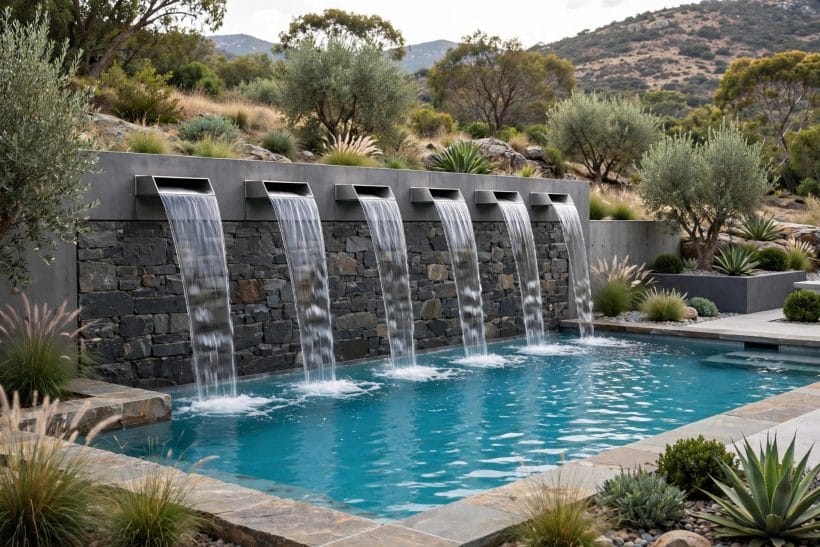
The formal falls trades rock for geometry: blades, spouts, walls and sheets of water drawn with a ruler. In modern and classical gardens alike, the architectural fall is a line of light and sound in the composition.
23. Drop a sheer blade into a still pool
A slim metal or stone blade projects a sheet of water falling unbroken into a dark, still basin — the modern falls in its purest form. The sheet’s glassiness is the lip’s truth; nothing hides here.
24. Spill from a scupper in a raised wall
A single spout or scupper set in a wall pours into a trough or pool below: the oldest formal falls, from cloister gardens to today’s courtyards, dignified by its simplicity and its one clear note.
25. Build a water wall
Water sheeting down a textured face — riven stone, tile, ribbed metal — into a narrow channel: the water wall is a falls with its face to the audience, thin as a picture and loud as a stream.
26. Channel a spout falls like a rain chain grown up
An open channel carried on posts or a wall pours from its end in a free fall — aqueduct logic at garden scale. The channel’s journey is half the show; its pour is the full stop.
27. Step a formal cascade like canal stairs
Even, identical steps pouring sheet after sheet: the canal-stair cascade of great classical gardens, scaled down. Its music is metronomic, its geometry unforgiving, its effect unforgettable when level.
28. Still the basin to a mirror
Under a single spout, a basin kept mirror-still doubles the falls in reflection. The design’s restraint — one spout, one sheet, one mirror — is the whole of its luxury.
29. Pour from a weathering-steel trough
A rust-finished steel trough spilling over its front edge colours the water’s frame in burnt orange — the industrial garden’s falls, ageing on purpose and improving yearly.
30. Edge a raised pool with an infinity fall
Where a raised pool or spa meets a lower basin, one side pours over in a continuous sheet — the infinity edge as a waterfall, the upper water forever arriving in the lower.
31. Slot the falls through a bench or wall
A horizontal slot in a wall or a bench’s back pours a wide, thin sheet: the falls concealed in furniture and architecture alike, found by its sound before its sight.
32. March a row of spouts along a rill
A formal rill — a narrow channel in the paving — fed by a row of little falls from spout after spout: rhythm in water and stone, the processional falls for a long garden’s spine.
33. Keep one sheet of water in a gravel court
The minimalist court: gravel, one wall, one blade, one dark basin. A single falls in an empty court is a meditation with plumbing — the boldest restraint a garden can practise.
5. Streams and Multi-Drop Falls: Water on a Journey
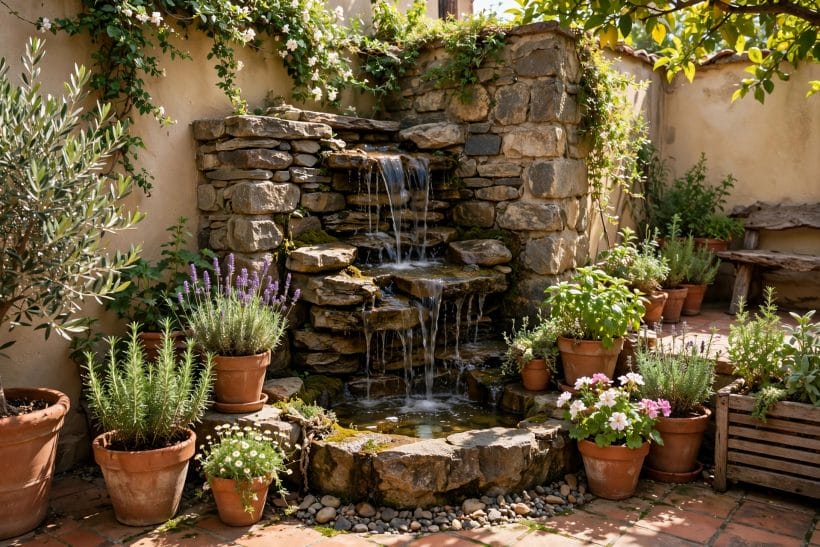
A stream multiplies a waterfall: every change of level becomes a fall, every fall a resting pool, and the garden gains a journey instead of a feature. Stream falls are designed in sequence, like verses.
34. Fall at every level change of the stream
The stream’s rule: where the ground drops, the water should be seen to drop. A little fall at each step keeps the current honest, the sound continuous and the channel safe from scouring.
35. Switchback the stream down a bank
A zig-zag stream doubles its length on a steep bank, falling at each turn — the mountain path in miniature, with a pool at every hairpin for the planting and the frogs.
36. Feed a series of pools, fall by fall
Pool, falls, pool, falls: the staircase of waters down a garden, each pool a room with its own planting and its own stillness, the falls the doors between them.
37. Walk a woodland stream from fall to fall
Where the garden is big enough for a path, the stream-and-falls walk is its itinerary: bridge, falls, pool, falls — the garden experienced as a story the water tells at walking pace.
38. Cascade beside the garden steps
Steps for people, steps for water, side by side down the slope: the companion cascade. Handrail on one side, handrail of falling water on the other — the kindest way down a steep garden.
39. Fall where the stream meets the pond
The stream’s last act is its best: a final falls into the pond, the journey ending in the garden’s still heart. Give the meeting the widest lip and the deepest welcome of the whole course.
40. Split the stream and rejoin below the falls
An island in the stream, two channels, two little falls rejoining in one pool: the braided drop doubles the carpenters’ work and the garden’s charm in about the same proportion.
41. Run a rapids between two calm falls
A shallow, stony rush between two still pools and their falls gives the stream its fast movement — sound up, sparkle up, and a shallows where birds queue to bathe.
42. Fall beneath a small bridge
A bridge is an audience seat built over the falls: the drop pours under the walker’s feet, heard through the boards, seen from the bridge’s low rail at the perfect distance.
43. Cascade down the hillside in view of the house
On a real slope, one long cascade stepped down the hill in full view of the windows gives the house a living picture in all weathers — the falls as the garden’s facade.
44. Chain pocket falls through a rock garden
In the rock garden, a chain of handkerchief falls — pool to pool among the stones — waters the alpines’ world and makes a small slope feel like a mountain valley in Lilliput.
6. Stone, Liners and the Hidden Works
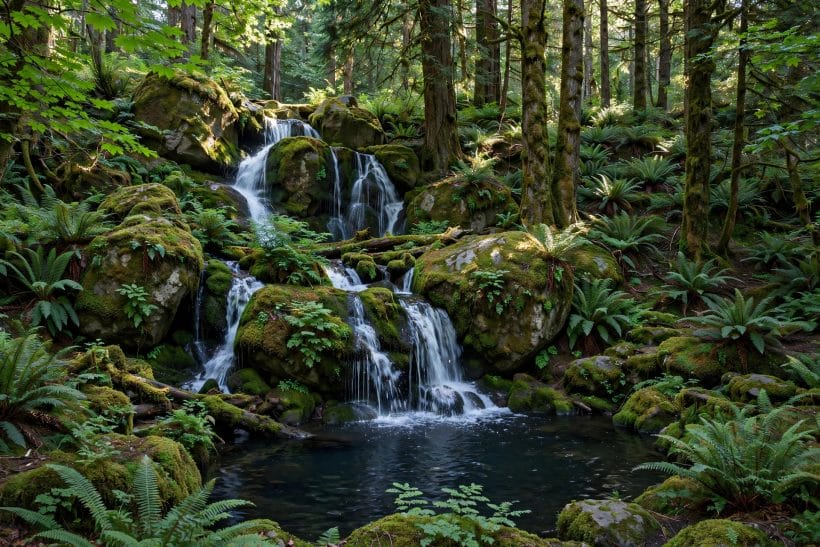
Every beautiful falls stands on invisible competence: a liner that does not leak, a lip set true, a pump with an honest path back to the top. The practical literature — liners, pumps and stone, as in the rock garden waterfall guides — is unglamorous and decisive.
45. Choose the lip stone first
The whole falls is designed backwards from its lip, the stone whose edge shapes the sheet. Pick it, set it level, and let every other stone be its supporting cast.
46. Hide every edge of the liner
A visible liner edge is a waterfall’s torn hem. Carry the stone and the planting over every margin, keep the water level below the liner’s top, and the illusion of a natural fall survives inspection.
47. Keep the header pool small and true
The little pool at the falls’ head — where the pump’s water arrives — must be level and calm, or the sheet leaves the lip unevenly. Small, deep enough to still the inflow, hidden under the top stones.
48. Size the pump to the lift and the sheet
A pump is chosen for the height it must lift and the width of sheet it must feed: take the maker’s figures for your exact drop and lip, and buy the pump the arithmetic names.
49. Hide the plumbing inside the rockwork
The rising pipe should travel inside the falls’ body, invisible at every joint, with its route remembered or mapped. Water arriving from a hidden mouth is the whole trick; a visible hose is the trick confessed.
50. Keep the skimmer and filter out of sight
On pond falls, the working boxes live under stones, behind planting, inside the bank — present to the hand, absent to the eye. Design their access covers as part of the rockwork from the start.
51. Protect the liner under sharp stone
Underlay beneath the liner and a cushion of sand or fabric under every sharp stone: the falls’ weight settles for years, and punctures are the leaks that arrive in year three wearing a disguise.
52. Place boulders big-low and lip-true
The rockwork’s grammar: the largest stones low and at the edges, diminishing upward, the lip stones few and perfect. Nature’s falls are mostly buried boulder — imitate the proportion and the eye believes.
53. Choose mortared or dry-laid knowingly
Mortared rockwork holds its shape and its lip exactly, and repairs are surgery. Dry-laid work settles, plants itself and forgives. Both are honourable; choose for the falls you mean to keep.
54. Build a service loop into the falls
One section of rockwork designed to lift away — the pump’s door, the pipe’s junction made reachable — saves the falls from demolition at its first repair. Design the maintenance in, or design the demolition in.
55. Seal the water’s shortcuts
Water escapes sideways behind stones wherever a gap offers. Backing the channel and closing the flanks — with the sealants and foam made for the work — keeps the flow going over the lip.
7. Planting and Lighting Around the Falls
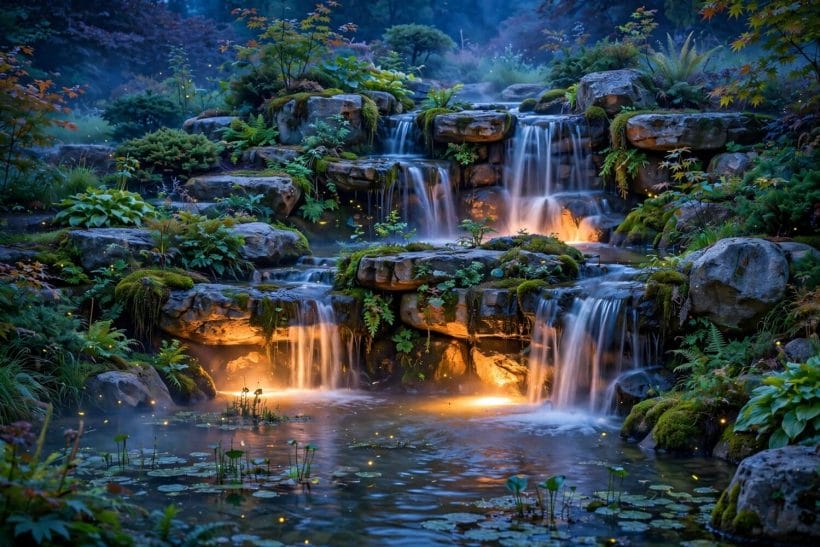
Water is the soloist; planting is the orchestra. The falls’ edges, backdrop and night lighting decide whether the water reads as a garden’s heart or a contractor’s leftover — and the edging discipline is the same one that tidies raised garden beds: a clear edge, generously planted.
56. Fern the falls’ feet
Ferns are falling water’s oldest companions — fronds for the spray zone, roots in the damp stone. A falls without ferns is a paragraph without commas; plant them in every shaded joint.
57. Soften the basin’s edge with marginals
Where the falls meets a pond or basin, marginal plants — iris, rushes, moisture grasses — blur the line between stone and water and give the wildlife its ladder in and out.
58. Back the falls with evergreen structure
Water rests in winter; the backdrop must not. An evergreen frame behind the falls keeps the composition standing in January, when the structure is all the garden has.
59. Light the falls from behind the sheet
A light set behind the falling water turns the sheet into a lantern — the night falls in its glory. One fitting, honestly waterproofed and professionally connected, outperforms a dozen garden spikes.
60. Uplight the lip stone
The lip is the falls’ face; a low light raking across it at night doubles its presence and throws the sheet’s shadow dancing on the pool. Aim it once, at dusk, with patience.
61. Lead path lights to the listening post
A falls is heard before it is seen; a few low lights along the path to its bench choreograph the evening visit — pools of light, then the water’s own glow.
62. Encourage moss on the shaded rockwork
Moss is the falls’ patina and cannot be rushed — shade, damp and time apply it. Where it comes, leave it; it is the signature that the waterfall has become a place, not a project.
63. Echo the water with grasses
Ornamental grasses beside the falls repeat its movement in wind — two kinds of falling, one wet, one dry. The pairing is the planting designer’s easiest harmony.
64. Give the falls a listening post
A bench or flat stone at the falls’ best distance — close enough for spray on a hot day, far enough for the whole composition — is the falls’ final furnishing. Every waterfall deserves its audience of one.
65. Plant pockets into the rockwork
Soil pockets designed between the stones take small alpines and trailers that root in the damp and soften the falls’ masonry year by year. The planted falls ages; the bare one merely weathers.
8. Small Gardens, Patios and Courtyard Falls
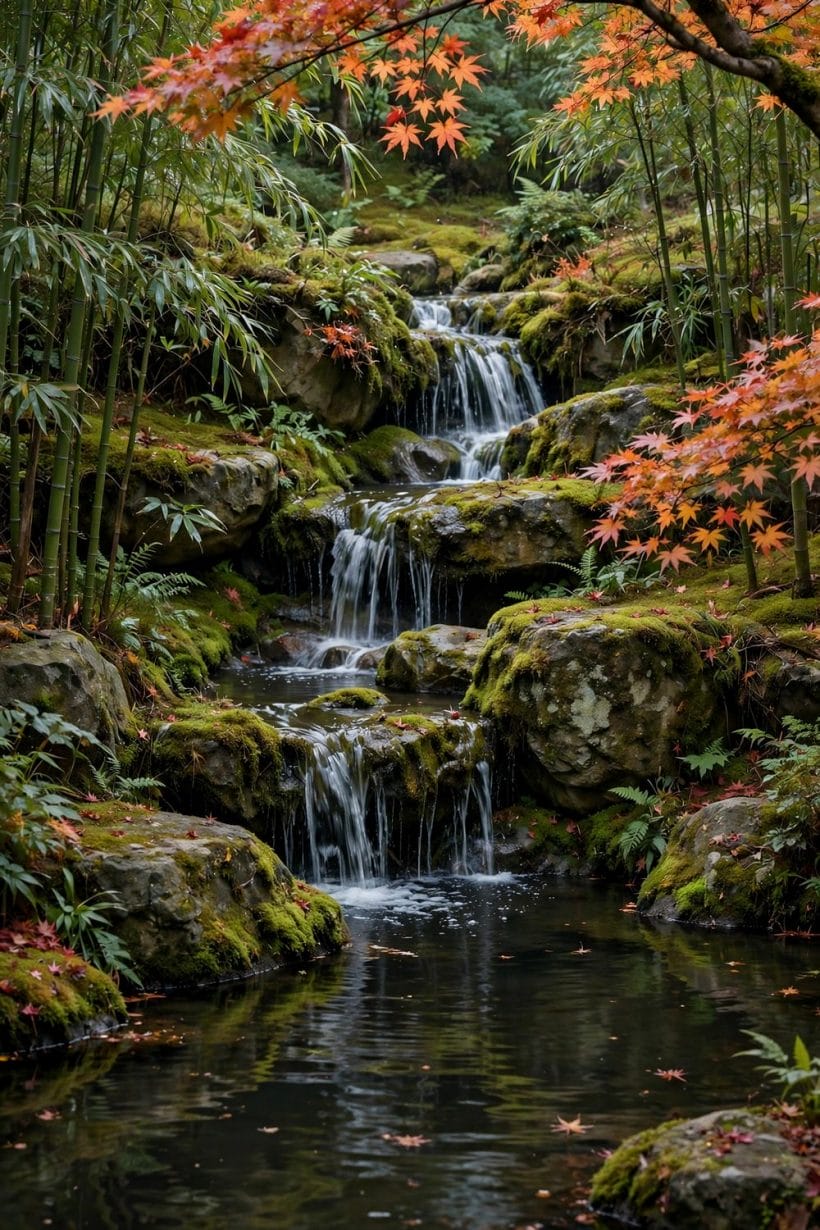
The waterfall does not need a hillside or an acre. Some of the best falls pour in courtyards the size of a tablecloth — the courtyard is falling water’s natural small room — and along the garden’s tightest edges, past the garden gate and down the side return.
66. Mount a spout falls on the courtyard wall
One spout, one sheet, one narrow basin along the wall’s foot: the courtyard falls entire. Its sound fills the little court like a fountain in a cloister, its plumbing in a finger’s width of wall.
67. Turn a raised planter’s corner into a falls
A planter’s end rebuilt as a stony drop into a gravel pocket gives a small patio a waterfall at chair height — heard intimately, maintained from a kneeling pad, loved out of proportion to its size.
68. Build a container falls from pot, pump and pebbles
A great pot, a small pump, a dish of pebbles and a spilling lip: the container falls is the renter’s and the beginner’s waterfall, an afternoon’s build and a summer’s pleasure.
69. Plant a trough garden with a miniature falls
In a sink or trough garden, a thumb’s-width falls pours between tiny pools among the alpines — a mountain landscape in a metre, the small garden’s most concentrated delight.
70. Fall between two raised beds
Where raised beds step down a slope, the step between them can pour: a little falls from the upper bed’s pond pocket to the lower, watering the garden’s terraces with theatre.
71. Thread a stream down the narrow side garden
The side return — too narrow for anything else — takes a ribbon stream with two or three little falls, turning the house’s least-loved strip into the walk to the back gate’s reward.
72. Keep the front garden’s falls small and formal
A front garden asks formality: one scupper, one basin, gravel and green. A small formal falls at the front door is a house’s jewellery, admired daily and maintained in minutes.
73. Fall into a stock-tank pool in a small yard
The galvanised tank pool with a rock or blade falls at its head is the small yard’s swimming hole — plunge pool, water music and garden sculpture sharing two square metres.
74. Tier a planter falls down the fence line
Planters at descending heights along a fence, each spilling to the next through a stony lip: the boundary becomes a cascade, and the fence — the small garden’s longest wall — earns its keep.
75. Design the falls to read in winter rest
Pumps rest in hard frosts; the falls must still compose. Stone set like sculpture, an evergreen frame, a basin holding its line dry — the winter falls is a rock garden with a memory of water.
9. Checks and Mistakes: Pumps, Safety and Upkeep
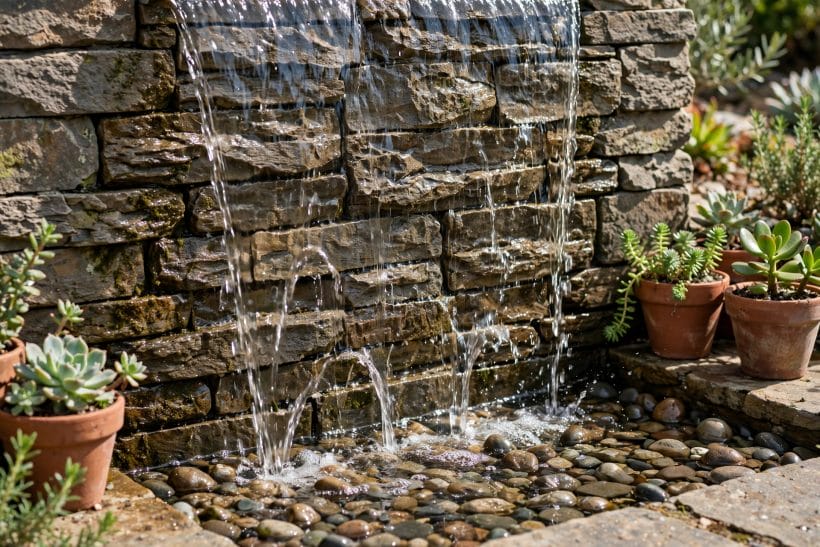
Water rewards the careful. First, power: pumps and lights work in and around water, so their supply belongs in professional hands — have the electrical work done or checked by a qualified electrician and follow the makers’ instructions. Second, open water: any pond or basin must be treated with respect around children — fence it, cover it or choose the pondless form — and give every basin an escape slope so wildlife can climb out. Third, the leak hunt: a falling water level almost always means an edge or a lip letting the stream escape sideways; check the margins before condemning the liner.
The design mistakes are quieter: a lip set almost level, pouring a lopsided sheet forever; a pump guessed at, starving the falls or drowning it; rockwork all one size, reading as rubble; and a falls placed where nobody sits, singing to the fence. Set the lip true, size the pump by the arithmetic, vary the stone, and put the bench where the sound is best.
10. Costs and Pulling It Together
A waterfall’s money hides underground: the reservoir, liner, pump and plumbing cost what they cost at every scale, while the visible falls can be as modest as one drilled boulder or as grand as a hillside of stone. Small falls are mostly machinery money; large falls are stone and labour. Running costs are a pump’s appetite and your own hours.
Pull the design together by choosing the falls’ one sentence — a curtain in a court, a cascade down the bank, a blade over black water — and letting it choose the lip, the stone and the sound.
Final Considerations
A waterfall is the garden keeping its promise to be alive: water falling, stone standing, plants softening, a bench within earshot. Designed at the lip and hidden in the works, it will outlast the furniture and the fences.
Start with the sound you want to live with, set one stone perfectly level, and let the water do the rest.



0 Comments