
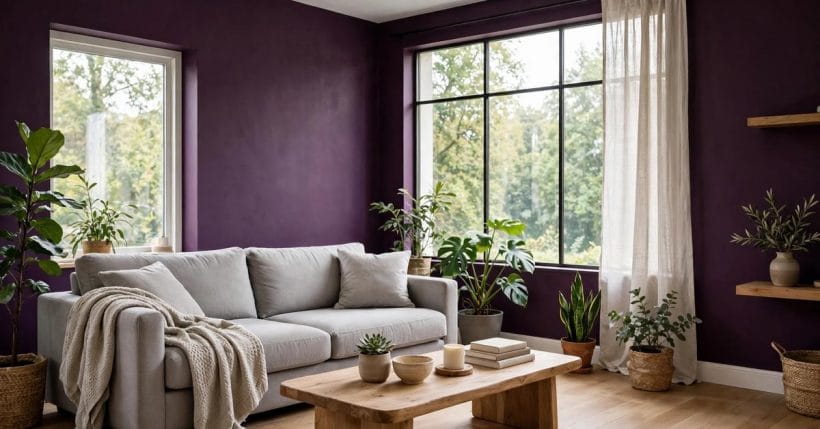
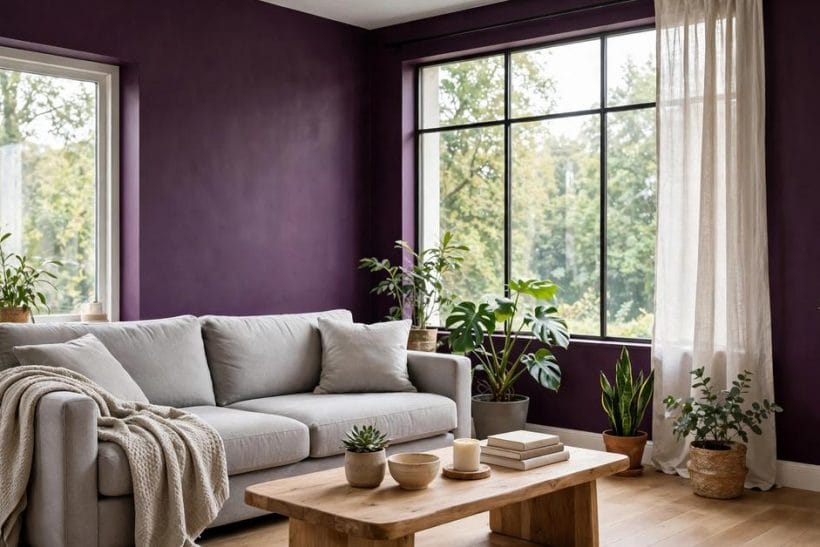
A living room built around a single purple wall can feel calm, generous and quietly dramatic all at once, because violet carries both warmth and depth in a way few other colours manage. This gallery gathers seventy-five ideas for rooms where violet leads, from pale lilac washes that open a small room to deep aubergine depths that make an evening room glow. The ideas cover shades, sofas, pairings, textures and layered lighting, so you can picture the mood that suits your home and talk about it clearly with the people who will help you make it.
Paint is the place to start, and the living room paint guide is a useful companion for thinking through colour in a living room before you commit to a shade. Throughout this gallery, violet stays the leading colour and every other choice supports it, whether that support comes from a pale sofa, warm wood, soft brass or a lamp placed exactly where evening light is needed. Read the ideas as a way to picture your room, and let samples and daylight settle every final choice.
1. Shades of Violet for the Main Wall
The shade you choose sets the whole temperature of the room, so it deserves the first and slowest look. Pale violets lift a room and keep it airy, mid violets feel balanced through the day, and deep violets turn the walls into a backdrop that makes furniture, art and lamplight stand out. The interior paint colours guide offers a wider view of how colours behave in small and light-filled homes, and these ideas narrow that view to violet alone.
| Item | What it is |
|---|---|
| A Lilac Wash Across Every Wall | Let a pale lilac wash run across every wall so the room reads as one soft envelope rather than a set of separate surfaces. |
| Lavender Mist for a Calm Morning Room | Choose a misty lavender for a room that is used most in the morning, when daylight is soft and the colour can stay quiet. |
| Greyed Mauve for a Grounded, Quiet Room | Greyed mauve suits a room that needs to feel settled rather than showy, because the grey in the colour steadies the violet and lets furniture take the eye. |
| Rich Plum on the Main Wall Only | Put rich plum on the main wall, the one your sofa faces or the one behind it, and keep the remaining walls in a pale neutral so the plum has room to breathe. |
| Aubergine Depth for an Evening Room | Save near-black aubergine for a room that comes alive in the evening, when lamps can pick out its depth and the walls can recede into a soft darkness. |
| Violet with Crisp White Trim | Frame violet walls with crisp white trim around doors, windows and skirting so the colour has a clean edge and the room keeps its shape. |
| A Two-Tone Violet Wall, Pale Above and Deep Below | Split a wall into a pale violet upper part and a deeper violet lower part, divided by a simple rail or a clean painted line, for a room with a tailored, traditional feel. |
| Testing Violet in Daylight and Lamplight | Test any violet on a large painted board and move it around the room through the day, watching it in morning light, afternoon light and lamplight before painting the full wall. |
| The Sofa Wall as the Violet Anchor | Paint the wall behind the sofa in violet so the seating arrangement gains a clear backdrop and the room gains a natural focal point. |
| A Violet Wall Behind the Fireplace | Let violet frame the fireplace so the hearth becomes the warm heart of the room and the colour deepens the glow of the fire. |
| A Violet Alcove for Reading | Turn a small alcove into a reading nook by painting its walls violet and placing a comfortable chair, a small table and a lamp inside it. |
| Violet Behind Open Shelving | Paint the wall behind open shelves violet so books, pottery and plants gain a rich backdrop that makes their shapes and colours stand out. |
| The Dining-End Wall in an Open Plan | In an open-plan room, paint the wall at the dining end violet to mark where one zone ends and another begins, without building any barrier. |
| A Violet Wall in the Entry View | Place violet on the wall seen first from the entry so guests are greeted by colour the moment they step into the living room. |
| Panelled Violet for a Tailored Look | Add simple wall panelling painted in violet for a tailored, crafted feel that suits both traditional and modern rooms. |
| A Violet Chimney Breast as the Focal Point | Paint a chimney breast violet, leaving the walls either side pale, so the structure of the room itself becomes the focal point. |
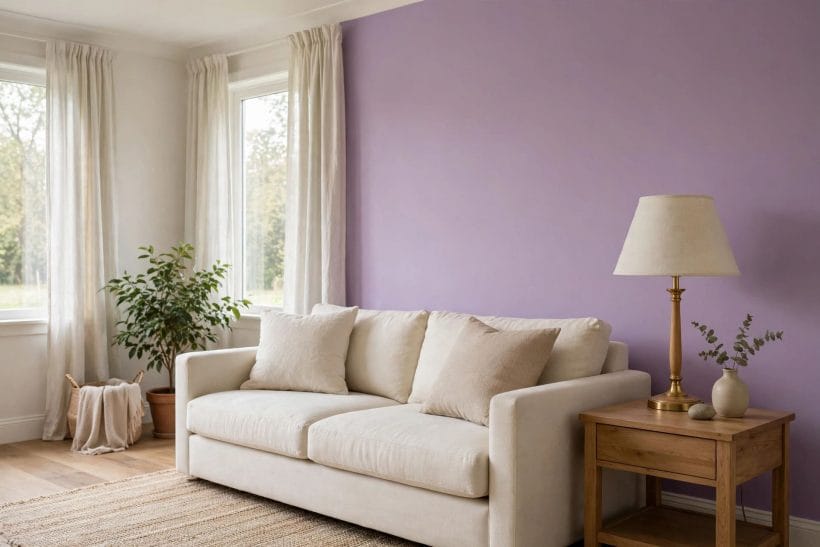
| A Cream Sofa Against Lilac Walls | Set a cream sofa against lilac walls for a pairing that feels fresh, soft and endlessly easy to live with. |
| A Light Grey Sofa Against Plum Walls | Pair a light grey sofa with plum walls for a calm, grown-up room where the violet provides all the colour and the grey provides the composure. |
| A Velvet Sofa in a Deep Violet Tone | Choose a velvet sofa in a deep violet tone for a room that wants to feel luxurious, with the wall colour a few shades lighter or darker so the two violets converse rather than match exactly. |
| A Tan Leather Sofa Against Violet Walls | Set a tan leather sofa against violet walls for a warm contrast that feels both traditional and relaxed, because leather's warmth balances violet's cool depth. |
| A Pale Linen Sofa for a Soft Violet Room | Choose pale linen for a violet room that should feel breezy and informal, with the fabric's natural texture softening both the wall colour and the light. |
| A Charcoal Sofa for a Bold Violet Room | Place a charcoal sofa against deep violet walls when the room should feel dramatic and cocooning, with pale cushions and warm lamplight to keep the darkness welcoming. |
| A Curved Sofa Softening a Violet Corner | Try a curved sofa in a violet corner so the room gains a gentle shape that echoes the softness of the colour itself. |
| A Low Sofa Keeping Violet Walls in View | Choose a low-profile sofa so the violet walls stay fully visible above it and the room keeps its sense of height. |
| Violet and Cream, the Classic Calm Pairing | Pair violet with cream throughout the room for a classic combination that never feels dated and always feels clean. |
| Violet and Soft Grey for a Modern Quiet | Combine violet with soft grey for a modern room that feels quiet rather than cold, using grey in seating, rugs and throws while violet holds the walls. |
| Violet and Warm Wood for Natural Warmth | Let warm wood be violet's main partner, through floors, tables, shelves and frames, so the room gains a natural warmth that painted colour alone cannot provide. |
| Violet and Brass for a Gentle Glow | Add brass in small, warm touches, through lamp bases, picture frames, handles and a mirror edge, so the room gains a gentle glow that flatters violet beautifully. |
| Violet and Blush for a Soft, Romantic Room | Soften violet with blush cushions, throws and flowers for a romantic room that feels tender without feeling sweet. |
| Violet and Charcoal for Evening Depth | Pair violet with charcoal in cushions, frames and a rug when the room is used mostly in the evening and should feel enveloping. |
| Violet and Pale Blue for a Cool, Airy Feel | Lighten a violet room with pale blue accents in cushions, art and ceramics for a cool, airy feeling that suits bright rooms and summer months. |
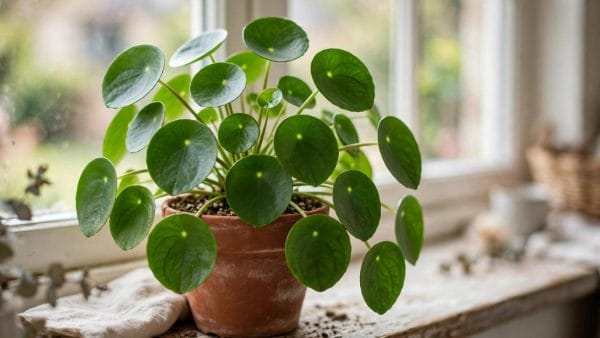
| Violet and Green Plants for Living Colour | Let green plants be the living accent in a violet room, because foliage adds a natural contrast that no painted colour can imitate. |
| Warm Table Lamps Beside the Sofa | Place warm table lamps on side tables beside the sofa so evening light falls at seating height, where it flatters both people and violet walls. |
| A Floor Lamp for a Reading Corner | Stand a floor lamp beside a reading chair so the corner gains its own pool of warm light and the violet around it deepens into a cosy backdrop. |
| Wall Washers That Flatter Violet Paint | Use wall-washing lights, placed to graze the violet surface gently, to show off the paint's depth and any texture in the wall itself. |
| A Statement Pendant Over the Coffee Table | Hang a statement pendant over the coffee table or the centre of the seating group to give the room a focal light as well as a focal colour. |
| Candlelight for Violet Evenings | Add candlelight in safe holders on the mantel, shelves and table for evenings when the room should feel at its most romantic, because flickering light makes violet walls shimmer gently. |
| Dimmers for Every Layer of Light | Fit dimmers to the room's lights so the violet can shift from a bright daytime colour to a deep evening backdrop with a single adjustment. |
| Daylight Kept Generous by Pale Curtains | Keep daylight generous with pale, sheer curtains that filter sun without blocking it, so violet walls stay luminous through the day. |
| Velvet Cushions on a Pale Sofa | Add velvet cushions in violet and blush tones to a pale sofa so the seating gains depth and the wall colour is echoed in a softer, touchable form. |
| A Wool Throw for Every Seat | Drape a wool throw over the sofa arm and each chair so the room always looks ready for a long sit, and so violet walls gain a soft, lived-in companion. |
| Linen Curtains Softening Violet Walls | Hang linen curtains in a pale neutral so the windows gain softness and the violet walls gain a gentle frame that never competes with them. |
| A Woven Rug Grounding the Room | Ground the room with a woven rug in natural tones so the floor gains texture and the violet walls gain a calm base to sit on. |
| Rattan and Cane for a Relaxed Violet Room | Bring in rattan and cane through chairs, baskets and lamp shades for a relaxed violet room that feels breezy rather than formal. |
| Wood Grain Against Smooth Paint | Let wood grain be the main contrast to smooth violet paint, through tables, shelves and frames whose grain gives the eye a natural pattern to rest on. |
| Glass and Mirror for Lightness | Add glass and mirror in small touches, through a glass-topped table, a mirror and clear vases, so the room gains lightness and reflected light without adding colour. |
| Pale Lilac to Open a Small Room | Paint a small room in pale lilac rather than deep violet so the walls recede and the room feels larger than it is. |
| One Violet Wall in a Compact Room | Keep violet to a single wall in a compact room so the colour gives focus without surrounding the sitter on every side. |
| A Mirror Doubling Light Against Violet | Hang a generous mirror on or opposite a violet wall so daylight and lamplight double and the room feels wider. |
| Low Furniture Keeping Walls Visible | Choose low furniture for a small violet room so the walls stay visible and the room keeps its height, because tall pieces would crowd the colour and shrink the space. |
| Pale Floors Lifting Violet Walls | Pair violet walls with pale floors, whether pale wood, a light rug or pale tiles, so the floor reflects light upward and the room stays bright. |
| Vertical Stripes of Violet in a Narrow Room | Use vertical painted panels or stripes of violet in a narrow room to draw the eye upward and give the walls a sense of height. |
| A Violet Nook, Not a Violet Room | Paint only a nook, such as a window seat recess or a reading corner, violet in a small home so the colour becomes a delightful surprise rather than a commitment. |
| Deep Violet on Tall Walls | Use deep violet on tall walls so the height of the room becomes a feature and the colour gains the scale it deserves. |
| Zoning an Open Plan with Violet | Zone an open-plan room by giving the sitting area violet walls while the adjoining dining or kitchen zone stays pale, so each part of the space gains its own mood without any wall between them. |
| A Violet Feature Wall in a Double-Height Space | Give a double-height wall a violet treatment, with art hung at both levels or shelving that climbs the wall, so the room's height becomes its most memorable feature. |
| Two Violet Tones in One Large Room | Use two violet tones in a large room, a deeper shade on the main wall and a paler shade elsewhere, so the room gains depth without feeling divided. |
| A Violet Library Wall for a Large Room | Turn one large wall into a violet library wall, with shelving painted in the same violet as the wall behind it, so books and objects appear to float on colour. |
| Violet and a Fireplace in a Grand Room | Centre a large room on a violet fireplace wall, with the mantel in pale stone or painted wood standing out against the depth behind it. |
| Open Sightlines Through Violet Zones | Keep sightlines open through violet zones so a large room never feels divided, even where wall colours change. |
| A Violet Gallery Wall for Collected Art | Hang a gallery of collected art on a violet wall in a large room, mixing frames in wood, brass and cream so the collection feels gathered over time. |
| Large Art That Breathes on Violet | Hang one large piece of art on a violet wall rather than many small ones, so the art gains presence and the violet gains a clear partner. |
| A Mirror as the Violet Wall's Partner | Place a large mirror on a violet wall so the room gains light, depth and a reflected view that changes through the day. |
| Shelves Styled in Cream and Wood | Style shelves against violet walls in cream ceramics, wood objects and a few books, keeping the palette pale so the shelves read as a light pattern on a dark field. |
| Plants Trailing from Violet Shelves | Let trailing plants spill from shelves mounted on violet walls so the room gains movement and living green against the painted colour. |
| A Fireplace Display on a Violet Wall | Style the mantel on a violet wall with a simple, balanced display, such as a pair of candlesticks, a small mirror and a vase of flowers, so the fireplace remains the room's heart. |
| Photographs in Cream Frames on Violet | Hang family photographs in cream or pale wood frames on a violet wall so personal memories gain a warm, gallery-like setting. |
| A Clock or Sculpture as a Single Statement | Place a single statement object, such as a beautiful clock or a small sculpture, on a violet wall where it can be appreciated alone. |
| Spring Flowers Against Violet Walls | Bring spring flowers into a violet room, in pale pinks, creams and whites, so the season's freshness contrasts beautifully with the wall colour. |
| Summer Lightness with Sheers and Pale Textiles | Lighten a violet room for summer with sheer curtains, pale linen cushions and a light rug, so the colour stays but the room feels breezy. |
| Autumn Warmth with Wool and Brass | Warm a violet room for autumn with wool throws, brass lamps and candlelight, so the colour deepens into the season's mood. |
| Winter Evenings by Lamplight | Let winter evenings belong to lamplight in a violet room, with every lamp lit, throws within reach and the curtains drawn against the dark. |
| A Violet Room for Gatherings | Arrange a violet room for gatherings by pulling chairs into the conversation group, adding extra cushions and making sure every seat has a surface nearby for a drink. |
| A Violet Room for Quiet Reading | Keep a corner of the violet room for quiet reading, with a comfortable chair, a good lamp and a small table for a book and a drink. |
| Living with Violet for the Long Term | Live with violet for the long term by choosing a shade you love in every light, keeping the supporting palette simple, and changing only textiles and flowers as tastes evolve. |
1. A Lilac Wash Across Every Wall
Let a pale lilac wash run across every wall so the room reads as one soft envelope rather than a set of separate surfaces. The lightness keeps the room feeling open, the violet tint keeps it from feeling plain, and pale furniture can sit against it without any sharp contrast. Add warm wood and cream textiles so the lilac feels like a gentle background rather than a cold one.
2. Lavender Mist for a Calm Morning Room
Choose a misty lavender for a room that is used most in the morning, when daylight is soft and the colour can stay quiet. Lavender mist works beautifully with white trim, pale curtains and a light rug, and it gives plants a fresh green contrast without any drama. Keep the rest of the palette pale so the room holds its calm from the first light of the day.
3. Greyed Mauve for a Grounded, Quiet Room
Greyed mauve suits a room that needs to feel settled rather than showy, because the grey in the colour steadies the violet and lets furniture take the eye. Pair it with grey or stone-coloured seating, natural wood and simple shapes, and the room will feel composed at any hour. This is a shade for long sitting, reading and unhurried conversation.
4. Rich Plum on the Main Wall Only
Put rich plum on the main wall, the one your sofa faces or the one behind it, and keep the remaining walls in a pale neutral so the plum has room to breathe. The depth draws the eye without closing the room in, especially when the plum wall carries art, a mirror or a simple shelf. Let lamplight fall on the plum in the evening and watch it warm up beautifully.
5. Aubergine Depth for an Evening Room
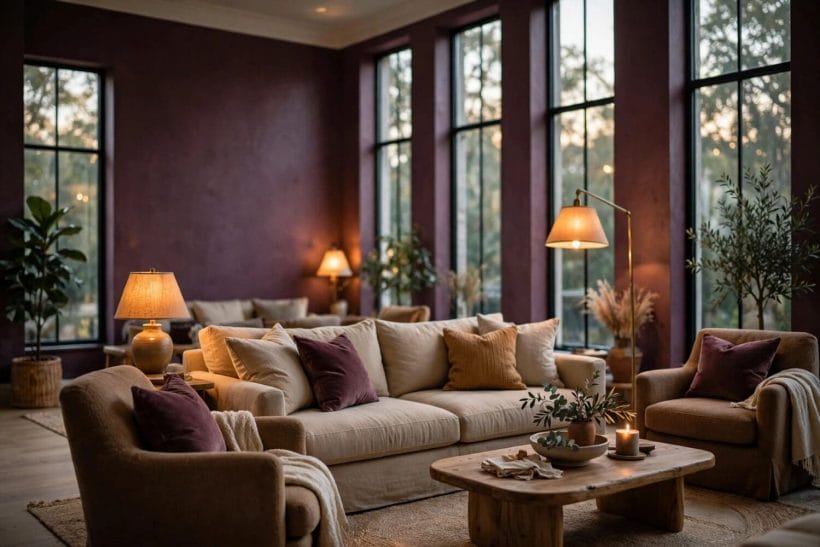
Save near-black aubergine for a room that comes alive in the evening, when lamps can pick out its depth and the walls can recede into a soft darkness. Cream seating, brass details and warm light keep the depth inviting rather than heavy, and books or art on the walls gain a gallery-like presence. This is violet at its most dramatic and its most restful.
6. Violet with Crisp White Trim
Frame violet walls with crisp white trim around doors, windows and skirting so the colour has a clean edge and the room keeps its shape. White trim stops deep violet from feeling vague at the corners and gives pale violet a fresh, finished outline. Keep the trim simple and consistent throughout the room for the calmest effect.
7. A Two-Tone Violet Wall, Pale Above and Deep Below
Split a wall into a pale violet upper part and a deeper violet lower part, divided by a simple rail or a clean painted line, for a room with a tailored, traditional feel. The pale upper half keeps the ceiling feeling high, the deeper lower half grounds the furniture, and the division gives the wall a sense of structure. This works especially well behind a sofa or along a long wall.
8. Testing Violet in Daylight and Lamplight
Test any violet on a large painted board and move it around the room through the day, watching it in morning light, afternoon light and lamplight before painting the full wall. Violet shifts more than many colours as light changes, so a shade that looks soft at noon can look much deeper at dusk. Living with the sample for a few days is the surest way to choose with confidence.
2. One Accent Wall, Done Well
An accent wall works when it has a clear job: it anchors the sofa, frames the fireplace or gives a quiet corner its own identity. The rest of the room stays pale and calm, so the single violet surface can carry the colour story without competition. Choose the wall that the eye naturally lands on when entering the room, and let everything else support it.
9. The Sofa Wall as the Violet Anchor
Paint the wall behind the sofa in violet so the seating arrangement gains a clear backdrop and the room gains a natural focal point. A pale sofa against a violet wall reads crisply, cushions in cream and blush soften the contrast, and a pair of lamps on side tables completes the picture. Keep the wall itself simple so the sofa remains the star.
10. A Violet Wall Behind the Fireplace
Let violet frame the fireplace so the hearth becomes the warm heart of the room and the colour deepens the glow of the fire. A pale mantel or light stone surround will stand out against the violet, and the wall above can carry a mirror or a single piece of art. This pairing feels traditional and cosy, especially on winter evenings.
11. A Violet Alcove for Reading
Turn a small alcove into a reading nook by painting its walls violet and placing a comfortable chair, a small table and a lamp inside it. The enclosed colour makes the corner feel separate from the rest of the room, like a room within a room, and the deeper tone helps the mind settle into a book. Keep the chair pale so it invites you in.
12. Violet Behind Open Shelving
Paint the wall behind open shelves violet so books, pottery and plants gain a rich backdrop that makes their shapes and colours stand out. Pale ceramics and cream book spines read beautifully against violet, while wood shelves warm the whole arrangement. Keep the shelves uncluttered so the colour can do its quiet work behind them.
13. The Dining-End Wall in an Open Plan
In an open-plan room, paint the wall at the dining end violet to mark where one zone ends and another begins, without building any barrier. The violet signals a change of mood as you move from sitting to eating, while a shared palette of wood and cream keeps the whole space feeling connected. A pendant light over the table can echo the change.
14. A Violet Wall in the Entry View
Place violet on the wall seen first from the entry so guests are greeted by colour the moment they step into the living room. A single bold surface in the sightline sets the tone for the whole home, and the rest of the room can stay pale so the greeting never feels overwhelming. A mirror or console against it completes the welcome.
15. Panelled Violet for a Tailored Look
Add simple wall panelling painted in violet for a tailored, crafted feel that suits both traditional and modern rooms. The panels give the wall rhythm and shadow, the violet gives it warmth, and the combination reads as considered rather than decorative for its own sake. Keep the panel profile simple so the colour remains the main event.
16. A Violet Chimney Breast as the Focal Point
Paint a chimney breast violet, leaving the walls either side pale, so the structure of the room itself becomes the focal point. The projection catches light differently from flat walls, which gives the colour extra depth, and a mantel display or art above it gains a natural frame. This is an elegant way to celebrate a room’s bones.
3. Sofas That Sit Beautifully Against Violet
The sofa is the largest single shape in most living rooms, so its colour either calms the violet or competes with it. Pale sofas give violet breathing room, deep sofas deepen the mood, and textured fabrics stop a large seat from looking flat against a coloured wall. The general purple living room guide looks at violet rooms more broadly, while this gallery stays with violet walls and the seating that sits against them.
17. A Cream Sofa Against Lilac Walls
Set a cream sofa against lilac walls for a pairing that feels fresh, soft and endlessly easy to live with. The cream lifts the lilac, the lilac keeps the cream from looking stark, and natural wood and woven textures add the warmth that both colours need. This is the gentlest violet room in the gallery, and often the most liveable.
18. A Light Grey Sofa Against Plum Walls
Pair a light grey sofa with plum walls for a calm, grown-up room where the violet provides all the colour and the grey provides the composure. Grey cushions in mixed textures keep the sofa interesting, a pale rug keeps the floor light, and brass or wood details stop the palette from feeling cool. The result is quiet confidence.
19. A Velvet Sofa in a Deep Violet Tone
Choose a velvet sofa in a deep violet tone for a room that wants to feel luxurious, with the wall colour a few shades lighter or darker so the two violets converse rather than match exactly. Velvet catches light as you move around the room, so the sofa changes through the day, and pale cushions keep it from feeling too dense. This is a room for evenings.
20. A Tan Leather Sofa Against Violet Walls
Set a tan leather sofa against violet walls for a warm contrast that feels both traditional and relaxed, because leather’s warmth balances violet’s cool depth. The pairing suits wood floors, woven rugs and plants, and it ages gracefully as both materials soften with use. Keep cushions in cream and muted blush to bridge the two colours.
21. A Pale Linen Sofa for a Soft Violet Room
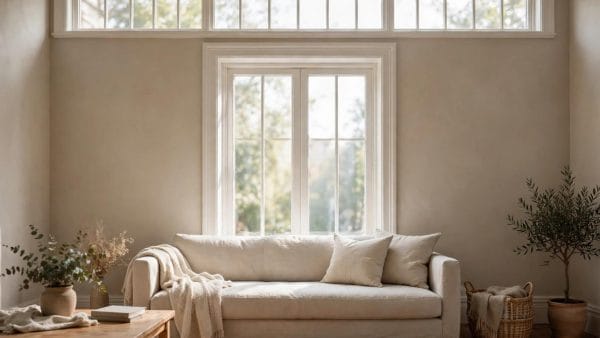
Choose pale linen for a violet room that should feel breezy and informal, with the fabric’s natural texture softening both the wall colour and the light. Linen slipcovers suit a relaxed household, they invite bare feet and open windows, and they pair beautifully with rattan, wood and cotton throws. The room will feel like a summer afternoon.
22. A Charcoal Sofa for a Bold Violet Room
Place a charcoal sofa against deep violet walls when the room should feel dramatic and cocooning, with pale cushions and warm lamplight to keep the darkness welcoming. Charcoal and aubergine sit close in tone, so the room reads as one deep envelope, and the contrast comes from light, texture and metal rather than colour. Add a pale rug to anchor the floor.
23. A Curved Sofa Softening a Violet Corner
Try a curved sofa in a violet corner so the room gains a gentle shape that echoes the softness of the colour itself. Curves break up the straight lines of walls and windows, they invite conversation by facing people toward each other, and they make a violet room feel deliberately designed. Keep the rest of the furniture simple so the curve can lead.
24. A Low Sofa Keeping Violet Walls in View
Choose a low-profile sofa so the violet walls stay fully visible above it and the room keeps its sense of height. Low seating suits rooms where the wall colour is the main decoration, it leaves space for art or shelving above, and it gives the room a modern, open feeling. Pair it with a low coffee table so the sightlines stay clear.
4. Colour Pairings That Calm the Room
Violet pairs best when its partners are chosen for calm rather than competition, because a colour this rich needs quiet company. Cream, grey, warm wood and soft metallics all let violet lead, while small touches of blush or green from plants add life without starting a second colour story. Keep the supporting palette narrow and repeat it through cushions, rugs and art.
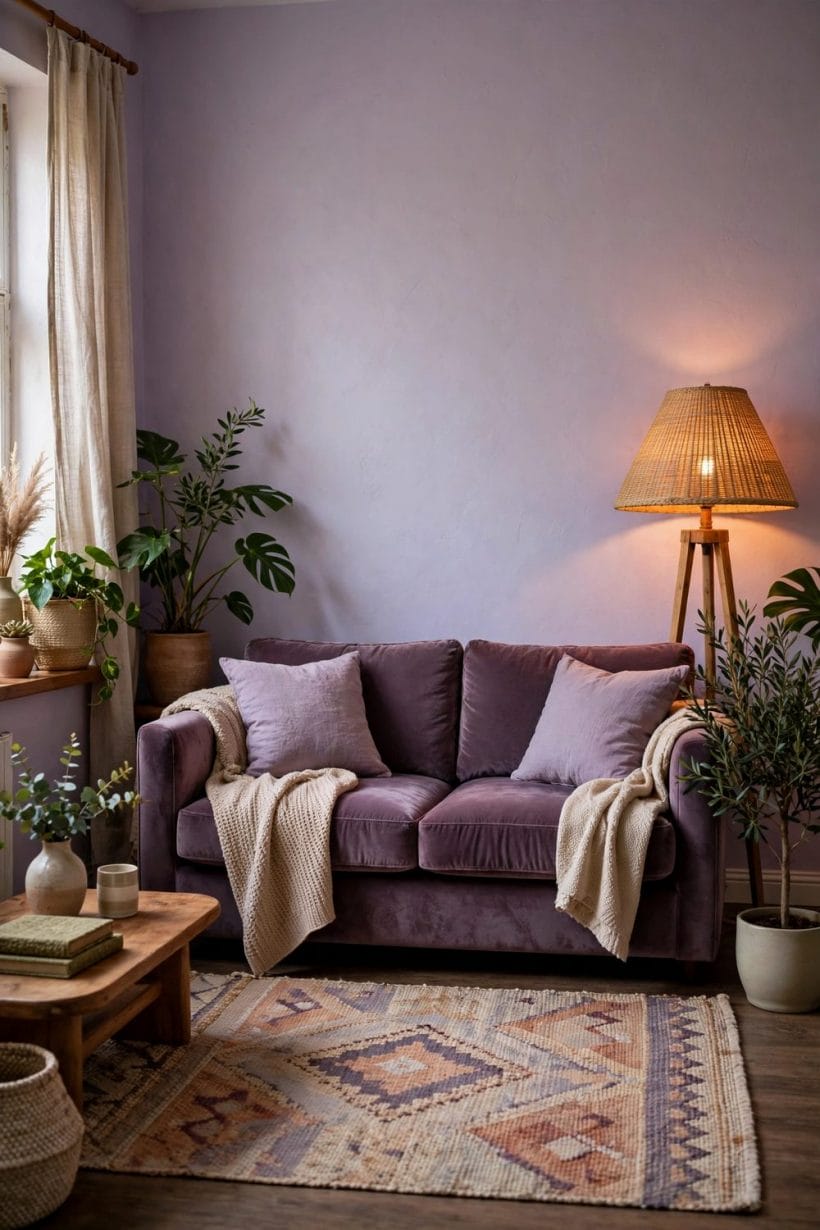
25. Violet and Cream, the Classic Calm Pairing
Pair violet with cream throughout the room for a classic combination that never feels dated and always feels clean. Cream curtains, cream cushions and a cream rug lighten deep violet, while cream woodwork gives pale violet a crisp frame. This pairing is the safest route to a violet room that feels calm from the first day.
26. Violet and Soft Grey for a Modern Quiet
Combine violet with soft grey for a modern room that feels quiet rather than cold, using grey in seating, rugs and throws while violet holds the walls. The grey steadies violet’s warmth, violet warms grey’s coolness, and together they make a balanced backdrop for art and plants. Add wood to keep the room from feeling flat.
27. Violet and Warm Wood for Natural Warmth
Let warm wood be violet’s main partner, through floors, tables, shelves and frames, so the room gains a natural warmth that painted colour alone cannot provide. Wood’s grain and tone soften violet’s richness, and the combination suits both traditional rooms and relaxed modern ones. Keep the wood tones consistent for the calmest result.
28. Violet and Brass for a Gentle Glow
Add brass in small, warm touches, through lamp bases, picture frames, handles and a mirror edge, so the room gains a gentle glow that flatters violet beautifully. Brass reads as warm light even in daylight, it lifts deep aubergine especially well, and a little goes a long way. Keep brass details few and well placed rather than scattered everywhere.
29. Violet and Blush for a Soft, Romantic Room
Soften violet with blush cushions, throws and flowers for a romantic room that feels tender without feeling sweet. Blush sits close to violet on the colour family, so the pairing feels harmonious, and the lighter tone stops deep violet from feeling heavy. Use blush as an accent only, and let violet remain clearly in charge.
30. Violet and Charcoal for Evening Depth
Pair violet with charcoal in cushions, frames and a rug when the room is used mostly in the evening and should feel enveloping. Charcoal deepens violet without competing with it, and warm lamps become essential in this palette, because light is what keeps the depth welcoming. This is a pairing for lamplight and long conversations.
31. Violet and Pale Blue for a Cool, Airy Feel
Lighten a violet room with pale blue accents in cushions, art and ceramics for a cool, airy feeling that suits bright rooms and summer months. The blue cools violet’s warmth just enough to keep the room feeling fresh, while cream and wood stop the palette from feeling cold. Keep the blue pale and the violet clearly dominant.
32. Violet and Green Plants for Living Colour
Let green plants be the living accent in a violet room, because foliage adds a natural contrast that no painted colour can imitate. Large leafy plants, trailing plants on shelves and small pots on tables all soften violet walls, and their green makes the violet look richer by comparison. Choose plants that suit your light and your routine.
5. Layered Lighting for Evening Depth
Layered lighting is what turns a violet room from a daytime colour into an evening mood, because violet changes more than most colours as light changes. A single ceiling light flattens violet, while a mix of overhead light, table lamps, floor lamps and candles gives the walls depth and movement. Plan lighting in layers, and make sure every seat has light within reach.
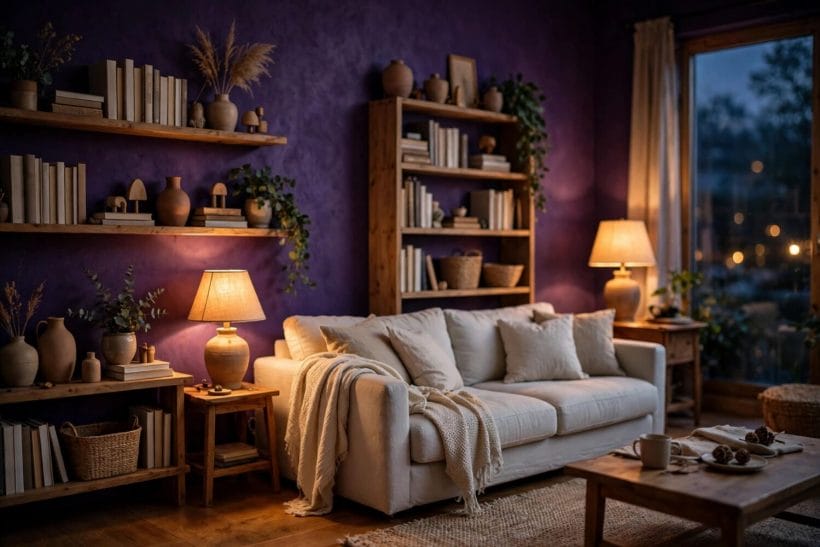
33. Warm Table Lamps Beside the Sofa
Place warm table lamps on side tables beside the sofa so evening light falls at seating height, where it flatters both people and violet walls. Lamplight from a low position warms the wall behind the sofa and creates pools of light that make the room feel intimate. Choose shades that diffuse light softly rather than throwing it harshly.
34. A Floor Lamp for a Reading Corner
Stand a floor lamp beside a reading chair so the corner gains its own pool of warm light and the violet around it deepens into a cosy backdrop. A floor lamp is easy to move as seating changes, it lights the page without lighting the whole room, and its glow on violet walls is one of the room’s prettiest evening sights. Keep the shade simple.
35. Wall Washers That Flatter Violet Paint
Use wall-washing lights, placed to graze the violet surface gently, to show off the paint’s depth and any texture in the wall itself. Washed light reveals the richness of plum and aubergine in a way that direct light cannot, and it turns a plain wall into a feature after dark. Keep the washing soft and even rather than spotty.
36. A Statement Pendant Over the Coffee Table
Hang a statement pendant over the coffee table or the centre of the seating group to give the room a focal light as well as a focal colour. The pendant draws the eye upward, it marks the gathering place in the room, and its glow falls on the table where people gather. Choose a shade that spreads light widely and warmly.
37. Candlelight for Violet Evenings
Add candlelight in safe holders on the mantel, shelves and table for evenings when the room should feel at its most romantic, because flickering light makes violet walls shimmer gently. Candles suit violet better than almost any other wall colour, and their small flames create a warmth that electric light struggles to match. Never leave candles unattended.
38. Dimmers for Every Layer of Light
Fit dimmers to the room’s lights so the violet can shift from a bright daytime colour to a deep evening backdrop with a single adjustment. Dimming lets you tune the room to its use, bright for gathering and tidying, low for conversation and rest, and it protects the mood that violet creates. Every layer deserves its own control.
39. Daylight Kept Generous by Pale Curtains
Keep daylight generous with pale, sheer curtains that filter sun without blocking it, so violet walls stay luminous through the day. Heavy dark curtains would fight the violet and darken the room, while sheer pale fabric lets the colour breathe and keeps the room feeling open. Layer sheers with a heavier curtain for evenings if privacy requires it.
6. Textures That Keep Violet Soft
Texture is what stops a violet room from feeling flat, because a single strong colour needs varied surfaces to stay interesting. Velvet, linen, wool, wood, rattan and metal each catch light differently, and together they give the eye plenty to explore without adding another colour. Repeat textures through the room so the palette feels layered rather than assembled.
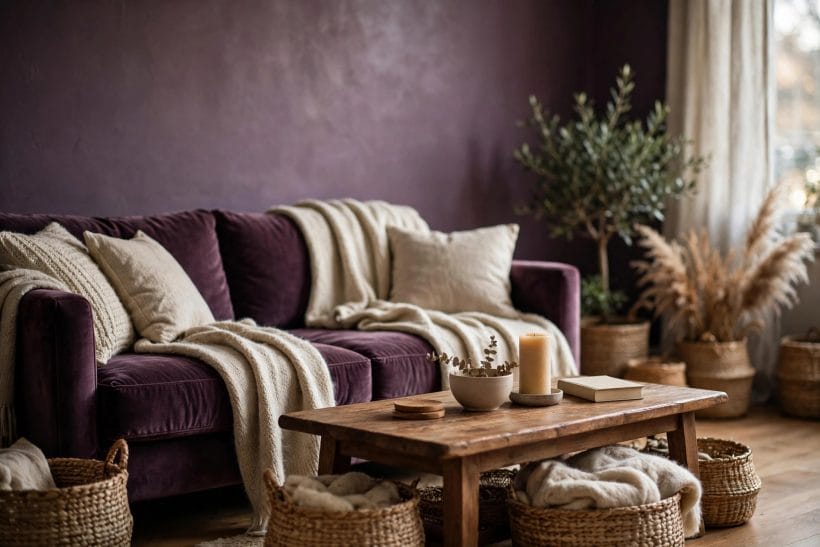
40. Velvet Cushions on a Pale Sofa
Add velvet cushions in violet and blush tones to a pale sofa so the seating gains depth and the wall colour is echoed in a softer, touchable form. Velvet catches light as people move, which keeps the sofa lively, and the cushions can be changed with the seasons without repainting anything. Mix velvet with linen for contrast.
41. A Wool Throw for Every Seat
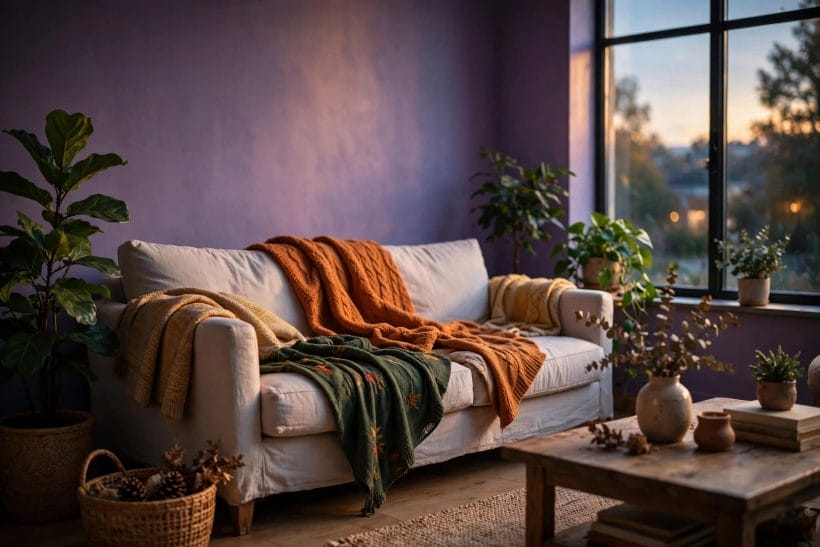
Drape a wool throw over the sofa arm and each chair so the room always looks ready for a long sit, and so violet walls gain a soft, lived-in companion. Wool adds weight and warmth to the palette, it invites people to settle, and its texture contrasts beautifully with smooth painted walls. Choose throws in cream, grey or muted blush.
42. Linen Curtains Softening Violet Walls
Hang linen curtains in a pale neutral so the windows gain softness and the violet walls gain a gentle frame that never competes with them. Linen’s natural texture and slight irregularity suit violet’s richness, and the fabric moves with the breeze in a way that keeps the room feeling alive. Keep the curtains long and simple.
43. A Woven Rug Grounding the Room
Ground the room with a woven rug in natural tones so the floor gains texture and the violet walls gain a calm base to sit on. A woven rug softens hard floors, defines the seating area, and adds a handmade feeling that balances the formality of a strong wall colour. Choose a pattern that is quiet rather than loud.
44. Rattan and Cane for a Relaxed Violet Room
Bring in rattan and cane through chairs, baskets and lamp shades for a relaxed violet room that feels breezy rather than formal. The open weave and pale tone of rattan lighten deep violet beautifully, and the natural material stops the room from feeling too polished. Use rattan as an accent, not as the dominant material.
45. Wood Grain Against Smooth Paint
Let wood grain be the main contrast to smooth violet paint, through tables, shelves and frames whose grain gives the eye a natural pattern to rest on. The contrast between organic grain and flat paint is one of the simplest ways to keep a coloured room interesting, and it works in every style from rustic to modern. Keep wood tones warm and consistent.
46. Glass and Mirror for Lightness
Add glass and mirror in small touches, through a glass-topped table, a mirror and clear vases, so the room gains lightness and reflected light without adding colour. Reflective surfaces bounce lamplight around a violet room, which keeps deep shades from feeling heavy, and they add a quiet sparkle. Place a mirror where it reflects a window or a lamp.
7. Small Living Rooms in Violet
Small rooms can wear violet beautifully, provided the shade is chosen for light and the rest of the room stays pale and simple. Pale violets open a small room, a single accent wall gives it focus without closing it in, and mirrors, low furniture and pale floors keep the space feeling generous. The small living room guide covers compact rooms more broadly, and these ideas apply its lessons to violet specifically.
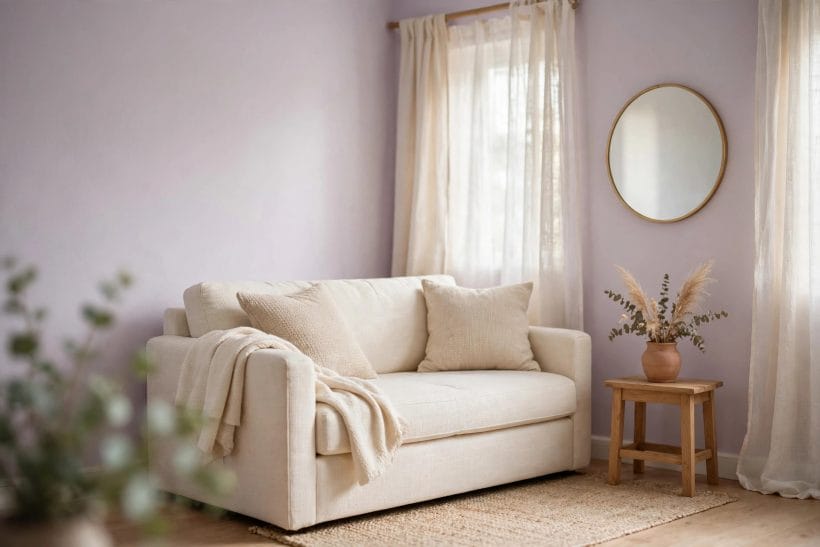
47. Pale Lilac to Open a Small Room
Paint a small room in pale lilac rather than deep violet so the walls recede and the room feels larger than it is. Pale lilac gives a small room colour without weight, it works with white ceilings and pale floors, and it keeps the room feeling fresh through the day. Save deep violet for a single accent if the room has generous daylight.
48. One Violet Wall in a Compact Room
Keep violet to a single wall in a compact room so the colour gives focus without surrounding the sitter on every side. The accent wall anchors the sofa or the main view, the remaining walls stay pale, and the room gains personality without losing its sense of space. This is the most forgiving violet approach for a small home.
49. A Mirror Doubling Light Against Violet
Hang a generous mirror on or opposite a violet wall so daylight and lamplight double and the room feels wider. A mirror against violet creates a beautiful contrast between colour and reflection, and it stops a small room from feeling enclosed by its own colour. Choose a simple frame so the mirror itself stays quiet.
50. Low Furniture Keeping Walls Visible
Choose low furniture for a small violet room so the walls stay visible and the room keeps its height, because tall pieces would crowd the colour and shrink the space. Low sofas, low tables and low shelving let violet be the decoration, and they leave sightlines open across the room. The room will feel taller and calmer.
51. Pale Floors Lifting Violet Walls
Pair violet walls with pale floors, whether pale wood, a light rug or pale tiles, so the floor reflects light upward and the room stays bright. A pale floor is the simplest way to balance a strong wall colour in a small room, and it gives furniture a light base to stand on. Keep the rug pale and simple for the same reason.
52. Vertical Stripes of Violet in a Narrow Room
Use vertical painted panels or stripes of violet in a narrow room to draw the eye upward and give the walls a sense of height. The vertical rhythm suits narrow spaces, it adds structure without adding furniture, and the violet remains a wall treatment rather than a roomful of colour. Keep the stripes soft and the remaining wall pale.
53. A Violet Nook, Not a Violet Room
Paint only a nook, such as a window seat recess or a reading corner, violet in a small home so the colour becomes a delightful surprise rather than a commitment. A nook in violet feels like a destination within the home, it photographs beautifully, and it lets you enjoy the colour daily without living inside it on every wall. Add a cushion and a lamp to complete it.
8. Large and Open Living Rooms
Large rooms can take violet at full depth, because space and light give the colour room to breathe. Deep shades that would overwhelm a small room become grounding in a large one, zones can each carry their own violet treatment, and tall walls give art and shelving the scale they deserve. The tiny living room guide may seem an unlikely companion here, but its lessons about defining zones and keeping sightlines clear apply just as well when the room is generous.
54. Deep Violet on Tall Walls
Use deep violet on tall walls so the height of the room becomes a feature and the colour gains the scale it deserves. Tall violet walls feel architectural rather than decorative, they make art and mirrors stand out, and they give a large room the sense of occasion it needs. Balance the depth with pale ceilings and generous light.
55. Zoning an Open Plan with Violet
Zone an open-plan room by giving the sitting area violet walls while the adjoining dining or kitchen zone stays pale, so each part of the space gains its own mood without any wall between them. The colour change signals a change of use, furniture can echo the zone, and the whole plan still reads as one home. Repeat a shared wood tone across zones to hold them together.
56. A Violet Feature Wall in a Double-Height Space
Give a double-height wall a violet treatment, with art hung at both levels or shelving that climbs the wall, so the room’s height becomes its most memorable feature. Violet at this scale feels confident and calm, especially when the lower part of the room stays pale and furnished simply. Light the wall in the evening so the height glows.
57. Two Violet Tones in One Large Room
Use two violet tones in a large room, a deeper shade on the main wall and a paler shade elsewhere, so the room gains depth without feeling divided. The tonal shift is subtle enough to feel like one colour story, yet strong enough to give the room structure, and furniture can sit comfortably against either tone. Keep the two tones clearly related, not competing.
58. A Violet Library Wall for a Large Room
Turn one large wall into a violet library wall, with shelving painted in the same violet as the wall behind it, so books and objects appear to float on colour. The unified treatment makes a large wall feel intentional rather than empty, and the violet gives the collection a rich, quiet backdrop. Leave some shelves partly empty so the wall can breathe.
59. Violet and a Fireplace in a Grand Room
Centre a large room on a violet fireplace wall, with the mantel in pale stone or painted wood standing out against the depth behind it. The fireplace gives the violet a natural focal point at the room’s heart, seating can gather around it, and the colour gains a warmth that suits the fire’s glow. This is a room made for gatherings.
60. Open Sightlines Through Violet Zones
Keep sightlines open through violet zones so a large room never feels divided, even where wall colours change. Low furniture, open shelving and clear paths between zones let the eye travel, and the violet reads as a series of related moments rather than separate rooms. Openness is what keeps a large violet room feeling generous.
61. A Violet Gallery Wall for Collected Art
Hang a gallery of collected art on a violet wall in a large room, mixing frames in wood, brass and cream so the collection feels gathered over time. Violet makes art colours sing, especially warm tones and pale landscapes, and a gallery wall gives a large violet surface a purpose beyond colour alone. Plan the arrangement on the floor first.
9. Art, Shelves and Focal Points
A violet wall is a backdrop, and a backdrop deserves something worth looking at, whether that is art, shelving, plants or a fireplace. The right focal point stops violet from feeling like colour for its own sake, and it gives the room a story beyond its paint. The decorating guide for living rooms offers general decorating lessons that sit well beside these violet-specific focal points.
62. Large Art That Breathes on Violet
Hang one large piece of art on a violet wall rather than many small ones, so the art gains presence and the violet gains a clear partner. Large art needs breathing space around it, and violet provides a calm, rich field that lets colours and shapes stand out. Choose art with pale or warm tones for the strongest effect against deep violet.
63. A Mirror as the Violet Wall’s Partner
Place a large mirror on a violet wall so the room gains light, depth and a reflected view that changes through the day. A mirror’s frame can be wood, brass or painted cream, and each choice changes the mood, from rustic to glamorous to quiet. The mirror also doubles the room’s light, which violet rooms always welcome.
64. Shelves Styled in Cream and Wood
Style shelves against violet walls in cream ceramics, wood objects and a few books, keeping the palette pale so the shelves read as a light pattern on a dark field. The contrast is what makes shelving against violet so attractive, and the pale objects stop the wall from feeling heavy. Leave breathing space between objects rather than filling every shelf.
65. Plants Trailing from Violet Shelves
Let trailing plants spill from shelves mounted on violet walls so the room gains movement and living green against the painted colour. Trailing foliage softens the geometry of shelving, it adds a natural line that contrasts with straight walls, and it makes the violet look fresher by comparison. Choose trailing plants that suit the room’s light.
66. A Fireplace Display on a Violet Wall
Style the mantel on a violet wall with a simple, balanced display, such as a pair of candlesticks, a small mirror and a vase of flowers, so the fireplace remains the room’s heart. The violet behind the display deepens every object placed on the mantel, and the display itself should stay simple so the colour can lead. Change the flowers with the seasons for a living focal point.
67. Photographs in Cream Frames on Violet
Hang family photographs in cream or pale wood frames on a violet wall so personal memories gain a warm, gallery-like setting. Pale frames stand out against violet without shouting, and a group of photographs becomes a family gallery that visitors naturally gather around. Keep the frames consistent in colour for a calm, collected look.
68. A Clock or Sculpture as a Single Statement
Place a single statement object, such as a beautiful clock or a small sculpture, on a violet wall where it can be appreciated alone. Violet walls suit singular statements, because the colour itself is already a statement, and one well-chosen object adds character without clutter. Give the object space, light and a clear sightline from the main seat.
10. Everyday Living, Season by Season
A violet room should work for everyday life, not just for photographs, and that means thinking about how it changes through the seasons and through the week. Throws, flowers, cushions and light can all shift with the time of year while the walls stay constant, so the room always feels current. The best violet rooms are the ones that are lived in, not just looked at.
69. Spring Flowers Against Violet Walls
Bring spring flowers into a violet room, in pale pinks, creams and whites, so the season’s freshness contrasts beautifully with the wall colour. Fresh flowers are the quickest way to change a room’s mood, and against violet they look especially luminous. A simple vase on the coffee table is enough to mark the season.
70. Summer Lightness with Sheers and Pale Textiles
Lighten a violet room for summer with sheer curtains, pale linen cushions and a light rug, so the colour stays but the room feels breezy. Summer is when violet needs the most light and the palest companions, and the seasonal swap can be as simple as changing throws and cushion covers. Keep the walls as the constant and let textiles do the seasonal work.
71. Autumn Warmth with Wool and Brass
Warm a violet room for autumn with wool throws, brass lamps and candlelight, so the colour deepens into the season’s mood. Autumn suits violet better than any other season, because the colour’s warmth matches falling light and longer evenings, and the room becomes a natural gathering place. Add dried flowers or foliage for a seasonal touch.
72. Winter Evenings by Lamplight
Let winter evenings belong to lamplight in a violet room, with every lamp lit, throws within reach and the curtains drawn against the dark. Violet walls glow in lamplight in a way pale walls cannot, and the room becomes a cocoon against the cold outside. This is the season when a deep violet room earns its keep.
73. A Violet Room for Gatherings
Arrange a violet room for gatherings by pulling chairs into the conversation group, adding extra cushions and making sure every seat has a surface nearby for a drink. Violet’s warmth makes guests feel welcome, and the colour gives a gathering a sense of occasion without any formality. Keep pathways clear so people can move easily.
74. A Violet Room for Quiet Reading
Keep a corner of the violet room for quiet reading, with a comfortable chair, a good lamp and a small table for a book and a drink. Violet’s depth helps the mind settle, and a dedicated reading corner means the room serves solitude as well as sociability. The best rooms offer both, at different hours of the day.
75. Living with Violet for the Long Term
Live with violet for the long term by choosing a shade you love in every light, keeping the supporting palette simple, and changing only textiles and flowers as tastes evolve. A violet room that is chosen slowly and lived in happily will outlast many trends, because its appeal comes from warmth and depth rather than novelty. Let the walls stay, and let the room grow around them.
Final Considerations
If you are choosing a violet room for the first time, start with one purple wall in the shade you love most, live with it through daylight and lamplight, and let the rest of the room follow from what you learn. A single wall is a forgiving first step, it teaches you how violet behaves in your light, and it can always grow into a fuller scheme once you are sure. Samples, patience and honest daylight are better guides than any single photograph.
Remember that violet rooms reward restraint: one strong colour, a narrow supporting palette, varied textures and layered light will carry a room further than a crowd of competing ideas. Keep furniture pale or warm, keep art and shelving simple, and let lamps do the evening work. For planting ideas that sit well against violet, the garden ideas guide offers a wider view of green planting for small homes, and its lessons about light and routine apply indoors too.
Above all, choose the violet that makes you want to sit down and stay a while, because a living room is judged by the hours spent in it, not by the boldness of its first impression. Whether your room ends up pale lilac or deep aubergine, whether it is small or generous, a violet room chosen with care will feel personal, calm and quietly joyful for years.


0 Comments