

Stone settles a garden like nothing else can: a boulder that looks as if it has always been there, a path that slows the walk, and edges that hold planting in calm, clear lines.
These 75 stone landscaping ideas stay with stone itself — boulders, paths, dry creeks, edging, walls, gravel and stone around water — so you can choose and place stone that belongs in your garden.
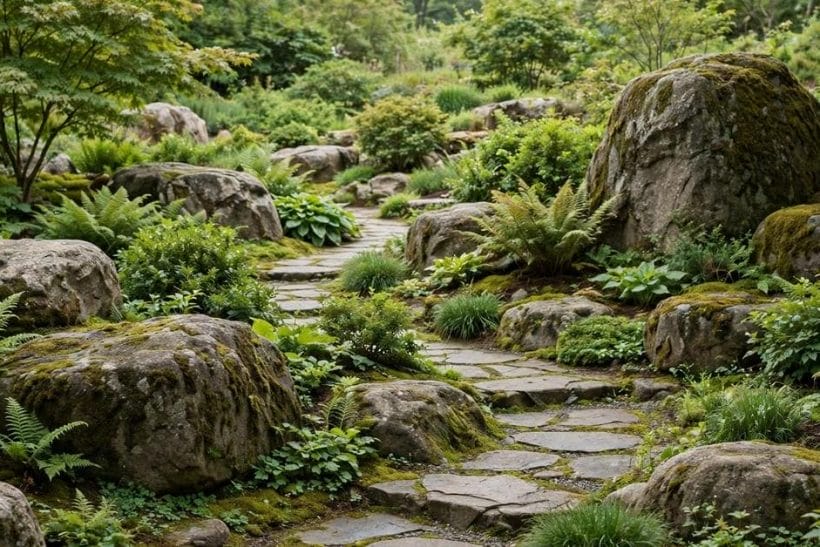
1. Stone Landscaping at a Glance
Scope first. This post owns the stone lane only: choosing, placing and pairing stone in the garden. Wider planting and layout planning sit elsewhere, and the companion guide to front yard landscaping ideas covers the entrance garden in full.
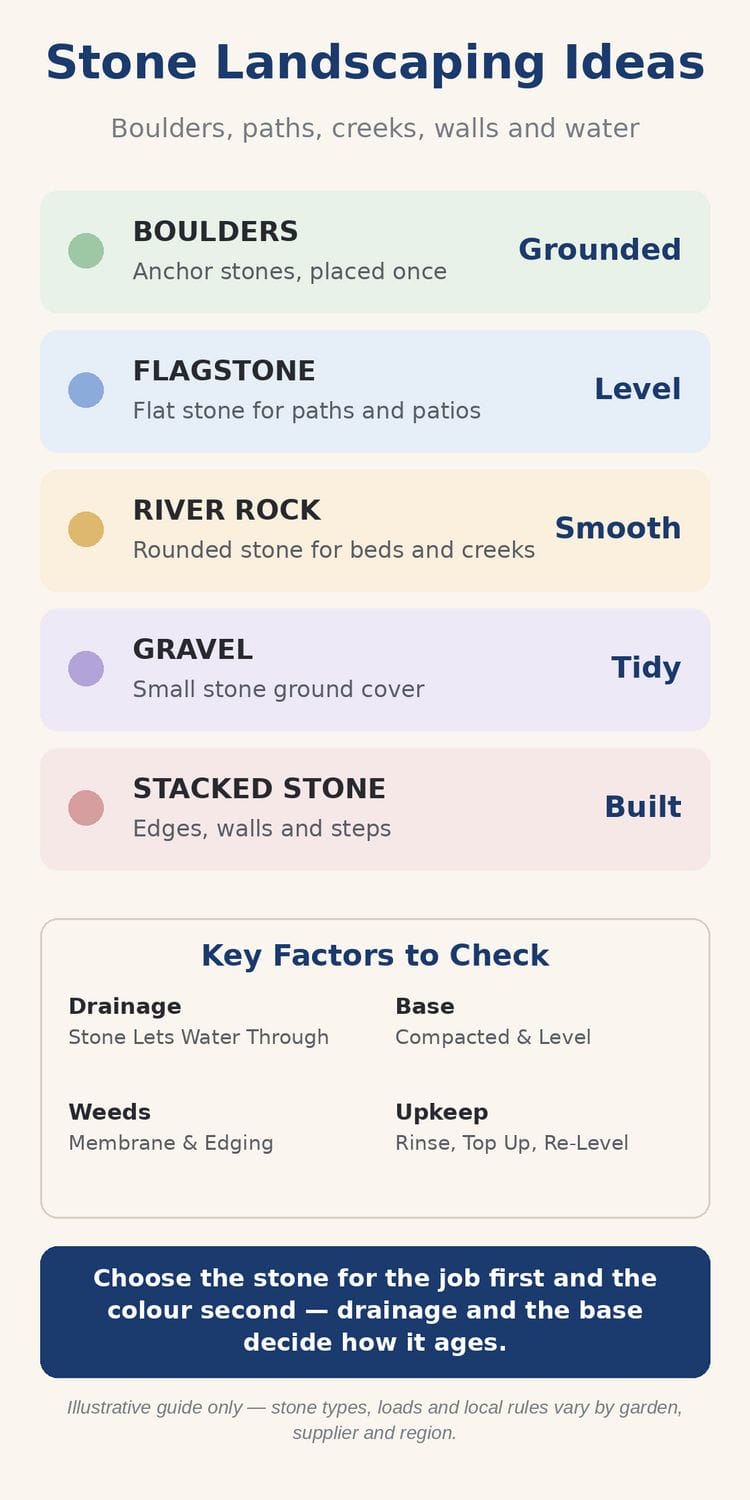
Read the stone before the layout. Colour, shape and surface decide how a garden feels, how water moves through it, and how much upkeep it asks for. The table below names the five stone families this post returns to, so later sections can speak plainly about each one by name.
| Family | Character | What it means |
|---|---|---|
| Boulders | Anchor | Large stones placed once to ground beds, corners and entrances |
| Flagstone | Level | Flat stone for paths, patios and steps that sit calmly |
| River Rock | Smooth | Rounded stone for dry creeks, margins and soft edging |
| Gravel | Tidy | Small stone ground cover that keeps beds clean and open |
| Stacked Stone | Built | Layered stone for edging, walls and terraces with structure |
2. Boulders and Feature Rocks
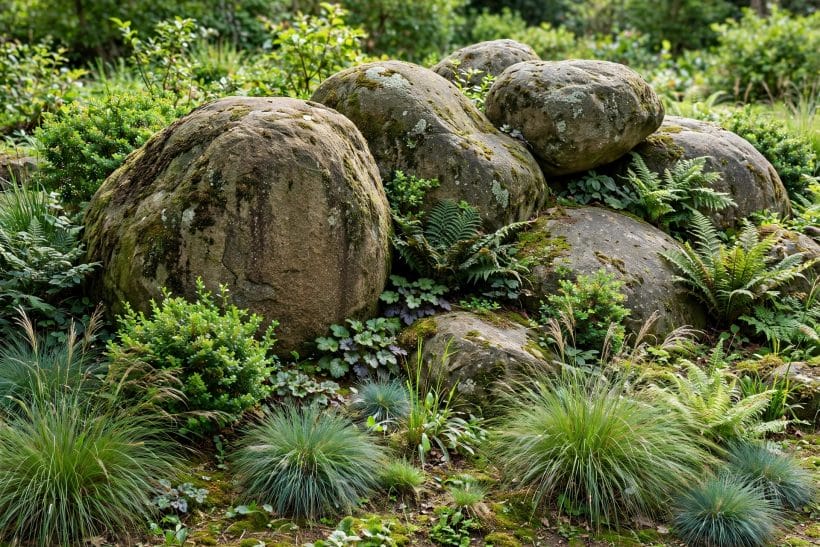
A boulder does the heavy visual work in a garden: it anchors a bed, marks a turn and gives planting something solid to gather around. Place boulders sparingly, settle them into the ground line, and let plants soften their bases over time.
1. Anchor boulder beside the front path
One well-chosen boulder beside a front path gives the entrance weight and permanence. Set it where the path turns or meets the door, keep its base planted low, and let the surrounding shrubs stay quieter than the stone.
2. Boulder trio in a planting bed
Groups read more naturally than single stones scattered alone. A trio of boulders in varied sizes, nestled into a planting bed, looks settled, especially when grasses and low shrubs weave between them and soften every hard edge.
3. Weathered boulder softened by low planting
A weathered boulder carries age in its surface, and low planting at its foot completes the picture. Creeping plants, small ferns or mounded grasses spilling against the stone make the join between rock and garden feel gradual and unforced.
4. Boulder cluster at a garden corner
Corners can drift into nothing in a loose garden, and a boulder cluster gives them a clear full stop. Anchor the corner with grouped stone, plant behind it, and the whole border gains a stronger outline.
5. Flat-topped boulder as a garden seat
A flat-topped boulder offers a perch without adding furniture to the garden. Set it beside a path, near a bed you tend often, and it earns its place as both sculpture and a resting spot.
6. Boulders framing a path entrance
Two boulders flanking the start of a path act like quiet gateposts, signalling where the walk begins. Keep them uneven in size, plant low around them, and let the path itself carry the eye onward.
7. Mossy boulders in a woodland corner
Shade and stone belong together. In a woodland corner, mossy boulders among ferns and hostas feel cool and settled, and the damp shade that challenges other materials only improves the stone, deepening its colour after rain.
8. Boulder and gravel in a dry garden
In a dry garden, boulders rising from gravel make a calm, spare composition. Space the stones generously, add drought-tolerant grasses for movement, and let the gravel keep the whole scene tidy and open.
3. Stone Paths and Stepping Stones
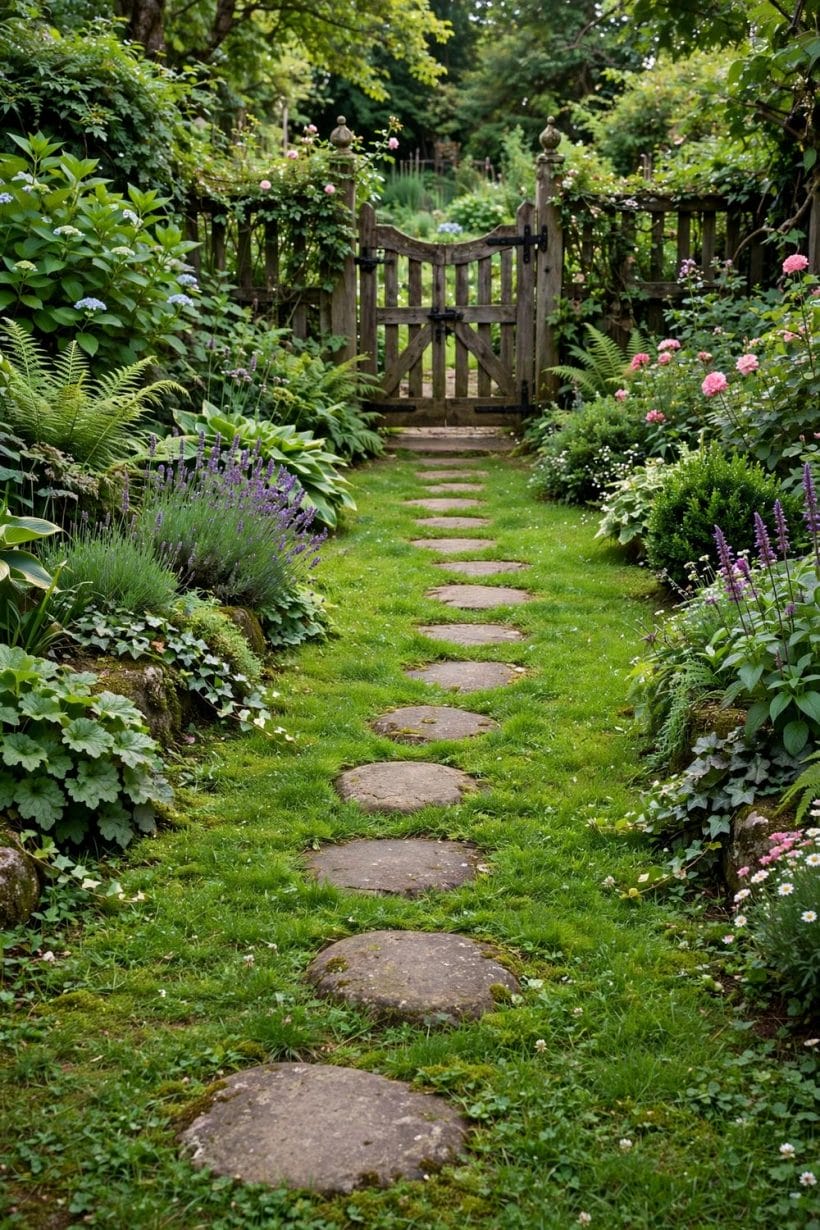
A stone path sets the pace of a garden, slowing the walk where planting deserves attention. The dedicated guide to flagstone walkway ideas covers walkways in full; here the focus stays on stone paths and stepping stones in garden settings.
9. Flagstone stepping stones across a lawn
Stepping stones across a lawn keep feet dry and the grass unmarked while adding a gentle rhythm to the crossing. Space the flagstones to a comfortable stride, keep them level with the turf, and mow around them easily.
10. Irregular stone path through cottage planting
An irregular stone path suits cottage planting perfectly, wandering slightly as beds spill over its edges. Let the stones vary in shape, keep the route clear beneath the softness, and the walk feels discovered rather than designed.
11. Straight stepping stones to a garden gate
A straight route reads honest and direct, ideal between a door and a garden gate used every day. Evenly spaced stones in a calm line, edged by low planting, make the everyday walk feel ordered.
12. Curved stone path softened by ground cover
A curve hides what lies ahead and makes a small garden feel larger on the walk through it. Soften the edges with low ground cover creeping between stones, and the path becomes part of the planting.
13. Large slab steps on a gentle slope
Where a garden slopes gently, large slab steps turn an awkward bank into a graceful change of level. Keep each step broad and even, flank it with planting, and seek professional advice on levels and fixing.
14. Stone path edged with low river rock
A border of low river rock gives a stone path a finished edge and keeps gravel, soil and lawn in their places. The rounded stones contrast gently with flat path slabs, and the whole route reads tidier.
15. Mixed-size flagstones in a relaxed walkway
Mixed sizes keep a walkway relaxed: larger slabs where the walk is busiest, smaller pieces filling the joins. The pattern feels natural rather than gridded, and it makes good use of varied stone while keeping the surface calm.
16. Stone path to a quiet seating nook
A path earns its keep when it leads somewhere worth going. Run stone toward a shaded bench or a small seating nook, let the planting close in slightly along the way, and the arrival feels rewarding.
4. Dry Creek Beds and River Rock
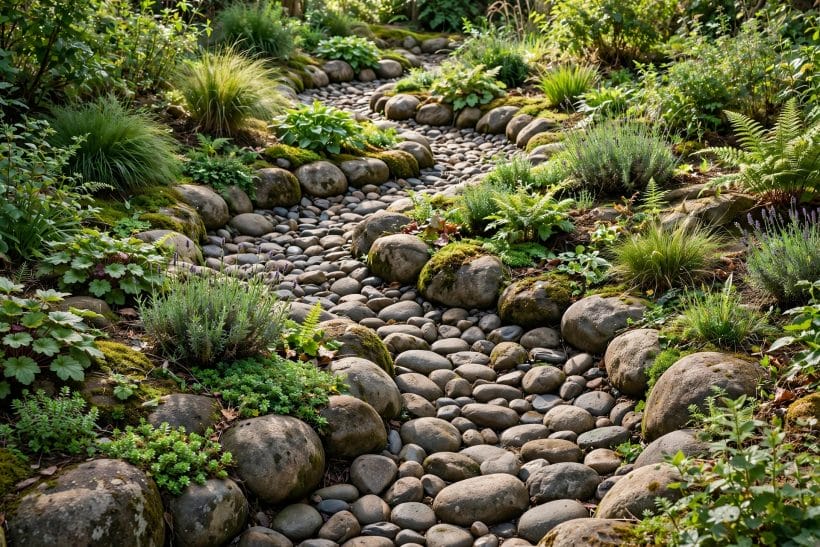
A dry creek bed gives a garden a story about water without the water itself: a winding line of river rock that suggests a stream, guides the eye and handles the look of a natural low point beautifully.
17. Winding dry creek in a front garden
A winding creek bed brings movement to a flat front garden, curving river rock through planting in a natural S-shape. Vary the width as it travels, cluster larger stones at the bends, and it reads like a stream at rest.
18. River rock creek edged with larger boulders
Boulders along a creek edge keep the line believable, as if water had nudged them there over time. Set the largest stones at turns, fill between them with smaller river rock, and plant grasses to soften the banks.
19. Dry creek under a small bridge
A small bridge over a dry creek is pure garden theatre, even in modest spaces. Let the river rock pass beneath it in one clear line, keep planting low nearby, and the crossing becomes a favourite moment.
20. Shallow creek bed planted with grasses
Grasses planted along a shallow creek bed add the movement real water would bring, swaying above the stone. Choose clumping varieties that stay tidy, set them in pockets along the edges, and leave the centre clear and stony.
21. Creek bed around a feature boulder
Letting a creek bed bend around one feature boulder gives the whole composition a reason for its curve. The stone sits like an island the water avoided, and planting behind it completes a scene that feels found, not arranged.
22. River rock swale in a naturalistic garden
In a naturalistic garden, a broad swale of river rock can suggest a seasonal stream bed through meadow-style planting. Keep the edges loose and planted, let the stone vary in tone, and it settles quietly into the wider landscape.
23. Dry creek beside a stone path
Running a dry creek beside a stone path doubles the pleasure of a walk, stone answering stone across a strip of planting. Keep the two lines roughly parallel, vary their distance slightly, and the pairing feels companionable.
24. Creek bed ending in a rock pool
A creek bed needs a satisfying ending. Let it widen into a shallow bowl of larger rock, planted densely with moisture-loving plants, and the line resolves like a pool at rest among the planting.
5. Stone Edging and Borders
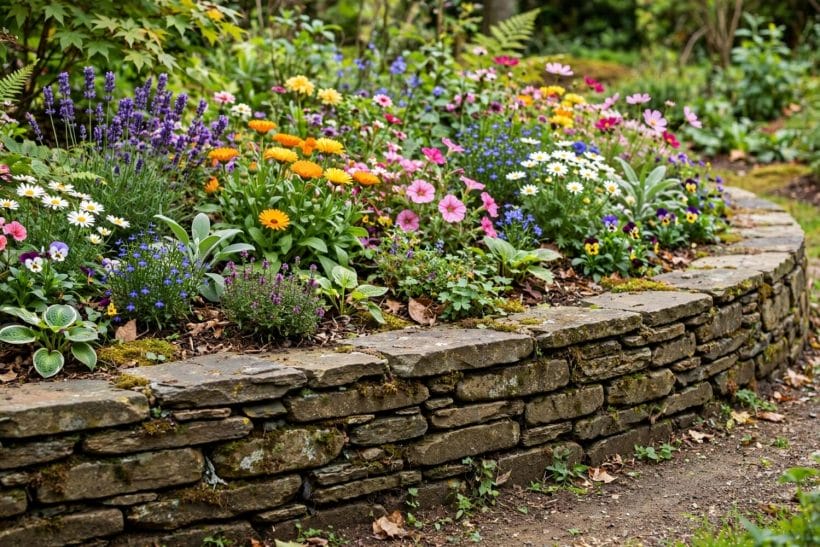
Edging is where stone quietly earns its keep, holding the line between lawn, path and bed. Good stone edging stays put, reads clearly in every season, and lets the planting above it look generous rather than unruly.
25. Stacked-stone edging along a flower bed
Stacked-stone edging gives a flower bed a low, built boundary that suits both cottage and formal gardens. The layered face reads crafted, holds soil back neatly, and gives sprawling plants a handsome line to tumble over.
26. River rock border for a curved bed
Rounded river rock follows a curve more forgivingly than cut stone, making it ideal for beds that sweep and bend. Set the stones closely in a single line, keep sizes similar, and the border feels like a shoreline.
27. Upright stone edging for a cottage border
Stones set upright, shoulder to shoulder, give a cottage border its classic, slightly irregular rhythm. The varied heights catch light and shadow through the day, and the edging holds its own against full summer planting.
28. Flagstone edging keeping gravel and lawn apart
Where gravel meets lawn, a line of flat flagstone keeps the two from mingling and gives mowing a clean edge. Laid flush and even, it reads as a quiet design line rather than a purely practical fix.
29. Boulder edging for a woodland bed
Small boulders spaced along a woodland bed make edging that looks gathered rather than built. Let the gaps fill with ferns and ground cover, vary the stones gently, and the bed edge dissolves into the woodland floor.
30. Stone edging around a tree circle
A circle of stone around a tree defines its planting bed, keeps mulch and soil in place, and gives the trunk a composed setting. Keep the ring generous, and plant the circle with shade-tolerant companions.
31. Pebble edging beside a stone path
A narrow strip of pebbles beside a stone path is a soft edge that still reads clearly, easing the join between hard path and planted bed. It also gives stray soil and gravel somewhere tidy to land.
32. Mixed stone edging in an informal garden
Mixing stone types along one border — a run of river rock, a few small boulders, a stretch of stacked stone — suits informal gardens where strict repetition would feel stiff. Keep the height calm and the line continuous.
6. Stacked-Stone Walls and Retaining
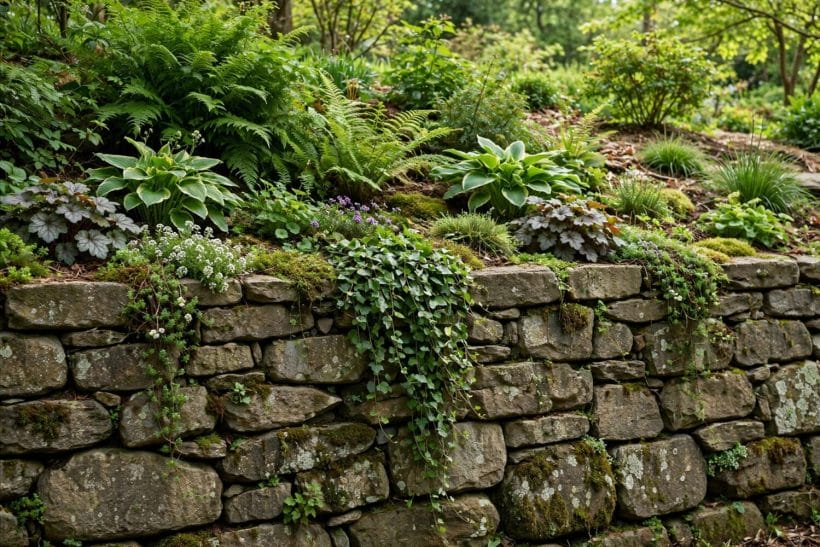
Stacked stone gives a garden its bones, holding slopes and defining levels with real presence. The guide to hillside landscaping ideas covers slopes in full; here walls stay in general terms, with structure and retaining always a matter for professional advice.
33. Dry-stacked retaining wall with planting above
A dry-stacked retaining wall holds a bank while looking like part of the landscape, with planting spilling from above. Retaining work carries real structural demands, so treat design and building as a professional job from the outset.
34. Low stacked-stone wall edging a terrace
A low wall around a terrace gives seating, definition and a place to perch a drink, all in one line of stone. Keep the top course even, match the stone to nearby paths, and the terrace feels built into the garden.
35. Stone wall softened by trailing plants
Trailing plants are a stone wall’s best softener, threading green over the face and blurring its geometry. Plant pockets and the bed above generously, let the growth wander, and a firm structure becomes a living part of the planting scheme.
36. Curved retaining wall on a slope
A wall that curves with the slope feels gentler than a straight barrier and often sits more naturally in the land. Curved retaining still needs professional design for strength and drainage, and the result rewards that care for decades.
37. Tiered stone walls in a sloping garden
Terracing a slope into tiers of stone walls turns unusable bank into level beds and paths. Each tier gains its own planting character, the climb becomes gradual, and professional advice on structure and drainage keeps the whole arrangement sound.
38. Stacked-stone wall framing a garden entrance
Short walls flanking an entrance give a garden a sense of arrival, like a doorway without a door. Cap them with a feature stone, keep the opening generous, and visitors read the welcome immediately.
39. Rustic fieldstone wall in a country garden
Fieldstone, with its varied shapes and tones, makes walls that look gathered from the land itself. In a country garden that informality is the point: the wall feels honest, and ages gracefully beside hedges and orchards.
40. Stone wall with steps alongside
Walls and steps belong together on any change of level, the wall holding the bank while steps carry the walk. Keep the stone consistent between them, flank the steps with planting, and confirm structure with a professional.
41. Planted stone wall pockets for colour
Small planting pockets in a stone wall face bring colour to the structure itself, tiny gardens set into the stonework. Choose compact, drought-tolerant plants, and the wall flowers through the season from spring onward.
7. Gravel and Pebble Ground Cover
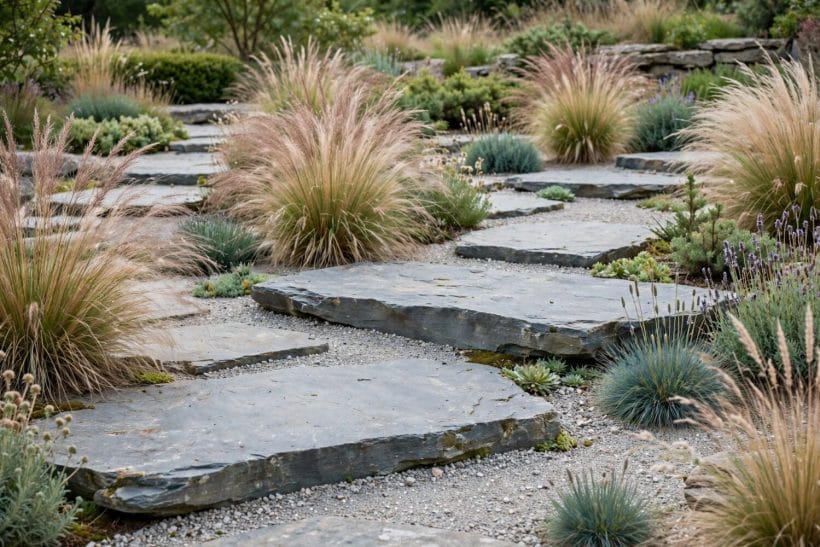
Gravel is stone at its most generous, covering ground cleanly and setting off everything planted through it. The split is simple: the guide to mulch landscaping ideas owns the organic-cover lane, while stone cover is this post’s ground.
42. Gravel garden with large stone slabs
Large slabs set into a gravel garden give the eye resting places and the feet firm ground between plantings. Space the slabs like stepping places among grasses and perennials, and the composition feels calm and spare.
43. Pebble ground cover under ornamental trees
Pebbles under ornamental trees keep the root zone tidy, suppress the scruffy look bare soil gets, and show off bark and canopy beautifully. Keep the layer even, edge it cleanly, and fallen leaves lift off the surface with little fuss.
44. Pale gravel brightening a shaded courtyard
In a shaded courtyard, pale gravel bounces what light there is and lifts the whole space. Pair it with large stones and simple green planting, and a dim corner becomes the calmest seat in the garden.
45. Gravel and boulder in a dry border
A dry border of gravel studded with boulders suits sunny, free-draining ground and plants that like it lean. The stone stores daytime warmth, the gravel keeps crowns dry, and the bed asks for remarkably little.
46. Stone-dusted gravel path through planting
A gravel path through deep planting gives a walk that crunches pleasantly and can curve as freely as the beds do. Edge it with stone, refresh the surface as needed, and enjoy its unhurried character.
47. Gravel bed edged with stacked stone
Stacked-stone edging gives a gravel bed a clear, built boundary that stops the two materials from wandering into each other. The contrast — loose stone inside, layered stone at the edge — reads deliberate and keeps maintenance simple.
48. Pebble cover around stepping stones
Pebbles packed around stepping stones ease the join between path and bed, filling gaps stone alone leaves awkward. Match the pebble tone with the slabs, keep the surface level, and the path feels woven into the garden.
49. Gravel seating area ringed with planting
A circle or square of gravel makes a simple, permeable seating area that planting can ring closely. Add a boulder or two at the edge, and the spot stays informal, dry underfoot and very welcoming.
8. Stone Around Water
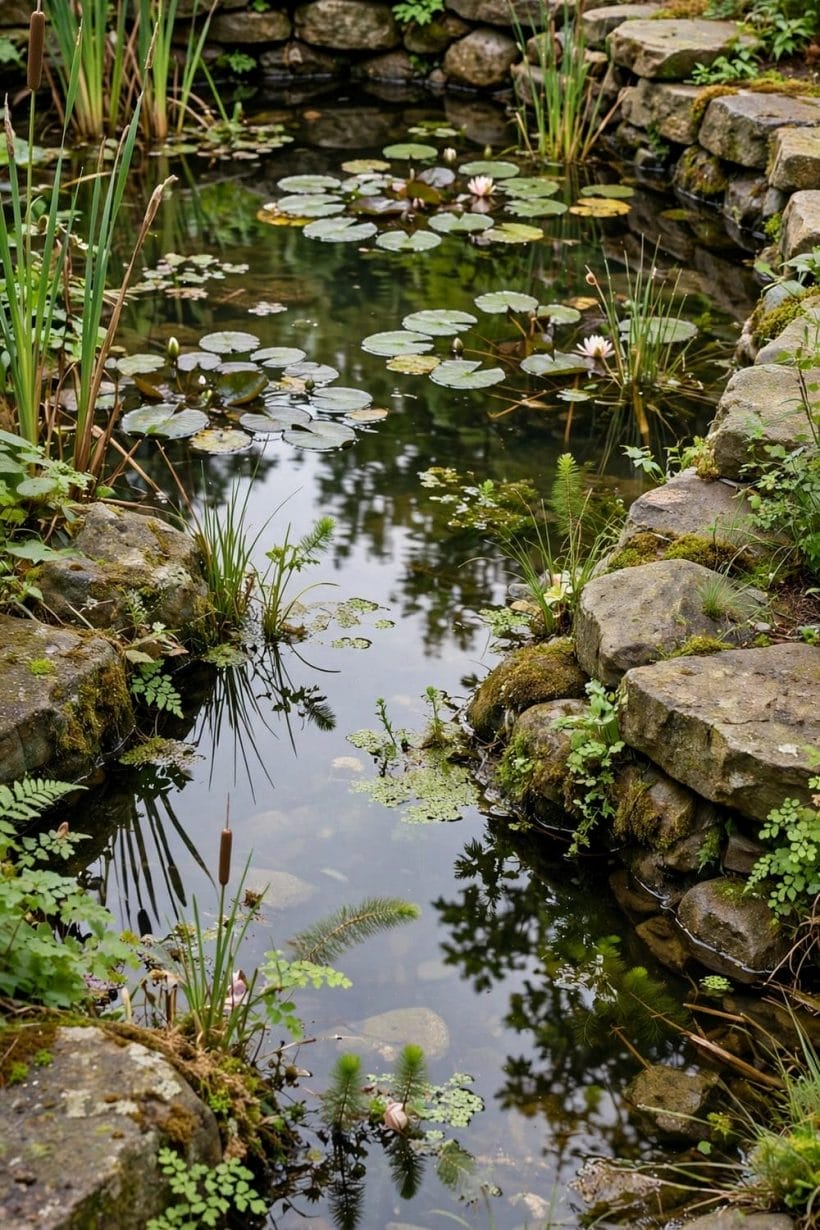
Stone and water are natural partners: rock gives water its edges, its sound and its setting. Around ponds, streams and small features, the right stone makes water feel like part of the landscape rather than an object placed in it.
50. Stone-edged pond with rocks and water plants
A stone-edged pond settles into a garden when its rim varies — larger rocks at the back, smaller stones at the front, water plants threading between them. The irregular edge hides the pond’s construction and lets planting meet the water naturally.
51. Boulders framing a small garden waterfall
Boulders around a small waterfall give falling water its drama, framing the drop and catching sound. Arrange the largest stones at the sides, let planting soften the top, and even a modest fall feels like a discovery.
52. River rock margin around a still pond
A margin of river rock around a still pond makes a calm shoreline where the water meets the garden gradually. The rounded stones suit reflections beautifully, and a planted margin gives wildlife an easy way in and out.
53. Flagstone surround for a formal water feature
In a formal garden, a flagstone surround gives a water feature clean geometry and a dry edge to stand on. Keep the cutting crisp, the planting architectural, and the stone matched to nearby paths for a composed effect.
54. Stone rill through a gravel garden
A narrow stone rill carrying water through a gravel garden adds movement and a faint, pleasant sound to a dry scheme. The contrast of moving water against still stone is subtle, elegant and restful to sit beside.
55. Rocky stream edge planted with moisture lovers
Along a garden stream, a rocky edge planted with moisture-loving perennials looks lush and entirely natural. Let stones vary in size, cluster plants in damp pockets between them, and the banks become a planting feature.
56. Stone basin in a quiet courtyard
A carved stone basin, filled and gently overflowing or simply still, brings water to the smallest courtyard. Set it on gravel or flagstone, add one sculptural plant, and the basin becomes a focal point of calm.
57. Pebble beach edge for wildlife-friendly water
A shallow pebble beach at one side of a pond gives birds a place to bathe and wildlife a gentle slope in and out. Grade the pebbles softly into the water, keep planting nearby for cover, and the pond serves its creatures.
9. Stone Patios, Steps and Terraces
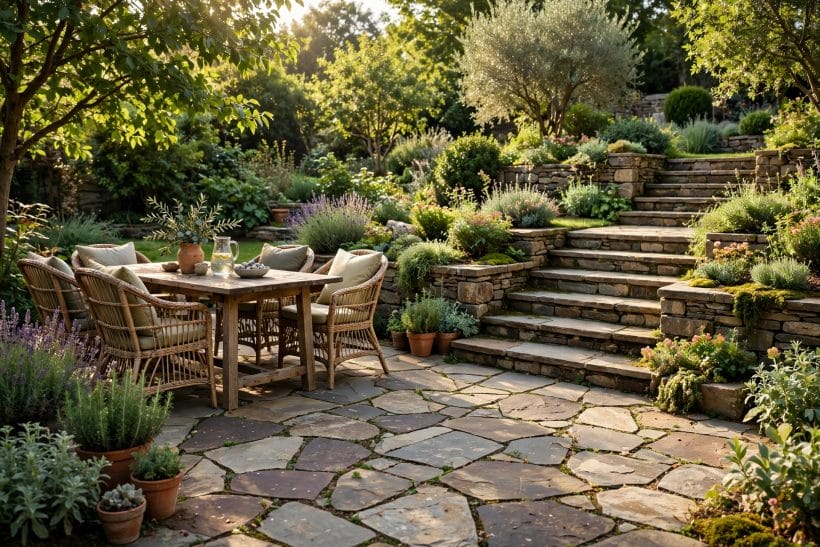
Stone underfoot in seating areas and on steps brings a permanence no other surface quite matches. The guides to flagstone patio ideas and paver patio ideas cover patio layouts in full; here the stone surface itself takes the lead.
58. Flagstone patio with planted stone joints
Planting low herbs and creepers in the joints of a flagstone patio softens its geometry and scents the air when brushed by feet. Keep the sitting area clear, plant the quieter edges fully, and the patio feels grown rather than laid.
59. Stone terrace steps linking garden levels
Broad stone steps between terraces make a change of level feel generous rather than negotiated. Flank them with planted walls or boulders, keep each tread even, and take professional advice on structure at every stage.
60. Irregular stone patio in a sunny corner
An irregular stone patio in a sunny corner feels relaxed and cottage-like, its varied slabs echoing the planting around it. Add simple furniture and a pot of herbs, and the corner becomes a favourite breakfast spot.
61. Stacked-stone terrace wall with seating above
A terrace held by a stacked-stone wall, with seating on the level above, gives a sloping garden a clear social centre. The wall face becomes a backdrop for planting, and the level above finally earns furniture.
62. Large slab patio softened by beds
Very large slabs make a patio feel calm and spacious, with fewer joints and a quieter pattern underfoot. Surround it with full beds so the stone reads as a clearing in the garden, and furnish it simply.
63. Stone steps flanked by boulder planting
Boulders flanking a flight of garden steps give the climb a sense of occasion, as if the path were cut through rock. Plant between the boulders with grasses and low shrubs, and keep the steps clear and welcoming.
64. Terraced stone garden on a gentle slope
Terracing a gentle slope with stone turns a slide of lawn into a series of level garden rooms. Each terrace can hold a different mood — herbs, seating, a small lawn — linked by stone steps and one stone tone.
65. Flagstone seating circle edged with stone
A circle of flagstone makes a natural gathering place, its roundness easing conversation and suiting a fire bowl or a central planted pot. Edge it with low stone, ring it with planting, and the garden gains a heart.
66. Stone patio with a gravel border
A gravel border around a stone patio softens the meeting with beds and gives the hard surface room to breathe. The border catches stray leaves tidily and makes the patio feel settled into planting.
10. Stone in Beds and Front Gardens
The front garden is where stone makes its first impression, and beds anywhere gain from its structure. The companion guide to brick stone combination ideas explores pairing the two materials; here stone in beds and front gardens leads.
67. Stone dressing in a low-care front bed
A top dressing of stone in a front bed keeps the surface tidy, sets off shrubs cleanly and cuts the scruffy look bare soil develops. Choose a tone that suits the house, and the entrance planting looks cared for.
68. Stone and brick edging in a front bed
Stone against brick is a classic front-garden pairing: brick brings warmth and order, stone brings texture and weight. Use one as edging, the other as dressing, and keep planting simple so the materials speak.
69. River rock dressing around shrubs and grasses
River rock spread around shrubs and ornamental grasses gives beds a smooth, finished surface that flatters foliage. The rounded stones contrast with leaf shapes, hold the bed’s outline, and keep planting deliberate through winter.
70. Feature stone in a front bed
One feature stone at the centre of a front bed gives the planting a heart and the house a more composed approach. Plant around it in low drifts, keep its best face forward, and let everything else stay quieter.
71. Stone grouping softening a house corner
House corners can look stark where walls meet garden, and a grouping of stones with planting piled gently around them softens the junction. Vary the stone sizes, plant taller companions behind, and the corner becomes a feature.
72. Gravel and stone front garden, clean lines
A front garden of gravel, large stones and clipped planting suits houses that favour clean lines and low upkeep. The composition reads smart from the street, and a single feature boulder gives it a signature.
73. Low stone edging for a front lawn
Low stone edging along a front lawn gives the whole property a finished frame, holding beds back and the lawn line crisp. It is a modest detail with an outsized effect, making the simplest front garden look planned.
74. Planting pockets in a sunny stone bed
Stones in a sunny bed create warm pockets where small plants thrive tucked against the rock. Alpines, herbs and low grasses suit these niches, spilling over the stone, and the bed gains real texture.
75. Stone accents guiding visitors to the door
A short sequence of stones — a boulder, a dressed bed, stepping stones to the door — guides visitors without a single sign. Keep the sequence calm in tone, and the approach feels welcoming and clear.
Final Considerations
Choose the stone for the job first and the colour second. Drainage, a sound and level base in general terms, and honest edging decide how stone ages, far more than any first impression in a supplier’s yard. Where walls retain ground or steps change level, take professional advice early, and the stone you place will settle in rather than become a problem to fix.
Whether the result is a single boulder anchoring a front bed or a full terraced garden of walls, paths and gravel, the principle holds: place stone sparingly, let planting soften it, and a stone garden repays the patience for as long as the garden stands.

0 Comments