

A farmhouse garden does not arrive all at once. It settles in: gravel underfoot, deep flower beds against the walls, a fence that marks the line without closing the view, and vegetables growing close enough to the kitchen to be picked in slippers.
These seventy-five ideas keep that one character from gate to back fence: generous near the house, looser as the ground walks away, and always practical enough to live with. Nothing in the style asks for grandeur or newness. It asks for timber, gravel, deep soil and plants allowed to be themselves, arranged with care.
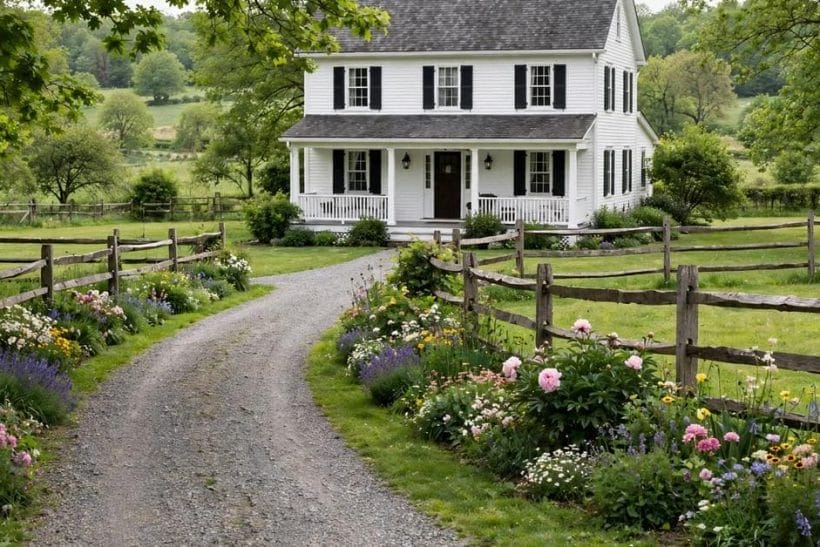
1. Farmhouse Landscaping Ideas at a Glance
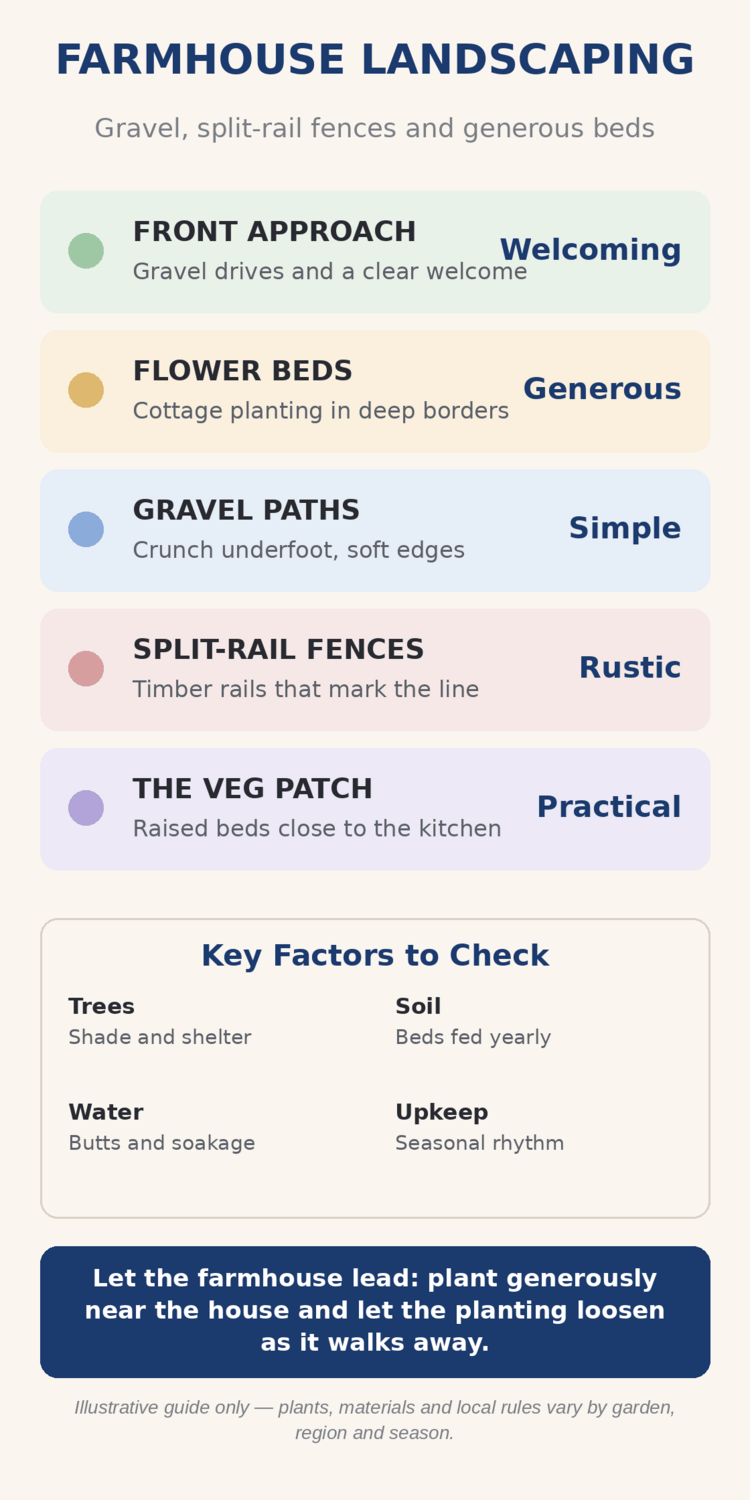
Farmhouse landscaping is a system of five working parts: the approach that welcomes, the beds that soften the walls, the paths that carry daily traffic, the fences that mark the ground, and the veg patch that feeds the house. Get those five in sympathy and the whole farm landscape reads as one settled place rather than a collection of projects.
For the wider front-ground family, start with front yard landscaping ideas, which covers the general ground this style grows from.
| Family | Character | What it means |
|---|---|---|
| Front Approach | Gravel drives and a clear welcome | Welcoming |
| Flower Beds | Cottage planting in deep borders | Generous |
| Gravel Paths | Crunch underfoot, soft edges | Simple |
| Split-Rail Fences | Timber rails that mark the line | Rustic |
| The Veg Patch | Raised beds close to the kitchen | Practical |
Scope, so the lanes stay clear: this post owns the farmhouse style only — its planting, paths, fences and working corners. Stone as a material in its own right belongs to stone landscaping ideas, and narrow side ground is a separate conversation elsewhere; a farmhouse garden may use a stone step or a side path, but neither leads here. Everything below serves the one central subject: a farm landscape arranged around a working house. The sections that follow walk the ground in the order a day walks it: arrival first, then beds, paths and fences, the trees and the veg patch, the porch, the open lawn and meadow, and finally the upkeep that holds it all together.
2. The Front Approach and Arrival
The approach sets the farmhouse tone before a visitor reaches the door: open, unhurried and clearly kept. These ideas keep the arrival simple, legible and welcoming in every season.
1. A Gravel Drive that Announces Itself
Gravel is the farmhouse drive: it crunches under tyres and boots, drains freely after rain, and can be raked back into order in minutes. Keep its edges honest with timber or brick and it looks deliberate rather than spilled. It also suits a working yard: puddles drain, ruts rake out, and a fresh top-up restores the whole surface without any machinery.
2. A Split-Rail Fence Along the Drive
Two or three rough timber rails on sturdy posts give the drive a boundary that suits open ground. The fence marks the line, frames the house beyond it, and never pretends the garden is a fortress.
3. A Wide, Clear Welcome at the Gate
Keep the gateway generous and uncluttered: room to turn, room to unload, room for a visitor to pause and take in the house. A farmhouse welcome is space first and decoration second.
4. Planting that Frames, Not Hides, the House
Beds and shrubs at the approach should frame the farmhouse like a picture mount, leaving walls, windows and porch clearly visible. The house is the subject of this landscape; planting is its setting.
5. A Lantern or Lamp by the Entrance Path
One warm light where the path meets the porch answers the approach’s real evening work: safe feet, a visible door, a welcome after dark. Keep it simple, sturdy and in keeping with the house.
6. A Boot Scraper and a Place for Mud
Farms and mud are old companions. A scraper, a coarse mat and a small paved standing place by the door keep the approach practical, and the hall beyond it stays clean without any fuss.
7. Low Beds Either Side of the Front Path
Shallow beds flanking the front path soften its line with low, forgiving planting: herbs, grasses and cottage flowers that can be brushed past daily without damage or complaint.
8. A Turning Space Kept Gravel and Green
Where vehicles turn, keep the surface gravel and the surround green and simple. A planted island or a single tree at its edge stops the practical ground from reading as a car park.
3. Flower Beds and Cottage Borders
Farmhouse beds are deep, full and unembarrassed. The planting leans cottage in character — roses, herbs, old-fashioned flowers in drifts — and forgiving in upkeep, because a working garden cannot be replanted every season.
9. Deep Borders Against the House Walls
Generous depth is the farmhouse border’s first virtue: room for tall plants at the back, billowing middles and a soft front edge. Deep beds also keep planting clear of the walls themselves.
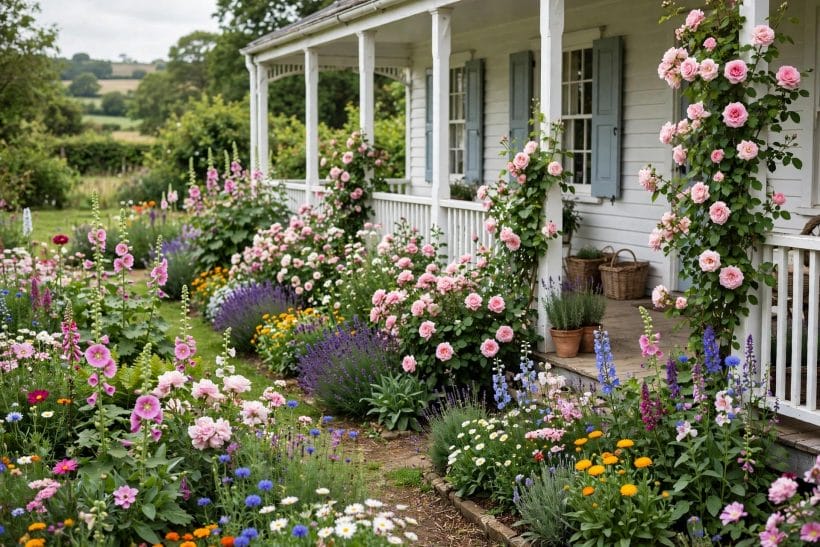
10. Roses Trained Around the Porch
A climbing rose around the porch posts is the farmhouse signature in flower. Train it loosely, tie it in as it grows, and let a few rambling stems do what they clearly intend to do. A porch rose also works through the year: hips after the flowers, bare stems with good bones in winter, and a scent at the door that no bought ornament can match.
11. Drifts Rather Than Dots of Colour
Plant in drifts and loose groups, never in single specimen dots. Drifts read from the drive, repeat calmly along a long border, and forgive the gaps that real gardens always develop.
12. Herbs at the Front of the Border
Lavender, rosemary, sage and chives along the front edge earn their place twice: soft grey-green foliage all season, and leaves within reach of the kitchen door when cooking calls.
13. A Mulch Blanket, Renewed Yearly
A yearly blanket of mulch keeps beds fed, moist and visibly cared for; the wider subject is covered in mulch landscaping ideas. On farmhouse beds it is the quiet background that lets the flowers perform.
14. Self-Seeders Allowed Their Say
Foxgloves, hollyhocks and forget-me-nots seeding themselves into gravel edges and bed corners give the farmhouse garden its happy accidents. Edit them kindly; never quite eradicate the volunteers.
15. A Cutting Patch Inside the Flower Beds
Reserve a corner of the border for flowers grown to be cut: sweet peas on a frame, dahlias in a row, whatever the house vase loves. A farmhouse table with its own flowers is a small daily ceremony.
16. Evergreen Bones Behind the Flowers
A few steady evergreens at the back of each border hold the garden’s shape when the flowers rest. The cottage show is seasonal; the bones underneath it should not be.
4. Gravel Paths and Soft Edges
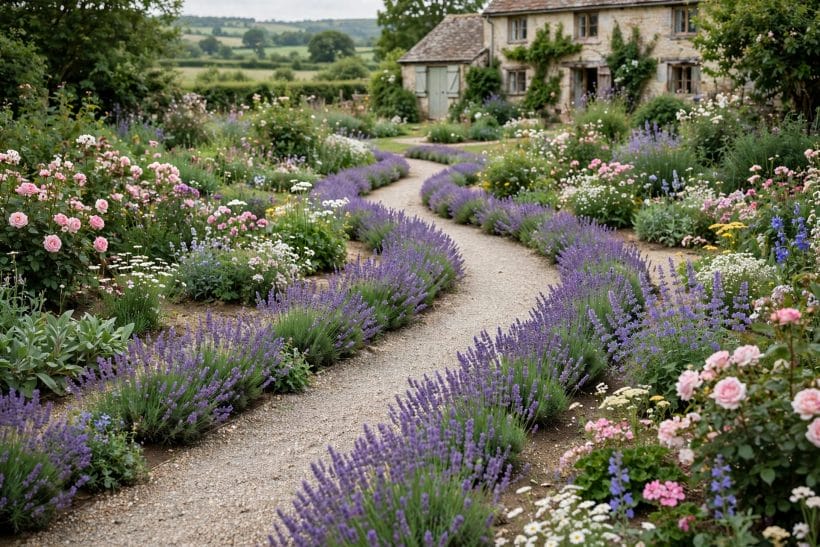
Paths in a farm landscape are working routes first: from door to gate, kitchen to veg patch, house to barn or shed. Gravel suits them — cheap to lay, easy to mend, and kind underfoot in all weathers.
17. A Gravel Path from Door to Gate
The main path deserves the main treatment: a firm base, a clean gravel surface and a line that goes where feet actually walk. Straight where the work is straight, gently curved where the garden invites it.
18. Lavender Edging Along the Path
A low lavender hedge along a sunny path brushes every passer-by with scent and holds the gravel’s edge in a soft green-grey line. Clip it after flowering and it stays tight for years.
19. Timber Edging that Keeps Gravel Honest
Simple timber boards or half-round logs along a path’s edge stop gravel wandering into the beds. Weathered timber suits the style; it should look settled, not showroom new. When a length finally rots, it lifts out and replaces in an afternoon, which is exactly how farm repairs should behave.
20. Stepping Stones Across Working Ground
Where a route crosses lawn or a damp corner, flat stepping stones keep feet dry and the grass unscarred. Set them at a natural stride and let the planting close around them.
21. A Path that Widens at the Porch
Let the front path flare slightly as it reaches the porch: room for two people, a basket and a dog, all arriving at once. Farmhouse hospitality is partly a matter of square footage.
22. Brick Where the Traffic Is Hardest
At gates, door thresholds and the veg patch entrance, a small apron of brick or setts takes the wear gravel cannot. For full paved surfaces, see paver patio ideas; here paving is the servant, not the master.
23. Grass Paths Through the Quiet Corners
In the orchard and meadow corners, a mown grass path is path enough: it appears in spring, shifts if the garden changes its mind, and costs nothing but the mowing it replaces.
24. Raking and Topping Up as a Ritual
Gravel paths ask for little: a rake to level the hollows, a top-up where the surface thins, weeds pulled while they are small. Done little and often, the path never needs rebuilding.
5. Fences, Gates and Boundaries
Farmhouse boundaries declare rather than defend. Timber rails, pickets near the house and a gate that swings sweetly give the ground its structure while keeping long views and open sky intact.
25. Split-Rail Fencing for the Outer Ground
On the wider ground, split-rail fencing is the honest boundary: strong enough for its job, open enough for the view, and quick to repair rail by rail when weather or livestock test it.
26. A Picket Fence Near the House
Close to the farmhouse, a low picket fence in a soft white or weathered finish draws the domestic line — garden inside, working ground outside — and gives climbing roses something to lean on.
27. A Five-Bar Style Gate at the Drive
A wide timber gate at the drive’s end is the farmhouse full stop. Hung true, latched simply and kept swinging freely, it welcomes visitors and closes the day with equal ease.
28. A Small Garden Gate with a Lift Latch
The pedestrian gate wants charm and reliability in equal measure: a lift latch that works with full hands, hinges that do not sag, and a path that clearly continues beyond it.
29. Lattice Panels Where Privacy Helps
By a seating corner or a busy boundary, a lattice panel gives screening without a wall’s weight; the wider family is explored in lattice fencing ideas. Grow a climber through it and the screen becomes planting. It also breaks the wind gently instead of fighting it, which makes the sheltered corner behind it pleasanter than any solid board could.
30. Hedging as the Living Boundary
Where time allows, a native hedge is the finest farm boundary of all: shelter for birds, blossom in spring, berries later, and a line that thickens and improves with every year it is laid and trimmed.
31. Posts Dressed with Climbers
A rose, honeysuckle or clematis sent up the gate posts and fence corners softens every junction. Keep growth clear of the gate’s swing and the latch’s travel, and the dressing stays a pleasure.
32. Boundaries that Follow the Ground
Let fences step and ease with the slope rather than fighting it in rigid panels. A boundary that follows the land looks settled from the first day and weathers into the place gracefully.
6. Trees, Shade and Shelter
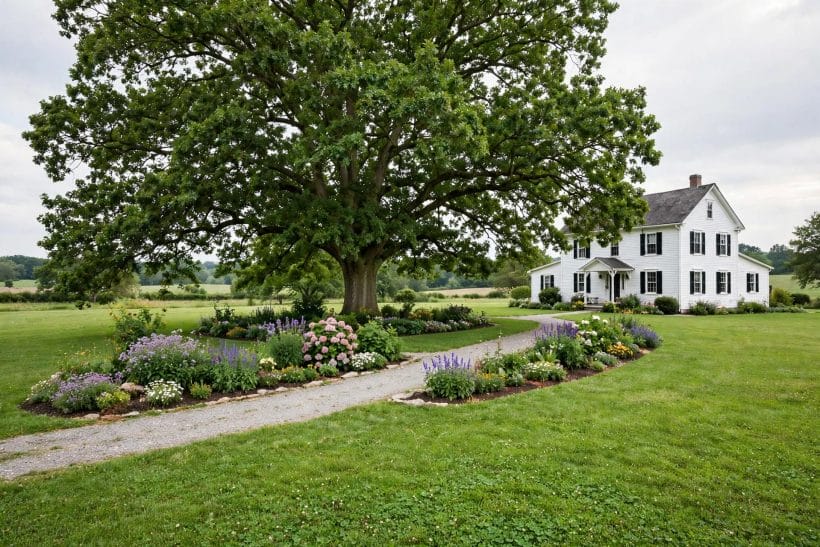
One mature tree does more for a farm landscape than any ornament: shade for the house, shelter for the garden, a landmark for the whole holding. These ideas plant for decades, not seasons.
33. A Mature Shade Tree Near the House
A generous shade tree on the sunny side of the farmhouse cools rooms, shelters the porch and gives the garden its ceiling. Choose for the soil and space you actually have, then be patient.
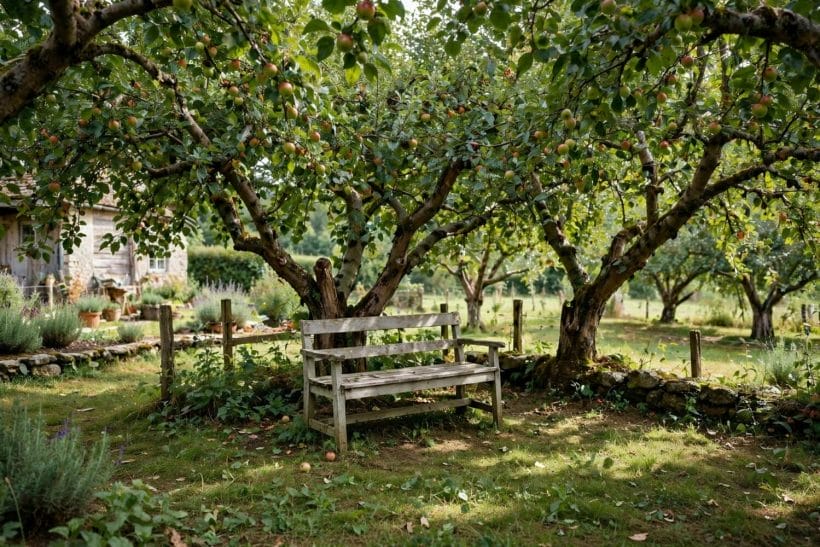
34. An Orchard Corner with a Bench
A small group of fruit trees with a simple bench beneath them is the farmhouse garden’s orchard room: blossom in spring, shade in summer, fruit in autumn and a seat among all three. Keep the bench plain and sturdy, facing back toward the house if the view allows: an orchard seat is as much for looking at the farm as for sitting in it.
35. A Windbreak on the Weather Side
A staggered row of tough trees and shrubs on the windy boundary calms the whole garden behind it. Plant it young, guard it well, and within years the beds and seating sit in borrowed stillness.
36. A Single Specimen Tree in the Lawn
One fine tree standing alone in open lawn — an oak-like presence, whatever the species — gives a large garden its punctuation mark. Give it room to become what it promises.
37. Blossom Trees Along the Drive
A loose row of blossom trees along the approach turns the daily drive home into a spring event, and their light shade never darkens the house. Underplant simply and let the blossom lead.
38. Shade Planting Under the Big Tree
Beneath a mature canopy, plant what loves the conditions: bulbs for spring, ferns and shade-tolerant perennials for summer, fallen leaves left as the tree’s own mulch each autumn.
39. A Tree Seat Around a Favourite Trunk
A simple circular or hexagonal bench built around a much-loved trunk makes the shadiest seat in the garden and a natural gathering point. Build it loosely; trunks widen whether benches allow it or not.
40. Hedgerow Trees Kept in the Boundary
When clearing or laying a hedge, spare the promising young trees within it. A boundary punctuated by its own grown trees looks inherited rather than installed — the highest farmhouse compliment.
41. Young Trees Guarded and Watered Honestly
New trees fail from thirst and strimmers, not from mystery diseases. A guard, a mulch ring and faithful watering through dry spells in their early years are the whole secret of establishment.
7. The Veg Patch and Orchard Corner
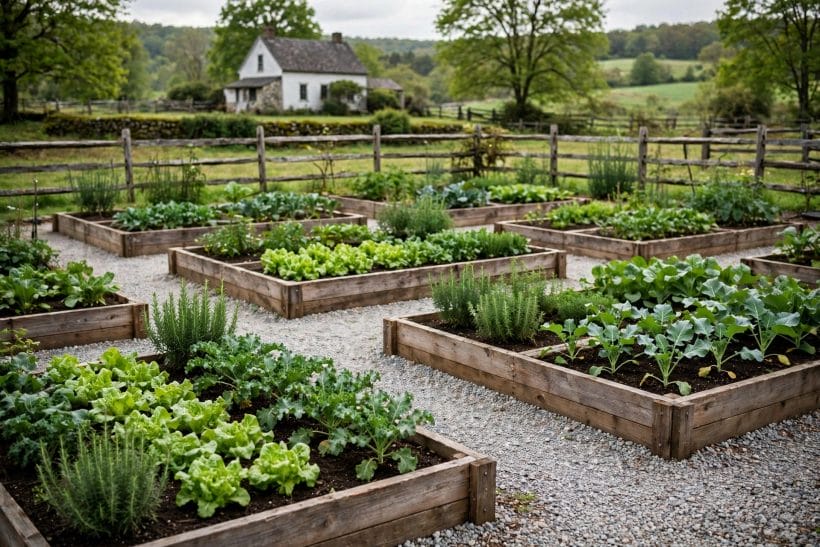
A farmhouse garden feeds the house. The veg patch sits close to the kitchen, laid out plainly and worked in a steady rhythm, with the orchard corner doubling as the garden’s shadiest room.
42. Raised Beds Close to the Kitchen
Raised beds a short walk from the back door are the veg patch’s whole argument: salads picked minutes before eating, herbs gathered in the rain, and soil that warms early and drains kindly. Raised beds also suit an ageing gardener and a tidy mind equally: no digging of whole plots, clear edges, and each bed can be fed, sown and rested on its own schedule.
43. Gravel Paths Between the Beds
Gravel paths between raised beds keep feet clean, wheels rolling and edges tidy in every month. They also make the patch read as a garden room in its own right, not an allotment squeezed in.
44. A Compost Corner Kept Tidy
Every farmhouse garden makes its own fertility. A simple compost corner near the beds — screened by a fence panel or hedge — turns clippings, peelings and bedding into next year’s soil quietly.
45. A Water Butt by the Back Door
Rain caught from the roof and stored by the door is the veg patch’s lifeline in dry spells. Keep a butt where filling a can is effortless; water that is easy gets used, water that is far away does not.
46. Fruit Bushes Along the Fence
Currants, gooseberries and raspberries along a sunny fence give a harvest for almost no ground. They ask for a yearly prune, a mulch and netting discipline when the birds start paying attention.
47. Herbs in a Sunny Bed by the Path
A dedicated herb bed where the path passes keeps the most-used plants at hand height for picking. Mediterranean herbs want the sunniest, driest corner; mint always gets a pot of its own.
48. A Simple Cold Frame for Early Starts
A cold frame against a sunny wall stretches the season at both ends: seedlings hardened off in spring, salads protected in autumn. Humble, glass-topped and endlessly useful.
49. Orchard Fruit Given a Grass Ring
Under fruit trees, keep a clear grass ring rather than planting to the trunk: fallen fruit is easy to gather, mowing stays simple, and the trees read as a small orchard rather than a thicket.
8. Porch-Edge Planting
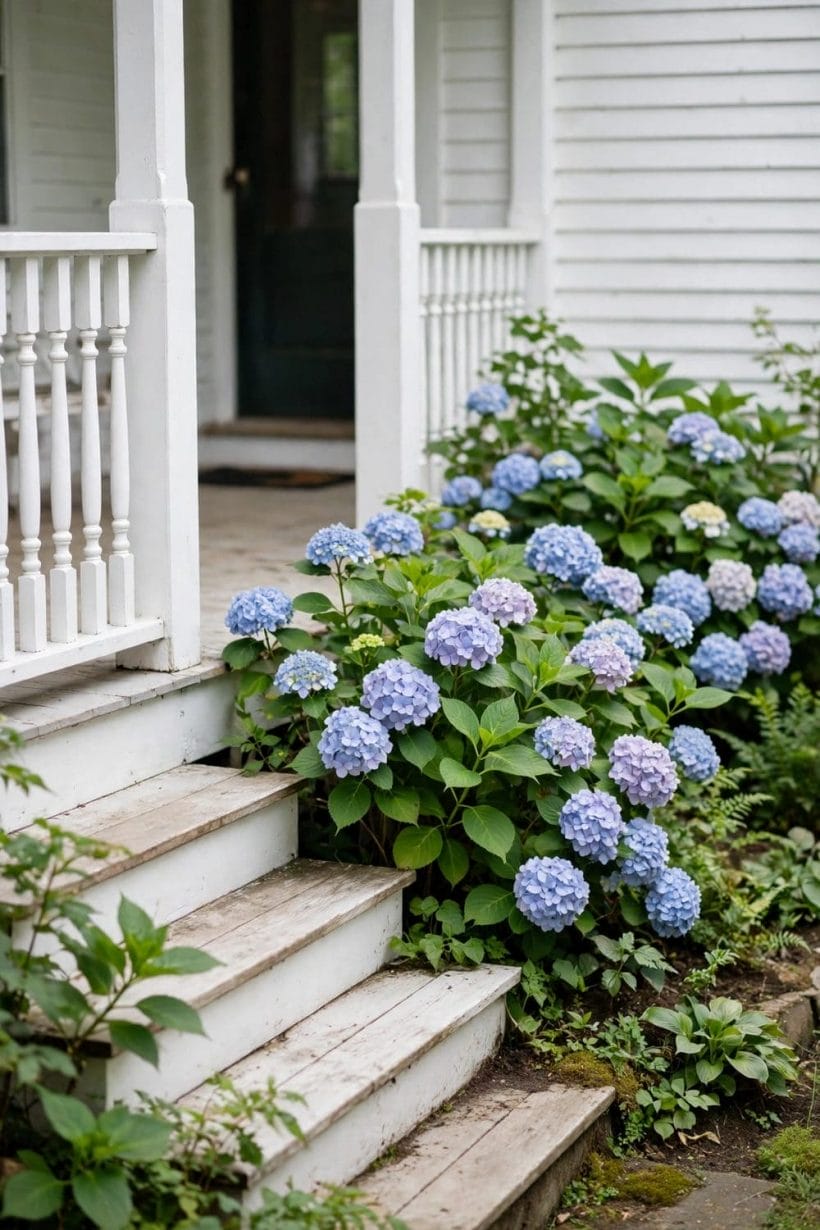
The porch is where the house meets the garden, and its edges want the softest planting of all. The porch structure itself is covered in farmhouse porch ideas; here the subject is the green frame around it.
50. Hydrangeas Flanking the Porch Steps
Generous hydrangeas either side of the steps are the farmhouse porch’s classic planting: big leaves, long bloom, and a presence that fills the frame without any fussiness. They also forgive the porch’s awkward light — bright at midday, shaded by evening — and still flower generously, which is more than most showier shrubs will promise.
51. Lavender Along the Porch Edge
A lavender line where the porch meets the path releases scent every time someone brushes past with shopping, a child or a dog. It is planting that greets people before the door does.
52. Pots of Seasonal Flowers by the Door
A pair of sturdy pots flanking the door, replanted with the seasons, keeps the entrance dressed even when the borders rest. Keep the pots plain and let the flowers be the ornament.
53. A Climber Framing the Porch Opening
One well-trained climber — rose, jasmine or honeysuckle — framing the porch opening ties house and garden together in a single gesture. Tie it in yearly and prune with a light hand.
54. Ferns in the Shady Porch Corner
Every porch has a corner the sun ignores. Ferns and other shade lovers turn that dead spot into the coolest, greenest moment on the approach, and they ask for almost nothing in return.
55. A Low Hedge Defining the Porch Garden
A low hedge — box-like in spirit, whatever the plant — around the small garden at the porch gives the house’s front room its walls. Inside it, cottage planting can billow as it pleases.
56. Window Boxes in Keeping with the House
Simple timber window boxes under the front windows, planted generously and watered faithfully, lift the whole facade. Match their finish to the porch woodwork and they look built-in.
57. Night Scent Planted by the Steps
Evening-scented planting near the steps — stocks, nicotiana, honeysuckle — rewards everyone who sits on the porch after supper. Scent is the farmhouse garden’s invisible planting, and its most remembered.
9. Lawns, Meadows and Places to Sit
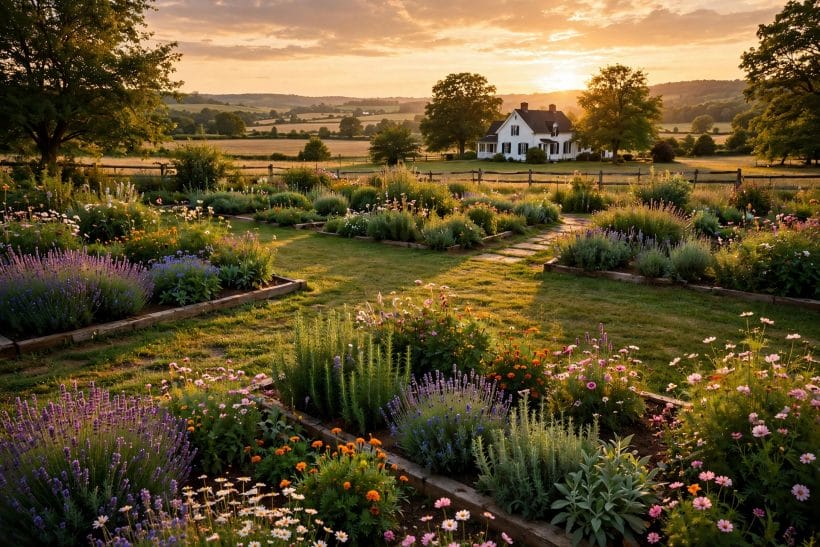
Between the beds and fences, a farm landscape needs its open ground: honest lawn near the house, looser meadow beyond it, and seating placed where the garden actually performs. For paved seating terraces, front yard patio ideas takes that subject further.
58. A Wide Lawn Kept Simple
The farmhouse lawn is a green room, not a bowling green: mown regularly, edged where it meets beds, and otherwise left to be walked on, played on and picnicked on without anxiety.
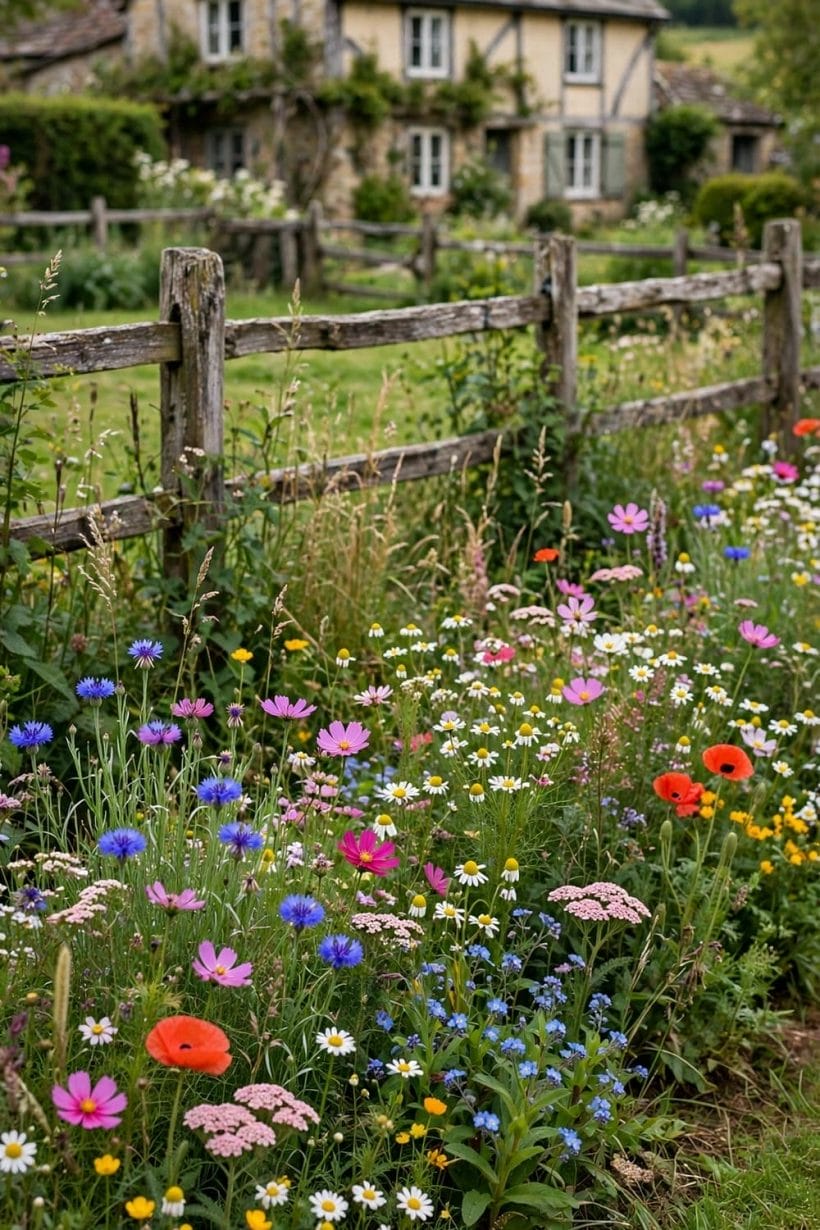
59. A Wildflower Meadow Strip
Along a fence, drive or orchard edge, a wildflower strip trades weekly mowing for a summer of bees, butterflies and shifting colour. Cut it once the season turns and rake the clippings away. A meadow strip is also the garden’s wildlife pantry and its easiest beauty: the less it is tidied through summer, the richer it becomes, which suits a busy farm calendar perfectly.
60. Mown Paths Through Longer Grass
Where grass is left long, a mown path through it keeps the garden walkable and makes the wildness look chosen. The contrast between cut and uncut is the whole design, and it costs nothing.
61. A Bench Facing the Evening Sun
Place one solid bench where the last light lands: across the beds, down the drive or over the meadow. A bench aimed at sunset will be used more than any other seat in the garden.
62. A Table Under the Big Tree
A sturdy table in the shade tree’s circle turns summer meals into garden events and gives potting, shelling and sorting a pleasant headquarters. Plain timber, honestly weathered, suits it best.
63. A Hammock Between Two Sturdy Trees
Where two trees stand at the right distance, a hammock is the farmhouse garden’s laziest luxury. Check the trees are sound, hang it low, and accept that afternoons will occasionally disappear.
64. A Fire Pit Corner on Gravel
A simple fire circle on a gravel apron, well away from fences and overhanging branches, extends garden evenings deep into autumn. Keep seating loose, fuel stacked nearby, and local rules about fires in mind.
65. Children’s Ground Kept in the Picture
Swings from a strong branch, a den in the hedge corner, room to run on the lawn: a farm garden includes its children in the main picture rather than fencing them into a plastic corner.
66. A Quiet Seat in the Veg Patch
A small bench at the veg patch’s end rewards the gardener mid-task and gives the patch a destination beyond work. Gardens that are sat in get noticed sooner, weeded sooner and loved longer.
10. Colours, Costs and Practical Details
Farmhouse landscaping stays affordable because its palette is honest and its upkeep is a rhythm rather than a rescue. Costs here stay in general terms, because plants, timber and local rules vary by garden, region and season.
67. A Colour Palette of Greens and Soft Blooms
Let green do the heavy lifting — lawns, hedges, foliage in many tones — with flowers in soft, cottage colours laid over it. One or two brighter notes per bed are plenty; the calm is the style.
68. White and Cream Paintwork Outdoors
Pale paint on fences, gates and porch woodwork is the farmhouse accent: it lifts timber, sets off planting, and unifies pieces gathered over years. Repaint in rotation and no single job grows large.
69. Gravel and Timber before Costly Surfaces
The style’s economy is built in: gravel paths and drives, timber fences and edges, grass doing the rest. Spend first on plants, trees and soil; hard surfaces here are the cheapest honest ones.
70. Plants Bought Small and Grown On
Farmhouse planting forgives patience: shrubs and perennials bought young cost a fraction of mature specimens and establish better. The garden fills in within a few seasons and looks grown, not installed.
71. Soil Fed Yearly, Beds Kept Mulched
The practical foundation is unglamorous: compost and mulch on the beds each year, paths topped up, edges trimmed. Fed soil holds water, suppresses weeds and quietly halves the garden’s workload.
72. A Seasonal Rhythm of Small Jobs
Spring planting, summer watering and deadheading, autumn cutting-back and leaf gathering, winter fence and gate repairs: small jobs in their season keep a farm landscape from ever needing an overhaul.
73. Checking Rules Before Building
Fences, gates, new drives and larger structures can fall under local rules, boundary agreements or conservation limits. Check before building, talk to neighbours early, and let professionals handle structural work.
74. Drainage Watched Where Water Gathers
Farm ground tells you where its water goes after heavy rain. Keep paths and drives draining freely, gravel topped up in hollows, and planting that loves moisture in the corners that stay damp.
75. The Detail that Dates the Whole Garden
Every farm garden has one weakest detail — a rotten gate, a bald bed corner, a fence line sagging into the hedge. Fix that first: the whole landscape’s character returns for the price of its smallest repair.
Final Considerations
A farmhouse garden is never finished, and that is its comfort: it grows with the household, absorbs new beds and borrowed plants, and forgives a season of neglect better than any formal style. Keep the approach welcoming, the beds generous, the paths honest and the veg patch fed, and the character looks after itself.
Start where the ground asks loudest — the gate that sags, the bed that thins, the bench facing the wrong way — and work outward in the style’s own order: house first, then paths and fences, then trees and the veg patch, and only then the wider ground beyond. Each stage makes the next one easier to judge, because a farm landscape is read as one place, not as a list of projects. A garden made this way does not date, because it was never a fashion. It is simply a working house with its garden wrapped kindly around it.




0 Comments