
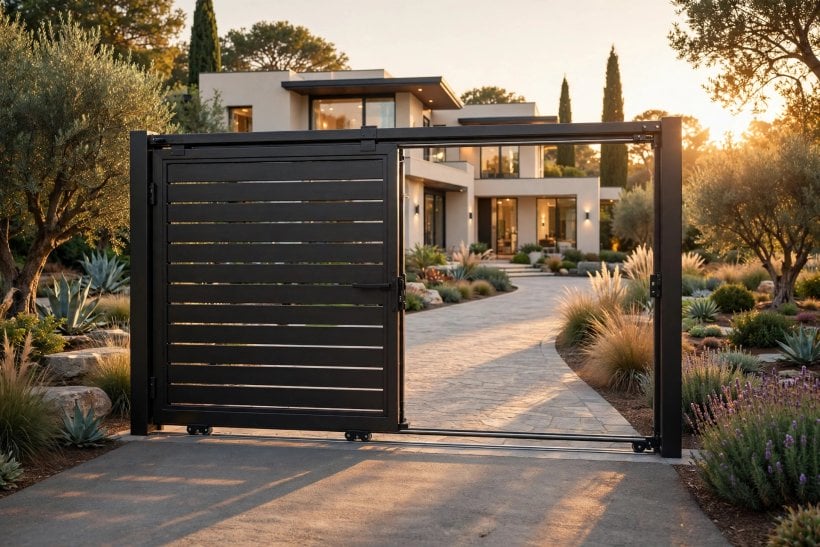
A sliding gate solves the two problems swing designs cannot: it needs no swing arc on a short or sloping drive, and it opens even when a car is parked close behind it.
This guide works through 75 ideas in ten sections, from measuring the run-back space and choosing tracked or cantilever movement, to styles, materials, automation, safety and the maintenance that keeps everything gliding.
1. Sliding Gate at a Glance
| Best for | Short, sloping or exposed driveways, wide entrances, and homes where swing space is blocked by parking, planting or the street. |
|---|---|
| Main types | Tracked designs that run on a ground rail, and cantilever designs that float above the surface on counterbalanced rollers. |
| Space needed | A clear run-back alongside the opening, at least the width of the entrance plus extra for the tail, kept free of bins, cars and shrubs. |
| Watch out for | Levels across the opening, drainage crossing the track line, wind load on solid panels, and where vehicles wait while the entrance opens. |
| Start with | Accurate measurements of the opening, the slope and the run-back, plus a decision on manual or automated operation. |
| Budget approach | Put money into posts, foundations and the running gear first; decorative infill and automation extras can follow. |
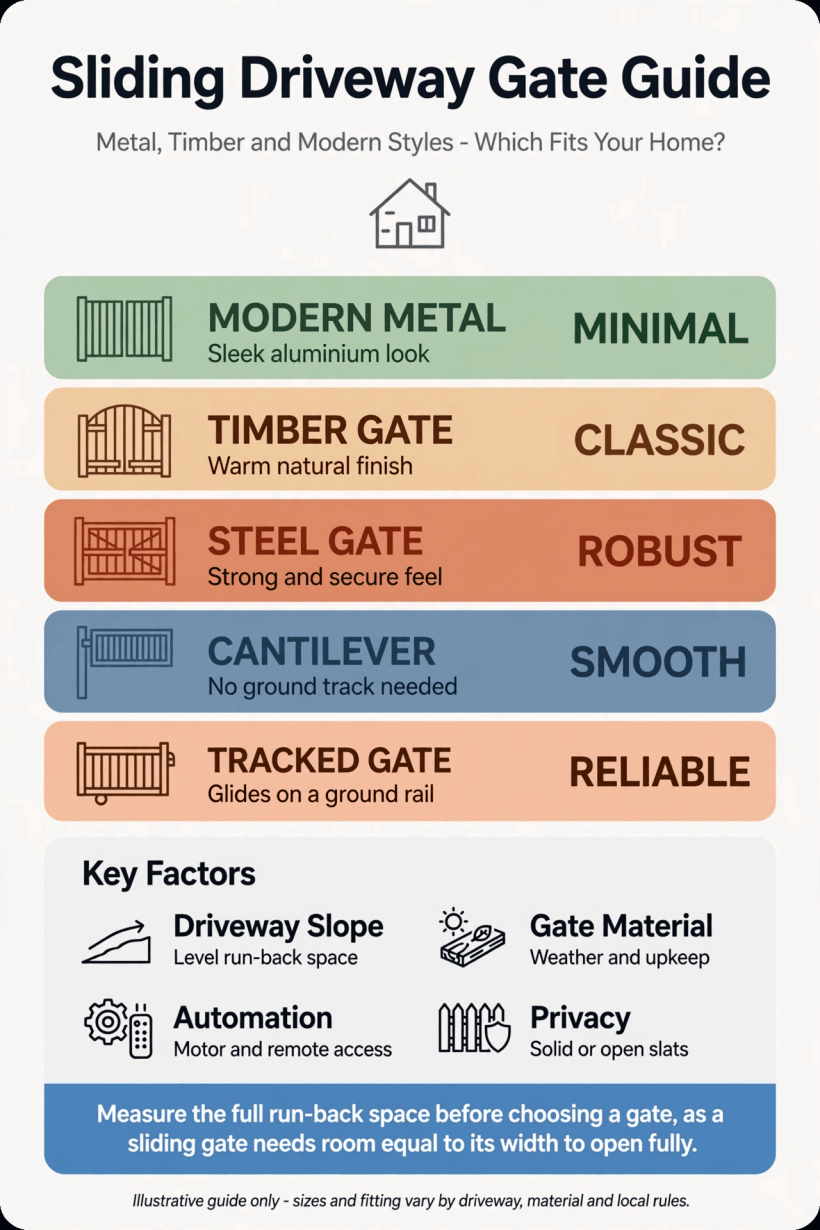
A visual summary of the measurements, movement types and hardware checks covered in this guide.
The table is your shortcut past the showroom talk. Every successful installation is really three projects in one: a civil project of posts, levels and foundations; a mechanical project of wheels, rollers and guides; and, if you automate, an electrical project of power, controls and safety devices. Judge every quote and design against all three, not just the photograph of the finished leaf.
Work through the sections in order and the decisions sequence themselves: site first, then structure, then style, then the motor and controls, and finally the upkeep that keeps a well-chosen design running quietly for years.
2. Why Sliding Designs Suit So Many Driveways
A swing leaf needs a clear arc, and that single fact rules it out on more plots than people expect. On a short drive the arc is where the car parks; on a rising drive the leaf grounds out as it opens; on an exposed site a gust can tear a half-open leaf from your hands or strain its hinges. A design that travels sideways along the fence line sidesteps all three problems, which is why it has become the default answer for wide, awkward or sloping entrances.
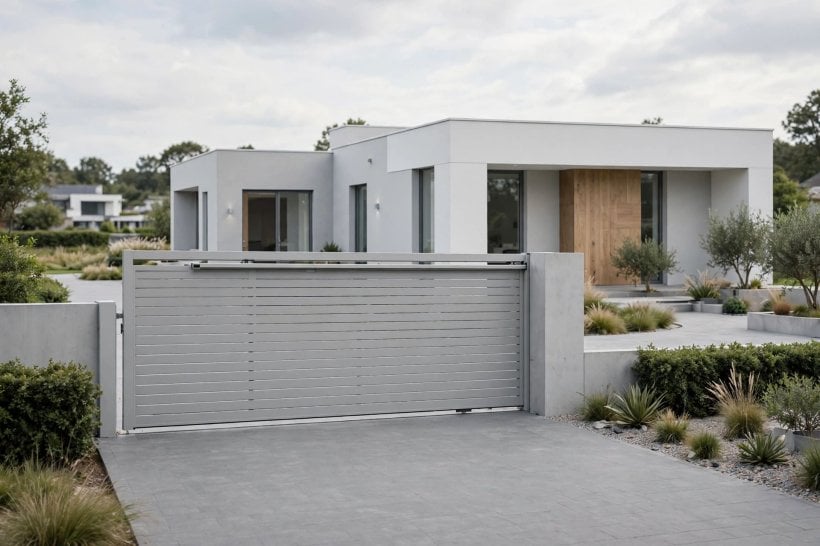
Security and tidiness follow from the mechanics. A closed sliding leaf can be locked along its length, sits close to its posts, and offers no easy leverage point for lifting; and because it parks flat against a boundary, the open entrance looks clean rather than cluttered with angled leaves. Where the boundary itself is part of your front-garden design, the entrance treatment can echo the planting and path ideas in these tiny house landscaping ideas, so gate, fence and garden read as one composition.
There are limits to respect. Sideways travel needs that clear run-back, which not every plot has; very wide leaves get heavy, and heavy leaves need serious posts and running gear. Sections three and six deal with those realities in turn, so you can match the mechanism to the site instead of the brochure.
3. Measuring Up: Space, Slope and the Run-Back
Measure three things before falling for any design: the clear opening between posts, the total run-back available on the opening side, and the levels. The run-back must accommodate the full leaf plus its tail; on cantilever systems the tail is a substantial counterweight section, so the fence line you need is noticeably longer than the opening you see. Mark it out with a hose or chalk and honestly account for bins, meters, downpipes and the neighbour’s overhanging hedge.

Slope decides more than style does. A drive that rises across the opening can sometimes be handled by a tracked design following the gradient, while a drive that rises along the run-back, in the direction of travel, makes the motor work uphill and the leaf eager to roll back; your installer may suggest regrading, a different mechanism, or splitting the entrance. Measure the fall with a long level or a laser and write the numbers down; vague descriptions produce vague quotes.
Also check what crosses the line: drainage channels, service covers, tree roots and the pavement crossover outside. If your plot is still at the planning stage, the discipline in these tiny house building design ideas, designing circulation and access before decoration, is exactly the mindset that produces entrances which work first and look good second.
4. Styles: Modern Slats, Timber Warmth, Classic Ironwork and Privacy Panels
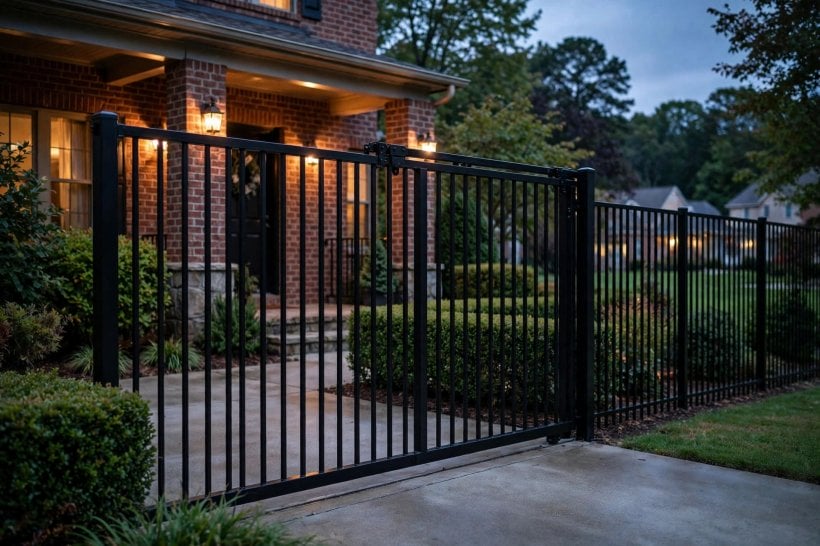
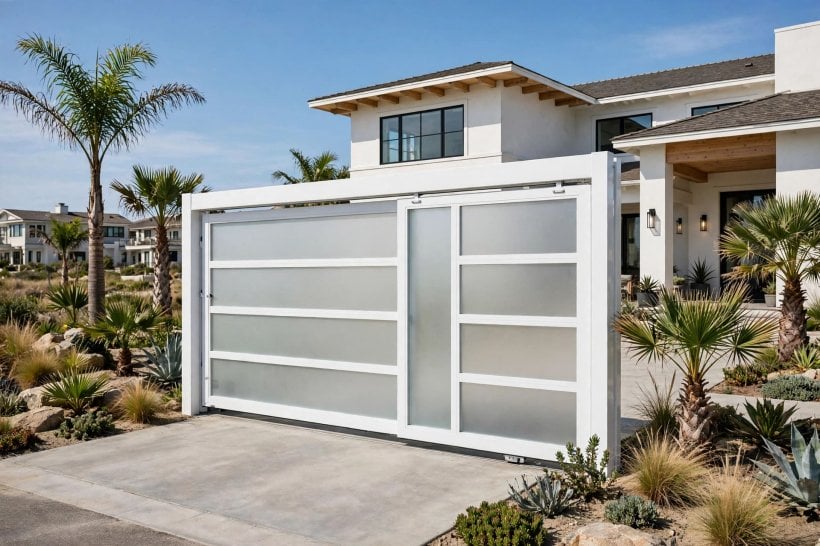
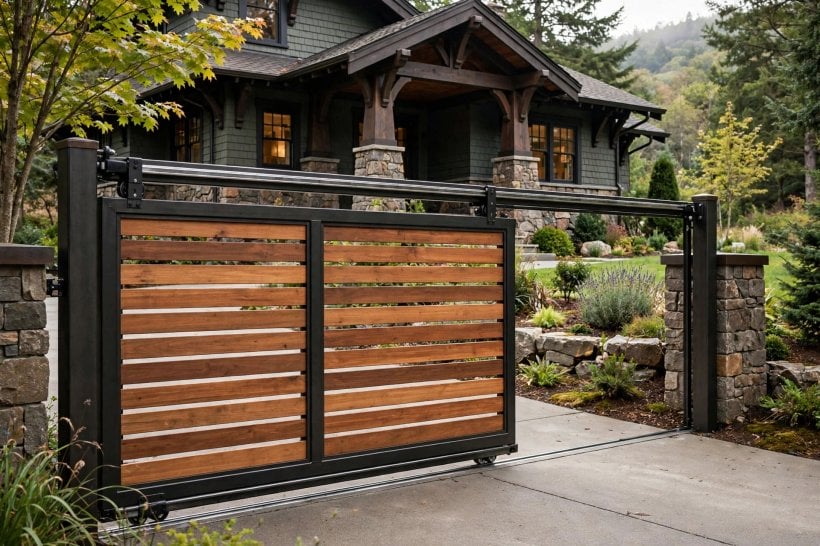
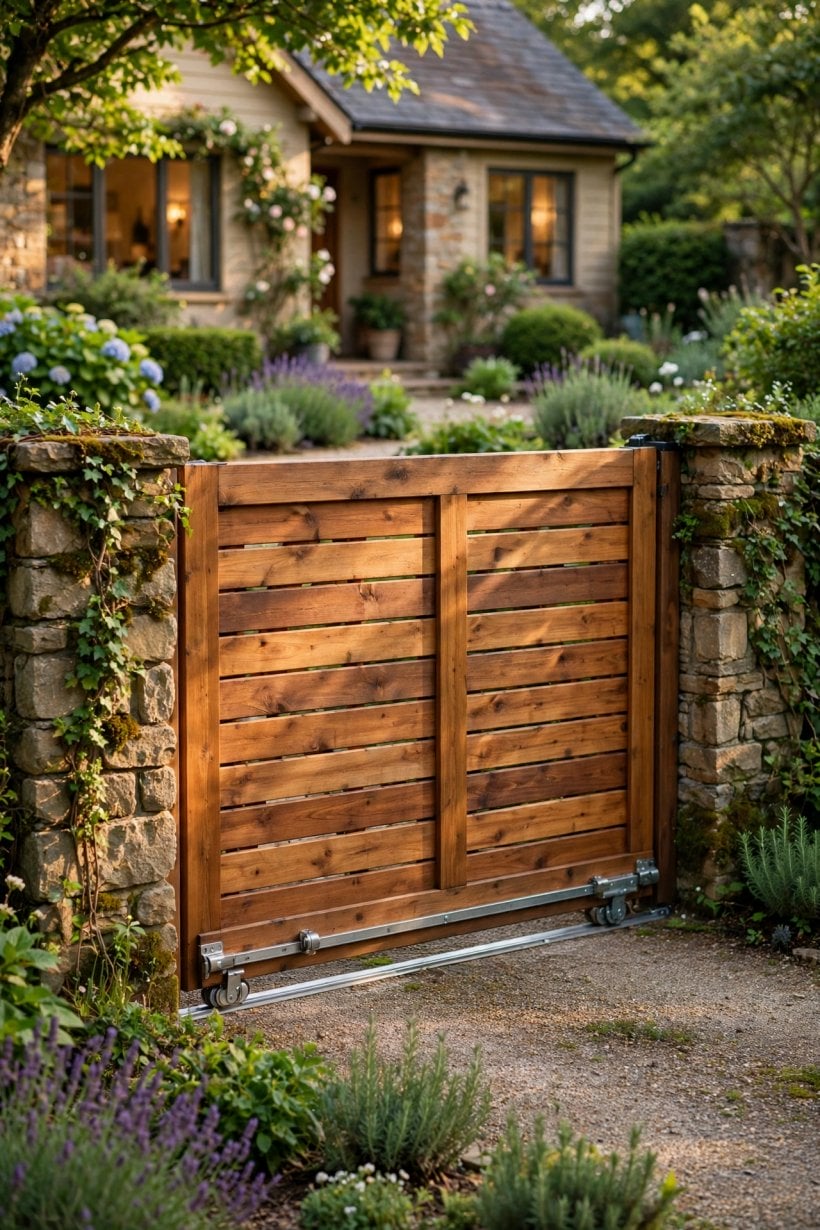
Style is where the 75 ideas multiply, because the frame-and-infill format accepts almost any face. Horizontal slats in powder-coated metal or timber-effect boards give the crisp, modern look that suits rendered walls and minimalist planting, and the gaps can be tuned from airy to near-solid. Close-boarded timber brings warmth and privacy and pairs naturally with fences of the same species, ageing to silver if you let it or holding its colour with regular oiling.
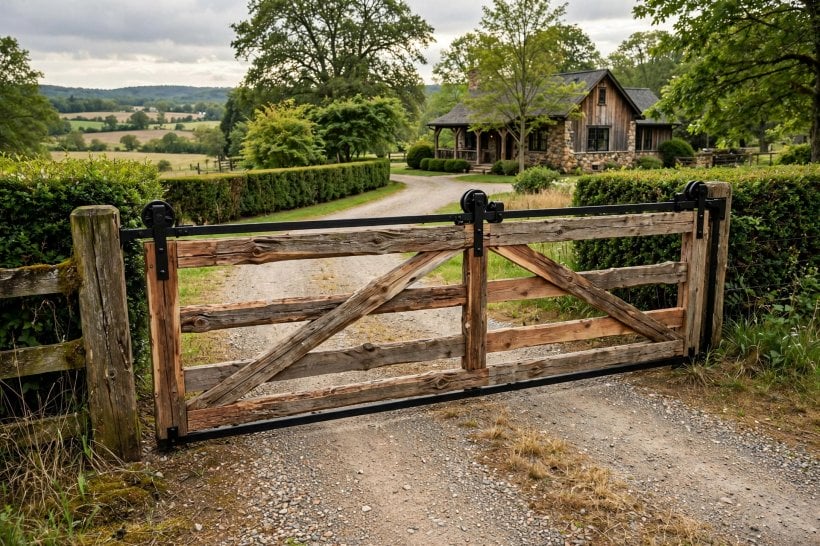
Classic wrought-iron-style designs, vertical bars, finials, a gentle arch to the top rail, still suit period houses best, and their openness keeps sightlines clear where the drive meets the street. Solid privacy panels in metal or composite make the entrance a wall that moves: excellent for security and for screening a busy road, but remember that a solid leaf is a sail, so wind load must be part of the engineering conversation, not an afterthought.
Mixed designs reward confidence: a metal frame with timber infill, a solid lower half under an open railed top, or a pedestrian door leaf in the same style beside the main span. Whichever face you choose, repeat one material or colour from the house, the front door, the window frames, the fence stain, so the entrance belongs to the property rather than visiting it.
5. Materials Compared Honestly
Steel is the traditional backbone: strong, repairable, and able to carry large spans and heavy infill. Its honesty is weight, so posts, foundations and motors must be sized for it, and its maintenance is about protecting the finish; ask how the steel is treated against corrosion and check the manufacturer’s care guidance rather than assuming a coating lasts forever. Galvanised and powder-coated finishes, kept clean and touched up where chipped, are what stand between steel and rust.
Aluminium trades some of that heft for lightness and natural corrosion resistance, which running gear and motors appreciate, and modern finishes imitate timber convincingly. Timber itself is the warmest and most repairable material, board by board, but it moves with the seasons and wants a maintenance rhythm; choose species and treatments with your supplier’s written guidance, and expect to re-oil or re-stain on a cycle. Composites promise low upkeep and colour stability; verify fixings, expansion allowances and spare-part availability with the maker before committing a whole entrance to a newer material.
In every case, the frame matters as much as the face. A beautifully clad leaf on an undersized frame will rack and drag within a few seasons, so ask what section sizes and bracing the design uses, and treat unusually cheap quotes as a question, not a bargain.
6. Tracked or Cantilever: How the Leaf Travels
A tracked design runs on wheels along a steel rail fixed to the ground across the opening and run-back. It is the simpler, often more economical mechanism, it handles long leaves predictably, and the leaf is supported along its travel. Its weakness is the rail itself: it must sit in a sound, level foundation, it crosses your drainage path, and it collects gravel, leaves and winter ice, so it rewards a quick sweep on bin day and a layout that keeps loose gravel away from the line.
A cantilever design carries the leaf on roller carriages set in a concrete foundation beside the opening, with the leaf floating clear of the ground. No rail crosses the drive, so gravel surfaces, drainage channels and uneven thresholds stop being problems, and snow or debris cannot block the path. The price of that freedom is the tail: a long counterweight section that needs extra run-back and a substantial foundation block, plus precise setting-out so the leaf runs true.
Hybrid and telescopic arrangements exist for the plots that defeat both: leaves that stack as they open, or twin leaves travelling to opposite sides. If your entrance is short of run-back, ask about these before giving up on sideways travel altogether; a good installer will survey the levels and propose the mechanism the site dictates, not the one on promotion.
7. Automation, Power and Access Control
Motors turn a heavy leaf into a fingertip job, and for most households automation is where the design earns its keep twice a day. The essentials to discuss are motor sizing for your leaf’s weight and exposure, how power reaches the motor position, battery back-up behaviour during outages, and the manual release, which you should be shown, and should practise, before the installers leave. Confirm specifications and duty ratings with the manufacturer or installer in writing rather than relying on headline claims.
Access control is a menu, not a package: remotes for the household, a keypad for deliveries and grandparents, an intercom or phone-based entry for visitors, and timed closing so the entrance never stands open and forgotten. Decide who should be able to open your entrance before the sales conversation, and your choices will be calmer. Electrical work belongs with a qualified electrician and must follow your local rules; the sequencing sense in this guide on how to build your own tiny house, trades in the right order, nothing buried before it is tested, applies squarely here.
Plan the waiting, too. A car pausing on the pavement while a leaf travels needs a safe place to stand, and visitors need to understand the intercom at a glance. Small, clear details, a visible bell push, house number lit at night, an instruction plate, are what make an automated entrance feel hospitable instead of forbidding.
8. Safety, Sensors and Family-Proofing
A powered leaf is a moving machine in a domestic space, so safety is a section, not a footnote. Modern systems use a combination of safety edges that stop and reverse the leaf on contact, photocell beams that hold it open while something crosses the entrance, and force limitation in the motor itself. Ask which devices your installation includes, have them demonstrated, and test the photocells with a cardboard box before you sign the job off.
Family-proofing is mostly geometry and habit. Keep the run-back zone fenced or planted so children and pets cannot wander into the leaf’s path or reach through moving bars; site controls where small hands cannot experiment; and agree a household rule that the entrance is watched while it moves, every time. If the leaf is manually operated, teach the same discipline: open fully, secure it, then drive through, because a half-open heavy leaf on a slope has its own ideas.
Finally, keep the paperwork: installer certificates, safety test results where your area issues them, and the manual with the manual-release instructions. If you ever sell, that folder answers a buyer’s questions instantly, and if anything misbehaves, it is the first thing a service engineer will ask for.
9. Posts, Piers and the Entrance as a Whole
The leaf gets the compliments, but the posts do the work. Guide posts and the motor-side post carry the leaf’s weight, wind and enthusiasm of a thousand closings, and they stand in foundations sized for your soil and span; undersized posts are the most expensive saving in the whole project. Brick or stone piers can match the house beautifully, but they need a structural core and room for the running gear, so design the pier and the mechanism together rather than asking one to fit around the other.
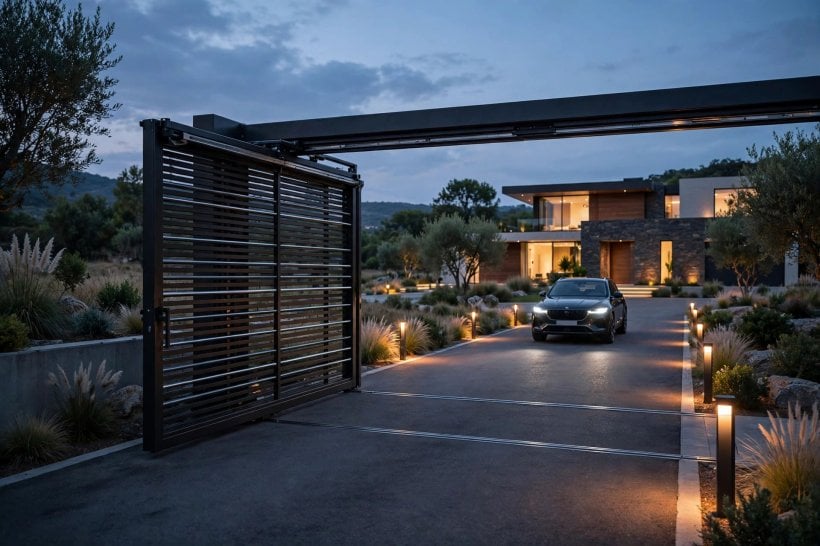
Compose the whole entrance while you are at it: a pedestrian gate in the same style saves opening the main leaf for the post, lighting on the piers or in the drive edge makes winter arrivals safer, and the house number deserves to be findable at speed by a delivery driver or an ambulance. Surfacing under the leaf’s travel should be firm, bound and easy to sweep, whatever the rest of the drive is made of.
Entrances are the handshake of a house, and they matter at resale as much as on arrival night. The presentation thinking in this guide to tiny houses for sale and rent, kerb appeal, clear access, everything working as it should, is exactly how a future buyer will read your entrance in the first thirty seconds.
10. Costs in Plain Terms, Maintenance and Troubleshooting
Costs resist tidy numbers because spans, groundworks, materials and automation vary so widely, so think in layers instead: the leaf and frame; posts, foundations and civils; the running gear or motor; power and controls; and finishing, surfacing, lighting, making good. Quotes that itemise those layers can be compared fairly; a single all-in figure cannot. Keep a contingency for the ground, because drives conceal old concrete, drains and services that nobody remembers until the digger finds them, and confirm what permissions, if any, your local authority requires for your height, position and any works near the highway before you book.
Maintenance is light but real. Keep the track or the leaf’s path swept, wash the finish as the manufacturer advises, lubricate only what the manual tells you to, and check wheels, rollers and guides for wear or wobble each season. Timber infill wants its oil or stain renewed on the maker’s cycle; painted and coated finishes want chips touched in promptly, the same patience these tiny house decorating ideas recommend indoors, because small finish repairs done early are what postpone big ones.
Troubleshooting follows a pattern: a leaf that drags has usually met debris, a dropped roller or a shifted post; a motor that strains points to the same causes before it points to itself. Work through the manual’s checks in order, and call your installer with the paperwork folder open rather than forcing anything. Machines that are maintained gently rarely fail dramatically.
Final Considerations
Choose the mechanism your site dictates, the material your maintenance appetite can honour, and the style your house will still be pleased with in ten years, and the result will feel inevitable in the best way. Measure honestly, spend first on posts, foundations and running gear, and treat safety devices and the manual release as essentials rather than extras.
An entrance is used more than almost any other part of a home’s exterior, in all weathers and all moods. Get these decisions right and every arrival becomes a small, quiet pleasure: press, glide, home.

0 Comments