
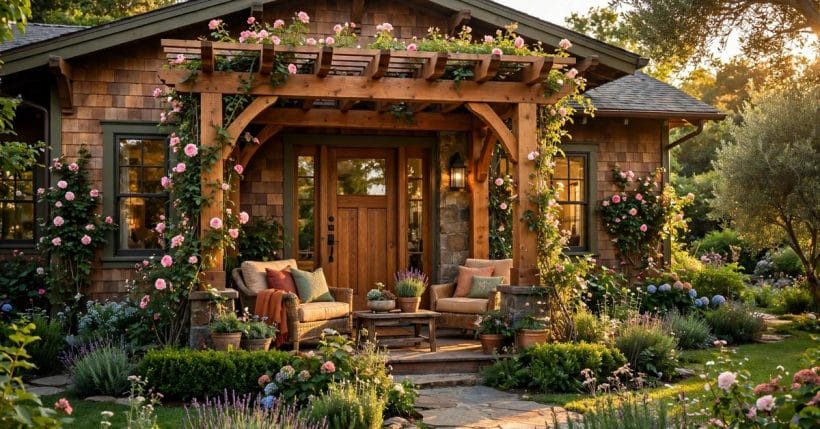
An entrance pergola does one job beautifully: it marks the front door. A simple open frame over the entrance turns a flat facade into a welcome. It gives shade on a sunny approach, a place for climbing plants, a frame for lighting, and a clear signal to visitors that this is where they arrive. It costs far less than a porch rebuild and changes the whole front of the house.
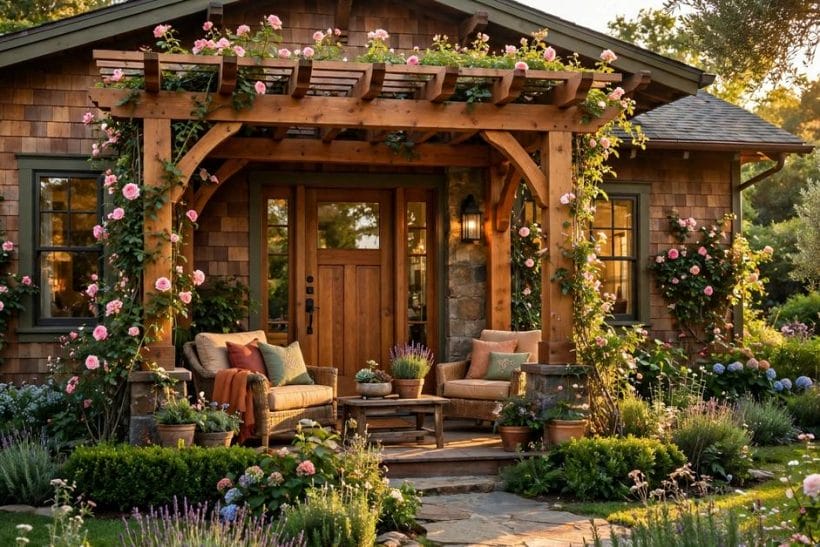
This guide stays strictly on the pergola over the front door: its size, its materials, its shade, its planting, its lighting, its approach, its seating, its upkeep, and the cases where a pergola is the wrong choice. It links to the porch ideas that surround it without becoming a general porch post.
1. What an Entrance Pergola Does
An entrance pergola is an open timber or metal frame, usually four posts and a set of crossbeams, set over or just in front of the front door. Unlike a solid porch roof, it does not fully cover the entrance. It filters sun, breaks up the facade and gives climbing plants something to grow on. The result is shade that moves through the day and a doorway that feels sheltered without feeling enclosed.
The pergola also works as a signpost. Visitors approaching a house look for the door, and a pergola frames it. A house with a flat front and a door lost among windows gains a clear arrival point the moment a pergola goes up. Estate agents and designers call this kerb appeal, but the simpler truth is wayfinding: guests stop guessing where to knock.
There is a limit to what a pergola does. It is not a rain shelter in the way a solid porch roof is. Rain passes through the open top, though climbing plants and a denser slat spacing slow it. Anyone wanting a dry place to stand while finding keys needs a solid canopy as well, or must accept that a pergola trades full shelter for light, air and planting. Knowing that trade before building avoids disappointment later.
2. Size and Proportion at the Door
Proportion decides whether an entrance pergola looks made for the house or bolted on as an afterthought. The frame should sit wider than the door and its surround, so the door reads as centred within it rather than squeezed beneath it. Height should clear the door comfortably and relate to the house: a tall frame suits a tall facade, while a lower frame suits a cottage or bungalow. A pergola that dwarfs a small door looks wrong; one that barely clears it looks cramped.
Depth matters too. A shallow frame, barely deeper than the door surround, reads as decoration. A deeper frame creates a real threshold space, room for a step, a mat and perhaps a seat. Most entrance pergolas sit somewhere between: deep enough to stand under, shallow enough not to darken the hallway behind the door. Walk the approach and picture standing under it with shopping bags or an umbrella; that picture tells you whether the depth works.
Check the facade before fixing anything. The frame needs solid fixing points, clear of gutters, wires and vents, and it must not block upstairs windows or light into the hall. A pergola fixed to weak render or covering a vent creates problems that outlast the good looks. Where fixing is doubtful, freestanding posts set into the ground beside the path give the same look without relying on the wall at all.
3. Timber, Metal and Painted Frames
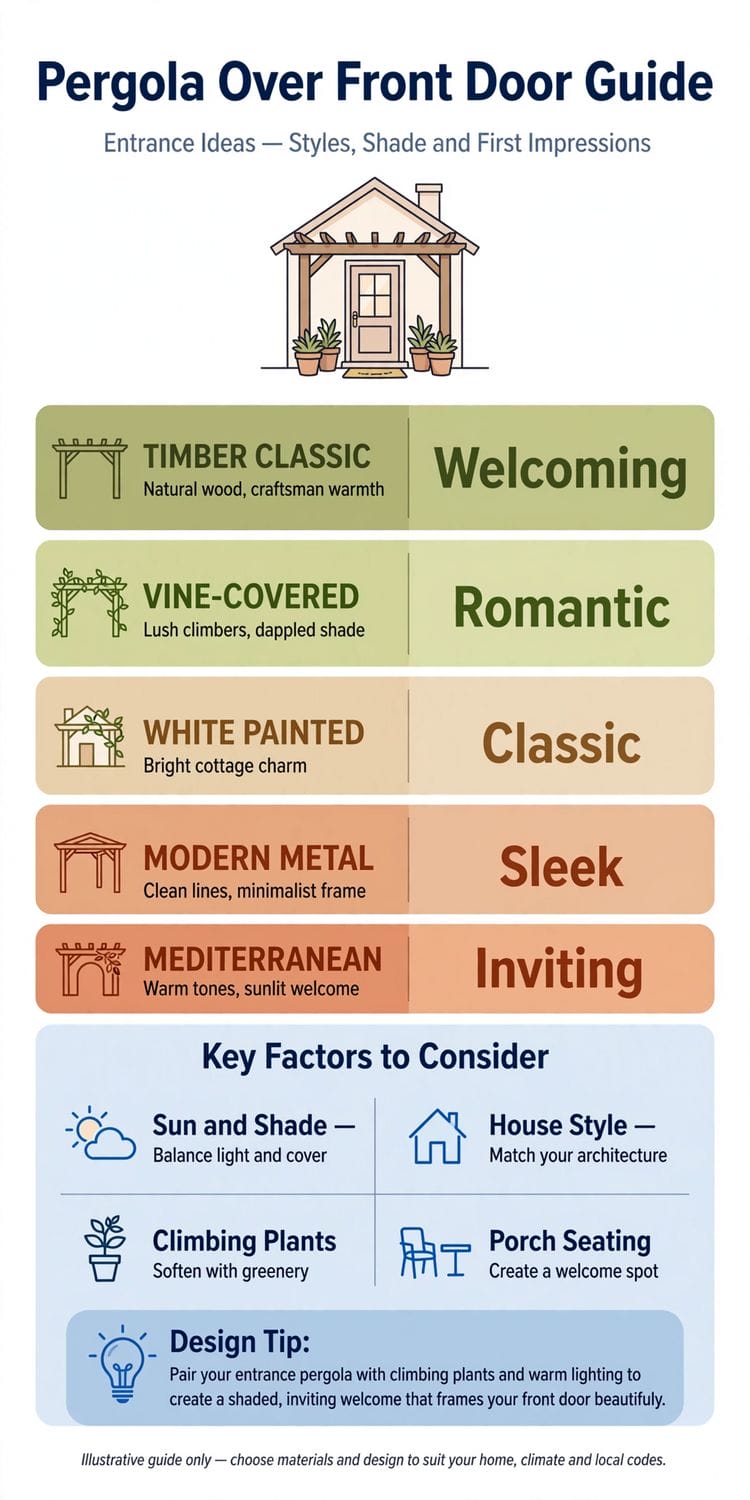
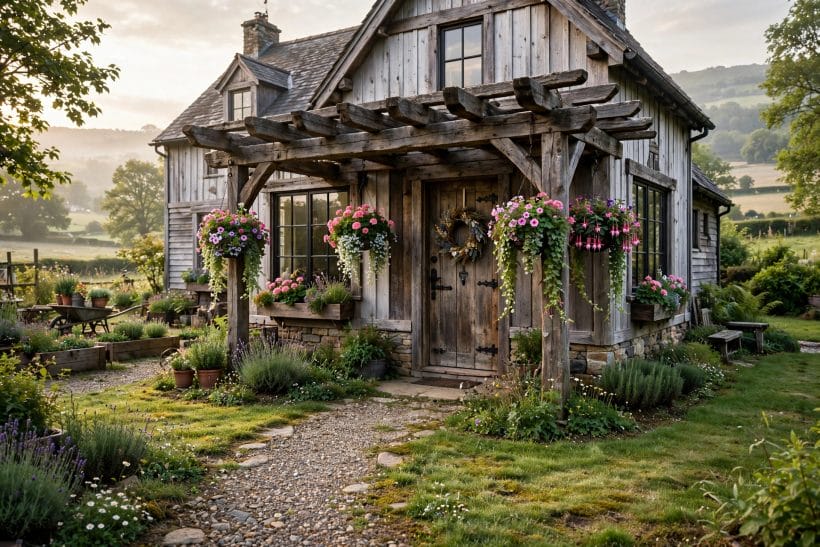
Timber is the classic entrance pergola material. It looks warm against brick, stone and render, takes climbing plants well, and can be stained or left to weather. Softwood frames are common and affordable; hardwood frames last longer with less upkeep but cost more. Either way, timber in contact with the ground needs protection from damp, and cut ends need sealing, or the posts will fail at the base first.
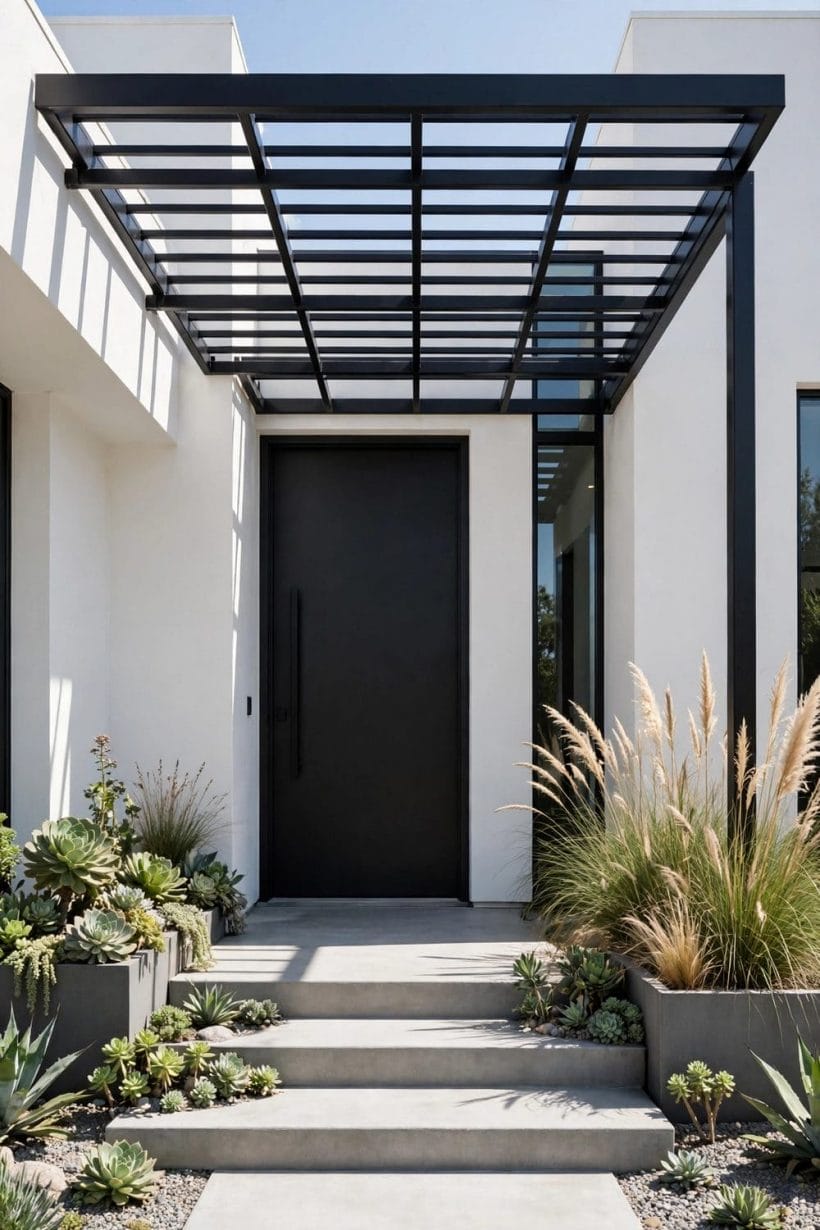
Metal frames suit modern houses. Slim steel or aluminium posts and beams give clean lines and a lighter look, and they need little upkeep beyond occasional cleaning. Metal can feel cold against a traditional facade, so it suits houses where the rest of the detailing is already crisp and minimal. A black metal frame over a modern door, for example, reads as part of the architecture rather than an addition.
Painted frames bridge the two. A white painted timber pergola suits cottages and coastal houses, reading fresh and light. Paint needs renewing every few years, especially on sun-facing fronts, but repainting is also a chance to change the look cheaply. Whatever the material, the finish should match the house: the pergola is part of the facade, not a separate object, and a finish that clashes with the door or windows will fight the house every day.
4. Shade: Open, Slatted or Vine-Covered
Shade is the pergola’s practical gift, and it comes in degrees. An open frame with wide slat spacing gives dappled shade and keeps the entrance bright. Closer slats give deeper shade but darken the doorway and the hall behind it. The right spacing depends on which way the front faces: a south-facing entrance wants more shade, a north-facing one wants all the light it can get.
Climbing plants change the shade through the seasons. Deciduous climbers leaf out in summer when shade is wanted and drop leaves in winter when light is wanted, which is a neat natural fit. Evergreen climbers give year-round cover but also year-round gloom at the door. Roses, jasmine and clematis are common choices, each with its own habit: roses need tying and pruning, jasmine scents the entrance, clematis comes in forms for sun and shade. Choose by aspect and by how much pruning you will honestly do.
For entrances that need steadier shade, a retractable canopy or shade cloth under the beams gives control without rebuilding. These can be drawn across in high summer and pulled back in winter. They need fixings that suit the frame and fabric that dries quickly, or they mildew. A canopy is a practical addition, but it changes the look: the open frame becomes a covered one, so weigh the shade gain against the lighter feel you may lose.
5. Climbing Plants That Suit an Entrance
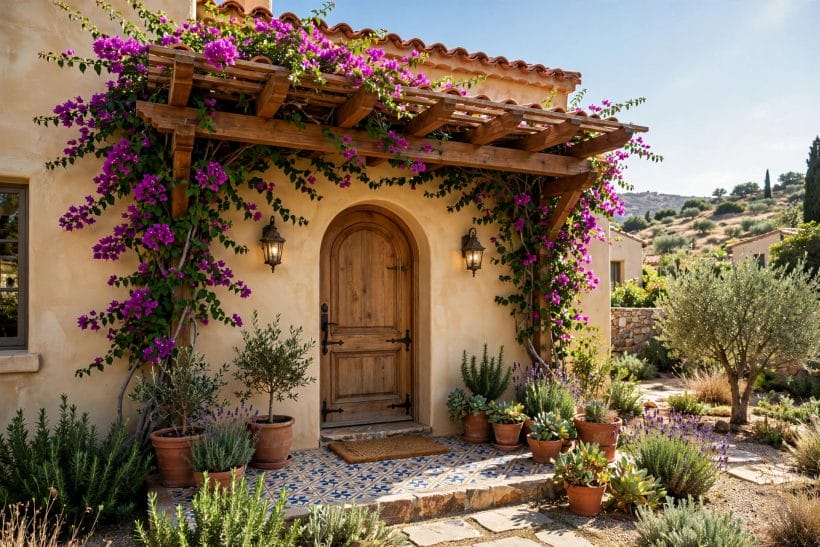
Plants make an entrance pergola, but the wrong plant makes work. Fast growers cover the frame quickly and then need cutting back twice a year or they swallow the door, the lights and the house number. Slower growers take longer to cover but stay manageable. The honest question is not what looks good in a photograph, but what you will prune, tie and feed year after year.
Match the plant to the aspect. Sun-loving climbers sulk on a north-facing front; shade-tolerant ones scorch on a south-facing one. Check the soil at the base too: climbers beside a path often sit in poor, dry soil next to foundations, so planting holes need compost and watering until established. A climber planted well in year one repays the effort for a decade; one planted badly struggles from the start.
Keep plants off the door furniture, the house number, the letterbox and any lights. Growth that covers the number or blocks the light defeats the pergola’s wayfinding job. A yearly prune that clears the door surround, the number and the lights keeps the entrance working as an entrance. For the wider garden context, see our Asian landscaping ideas, which treat planting as structure rather than decoration.
6. Lighting the Welcome
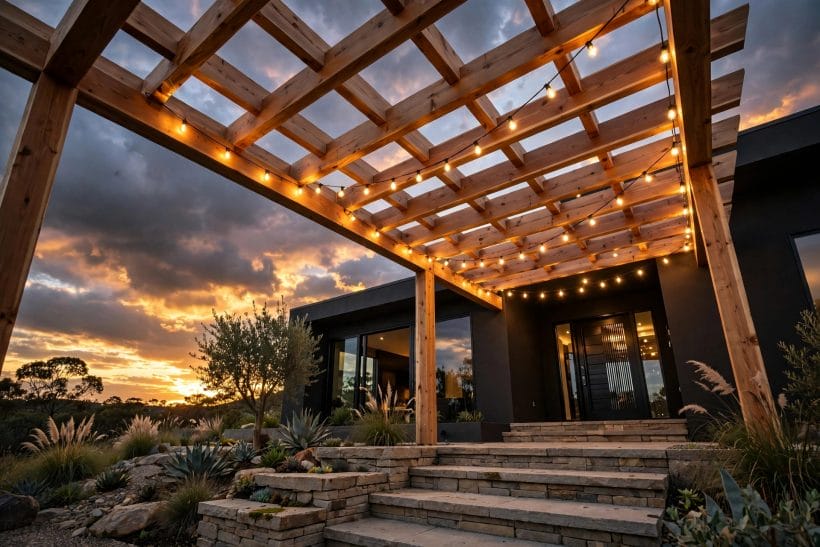
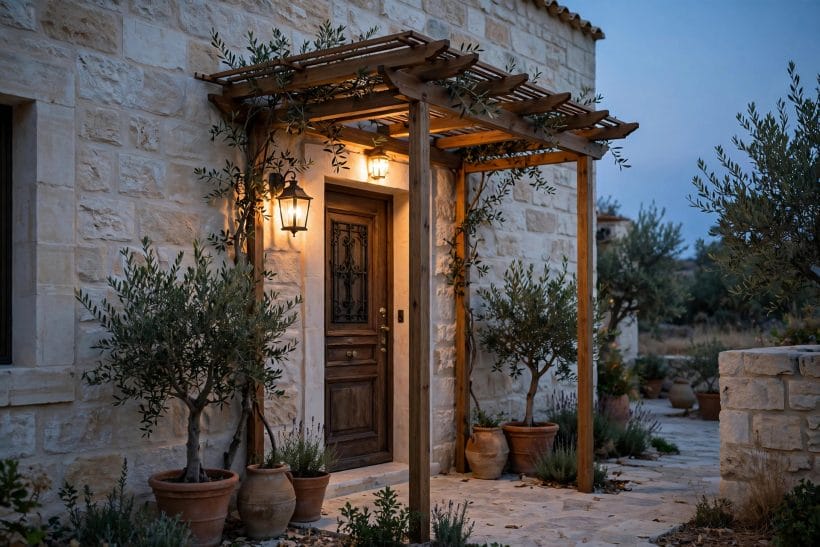
Lighting turns an entrance pergola from a daytime feature into an evening welcome. Wall lights beside the door, small lights on the posts, or string lights along the beams all work, and each gives a different mood. Wall lights are practical: they light faces, keys and steps. String lights are festive: they make the entrance glow and suit summer evenings. Post lights sit between the two.
Place lights to serve the approach, not just the frame. The path, the step and the door handle need light; the top of the pergola does not. Lights that shine into visitors’ eyes or into neighbours’ windows cause more annoyance than welcome. Warm white light flatters timber and planting; harsh white light flattens both. A timer or a dusk sensor means the welcome is lit whether anyone remembers or not.
Electrical work outdoors belongs to qualified people. Cables, fittings and connections exposed to weather need proper outdoor ratings and safe installation, and no guide can substitute for that. Plan the lighting positions when the pergola goes up, so cables can be run neatly, rather than adding lights later with visible wiring. A well-lit entrance feels safe and welcoming; a badly wired one is a hazard dressed as decoration.
7. Steps, Paths and the Approach
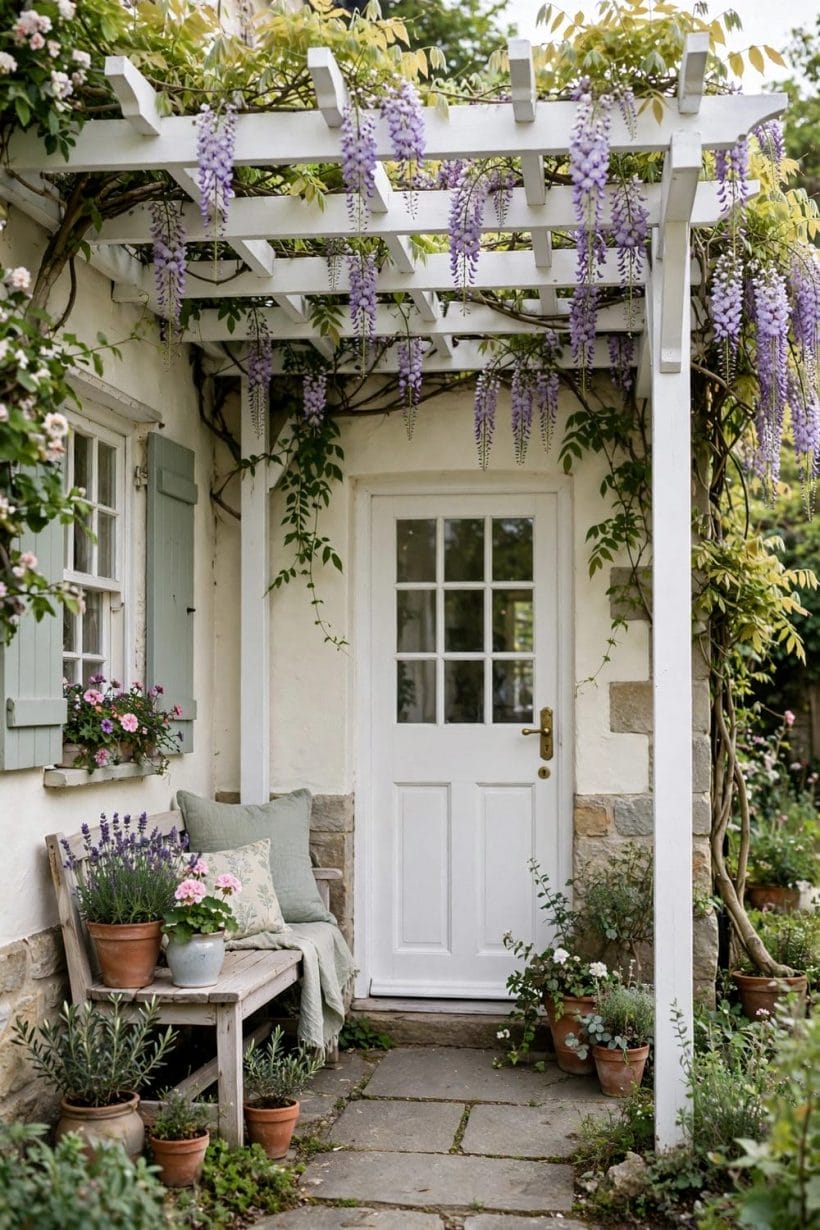
A pergola frames the door, but the approach frames the pergola. The path, the step and the planting beside them decide whether the entrance feels generous or cramped. A path that runs straight at the door under the pergola feels formal. One that curves gently feels relaxed. Either works if the width suits: a path too narrow for two people to pass, or for carrying bags, undermines the welcome the pergola promises.
Steps deserve the same care. A single deep step under a pergola feels grander than two shallow ones, and a step with a non-slip surface stays safe in wet weather. Keep the step clear of pots and ornaments that narrow it. The threshold is a working space, not a display shelf, and clutter there causes trips exactly where visitors are looking up at the pergola instead of down at their feet.
Planting beside the approach should frame, not block. Low shrubs, pots and ground cover soften the posts without hiding them. Tall shrubs that swallow the frame hide the pergola’s shape and darken the entrance. The rule is simple: planting should lead the eye to the door, not compete with the structure that frames it. For the door surround itself, see our exterior entryway ideas, which cover the approach in full.
8. Seating Under the Pergola
A seat under an entrance pergola turns a threshold into a place. A small bench or a pair of chairs gives somewhere to wait, to put bags down, or to sit on a summer evening. Seating suits deeper pergolas with room to spare; under a shallow frame it crowds the doorway and blocks the path. Measure the depth honestly before adding furniture.
Keep seating simple and weatherproof. A wooden bench that matches the frame looks made for the spot. Cushions left out in rain become a chore, so either bring them in or choose outdoor fabric that dries fast. A seat that is always wet or always cluttered stops being used, and an unused seat under a pergola looks like a prop rather than a place.
Seating also changes how the entrance is used. A bench invites lingering, which suits a quiet front garden but may not suit a busy street where privacy matters. If the front is overlooked, a seat may go unused while still narrowing the approach. In that case, skip the seat and let the pergola do its framing job alone. Not every entrance needs furniture; some need only the frame and the plants.
9. Weather and Upkeep
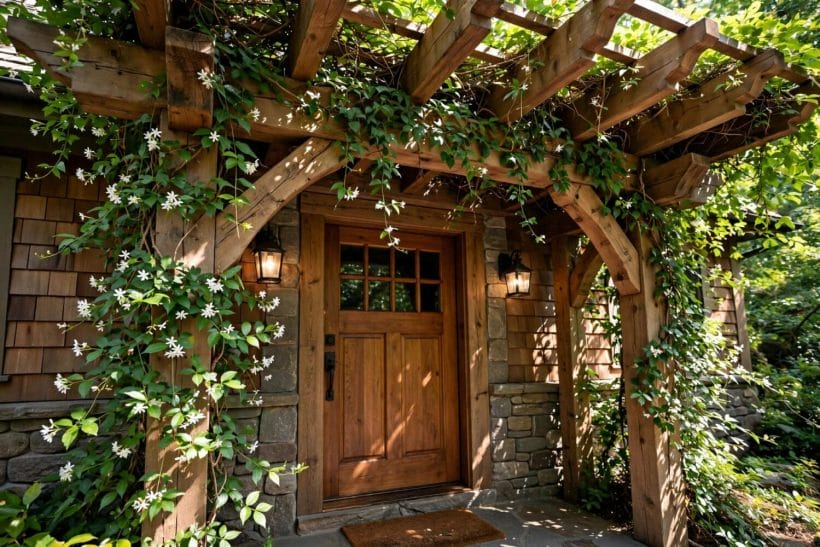
An entrance pergola lives outdoors, facing the weather year-round, so upkeep is part of the design, not an afterthought. Timber needs staining or oiling every few years, more often on sun-facing fronts. Paint needs touching up where it cracks or peels. Metal needs checking for rust at joints and fixings. None of this is heavy work, but all of it is regular, and a pergola left unmaintained looks tired fast.
Plants add their own upkeep rhythm: tying in new growth, pruning after flowering, clearing dead stems, and keeping growth off gutters and roofs. A climber that reaches the roofline needs cutting back before it lifts tiles or blocks gutters. A yearly check that covers the frame, the fixings, the plants and the lights keeps small jobs small. Skip the check for a few years and small jobs become repairs.
Storms test fixings. A pergola is a sail when covered in climbers, and high winds pull at posts and wall fixings. After a storm, check for movement, cracked timber and loose bolts before the next one. Freestanding posts should be checked for ground movement too. A pergola that moves is a pergola that needs attention promptly, not eventually, because movement only grows.
10. When a Pergola Is the Wrong Choice
A pergola is not right for every entrance. A very small front with no depth cannot hold a frame without crowding the path. A facade with weak fixing points and no room for freestanding posts cannot hold one safely. A north-facing entrance that already struggles for light may not want any more shade, even dappled. In these cases, a simpler treatment, like a door canopy, a painted surround or better lighting, serves the entrance better.
Planning and local rules can also decide the matter. Some areas restrict structures at the front of a property, and listed buildings or conservation areas add their own requirements. Check before building, not after, because moving a pergola that breaches a rule costs far more than checking first. Neighbours matter too: a tall frame that blocks a neighbour’s light or view creates friction that outlasts the build.
Finally, a pergola should not be built to hide a problem. A cracked facade, a failing door or a damp entrance will not be fixed by framing them beautifully. Fix the underlying issue first, then frame the result. A pergola over a sound, well-kept entrance is a finishing touch. Over a neglected one, it is decoration on a problem, and problems show through eventually. For the wider front-of-house picture, see our tiny house porch ideas, our Tuscan style homes and our Italian villa home designs, plus our tiny house designs for small-front inspiration.
Final Considerations
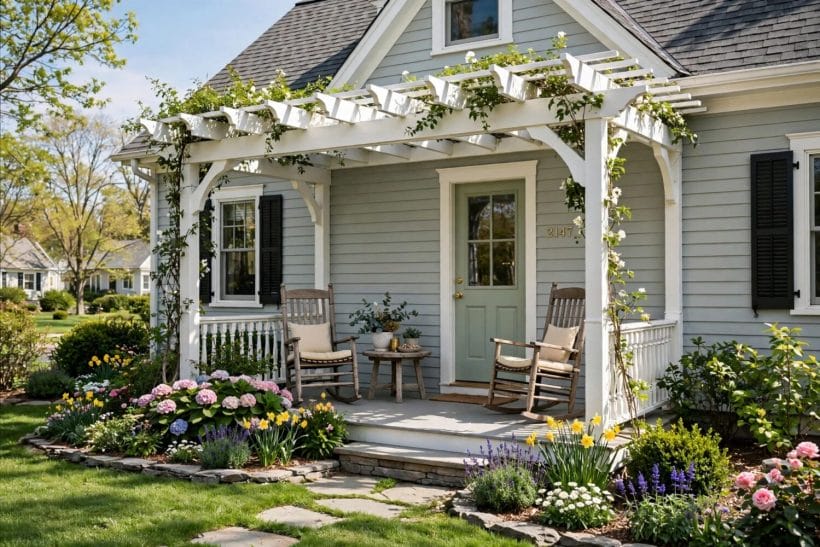
An entrance pergola earns its place by doing a few things well: framing the door, giving shade that suits the aspect, carrying plants that are honestly maintained, and lighting the welcome after dark. Size it to the house, fix it soundly, plant it for the aspect, and keep up the small yearly jobs. Done that way, it is one of the cheapest ways to change the whole front of a house.
Start from the door, not from a photograph. Stand on the path, look at the facade, and ask what the entrance lacks: a marker, shade, planting, light or simply presence. If a pergola answers that lack, build it to the house. If it does not, choose the simpler treatment that does. The best entrance is the one that welcomes people clearly, whatever structure frames it.



0 Comments