
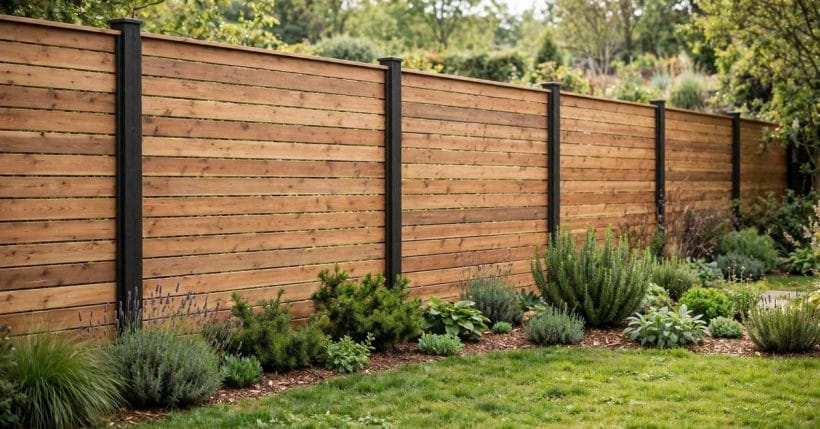
A horizontal wood fence changes a garden’s whole geometry. Where vertical pickets draw the eye up and down, horizontal boards draw it sideways, making a garden feel wider and a boundary feel calmer. The long lines suit modern houses, but they also suit rustic gardens, where wide boards and weathered timber feel right at home. The form is simple; the details are what make it last.
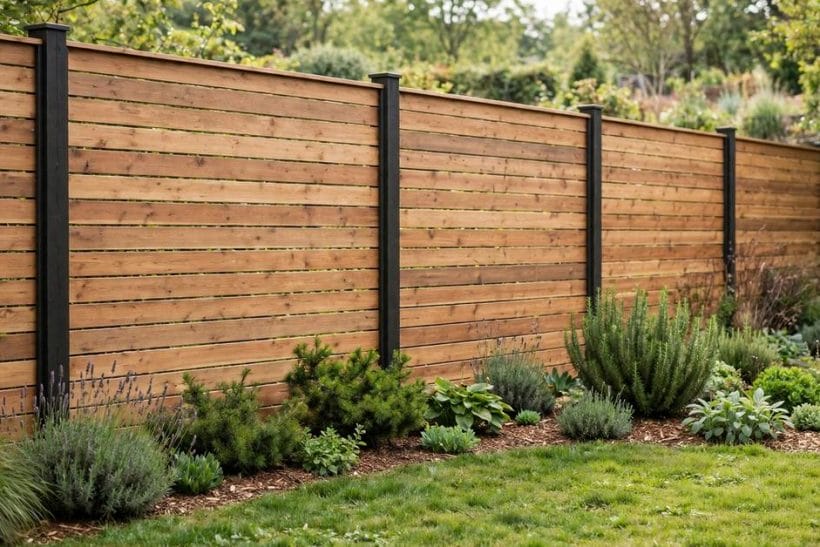
This guide covers horizontal wood fences by their parts: why the form looks different, board widths and gaps, posts and frames, timber in general terms, finishes and weathering, gates in a horizontal run, slopes, planting against the fence, privacy and airflow, and seasonal upkeep. It stays on the horizontal form only, splitting from gate design and general fence styles.
1. Why Horizontal Boards Look Different
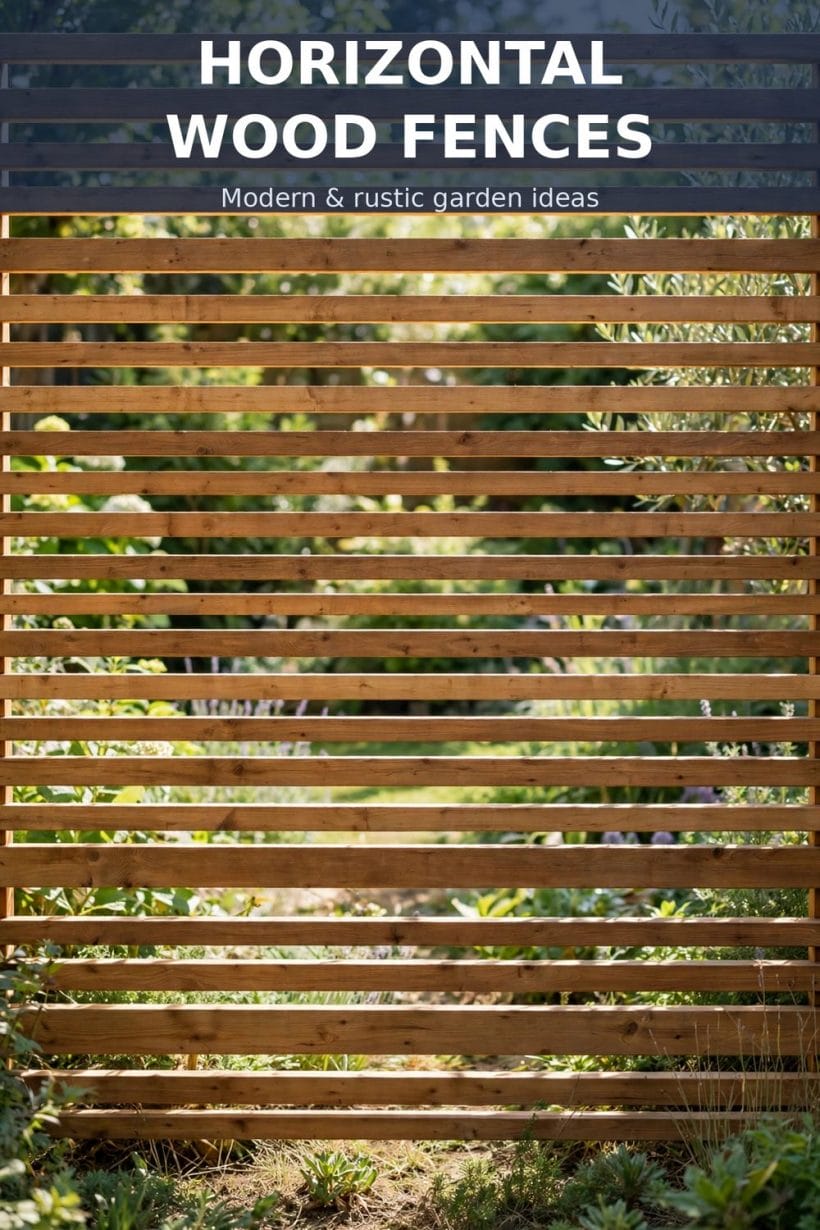
Horizontal boards change how a boundary reads. The eye follows the long lines, so a short garden feels longer and a narrow garden feels wider. The fence becomes a backdrop rather than a barrier: plants, furniture and paths stand out against the calm horizontal rhythm. Vertical fences, by contrast, chop the view into uprights and can make a small garden feel fenced in.
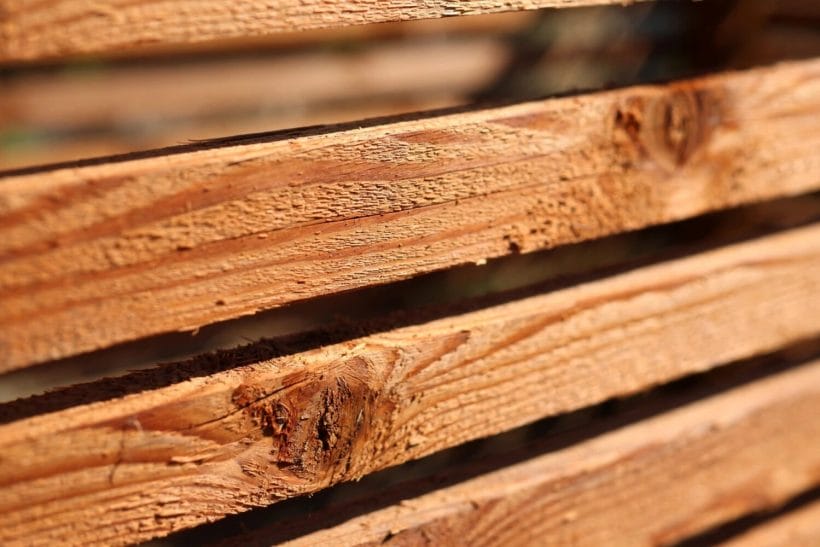
The form also changes how light and shadow play. Sun striking horizontal boards casts long, even shadows that shift through the day. In the evening, low sun rakes across the boards and brings out the grain. A vertical fence gives a picket pattern of light and dark; a horizontal one gives bands. Neither is better in itself, but the banded light suits gardens designed around seating and planting rather than around the fence itself.
There is a practical side too. Horizontal boards are easy to replace one at a time: a damaged board comes off and a new one goes on without disturbing the rest. Vertical pickets need similar work, but a horizontal run lets you replace a single board at any height without touching its neighbours. That repairability matters over a fence’s life, because boards do get damaged by weather, balls and garden work.
2. Board Widths and Gaps
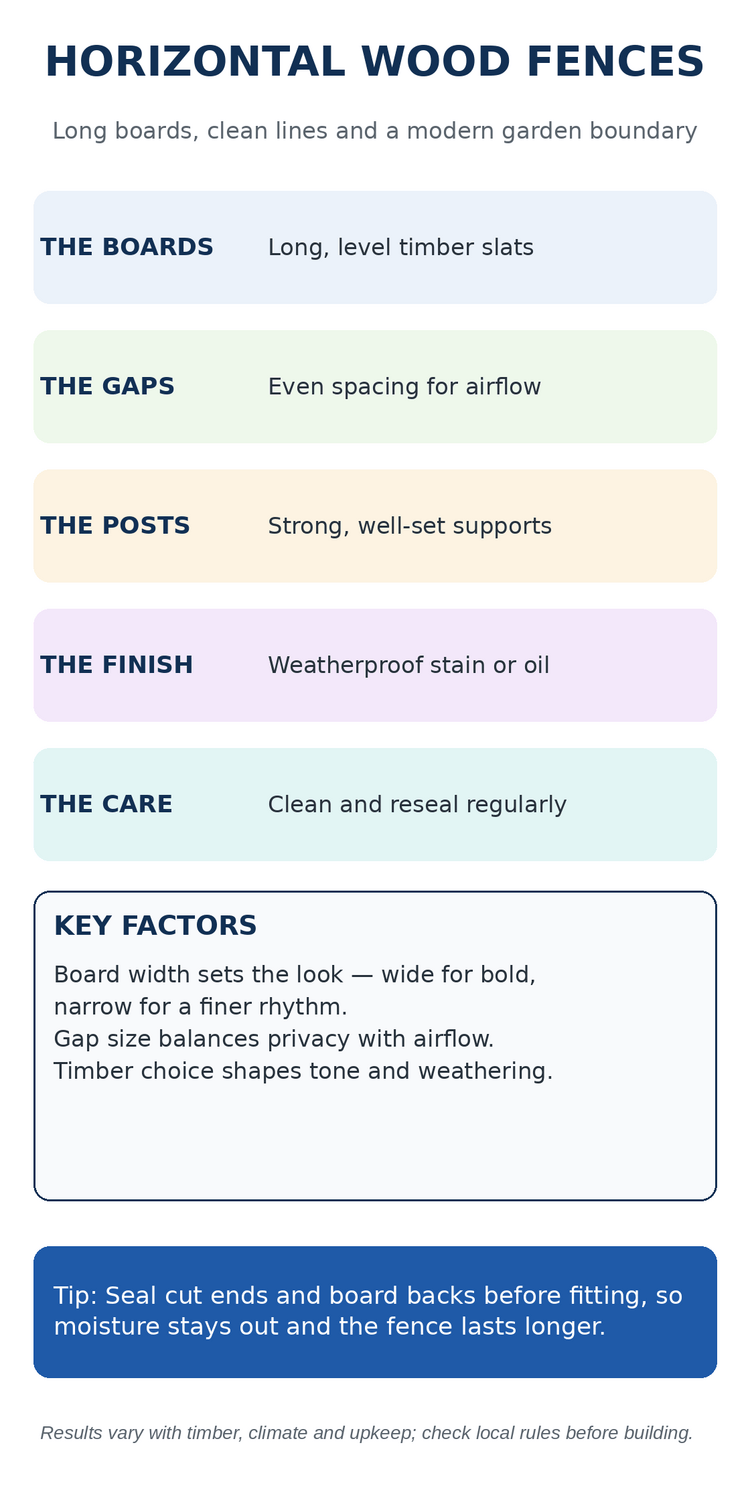
Board width sets the fence’s character. Wide boards give a bold, modern look with few lines; narrow boards give a finer, more detailed rhythm. Wide boards suit large gardens and contemporary houses; narrow boards suit smaller gardens where a bold board would dominate. There is no standard width that suits every garden, so the choice is visual: stand back and picture the run at full length, not just a single board.
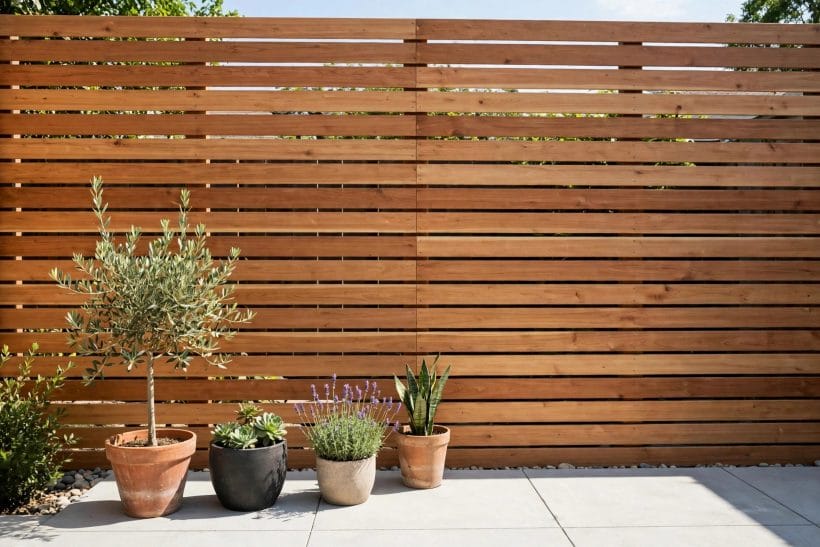
Gaps between boards set privacy and airflow. Closed boards with no gaps give full privacy but block wind, which loads the fence in storms. Small gaps let air through and relieve wind pressure, while still blocking most views. Larger gaps give a slatted look that filters light and views, suiting front gardens and internal divisions where full privacy is not wanted. The gap choice is a balance between screening and wind, and exposed gardens should lean toward gaps.
Spacing must stay even along the run, or the eye catches the error immediately. Spacers during fitting keep gaps consistent, and a string line keeps boards level. A run where gaps wander looks homemade in the wrong way, while a run with even gaps looks considered even if the timber is plain. Consistency is the cheapest way to make a fence look good.
3. Posts and Frames That Hold the Line
Posts carry the fence, and horizontal runs load them differently from vertical ones. Wind pushes a closed horizontal fence as a sail, so posts need depth and solid fixing. Posts set in concrete or on proper footings hold; posts pushed shallowly into soil lean within a season or two. The post spacing matters too: wider spacing saves posts but lets boards flex; closer spacing holds the line true.
Frames behind the boards keep long runs straight. Horizontal rails, or a framed panel, stop boards bowing and twisting as timber moves with moisture. Timber moves across its width with the seasons, so fixings should allow a little movement rather than pinning boards rigidly. Screws hold better than nails for horizontal boards, since nails work loose as boards swell and shrink.
Post tops deserve a thought. Flat tops collect water and rot first; sloped or capped tops shed water and last longer. Metal caps or a simple angled cut both work. The posts are the fence’s structure, and a fence is only as good as its posts: boards can be replaced board by board, but a failed post takes a whole section with it.
4. Timber Choices in General Terms
Timber choice for a horizontal fence is about durability, looks and upkeep, in general terms. Naturally durable species last longer outdoors with less treatment. Less durable species need preservative treatment to last, and the treatment must suit ground contact for posts and above-ground use for boards. Treated timber should be checked for proper treatment, not assumed, since treatment quality varies.
Grain and knots affect looks more than strength in a fence board. Clear boards give a clean modern line; knotty boards give rustic character. Neither is structurally better for a garden fence, so the choice is visual and budgetary. Boards should be straight and dry when fitted; bowed or wet boards twist as they dry and spoil the line.
Sustainability matters to many gardeners. Timber from certified sustainable sources, or reclaimed boards where suitable, reduces the fence’s footprint. Reclaimed boards need checking for nails, rot and old finishes, but they bring character no new board matches. Whatever the source, the fence should be built to last: a fence replaced every few years wastes more timber than one built well once.
5. Staining, Oiling and Weathering
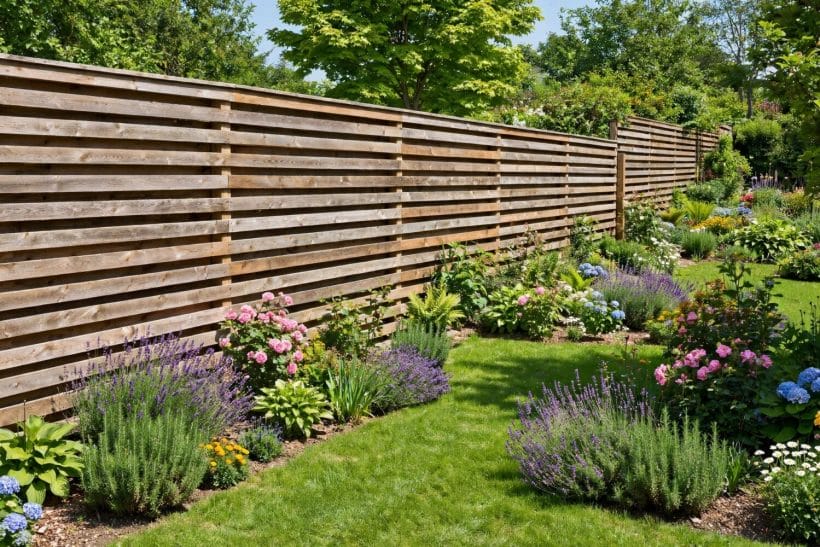
Finish decides how a horizontal fence ages. A stain or oil keeps the timber’s colour and grain visible while protecting against water and sun. Oils need renewing more often but are easy to reapply. Stains last longer but change the colour more. Paint covers the grain entirely and gives a colour statement, but peels in time and needs stripping before repainting.
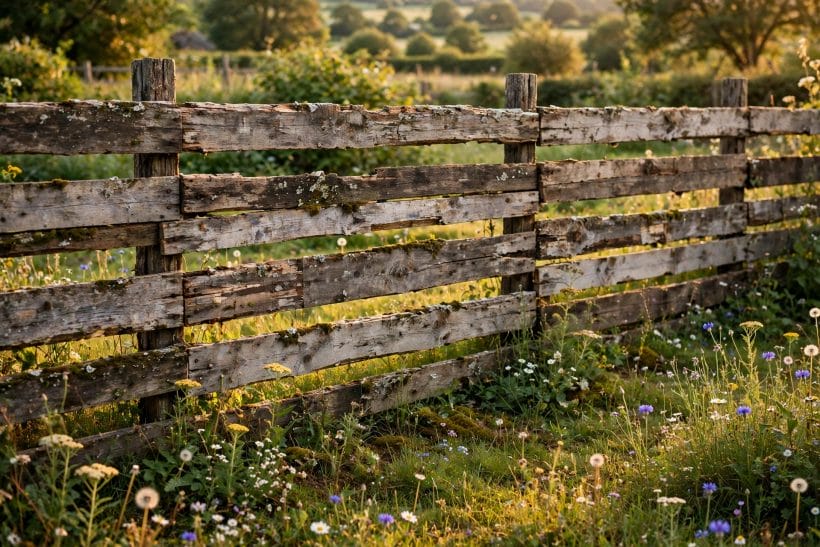
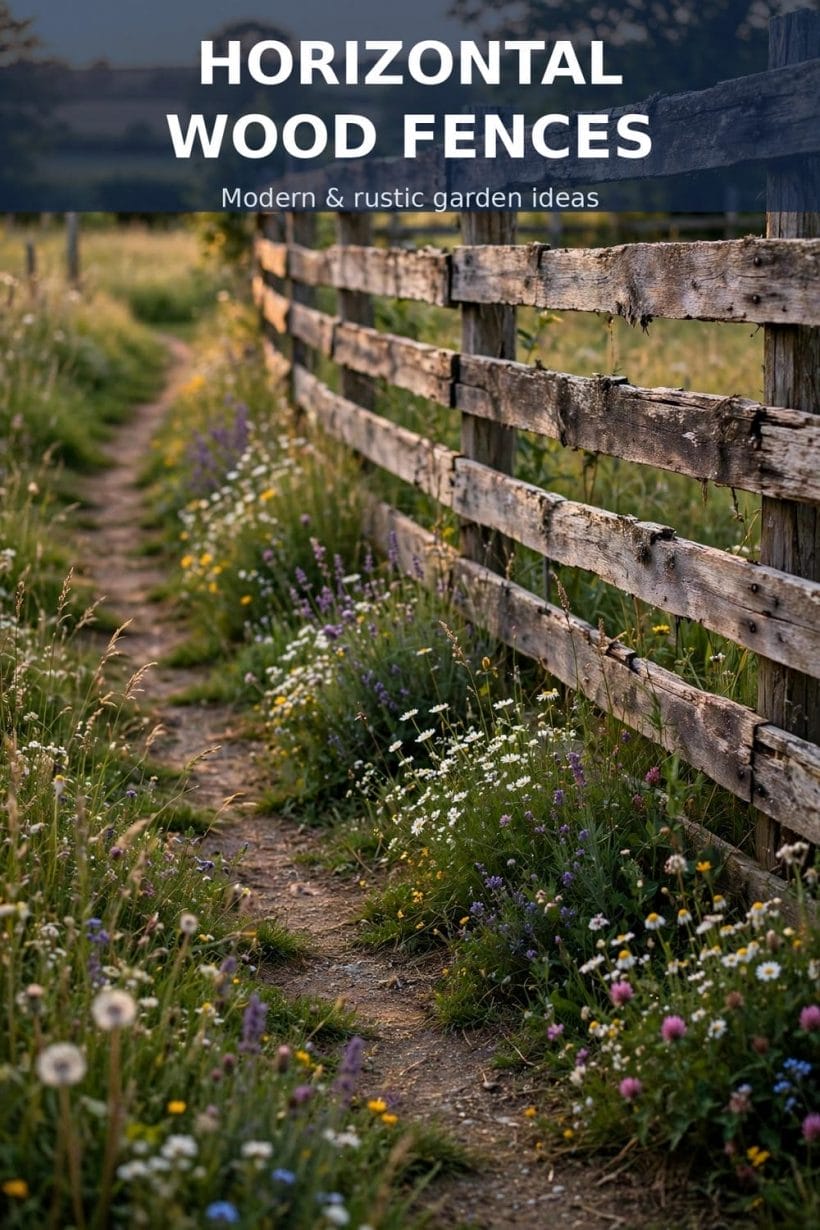
Left unfinished, timber weathers to grey. Grey weathering suits rustic and coastal gardens and needs no upkeep, but it is uneven at first: sun-facing boards grey faster than shaded ones, and the fence looks patchy for a season or two before settling. If even weathering matters, a UV-protective oil slows the change and evens it out.
Whatever the finish, preparation matters. Boards should be clean and dry before finishing, and cut ends should be sealed, since end grain drinks water fastest. A finish applied to dirty or wet timber fails early and peels. Recoat before the old finish fails completely: a maintenance coat over sound finish is easy, while restoring a fence whose finish has gone takes far longer.
6. Gates in a Horizontal Run
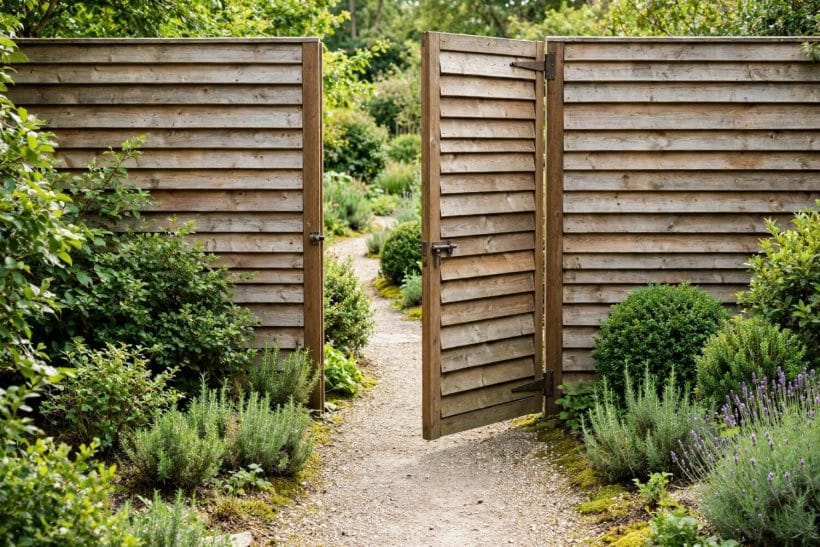
A gate in a horizontal fence should continue the line, not break it. Boards on the gate should match the fence boards in width, gap and finish, so the gate reads as part of the run when closed. A gate that looks different draws the eye and breaks the calm rhythm the horizontal form creates. Hinges and latches should be strong enough for the gate’s weight, since a sagging gate drags and sticks.
Gate posts need extra strength. A gate hangs its weight on one post and swings on it daily, so the post must be deeper and better fixed than line posts. A gate that sags within months usually traces back to a post that was never strong enough, not to the gate itself. Diagonal bracing on the gate frame stops the gate itself sagging out of square.
Think about how the gate is used. A garden gate used daily wants a latch reachable from both sides and a self-closing option where children or pets are around. A gate used rarely can be simpler. Either way, the gate should open without catching the ground or plants, and swing clear of paths. For gate design in full, see our fence gate pictures and ideas.
7. Slopes and Stepped Runs
Slopes test a horizontal fence. Boards can follow the slope in a continuous rake, or step down in level sections. Raked boards follow the ground smoothly and suit gentle slopes, but the boards sit at an angle and the gaps change along the run. Stepped sections keep each panel level and suit steeper slopes, but create triangular gaps under each step that need filling or accepting.
Stepping suits most gardens with a real slope, because level panels look cleaner and gates fit better into level sections. The gaps under steps can be filled with boards cut to shape, with planting, or with gravel boards. Raking suits gentle falls where the angle is barely noticeable. Either way, the posts must follow the ground level: posts set to a level line on a slope leave some posts too short and some buried too deep.
Measure the slope before ordering boards. A run that looks level from the house may fall more than expected, and boards ordered to the wrong length waste timber. Walk the boundary, note the fall, and plan the steps or rake before digging post holes. A fence planned on the ground fits; one planned on paper often does not.
8. Planting Against a Horizontal Fence
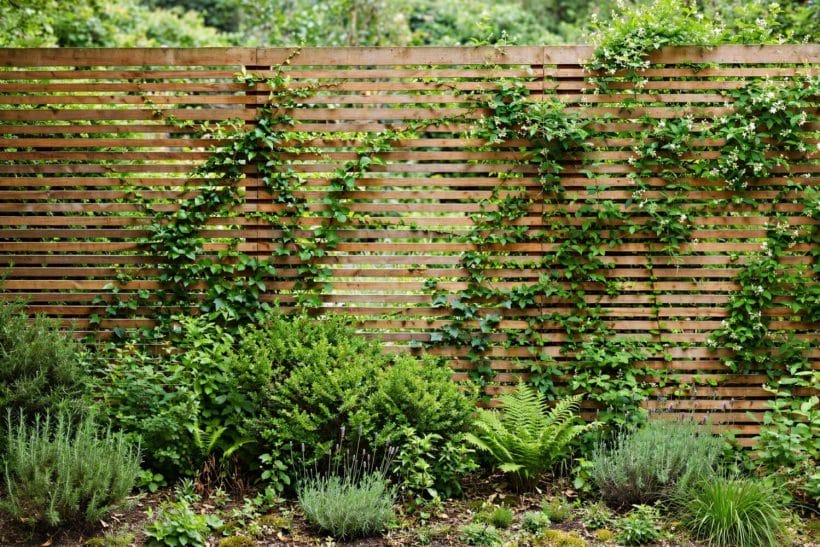
Planting softens a horizontal fence and makes it part of the garden rather than a boundary wall. Climbers trained along the boards add green without hiding the line. Shrubs in front break up long runs. Grasses and perennials at the base hide the bottom boards and the ground line. The fence becomes a backdrop, which is exactly what horizontal boards do best.
Keep plants off the boards themselves where possible, or accept the upkeep. Climbers that grip boards trap moisture against timber and speed rot, so trellis set slightly off the fence is kinder to the boards than plants grown directly on them. Shrubs planted too close hold damp against the bottom boards. A small gap between planting and fence, enough for air and a brush, keeps both healthy.
Choose planting that suits the fence’s aspect and the garden’s style. Sun-loving plants suit a south-facing fence; shade-tolerant ones suit the shadow side. The planting should complement the horizontal lines, not fight them: low, spreading plants echo the line, while tall, spiky ones contrast it. Either can work if the choice is deliberate. For the wider planting picture, see our southwestern landscaping ideas and our Asian landscaping ideas.
9. Privacy, Light and Airflow
Privacy is the usual reason for a horizontal fence, and closed boards deliver it fully. But full privacy has costs: blocked wind loads the fence, blocked light shades the garden, and a fully closed boundary can feel enclosing. Slatted boards with small gaps give most of the privacy with airflow and dappled light, and often feel better in the garden than a solid wall of timber.
Height and privacy interact. A taller fence screens more but shades more and catches more wind. Local rules often limit front-garden fence heights, and neighbours’ light and views matter too. Check the rules before building tall, and consider whether a slightly lower fence with planting above it gives the screening wanted without the bulk. Planting above a fence adds privacy that grows, while timber height is fixed.
Overlooked gardens need a different answer from private ones. Where neighbours overlook, a taller closed section near seating areas and lower slatted sections elsewhere gives privacy where it matters and openness where it does not. A fence need not be one height along its whole run; varying height by section suits the garden’s actual use better than a uniform wall.
10. Upkeep Through the Seasons
Seasonal upkeep keeps a horizontal fence straight and sound. In spring, check posts for movement, boards for damage, and finish for wear, and recoat where needed. Summer is for planting and trimming growth off boards. Autumn is for clearing leaves from the base, where damp rots bottom boards first. Winter is for checking after storms, when wind and wet test fixings hardest.
Cleaning is simple: brush off dirt and algae, wash with water, and let boards dry before refinishing. Pressure washing too close damages the surface and drives water into joints, so keep the nozzle back and the pressure low. A fence cleaned yearly and recoated when the finish wears looks good for decades; one left dirty and uncoated weathers fast and unevenly.
Replace damaged boards promptly. A split or rotten board left in place spreads damp to its neighbours and spoils the line. Single-board replacement is the horizontal fence’s great advantage, so use it: keep a few spare boards from the original batch, since timber colour varies between batches and a new board from a different batch may stand out. For the entrance side of the boundary, see our exterior entryway ideas, and for the wider design context, our tiny house designs and interior design ideas.
Final Considerations
A good horizontal wood fence is a line drawn well: even boards, even gaps, strong posts, a gate that continues the run, and a finish maintained through the seasons. The form itself does much of the work, widening the garden’s feel and calming the boundary. The details, posts, gaps and upkeep, decide whether that first impression lasts.
Start from the garden, not from a catalogue photograph. Walk the boundary, note the slope, the wind and the aspect, and choose board width, gaps and height for that ground. Build the posts properly, finish the boards before they weather, and keep up the small seasonal jobs. A horizontal fence built that way is a backdrop the garden can rely on for years.



0 Comments