

A home theater in a tiny house sounds like a contradiction — until you realize small spaces are better cinemas. Shorter viewing distances, easier light control, intimate acoustics: the physics of tiny favors the movie night. These 20 ideas cover building a genuinely cinematic experience into a tiny house or small space, from projector setups to acoustic tricks.
Why Small Spaces Win at Cinema
- Short throw: in a 12-foot room, even a basic projector fills a 100″+ screen — the geometry tiny houses give you free.
- Light control: fewer, smaller windows are easier to black out — the dark room is half the battle.
- Acoustics: small rooms need less power for room-filling sound — a good soundbar can outperform a big-room surround system.
- Intimacy: 2–4 viewers close together is the ideal cinema social unit — tiny houses seat exactly that.
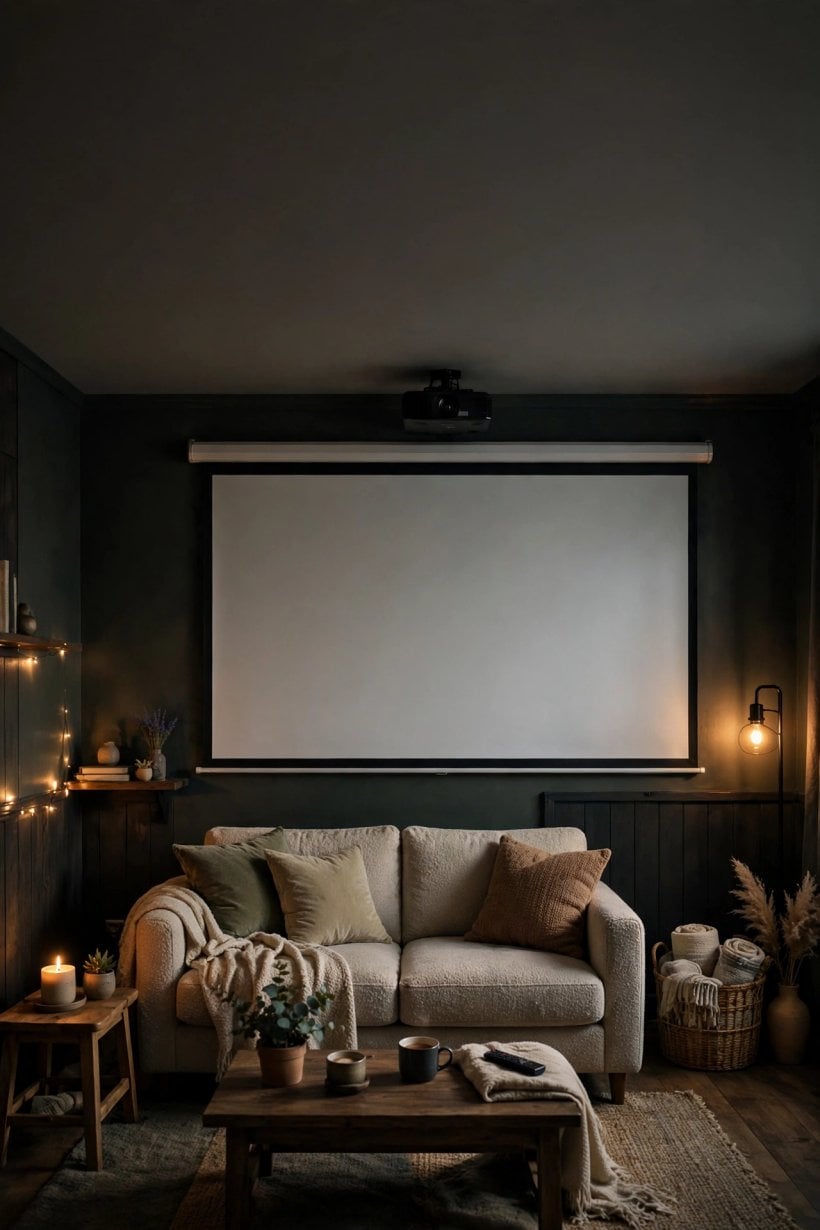
The Screen: Projector vs. TV
1. Short-throw projectors
The tiny-house champion — a short-throw projector 3–4 feet from the wall fills 100″+. No TV dominating the room when the movie’s off.
2. Pull-down screens
Manual or motorized screens that vanish — the wall returns to art or windows between films. The disappearing cinema.
3. Painted screen walls
Projector screen paint on a smooth wall section — zero hardware, always ready. The minimalist’s screen.
4. The big TV option
55–65″ TVs are cheap and simple — wall-mounted on an articulating arm, it serves as both TV and (with a soundbar) cinema. Less magic, more practical.
5. Ambient light rejecting screens
ALR screens preserve contrast with some ambient light — for living rooms that can’t go fully dark.
Sound in Small Spaces
6. The soundbar solution
A quality soundbar + subwoofer is 90% of the cinema experience in a tiny room — simple, compact, and genuinely impressive at short distances.
7. 5.1 in miniature
Compact satellite speakers + small sub — true surround is achievable; the short distances mean small speakers play loud.
8. The subwoofer question
Small rooms amplify bass — a modest 8″ sub can overwhelm a tiny house. Start small, tune carefully, consider your neighbors.
9. Acoustic treatment
Rugs, curtains, bookshelves, upholstered furniture — tiny houses are naturally damped. Add soft surfaces opposite the speakers.
10. Headphone cinema
Wireless headphone systems (or two pairs) — the full-volume experience at midnight without waking anyone. The considerate cinephile’s choice.
Seating: The Tiny Theater
11. The loveseat cinema
A deep loveseat or two recliners — the 2-person theater is the tiny-house standard, and honestly the best seat configuration.
12. Floor seating
Big cushions and bean bags — casual, storable, and kid-approved. The flexible theater.
13. The convertible couch
The everyday sofa becomes theater seating — throw blankets, dim lights, and it’s a cinema. No dedicated furniture needed.
14. Riser? Skip it
Tiered seating needs depth tiny houses don’t have — one good row beats two bad ones.
Light Control
15. Blackout everything
Blackout curtains or cellular shades on every window — the $200 upgrade that transforms daytime viewing.
16. Bias lighting
LED strips behind the screen — reduces eye strain and makes the image pop. The cheapest pro-cinema trick.
17. Smart dimmers
One-tap “movie mode” — lights down, screen down, sound on. The theater ritual, automated.
The Tiny Theater Lifestyle
18. The outdoor cinema
Projector + portable screen + the side of the tiny house (or a sheet) — summer movie nights under the stars. The tiny-house exclusive.
19. Movie-night hosting
4 guests max is a feature — curated movie nights for a tiny audience. The dinner-party of cinema.
20. The gaming theater
The same setup serves gaming beautifully — short-throw projectors with low input lag make tiny houses great game rooms too.
Budget Tiers
- $300 tier: existing TV + decent soundbar + blackout curtains — the instant upgrade.
- $1,000 tier: short-throw projector + pull-down screen + soundbar/sub — the real tiny cinema.
- $2,500 tier: quality projector + ALR screen + 5.1 compact surround + smart lighting — the enthusiast build.
- The sweet spot: the $1,000 tier delivers 90% of the experience — diminishing returns hit fast in small rooms.
Small-space living: our home office ideas and bedroom designs.
Projector Buying Guide for Tiny Spaces
- Throw ratio: the key spec — short-throw (0.5–1.0) fills 100″ from 3–5 feet. Measure your wall distance first, then match the ratio.
- Brightness: 2,000+ lumens for rooms with some ambient light; 1,500 suffices in a truly dark tiny room.
- Resolution: 1080p is the value sweet spot; 4K short-throws exist but cost multiples more — at 100″ and 10 feet, most viewers can’t tell.
- Input lag: under 40ms if gaming matters — check reviews, not just spec sheets.
- Noise: fan noise matters more in a tiny room — look for eco modes under 30dB.
- Laser vs. lamp: laser lasts 20,000+ hours with no bulb changes — worth the premium for heavy users.
Sources & Streaming
- The stick solution: a streaming stick in the projector’s HDMI port — the whole cinema runs from a $50 dongle.
- Physical media: a Blu-ray player for the purists — tiny houses can still have disc collections (small ones).
- Offline downloads: download before boondocking — the off-grid cinema needs local content.
- Antenna: a small OTA antenna for local channels — free TV, tiny footprint.
Theater Layouts for Tiny Floor Plans
- The living-room theater: screen on the long wall, seating opposite — the default; works in any 10×12+ living area.
- The loft cinema: projector in the loft aimed at the gable-end wall — the loft becomes the screening room; surprisingly cinematic.
- The bedroom theater: screen opposite the bed — the lazy cinema; a projector turns any bedroom into a theater.
- The murphy theater: murphy bed up = theater room; bed down = bedroom — the transformer space.
- Viewing distance rule: screen diagonal × 1.2–1.5 = ideal seating distance — a 100″ screen wants 10–12 feet, which tiny living rooms have.
The Kids’ Theater
- Floor seating wins: cushions and bean bags — kids prefer sprawling to sitting.
- Durability: portable projectors survive kid handling better than ceiling mounts — and move to the backyard for summer.
- Volume limits: small rooms get loud fast — set max volume; little ears are close to speakers.
- The magic: a blanket fort + projector is the childhood memory factory — tiny houses do this better than big ones.
DIY Acoustic Panels That Look Good
- Fabric-wrapped panels: rockwool or Owens Corning 703 in wood frames, wrapped in attractive fabric — the pro look for ~$30/panel.
- Placement: first reflection points (side walls between speakers and seats) matter most — 2–4 panels transform a room.
- Double duty: panels as art — printed fabric with photos or designs; acoustic treatment that decorates.
- The tiny advantage: you need fewer panels — small rooms treat cheap.
Power & Cable Management
- One outlet plan: projector, screen (if motorized), soundbar, sub, streaming stick, bias lighting — map it before mounting anything.
- Ceiling outlets: a ceiling-mounted projector wants a ceiling outlet — plan during build, or use raceways after.
- Cable raceways: paintable channels hide HDMI and power runs — the difference between theater and tech mess.
- Power conditioning: a decent surge protector/UPS — tiny-house power can be quirky (especially off-grid); protect the gear.
Theater Maintenance & Longevity
- Projector filters: clean them quarterly — tiny houses are dusty; clogged filters kill projectors.
- Lamp/laser life: eco mode extends life dramatically — use full brightness only when needed.
- Screen care: retractable screens last longer kept retracted; fixed screens just need dusting.
- Software updates: keep streaming sticks updated — the $50 dongle is the system’s brain.
Frequently Asked Questions
Can you have a home theater in a tiny house?
Absolutely — small rooms are naturally good cinemas: short viewing distances, easy light control, and efficient acoustics. A short-throw projector + soundbar in a 200 sq ft room outperforms a mediocre setup in a 2,000 sq ft house.
Projector or TV for a small space?
Projector for the cinema experience (100″+ image, disappears when off); TV for simplicity and daytime viewing. Many tiny-house owners do both: a modest TV for daily use, a projector setup for movie nights.
How do you soundproof a tiny house theater?
Full soundproofing is hard in any small space — focus on damping (rugs, curtains, soft furnishings) and considerate hours. For late-night viewing, wireless headphones deliver the full experience silently.
What’s the cheapest good tiny home theater setup?
Around $300: a decent soundbar with your existing TV plus blackout curtains. The sound upgrade alone transforms the experience — most “bad” home viewing is bad audio, not bad video.
Can you do surround sound in a tiny house?
Yes — compact 5.1 systems work well; short distances mean small speakers play plenty loud. But a quality soundbar + sub gets you 90% there with 10% of the complexity — start there.
How big a screen can I have in a tiny house?
Bigger than you’d think — a short-throw projector fills 100–120″ from just a few feet. The limit is wall space, not room size: you need a smooth 8–10 foot wall section. In most tiny living rooms, 100″ is very achievable.
Does a projector work off-grid?
Yes with planning — LED/laser projectors draw 100–300W; a 2-hour movie needs 200–600Wh from your battery bank. LED pico-projectors sip power (under 50W) for casual viewing. Size the solar/battery system for the theater if movie nights matter.
Soundproofing Your Tiny Theater (and Neighbor Relations)
A tiny house is an excellent cinema and a terrible neighbor — thin walls carry every explosion to the next lot. Soundproofing a tiny theater is really two projects: containing your sound and improving your acoustics. For containment, mass is the physics: a second layer of 5/8″ drywall with Green Glue damping compound on the theater walls cuts transmitted sound dramatically. Seal every gap — outlets, vents, door frames — because sound leaks like water through the smallest opening. A solid-core door with weatherstripping outperforms any hollow door by an order of magnitude.
Inside the room, treat the reflections. Small rooms sound harsh because sound bounces between parallel walls; acoustic panels (or even thick curtains and bookshelves) at the first reflection points tame the harshness and make dialogue intelligible at lower volumes — which itself reduces what escapes. A thick rug over the floor kills the worst reflections for under $200.
The social engineering matters as much as the acoustic engineering: introduce yourself to neighbors, agree on quiet hours before there’s a problem, and consider a simple “movie night” text warning for the big action films. Most neighbor conflicts aren’t about decibels — they’re about surprise. A little courtesy plus real soundproofing means you get the cinema and keep the community.
Projector vs. TV in a Tiny Theater
The display choice defines the room. A projector gives you the true cinema scale — 100+ inches on a wall that would fit a 55″ TV — and disappears when not in use (a pull-down screen or even a painted wall section). The catches: you need light control (blackout shades are mandatory, not optional), fan noise matters enormously in a small room (look for sub-30dB eco modes), and bulb/laser replacement is a real long-term cost. Budget $800–$1,500 for a decent 1080p or entry 4K setup.
A TV (55–65″) is simpler, brighter, and better for casual viewing — no warm-up, no light-control anxiety, no fan hum. In a tiny house, wall-mount it on an articulating arm so it tucks flat when not in use. The picture quality per dollar favors TVs heavily.
The deciding factor is viewing distance: under 8 feet, a 65″ TV fills your field of view nearly as well as a projector screen, with none of the compromises. Over 10 feet, the projector’s scale advantage becomes undeniable. Measure your seating distance before you choose — the room decides, not the dream.
Start with the room: before buying any equipment, sit in your planned theater spot and clap loudly — the echo tells you everything about what the room needs. A sharp slap-back means you need soft surfaces; a dull thud means you’re already in good shape. This 10-second test saves hundreds in unnecessary acoustic treatments.
Final Considerations
The tiny-house home theater isn’t a compromise — it’s the format’s secret advantage. Short distances, dark rooms, and intimate seating are what cinemas try to engineer; your tiny house has them by default. Projector, soundbar, blackout curtains, and a comfortable loveseat: that’s the whole formula. Dim the lights — the show’s better in small spaces.


0 Comments