

Small laundry room ideas turn the hardest-working corner of the home into a space that actually works: machines that fit, laundry that has somewhere to land, and supplies you can reach without a treasure hunt.
These forty layouts, storage tricks and styling details will help any closet, nook or narrow room earn its keep. For more space-savvy planning, see our smart tiny house design ideas.
1. Small Laundry Room Ideas at a Glance: Layouts That Fit Any Nook
Almost every small laundry space is one of four shapes: a closet, a galley, a corner or a cupboard wall. Identify yours first, because the right layout follows the shape — then storage and styling fall into place.
| Layout | Machines | Best Storage | Watch Out For |
|---|---|---|---|
| Closet laundry | Stacked pair behind doors | One shelf above, slim side cabinet | Door swing and ventilation |
| Galley | Side-by-side along one wall | Full counter over machines | Aisle width for bending and baskets |
| Corner nook | Machines on the short wall | Corner shelves and a drying rail | Dead corner space — use a turntable |
| Cupboard wall | Hidden behind cabinet doors | Integrated drawers and pull-outs | Plumbing access panels |

At a glance: match the layout to your space shape, stack or counter the machines, and store vertically — the formula behind every hard-working small laundry.
Idea 1: Measure Twice, Machines Once
Measure the room, the doorways and the stair turns before choosing machines, and note where water, waste and power already run. In small rooms the plumbing decides the layout more than taste does, so plan around it from the start.
Idea 2: Keep a Clear Landing Zone
Even a tiny laundry needs one clear surface or floor patch where a basket can land mid-task. Protect that zone fiercely — if every surface is storage, the room slows down exactly when you are busiest in it.
Idea 3: Put the Sink Where Stains Happen
A small utility sink between or beside the machines catches soaking, hand-washing and muddy boots before they travel through the house. If plumbing allows only one luxury in the room, most households would vote for the sink.
Idea 4: Zone the Room by Task
Think in stations: wash, dry, fold, put away. Even in a closet-sized space, assigning each task a spot — and its supplies within arm’s reach — removes the shuffling and pile-building that makes laundry day drag.
Clever zoning is storage thinking; our tiny house closet design ideas apply the same principles to wardrobes.
2. Stacked or Side-by-Side: Choosing Your Machine Layout
The machine arrangement decides everything else. Stacking frees floor for storage and sorting; side-by-side buys you a counter. Choose based on your ceiling height, your back, and how much folding you honestly do in the room.
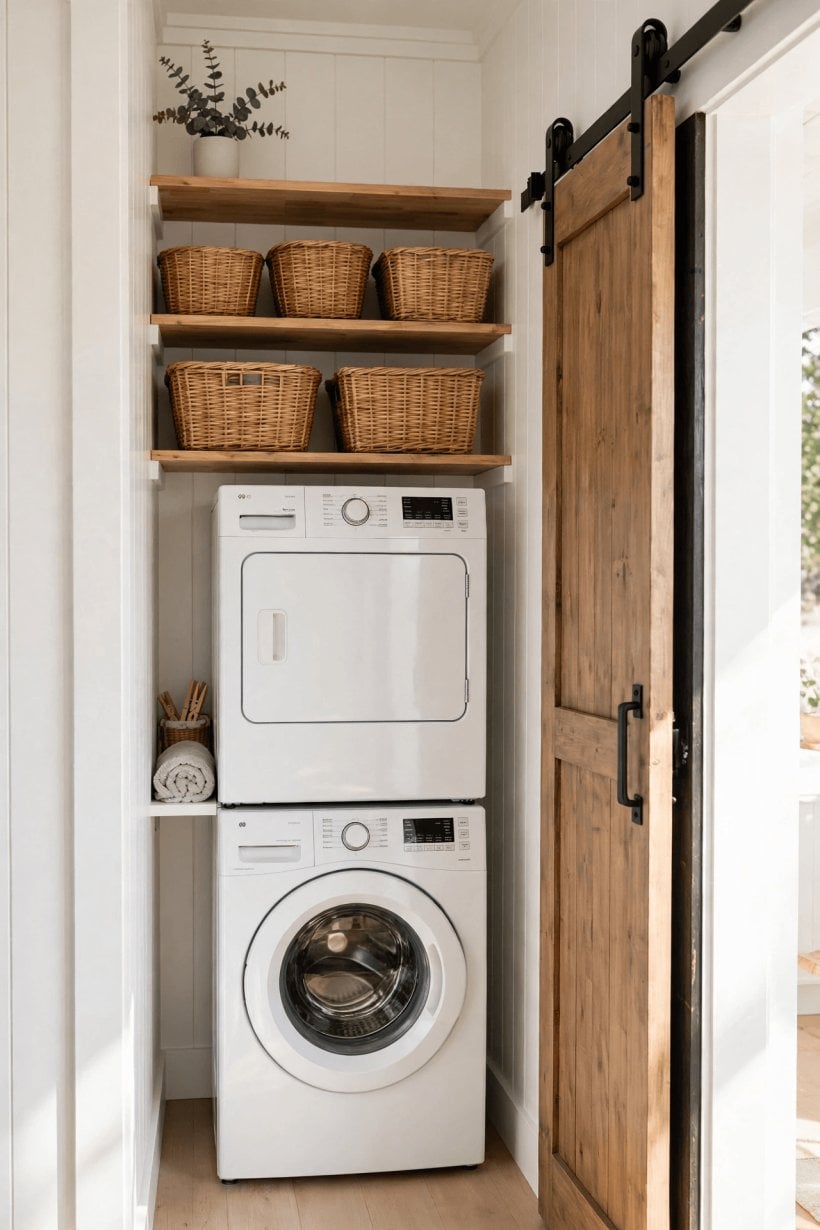
Idea 5: Stack Machines to Free the Floor
A stacked washer and dryer occupy one machine’s footprint and hand you back a whole wall or corner for shelves, a sink or sorting baskets. Use a proper stacking kit and keep the controls of the upper machine comfortably reachable.
Idea 6: Side-by-Side With a Counter Over
Front-loaders standing side by side accept a worktop across both, creating the folding counter most small laundries lack. The counter also stops socks and coins vanishing down the gap between machines — a small daily mercy.
Idea 7: Raise Machines on a Plinth Drawer
Pedestal drawers under each machine lift drums to a kinder height and add a drawer per machine for detergents or linens. In a galley layout this is often the only “cabinet” the room can hold, so choose sturdy ones.
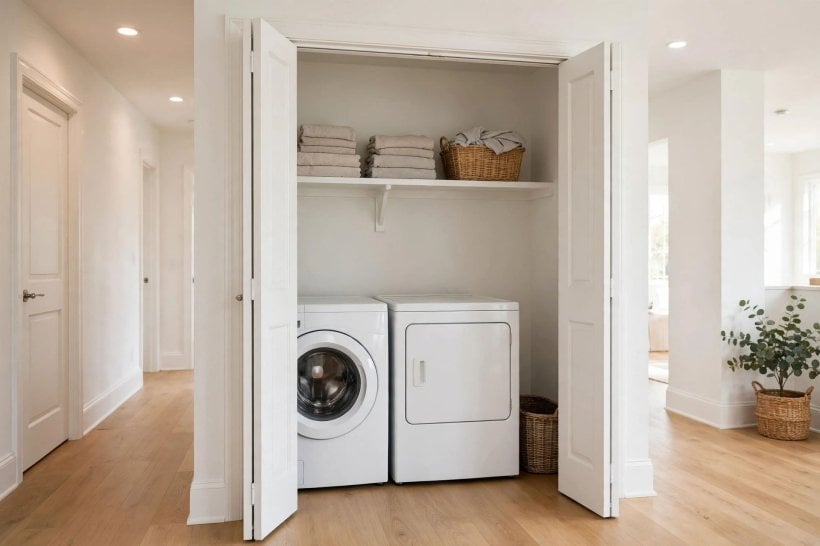
Idea 8: Hide Machines Behind Doors
Bifold, sliding or cabinet-style doors let a laundry closet disappear into a hallway or bathroom when guests arrive. Ventilation matters: louvered doors or a vented panel keep air moving so the closet never smells musty.
3. Counters and Folding Stations That Earn Their Space
Folding where the machines are — instead of hauling baskets to a bed — is the habit that keeps laundry from colonising the house. A small room can still offer a fold zone if the surface multitasks.
Idea 9: A Flip-Down Folding Shelf
A hinged shelf on the wall folds flat when you need the floor and drops down when the dryer finishes. Fit it at comfortable standing height and it becomes the room’s hardest-working thirty centimetres.
Idea 10: A Counter That Bridges Sink and Machines
One continuous surface from sink across machines reads as a proper worktop and wipes clean in a single pass. Leave a cut-out or removable section above machine hoses so servicing never means demolishing your counter.
Idea 11: A Rolling Cart as a Mobile Counter
A slim trolley parks in the gap beside machines and rolls out as extra surface, storage or a laundry-sorting station. In the smallest rooms, furniture that moves beats furniture that merely fits.
Idea 12: Fold on a Door-Mounted Ironing Board
A fold-down ironing board mounted inside a cabinet or on the back of a door removes the freestanding board that eats small rooms. Between uses it vanishes; during use it doubles as a pressing and folding surface.
4. Shelves, Cabinets and Wall Storage
Vertical space is the small laundry’s real estate. Walls above machines and doors hold more than most floors do — the craft is mixing closed storage for clutter with open shelves for the things you grab daily.
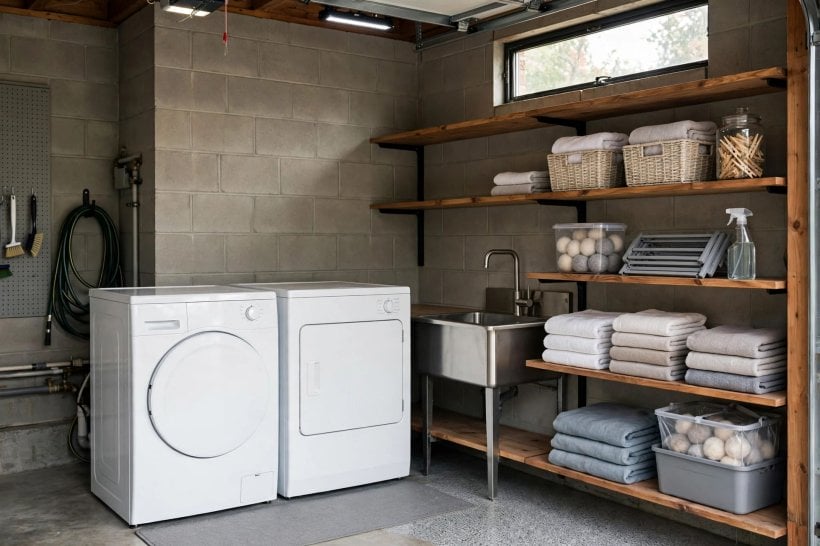
Idea 13: One Deep Shelf Above the Machines
A single shelf running the wall’s width above the machines holds baskets of supplies in one tidy row. Keep everyday items at the front edge so nothing requires a stool on a busy morning.
Idea 14: Closed Cabinets for the Ugly Essentials
Detergent refills, stain treatments and cleaning chemicals look calmer behind doors. Reserve at least one closed cabinet; visual quiet in a tiny room is worth as much as extra capacity.
Idea 15: Use the Space Above the Door
The strip above the doorframe fits a shallow shelf for rarely used items — bulk refills, seasonal linens, the good iron. It is pure found space, and small rooms cannot afford to waste any.
Idea 16: Rails, Hooks and Peg Strips
A wall rail with hooks holds brushes, dustpans, a hand towel and the mesh bag for delicates — all off the counter, all visible. Peg strips let you rearrange the line-up as your routine changes.
5. Hanging and Drying Solutions
Air-drying saves energy and keeps clothes alive longer, but racks devour floor space. Small laundries dry upwards, outwards or behind doors — anywhere the laundry can hang without becoming an obstacle course.

Idea 17: A Ceiling-Mounted Pulley Airer
A traditional pulley rack hoists washing up to the warm air near the ceiling and out of everyone’s way. It is the classic solution for small homes because the drying zone simply leaves the floor plan.
Idea 18: Pull-Out or Folding Wall Racks
Concertina racks screw to the wall, pull out for a load of delicates and fold flat to a few centimetres afterwards. Fit one beside the machines so drips land where drips belong.
Idea 19: A Hanging Rail Under a Shelf
A short rail under a high shelf gives shirts and dresses a place to drip-dry and de-crease straight from the drum. Add a row of spare hangers living permanently on the rail, ready for washday.
Idea 20: Over-Door Hangers for Small Items
Hooks and racks on the back of the door hold socks-and-smalls airers, the ironing pile or tomorrow’s outfits. Door backs are storage walls that happen to move — use them like it.
6. Sinks, Sorting and Basket Systems
Sorting is where small laundries succeed or dissolve into one grey mountain of clothes. Give every category a container, keep the containers at the point of use, and the system will run itself.

Idea 21: Divided Hampers for Pre-Sorting
A two- or three-section hamper — lights, darks, delicates — means washday starts with loading, not archaeology. Slim divided hampers exist for the narrowest gaps between machine and wall.
Idea 22: Baskets on Shelves, One per Person
Assign each household member a labelled basket for folded clean laundry. Distribution becomes a grab-and-go shelf, and the “whose is this” pile on the stairs quietly disappears.
Idea 23: A Soaking Bucket That Lives in the Sink
Keep a dedicated bucket or basin in the utility sink for stain soaks, so treatment starts the moment the garment arrives. A lidded version keeps soaking private in a laundry that doubles as a guest bathroom.
Idea 24: Decant Supplies Into Labelled Jars
Powders and pods decanted into clear, labelled jars or canisters look orderly, stack neatly and show levels at a glance. Keep the original safety information with them and store everything out of children’s reach as labelled.
7. Doors, Lighting and Ventilation
Small laundries are often windowless interior rooms, which makes the unglamorous trio — doors that don’t fight you, light you can sort colours by, and air that keeps moving — genuinely important.

Idea 25: Swap a Swing Door for a Slider or Pocket Door
A hinged door’s swing can consume the very floor you need for baskets and bending. Sliding, pocket or bifold doors return that space to the room and remove the daily door-versus-basket collision.
Idea 26: Bright, Colour-True Task Lighting
Fit a bright ceiling light plus a strip under shelves or cabinets so the folding surface has no shadows. Good light is how you spot the stain before the wash, not after the tumble dry.
Idea 27: Ventilate Like You Mean It
An extractor fan, a vented door or a small window prevents the damp, musty smell that plagues interior laundries and protects the room from humidity. Run the fan during and after drying loads.
Idea 28: A Mirror or Gloss Surfaces to Bounce Light
In a windowless nook, a mirror, glass-fronted cabinet or glossy tiles multiply the light you have and make the room feel less like a cupboard. Borrow the trick from small bathrooms; it works just as well here.
Light and air matter in every compact room; our modern tiny house interior ideas show the same principles in living spaces.
8. Colour, Tile and Making It Pretty
A utility room used daily deserves the same design care as any other. Small square footage means bold choices cost little and change everything — this is the safest room in the house to experiment in.
Idea 29: One Joyful Wall Colour or Wallpaper
Paint the back wall, or paper it, in a colour that makes you smile on a Monday morning. Because the room is tiny, even a dramatic shade reads as a jewel-box moment rather than a commitment.
Idea 30: A Tile Splashback With Pattern
Patterned tiles behind the sink and machines protect the wall and supply the room’s personality in one wipeable surface. A small area means a premium tile stays within a modest budget.
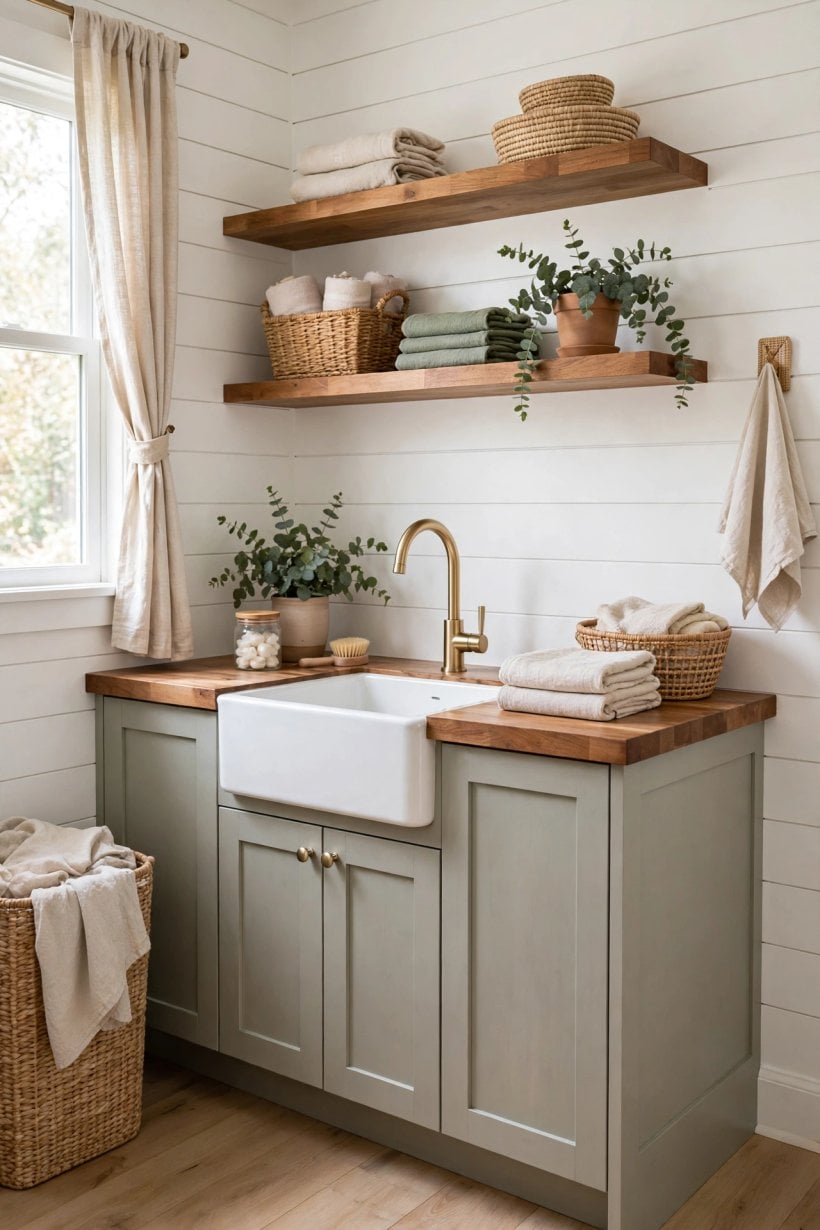
Idea 31: Matching Baskets and Containers
Storage that matches — one material, one colour family — instantly makes open shelves look designed instead of accumulated. Woven, enamel or simple white: pick a lane and let everything in it match.
Idea 32: Art, a Plant and a Good Rug Runner
Finish the room like a room: a framed print, a plant that tolerates humidity, and a washable runner softening the floor. These touches cost little and repay you every single washday.
9. Laundry-Mudroom Combos and Multi-Use Tricks
Many small laundries share their footprint with a back door, coats and boots. Designed as one system — wet things near the door, washing at the back — the double-duty room works harder than either would alone.

Idea 33: A Bench With Boot Storage by the Door
A sit-down bench with shoe cubbies beneath catches mudroom chaos at the threshold, keeping it out of the laundry zone. The bench top doubles as a folding overflow surface on big wash days.
Idea 34: Hooks Row for Coats, Bags and Robes
A run of sturdy hooks handles coats and school bags — and gives bathrobes and gym kits a home between washes. Place the row on the door side of the room so outdoor gear never crosses the clean-laundry zone.
Idea 35: A Pet Shower or Boot Tray Corner
If plumbing allows, a low handheld shower or even a deep tray by the door rinses paws and boots before dirt reaches the machines. In muddy seasons this single corner saves the whole room.
Idea 36: Curtain Off the Machine Wall
In a shared room, a ceiling-track curtain hides machines and shelves when the space is in mudroom or guest mode. Choose a washable fabric in the room’s colour story and the disguise looks deliberate.
Shared utility spaces suit rural living especially well; see our tiny barn house interior ideas for workhorse rooms with style.
10. Habits, Safety and Keeping It Working
The best-designed small laundry still fails without small habits: clear filters, reachable valves and a routine that stops piles forming. Build these into the room and the weekly wash stays a task, not an event.
Idea 37: Keep Access to Valves and Filters Clear
Never bury water shut-off valves, drain filters or the machine plugs behind fixed joinery. A removable panel or a gap you can actually reach turns a leak from a disaster into an inconvenience.
Idea 38: A Lint and Lost-Sock Station
A tiny bin for lint and pocket debris, plus a clip line or basket for single socks awaiting partners, keeps small annoyances contained. It sounds trivial; it saves tempers weekly.
Idea 39: A Weekly Reset Shelf Check
Once a week, return strays, wipe the counter and check detergent levels before they run out mid-load. Five minutes of reset keeps the small room’s system — and its calm — intact.
Idea 40: Store Chemicals High, Locked and Labelled
Keep all laundry chemicals on a high shelf or in a latched cabinet, in labelled containers, away from children and pets. In a multi-use room this rule outranks every styling idea in this list.
Final Considerations
Start with the layout your space shape dictates, spend first on the practical bones — machine arrangement, one real folding surface, ventilation and light — and let storage go vertical before it goes anywhere else. Pretty finishes come last and cost least in a small room, which is the happy economics of laundry design: phase the work, live with each stage, and adjust. Costs stay mostly modest — shelving, rails, baskets and paint — with machines and plumbing as the only big-ticket items, so get quotes before moving any water lines. For more hard-working small rooms, explore our tiny house home office ideas and colourful tiny house interior ideas next.


0 Comments