

A rug is the biggest thing in a room that arrives as a photograph. You choose it from a screen, it turns up rolled at the door, and only then — feet on it, daylight on it — do you learn what you bought.
This guide is the question list for buying a rug online: what to ask before ordering, on the day it arrives, and while it settles — asked in that order, while every answer can still change the decision.
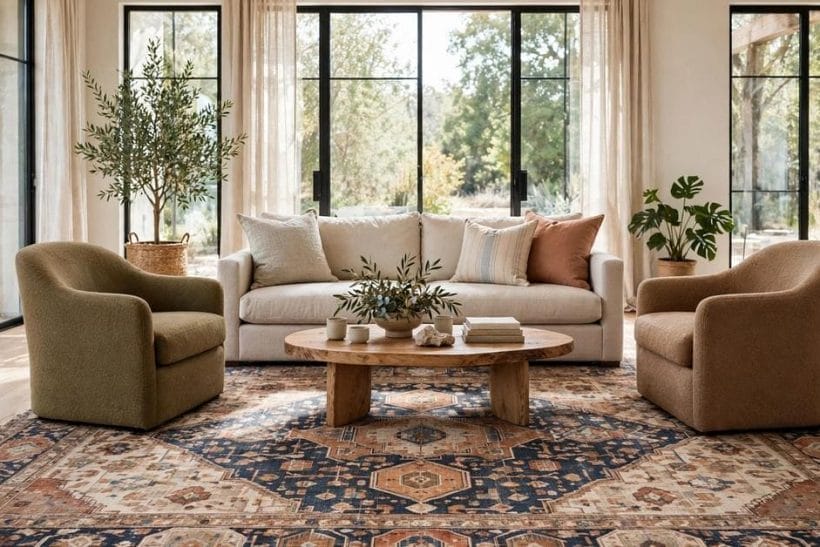
1. Buying a Rug Online at a Glance
Ask the questions in the wrong order and even a good rug can feel like a mistake: the size queried after it arrives, the colour trusted to a screen, the way out considered only once the rug is unrolled. Asked in the right order, the same questions make buying a rug online a calm, staged decision. If you would rather follow the same ground as a sequence of checks in order, the companion is the ordered-checks companion guide, which runs those checks step by step; this post keeps the questions, arranged by the moment each one matters.
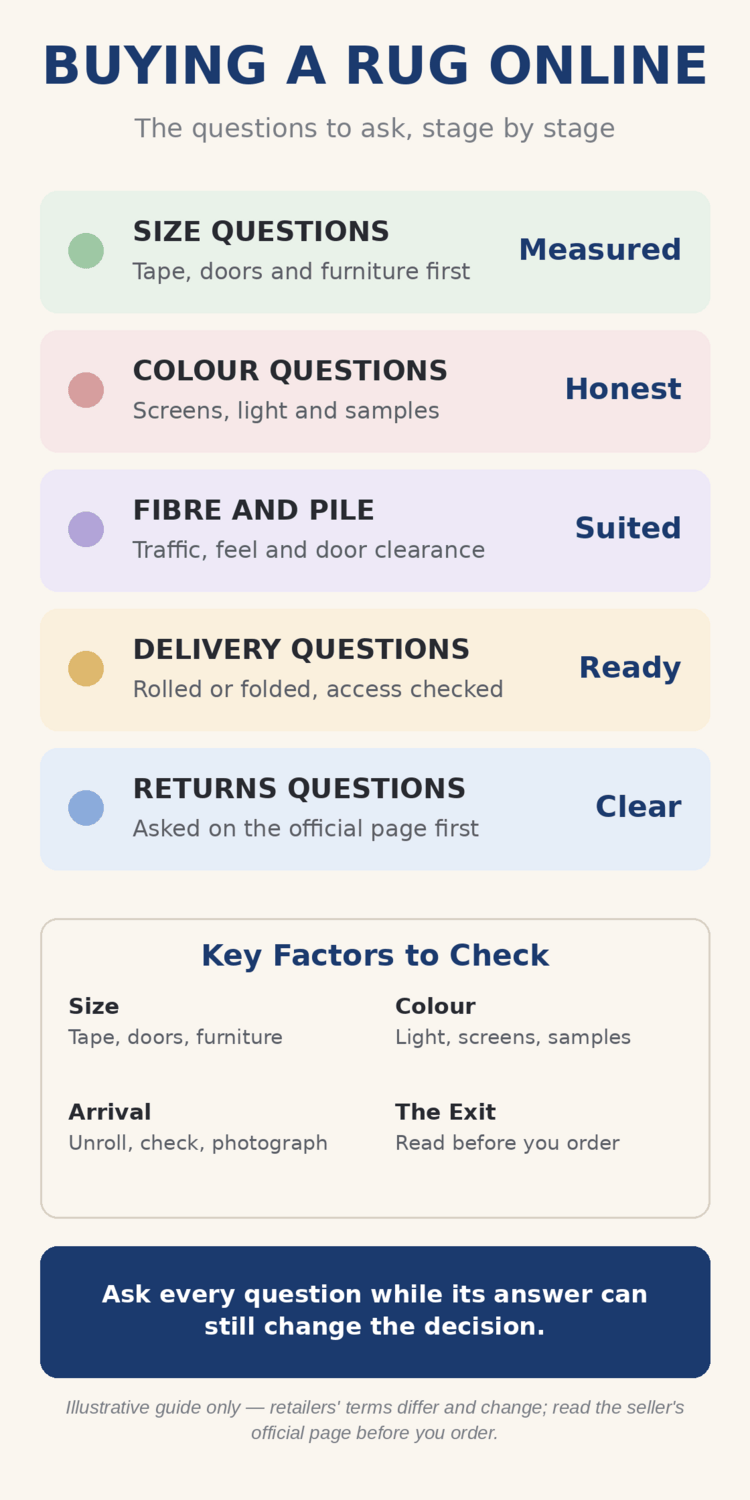
The five families in the table below are the whole method in miniature. Size and colour come first because they are settled in your room, not on a product page; fibre, delivery and the way out come next because they are settled on the seller’s pages, in writing, before the order is placed.
| Family | Character | What it means |
|---|---|---|
| Size Questions | Tape, doors and furniture first | Measured |
| Colour Questions | Screens, light and samples | Honest |
| Fibre and Pile | Traffic, feel and door clearance | Suited |
| Delivery Questions | Rolled or folded, access checked | Ready |
| Returns Questions | Asked on the official page first | Clear |
One honest note before the questions begin: sellers set their own arrangements, those arrangements differ from one another, and they change. This guide therefore states none of them. Where a question can only be answered from the seller’s own page, the guide says so and sends you there, while the answer can still change what you do.
2. Size Questions to Settle Before Ordering
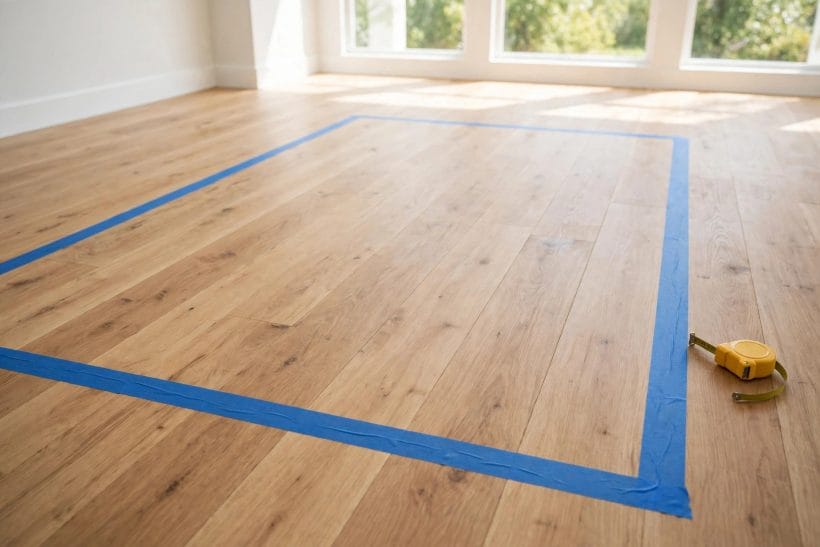
Every size question is asked in the room, with a tape measure, before a single product page is opened. The photograph shows the method: a rug that exists elsewhere only as numbers is drawn at full size on your own floor first, and the room answers honestly.
Have You Taped the Outline on the Floor?
Mark the candidate size with painter’s tape and live around it for a day. Walk the usual routes, sit in the usual chairs, watch where feet actually land. Tape reveals what listed dimensions cannot: whether the rug crosses a walkway awkwardly, crowds a doorway, or leaves the seating grouping looking stranded in the middle of the floor.
Where Do the Furniture Legs Fall?
Decide the arrangement before the size. Do the front legs of the sofa and chairs sit on the rug, gathering the grouping, or does the rug float clear of all of them? Both can work; a rug that nearly reaches and then stops satisfies neither. Measure the grouping as it will stand, not as it stands today.
Does the Door Still Swing Clear?
Open every door that crosses the taped outline and watch its path. A rug plus its underlay sits higher than bare floor, and a door that grazes the pile will announce itself daily. If the swing and the outline argue, the outline moves or the size changes — a question settled with tape, not after delivery.
3. Colour Questions: What the Screen Cannot Tell You
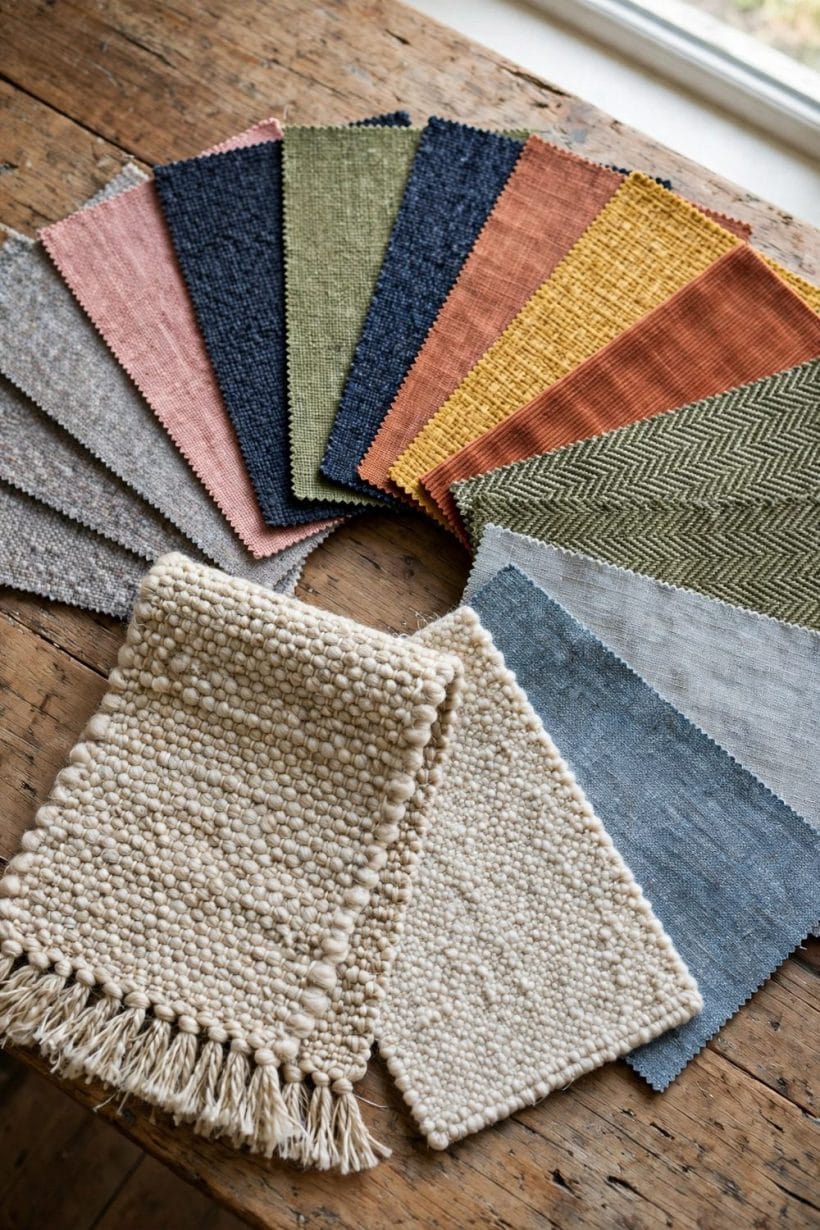
Colour is the question screens answer worst and buyers trust most. The swatches in the photograph are the honest alternative: small, physical pieces of the thing itself, read in your own light before the large version is ordered.
How Honest Is the Screen in Front of You?
Every screen renders colour differently, product photographs are lit by professionals, and a pile changes its apparent shade as it leans towards or away from the light. Treat the photograph as an approximation and the seller’s written description of the colour family as the steadier guide — then ask what else can confirm it.
What Light Does Your Room Actually Give?
A rug lives under your light, not the studio’s. A north-facing room cools colours, a sunny room warms and fades them, and evening lamplight yellows everything it touches. Judge any sample at the hours the room is most used, in daylight and after dark, before trusting what you see.
Can You Order a Sample First?
Where a sample or swatch is offered, ask for it before the rug itself. Held against the floor, the sofa fabric and the wall colour — the fixed points the rug must live with — a small square settles in an afternoon what a full-size delivery would take far longer to argue about.
4. Fibre and Pile Questions for the Room It Must Serve
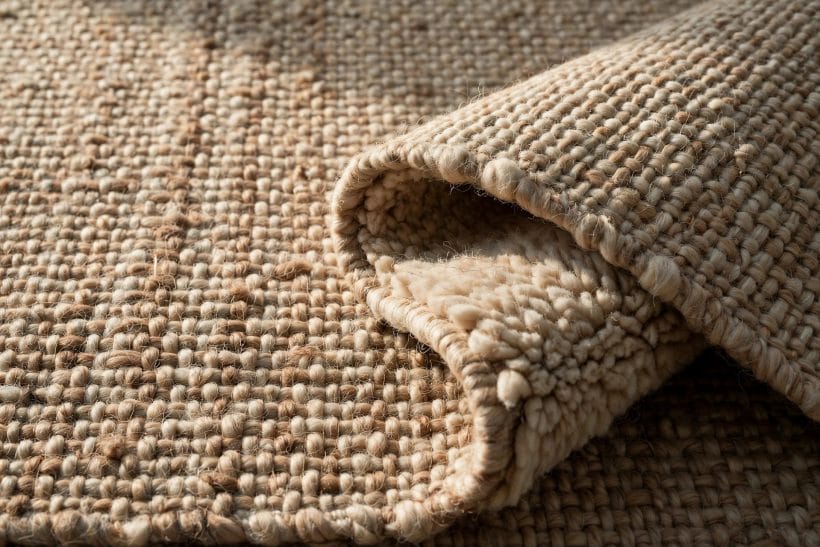
Beneath the colour, a rug is fibre and pile, and the right questions about them follow the room: who walks there, what lands there, and what the rug must shrug off daily. The close view in the photograph is where those answers live, in the weave itself.
Which Fibre Suits This Room’s Traffic?
Wool is the traditional rug fibre — resilient and forgiving under daily feet. Plant fibres such as jute and sisal give texture with less softness. Synthetic fibres are valued for easy care and steady colour. The question is never which fibre is best in the abstract, but which suits this room’s traffic and your tolerance for upkeep.
How Deep Is the Pile, and What Must It Clear?
A deep pile is a pleasure in a bedroom and a daily argument under a dining chair or a swinging door. Ask the pile height before ordering, and set it against door clearances, chair legs that must slide, and wheels that must roll. It is the detail most often skipped and most often regretted.
How Will It Feel Where Feet Actually Land?
A rug is walked on barefoot beside the bed, stood on at the sink of daily life in the hall, and gathered around in the sitting room. Ask where feet will actually land on yours, and whether the texture you are choosing is the one those places want — softness where it is lingered on, toughness where it is crossed.
5. Underlay Questions: What Goes Beneath the Rug
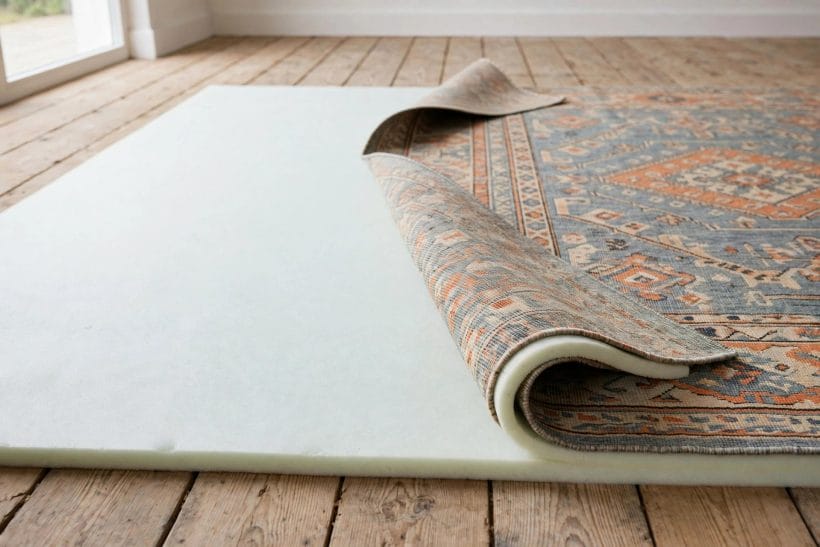
A rug is only half the surface; the other half is the floor it lies on and the layer between. The wider online flooring guide covers choosing floor coverings sight-unseen generally, and hard floors of the kinds treated in the vinyl flooring wear layer guide and the epoxy flooring ideas each meet a rug differently. The underlay questions check the pairing before the rug is on its way.
Does This Rug Need an Underlay at All?
On hard floors, most rugs benefit from one: it stops creeping, softens the feel underfoot, and protects both the rug’s backing and the floor beneath. Ask whether the seller recommends one for this rug on your floor type, rather than assuming the rug alone is the whole purchase.
Is the Underlay Right for Your Floor?
Underlays are not interchangeable. Some suit hard floors, some are kinder to polished surfaces, and heated floors ask their own question, since some backings and underlays are not recommended over heat. Ask the pairing question — this rug, this underlay, this floor — and let the seller’s guidance answer it.
Will the Added Thickness Cause a Problem?
An underlay lifts the rug. At a doorway that lift can meet a swinging door; at an edge it can become a small step feet catch on; under light furniture it can let a piece rock. None of these ends the idea — all of them belong in the questions asked before the order, not after the unrolling.
6. Delivery Questions: How the Rug Reaches the Room
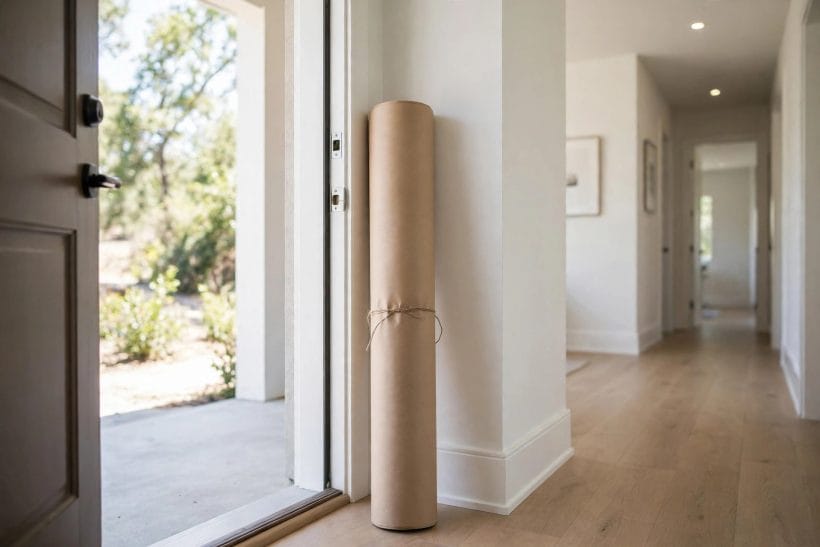
A large rug is a bulky, heavy parcel, and its journey is part of the purchase. The rolled rug in the photograph is how most arrive. The delivery questions are asked before ordering, because the answers shape the day — who is home, what help is needed, which route the rug will travel.
Will It Arrive Rolled or Folded?
Rugs travel rolled or, in some cases, folded, and the difference matters for what you should expect on unrolling: a rolled rug may curl at its ends, a folded one may carry crease lines. Both are journey effects that usually settle. Ask which way yours travels so the arrival surprises you less.
Who Brings It Into the House?
Ask where the delivery ends. Some rugs are left at the door; others are carried in. A large rug is heavier than its photograph suggests, and the difference between doorstep and room decides whether you need a second pair of hands at home that day. It is a small question with a heavy answer.
Can It Get Through Your Doors and Stairs?
Walk the route the rug will travel — front door, hall, any turn, any staircase — and ask whether its longest dimension makes every corner. Rooms are measured for rugs; routes rarely are. The buyer who tapes the room and forgets the hallway has answered only half the size questions.
7. Returns Questions to Read Before You Order
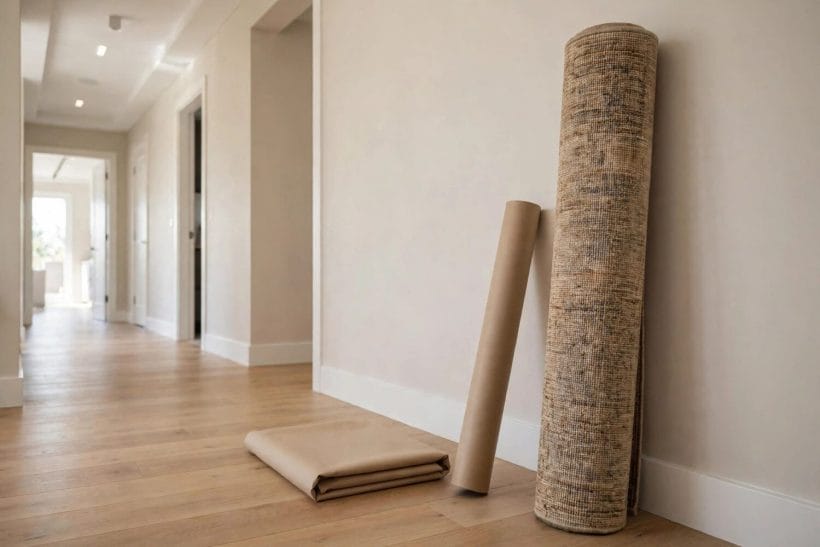
These are the only questions here that cannot be answered in your room. Their answers live on the seller’s official page, they belong to the seller, and they change — so they are set out exactly as you should put them there: as questions, read before you order, with the answers noted at the time.
Is a Change-of-Mind Return Offered at All?
Begin with the plainest question on the page: is returning the rug because you have changed your mind offered at all? Then ask whether the answer differs for sale items, for made-to-order pieces, and for rugs that have been unrolled and lived on. Do not assume; the page states it, and the page is the authority.
What Condition Must the Rug Be In?
Ask what state the rug must be in for the seller to accept it back. Must it be unused? May it have been opened and unrolled? May it have been tried in the room at all? These condition questions are the difference between a rug you may test fairly at home and one you must judge through its wrapping.
Who Arranges the Carriage, and How Long Does the Window Run?
Ask who arranges the return carriage of something this large, and who pays for that carriage. Ask how long the window for deciding runs, and from which day it is counted. Note every answer beside your order confirmation on the day you order — the answers that matter are the ones in force at purchase time.
8. On Delivery: Questions for the Same Day
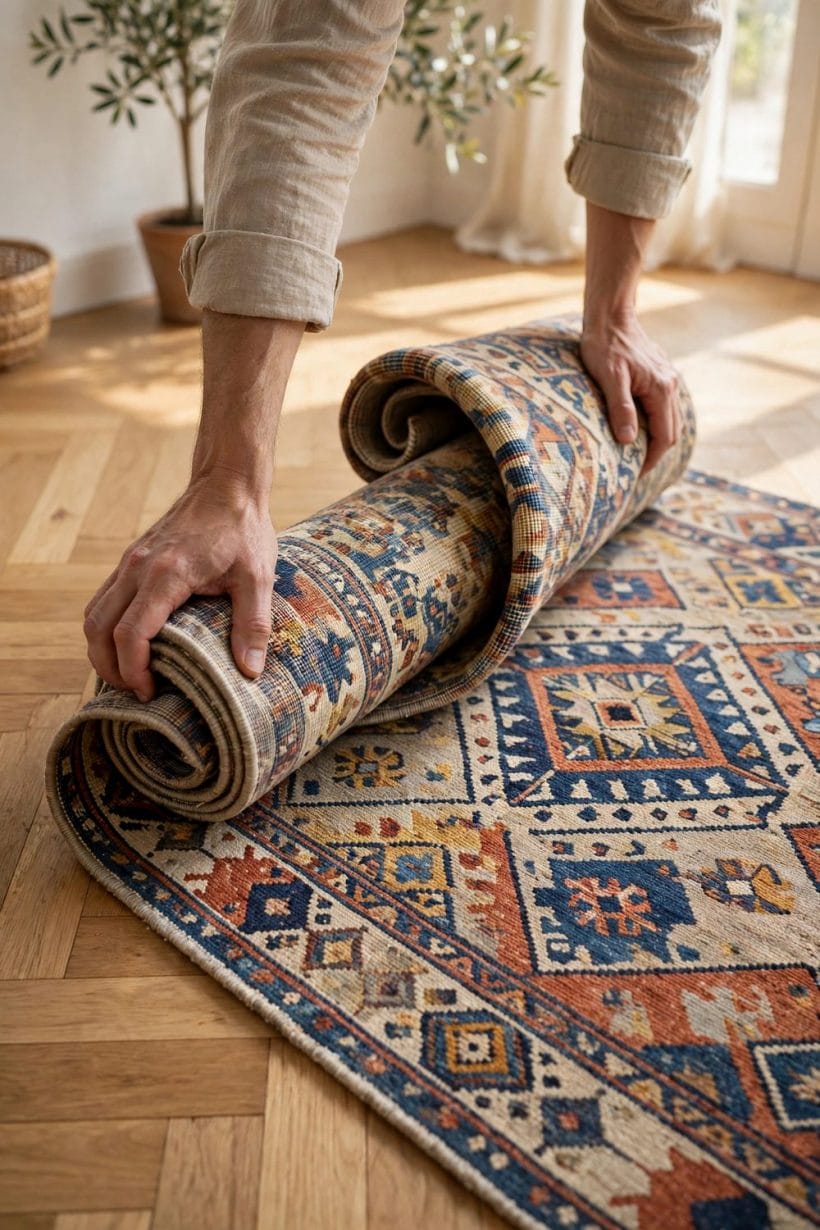
Delivery day has its own short list, and it is worked through on the day itself, while everything is fresh and photographed. The photograph shows the first act: the rug unrolled fully, in the room it was bought for, in the best light the day offers.
Have You Unrolled It Fully, Today?
Unroll the rug fully, in its own room, on the day it arrives — not half-opened in the hall, not left rolled until the weekend. A rug still curled at the edges has not yet shown you its size, its colour or its edges, and every later question depends on this one being answered first.
Does It Match, in Daylight?
Stand the delivered rug against the questions you asked with tape. Does its size match the outline you lived around? Does its colour, in honest daylight, match the sample and the description? Are its edges straight, its binding sound, its pile even? Daylight first; lamplight flatters faults and colours alike.
Have You Photographed Anything Wrong, Promptly?
If something is wrong — damage, a flaw in the pile, the wrong rug entirely — photograph it promptly and clearly: the fault close, the whole rug for context, the labels as they arrived. A prompt, dated photograph is the most useful thing you own in any later conversation with the seller.
9. First Days: Settling, Shedding and Fair Judgement
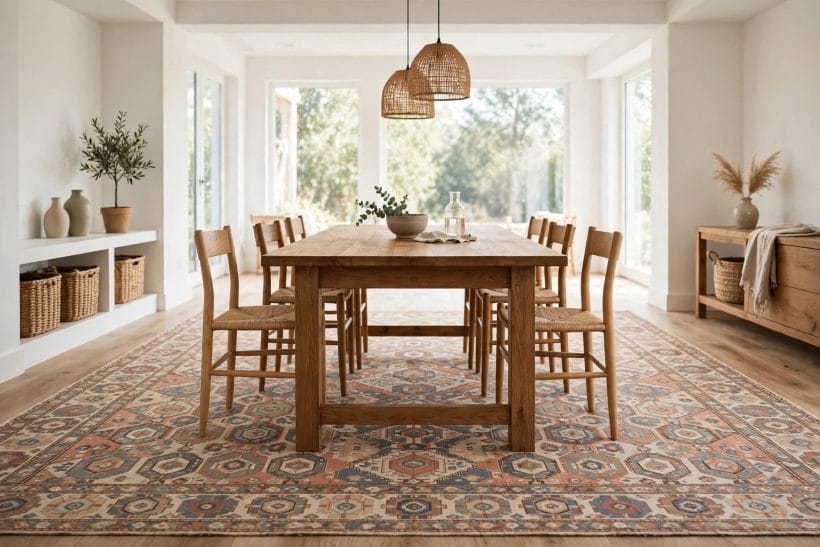
The first days ask for patience and a fair eye. A rug that has travelled rolled or folded needs ordinary life before it can be judged — walked on, sat around, vacuumed gently. The house’s other soft floors are judged the same way: the carpeted staircase ideas and the carpeted staircase alternatives alike earn their verdicts lived on, not at first glance.
Are the Creases Settling, Given Time?
Crease lines from folding and curled ends from rolling are journey effects, stated generally of new rugs: given days of ordinary use — walking, furniture standing where it will stand, gentle vacuuming — they usually relax. The question for the first days is not whether they are present, but whether they are visibly retreating.
Is the Shedding Settling Too?
New rugs commonly shed loose fibres at first, most noticeably where feet turn and chairs move. Stated generally, the shedding eases as the loose fibres leave and the pile settles into use. Gentle, regular vacuuming is the household’s part; alarm is not required while the amount is plainly falling week by week.
Is This a Fault, or a Settling Characteristic?
Natural and hand-finished rugs carry small irregularities — a slub in the weave, a slight shade shift, a fringe not machined straight. Those are characteristics of the type. A fault is something else: damage, a defect in the pile, or a rug that is not what was ordered. Your daylight photographs from delivery day are how the two are told apart.
10. Paperwork and the Final Questions
The last questions gather the purchase into a small, findable record and bring the decision to its close. None needs the screen or the shop — only the rug in its room, the packaging in its corner, and the notes made when the answers were fresh.
Have You Kept Everything Until the Decision Is Final?
Until the decision is made and the rug is simply yours, keep everything it arrived with — the wrapping, the tube or bag, the tags and labels. If the rug must travel again, its own packaging is the difference between a manageable task and an improvised one. It costs a corner of a room for a short while, and it keeps every option open meanwhile.
Is the Paperwork Together and Dated?
Keep the order confirmation, the photographs from delivery day, and your note of the answers you read on the seller’s official page at purchase time, together in one place. Every useful conversation about the rug begins with that small file — what was ordered, what the page stated that day, and what arrived.
Does the Room Look Better With It In?
Stand back in full daylight, the furniture in place, and ask the only question that finally matters: does the room look and feel better with this rug in it? Walk on it barefoot, pull the dining chairs in and out, live the ordinary evening. Decide fairly, on that evidence — and decide while the options you checked before ordering are still open to you.
Final Considerations
A rug bought online is judged in stages, and each stage has its questions: tape and doors before the order, fibre and samples at the screen, the seller’s own page for the questions only it can answer, daylight and photographs on the day, patience across the first days. The floor beneath keeps its own counsel — the laminate flooring cost guide treats one popular hard surface in full — but the rug’s questions end here.
If you want the same ground as a walk-through to follow step by step, the ordered-checks companion guide linked in the opening section runs it as a sequence; this post’s promise is narrower: that no question is asked after the moment when its answer could still help you. Ask them in stage order, note the answers, and let the large, soft, room-changing thing at your door become, within days, simply the floor of the room’s life.

0 Comments