

Every tiny house journey reaches the same unglamorous question: where will it park? A house on wheels can be built beautifully, financed sensibly, and insulated for winter, and still be homeless in the only sense that matters, with nowhere it is legal to sit and connect. That is why tiny house parking rental deserves to be treated as a housing search in its own right, with the same seriousness as buying the house itself: the spot determines your legality, your monthly costs, your commute, your mail, and how welcome you feel coming home at night.
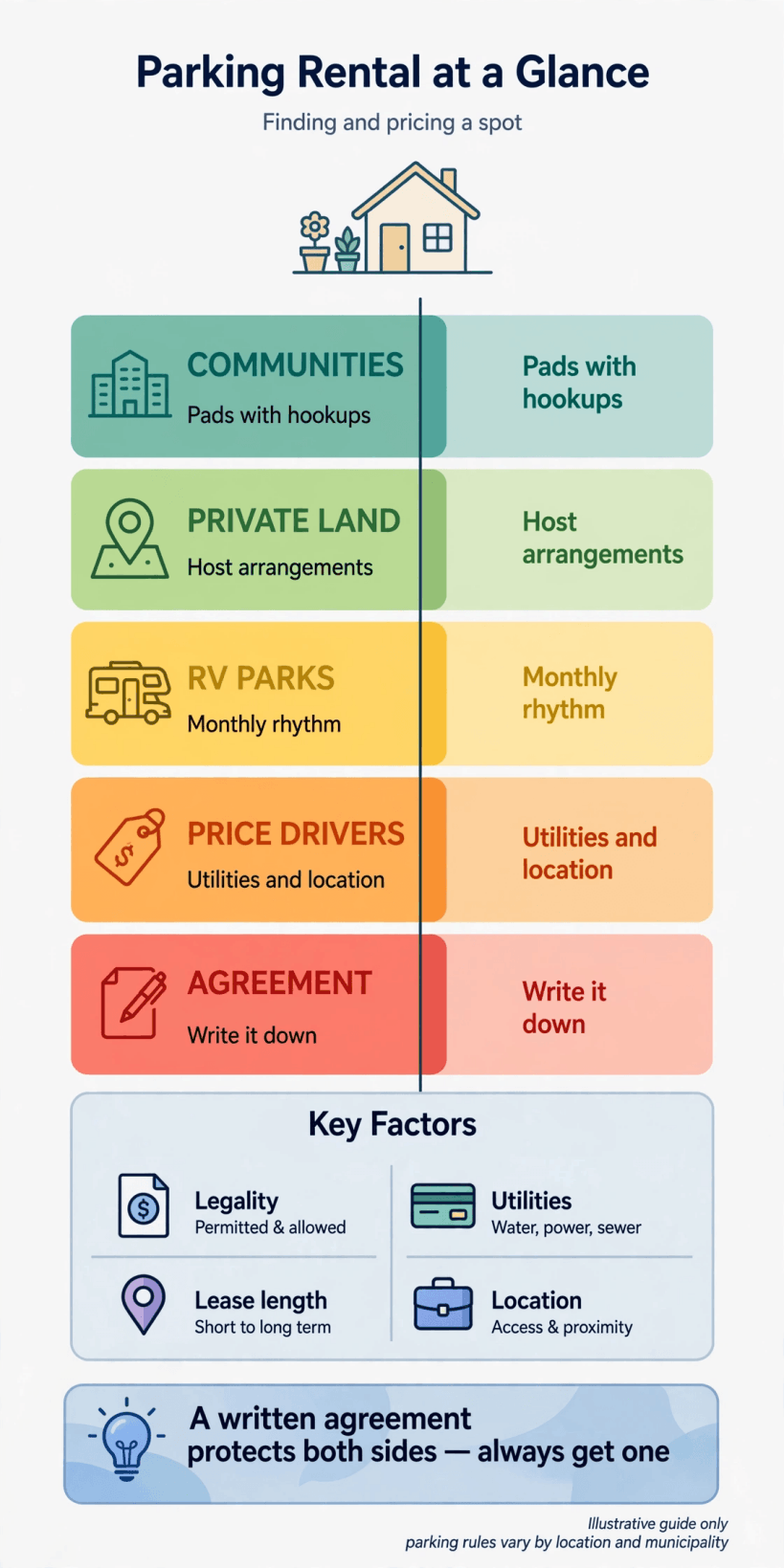
This guide covers the whole search end to end. It shows the three places rentable spots actually exist, in tiny house communities, on private hosts’ land, and in RV parks, then explains what really drives the price of a spot so you can judge value instead of guessing, the legality checks to run before you tow anything anywhere, and the written agreement essentials that protect both the person parking and the person providing the ground. No invented prices and no named parks, because spot costs are local and changeable; instead you get the pricing logic that works in any market.
At a Glance: The Three Kinds of Spot Compared
| Spot type | What you typically get | What drives its price | Watch out for |
|---|---|---|---|
| Tiny house community lot | A lot designed for a tiny home, usually with hookups and community rules | Location, amenities, and how established the community is | Waitlists, house standards, and lease length |
| Private host land | A backyard, side lot, or rural corner on someone’s property | What the host provides: pad, hookups, privacy, access | Legality of the placement and how informal the arrangement is |
| RV park long-stay site | A serviced site in a park that accepts extended stays | Season, region, and whether the park allows homes or only vehicles | Occupancy limits, age or certification rules, and seasonal closures |
1. The Three Places Parking Spots Actually Exist
Almost every legal tiny house parking spot on Earth belongs to one of three families. Tiny house communities exist specifically for small homes and rent lots inside a property whose permissions were arranged for exactly this use. Private hosts rent a piece of residential or rural land, a backyard corner, a side lot, a farm edge, where a single tiny house sits as a guest, a tenant, or an accessory unit. And RV parks rent serviced sites, some of which accept tiny houses for long stays under their vehicle rules. Every search you run will surface variations on these three, and recognising which family a listing belongs to tells you most of what to ask next.
The families differ in more than price. Communities sell legality, neighbours, and infrastructure as a package. Hosts sell flexibility and often the best locations, at the cost of informality. Parks sell services and simplicity, under rules written for travellers rather than residents. Keep all three in play while you search, because availability is local and lumpy: a town with no community may have wonderful hosts, and a county hostile to backyard placements may contain a park that welcomes tiny homes with open arms.
2. Tiny House Communities: The Simplest Legal Answer
A tiny house community is the closest thing to a turnkey answer. The community has done the zoning work once, for the whole property, and each lot inherits that legality, along with hookups, roads, and rules designed around small homes rather than adapted from something else. For a renter, that means the questions shrink to the lease itself: lot terms, what the rent includes, house standards your home must meet, and how long you may stay. It is no accident that communities are the first recommendation most tiny dwellers give each other.
The trade-offs are availability and conformity. Communities cluster where demand and permissive rules overlap, so your preferred town may not have one, and existing communities may run waitlists. Inside the fence, expect standards: skirting, maintenance, guest and vehicle rules, quiet hours, the ordinary machinery of shared living. Our tour of tiny house communities for seniors shows how one well-developed segment handles these arrangements, and the model generalises: read the community’s rules as a preview of your daily life, not as fine print.
3. Private Hosts: Backyards, Farms, and Side Lots
Private hosting is the quiet giant of tiny parking. A homeowner with a big backyard, a farmer with a serviced corner, a family with a side lot and a mortgage to offset: hosts rent land that was never advertised as a tiny house product, which is both the opportunity and the work. These spots can put you in established neighbourhoods no community serves, at terms negotiated person to person, and they can also be the most legally fragile arrangements in this guide if nobody checks whether the placement is allowed.
Find hosts the way you would find anything scarce and local: tiny house community groups, classifieds, word of mouth through builders and meetups, and direct, polite approaches to owners of obviously suitable land. Vet the human side as carefully as the physical side, because a host is a landlord and a neighbour in one person. And prepare the ground conversation early: level access, a pad or gravel, and utility reach decide whether a charming yard is actually a parking spot, which is why our guide on how to prepare land for a tiny house is as useful to renters evaluating a host’s land as it is to owners preparing their own.
4. RV Parks: Read the Long-Stay Fine Print
RV parks are the most visible option and the most misunderstood. A park that happily hosts your tiny house for a holiday week may prohibit it as a residence, cap stays at a set number of days, require the house to meet vehicle certification standards, or close seasonally, and each of those is a policy choice that varies park by park rather than a law of nature. The tiny house on wheels lives in the grey zone of park rules precisely because it is both vehicle and home, and the park decides which half it sees.
So ask parks the residential questions directly: Do you accept tiny houses, and under what certification or appearance standards? What is the longest stay, and can it renew? What does the long-stay rate include, and what happens to mail, guests, and winter hookups? Our comparison of tiny house communities vs RV parks digs into these contrasts in rules, costs, and culture, and it will sharpen your sense of when a park is a genuine home base and when it is a pleasant layover on the way to one.
5. What Drives the Price of a Spot
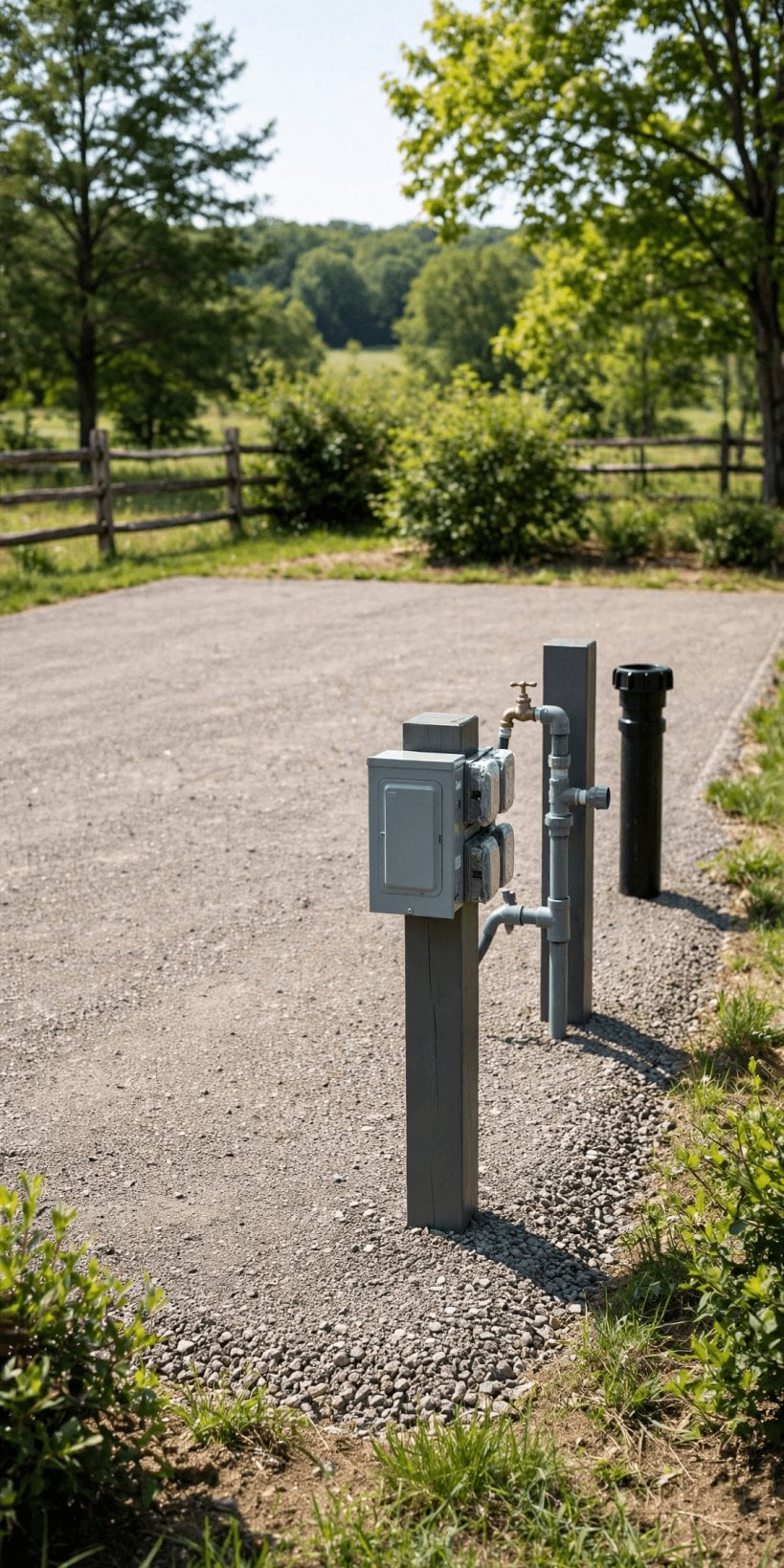
Spot prices look arbitrary until you unpack them, and then they are mostly five drivers wearing local clothes. Location is the first: land near jobs, cities, and coastlines costs more to rent a corner of, exactly as it costs more to buy. Hookups are the second: a spot with power, water, and sewer or septic costs more than a dry corner of a field, because the host paid to install and maintains that infrastructure. The third is what surrounds the pad, privacy, level hardstanding, storage, laundry, internet, shared spaces, which separate a serviced lot from a patch of grass with an extension lead.
The fourth driver is term and certainty: a spot you may occupy all year, with renewal rights, is worth more than one that evaporates each season, and both sides know it. The fifth is scarcity, the local balance between tiny houses hunting and spots offered, which is why identical setups price differently two counties apart. When you evaluate any asking price, score it driver by driver against the alternatives genuinely available to you, not against a spot you saw advertised in a cheaper state. Your real comparison set is local, and your real leverage is being a tenant who understands what they are paying for.
6. How to Price a Spot You Are Offering
The pricing logic runs both ways, and many readers of this guide are landowners wondering what their spare corner is worth. Price from the same five drivers: what your location supports, what your hookups cost you to provide, what the renter gets beyond the pad, the length and certainty of term you can honestly offer, and what comparable arrangements nearby, communities, parks, other hosts, actually charge. A spot priced with that arithmetic is defensible in conversation and sustainable over years, which matters, because a host who underprices quietly resents the arrangement and a host who overprices simply stays empty.
If you are building the spot rather than pricing an existing one, think like an operator from the start: legal placement first, hookup costs honestly totalled, rules written before the first tenant arrives. The organiser’s side of this world is covered in our guide on how to start your own tiny house community, and its zoning and business steps scale down surprisingly well to a single well-run host lot. A good host arrangement is a small business wearing a friendly face, and the friendship lasts longer when the business part is done properly.
7. Legality Checks Before You Tow
Before any spot, however friendly, however cheap, run the legality checks, because a rented spot is only as legal as the land under it. Confirm the property’s zoning allows the placement: an accessory dwelling pathway, a community or park use, or another permitted basis, and ask who confirmed it and when. Confirm occupancy: that a person may live in a tiny house there all year, not merely store or holiday in it, since vehicle-occupancy limits are the silent killer of informal arrangements. And confirm hookup legality, that the power, water, and waste arrangements meet local requirements rather than a neighbourly improvisation.
These questions have owners. The planning office owns the zoning answer, the health department the septic and water answer, and the host owns the duty to have asked both before taking your money. Our explainer on the IRC Appendix Q rules for tiny homes will help you understand the building-code side of the conversation. Treat vague answers as answers: a spot whose legality nobody can describe is a spot whose legality you are being asked to gamble on, and the stake in that gamble is your home.
8. The Written Agreement: Essentials That Protect Both Sides
However warm the handshake, put the arrangement in writing. A proper parking agreement names the parties and the exact spot, the term and how it renews, the rent, what it includes, and when it can change. It describes the hookups provided and who pays for utilities beyond them, the rules both sides live by, guests, vehicles, pets, noise, upkeep of the pad and surroundings, and what insurance each side carries. It states the notice period for either side to end the arrangement, and what happens to the house, the hookups, and any deposit when it ends. None of this is mistrust; it is the document that lets two friendly parties stay friendly when memories differ.
Two clauses deserve special care. The legality clause should record the basis on which the placement is permitted, so that if an authority ever questions the arrangement, the answer exists on paper rather than in recollection. And the exit clause should be realistic about physics: moving a tiny house takes time, transport, and a destination, as our tiny house moving guide makes clear, so notice periods should reflect the weeks a move actually takes, not the days a car lease allows. Sign two copies, keep yours with your house documents, and update the agreement when anything material changes.
9. Moving In: Setup, Hookups, and Neighbour-Proofing
Moving onto a spot is a small construction day. Plan the tow route and the turn into the space, check overhead clearance and ground softness before the day rather than during it, and set the house level, blocked, and skirted as your setup requires. Connect utilities in the right order and test everything while help is still standing there: water pressure and leaks, power load with your real appliances running, and the waste arrangement exactly as the agreement describes. Our tiny house utilities guide is the reference to have open during this work.
Then do the social setup, which matters as much. Introduce yourself to the neighbours your host cares about, learn the unwritten rules of the lane or the community, and secure the house as you would anywhere, using the measures in our guide on how to keep your tiny house safe. The first month on a spot sets its reputation, yours and the arrangement’s, and in the small world of tiny parking, reputation is the currency the next spot is bought with.
10. When to Walk Away: Red Flags and Exits
End where you began, with judgment. Walk away from a spot whose legality the host discourages you from checking, from agreements a host refuses to write down, from prices justified only by pressure, and from any arrangement whose term is shorter than the effort of moving in. Walk away, too, from your own wishful thinking: a spot that fails your commute, your winter, or your budget on paper will not improve with a house parked on it. The right spot is not the first spot; it is the first spot that survives your checklist.
Keep your exit in good repair even in a good spot. Know the notice you must give, keep the house tow-ready in the ways that matter, and keep a living list of alternative spots, because circumstances change on both sides of every agreement. Mobility is the tiny house’s founding promise, and a renter who can move is never trapped. That freedom, exercised calmly and rarely, is what turns parking from the movement’s hardest problem into just another part of the logistics of living small.
Final Considerations
Parking is housing. Search all three families of spot, communities, hosts, and parks; judge every price by its five drivers; verify legality with the offices that own the answers; and sign a written agreement that respects both the friendship and the physics. Do those four things and the question that haunts every tiny house buyer, where will it park, becomes the most solvable part of the whole project, answered not with luck but with a method you can reuse in every county you ever consider home.


0 Comments