

Some houses are dressed. Stone houses are built — and you can tell from the road, before the door, before the garden, in the way the walls sit in the ground like they were always there.
Seventy-five stone exteriors follow: the stones and cuts themselves, full facades and single accents, the classic pairings and style lanes, stone at tiny scale, and the keeping of it — the stone material lane only.
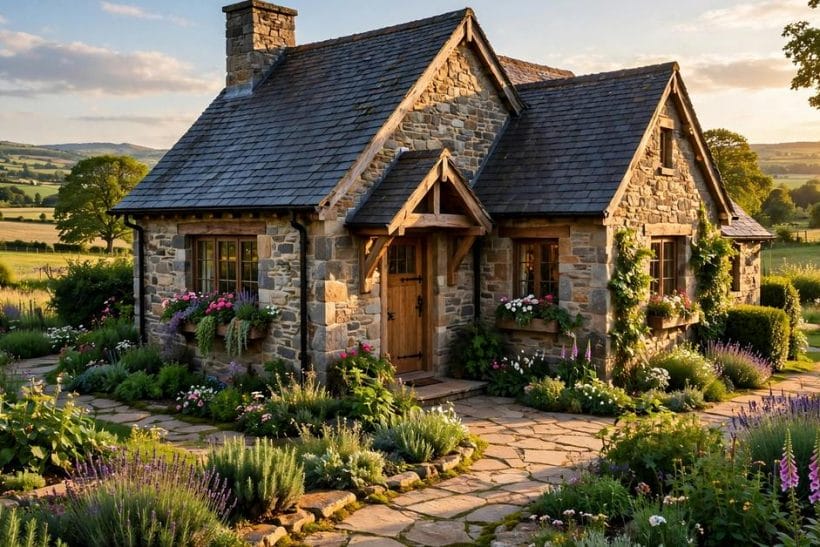
1. Beautiful Stone Houses at a Glance
The central entity is the stone exterior: a house whose outer walls — wholly or in decisive part — are stone or honest stone veneer, where the material itself, its type, cut, laying pattern and mortar, carries the architecture. Stone exteriors trade in permanence, thermal mass, texture and regional belonging; they ask for structural honesty, skilled masonry and correct detailing at every junction, all stated generally in this survey with the work itself left to masons, engineers and local rules. This post owns the stone material lane inside the wider exterior field surveyed by the exterior home ideas pillar, and it links the craftsman, modern, Mediterranean and colour lanes as their own posts without absorbing any of them.
| Question | Short answer |
|---|---|
| What defines a stone exterior? | Walls of stone — solid, veneer or accent — where the stone’s type, cut and mortar carry the design. |
| Which stones appear most? | Fieldstone, ashlar, ledgestone, limestone, sandstone and granite, plus honest veneers of real or manufactured stone. |
| Where is stone used if not everywhere? | At plinths, entries, porch piers, chimney breasts, quoins and one great garden-facing wall. |
| What does stone ask in return? | Structural planning, skilled masonry, compatible mortar and detailed water management — professional work throughout. |
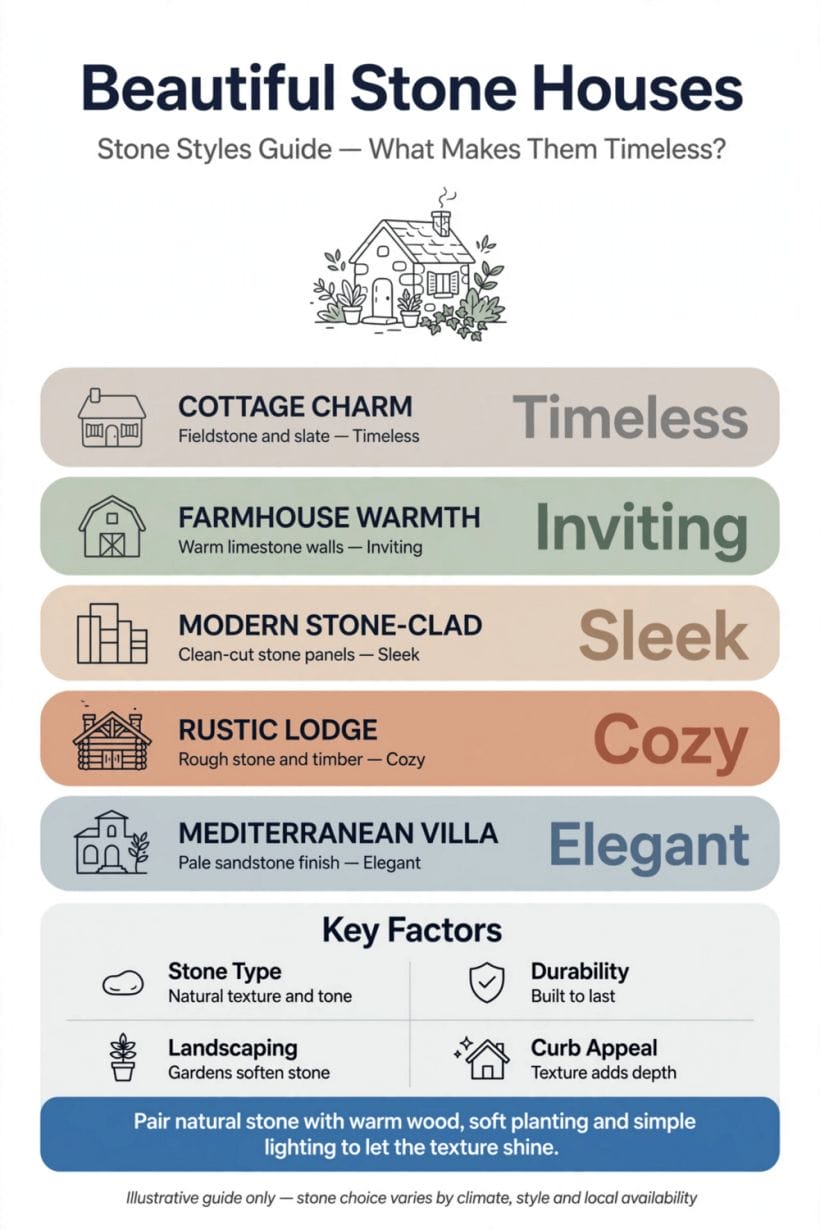
2. Stone Types and Cuts: Choosing the Material Itself
Every stone exterior begins as a material decision, and this survey stays on that decision throughout. The whole exterior field is surveyed by the exterior home ideas pillar; here the question is narrower and older: which stone, cut how, laid in what pattern — because the same house reads cottage, manor or mountain lodge purely from the mason’s choices.
1. Fieldstone, gathered and irregular
Rounded and varied stones laid as they come from field and quarry give the most settled, least formal wall — the house looks grown rather than built.
2. Ashlar: squared stone, calm courses
Stone cut into rectangles and laid in level courses reads architectural and quiet. It suits houses that want permanence without rusticity, and it pairs cleanly with painted timber windows and a simple roof line above it.
3. Ledgestone: thin horizontal layers
Narrow, stacked strips give a wall strong horizontal movement and a contemporary edge. The rhythm flatters long, low houses and ranch forms, and it needs careful corner work so the layers turn the building convincingly.
4. Rubble stone with generous mortar
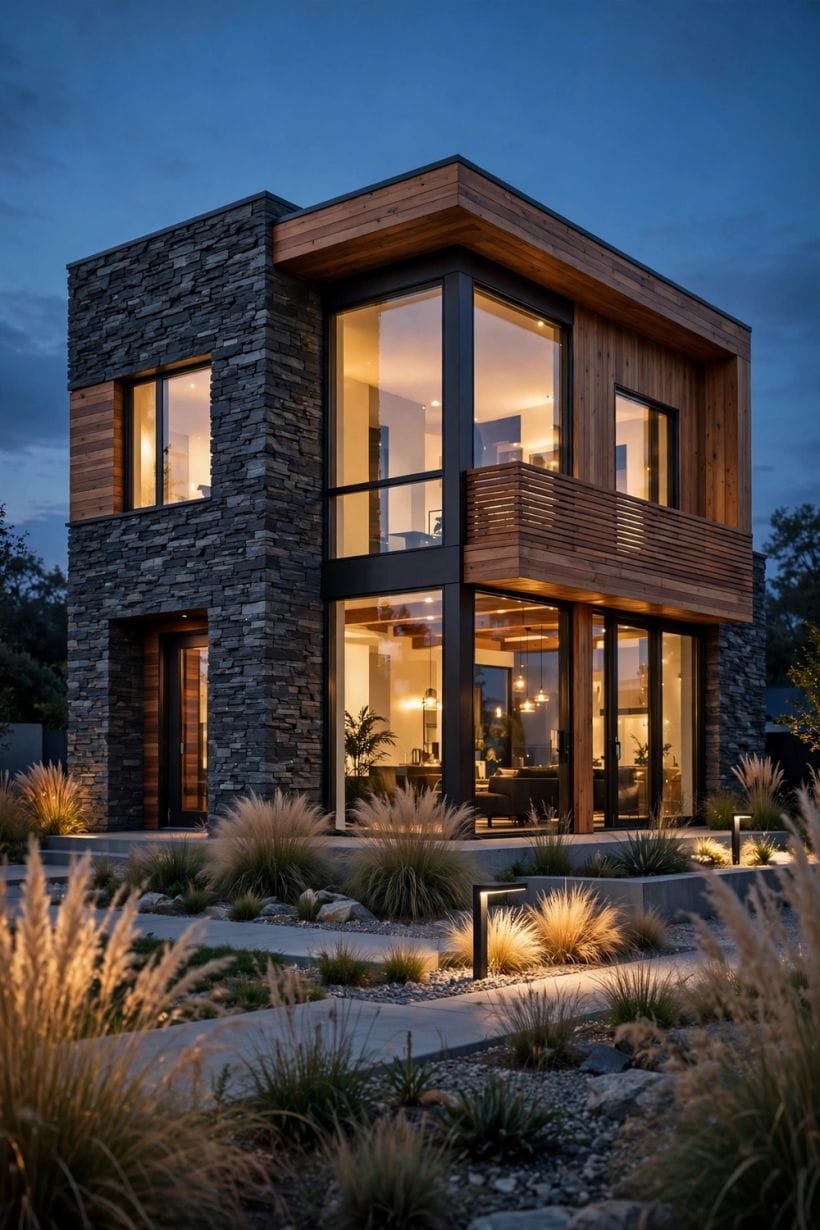
Rough pieces bedded deep in visible mortar make the soft, storybook wall of cottages and old farm buildings.
5. Dry-laid stone, no visible mortar
Stones fitted tightly with the joint recessed read as the oldest craft of all.
6. Stone veneer, honestly used
Thin real stone or manufactured pieces applied over a framed wall give the look at a fraction of the weight and depth.
7. Local stone, from the region’s own ground
Building in the stone the landscape already owns settles a house instantly: the wall colour is the field colour, the quarry colour, the colour of every old barn nearby.
8. Limestone: pale, even and formal
Pale, fine-grained limestone gives bright, formal facades that hold detail well around windows and doors. It weathers gently and evenly, which is why it fronts so many dignified town houses and garden pavilions.
9. Sandstone in warm bands
Sandstone’s warm buffs, pinks and rusts bring a glow no paint matches, and banded laying shows off its sedimentary stripes. It is softer stone, happiest where detailing is bold rather than fiddly.
10. Granite and hard dark stone
Dense, dark and nearly indestructible, granite reads as strength itself. Whole facades are rare and weighty; as plinths, lintels and the base course of a paler wall it anchors a house like a foundation made visible.
11. Mixed stone, sorted by size
Large stones low, smaller stones above, occasional long bond stones tying the wall together — the traditional sorting that makes mixed rubble look intentional.
3. Whole-House Stone: Full Facades, Gables and Roofs Above Stone
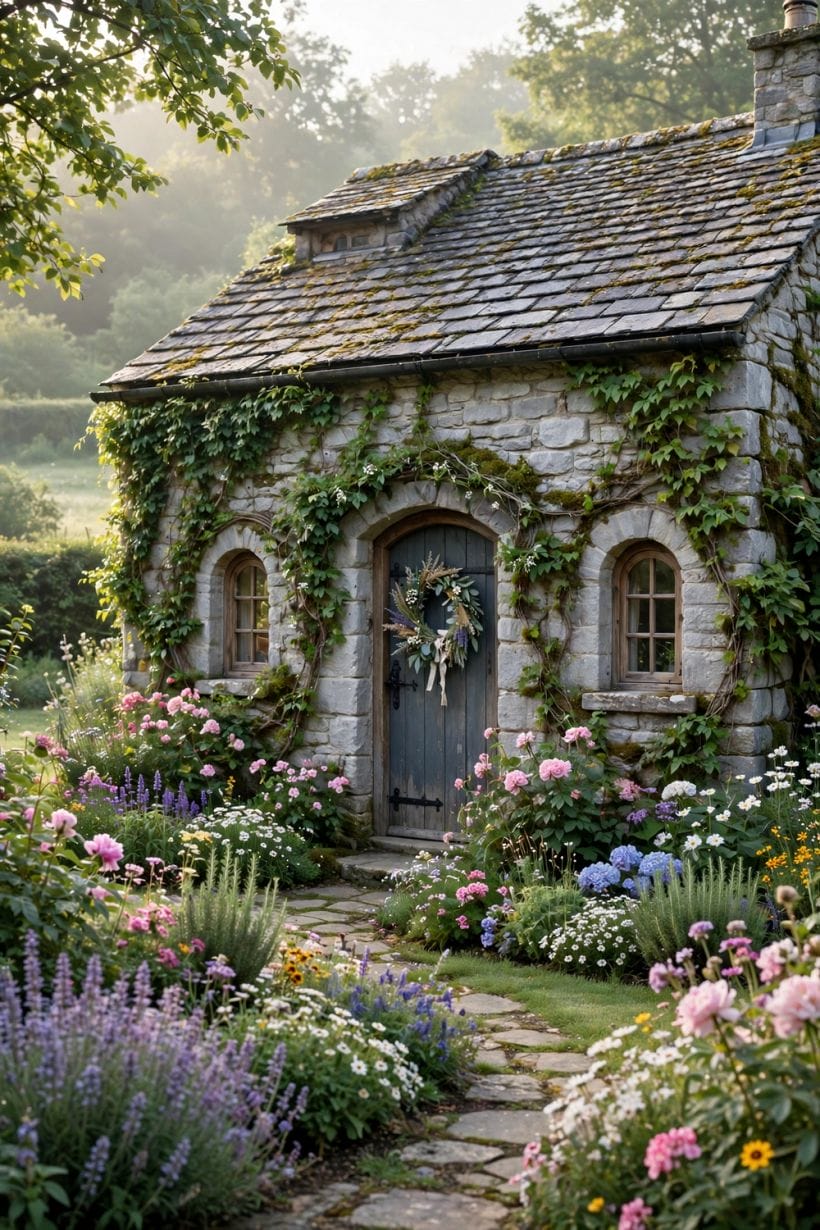
A full stone exterior is a commitment of weight, budget and character, and it rewards the houses that carry it plainly. The pillar survey of exterior home ideas covers every cladding family; this section stays inside the all-stone house and the few decisions — roof, openings, colour of mortar — that make it feel inevitable rather than applied.
12. The full stone facade, plainly detailed
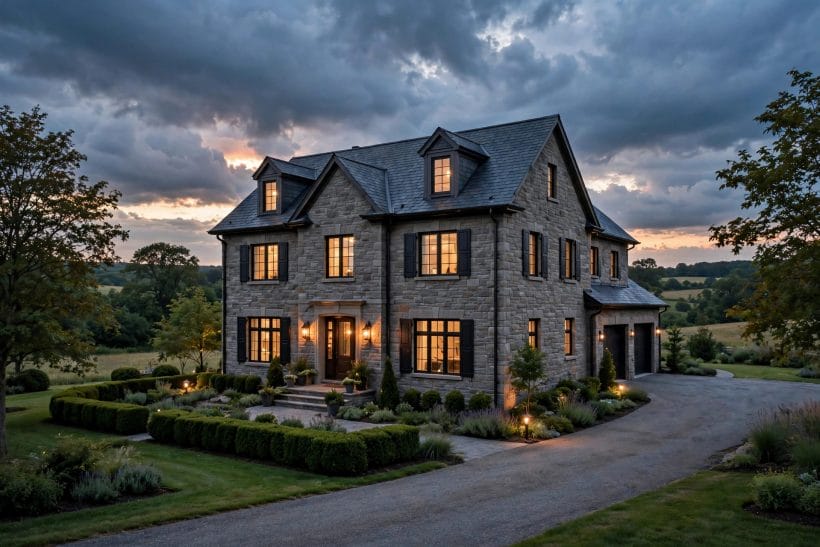
Stone on every wall, with simple window openings and a quiet roof, is the timeless register: nothing performs, everything lasts. Restraint in the details is what separates the farmhouse that has stood for generations from the themed replica.
13. Stone gables carried to the peak
Running stone up the gable to the ridge gives the roofline real weight and shelters the wall below.
14. A stone ground floor, lighter walls above
The old structural logic made beautiful: heavy stone below, timber or render above. It grounds tall houses, protects the most weather-beaten storey in the toughest material, and gives upper rooms a lighter, warmer face.
15. Stone around a deep-set entrance
Thick stone walls allow doorways recessed into genuine depth, shaded and sheltered. Even a veneer house can borrow the feeling with a stone porch surround that gives the entry shadow, weight and ceremony.
16. Mortar colour as the facade’s quiet decision
On a full stone house the mortar is a third of what you see.
17. Dark roofs over pale stone
Slate-grey and charcoal roofs over pale limestone or light rubble give the classic two-tone farmhouse read. The contrast sharpens the stonework and keeps a big roof from visually crushing the walls beneath it.
18. Warm roofs over warm stone
Terracotta, weathered cedar tones and soft browns over sandstone or warm fieldstone make the sun-baked, southern register. It is the palette of villages where stone and roof have always shared the same earth.
19. Stone and the big window wall
A largely glazed wall set into an otherwise stone house makes the contrast the design: ancient mass against modern transparency.
20. Extensions in matching stone
Adding to a stone house in its own stone — ideally from the same quarry or reclaimed nearby — keeps the building one organism.
21. Stone boundary walls continuing the house
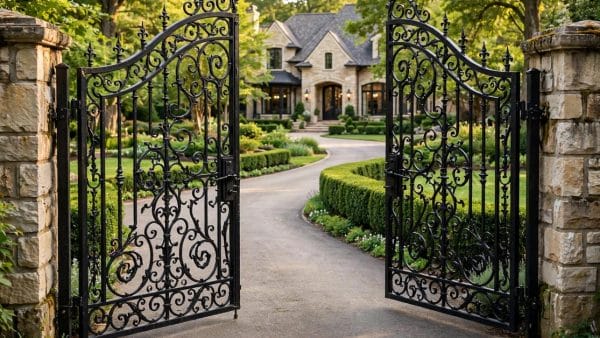
Carrying the house stone into the garden wall, gate piers and terrace edging makes the whole plot one composition. The house stops being an object in a garden and becomes the largest room of a stone-built place.
22. Weathering welcomed, not fought
Stone mellows: edges soften, lichens tint, rain streaks settle into pattern. Choose stone expecting its tenth year, not its first week — the houses in this survey that age best were designed for the patina from the start.
4. Stone as Accent: Entries, Plinths, Corners and One Great Wall
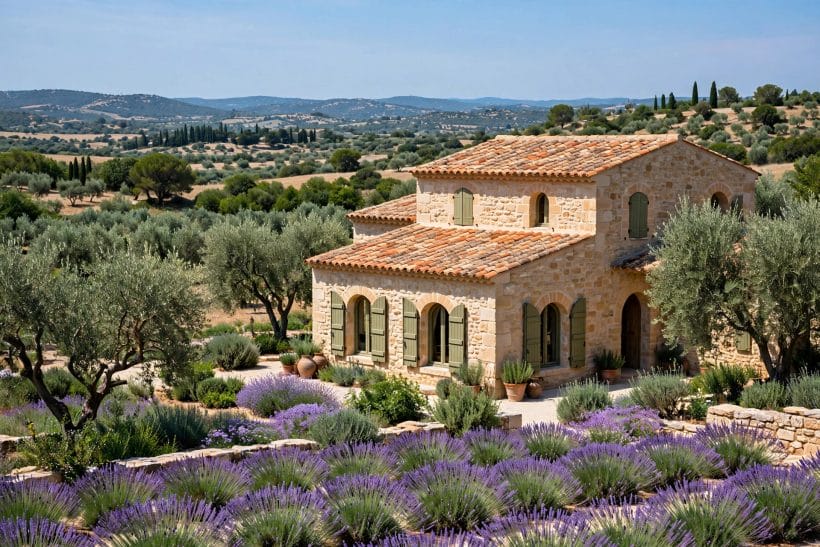
Most real houses use stone the way good cooks use salt — decisively, in the right places. An accent strategy buys stone’s permanence and texture where the eye and the weather land hardest, and leaves the budget for the rest of the house to be done properly.
23. The stone plinth: a house with its boots on
A stone base course lifts timber or render walls out of the splash zone and gives every house, however light, a grounded start.
24. Stone piers under a porch roof
Porch posts standing on stone piers gain the crafted, settled look that plain posts never achieve.
25. A stone chimney breast on the gable
One external chimney stack in stone gives a plain house a landmark and a hearth’s promise from the road. It is a single wall’s worth of masonry doing the work of a whole stone facade.
26. The one stone wall: garden side
Facing only the garden elevation in stone puts the material where the household actually lives, and lets the street side stay simpler.
27. Stone quoins at the corners
Large, squared stones alternating at the corners — quoins — frame a rendered or brick house with instant architecture. It is an accent with genuine structural ancestry, and it reads as craftsmanship from a hundred paces.
28. Stone window and door surrounds
Lintels, sills and architraves in cut stone sharpen plain openings the way a frame sharpens a picture. On a rendered house, pale stone dressings are the whole classical effect for a fraction of a stone wall’s cost.
29. Stone steps and a stone threshold
The most-touched, most-worn part of any exterior deserves the toughest material. Wide stone steps to the front door, worn slightly hollow over years, give a house the dignity of long use from its very first season.
30. A stone arch over the entry
A true arch — or an honest flat gauged lintel — in stone over the front door concentrates all the house’s ceremony into one opening. Keep everything around it plain and the single gesture carries the whole facade.
31. Stone panels between windows
On modern houses, stone used as flat panels in a grid of glass and render brings texture without rusticity. The panel must meet its neighbours cleanly; modern stone is a precision game, not a rustic one.
32. The stone garden wall the house leans on
A house wall extended into the garden as a stone retaining or boundary wall ties building to land. Terraced gardens against warm stone are among the most loved photographs in this whole survey.
33. Stone at the water’s edge
Where a house meets a pond, stream or pool, stone is the natural mediator — steps into water, a stone-edged terrace, a boulder bank.
5. Pairings: Stone with Timber, Brick, Metal and Render
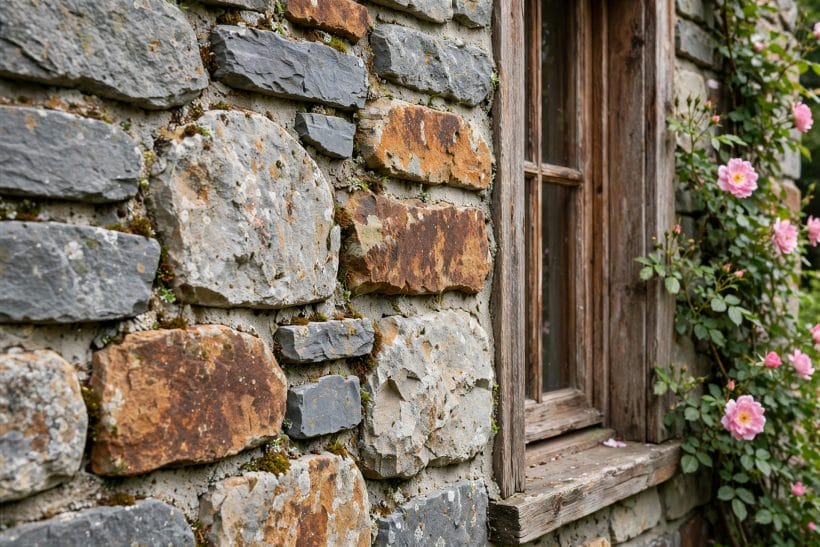
Stone rarely performs alone, and its partners decide the house’s temperature. This section reads the classic marriages — and the junctions between them, which are where paired-material houses succeed or quietly fail, and which belong, as all exterior junction work does, to professional builders.
34. Stone and dark timber framing
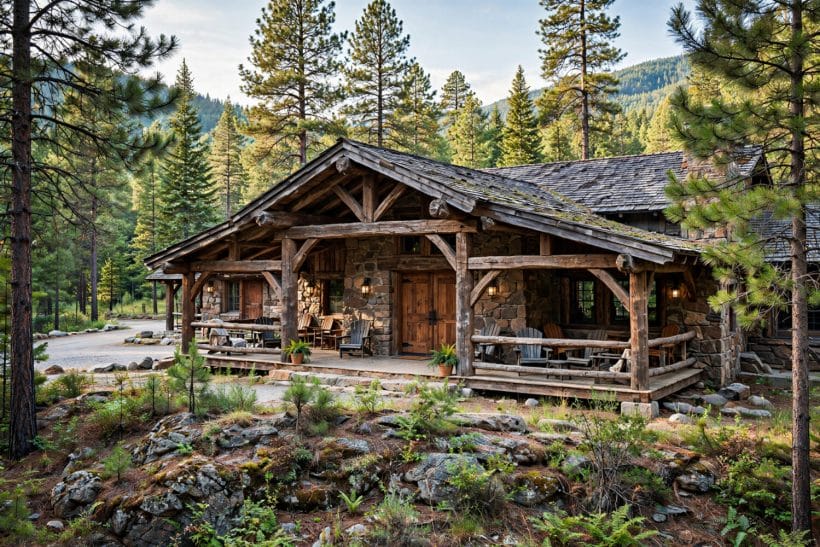
Heavy timber posts, beams and bargeboards against stone make the lodge and barn register: two structural materials telling the truth together. Keep both finishes matte and the partnership feels inevitable; gloss either one and it turns theatrical.
35. Stone and cedar shingles
Silvering cedar shingles above a stone base give the coastal and lake-house softness that all-stone cannot reach. The shingles take the weather’s artistry, the stone takes its force, and the house mellows as one.
36. Stone and brick, the old neighbours
Brick above stone, stone dressings on brick, or the two in separate wings — these are centuries-old companions. Match mortar families and keep one material clearly senior in area, or the facade argues with itself.
37. Stone and lime render
Soft, breathable render in earth tones is stone’s oldest partner, letting the masonry show at plinth, quoins and chimney while the walls stay warm and plain. The pair suits cottages, farmhouses and Mediterranean lanes alike.
38. Stone and black metal cladding
Charcoal steel or zinc panels against rough stone is the contemporary contrast: machined precision against geological time. It works when the stone is genuinely rough and the metal genuinely plain — half-measures in either spoil both.
39. Stone and white painted siding
Crisp white boards over a stone plinth or beside a stone chimney make the fresh, northern farmhouse read. The white needs the stone’s weight to stop it floating; the stone needs the white to stop it brooding.
40. Stone inside the glass house
One internal-external stone wall running through a glass pavilion anchors modern space to the earth. The wall is structure, hearth and artwork at once — and the single most photographed device in modern stone houses.
41. Junctions detailed, never smeared
Where stone meets any other material, the meeting is a designed line: a flashing, a shadow gap, a change of plane.
42. Colour discipline across materials
Choose the stone first — it is the least changeable and the most variable — then pull timber stains, brick choices and paint colours from within its own range.
43. The green partner: planting against stone
Climbers softening one corner, espaliered fruit on a warm wall, planting pockets in a garden wall — green is stone’s living partner. The colour-lane survey of planted and painted exteriors as a whole sits with the green exterior home ideas lane; here the planting is read purely as stone’s companion.
44. Roof materials that respect stone
Slate, clay tile, cedar and standing-seam metal all sit honourably on stone walls; the choice follows the house’s region and style lane.
6. Styles in Stone: Cottage, Craftsman, Mediterranean, Mountain and Modern
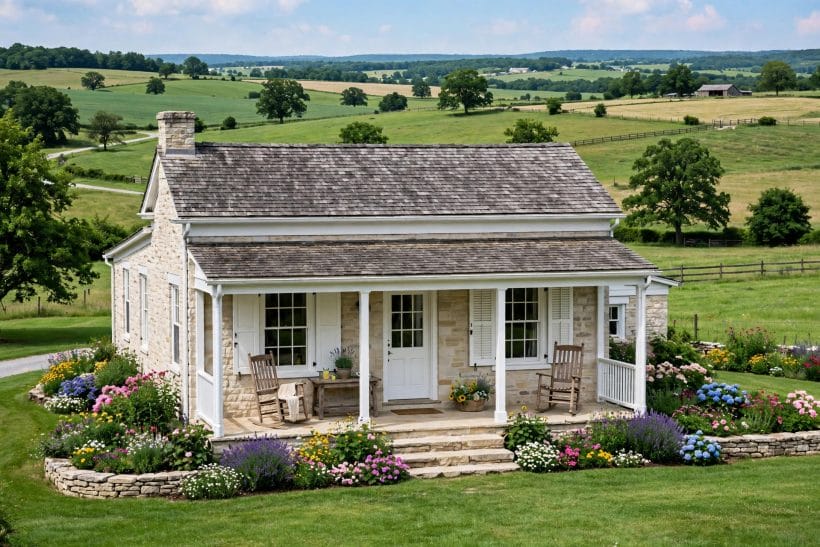
Stone is older than every style in this section, and each lane borrows it differently. Two of these lanes own their own full surveys — stone appears in them as one material among their details, and this section reads only the stone’s contribution, linking out rather than retelling them.
45. The cottage in rubble stone
Small windows, a steep roof and rubble walls with deep mortar make the cottage archetype. The stone is doing the cosiness: thick-looking walls, tiny openings, and a garden that reaches right up to the doorstep.
46. Craftsman stone: piers, plinths and porch bases
In the Craftsman lane stone works at ground level — tapered porch piers, foundations, chimney bases — grounding the timber artistry above it. That lane’s own full survey is the craftsman exterior home ideas post; here the point is simply that its stone is structural in spirit, never decorative wallpaper.
47. Mediterranean stone: sun-warm and whitewashed
Honeyed stone, sometimes whitewashed in part, with tile roofs and deep shaded openings makes the southern register. The warm-climate house family as a whole is surveyed in the mediterranean home design ideas lane; in stone terms it is the art of looking cool while standing in full sun.
48. Modern stone: flat, large and precise
The modern lane lays stone as big, flat, tightly-jointed planes — the material’s texture kept, its rusticity edited out. Its full clean-lined survey is the modern exterior home ideas post; stone’s role there is to give minimalist houses a surface with a past.
49. Mountain stone: boulders and big timbers
At altitude, stone goes massive — boulder plinths, huge fireplaces, walls that look quarried on site. Scale is the style: everything, including the stonework’s joints and corners, is sized for snow load and long views.
50. Farmhouse stone: the working wall
Farm buildings were stone because stone was there. The farmhouse register keeps that honesty — fieldstone, simple openings, additions in the same walling — and it forgives imperfection more gracefully than any other lane.
51. Tudor echoes: stone with half-timber
Stone below, dark half-timbering and steep roofs above: the romantic lane that borrows from older English building. It succeeds when the stone is genuinely sober and the timbering restrained, and turns storybook-sweet only when both are overplayed.
52. Coastal stone: salt-proof and wind-calm
By the sea, stone shrugs off salt and storm that eat other claddings.
53. Desert stone: the colour of the ground
In dry country the best stone houses vanish into their landscape — walls the colour of the canyon, flat roofs, deep shade at every opening.
54. Stone in the suburbs, done quietly
A stone front elevation among brick neighbours can sit comfortably if the stone is local in character and the detailing plain.
55. Contemporary rustic: stone as the warm layer
New houses increasingly use stone as the single warm, textured layer in an otherwise smooth palette — one wall, a fireplace volume, a plinth.
7. Small Houses and Tiny Footprints in Stone
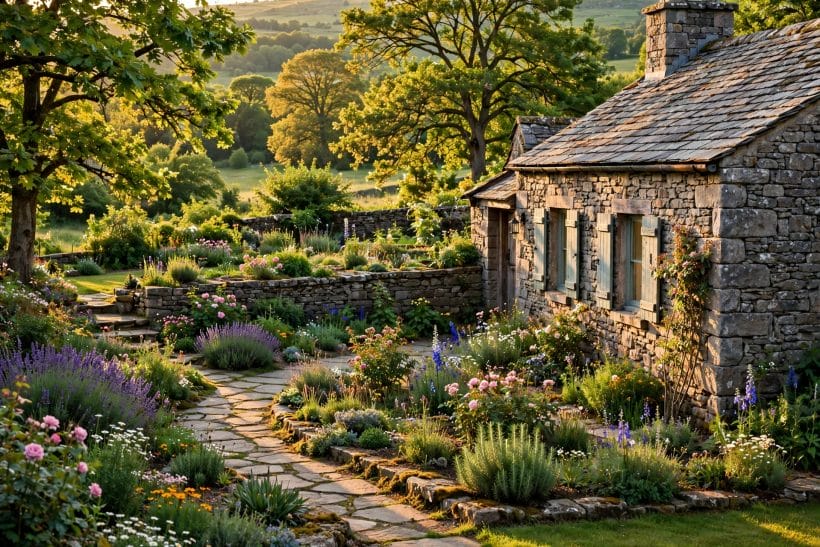
Stone flatters small houses disproportionately: a little building in a permanent material gains a dignity that size alone never gives it. This section scales the whole survey down — with the standing caution that stone’s weight and wall thickness are structural matters for professionals, stated generally here.
56. The tiny stone cottage
One room wide, stone all round, a roof like a hat — the tiny cottage is this survey’s most loved photograph for a reason.
57. Stone gable, timber long walls
For a small house on a budget, stone on the two gable ends and lighter cladding between concentrates cost and character together. The gables are what the landscape sees; the long walls are what the garden enjoys.
58. A stone base lifting a tiny house
Even a small timber cabin reads established standing on a proper stone base, and the base does real work keeping splash and vermin from the frame.
59. The stone bothy and garden room
A garden studio, potting shed or bothy built in stone becomes a permanent garden feature rather than an appliance. Small stone outbuildings are where many owners practise the craft before trusting it to the house.
60. Stone cladding on a small modern box
A compact modern house wrapped in one stone — panels or veneer — gains texture that stops minimalism turning stark. Keep openings few and large, detailing near-invisible, and let the stone’s variation be the whole ornament.
61. Thick walls, deep reveals, small rooms
Stone’s honest cost in a small house is floor area: real masonry walls are thick.
62. Stone porches on small houses
A small house with a stone porch gains a room’s worth of shelter and a facade’s worth of character in one small structure.
63. Reclaimed stone for small projects
Small footprints make reclaimed stone feasible: a demolished wall or barn can genuinely supply a cottage or garden room.
64. Stone and the small-plot frontage
On a tight plot the facade is nearly all anyone sees, and stone makes a narrow frontage feel like a jewel rather than a compromise.
65. One stone wall inside a tiny interior
Carrying one stone wall through into a small interior — the hearth wall — ties the tiny house together and gives its single room a permanent centre.
8. Stone Beyond the Walls: Chimneys, Garden Walls, Steps and Keeping It
The survey closes where stone leaves the house and enters the land — and with the keeping of it, which is stonework’s happiest property: the maintenance is mostly looking, occasionally pointing, and never painting.
66. The stone chimney as the house’s full stop
A well-built stone stack, properly capped and flashed by professionals, crowns any house in this survey.
67. Garden walls in the house’s own stone
Dry or mortared garden walls in matching stone extend the architecture into terraces, kitchen gardens and sheltered seats. A garden inside stone walls gains a microclimate and a feeling of permanence no fence can offer.
68. Stone terraces and outdoor rooms
A stone terrace against a stone house wall is the classic outdoor room: warm after sunset, level, and effectively immortal.
69. Boulder and rockery planting
Great stones set into banks and borders — half-buried, grouped as geology groups them — give gardens the borrowed-mountain feeling. It is stone as landscape rather than building, and the easiest way into this survey’s world.
70. Stone water features
A stone trough, a rill edged in setts, a boulder fountain: water and stone are the garden’s oldest duet. Keep engineering simple and visible — stone forgives algae and leaf-fall with a patina that plastic never achieves.
71. Repointing: the one real chore
Mortar joints weather faster than stone — that is their job, protecting the stone by failing first.
72. Cleaning stone: less is more
Most stone needs no cleaning beyond a brush and time; aggressive washing and harsh chemicals damage surfaces that were meant to weather.
73. Moss, lichen and the living wall
On shaded garden walls and north faces, moss and lichen are patina, not damage. Many owners in this survey keep one deliberately wild stone wall as the garden’s oldest-looking corner, whatever the house’s actual age.
74. Repairs with matching stone
When a stone is damaged, replace it with its geological sibling, not a coloured imitation, and let time blend the repair.
75. Stone for the next owner
The closing thought of the whole survey: a stone house is built partly for strangers. Its walls will hold their value, their warmth and their face longer than any other choice in the exterior field — which is why this material lane, inside the wider story told by the site’s home design ideas collection, keeps its hold on everyone who builds to stay.
9. Checks and Mistakes: Before the First Purchase or the First Stone
Measure the wall before the stone: stone choices are constrained by structure first and taste second. Whether a wall can be solid masonry, a veneer over framing, or a plinth only is a professional determination — engineers and masons, not catalogues, answer it, and every idea in this survey assumes that answer comes first.
See the stone in quantity, in daylight. A single sample hides the variation that is stone’s character: ask to see a built wall or a full pallet, stand back, and judge the range of colour and size you will actually live with. Reject nothing for varying — variation is the material — but know its range before it is on your house.
Choose the mortar as carefully as the stone. Its colour is a third of the facade, its composition decides how the wall ages and breathes, and incompatible hard mortars can damage softer stones. This is specialist territory: take the mason’s advice over the internet’s, every time.
Detail the water paths. Stone sheds weather beautifully when drips, flashings, copings and falls are designed to throw water clear of the wall and its junctions; it stains and suffers when water is allowed to sit or track. The detailing is professional work, checked before the first course is laid.
Avoid the classic mistakes: stone stopped mid-air on a visible ledge, veneer corners that do not wrap, joints in bright white against dark stone, thin feature panels pretending to be structure, and stone chosen from a photograph of a different climate’s light. Every one is visible from the street, forever.
Plan the junctions with other materials on paper first — where stone ends, what covers the transition, how each material moves and drains. Stone punishes improvisation at its edges more than any other cladding; the houses in this survey that look effortless had their edges drawn, not discovered.
10. Costs and Pulling It Together
Costs for stone follow the material’s honest logic, stated without figures: solid masonry is the deepest commitment, real stone veneer the middle path, manufactured stone the lightest — and across all three, skilled masonry labour is the larger story, so quotes should be read for the mason’s craft and programme, not just the stone’s price per load.
Spend first on the stone the house is seen by: the frontage, the entry, the chimney and the plinth. Elevations no one reads can wait for a later phase or wear simpler finishes; phased stonework in matching material is a traditional and honourable way stone houses have always grown.
Pulling it together: pick the stone from your own landscape if you can, let its colours set the whole exterior palette, place it where weight reads as welcome — base, entry, hearth, gable — and detail its meetings with other materials like you mean them. Do that, and a house of any size or style gains the one quality no other material sells: the feeling that it was always there.
Final Considerations
Stone is the exterior material that asks the most at the start — weight, craft, patience — and the least ever after. The houses in this survey share a calm that comes from exactly that bargain, whether they wear stone on every wall or only at the step where a visitor first pauses.
Choose your stone the way the old builders did: from the ground you stand on, laid by hands that will still be proud of it in thirty years, and detailed for the weather you actually have. The result is not just a facade. It is the house’s permanent face, and it will still be keeping its promise long after every other finish on the street has been replaced twice over.

0 Comments