

Stone is the patio floor that was old before your house was drawn. It cools bare feet at noon, holds the evening’s warmth, and improves — genuinely improves — with every year of weather.
Seventy-five stone patios follow: the stones and patterns themselves, the groundwork beneath them stated plainly, terraces and courtyards, dining and firelight, paths and small courts, and the keeping of it all.
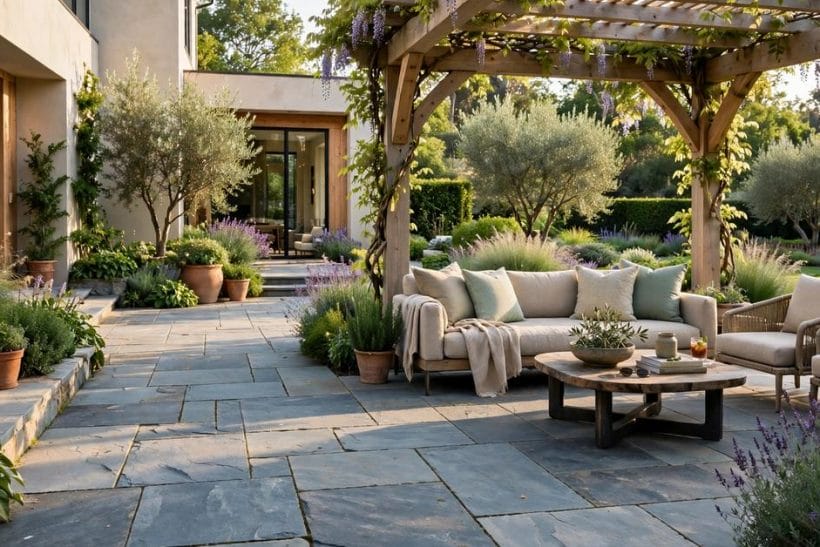
1. Stone Patio Ideas at a Glance
The central entity is the stone patio: an outdoor floor of natural stone — flags, slabs, setts or mixed pieces, bedded and jointed as landscape construction — together with the groundwork that carries it: excavated and compacted base, deliberate falls, drainage kept away from the house, and firm edge restraints. Stone’s attributes are permanence, coolness, grip, repairability by the piece and a patina that improves with age; its demands are weight, skilled laying and professional groundwork, stated generally throughout this survey. This post owns the stone lane of the patio cluster inside the wider field of the patio ideas pillar, links its flagstone sibling as that form’s own survey, and does not absorb the concrete, small-patio or general lanes linked from it.
| Question | Short answer |
|---|---|
| What defines a stone patio? | A patio floor of natural stone — flags, slabs, setts or composed pieces — laid as permanent landscape construction. |
| What matters most underneath? | A compacted base, a deliberate fall, drainage away from the house and firm edges — professional groundwork throughout. |
| How does stone differ from flagstone alone? | Flagstone is one stone form within the wider stone family; it owns its own linked survey in this cluster. |
| What upkeep does stone ask? | Sweeping, joint care, occasional re-levelling of a piece — repairs restore the original stone rather than patching it. |
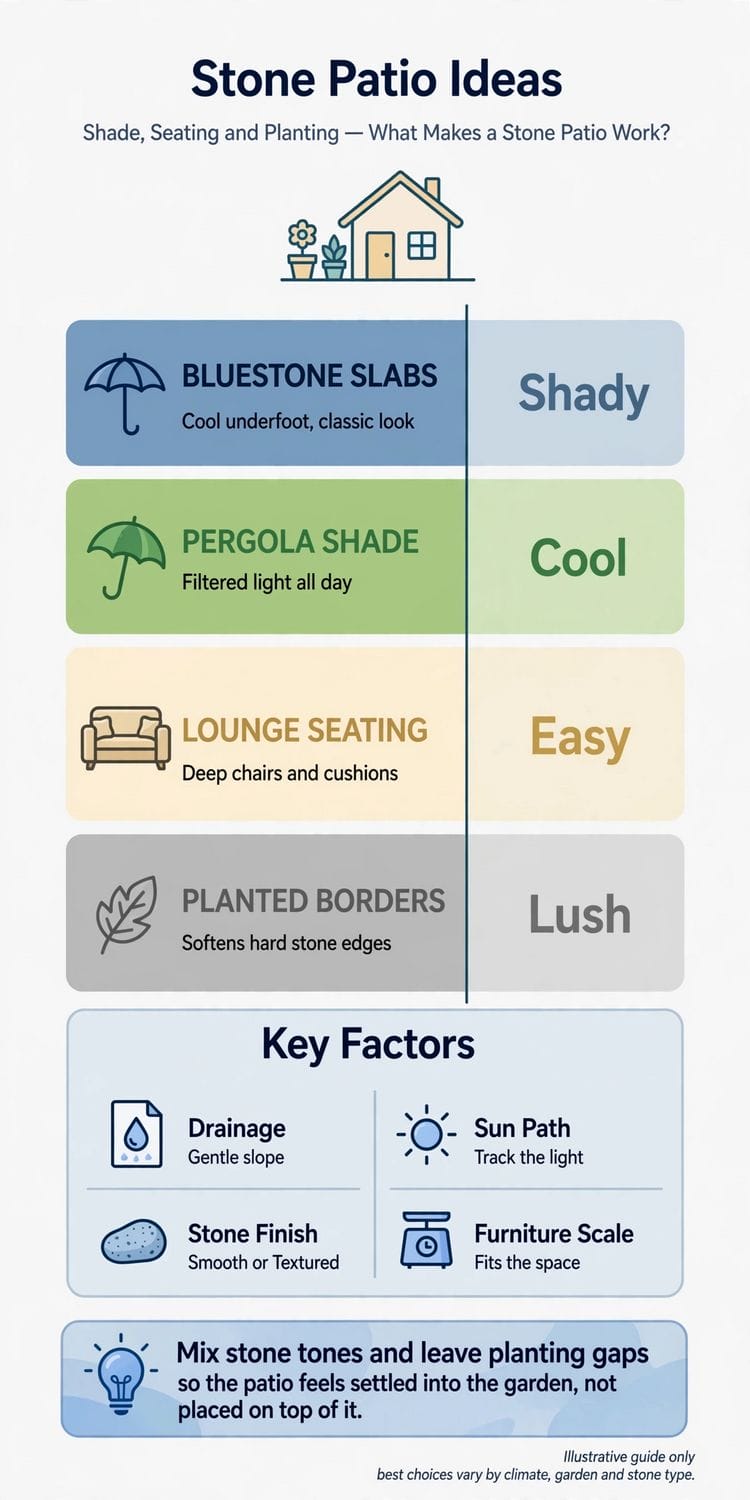
2. The Stone Floor Itself: Types, Cuts and Laying Patterns
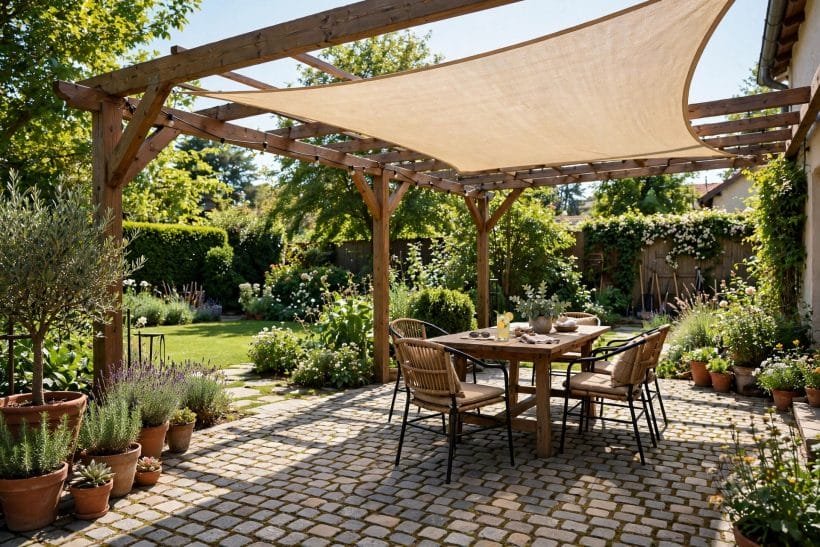
A stone patio begins underfoot, and this survey stays on that floor throughout. The whole outdoor-room field is surveyed by the patio ideas pillar; here the question is narrower: which stone, in what pieces, laid in what pattern, on what ground — because those four choices decide how the patio drains, grips, ages and feels under bare feet.
1. Irregular flagstone, the classic field
Large, naturally split flags with soft irregular edges make the most forgiving and most loved stone floor.
2. Sawn stone in a regular grid
Stone cut to true rectangles and laid in courses gives the crisp, architectural patio — the floor for modern gardens and formal terraces.
3. Stone setts and cobbles for texture
Small, deep blocks laid tight make a floor of wonderful texture and near-immortal wear. Setts suit small areas, thresholds and edging bands best; a whole terrace of them is beautiful, busy and demanding under chair legs.
4. Crazy paving, honestly composed
Broken pieces fitted like a jigsaw can charm or can look like an accident — the difference is composition: pieces sorted by size, joints kept even in width, and the field framed by a disciplined edge.
5. Large slabs, few joints
Big-format stone slabs give calm, spa-like floors with minimal joint maintenance and a luxurious sense of scale. Their weight and the precision of their bedding belong to professionals; the reward is a floor that reads as one geological surface.
6. Stone and gravel, the dry garden floor
Stepping stones and stone islands set in a gravel field drain freely, cost gently and suit dry gardens beautifully. The gravel is a surface in its own right — chosen, edged and raked — not an apology between stones.
7. Mortared joints for a finished room
Joints pointed in mortar make the patio read as an outdoor room: cleaner, firmer under furniture, and easier to sweep.
8. Open joints with planting between
Leaving joints open and planting them with low, tough creepers softens big stone fields into garden. It asks for patience and the right plants in the right gaps, and it rewards with a floor that blooms in spring.
9. Sand joints, the traditional bedding
Stones bedded and jointed in sharp sand flex with the seasons and can be lifted and re-laid when the ground moves — the repairable patio. The joints need topping and weeding, which owners count as gardening, not maintenance.
10. Tumbled stone for soft edges
Stone pieces tumbled to round their edges feel kind underfoot and look instantly aged. Tumbled setts and flags suit barefoot gardens, pool edges and family patios where sharp arrises are unwelcome.
11. One stone throughout, or a border of contrast
A single stone across the whole floor is the calm choice; a border course in a darker or smaller format frames the field and forgives the main stone’s variation.
3. Groundwork First: Base, Falls and Drainage, Stated Generally
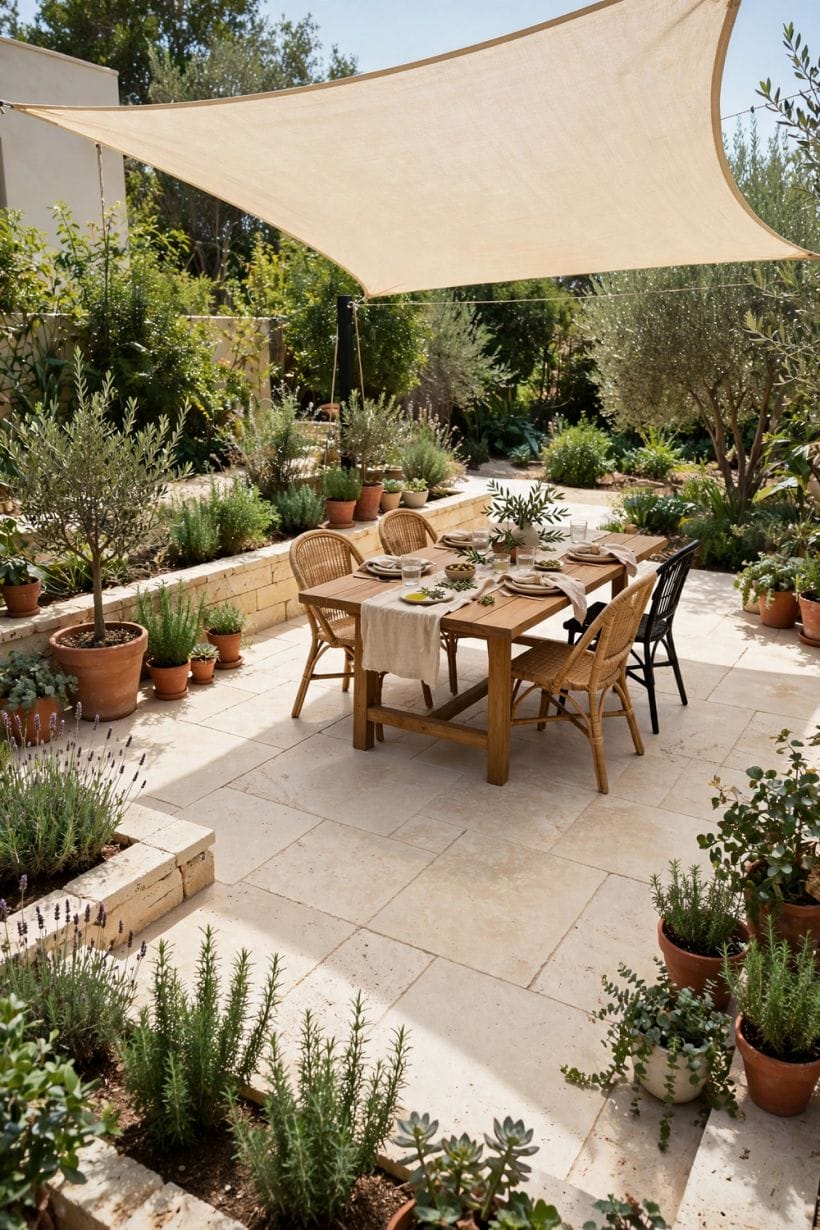
Every failed stone patio failed underneath first. This section is deliberately plain: the groundwork principles that make stone floors last, stated generally — the excavation, falls, foundations and drainage of any real patio are groundworkers’ and landscapers’ professional territory, set by your soil, your climate and local rules.
12. A compacted, stable base
Stone is only as still as what it lies on.
13. The fall: water must be told where to go
A patio is a roof for the soil, and like a roof it needs a gentle, deliberate fall carrying rain away from the house to a place designed to receive it.
14. Drainage at the house wall
Where patio meets house, the junction must protect the building: levels kept safely below the damp-proofing, and water intercepted rather than allowed to gather against the wall.
15. Edge restraints that hold the field
Stone floors creep outward without a firm edge — a stone kerb, a sett band, a wall or a properly built border.
16. Tree roots and honest distances
Laying stone hard against growing trees invites lifted flags and strangled roots alike. Give trunks their space, use open-jointed or gravel fields near roots, and let the patio bend around the garden’s elders rather than fight them.
17. Existing concrete as a base — sometimes
A sound, well-fallen concrete slab can sometimes be overlaid; a cracked, heaving or wrongly-fallen one merely telegraphs its faults into the new stone. Whether yours qualifies is a professional inspection, not a hope.
18. Frost, heave and the seasons
In cold climates the ground moves; flexible bedding systems forgive that movement and rigid ones must be engineered for it.
19. Services remembered before stone
Irrigation lines, lighting cables, drainage runs and outdoor sockets are all ten times easier before the stone goes down.
20. Steps and level changes built as structure
Where the patio meets lawn, deck or door at a different level, the step is part of the groundwork: founded, even and lit, not an afterthought of stacked offcuts. Uneven steps are how beautiful patios hurt people.
21. The test: hose it before you furnish it
Before furniture arrives, a hose test in honest rain-simulation shows where water stands and where it runs. Puddles found now are adjustments; puddles found in the first storm are grievances.
22. Access for the future
Leave a discreet way back in: a removable panel over drainage junctions, a recorded note of where services run, spare stone from the original batch.
4. Layouts: Terraces, Courtyards and the Shape of the Stone Room
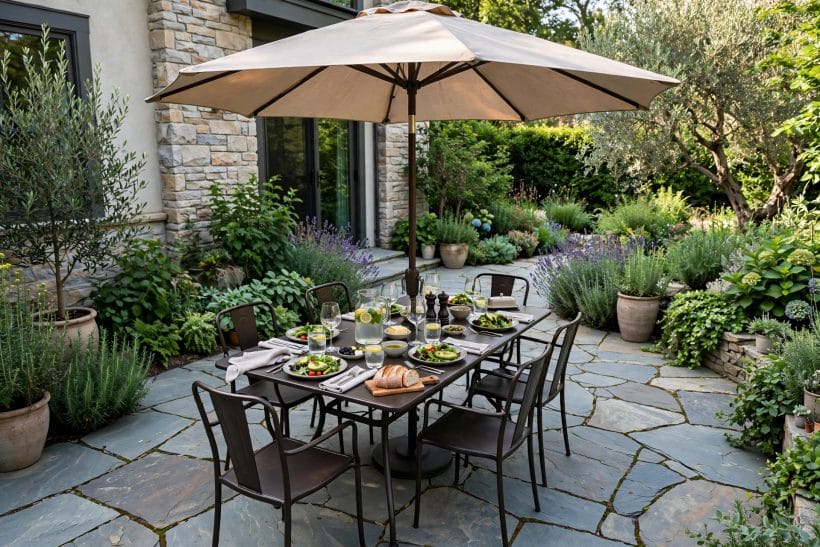
With the floor chosen and its groundwork understood, layout decides how the patio is lived in. The general patio field — every material, every size — belongs to the patio ideas pillar; this section stays inside stone: the shapes and arrangements the material itself does best.
23. The rectangular terrace, stone’s home ground
Stone’s weight and permanence suit the classic terrace: one level rectangle against the house, edged in setts, furnished like a room.
24. The courtyard enclosed in stone
Stone floor, stone or high walls, one tree — the courtyard is the Mediterranean gift to small houses everywhere. Stone holds the day’s warmth for the evening and gives the enclosure its cool, echoing calm at noon.
25. Stepped terraces on a slope
On falling ground, stone makes the natural terrace material: retaining edges in the same stone, level landings for each use, and steps composed as part of the floor’s pattern rather than apologised for.
26. The circular stone patio
A circle of setts or radial flags makes a natural gathering bowl — fire at the centre, seats around the rim, no corners wasted.
27. Two stone rooms, two purposes
A dining terrace near the kitchen and a quieter stone court for morning coffee, linked by a stone path, give a garden the room-plan of a house. Stone unifies them materially while distance separates them in mood.
28. The stone apron around a pool
Stone coping and surround give pool edges their cool, non-slip dignity — chosen, as all wet stone must be, for grip as much as looks, and laid by the pool’s own professionals to their falls and drainage.
29. A patio that wraps the corner
Turning the terrace around the house’s corner follows the sun through the day: breakfast on one leg, evening on the other.
30. Stone under a pergola
A pergola over stone makes the complete outdoor room — stone below, dappled shade above.
31. The sunken stone court
A few steps down into a stone-floored court gives shelter, privacy and a fire-pit’s natural home.
32. A narrow side-return in stone
The awkward strip beside many houses becomes a stone-paved passage garden: setts or long flags, wall planting, and a bench at the end. Stone makes even this leftover feel like a cloister rather than a corridor.
33. The stone patio as the tiny house’s floor
For tiny houses, a stone terrace is quite literally another room — the largest one.
5. Dining, Lounging and Firelight on Stone
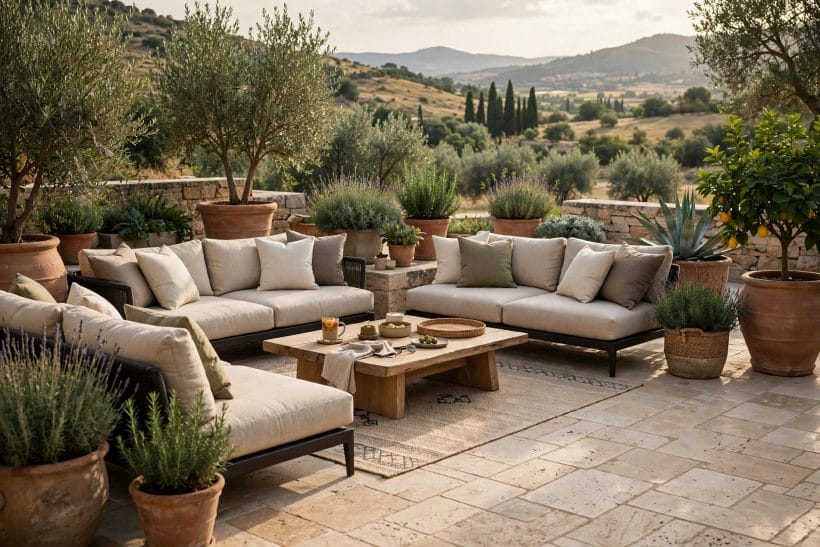
Furnishing stone is a pleasure with two cautions: stone is hard, and stone holds temperature. This section arranges the lived layer — tables, loungers, fire and shade — on the stone floors the survey has built.
34. The dining terrace in stone
A stone floor under a dining table gives outdoor meals their restaurant gravity — level, sweepable, cool in the evening. Choose the smoothest stone format for the dining zone; chair legs and irregular flags are enemies from the first dinner.
35. Loungers on warm stone
Sun-warmed stone under a lounger extends the lounging hour past sunset, the slab giving back the day’s heat. Darker stones hold more warmth; in fierce climates that virtue inverts, and pale stone with shade wins — latitude decides, as always.
36. A fire feature on a stone hearth-field
Fire bowls and fireplaces belong on stone, the one floor that welcomes them without anxiety.
37. Outdoor kitchen on a stone floor
Cooking outdoors wants a floor that shrugs off grease, heat and dropped everything: stone. Build the kitchen zone on the smoothest, most tightly jointed part of the patio, nearest the house door, and hose-downs become the whole cleaning regime.
38. Shade composed with stone
Stone amplifies light; shade tempers it. A pale stone patio under dappled pergola shade is the summer ideal — bright without glare, warm without roasting. Plant the shade where the afternoon sun lands, not where the drawing looked empty.
39. Cushions, rugs and the soft layer
Stone’s hardness is answered with textiles: outdoor rugs under seating groups, deep cushions, a throw for later. The soft layer is also the colour layer — change it and the greyest stone patio changes its season’s mood.
40. Lighting low and warm on stone
Low lights grazing across stone reveal its texture after dark and keep steps legible. Graze, never glare: fittings at ankle height along paths and edges turn the patio into the garden’s evening room without lighting the neighbours’ bedrooms.
41. A stone bench built into the edge
A low stone wall at the patio’s edge doubles as permanent seating for a crowd — cushions appear, and twelve people sit where four chairs stood. Built-in stone seating is the Mediterranean terrace’s oldest furnishing trick.
42. Planting pockets and pots on stone
Big pots group beautifully on stone, softening its geometry with green.
43. The winter patio
Stone patios earn their keep in winter too: a dry, level, sweepable surface for the fire bowl, the winter breakfast tray, the evergreen pots.
44. Furniture feet and stone faces
Metal chair feet can scratch and rust-mark softer stones; pads and glides are the cheap insurance. Choose furniture as you chose stone — for the decade, not the season — and the pair will weather into each other gracefully.
6. Stone Beyond the Floor: Paths, Steps, Walls and Water
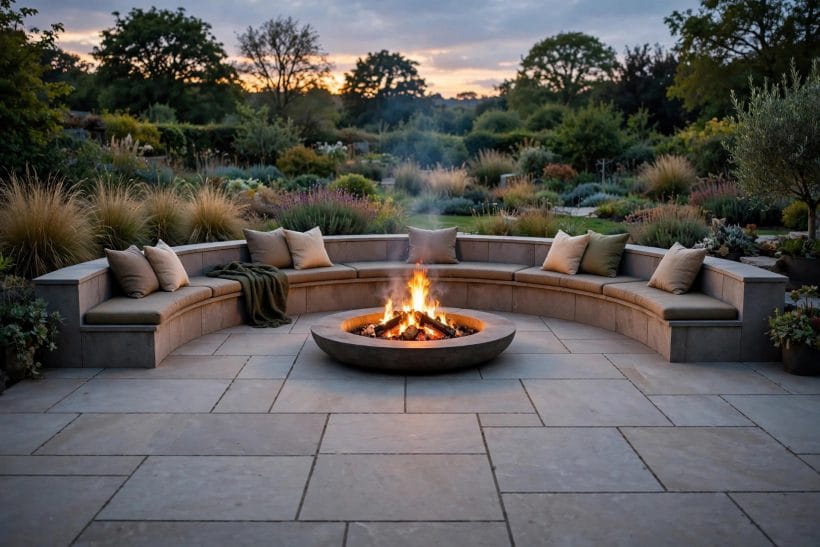
A stone patio rarely ends at its edge. This section follows the material out into the garden — paths, steps, low walls and water — where the same stone, continued, turns one patio into a whole landscape. The planted and lawn territories beyond belong to their own lanes, and the backyard’s whole composition is read by the backyard patio ideas lane; stone’s thread is what this section follows.
45. The stone path from patio to garden
Continue the patio’s stone as the path and the garden reads as one design. Paths can relax in format as they leave — slabs widening in spacing, gravel joining — so long as the stone itself stays the same family.
46. Stone steps between levels
Garden steps in the patio’s stone, wide and shallow, make level changes feel like architecture. Even rises, a nosing you can see at dusk, and drainage that never sheets across the treads are the professional basics, stated generally.
47. Low stone retaining walls
Where the patio holds back a bank, its retaining edge in matching stone is both structure and seat.
48. A stone-edged pond beside the patio
Water at the patio’s edge doubles its light and cools its air. Stone coping gives frogs, feet and glasses a safe rim, and the same flags stepping into the shallows make the classic naturalistic edge.
49. Stone around the outdoor shower or tap
A small stone apron under the garden tap, pool shower or dog-washing spot takes the daily splashing that rots decks and muddies lawns. Unglamorous, permanently useful — the kind of stone detail owners praise longest.
50. Boulders anchoring the patio corners
One great boulder at a patio corner pins the composition to the earth and gives plantings a geology to lean on. Set boulders a third into the ground, grouped as strata lie, never perched like ornaments.
51. The flagstone sibling, acknowledged
Irregular flagstone is stone’s own most famous patio dialect, and it owns a dedicated survey — the flagstone patio ideas post — which composes that one stone form in full. This survey stays on the wider stone family; where flagstone appears here, it is one voice in the choir, not the soloist.
52. Stone and lawn: the mowing edge
A sett or slab mowing strip where patio stone meets lawn saves an hour a week and keeps the edge crisp for decades. It is the detail every neighbour asks about, and the cheapest stone in the whole garden.
53. Stone firewood stores and utility corners
The working corner — wood store, bins, bikes — paved in the same stone stops looking like an apology. Utility in the house stone is a hallmark of gardens designed as one place rather than zones of pride and shame.
54. Carrying stone to the front garden
A front path and threshold step in the patio’s stone tie the house’s two faces together. Visitors meet the material at the gate and find it again in the garden — a quiet continuity money cannot fake with accessories.
55. Built-in stone planters at the patio edge
Planters built in the patio’s own stone along its sunny edge hold herbs, lavender and small shrubs at exactly hand height from a chair.
7. Small Stone Patios, Balconies and Courtyard Corners
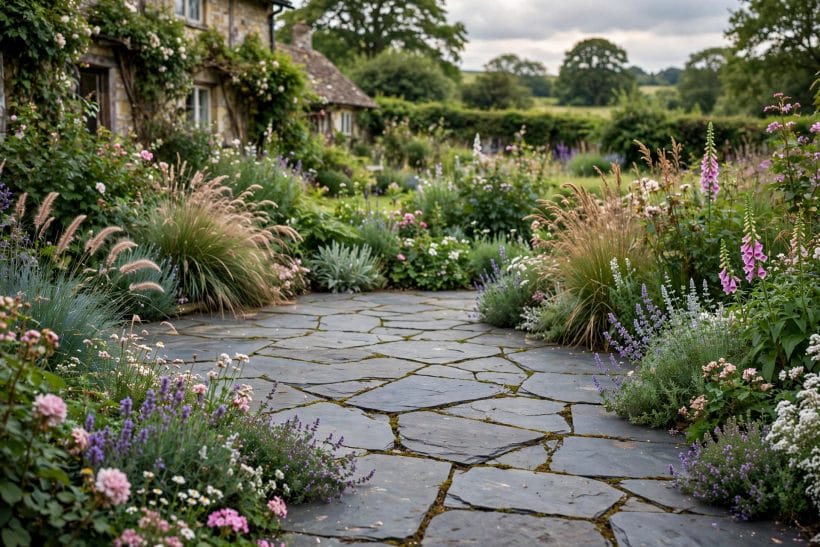
Stone is heavy, permanent and unhurried — which is exactly why it flatters small spaces, giving a tiny floor the dignity of a much larger one. The compact-patio specialism as a whole is surveyed by the small patio ideas lane; this section reads smallness through stone alone.
56. The two-chair stone court
Six flags, a bistro set, one pot — the smallest stone patio is still a room, with a floor that swept clean in a minute. Smallness concentrates stone’s virtues: every piece is seen, so every piece can be beautiful.
57. Balcony stone, weight permitting
Stone-look and thin stone tiles can give balconies the patio feeling, but real stone’s weight on any raised structure is a structural question for professionals, never an assumption.
58. A stone corner in a gravel garden
In a loose gravel garden, one paved stone corner gives furniture its firm footing and the garden its parlour. The contrast — crisp stone island in soft gravel — is a complete design in a single gesture.
59. Stone paving in the tiny side yard
Long flags laid lengthways stretch a narrow side yard visually, and stone’s cool surface suits the shaded slot between houses. Plant the walls, light the path, and the leftover strip becomes the house’s green corridor.
60. The doorstep patio
One deep stone landing outside the back door — wide enough for two chairs and the morning tray — is the smallest complete patio there is. Houses without gardens have been civilised by exactly this much stone for centuries.
61. Pattern as the small patio’s ornament
In a tiny floor, pattern does the decorating: a sett fan, a slab field with one patterned panel, a border that turns the corners with intent.
62. Vertical stone: the small patio’s wall
Where floor area is scarce, climb: a stone-clad wall behind the bench, a stacked-stone planter as the boundary. The small patio gains its stone character upward when it cannot spread outward.
63. Light stone for dark corners
In shaded urban slots, pale stone is the floor that fights back — reflecting what light there is into the seating.
64. A tiny stone water corner
One stone trough, one dripping tap, ferns in the joints — a square yard of coolth in a hot small garden. Water makes stone’s temperature virtue audible as well as visible.
65. Small but permanent: stone for renters of time
Owners who move often hesitate at stone’s permanence; those building their long home should hesitate at anything less.
8. Choosing and Keeping: Stone Character, Weather and Care
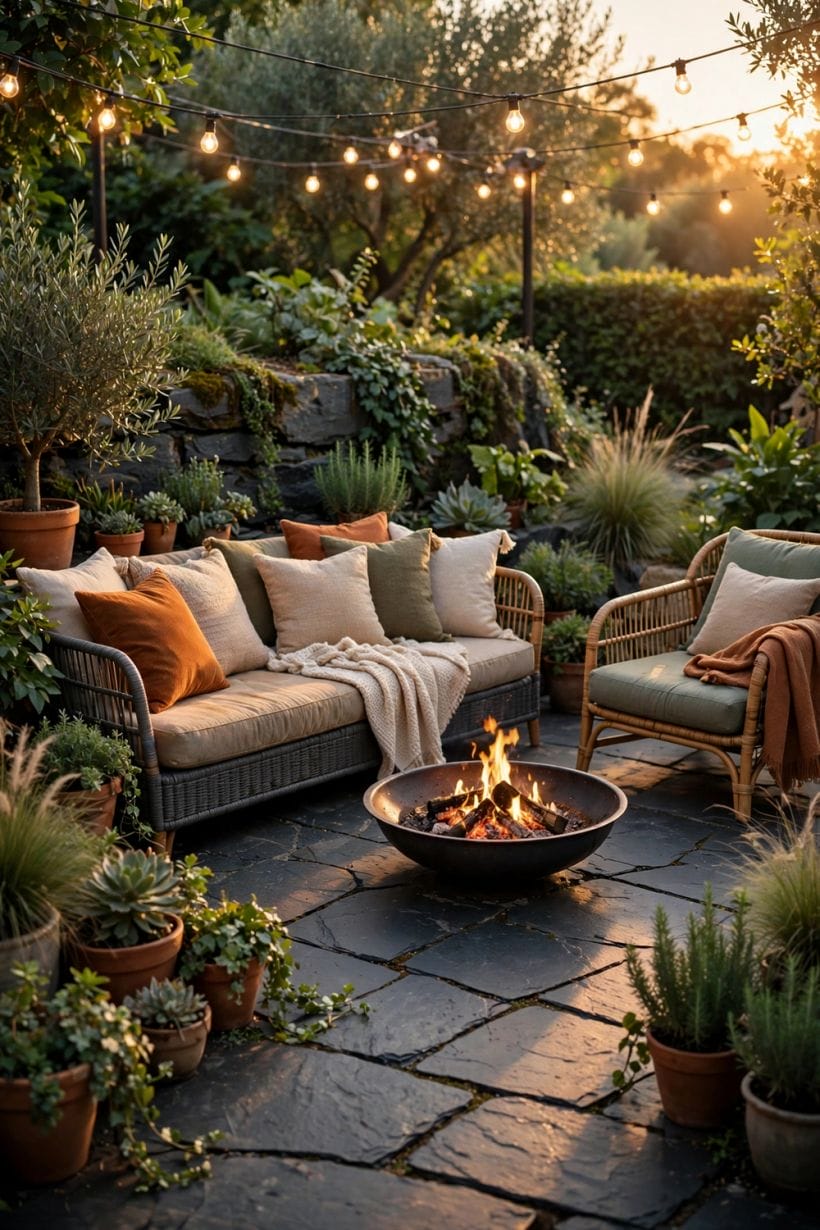
The survey closes with the long view: how stone patios age, what they ask of their owners, and how the stone choice made in section two echoes through decades of weather. The care regime is stone’s best argument — this section simply tells it plainly.
66. Patina: stone improves honestly
Unlike surfaces that peak on installation day, stone gains character: edges soften, colours mellow, moss threads the shaded joints. Owners who choose stone are choosing its tenth year.
67. Sealing: sometimes, never by default
Some dense stones never need sealing; porous ones in cooking zones may benefit. Sealing is a stone-specific decision — take the supplier’s and layer’s advice for your exact stone, and distrust any universal rule, including enthusiasm.
68. Weeds in the joints, gardened not cursed
Open and sand joints will green a little; owners either plant them deliberately with chosen creepers or lift and re-sand them in an afternoon a year. Both are gardening.
69. Pressure washing with respect
Gentle washing refreshes stone; fierce jets wound its face and blast out joints. Low pressure, wide fan, patience — and on old or soft stone, a brush and water only, exactly as its first owners cleaned it.
70. Winter care in frost country
Keep water from pooling and freezing in joints, lift leaves before they mat, and use grit rather than harsh chemicals on ice where your stone or plants object.
71. Re-levelling instead of replacing
A stone lifted, its bed refreshed, and the same stone re-laid: the stone patio’s repairs restore the original, not a patch.
72. Matching stone later
Keep the quarry and stone name recorded, and store a few spare flags from the original batch. Stone varies by bed and season; the spares box is the difference between an invisible repair and a permanent eyesore with a story.
73. Stone and resale reality
Estate agents have always known what this survey shows: a stone terrace photographs as permanence, and permanence is what buyers pay for in a garden. Among the floors surveyed across the concrete patio ideas lane and this one, stone is the material whose value story is told in decades.
74. The honest comparison, kept brief
Concrete costs less and can imitate; timber warms and weathers fast; stone costs most, asks most at the build, and repays longest.
75. Stone last, because stone lasts
The closing thought: a stone patio is not really bought, it is inherited forward — laid once, enjoyed daily, repaired by the piece, and handed on still improving.
9. Checks and Mistakes: Before the First Purchase or the First Stone
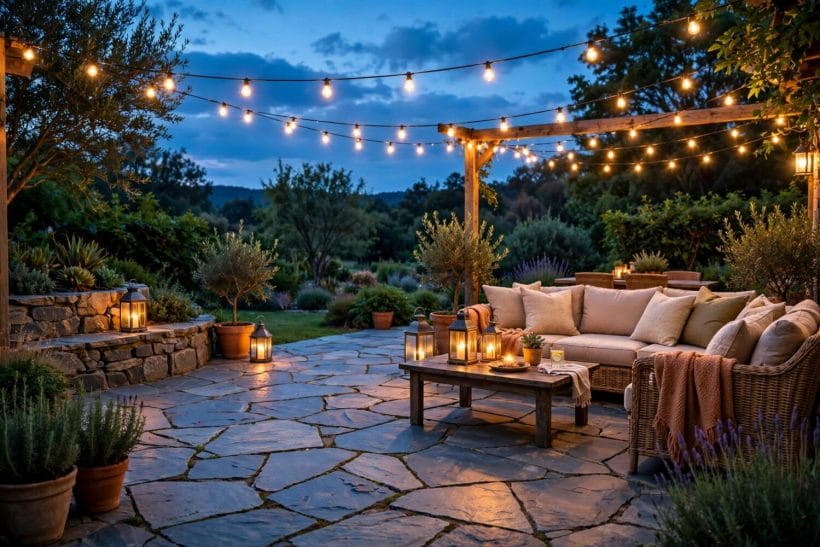
Walk the stone before you buy it — in both senses. Visit a built patio in your chosen stone, walk it barefoot and in rain if you can, and check its grip, its temperature and its sound. Stone is the most tactile floor there is; a photograph and a sample tile cannot tell you the half of it.
Get the groundwork quoted as its own line. Excavation, sub-base, falls, drainage and edges are the patio’s invisible majority, and a quote that lumps them into one vague figure is hiding the part that decides whether the patio lasts. Compare builders on their groundwork specification, not their stone price.
Fix the falls and the house junction before the pattern. Water leaving the surface, away from the walls, to a designed destination is the one non-negotiable in this entire survey; patterns, borders and planting pockets are all negotiable afterwards. Drainage drawings before tile patterns, always.
Avoid the standing mistakes: stone laid on soil or sand alone over clay, levels brought hopefully close to the house’s damp course, joints pointed in mortar too hard for the stone, dark stone specified for a scorching unshaded terrace, and furniture with bare metal feet on soft stone. Each is common, and each is permanent until re-laid.
Agree the joint before the laying starts. Open, sand, mortared or planted joints give the same stone four different characters and four different maintenance lives. A sample panel, laid and jointed in your own garden’s light, settles the argument better than any catalogue.
Keep the spares and the paperwork: a few flags, the stone’s name and quarry, the layer’s build-up notes. Future repairs, extensions and drainage work all become simple. Stone patios outlive memories; the folder you keep is the manual the next owner will thank you for.
10. Costs and Pulling It Together
Costs follow stone’s own logic, stated without figures: the stone itself is often the smaller half of the bill, with groundwork, skilled laying and edges the larger — so quotes should be read layer by layer, and the cheapest total usually belongs to the builder who described the base most carefully.
Spend in this order: groundwork first, the main field second, edges and steps third, and the decorative extras — borders, patterns, planting pockets — last, because a sound plain patio can gain its ornaments later while a beautiful patio on a bad base gains only problems.
Pulling it together: choose the stone your climate and your bare feet approve, lay it on groundwork you’d trust a house on, give its water somewhere designed to go, and furnish it as the outdoor room it now is. The wider patio field is gathered in the site’s home design ideas collection — but the stone floor, once down, mostly gathers dust only when you sweep it, which is the point.
Final Considerations
A stone patio asks for one serious weekend of decisions and one professional build, and then it asks for almost nothing, ever again. That exchange — effort now, ease for decades — is written into every photograph in this survey, from the two-chair court to the great terraced room.
Lay it on good ground, in a stone your landscape recognises, with its water politely shown the way out. Then put the kettle on. The floor under the morning tray will outlast the tray, the table and very possibly the kettle — and it will look better every single year it does.

0 Comments