

Working from a tiny home is a negotiation between two lives that want the same square feet. The desk wants daylight, the sofa wants the window, the meeting wants a door, and the evening wants all evidence of the job gone. The workspaces that succeed in 200 square feet are not miniature versions of big offices. They are honest, closable, and sized for the work actually done in them. The most useful tiny home office ideas share one trait: each one gives the work a real place, then gives the home its room back at the end of the day.
This roundup gathers twenty-two of those ideas, grouped so you can adopt them in layers: desks that fold and float first, then nooks, vertical closed storage, seating that fits, layered light, tidy cables, calm calls, boundaries you can close, all-day comfort, and a closing routine that protects the evening. None of them needs a spare room or a renovation. Most can be tested in a weekend, measured against your real chair, your real laptop and your real patience, and kept only if the room feels calmer with them than without them.
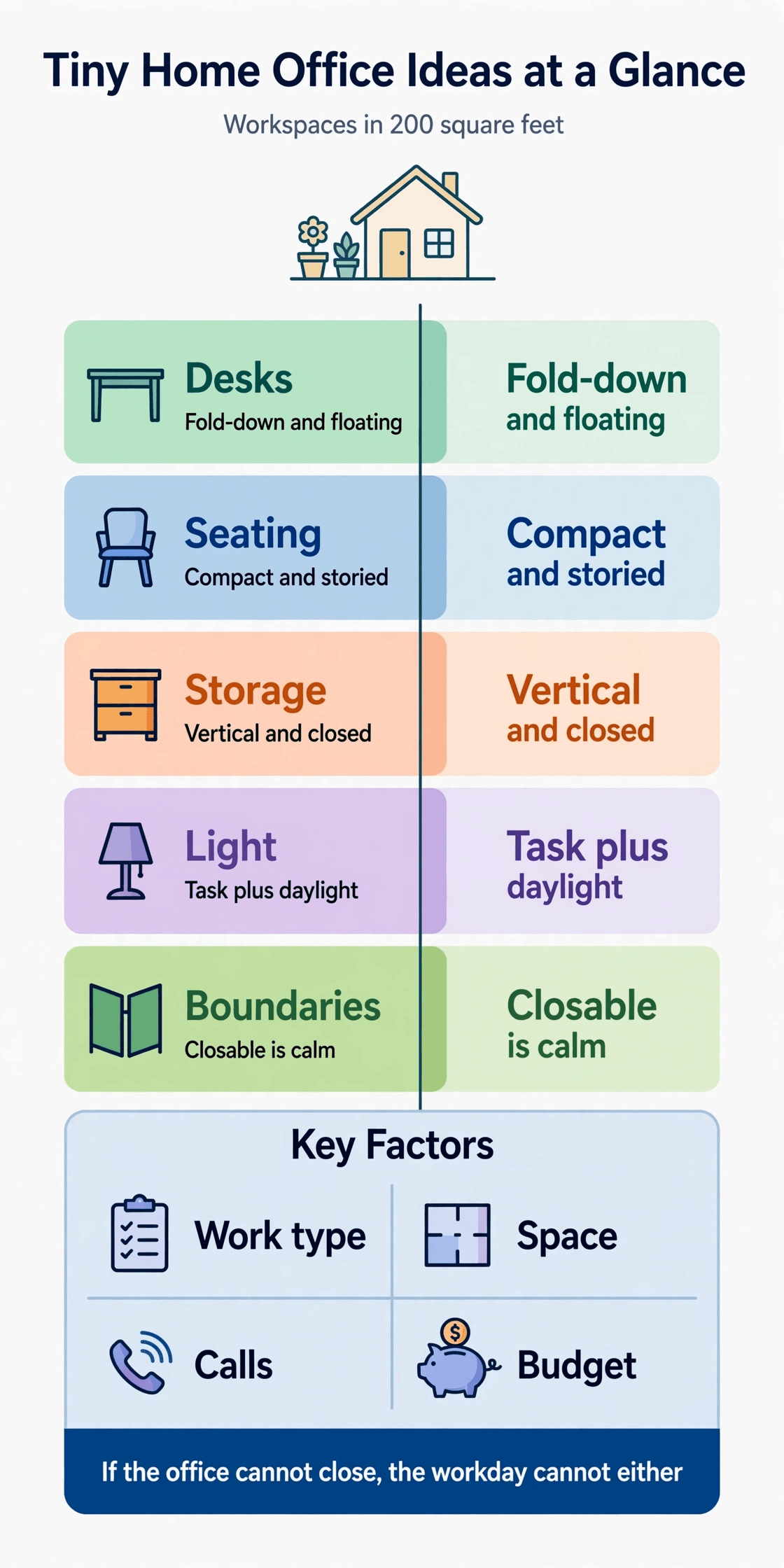
Tiny Home Office Ideas at a Glance
The summary table below maps the twenty-two ideas by theme, so you can start with the layer your workspace is missing. Every idea is then unpacked in its section, with the trade-offs stated honestly.
| Theme | Ideas | What It Solves |
|---|---|---|
| Desks that fold and float | 1 to 2 | A real work surface that returns its floor space the moment the laptop closes |
| Nooks and corners | 3 to 4 | Dead floor area, closets and corners converted into a defined place to work |
| Vertical closed storage | 5 to 6 | Walls carrying the files and kit behind doors, so the room stays visually quiet |
| Compact seating | 7 to 8 | Support for long days from chairs and stools that tuck completely away |
| Task light and daylight | 9 to 10 | Glare-free screens by day and focused, gentle light after dark |
| Paper and cable order | 11 to 12 | Chargers, cords and documents given one closed home each |
| Screens and calls | 13 to 14 | Better posture, a calm backdrop and softer sound on video calls |
| Boundaries you can close | 15 to 16 | A visible end to the working day that housemates can read at a glance |
| Comfort through the day | 17 to 18 | Fresh air and personal warmth without heating or cooling the whole home |
| Beyond the desk | 19 to 20 | Overflow and archives stored outside the workspace, plus a caddy that travels |
| The closing routine | 21 to 22 | A five-minute reset and a weekly edit that stop work colonising the home |
1. Desks That Fold and Float
Start with the surface, because everything else in a 200-square-foot workspace hangs off it. If you are still deciding what deserves floor space at all, the discipline behind tiny house living and decluttering for a move to 200 square feet applies to the desk first: it must earn its footprint every single day.
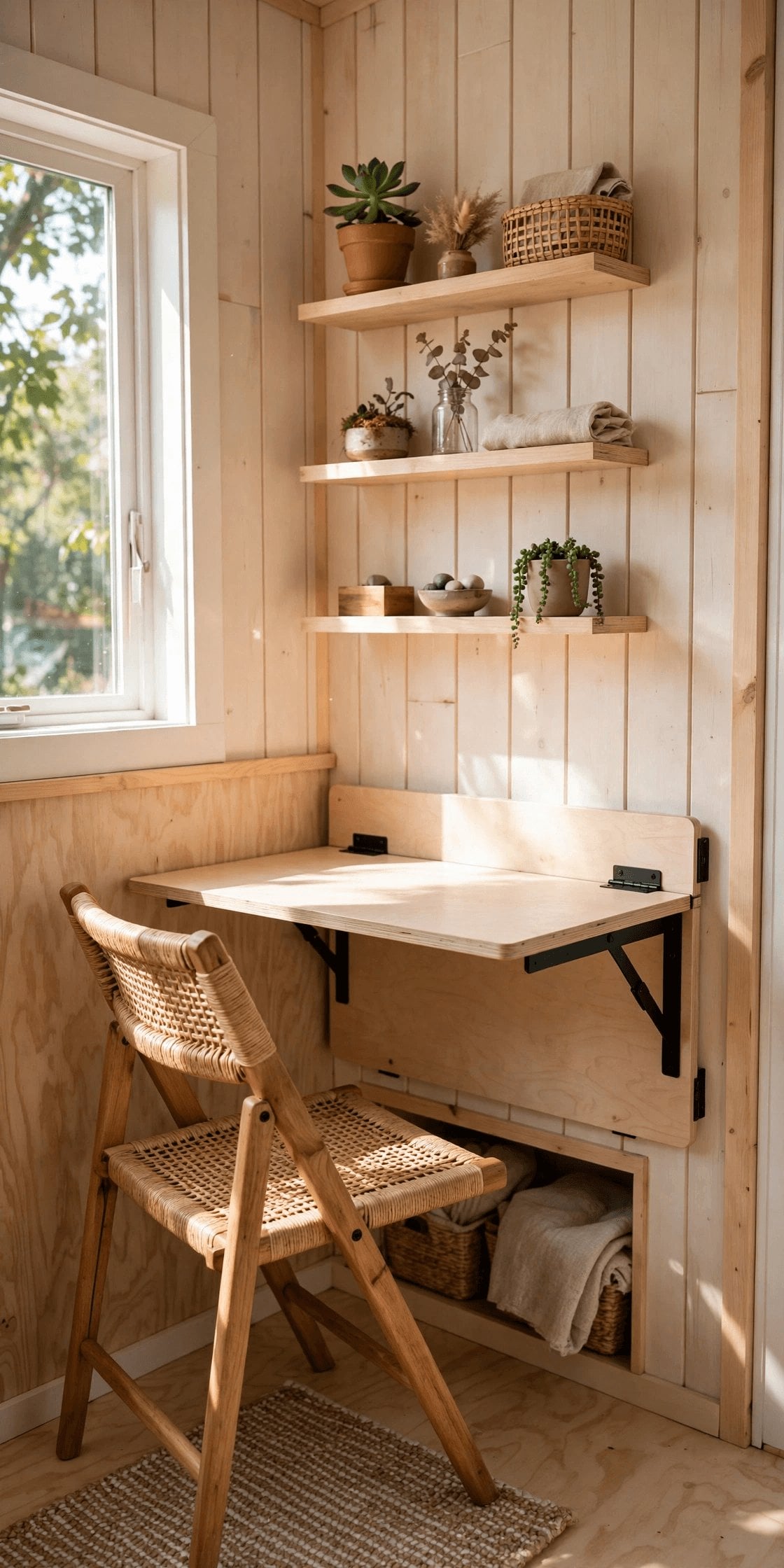
1. The fold-down wall desk mounts at seated elbow height and drops to a flat panel when the day ends, returning the floor to the room completely. Fit it with a stay or chain that holds the surface level under a laptop and a mug, and be honest about its limit: it suits laptop work beautifully and wobbles under heavy typing or a second screen, so test your real workload before you commit the wall.
2. The floating ledge desk is a deep, wall-fixed shelf with no legs to trap feet or a chair. Run it only as long as you truly need, keep the wall fixings into studs or proper anchors, and leave the space beneath empty so knees, a footrest and a tucked chair all fit. Its trade-off is permanence: it cannot move for guests, so place it where a permanent ledge will never block a bed, a door swing or a walkway.
2. Nooks, Closets and Corners
When no wall can spare a desk, look for volume the home is wasting. Alcoves, the slope under a loft and the end of a hallway all hold work surprisingly well, and reading how to frame a tiny house loft helps you judge which of those awkward spaces are structure and which are free to claim.
3. The closet office, or cloffice removes a little-used closet door, fits a shelf at desk height and keeps the frame, so the whole workstation closes away behind a curtain or the original door. Measure your chair inside the open closet before you build anything: many closets fit a desk but not knees and a chair back together, and the honest fix is a shallower shelf and a stool rather than a squeezed chair you dread.
4. The corner return wraps a short second surface around the corner from the main desk, turning a dead angle into the place for a notebook, a drink and the phone that otherwise colonise the keyboard zone. Keep the return narrow and at the same height as the desk, and let it be the only place where non-screen things land, so the main surface stays clear enough to start work without a tidy-up first.
3. Vertical Storage Behind Doors
In a small workspace, storage should climb, not spread, and it should close. Open shelves above a desk look charming in photographs and shout in real life. Fixings matter here, and the guidance on lightweight interior wall finishes for tiny houses is a useful reminder to keep wall-mounted weight modest and spread across proper anchors.
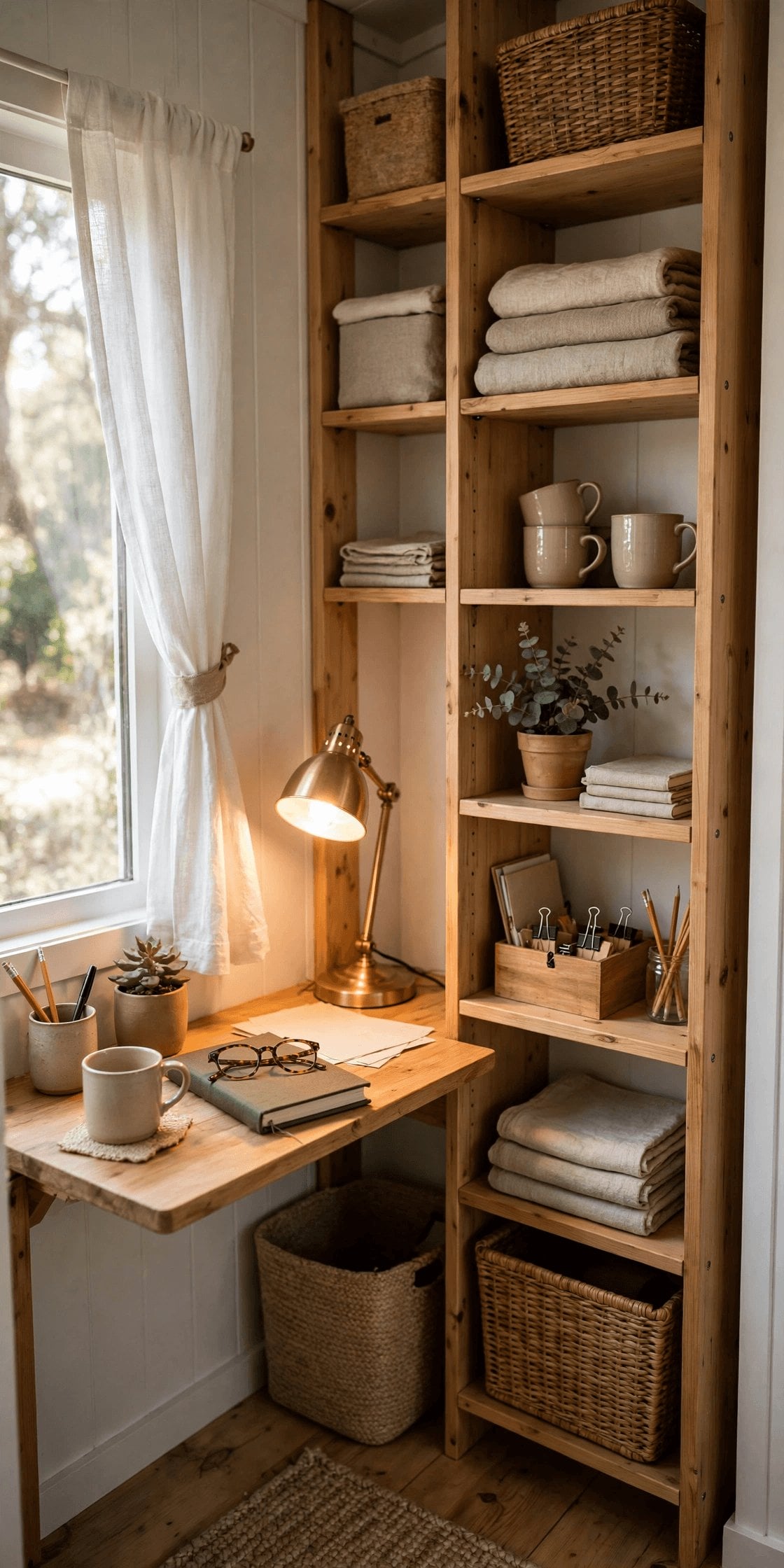
5. The tall, narrow closed cabinet takes files, a printer and the ugly kit up a single vertical strip beside the desk, using height the room was ignoring. Choose doors over open fronts, stand it where its door can swing fully, and put the heaviest items at the bottom so the unit stays steady. Its cost is visual: a tall cabinet darkens a corner, so keep its finish close to the wall colour and let it disappear.
6. High shelves with boxes, not displays run above door and window height for archives and seasonal kit, all of it in matching lidded boxes you can lift down one-handed. Label the box ends, keep everyday items below shoulder height, and accept the rule that makes it work: if it goes on the high shelf, it is storage, not decor, and it earns no right to multiply.
4. Seating That Fits the Work
The chair is the largest object in most tiny workspaces and the one people compromise on first, which is backwards. You sit in it longer than you sleep in the bed some weeks. Choose seating by the tuck test: at the end of the day, it should slide fully under the desk or fold away, returning the floor to the home.
7. The compact chair that tucks completely has a low or armless profile, casters that roll on your actual floor, and a back you have genuinely sat against for an hour before buying. Measure the desk underside and the chair at its widest point, not its seat. The trade-off is real: compact chairs support shorter frames better, so taller workers should prioritise seat depth and add a cushion rather than shrinking themselves to fit the furniture.
8. The perch stool and footrest pairing covers the short-task hours: answering messages, reviewing pages, sketching. A firm stool encourages posture changes, and a low footrest under the desk makes both stool and chair more comfortable by letting your feet rest flat. Neither replaces a proper chair for a full writing day, and pretending otherwise is how small-space workers earn a sore back; treat them as the second seat, not the only one.
5. Task Light and Daylight Together
Light decides whether a corner feels like a workplace or a cupboard. The goal is two layers: daylight positioned so it never reflects in the screen, and a task lamp that can rebuild that same clarity after dark. Windows in small homes also carry heat, which is why the thinking in how to insulate a tiny house belongs in a desk decision too: a seat beside single glazing can be bright and still be the coldest chair you own.
9. The side-on window seat places the desk so daylight falls across the work from the left or right, never from behind the screen or straight into your eyes. Test the spot at your actual working hours, morning and late afternoon, before fixing anything to the wall. If glare wins at one hour, a simple sheer or blind fixes it more cheaply than moving the whole desk, and keeps the daylight that makes the corner feel generous.
10. The layered lamp plan pairs one focused task lamp at the desk with one softer ambient light for the room, so video calls stop looking like interrogations and evening work stops straining your eyes. Choose bulbs by warmth and keep them consistent across the room; mixed colour temperatures make small spaces feel unsettled in ways people blame on clutter. Clamp or wall-mount the task lamp to keep its footprint off the desk entirely.
6. Paper, Cables and the Small Stuff
Desks in small homes rarely drown in furniture. They drown in chargers, cables, notebooks and the paper that arrives one sheet at a time. Give each category one closed home within arm’s reach, and make the home smaller than the habit, so editing is forced gently and often rather than in a yearly purge.
11. The single in-tray rule allows exactly one tray or shallow box for incoming paper, and everything in it is decided weekly: filed into the cabinet, acted on, or recycled. Beside it, one notebook and one pen live on the desk; the rest live in storage. The system sounds strict and feels kind, because a desk that starts clear makes starting work noticeably easier on the mornings motivation is thin.
12. The cable spine and charging drawer gather every cord into one covered route down the desk leg and one drawer or box where devices charge out of sight. Label both ends of each cable once, leave slack for a standing or shifted desk position, and keep one spare charging lead in the drawer rather than a nest of them. Ventilation matters: charging boxes get warm, so choose one with air gaps and never bury it under paper.
7. Screens, Calls and Sound
A tiny workspace usually shares air with the kitchen, the bed or both, so calls and concentration need designing, not hoping for. Small changes to screen height and to what sits behind you repay themselves on every single call.
13. The raised laptop and separate keyboard lift the screen toward eye level on a stand or a sturdy stack, with a compact external keyboard and mouse doing the typing. It is the cheapest posture fix available and it folds flat when guests come. Be honest about the footprint: the setup takes more desk depth than a bare laptop, so measure before you buy, and store the stand vertically in the cabinet when the desk folds away.
14. The deliberate call backdrop arranges what the camera sees: a plain wall, a curtain or the closed cabinet doors, with soft things nearby to calm echo. A rug, cushions and lined curtains make a small hard room sound noticeably warmer on calls. Keep the backdrop boring on purpose. Your colleagues should remember what you said, not study your shelving, and a calm background is also kinder when the rest of the room is mid-week chaos.
8. Boundaries You Can Close
The deepest problem of working in 200 square feet is not space. It is that work never visibly ends, so the home never fully becomes a home again. Boundaries in a tiny workspace are rituals and signals more than walls, and they work when everyone in the house can read them without a conversation.
15. The closable edge gives the desk one thing that shuts: a curtain on a ceiling track, a folding screen, the closet door from idea three, or simply the fold-down desk itself closing flat. Use it at the same time each day. The physical act takes ten seconds and tells your brain the shift is over far more clearly than closing a laptop lid, which the evening self will reopen for one more message.
16. The signal system agrees one visible cue for do not disturb: headphones on, a small lamp lit, or the curtain half-drawn during calls. In a shared tiny home this prevents the constant whisper-negotiations that exhaust both people. Keep the signal rare and respected; if everything is urgent, nothing reads as urgent, and the boundary collapses into background noise within a fortnight.
9. Air, Warmth and All-Day Comfort
Comfort failures end more tiny workspaces than layout failures. A desk you leave because you are cold, stuffy or headachy is a desk that migrates to the sofa, and then to the bed. Treat air and warmth as part of the workstation, using the same thinking as tiny house ventilation, HRV and mould prevention and, for cold floors, underfloor heating options for tiny houses, scaled down to one seat.
17. The fresh-air habit cracks a window or runs ventilation for a few minutes each hour, or times breaks to the door opening anyway. Carbon-heavy, still air makes afternoon thinking genuinely slower, and in a small sealed home the effect arrives faster than in a big house. If your desk sits far from an opening window, a small quiet fan moving air across the room helps more than sitting beside a heater blowing at your face.
18. The personal warmth layer heats the worker, not the room: a wool throw for legs, warm socks or a small heated pad at the feet, and a desk positioned out of the draught line between door and window. It is cheaper, kinder and more effective than raising the whole home’s temperature for one seated person, and it travels with you when the desk folds away and the same chair becomes the reading chair.
10. Storage Beyond the Desk
Even the best vertical storage fills. The mature tiny workspace keeps an overflow plan outside the work corner, so archives and spare kit have somewhere honest to go that is not the desk, the chair or the bed.
19. The remote archive moves finished projects, tax papers and reference books to one labelled box in a hallway cupboard, under-bed store or linen shelf. The desk keeps only live work. Set the box size once and let it discipline you: when the archive is full, something old leaves before anything new joins. Paper is heavier than it looks, which is why the same respect for load behind tiny house weight limits, GVWR and axle ratings applies to shelving in a home on wheels.
20. The mobile work caddy is a single handled box or rolling cart holding the day’s kit: laptop, notebook, chargers, headphones. It sets up the desk in two minutes, clears it in one, and lets the same table host breakfast, work and dinner in turn. Its discipline is size. One caddy, everything inside it; if the kit outgrows the caddy, the kit gets edited, not the caddy replaced with a bigger one.
Final Considerations
A tiny workspace is finished not when it photographs well but when an ordinary workday leaves no trace by dinner. The last two ideas protect exactly that, and they matter more than any single piece of furniture in this roundup.
21. The five-minute closing reset ends each day by clearing the surface to empty, filing the tray’s arrivals, coiling the cable and closing the boundary from idea fifteen. Five minutes is the honest cost; anyone promising less is selling something. Tie it to an existing cue, like the kettle for evening tea, and the habit survives tired days when willpower alone would not.
22. The weekly ten-minute edit reviews the whole workstation once a week: what arrived, what never got used, what is quietly becoming permanent that should not be. Remove one thing most weeks. Small spaces do not fail in dramatic collapses; they fail by accumulation, one reasonable object at a time, and the weekly edit is the only ritual on this list that reverses accumulation while it is still painless.
Build the layers in order, desk first and rituals last, and judge each one by the same test: does the room feel calmer at seven in the evening? A workspace in 200 square feet will never be generous, but it can be complete, closable and genuinely yours, and that is what lets the rest of the tiny home stay a home.


0 Comments