

In Louisiana, water writes the rules for every tiny home. Humidity soaks into framing, storms test every tie-down, and low ground can put a whole build at risk before it begins. Choosing well among tiny house builders louisiana buyers consider means finding the builder type that respects those realities first.
This guide compares the four builder types — custom, semi-custom, shell, and kit and plan sellers — on what you get, what drives cost, and what to check before you sign.
1. Louisiana at a Glance: Builder Types Compared
Start with the shape of the offer, not the floor plan. Every builder in this market sells one of four basic packages, and the differences between them matter more in Louisiana than almost anywhere else: a humid subtropical climate, frequent heavy rain, and real storm exposure punish shortcuts in ventilation, moisture control, and anchoring. The table below maps each builder type to what it includes and where it sits on cost and control.
| Builder type | What you get | Cost position |
|---|---|---|
| Custom builders | Full design-build | Most control |
| Semi-custom builders | Plans + options | Mid-range |
| Shell builders | Weather-tight shell | DIY finish |
| Kit & plan sellers | You build | Lowest cost |
Four key factors decide whether a quote is trustworthy in Louisiana. Flood specification asks whether the design accounts for elevation — raised piers, stem walls, or an elevated foundation that keeps living space above local flood guidance. Humidity control asks how the wall and roof assembly handles near-constant moisture: ventilation strategy, vapor control, and materials that tolerate damp air. Delivery covers the practical route — site access, ground conditions at arrival, and how the home is set and anchored. Warranty asks what is covered, for how long, and who performs the work if something fails.
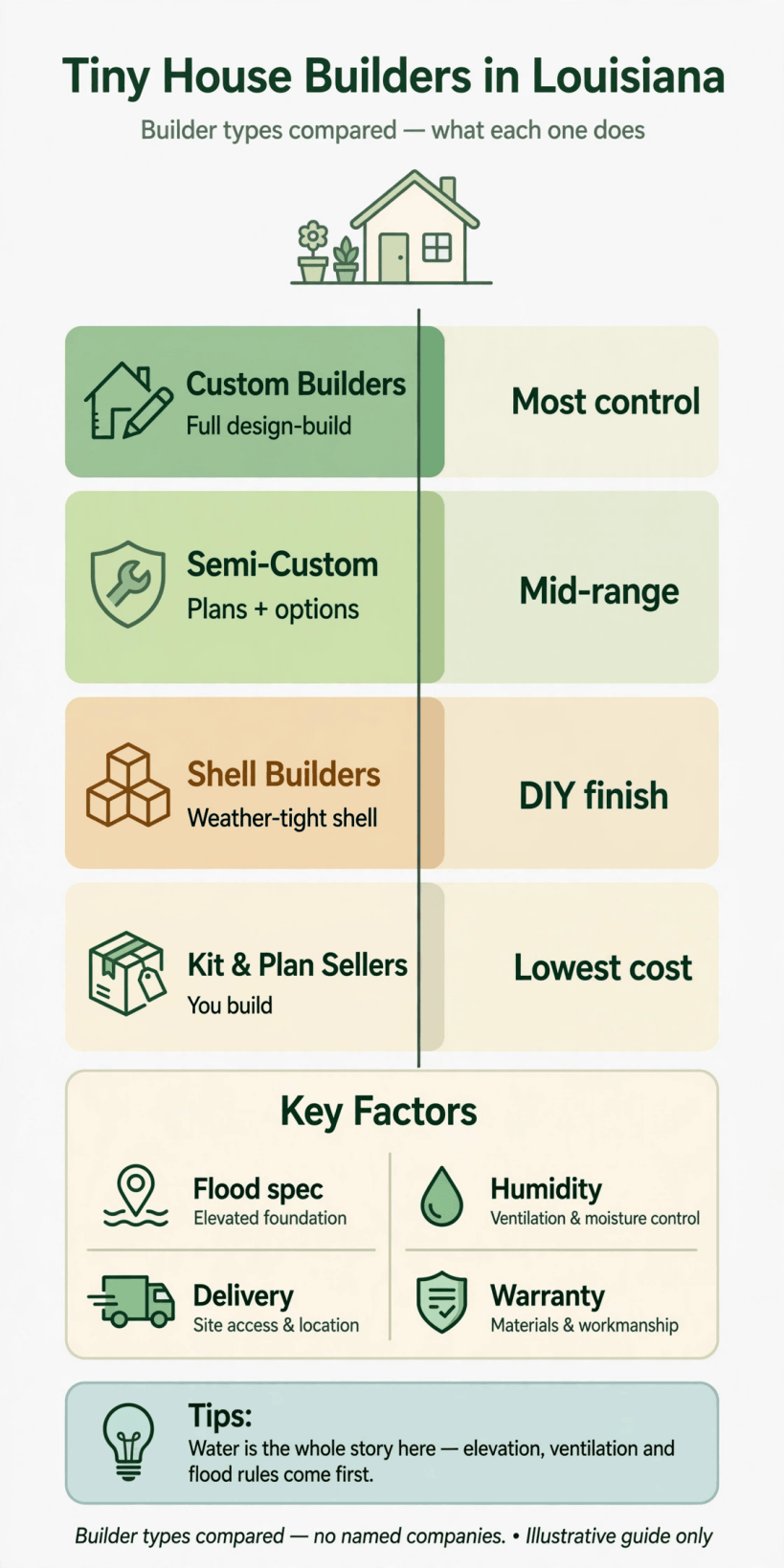
The four builder types compared for Louisiana — with the key factors of flood specification, humidity control, delivery, and warranty.
2. The Four Builder Types in Detail
Custom building is the full-service route. The builder designs around your household, your parcel, and your budget, then manages the project from first sketch to final walkthrough. In Louisiana this route has a specific advantage: a good custom builder will design for the parish you are building in — elevated floor heights where flooding is a concern, roof and wall assemblies detailed for humidity, and anchoring specified for storm exposure. You pay the most here, and you also get the most say. If you need an elevated placement, moisture-resistant detailing, or a layout shaped around an existing lot, custom is the natural fit.
Semi-custom building is the balanced middle: resolved plans, known costs, and personal choices inside a fixed menu. The builder starts from a proven design and lets you select finishes, fixtures, and a defined set of options. The trade is flexibility for predictability — pricing is clearer and timelines are shorter than custom, but you cannot redesign the structure. Ask which options touch the moisture and elevation details: can the standard plan be raised, can the ventilation package be upgraded, and what does each change cost? A semi-custom builder with Louisiana experience will already have answers.
Shell builders deliver a weather-tight structure — framed, roofed, dried-in — and leave the interior to you. The appeal is a professional structure at a lower price with the freedom to finish inside on your own schedule. The risk sits entirely in the handoff: the shell must be genuinely weather-tight on day one, because Louisiana humidity does not wait for your finish schedule. If the roof, windows, and flashing are not right, moisture enters the assembly while you are still choosing cabinets. If you go this route, inspect the dried-in shell the way how to get a tiny house built is usually taught — envelope first, finishes later.
Kit and plan sellers provide materials packages or drawings while you provide the labor. This is the lowest-cost route and the highest-sweat-equity one. Plans alone are only paper; a kit is only as good as its cutting list and instructions. In Louisiana, be especially honest about the moisture detailing: flashing, ventilation, and vapor control are not forgiving of improvisation. Before you commit, be realistic about which jobs you can finish, which you can learn, and which you must pay a professional to do — and price the professional help in from the start.
3. What a Louisiana Build Costs — and What Drives It
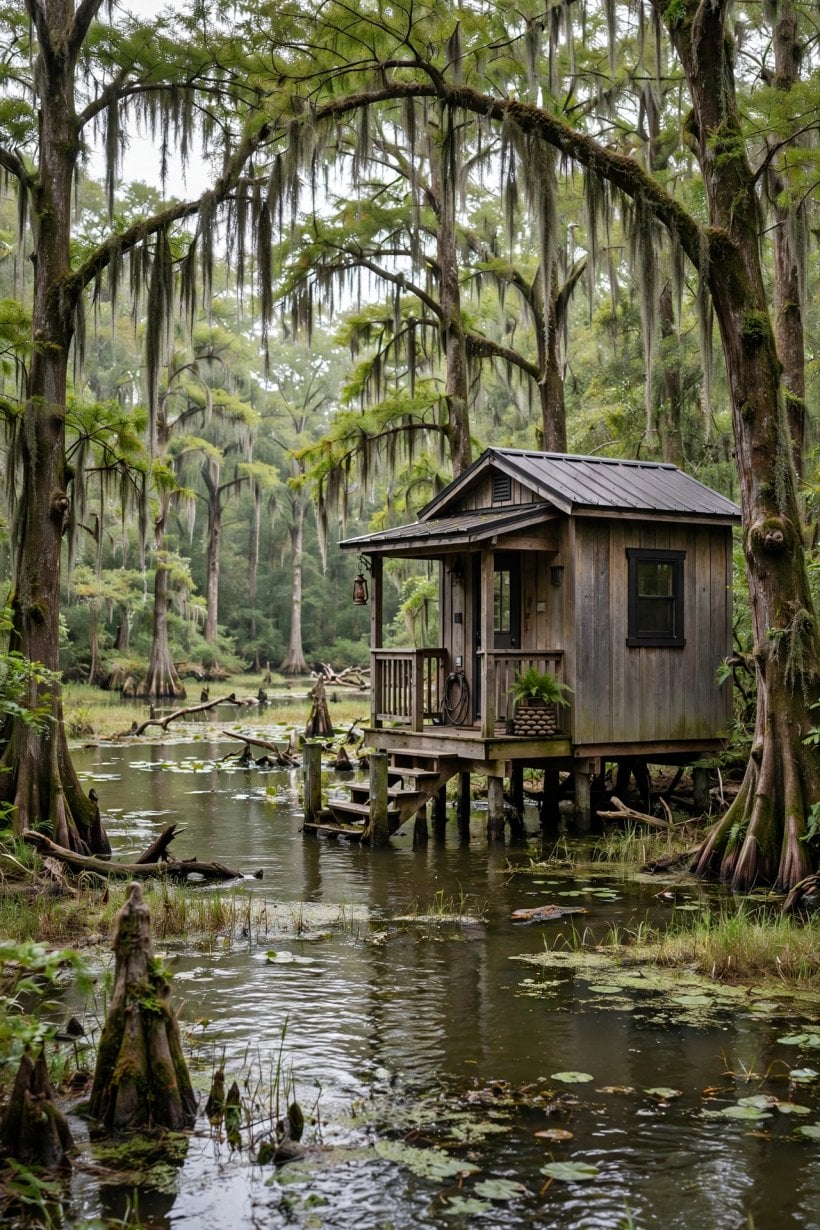
Quoted prices move within a wide band, and the band exists for reasons you can see and question. The biggest cost driver is the builder type itself: a full custom design-build commands more than a semi-custom plan, which commands more than a weather-tight shell, which commands more than a kit you assemble yourself. After that, size and complexity set the next big step — more square feet, more plumbing runs, more custom joinery, more money.
Louisiana adds its own line items. Elevated placement — raised piers or stem walls that lift the floor above local flood guidance — costs more than a simple slab or low skid, and it is money that protects everything above it. Moisture detailing costs more than basic framing: proper ventilation, vapor control, flashing, and humidity-tolerant materials add up, and skipping them costs more later. Delivery and setting vary with distance, site access, and ground conditions; a soft lot after rain can complicate a delivery that would be routine on dry, firm ground. Site preparation — clearing, grading, utility runs, and anchoring — is often quoted separately, so ask whether it is included before you compare two numbers.
The practical move is to compare quotes at the same level of completeness. Ask every builder to quote the same scope: structure, finishes, delivery, setting, and site work, each listed separately. A quote that looks low often turns out to be incomplete rather than cheap. If you need to borrow, read tiny house loans and lenders before you sign anything — the financing route you choose changes what documentation the builder must provide.
4. Certification, Classification and Why They Matter
Two words get confused here, and the confusion can be expensive. Certification describes a third-party standard the home is built and inspected to — a documented way of saying the structure, electrical, and plumbing meet a defined bar, verified by someone other than the builder. Classification describes what the finished home is legally treated as: a recreational vehicle, a manufactured home, a modular dwelling, or a site-built residence, depending on how it is constructed and where it sits.
Why does this matter in Louisiana? Because classification shapes everything downstream. It affects where you can place the home, whether you can get a mortgage on it, how it can be insured, and which building rules apply. A home classified for road use faces different expectations than one classified as a permanent dwelling on a foundation. Ask the builder, in writing, what certification the build carries and how the finished home is classified — and then check with your parish that this classification is welcome where you intend to put it. The builder’s word and the parish’s word should agree; when they do not, the parish wins.
Documentation closes the loop. Ask the builder what paperwork arrives with the home: the certification plate or label, the inspection records, the classification paperwork, and a written statement of the standard the home was built to. Keep these documents with the contract — a future buyer, lender, or insurer will ask for them, and a home with complete paperwork is easier to finance, insure, and resell. If the builder cannot produce certification paperwork, treat the claim of certification as unverified, no matter how confidently it was made.
5. Placement and Rules: Check With Your Parish and City
Louisiana’s equivalent of a county is the parish, and the parish is where placement questions get answered. Zoning rules vary parish by parish and city by city: minimum dwelling sizes, whether a tiny home on wheels is treated differently from one on a foundation, setback requirements, and floodplain overlays that add elevation or construction conditions. A builder can tell you what they have delivered before, but only the parish planning office can tell you what is allowed on your parcel.
Before you commit to a builder, make the call yourself. Ask the planning office: is a tiny home permitted as a primary residence on this parcel; does the parish distinguish between wheeled and foundation-built homes; what permits are required and what do they cost; and are there floodplain or stormwater conditions that change how the home must be built or anchored? Write down the answers — names, dates, and reference numbers — and share them with the builder so the design reflects the rules from day one. A builder who has worked in your parish will already know the questions; a builder who has not should be willing to learn them with you.
6. Foundations, Elevation and Louisiana Weather
The foundation conversation in Louisiana starts with water. Raised piers and stem walls are the workhorses here: they lift the living floor above standing water and flood guidance, they allow air to move under the structure, and they make anchoring straightforward. Slabs and low skids sit closer to the ground and closer to the problems that ground can bring. Whatever the system, the finished floor height should reflect local flood guidance, not the lowest number the builder can defend.
Above the foundation, anchoring and tie-downs carry the storm conversation. High winds test every connection between home and ground, so ask how the home is anchored, what hardware is used, and what wind performance the system is designed for. Then comes humidity — the quiet, constant force. Wall and roof assemblies need a deliberate ventilation strategy and vapor control, materials that tolerate damp air, and an HVAC approach that handles latent moisture load rather than just temperature. An undersized or poorly detailed system will cool the air while leaving the moisture, and moisture is what grows mold and rots framing.
Walk every foundation and envelope claim back to specifics: how high is the finished floor, how is the home anchored, where does vapor go, and how is fresh air exchanged? Builders who answer in details are builders who have thought about Louisiana. Builders who answer in slogans have not.
7. The Build Process, Step by Step
A well-run project follows a visible sequence. It starts with the conversation: your household, your parcel, your budget, and the parish rules that frame all three. Then comes design and specification — the plan, the materials, the elevation and moisture details, and a written scope that names what is included. Permits come next, where applicable, and the builder should either handle them or tell you exactly what you must do.
Construction itself is the long middle: foundation or trailer preparation, framing, envelope and roofing, mechanicals, insulation, and interior finish, with inspections at the stages the certification or parish requires. Ask how progress is documented — photos, checklists, and walkthrough milestones keep a long project honest. Delivery follows: transport to the site, setting on the foundation or piers, anchoring, and utility connections. The final walkthrough closes the project — every system tested, every finish inspected, and a written punch list for anything incomplete.
Keep your own paperwork parallel to the builder’s. Contracts, change orders, payment receipts, inspection reports, and correspondence should live in one place. The building a tiny house checklist is a useful spine for this — work through it alongside the builder’s schedule and you will catch missing steps before they become expensive surprises.
8. Questions to Ask Before You Sign
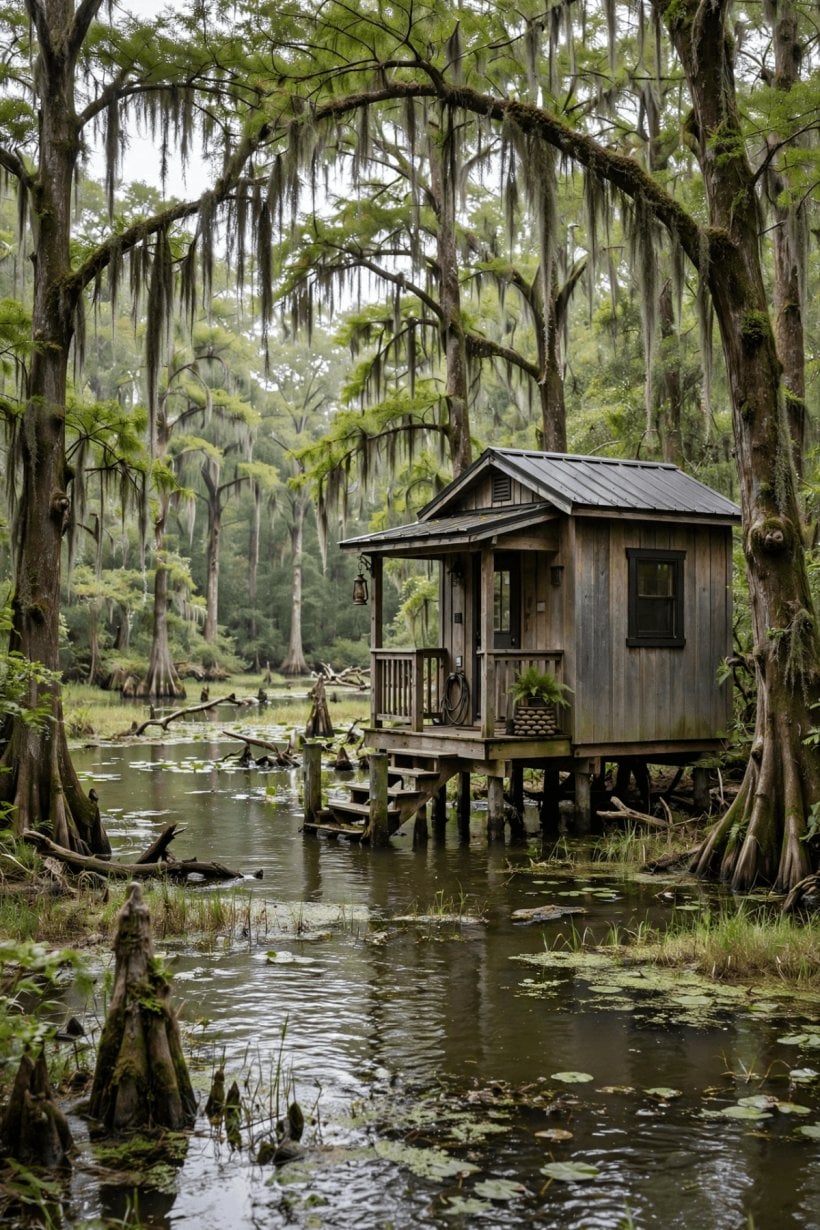
The right questions are specific, and they deserve written answers. Start with scope: exactly what is included in the quoted price, and what is excluded? Which appliances, fixtures, and finishes are in the base, and what costs extra? Then move to the Louisiana-specific items: how is the finished floor elevated relative to local flood guidance; how is the home anchored against storms; what is the ventilation and vapor-control strategy; and which materials are chosen for humidity tolerance?
Then the project questions: what is the realistic timeline, and what happens if it slips? Who are the subcontractors, and who supervises them? How are change orders priced and approved — in writing, before the work, every time? What does the warranty cover, for how long, and who performs warranty work — the builder or a third party? Can you speak with past clients, and can you see a completed home in person? A builder who welcomes these questions has good answers. A builder who deflects them does not.
9. Contracts, Payments and Warranties
The contract is the project in writing, and it should read like one. It names the full scope, the materials and specifications, the timeline, the total price, and the process for changes. Anything the builder promised verbally and would not put in writing should be treated as not promised. Read the change-order clause with particular care: in a long build, changes are normal, and the contract should say how they are priced, who approves them, and that no change proceeds without a signed order.
Payments should follow milestones, not the calendar. A deposit to begin, then payments tied to verifiable stages — foundation complete, dried-in, mechanicals roughed, finishes complete — with a meaningful holdback until the final walkthrough and punch list are done. Be cautious of anyone asking for most of the money up front or cash-only terms; both are classic warning signs. Warranties come in two layers: the builder’s workmanship warranty and the manufacturers’ warranties on appliances, roofing, and systems. Get both in writing, with durations and claim procedures, before you pay the final installment.
Two money topics deserve their own reading. Whether you can get a mortgage on a tiny house depends heavily on classification and foundation — a question to settle before you design, not after. And how to insure a tiny house in a storm-exposed state is its own project; start the insurance conversation early, because coverage terms can reshape the build specification.
10. Red Flags and How to Compare Quotes
Some signals mean walk away. A quote far below every competitor usually means missing scope, not efficiency. Vague specifications — “quality materials,” “standard finishes” — are not specifications at all. No written warranty, no verifiable references, no physical address, pressure to sign today, cash-only terms, or a demand for most of the money before work starts: each of these is a reason to stop, and any two together are a reason to run.
Comparing honest quotes takes a simple method. Put every quote into the same columns: builder type, scope included, materials specified, elevation and anchoring detail, timeline, payment schedule, and warranty. Line up the rows and the real differences appear — one builder includes delivery and setting, another does not; one specifies the ventilation strategy, another leaves it blank. The cheapest honest quote is the one with the fewest blanks, not the lowest number.
Delivery deserves its own line in the comparison. How to transport a tiny house through Louisiana means thinking about route, ground conditions at arrival, and the equipment needed to set the home — costs that vary widely and that some builders include while others leave to you. Confirm who handles transport, who insures it in transit, and who is responsible if the site is not ready on delivery day.
Final Considerations
Louisiana rewards builders who design for water first and everything else second. Match the builder type to your budget and your appetite for involvement, verify the parish rules before you commit, and insist on written specifics for elevation, anchoring, moisture control, and warranty. The patterns here travel well: readers comparing tiny house builders in Kansas face wind and winter where you face humidity and storms, while tiny house builders in Kentucky sit between the two. Choose the builder type that fits your situation, and let the written details do the deciding.


0 Comments