

Maryland packs a coastline, a major metro corridor and Appalachian foothills into one of the smallest states in the country, and that geography shapes everything about going tiny here. Land near Baltimore and the Washington suburbs is expensive and tightly zoned, land in the western mountains and on the Eastern Shore is comparatively cheap and loosely regulated, and a large share of the state drains into the Chesapeake Bay, which adds an environmental layer most states never have to think about. Tiny House Laws in Maryland are therefore not one rulebook but twenty-four local ones: twenty-three counties plus Baltimore City each decide what counts as a dwelling, how small it may be, and where it may stand.
This guide works through the full Maryland picture in the order the problems actually appear. It separates tiny houses on wheels from tiny houses on foundations, explains how the state building code and Appendix Q apply, covers minimum sizes, zoning, accessory dwelling units, septic realities near the Bay, and the permits that turn a small build into a legal home. The honest summary up front: Maryland is very workable for a foundation tiny house or a backyard ADU, conditional for a tiny house on wheels, and unforgiving anywhere the land fails a percolation test — so choose your county before you choose your floor plan.
1. Tiny House Laws in Maryland at a Glance
The table below answers the questions Maryland buyers ask first. Every answer is a starting point for a county conversation, not a substitute for one, because the county — and often the town inside it — writes the rule that will actually govern your lot.
| Question | Maryland in brief |
|---|---|
| Are tiny houses legal in Maryland? | Yes, but legality is decided locally. There is no single state approval for tiny houses; a foundation tiny house that meets the building code and county zoning is legal in much of the state, while wheeled units face stricter limits. |
| Is a tiny house on wheels a house or an RV? | In most Maryland counties a wheeled tiny house is regulated as a recreational vehicle, not a dwelling. That usually means campground or RV-park stays and time limits rather than permanent residential use on a private lot. |
| Does the state building code cover tiny houses? | Maryland’s statewide building standards are based on the International Residential Code, but counties adopt and amend them locally, and the IRC’s tiny-house appendix (Appendix Q) applies only where the county has adopted it — ask before you rely on it. |
| How small can a tiny house be? | There is no single statewide minimum size. Some counties and older subdivisions set minimum dwelling sizes that can block a very small footprint, so the minimum that matters is the one in your county zoning code and your deed restrictions. |
| Where can I live in one full-time? | The reliable routes are a code-built foundation tiny house on land you own, a permitted accessory dwelling unit behind an existing house, or a space in a licensed campground or RV park if your unit is on wheels. |
| Can I add a backyard tiny house as an ADU? | Increasingly, yes. State-level ADU reforms in Maryland push counties and towns toward allowing accessory units on single-family lots, and several large counties already run mature ADU permit programs — with size, parking and owner-occupancy conditions attached. |
| What about water and sewer? | Public sewer where it is available; otherwise a county-approved septic system sized by a percolation test, and near the Chesapeake Bay new systems commonly need nitrogen-reducing technology. A failed perc test can end a project before it starts. |
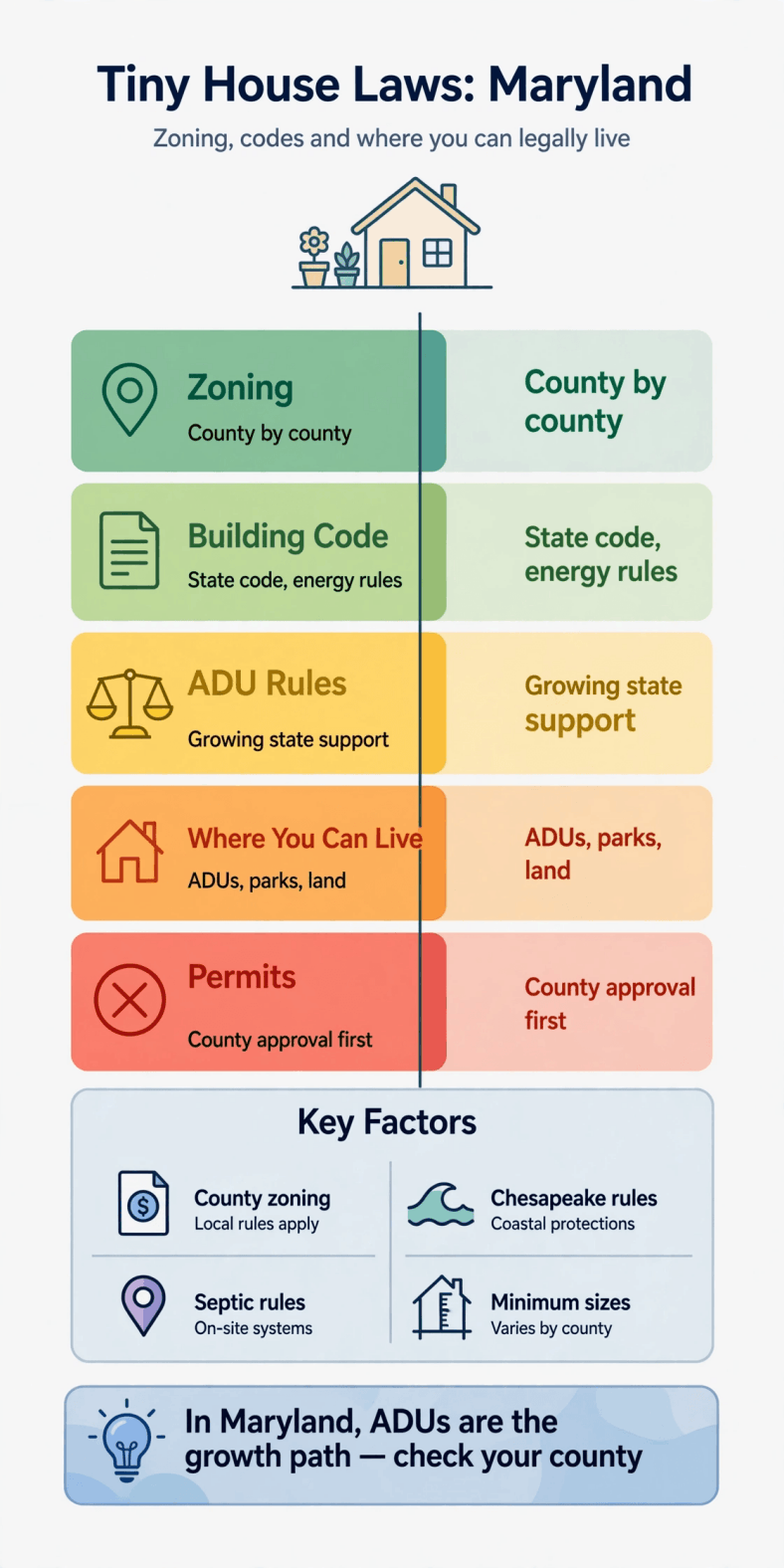
Tiny house laws in Maryland — the whole picture on one chart: county zoning first, septic and shoreline rules next, wheels versus foundation throughout.
Read the table as a filter. If your plan survives the county, the shoreline and the septic questions, the remaining sections explain how Maryland’s building code, minimum sizes and permit process will treat the house itself — and the final section turns it all into an order of operations.
2. Legal Status: Tiny Houses on Wheels vs on a Foundation in Maryland
Every Maryland decision starts with one classification: is the building a dwelling or a vehicle? A tiny house built on a permanent foundation, connected to approved water and sewer, is reviewed as a small single-family dwelling. It goes through plan review, inspections and a certificate of occupancy, and when it passes it is a house in the eyes of the county, the tax assessor, lenders and insurers. Its size raises code questions, but its right to exist as a residence is not really in doubt.
A tiny house on wheels lands in a different box. Maryland counties generally regulate wheeled units under their recreational vehicle and campground rules, which means the unit is expected to stay mobile, stay registered, and stay somewhere vehicles are allowed to be occupied — licensed campgrounds, RV parks, and private land only where local rules permit RV living, often with strict day limits. Hooking a wheeled unit to a septic tank and a mailbox does not convert it into a dwelling in most counties.
The registration side matters as much as the zoning side. If you go the wheeled route, work through how to register a tiny house as an RV so the unit is titled and tagged correctly, and understand what RVIA certification means for a tiny house, because Maryland campgrounds and insurers frequently ask for the RVIA or a comparable standards seal before they will accept a home-built wheeled unit. Neither document overrides county zoning — they simply prove the unit is what you say it is.
The trade-off is honest: wheels keep the build cheaper and movable but cap where and how long you can live in it; a foundation costs more in permits, utility connections and site work, and buys you permanence, financing and resale value. In a state where rural land an hour from the metro corridor can cost a fraction of suburban land, many Maryland owners decide the foundation premium is worth paying once rather than renegotiating their housing every season.
3. Building Codes for Tiny Houses in Maryland
Maryland builds under statewide standards based on the International Residential Code (IRC), administered through the Maryland Building Performance Standards, and each county adopts the code with its own amendments and enforcement office. That structure produces a familiar pattern: the general rules look the same across the state — structure, fire safety, egress, sanitation, energy — while the details that decide a tiny build, from stair geometry to ceiling heights, are interpreted by your county’s plans examiner.
For houses of 400 square feet or less, the pivotal document is IRC Appendix Q, which relaxes the usual code pressure points for tiny houses: it permits sleeping lofts with reduced ceiling heights, allows ladder and alternating-tread access to lofts under conditions, and scales emergency escape requirements to small footprints. Appendix Q is optional at adoption, and Maryland counties have not moved in lockstep, so the single most valuable phone call in a Maryland project is asking your county whether Appendix Q is in force locally. Our explainer on IRC Appendix Q for tiny homes walks through what it changes and what it leaves untouched — including the parts of the code, like foundations, wind bracing and sanitation, that apply at full strength regardless.
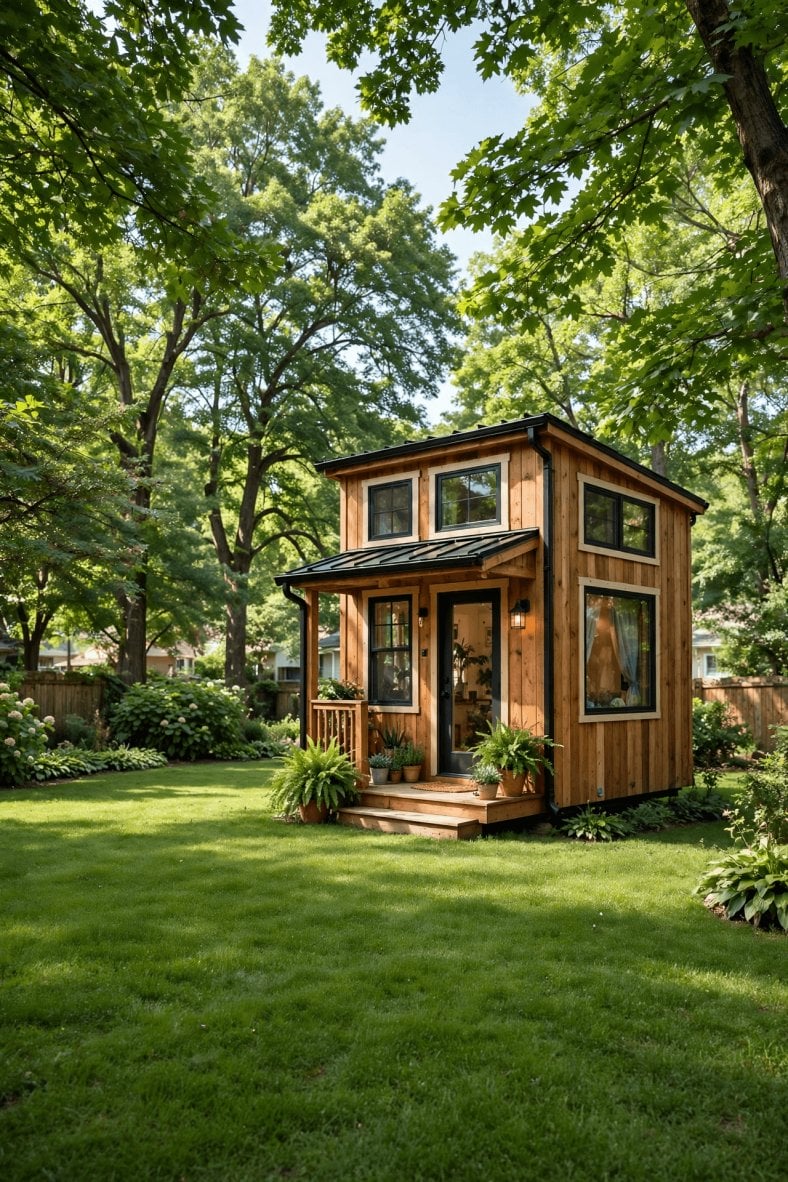
Tiny house laws in Maryland — pin this overview for the build: Appendix Q status, septic approval and shoreline rules decide most Maryland projects.
Regional engineering matters too. Western Maryland counties design for real snow loads and freeze-thaw cycles; coastal counties design for wind, driving rain and flood elevations; and energy-code compliance is checked statewide, which in a tiny footprint mostly means good insulation, sealed ductwork where it exists, and properly sized heating. A tiny house that would sail through review in a mild climate can need deeper footings, more bracing or a raised foundation here, and those changes are far cheaper on paper than after framing.
One more Maryland-specific caution: manufactured and modular small homes follow separate state programs with their own insignia and installation rules. Do not assume a factory-built unit’s state approval settles the county’s zoning questions — placement, foundation and utility rules still apply lot by lot.
4. Minimum Size Requirements for Tiny Houses in Maryland
Maryland sets no single statewide minimum house size, which misleads many buyers into thinking size is a free choice. In practice, four separate floors can apply at once. The building code, through Appendix Q where adopted, contemplates dwellings down to very small footprints provided rooms, ceilings and egress meet its scaled rules. County zoning may set a minimum dwelling size or minimum width for new homes in particular districts. Older subdivisions and HOA covenants frequently carry their own minimums written decades ago, and those private restrictions bind you even when the county does not. Finally, septic design rules effectively size a house by bedrooms, and a health department will permit the system for the bedroom count on the plan, not the one in your head.
The practical effect: a 320-square-foot foundation house can be straightforward on an unrestricted rural lot in one county and flatly impossible two counties away behind a 1,000-square-foot zoning minimum. Minimum-size rules are exactly the kind of provision counties amend quietly, so verify the current text rather than relying on a forum post, and get the answer tied to your parcel’s zoning district, not the county in general.
Loft sleeping deserves a sentence of its own. Where Appendix Q is adopted, lofts are a legitimate way to keep a footprint small; where it is not, a loft may be classified as storage rather than a bedroom, which affects both legality and the septic sizing above. Decide early whether your sleeping space needs to be a legal bedroom, because that decision ripples through the permit set.
5. Zoning and Placement Rules for Maryland Tiny Houses
Zoning is where Maryland tiny projects live or die. Counties divide land into districts — residential, agricultural, rural, commercial, and special resource categories — and each district lists which uses are allowed. A foundation tiny house is usually reviewed as a single-family dwelling, so it is welcome anywhere a conventional house is, provided lot size, setbacks, height and coverage limits are met. Agricultural and rural-resource districts in western Maryland and the Eastern Shore are often the most forgiving for small homes on large lots, while suburban residential districts add the minimum sizes and design standards discussed above.
The shoreline overlay is Maryland’s signature complication. Land within the Chesapeake Bay Critical Area — broadly, the band extending about 1,000 feet from tidal waters and wetlands — is regulated for development intensity, tree clearing and impervious surface, and local Critical Area programs review projects inside it. A tiny footprint can actually help here, since small roofs and driveways add little impervious cover, but the review is real, buffers from the water are enforced, and lots that look buildable on a map can shrink dramatically once the buffer is drawn. Floodplain rules layer on top along the coast, the Bay and inland creeks: expect elevation requirements and flood insurance where maps put your lot in a hazard area.
Placement mechanics are unglamorous and decisive: setbacks from property lines and roads, well and septic separation distances, driveway access permits on state and county roads, and erosion-control approval for disturbed ground. Before any of it, learn how to talk to zoning officials about tiny houses — in Maryland the pre-application conversation with the county planning office is free, fast, and routinely saves projects that arrive as finished drawings.
6. ADU Rules: Backyard Tiny Houses in Maryland
For many Marylanders the realistic tiny-house route is not a stand-alone house at all — it is an accessory dwelling unit (ADU): a small second home on a lot that already has a main house. Maryland has spent the last several years pushing local governments to open this door wider, and recent state-level ADU legislation requires jurisdictions across the state to make room for accessory units on single-family lots, with counties and towns writing the implementing rules on size, parking, setbacks and owner occupancy. Implementation is still rolling out place by place, which makes the county’s current ADU ordinance — not headlines about the state law — the document that governs your project.
The mechanics are consistent statewide even where numbers differ. An ADU normally needs its own building permit, code compliance as a dwelling, and water and sewer capacity: a public-sewer connection where available, or a health-department finding that the existing septic system can legally serve the added bedroom. Detached ADUs — the form a tiny house usually takes — attract the most conditions, including height limits and separation from the main house and lot lines, while attached and conversion ADUs are typically easier.
Economically the ADU route is Maryland’s quiet bargain. The land is already bought, utilities are already at the street, and the unit can house family, offset a mortgage with rent where renting is allowed, or become the main-house downsizing plan later. The compromises are equally real: the ADU stays legally tied to the main property, most programs require the owner to live on the lot, and resale treats the tiny house as part of the parcel rather than a separate asset. If those terms fit, an ADU permit is the lowest-friction legal tiny house in most of suburban Maryland.
7. Where You Can Legally Live in a Tiny House in Maryland
Pulling the threads together, Maryland offers five realistic places to live tiny. First, a foundation tiny house on your own land in a district that allows single-family dwellings — the default, fully legal endpoint most of this guide aims at. Second, a permitted detached ADU behind an existing house, increasingly available across the state. Third, a licensed campground or RV park for wheeled units, where stays are governed by the park’s licence and the county’s occupancy limits — workable for seasonal living, restrictive for permanent residence. Fourth, private land hosting a wheeled unit where the county allows RV occupancy, which exists in pockets of rural Maryland but is always time-limited and must be verified in writing, not assumed. Fifth, a manufactured-home community, which accepts manufactured homes built to the federal HUD code but not site-built or wheeled tiny houses — a separate product, worth not confusing with the first four.
Before choosing between the park and private-land routes, read the comparison of tiny house communities versus RV parks: tenure, utility quality, winterisation and exit costs differ sharply in a state where a January cold snap tests every hose and holding tank. Also be blunt about enforcement. Maryland counties vary, but complaint-driven enforcement is the norm — a wheeled unit tolerated on a relative’s farm for years can still be ordered out after one neighbour complaint, and “nobody has said anything” is not a legal strategy in a state with this much shoreline scrutiny.
8. Permits, Inspections and Documentation in Maryland
A legal Maryland build assembles its paperwork in a predictable order. The county planning and zoning office confirms the use is allowed on the parcel. The health department approves water and sewage — a well permit and a septic permit backed by percolation testing for off-sewer lots. The building office reviews plans under the adopted code, issues the building permit, and inspects footings, framing, rough mechanicals and final work before a certificate of occupancy is granted. Driveway entrances, sediment control on disturbed soil, and Critical Area or floodplain reviews slot into the same timeline where they apply.
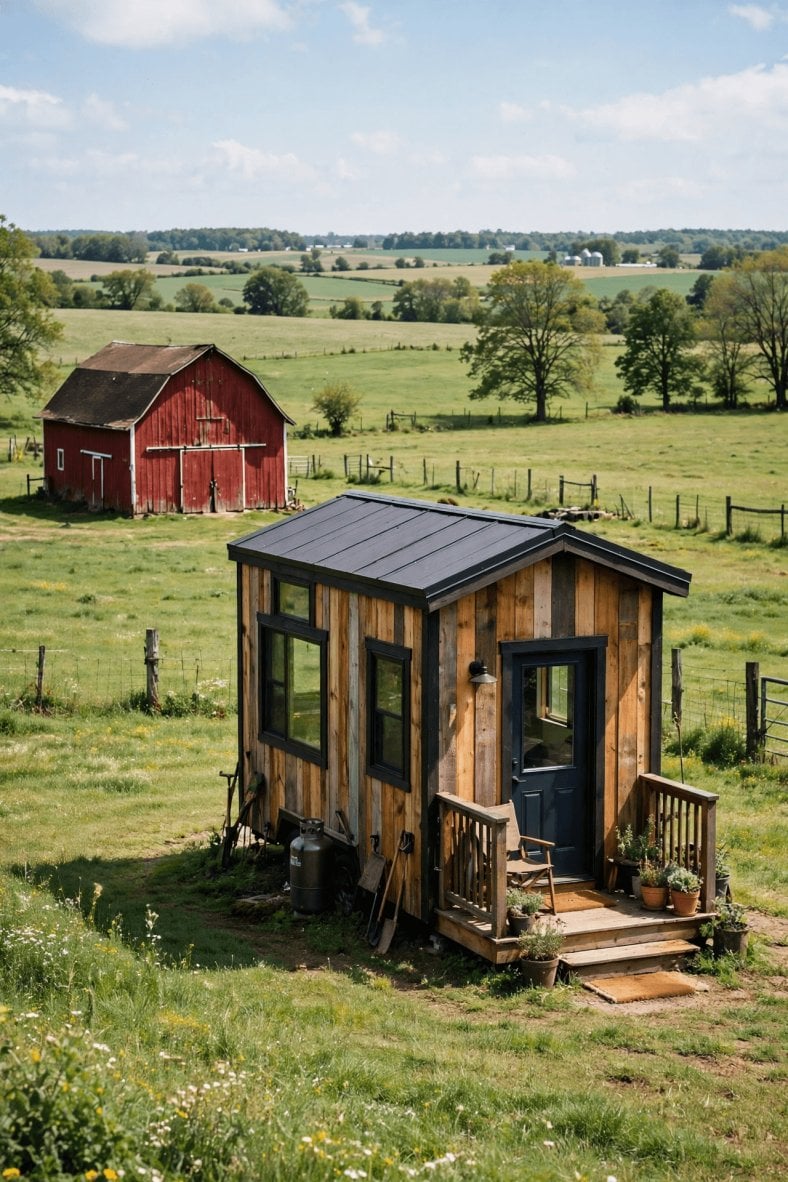
Tiny house laws in Maryland — the permit trail at a glance: zoning confirmation, health-department approval, then building inspections to occupancy.
Two Maryland details save real money when handled early. First, septic: in the Critical Area and much of the Bay watershed, new and replacement septic systems are expected to use nitrogen-reducing best-available-technology units, which cost meaningfully more than a conventional system and need ongoing maintenance agreements — budget for the system your lot will actually require, not the cheapest one in a catalogue. Second, timing: perc tests and health-department reviews run on their own calendars and wet-weather windows, and a missed season can add months, so the septic file should open before the house plans are final, not after.
Keep the whole file — zoning confirmation, perc results, permits, inspection sign-offs, the certificate of occupancy — permanently. Maryland buyers, lenders and insurers all ask for it, and a documented legal tiny house sells for what it is; an undocumented one sells as a problem.
9. Notable County and City Examples in Maryland
Montgomery County is the state’s ADU benchmark: a mature accessory-unit program close to the Washington suburbs lets homeowners add small second dwellings under defined conditions, and its permit guidance is the clearest in Maryland. The trade-off is price — it is also among the most expensive land markets in the state — but as a regulatory model it shows what organised ADU legalisation looks like, and its experience is one reason state-level reform found support.
Baltimore City operates under its own zoning code as an independent city, with rowhouse lots, conversion opportunities and an ongoing push to make small and accessory units easier to permit; detached backyard units face tight lots and alley access realities, but the city’s building stock and land prices make it a natural tiny market if the paperwork is respected. Frederick County blends suburban growth with a rural west, and is a common landing spot for foundation tiny builds that want metro access without metro land prices. Anne Arundel County adds the full shoreline package — Critical Area review, septic scrutiny and flood maps — around Annapolis and the western shore.
The state’s two rural ends are where stand-alone tiny houses breathe easiest. Garrett and Allegany counties in the mountains offer large lots, agricultural zoning and lower land costs, with winter design and well-and-septic logistics as the price of admission. On the Eastern Shore, counties such as Wicomico, Somerset and Worcester combine agricultural land with strict shoreline and septic rules, plus seasonal and campground economies near Ocean City where wheeled units fit the existing RV infrastructure. None of these examples replaces a parcel-level check; they show where each type of Maryland project tends to find its welcome.
10. How to Go Tiny Legally in Maryland: Practical Steps
Step 1: Pick the county before the house. Shortlist two or three counties that match your budget and your route — foundation, ADU or wheels — and confirm each one’s current position on small dwellings, Appendix Q and minimum sizes. Maryland’s county-first structure makes this the highest-value research you will do.
Step 2: Interrogate the specific lot. For any parcel, pull the zoning district, Critical Area status, flood map and any subdivision or HOA minimums, then ask the health department about septic feasibility before money changes hands. A cheap lot that cannot perc or sits inside a buffer is not cheap.
Step 3: Design to the adopted code. Fix the legal questions in the drawings: bedroom status for lofts, egress, ceiling heights, foundation and wind or snow design for the region, and energy compliance. Plans that answer the examiner’s questions in advance move measurably faster.
Step 4: Sequence the permits. Zoning confirmation, then health-department approvals, then the building permit, keeping every approval in writing. Do not pour footings on a verbal yes, and do not order a wheeled unit for a lot whose occupancy answer you have not seen on paper.
Step 5: Prepare the site like a small subdivision. The discipline in how to prepare land for a tiny house — access, grading, drainage, erosion control — is not optional in a state that reviews disturbed soil near waterways. Small houses still move full-size trucks and dig full-size trenches.
Step 6: Engineer the utilities honestly. Well yield, septic sizing, electrical service and freeze protection all belong in one plan; tiny house utilities: power, water and sewage explained covers the trade-offs. Maryland winters punish exposed plumbing from the mountains to the Shore, whatever the brochure promises.
Step 7: Finish the paper trail. Pass final inspection, collect the certificate of occupancy, register or title any wheeled unit correctly, insure the home as the dwelling or vehicle it legally is, and file everything where a future buyer or lender can find it.
Final Considerations
Maryland is neither the easiest nor the hardest state in this series — it is the most parcel-dependent. Within one small state, a project can meet a mature ADU program in Montgomery County, a shoreline review in Anne Arundel, a septic wall on the Eastern Shore and a permissive agricultural district in Garrett County, all under the same state flag. That variance is the real headline: your Maryland outcome will be decided by a county office, a soil test and a shoreline map far more than by the house you choose.
The opportunity is genuine to balance it. Foundation tiny houses and ADUs face no structural hostility here, state policy is moving toward more accessory housing, and rural land remains attainable by East Coast standards. Do the county homework first, respect the Bay, size the septic honestly, and keep the documentation — and a small, legal, permanent Maryland home is an entirely realistic result.