

Texas is the state everyone cites when they argue tiny houses should be simple: no state zoning code, counties that famously cannot zone, cheap land by the horizon, and a live-and-let-live reputation. The reputation is half right, and the wrong half is the expensive half. Texas counties largely cannot zone — but Texas cities can and do, Texas subdivisions carry deed restrictions with the force of private law, and Texas HOAs can ban the exact house the county happily permits. Tiny house laws texas is therefore less a story about government permission than about reading the deed: the freedom is real, and so are the neighbours’ covenants.
This guide separates the two: how wheeled and foundation houses are classified, building codes and who actually enforces them, minimum sizes in code and in covenants, the county-zoning myth and the city reality, accessory dwellings in Austin, Houston and beyond, tiny-home communities and other legal places to live, permits and utilities from septic to floodplain, and the practical steps that keep a Texas project standing. The summary up front: rural Texas offers some of the easiest tiny-house placement in America — once the deed restrictions, utility easements and septic soil have all said yes.
1. Tiny House Laws in Texas at a Glance
The table below answers the questions Texas readers ask first. The pattern is the reverse of most states: public law is permissive and quiet, while private restrictions — deed restrictions, HOA rules and subdivision plats — do most of the deciding.
| Question | Texas in brief |
|---|---|
| Are tiny houses legal in Texas? | Widely, yes. A small house on a foundation on land where dwellings are allowed is a legal home across most of the state, and in unincorporated counties there is usually no zoning permission to obtain at all. |
| Is a tiny house on wheels a house or an RV? | Generally an RV or vehicle. Full-time living in one belongs in RV parks, campgrounds, tiny-home communities and other settings that accept it — city rules often bar RV living on ordinary residential lots. |
| Which building code applies? | Texas has state-adopted model codes as a baseline, while cities adopt and enforce their own editions inside their limits; many unincorporated areas have no residential building inspection, though septic, floodplain and utility rules still apply. |
| How small can a house be? | Enforced codes set room-level minimums, not a state whole-house minimum. The binding size limits are usually private: deed restrictions and HOA rules routinely require minimum square footages far above tiny. |
| Are backyard cottages and ADUs allowed? | In the big cities, increasingly yes — Austin and Houston have both moved toward easier accessory dwellings, each in its own way, while deed restrictions can still override the city’s welcome on a given lot. |
| Where can I live in one full-time? | In a foundation house on suitable land, an allowed accessory unit, a tiny-home community, a manufactured-home community, or a park placement for wheeled units. |
| What surprises buyers most? | Deed restrictions. Buyers check zoning, find none, celebrate — and then read the covenants recorded against their lot decades ago, requiring a minimum-size site-built home. |
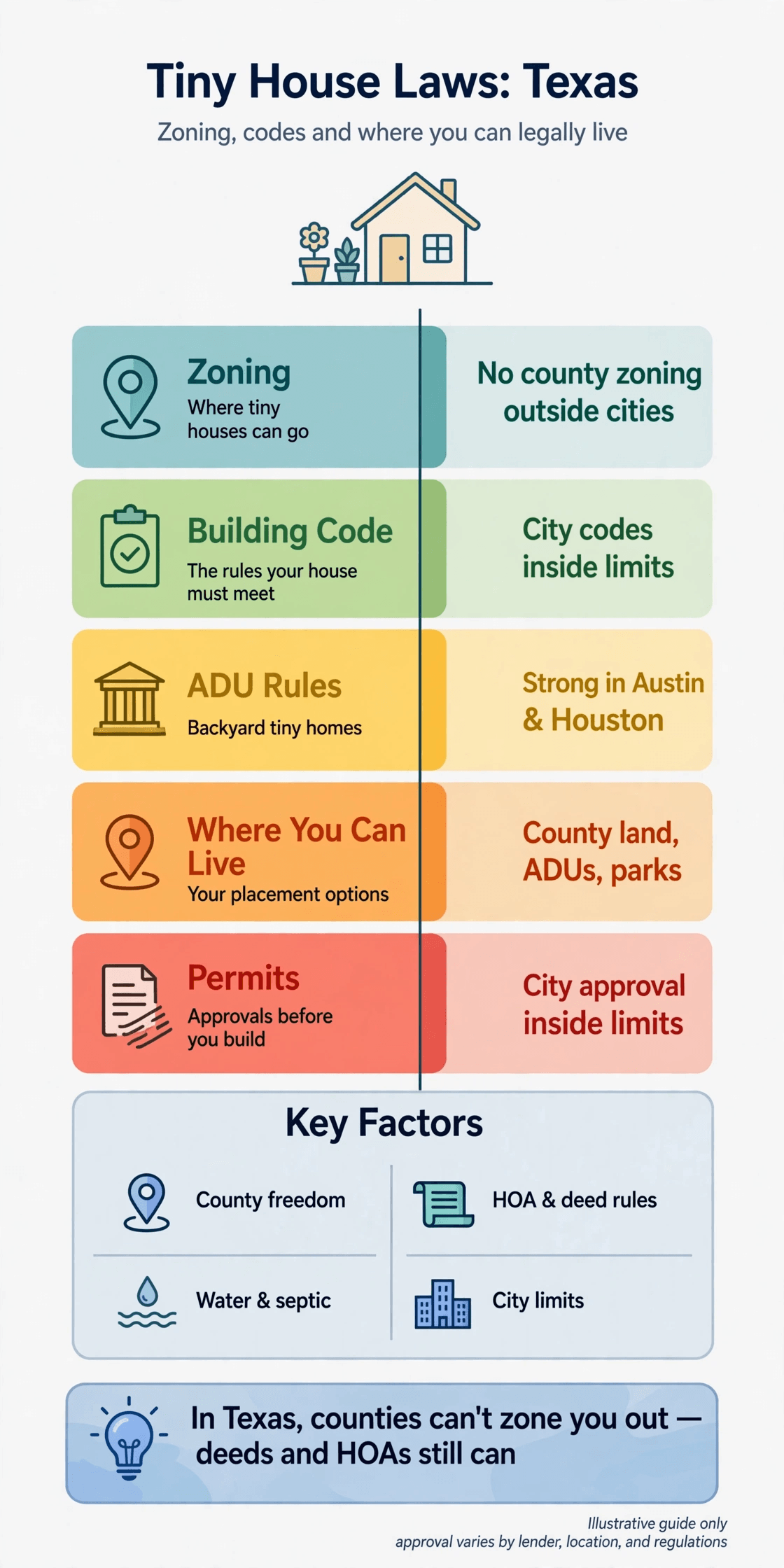
Tiny house laws in Texas at a glance — always confirm details with your city or county before you buy.
Read the table with the deed in your other hand. In Texas the public file — zoning, permits, floodplain — is the easy half of diligence; the private file recorded at the county clerk is where tiny-house projects go to die, and it is available to anyone willing to read it before closing.
2. Legal Status: What Counts as a Dwelling in Texas?
Texas sorts small homes by construction and wheels. A site-built house on a permanent foundation is a dwelling. A manufactured home follows the federal HUD code under the state’s manufactured-housing framework. A tiny house on wheels is ordinarily a recreational vehicle or vehicle, with occupancy expectations to match — which is why RVIA certification for tiny houses matters when parks, lenders or cities ask what exactly your home is.
Classification then drives the practical triangle of placement, finance and cover — work through tiny house insurance for wheels vs foundation before assuming a wheeled build on rural land is the cheap route. In unincorporated Texas almost anything can be placed; the questions that follow — can it be insured, financed, connected and resold — are where classifications collect their rent.
3. Building Codes for Tiny Houses in Texas
Texas adopts statewide baseline codes drawn from the international model codes, and its cities layer their own adopted editions, amendments and permitting on top. Inside city limits, expect a conventional process: plans, permits and inspections against the locally adopted residential code, including its room, ceiling, stair and egress minimums — the small-house design constraints that the model code’s tiny-house appendix can soften only where that appendix has actually been adopted locally.
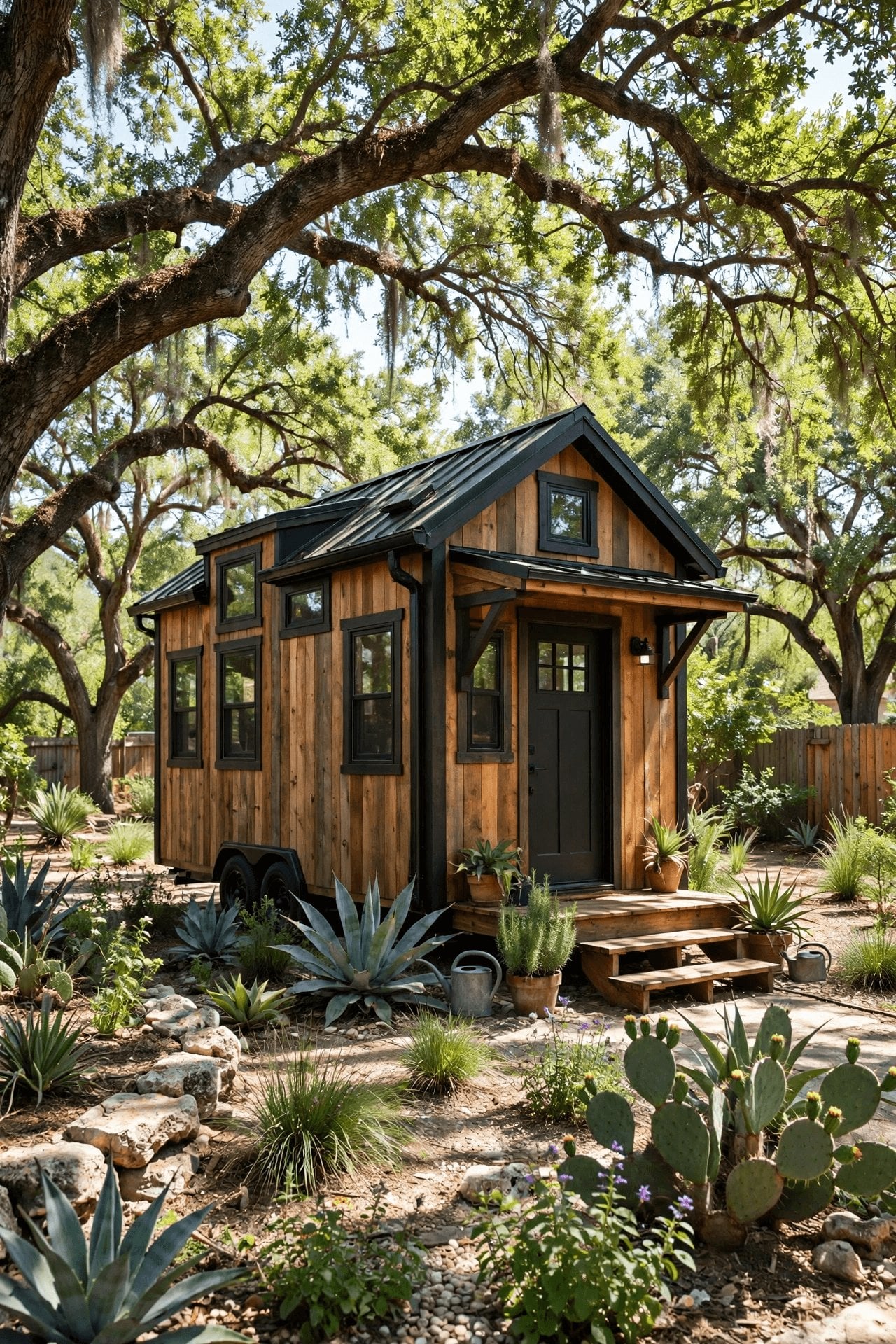
Outside city limits the picture thins dramatically: many counties run no residential building permitting or inspection at all. Freedom again cuts both ways — nobody inspects, and nobody certifies. Lenders, insurers and future buyers will ask the code questions the county skipped, and in wind and hail country the code’s structural core is also simply how a small house survives its first decade of Gulf weather, Hill Country storms and Panhandle wind.
4. Minimum Size and Occupancy Rules
No Texas statute sets a minimum size for a house. Enforced residential codes set the familiar room-level minimums, and some cities have historically carried minimum dwelling sizes in their ordinances or development codes — verify yours, because they change as housing politics shift. But the minimums that actually govern most Texas lots are private: subdivision deed restrictions commonly require houses of a stated minimum square footage, built of stated materials, on permanent foundations — three clauses that between them exclude most tiny houses, wheeled or not.
Occupancy rules complete the picture. City ordinances regulate RV occupancy on lots, the number of unrelated occupants and short-term rentals — Houston and Austin both police rental use actively — while counties regulate little of it. The pattern is consistent: in Texas, if a size or occupancy rule is going to stop your project, it was probably written by a city council or recorded by a developer, not enacted by the state.
5. Zoning and Placement: No County Zoning, Real City Zoning
Here is the famous freedom, stated precisely: Texas counties have only the land-use powers the state grants them, and general zoning is not among them, so unincorporated land usually carries no use zoning at all. Counties do regulate subdivision plats, septic systems, floodplain development and some nuisances — real rules, but not zoning. Cities are the opposite: Texas home-rule cities zone comprehensively, and their extraterritorial reach and development rules can touch land beyond the city line, so start any project with zoning laws for tiny houses and a map of whose limits your parcel sits in.
Then read the private layer: the recorded restrictions for your subdivision or, on unrestricted rural land, confirmation that none exist — get it from the county clerk’s records or a title commitment, not a seller’s assurance. Follow with the land work in preparing your land for a tiny house: easements, access, water and septic decide whether unrestricted land is buildable land, and in Texas those two adjectives part company often.
6. Accessory Dwelling Units (ADUs) in Texas
Austin has made accessory dwellings a flagship housing policy, progressively easing the path for backyard cottages and secondary units through code reforms — with details on size, lot eligibility, parking and rental use that Metro amendments keep revising, so verify the current Austin rules for your lot rather than relying on any summary. Houston is the fascinating counterpoint: famously without conventional zoning, it regulates through platting, development codes and — decisively — deed restrictions, so a Houston ADU’s fate often turns on the subdivision’s private rules more than the city’s public ones.
Dallas, Fort Worth, San Antonio and the suburbs each run their own accessory-unit provisions, from defined allowances to restrictive ones, and the state’s smaller cities vary further still. The universal Texas caveat repeats: a city can allow an ADU on every lot in town and your lot’s covenants can still forbid it. Check the private file first, the public file second, and design only after both have answered.
7. Where You Can Legally Live in a Tiny House in Texas
Texas offers the widest legal menu in this series: a foundation house on unrestricted rural land, a foundation house in a city district that allows its size, an accessory unit under a city’s ADU rules, a manufactured-home community, an RV park placement for wheeled units, and the state’s growing stock of dedicated tiny-home communities — the settings are compared in tiny house communities vs RV parks, and Texas is one of the few states where the community option is a real market rather than a rumour.
Tiny-home communities deserve the emphasis the state has given them: developments marketed specifically to small and wheeled homes have multiplied around the metros and in scenic counties, offering legal long-term placements with utilities handled. Read their documents like a deed — lot rents, rules on unit age and type, and resale terms vary as much as HOAs do — because in Texas the community’s private rules are, once again, the law of your lot.
8. Permits, Inspections and Utilities in Texas
Inside cities: conventional building permits and inspections, plus floodplain and utility connection rules. In unincorporated counties: a shorter public list — septic permitting through the authorised agent or state framework after a site evaluation, floodplain development permits where applicable, driveway and culvert approvals on county roads, and utility easement compliance. The list is short enough to tempt skipping; the septic evaluation in particular should never be skipped, because it determines legal placement as surely as any zoning map.
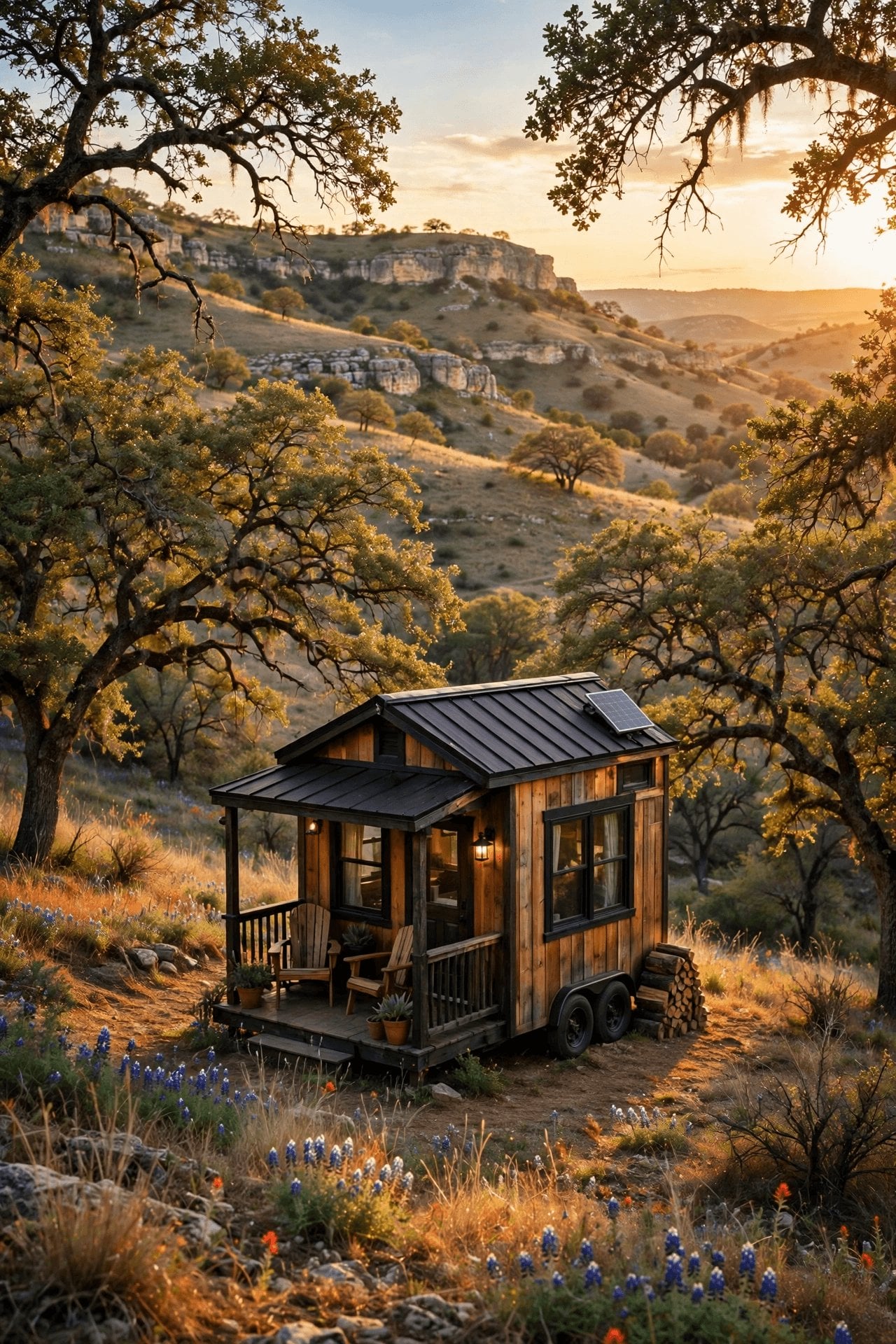
Utilities carry the rural budget. Water is the first question — well, rural water supply corporation, or rainwater where allowed — followed by power distance and septic soils; plan them with tiny house utilities: power, water and sewage before the offer, and remember that in much of West Texas the water question is geological, not administrative.
9. Notable City and County Examples
Austin is the policy leader: city ADU reforms, active tiny-house interest, and prices that push small living toward cottages, communities and the county fringe. Houston demonstrates the no-zoning paradox — public permissiveness governed by private restrictions, where one subdivision welcomes a cottage and the next bans it in a paragraph recorded in 1978. Dallas-Fort Worth’s suburbs show conventional zoning with minimum sizes and HOA layers, while San Antonio mixes city codes with large areas of attainable land at its edges.
Rural Texas — the Hill Country fringe beyond the ETJs, East Texas timber counties, the plains — is where the freedom story is simply true, tempered by septic, water, flood and the occasional unrestricted-looking lot that a pipeline easement crosses. Scenic counties add tourism and second-home pressure that lifts prices and rental scrutiny. Verify every example against the current city code and the recorded restrictions for your specific lot; in Texas more than anywhere, the lot’s paper is the jurisdiction.
10. Practical Steps and Common Pitfalls
Step 1: Classify the build. Foundation, manufactured or wheeled sets the rules for placement, finance and resale before any land is viewed.
Step 2: Read the deed restrictions. Pull the recorded restrictions or title commitment for the exact lot and search them for minimum size, foundation and use bans — first, not last.
Step 3: Map the jurisdiction. City limits, extraterritorial reach, floodplain and septic authority: write down who regulates what at this address.
Step 4: Prove the utilities. Septic site evaluation, water source and power distance priced in writing — alongside how to finance a tiny house, because unrestricted land still has to appraise.
Step 5: Paper everything. Keep permits, evaluations and approvals together; in inspection-free counties your own file is the house’s only certificate.
The recurring pitfalls are celebrating no county zoning before reading the covenants, assuming Houston’s lack of zoning means lack of rules, placing a wheeled unit inside a city that bars RV living, skipping the septic evaluation on unrestricted land, and buying a community lot without reading the community’s restrictions. Texas freedom is real, recorded and transferrable — it just lives at the county clerk’s office, not in the slogan.
Final Considerations
Texas rewards readers. Its public law steps back further than any other large state in this series — no county zoning, thin rural permitting, cities like Austin actively easing cottages — and its private law steps into the space, in covenants and community rules that are knowable in advance to anyone who looks. Buyers who look, and who prove septic, water and flood status before closing, get the genuine article: some of the easiest legal tiny-house living in the country.
Start at the clerk’s office, not the listing site: one parcel, its recorded restrictions, its flood map and its septic evaluation. Those four documents describe your Texas project more truthfully than a hundred freedom slogans — and if they all say yes, very little in this state will try to stop you.