

Utah has done something few states attempt: it has legislated in favour of small homes. State policy recognises tiny-house construction through its building-code framework and pushes cities to allow accessory dwellings, all while the Wasatch Front absorbs some of the fastest growth in America. Then geography collects its bill. The second-driest state in the union rations water like a strategy, mountain towns design for serious snow, and desert land that looks empty is empty partly because nothing reaches it — no water line, no sewer, sometimes no legal access. Tiny house laws utah is the meeting of friendly statutes and unforgiving terrain.
This guide covers both halves: how wheeled and foundation houses are classified, the statewide code and its tiny-house provisions, minimum sizes, zoning across fast-growing cities and rural counties, the state-backed accessory dwelling route, where you can legally live full-time, permits and the water question, examples from Salt Lake City to St. George to the mountain towns, and the practical steps that decide Utah projects. The summary up front: Utah is one of the best-positioned states in this series for a small foundation house or an accessory dwelling — provided the parcel has water, and the roof has the snow load to match its view.
1. Tiny House Laws in Utah at a Glance
The table below answers the questions Utah readers ask first. Note the unusual pattern: the state answers more of these questions than in most of this series — code recognition and ADU policy both carry a state signature — while cities still write placement rules and water providers quietly veto the rest.
| Question | Utah in brief |
|---|---|
| Are tiny houses legal in Utah? | Yes. A small house on a foundation, built to the state-adopted residential code on a lot where dwellings are allowed, is a legal home, and Utah’s code framework expressly contemplates tiny houses. |
| Is a tiny house on wheels a house or an RV? | Generally an RV or vehicle. Full-time wheeled living belongs in RV parks, campgrounds, tiny-home communities and other settings that accept it, rather than automatically on residential lots. |
| Which building code applies? | Utah adopts a statewide building code based on the international model codes, including the residential code with state amendments; local jurisdictions enforce it and may add local amendments within state limits. |
| What is the state’s tiny-house provision? | Utah is widely cited for including the model code’s tiny-house appendix — Appendix Q, with its tailored rules for houses of 400 square feet or less — in its statewide code conversation. Confirm the current adopted text and any local amendments with your building department before designing to it. |
| How small can a house be? | The code sets room-level minimums with small-house relief where the appendix applies. Some city zoning ordinances add minimum dwelling or lot sizes; many rural counties add few or none. |
| Are accessory dwellings allowed? | Utah state law supports internal accessory dwellings in owner-occupied single-family homes in many municipalities, and cities regulate detached units and details locally. It is one of the strongest state ADU frameworks in this series — verify your city’s current ordinance. |
| Where can I live in one full-time? | In a foundation house on suitable land, an allowed accessory dwelling, a manufactured-home community, a tiny-home community, or a park placement for wheeled units. |
| What surprises buyers most? | Water. Rights, connections and moratoria govern buildable land across much of Utah, ahead of zoning, price or design. |
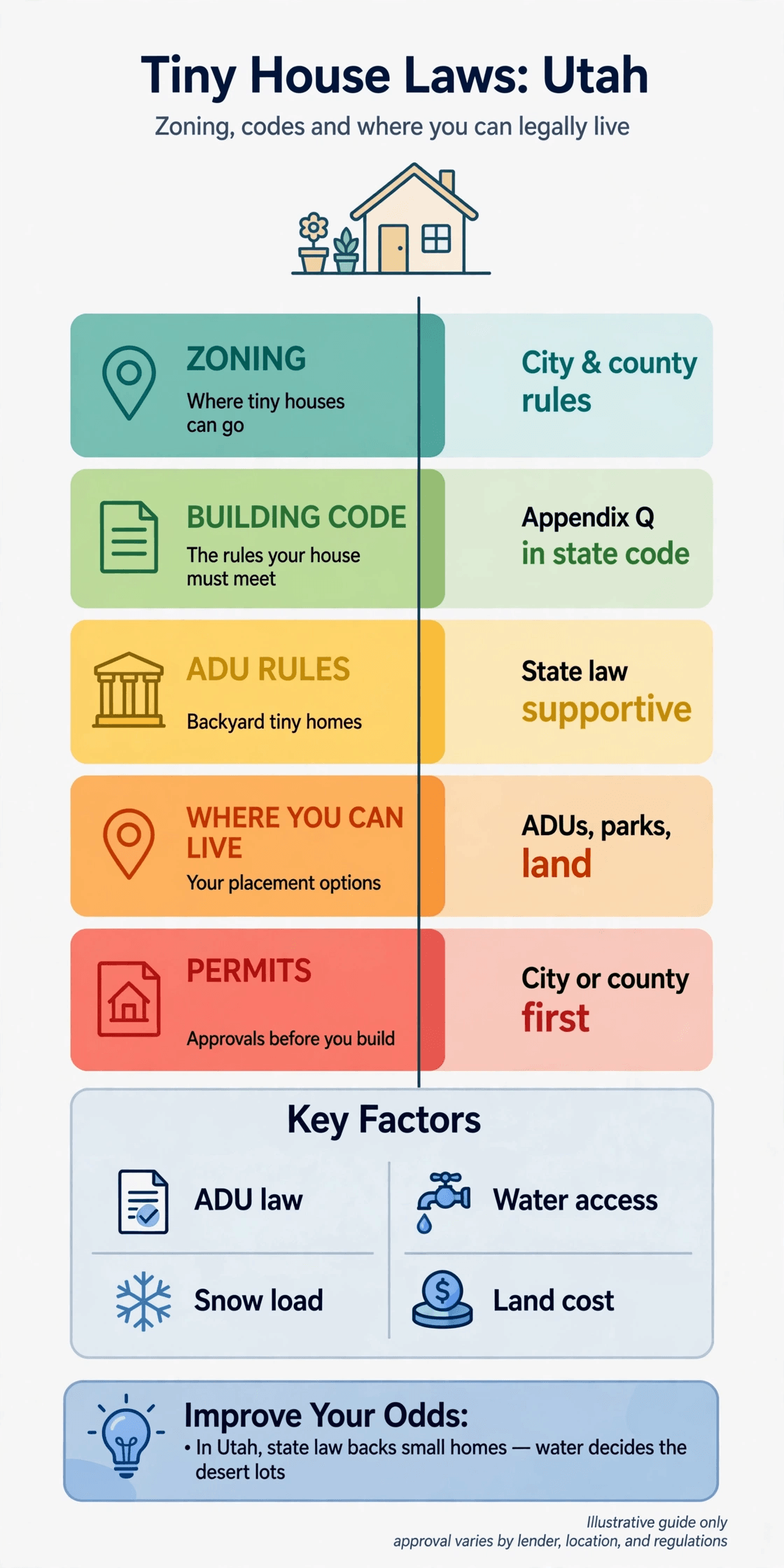
Tiny house laws in Utah at a glance — always confirm details with your city or county before you buy.
Read the table with a water map open beside it. Utah’s legal framework will rarely be the reason a project fails; the application for a water connection, the depth of the well nobody has drilled, or the subdivision plat drawn before current rules — those are the usual authors of failure here.
2. Legal Status: What Counts as a Dwelling in Utah?
Utah classifies small homes in the standard three lanes. A site-built or modular house on a permanent foundation is a dwelling under the residential code. A manufactured home follows the federal HUD construction code and state placement rules. A tiny house on wheels is ordinarily treated as a recreational vehicle or vehicle, with the occupancy limits that follow — so RVIA certification for tiny houses still matters for parks and insurers even in a tiny-friendly state.
The classification decides the practical outcomes that buyers actually feel: where the unit may sit, how it is taxed and titled, and what tiny house insurance for wheels vs foundation will cost or whether it is offered at all. Utah’s friendliness applies mostly to the foundation lane; choosing wheels means choosing the RV rulebook in Utah just as surely as in stricter states.
3. Building Codes for Tiny Houses in Utah
Utah’s statewide code, built on the international model codes with state amendments and enforced locally, gives tiny houses something rare: a recognised place in the document. The tiny-house appendix commonly known as Appendix Q tailors the residential code for dwellings of 400 square feet or less — adjusting loft access, ceiling heights and emergency escape for small plans instead of forcing tiny houses to fake being big ones. Verify the current adoption and amendments with your local building department, because editions update and local practice varies, but the starting position in Utah is unusually constructive.
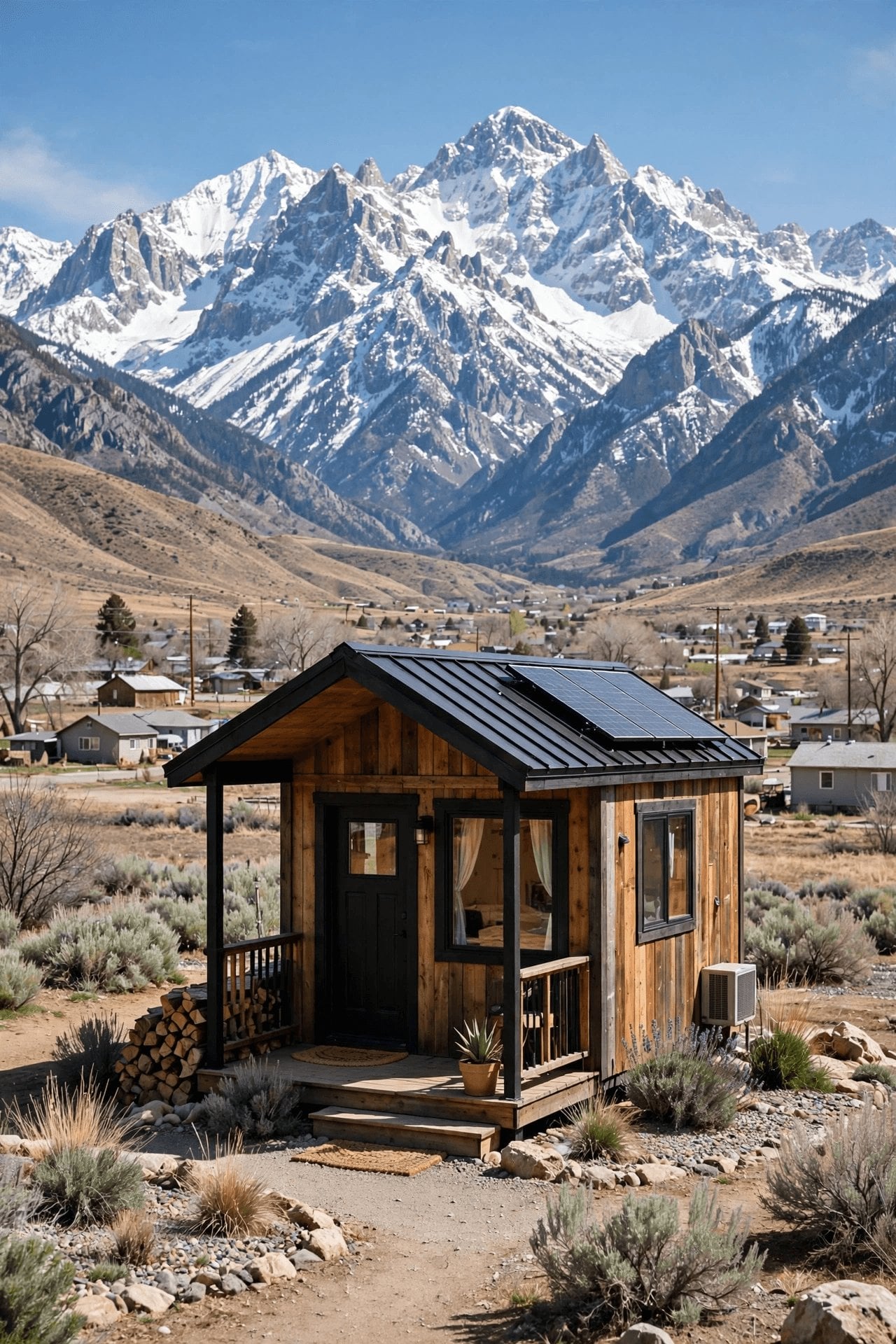
Utah then adds altitude. Snow-load design in the mountain counties is a first-order structural fact — roofs in ski-country and bench locations carry loads that would flatten a casual build — and seismic and wind provisions matter along the Wasatch fault and in exposed desert sites. A tiny house has a small roof and a small margin; design its structure for the parcel’s actual load numbers, and let the energy code’s envelope requirements work with the climate instead of against the heating bill.
4. Minimum Size and Occupancy Rules
There is no state minimum size for a Utah house. The residential code’s room-level minimums apply, softened for the smallest dwellings where the tiny-house appendix governs the design. Whole-house minimums, where they exist, are municipal choices: some city ordinances — particularly in established suburbs — set minimum dwelling sizes or large minimum lot sizes that filter small houses out of specific districts, while rural counties commonly ask nothing about house size at all.
Occupancy rules run through the ADU framework and rental regulation. Internal accessory dwellings under the state-supported model typically involve owner-occupancy conditions, and cities regulate short-term rentals separately and actively in resort and university areas. A tiny house can be a legal home and an illegal nightly rental on the same lot; establish both answers before the business plan depends on either.
5. Zoning and Placement in Fast-Growing Utah
Utah cities zone in the conventional way — districts, setbacks, lot sizes, design rules in some centres — under unusual growth pressure: the state has repeatedly ranked among America’s fastest-growing, and its cities revise housing ordinances accordingly, which means the ADU and small-lot rules you read about may be newer, older or mid-amendment. Start with zoning laws for tiny houses and then read the current ordinance for your city and district, dated, not summarised.
Counties govern the unincorporated majority of the land with a lighter touch, and private covenants govern subdivisions everywhere: minimum sizes and design rules recorded by developers bind in Utah’s newer suburbs regardless of what state ADU policy encourages. And underneath every zoning answer sits the land work in preparing your land for a tiny house — in Utah, above all, whether water legally and physically reaches the lot.
6. Accessory Dwelling Units (ADUs): Utah’s State-Level Push
Utah’s accessory-dwelling story is its signature policy. State law has pushed municipalities to allow internal accessory dwelling units — self-contained homes created within an owner-occupied single-family house — across much of the state’s residential map, while cities retain detailed control over permits, and regulate detached backyard cottages under their own ordinances, a growing number of them permissively as housing pressure builds. The result is a two-track system: internal units with a state wind behind them, detached units decided city by city.
Ask the local four questions — eligibility, size, owner-occupancy and rental limits — and add Utah’s fifth: parking and winter access on a bench lot in February. Also ask whether your lot’s covenants predate the policy; state ADU support does not erase private restrictions, and Utah’s subdivisions carry plenty. When both layers say yes, an accessory dwelling is the fastest legal small home in the state.
7. Where You Can Legally Live in a Tiny House in Utah
The secure full-time options: a foundation tiny house on a lot that allows it, an internal or detached accessory dwelling under the rules above, a manufactured-home community, a dedicated tiny-home community, or a park or campground placement for a wheeled unit within its licence — the settings are compared in tiny house communities vs RV parks. Southern Utah’s gateway towns add long-stay RV infrastructure built for the national-parks economy, with residential rules that must be read before a season becomes a year.
The pattern to avoid is the desert improvisation: a wheeled unit on a scenic parcel with a generator and a hope. Utah counties enforce health and sanitation rules even where they barely zone, water hauling is a lifestyle with a breaking point, and land without legal access or water rights is a photograph, not a homesite. If the arrangement cannot survive a call to the county health department, it is not an arrangement.
8. Permits, Inspections and the Water Question
A city or county foundation build runs the standard course — zoning confirmation, building permit under the state code, septic approval through the local health department where there is no sewer, utility connections and staged inspections to a certificate of occupancy. The Utah variable is water: new connections can require water rights, provider capacity letters or compliance with local moratoria, and in fast-growing or arid areas that approval can take longer, and cost more, than the building permit itself.
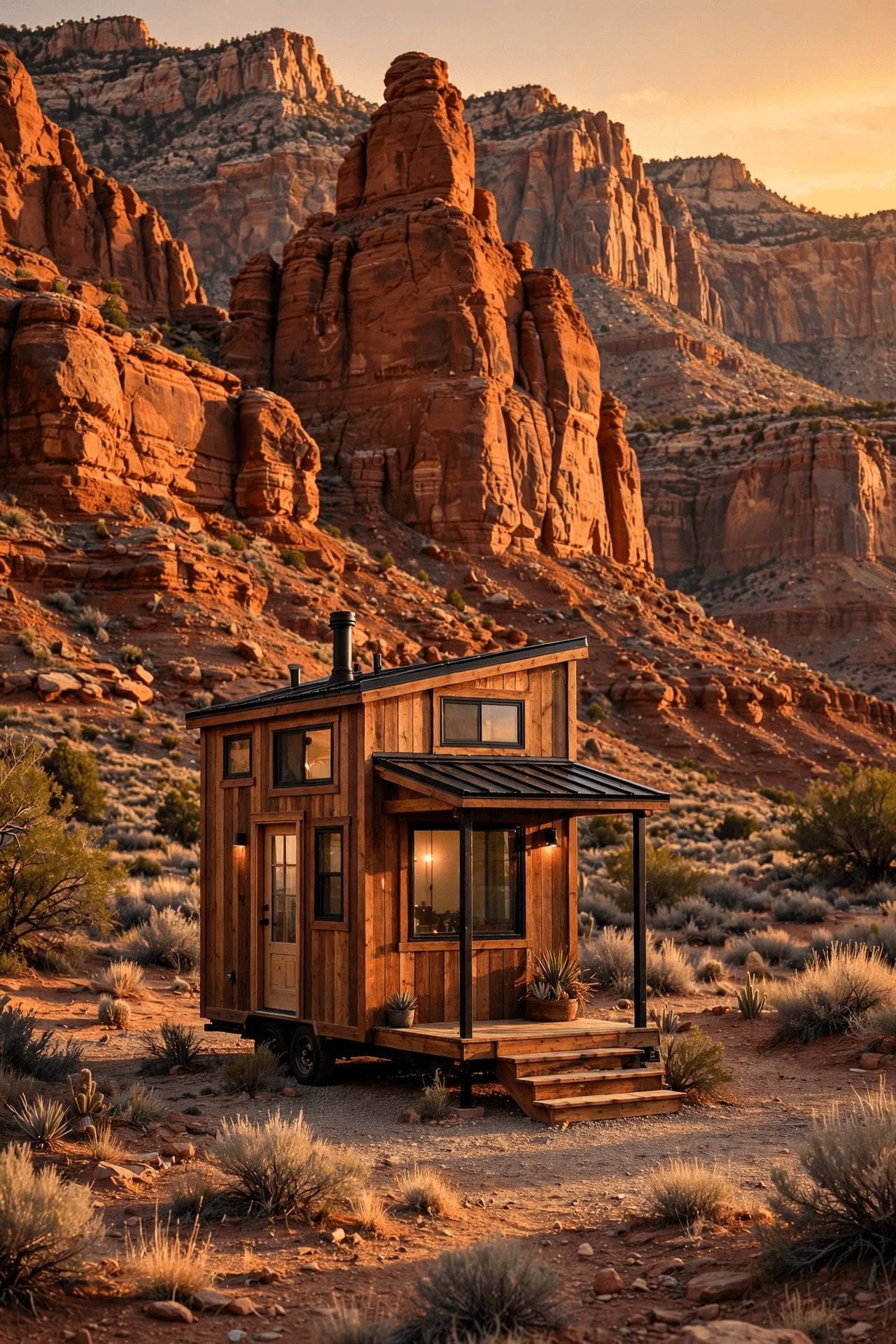
Plan utilities as the critical path: culinary water first, then sewer or septic, then power — with tiny house utilities: power, water and sewage as the checklist — and make any desert or rural purchase conditional on written water and septic feasibility. In Utah, a lot is not cheap if its water is theoretical; it is correctly priced, and the discount is the warning.
9. Notable City and County Examples
Salt Lake City is the policy centre: a capital revising its housing rules under growth pressure, with accessory dwellings, small-lot infill and rental regulation all live questions — verify the current district rules rather than trusting any cycle’s headlines. The Wasatch Front suburbs from Ogden to Provo share the growth and the covenant-heavy subdivisions, with city-by-city ADU ordinances. Park City and the mountain counties add resort economics, serious snow-load design and workforce-housing politics that can help or hinder small homes depending on the proposal.
St. George and Washington County show the desert-growth version: booming cities, water conservation as planning doctrine, and heat that designs a house as surely as snow designs one in the mountains. Rural Utah — Sanpete valleys, Uintah Basin, the red-rock counties — offers land, quiet and the full water-and-access examination. Every example here is a starting hypothesis; Utah amends quickly, so the current ordinance and a call to the water provider outrank any guide, including this one.
10. Practical Steps and Common Pitfalls
Step 1: Classify the build. Foundation and accessory routes carry Utah’s state support; wheels carry the RV rulebook. Choose the lane the policy actually favours.
Step 2: Prove the water. Written confirmation of a legal, physical water supply for the specific lot — rights, connection or well feasibility — before any other spending.
Step 3: Read both rulebooks. Current city or county ordinance plus the lot’s recorded covenants, with the tiny-house code provisions and ADU terms verified for your address.
Step 4: Design for the postcode’s weather. Snow load in the mountains, heat and sun in the desert, wind on the benches — priced into the first design, alongside how to finance a tiny house.
Step 5: Permit and paper the build. Keep approvals, inspections and the occupancy certificate together as the house’s permanent file.
The recurring pitfalls are buying desert land on the strength of a state-policy headline, discovering a water moratorium after closing, assuming state ADU support overrides subdivision covenants, under-designing a mountain roof, and treating a gateway-town RV placement as a residence. Utah’s framework is genuinely friendly — to projects that arrive with their water, structure and covenants already proven.
Final Considerations
Utah has earned its place near the top of this series. Its statewide code conversation recognises tiny houses, its legislature has pushed accessory dwellings into ordinary neighbourhoods, and its cities — however stressed by growth — are legislating about small homes rather than pretending they do not exist. Against that stand the oldest facts in the state: water is scarce, mountains are snowy, and distance is real. Buyers who prove the physical facts first will find the legal ones unusually cooperative.
Begin with the two documents that decide Utah projects: a written water answer for one real parcel, and the current ADU or zoning confirmation for its address. With those in hand, Utah’s tiny-house friendliness is not a headline — it is a permitting path, and a short one by the standards of this series.