

Every tiny house on wheels has a number it must not cross, stamped by the people who built its trailer, and a second number, its real weight, that nobody stamps anywhere and many owners never learn. The gap between those two numbers is where safety lives. Too many builds discover their real weight at the end, fully finished, fully furnished, when the only remedies left are removing beloved things or replacing the trailer. A working tiny house weight calculator is not a gadget. It is the habit of estimating every component as you choose it, honestly, with ranges, and then proving the total on a weighbridge before the road has to.
This guide walks through that estimation step by step, the way a careful builder actually does it. It starts with the ceiling, the trailer’s rated capacity, then adds a house component by component in a worked table. The weights in that table are typical ranges offered as starting estimates, not measurements of your build: materials vary, moisture varies, and two apparently identical boards can differ. Verify by weighing what you can, keep a margin on purpose, and treat the weighbridge in section 9 as the moment estimates retire. How heavy is too heavy has an exact answer for your trailer. This is how you reach it before it reaches you.
Tiny House Weight Calculator at a Glance
The table below answers the questions builders ask mid-build, usually holding something heavy and looking at the trailer. Each short answer points to the section that unpacks it.
| Question | Short Answer |
|---|---|
| What number must the finished house stay under? | The trailer’s GVWR: the maximum the trailer, axles and tyres are rated to carry, house, water, belongings and all. It is a ceiling, not a target. |
| Can a house be estimated before it is built? | Yes, component by component, using typical ranges for each system and weighing key items as they arrive. Section 2 is the worked method. |
| Which everyday load is most forgotten? | Water. Full tanks add a large, variable load, and batteries, fuel and a stocked kitchen follow close behind in the forgetting stakes. |
| Do finishes really change towing weight? | Decisively. Tile, stone, thick timber and big glass are among the heaviest choices per square metre a small home can make. |
| How much safety margin is sensible? | Enough to absorb estimation error, future additions and a full-tanks travel day. Build the margin in from the first estimate, not the last weigh-in. |
| How is an estimate verified? | On a weighbridge, finished and loaded as you travel, axles and tongue checked as well as the total. Section 9 explains the visit. |
| What if the total is already over? | Remove or swap the heaviest discretionary items first, finishes, stored water, stone and solid timber, before considering structural surgery. |
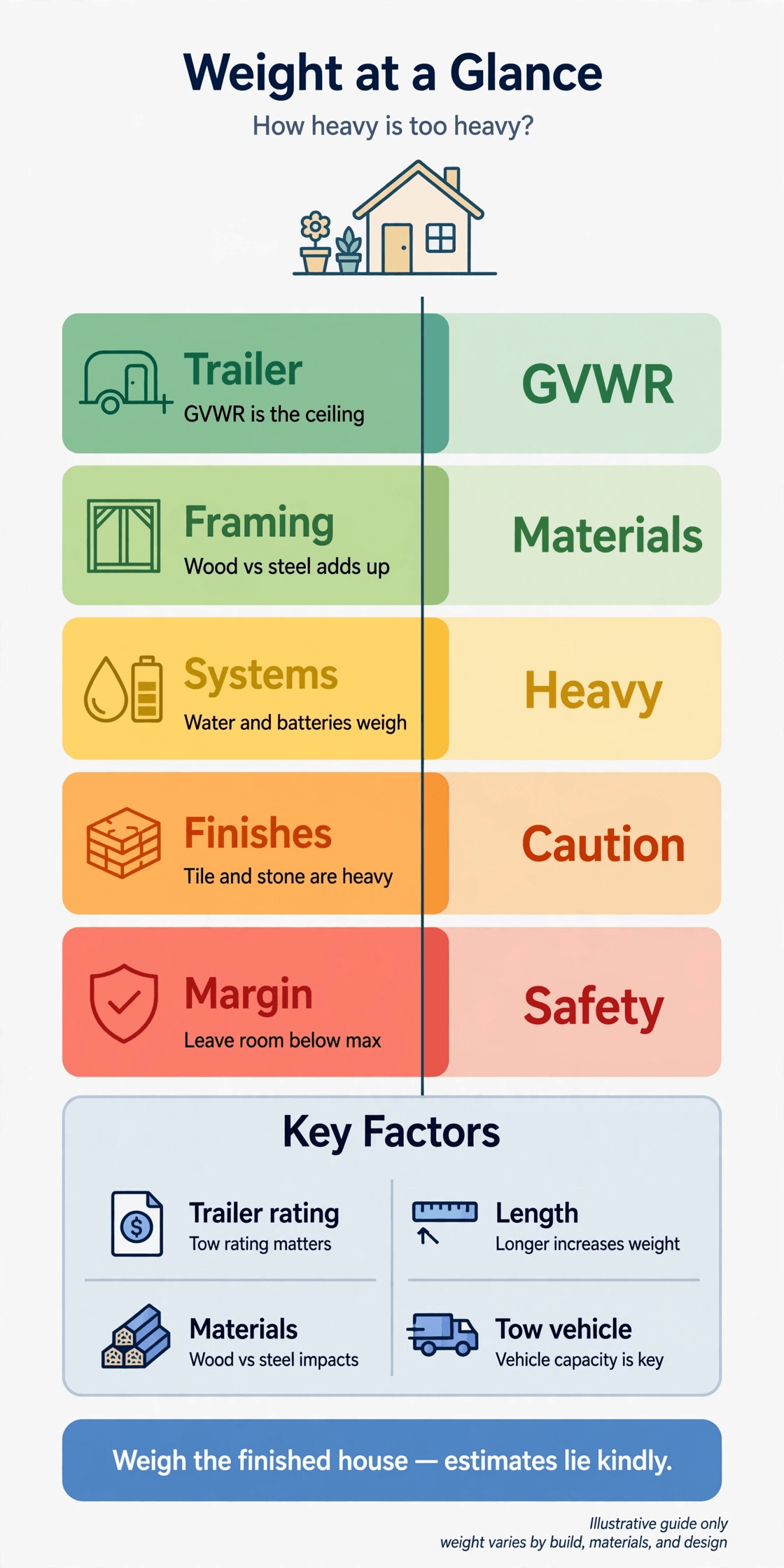
1. GVWR: The Ceiling Every Number Answers To
GVWR, gross vehicle weight rating, is the maximum total weight the trailer is designed to carry safely, set by its manufacturer from the frame, axles, suspension and tyres. Everything answers to it: the trailer’s own weight first, then the house built on it, then water, fuel, batteries, furniture and the stored evidence of a life. Exceeding it is not a paperwork offence in your own driveway; it is a physical overload on components that flex, heat and wear, and it can void insurance and warranties precisely when they are needed. Find the rating on the trailer’s plate or documents before any other number in this guide is allowed to exist.
The rating also explains why axle choice is a design decision and not a footnote. The reasoning in how to choose trailer axles rated at 14,000 lbs for a tiny house shows how the ceiling is built from the running gear up, and why a trailer bought for a lighter imagined house cannot be argued into carrying a heavier real one. Start every estimate with two figures written at the top of the page: the GVWR, and the trailer’s own empty weight, because their difference is the entire budget your house, its systems and your belongings must share. Every section that follows spends from that budget.
2. The Worked Estimate: Adding a House Component by Component
Here is the method, worked in the open. List the house as components, assign each a typical range from experience and supplier data, and total the ranges rather than pretending to a single false figure. The table below uses pounds, the units most trailer plates speak, and deliberately wide ranges: they are planning estimates to start a conversation with your own build, to be narrowed by weighing your actual materials wherever you can. A component you have personally weighed beats any range in any table, including this one.
| Component | Typical Estimate Range | How to Narrow It |
|---|---|---|
| Trailer (steel, tandem axle) | A substantial starting share of the budget; commonly the single heaviest item before building begins | Use the manufacturer’s stated empty weight, then confirm on a weighbridge before the build |
| Framing and structure | Varies widely with material and size: light timber or steel framing at the lower end, dense timber and complex roofs higher | Weigh a sample bundle or bay and scale by count; ask suppliers for per-piece weights |
| Roofing, cladding and insulation | Metal roofing and light cladding at the lower end; heavy shingles, thick boards and dense insulation higher | Calculate per sheet or per roll from supplier data and add offcuts honestly |
| Interior lining and finishes | Light panels at the lower end; plasterboard, tile and solid timber push this row up fast | Weigh one finished wall bay and multiply; see section 5 for the heavy offenders |
| Kitchen and bathroom fit-out | Compact flat-pack and acrylic at the lower end; stone counters, full-size appliances and tile higher | List each unit with its manufacturer weight, including the water heater, full |
| Water (tanks full) | Every litre of water weighs about a kilogram, roughly 8.3 pounds per US gallon, so tank size is a weight decision | Multiply your actual tank capacity; decide whether you travel full or empty |
| Batteries and power system | Lead-based storage is notably heavy per unit of capacity; lithium equivalents are far lighter for the same usable energy | Use manufacturer weights for your exact units, cables and inverter included |
| Furniture, appliances and belongings | The most underestimated row: books, tools, clothing and stored food accumulate quietly | Weigh the surprising items; if in doubt, carry a full sample load to a scale |
Work the table twice. Once with the low ends, once with the high ends, and read the gap between the totals as your uncertainty, the honest measure of how much you do not yet know. Then spend effort narrowing the heaviest rows first, because precision on the trailer and structure is worth more than precision on the cushions. If even the low-end total crowds the GVWR, the design itself must lose weight before building starts, when losing it costs a decision instead of a demolition. That is the entire purpose of estimating early: the cheapest pound to remove is the one never installed.
3. Framing Materials: Timber, Steel and SIPs by Weight
The frame is the house’s skeleton, and skeletons differ. Timber framing is familiar, workable and repairable almost anywhere, with weight that climbs with section size, species density and how generously the frame is specified. Steel framing can deliver equal strength in slimmer, often lighter members, with its own demands in tools, fixings and thermal detailing. Structural insulated panels package frame, insulation and sheathing in one system whose total must be counted as a system rather than admired piece by piece. None of these is the light choice in the abstract. Each is light or heavy as actually specified, in your sizes, at your spans.
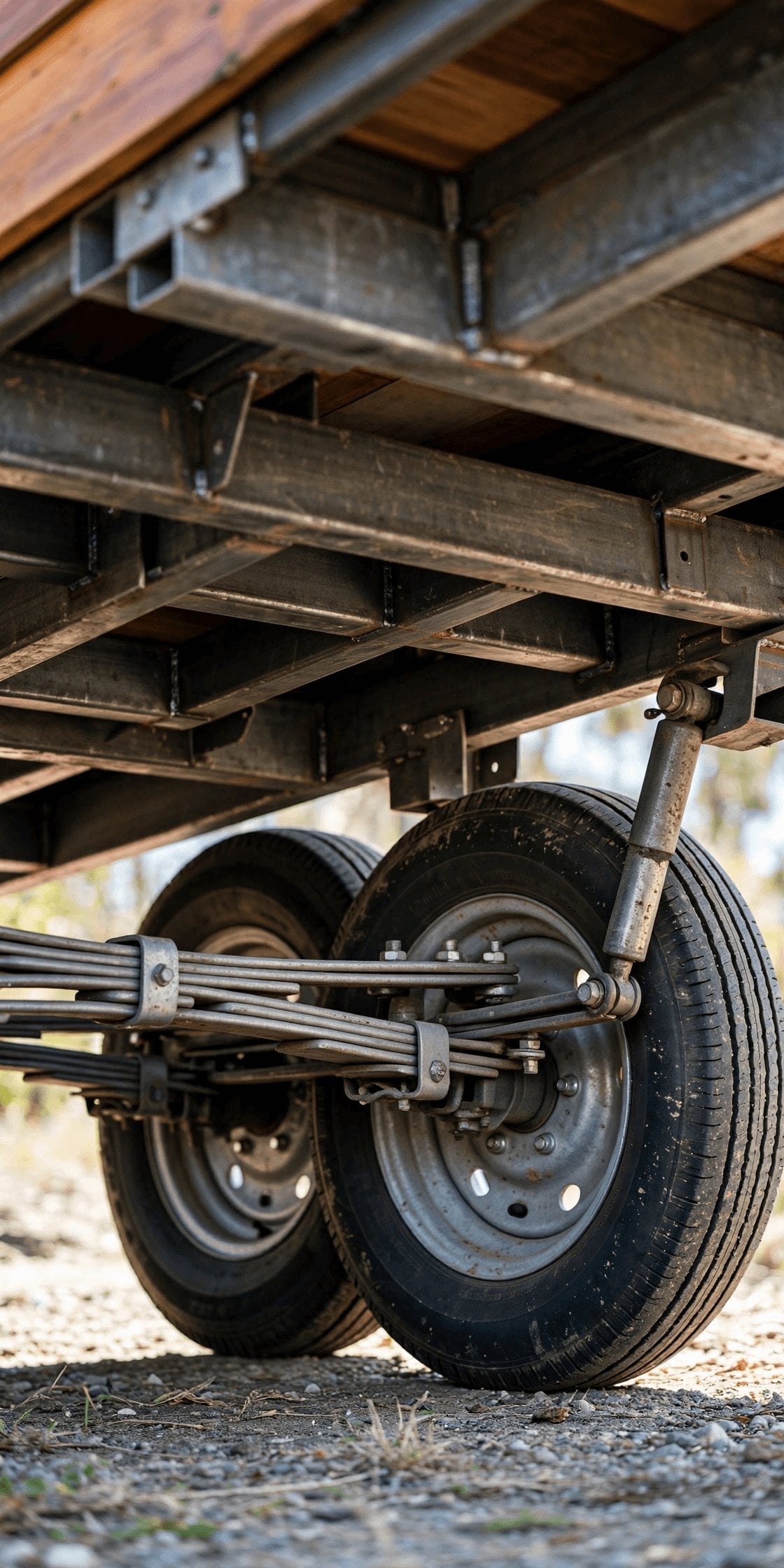
Two traps recur. The first is comparing a frame weight with a finished wall weight: insulation, lining, cladding and membranes all ride on the frame, and the honest comparison is assembly against assembly. The second is the loft-and-a-half effect, where extra structure, stairs, doubled floors and a second roofline quietly add a storey of material to a one-storey budget. Weigh a representative bay of your chosen assembly, complete, and scale it. A morning with a scale and one honest bay will correct more estimation error than a week of reading, and it is exactly the kind of verification this method is built on.
4. Water, Fuel and Batteries: The Loads That Move
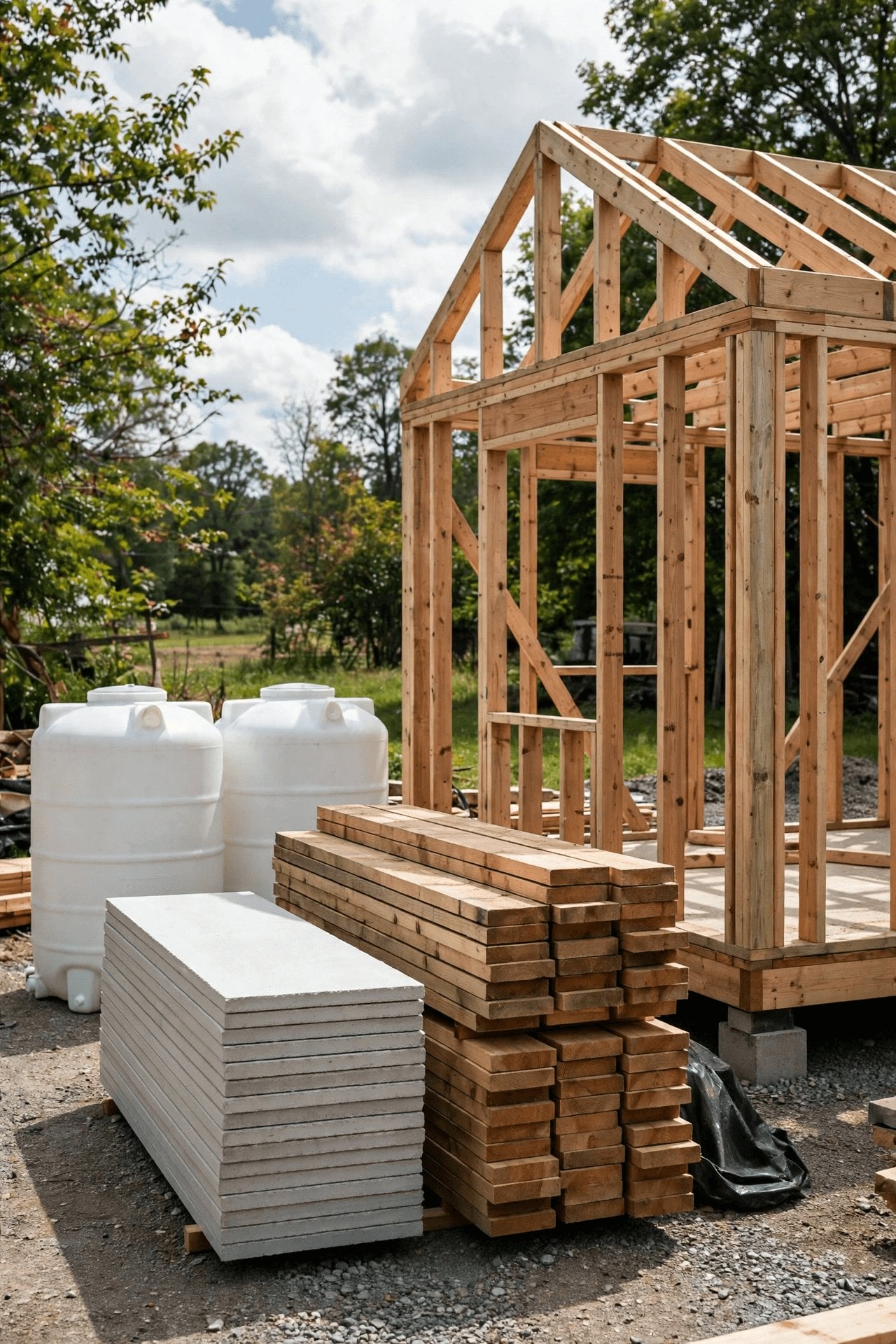
Some loads are not built in. They arrive, fill, empty and travel, and a house weighed empty can be a different, heavier house on the road. Water is the heavyweight of this section: at roughly a kilogram per litre, a generous fresh tank, a full water heater and grey storage together can add a load comparable to a major appliance or a wall of finishes, and they add it low and sometimes unevenly. Decide, as a stated policy in the estimate, whether the house travels with tanks full, partly full or empty, and write the corresponding figure into the travelling total, not the parked one.
Fuel and stored energy ride with it. Gas bottles are steel as well as gas, and their weight belongs in the total alongside the appliances they feed, a point the sizing discussion in propane vs electric for tiny houses, with tank sizing makes from the cost side and this guide repeats for weight. Batteries are the stealth load of off-grid builds, heavy per unit and usually installed in a bank, low and in one place; the equipment surveyed in the best off-grid power stations from Jackery, Bluetti and EcoFlow shows how capacity choices are weight choices too. Finally, the plumbing that carries the water has its own mass and its own plan, and tiny house plumbing layout and DWV design is where tank positions get decided, which section 7 shows is a balance decision as much as a plumbing one.
5. Heavy Finishes: Tile, Stone, Timber and Glass
If framing is the skeleton, finishes are where diets fail. Tile is dense, and it brings adhesive, board and grout with it. Stone counters concentrate remarkable weight into a few square feet that the frame must carry at counter height. Solid timber lining, flooring and doors are beautiful and cumulative, where engineered and lightweight alternatives can give a similar look for a fraction of the mass. Large glass, in showers, doors and generous windows, is heavier than the wall it replaces more often than intuition expects. Every one of these choices is legitimate. Every one must be priced in pounds as well as in money.
The good news is that the weight-conscious finish market is rich, and the survey in lightweight interior wall finishes for tiny houses shows the pattern: thin, repairable, honestly lightweight materials that still read as warm and finished. The method is substitution, not deprivation. Keep one heavy hero, the tiled shower, the timber bench, and let the supporting surfaces go light around it, instead of stacking five heavy heroes into a house whose trailer then has to carry the argument. Weigh finish samples as you choose them. A tile and its backing board, held in one hand, have settled more build arguments than any spreadsheet.
6. Appliances, Furniture and the Weight of Living
A finished house is not a moved house. Between the build and the road sits everything you own, and this row of the estimate fails more honestly than any other because nobody believes their belongings weigh what they do. Appliances come first, with manufacturer weights available and worth listing exactly: refrigeration, cooking, laundry and heating units are each significant, and compact choices pay twice, in space and in mass, a double dividend explored in the best compact kitchen appliances for tiny houses. Furniture follows, where solid timber, sofa beds and filled storage units routinely out-weigh the appliances that were so carefully chosen.
Then comes the long tail: books, tools, bikes, instruments, winter clothing, stored food, the cast-iron pan collection. Individually forgivable, collectively a load case. The practical technique is the trial pack: load the house as for a real move, everything aboard, and let section 9’s weighbridge grade the performance. Until then, estimate this row generously and suspiciously, especially if the household is downsizing from a larger home, because possessions expand to fill the estimate allowed for them. A tiny house does not just limit space. It rations weight, and the ration is spent by everything you keep.
7. Distribution and Tongue Weight: Where It Sits Matters
A house can be under its GVWR and still tow badly, because totals are only half the physics. Weight must also sit in the right places: balanced side to side so tyres and axles share fairly, and balanced front to back so the tongue, the share of weight pressing down on the hitch, lands in the range the trailer and tow vehicle expect. Too little tongue weight invites sway, the trailer’s dangerous argument with the road. Too much overloads the hitch and the tow vehicle’s rear axle and unloads its steering. Distribution is decided by where heavy things live: tanks, batteries, appliances and storage, fixed at design stage by people who may never think about a tow.
This is why the component table in section 2 should carry a location column in your own version, front, middle, rear, left, right, for every heavy row. Moving a battery bank or a water tank on paper is free; moving it after plumbing and wiring is a renovation. Heavy, dense and low is the guiding instinct: mass carried low between the axles steadies the whole combination, while mass stacked high or hung at the rear amplifies every motion of the road. When the weighbridge visit comes, weigh by axle and check the tongue separately, because a good total with a bad distribution is a problem the scale can find before the highway does.
8. The Safety Margin: Leaving Room on Purpose
Every estimate in this guide is wrong in detail, and the margin is how a build survives that fact. Ranges conceal heavier deliveries, wetter timber, an extra layer someone added, the belongings row doing what belongings rows do. A margin is a deliberate gap kept between your best travelling total and the GVWR, large enough to absorb estimation error and the small additions of real life: the second battery, the better stove, the tools that moved in. Builders who plan to land exactly on the rating have planned to exceed it, because life loads houses the way weather loads roofs, additionally and without asking.
Protect the margin like a budget line somebody keeps trying to spend, because somebody will, at every stage, with excellent reasons. The technique is a margin ledger: when a change adds weight, something else in the estimate must give it back, a finish lightened, a tank travelled emptier, a unit swapped for its lighter sibling, or the change does not happen. This sounds strict until the alternative is priced: removing finished work after a failed weigh-in, or shopping for a stronger trailer to rescue a heavier house. Margin kept on paper is freedom. Margin spent in secret is a deadline with a scale at the end of it.
9. Weighbridge Verification: Replacing Estimates With Truth
Every estimate must eventually retire, and the weighbridge is its retirement ceremony. The visit is simple: the house, finished and loaded as it will genuinely travel, tanks in their travelling state, belongings aboard, driven onto a public or commercial scale that returns a certified total, ideally axle by axle, with the tongue weighed separately by the methods the scale operator will know. Go before the first long tow, not after, and go again after any major change: new systems, new finishes, a different water policy. The scale does not grade your build. It informs it, while information can still change outcomes.
Read the result in three ways. Against the GVWR, for legality and safety of the trailer. Against your estimate, row by row where you can, to learn which components lied and by how much, knowledge that improves every future decision. And against the tow vehicle’s limits, which section 10 closes with. If the result is over, the remedy order matters: belongings and discretionary heavy items first, water policy second, finish substitutions third, structural changes last and most expensively. Almost every overweight house has a lighter house inside it, travelling under a layer of things its owners can release once a scale, rather than an opinion, asks them to.
10. Tow Vehicle Match: The Last Calculation
The final number is not the house’s at all. It is the combination’s: house at its real travelling weight, tongue load included, matched against a tow vehicle rated to pull it, carry the tongue, and control the pair in wind, gradient and emergency. Vehicle ratings are their own ceilings, covering towing capacity, payload and combined weight, and the house must fit inside all of them with the vehicle’s own passengers and gear counted too. A vehicle that can pull a weight on a flat brochure test may still be the wrong match for a tall, slab-sided house in crosswinds on a long descent, which is why experienced towers favour margin here as faithfully as on the trailer.
Match on verified figures, in this order: weigh the house, confirm the tongue, then choose or check the vehicle against both, with its ratings read from its own plate and documents rather than from advertising. Hire or borrow experience for the first tow if the combination is new to you, and treat a professional move as tuition as much as transport. How heavy is too heavy is, in the end, a question with three honest answers: heavier than the trailer allows, heavier than the vehicle can govern, or heavier than your margin can forgive. A build that respects all three can go anywhere the road goes, and that, for a house on wheels, is the entire point of counting.
Final Considerations
Weight is the invisible dimension of a tiny house, the one absent from photographs and present in every mile. It is governed by a stamped ceiling, spent by components that can be listed and estimated, distorted by loads that move and finishes that seduce, and finally settled by a scale that has no opinion and cannot be charmed. None of that makes it a frightening subject. It makes it a manageable one, for builders willing to count early, estimate in ranges, weigh what they can, distribute what they weigh, and keep a margin standing guard over all of it.
So run the calculation the way this guide walked it: ceiling first, components second, verification last, and no stage skipped because an earlier stage felt reassuring. The houses that tow sweetly and last are not the lightest houses. They are the known houses, whose owners can state their travelling weight, their tongue load and their remaining margin the way they state their floor area. Get your build into that company, and the question in the title stops being a worry and becomes what it should have been all along: a number you already know.


0 Comments