

Look up in the best living rooms and the ceiling is doing quiet, deliberate work — none quieter or more deliberate than the tray.
Seventy-five living-room tray ceilings: profiles and colour, cove light and pendants, sofas arranged on the ceiling’s axis, and the tray’s honest place among its coffered, vaulted and coved siblings.
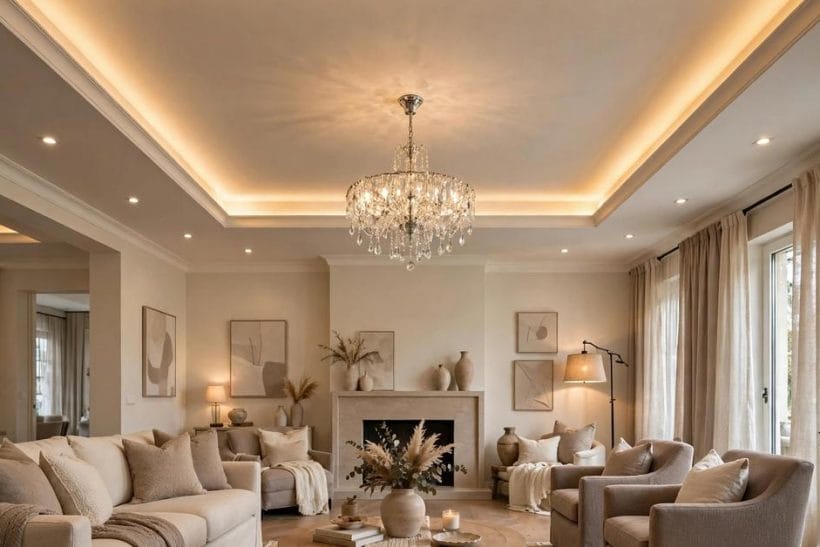
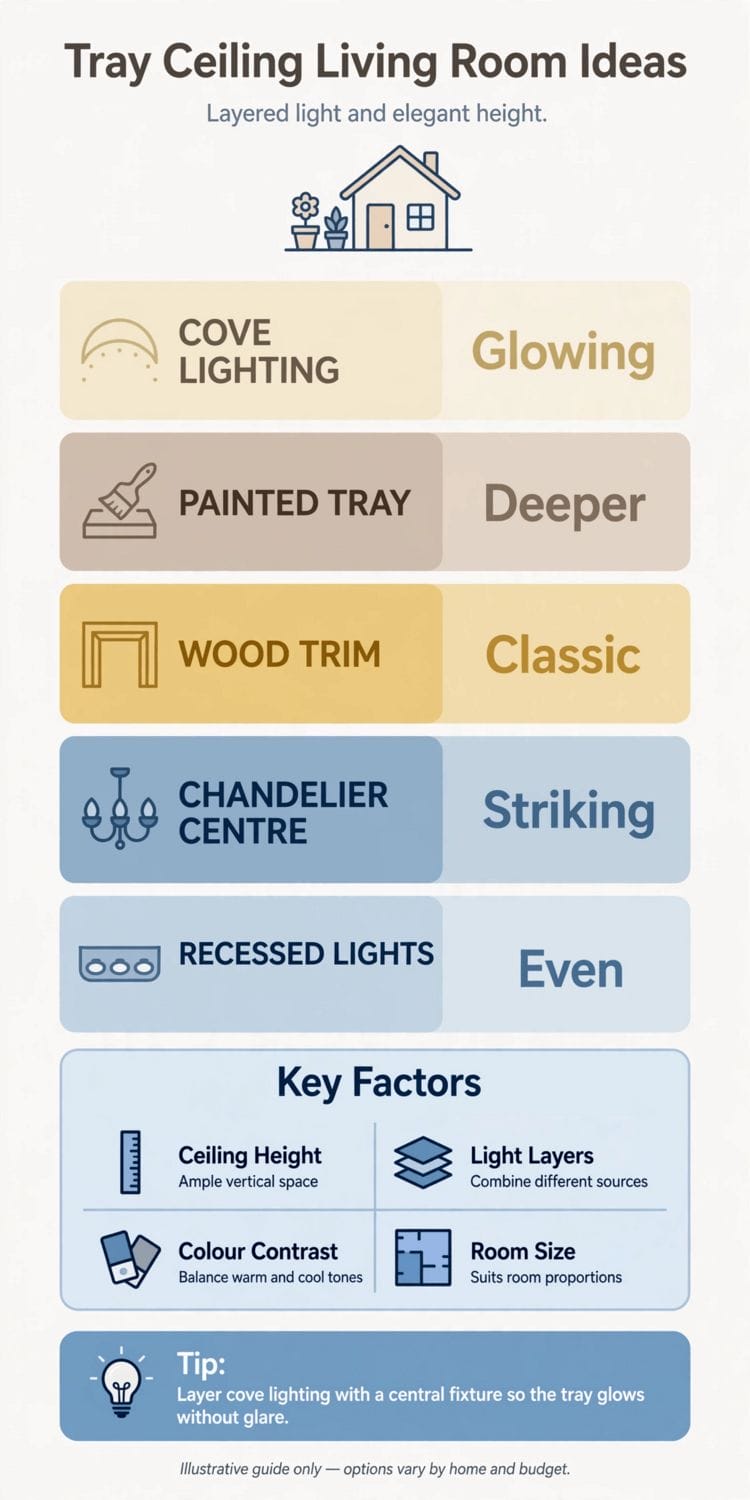
1. Tray Ceiling Living Room Ideas at a Glance
The tray ceiling living room is the living-room slice of the tray ceiling family — this post takes the general feature, owned whole by the collection’s tray ceiling ideas post, and holds it strictly to the one room where it performs best. Everything here is living-room business: seating on the axis, the main wall composed beneath the field, cove light balanced against lamps. It hangs from the living room ideas pillar, and it does not stray into bedrooms, entryways or the generic ceiling survey.
| Question | Short answer |
|---|---|
| What exactly is a tray ceiling? | A centre field raised above a lowered border, like an inverted tray — one architectural gesture that frames the room, holds its light and announces its centre. |
| Single or double step? | Single for most living rooms; double steps suit tall, formal rooms whose furniture and proportions can carry the ceremony. |
| What colour should the centre field be? | Pale to lift the room, deep for an evening room, or tone-on-tone with the border for quiet luxury — judged under lamplight, at the hour the room is used. |
| What lighting belongs in a tray? | A concealed cove wash as the signature, one centred pendant as the jewel, and table lamps doing the faces — layered, dimmed, warm. |
| How should furniture answer the tray? | Centred on the field’s axis: seating group, rug and main wall composed in rough symmetry, with one angled chair forgiven as the human touch. |
| When is a tray the wrong choice? | In low or small rooms, or houses whose period argues — there a plain, beautifully lit ceiling wins, and this post says so in its sibling section. |
2. Tray Profiles Suited to Living Rooms
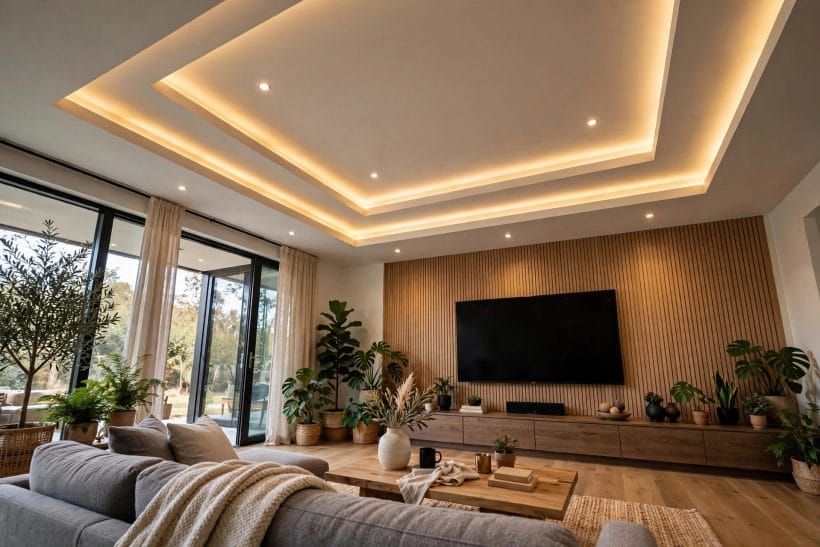
The tray ceiling is a single idea — a centre field raised above a lowered border — varied by depth, steps and softness. In a living room the profile must suit the room’s proportions and its furniture: grand enough to register from a sofa, quiet enough to live under every day.
1. Take the single-step tray for most living rooms
One clean step up to the centre field is the classic living-room tray: architectural without theatre, kind to ordinary ceiling heights, and easy to light and paint.
2. Deepen the tray where the ceiling allows grandeur
In a tall room, a deeper recess gives the centre field real presence and lets colour and light work dramatically.
3. Double-step the tray for a formal sitting room
Two receding steps read as deliberate classicism, the ceiling’s equivalent of a panelled door. It suits formal layouts, symmetrical furniture and houses whose other details are equally dressed.
4. Soften the step with a curve or a chamfer
A curved or angled transition instead of a hard right angle gentles the tray for cottages, coastal rooms and any living room whose mood is ease rather than ceremony. The shadow softens; the room relaxes.
5. Angle the tray’s corners to echo an angled room
Where the living room itself is L-shaped or bay-fronted, a tray that follows the room’s own geometry — clipped corners, an angled end — looks designed rather than applied.
6. Run the tray off-centre over the sitting zone
In a long living-dining room, the tray belongs over the sitting zone alone, drawing the room’s ceremonial centre where the sofas are. Centring it on the whole space centres it on nothing.
7. Keep the border wide enough to work
The lowered border is the tray’s working part — it carries the cove light, the curtain tracks and the visual frame.
8. Let a shallow tray serve a modest ceiling
Even a slight recess, honestly shallow, organises a living room’s ceiling and gives lighting a home.
9. Mirror the tray’s shape in the rug below
When the centre field’s outline is answered by the rug or the seating group’s shape, the room gains a vertical axis that feels inevitable.
10. Give the centre field one job only
The raised field can carry colour, or light, or a ceiling rose and pendant — in modest rooms, one of these. Fields asked to perform every trick at once perform none of them calmly.
11. Respect the beams and joists the house already has
Where structure crosses the intended tray, the honest answers are to work the tray around it or choose another ceiling treatment. A tray pretending the structure away reads as a lie at ceiling scale.
3. Colour Inside the Living Room Tray
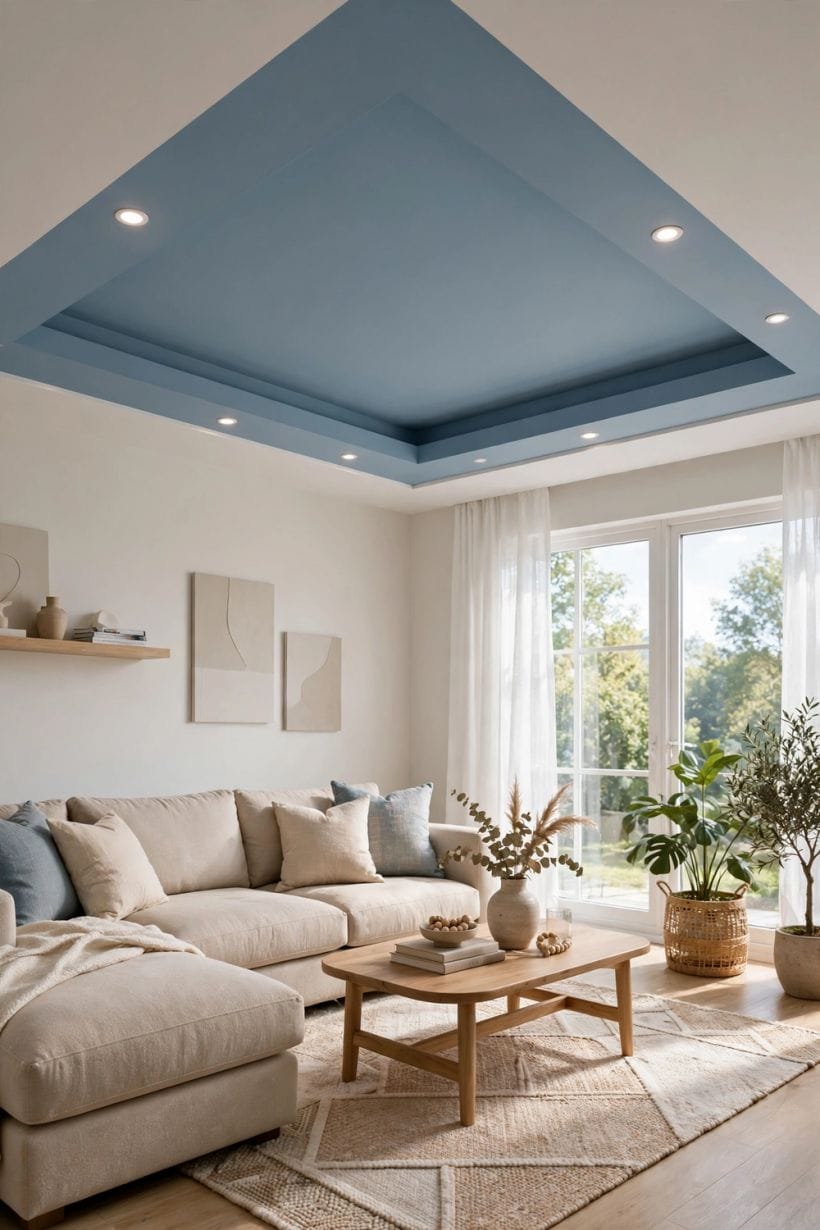
Colour is where the living-room tray earns or loses its keep. The recess is a shadow box: it deepens every tone placed in it and flatters contrasts kept simple. The rules below are the ones the good rooms obey, whether they know it or not.
12. Paint the centre field lighter to lift it
A paler centre reads as higher and airier — the tray’s oldest illusion. In a north-facing or lamp-lit living room, this single choice does more than any fitting to keep the ceiling off the furniture.
13. Take the centre deeper for a room of evenings
A deep centre field — ink, forest, oxblood — turns the tray into a canopy for a room used after dark with lamplight and a fire.
14. Use tone-on-tone for the quiet luxury effect
Centre and border in two depths of one colour give architecture without contrast’s noise. The steps read in shadow rather than in paint charts, and the room stays restful at every hour.
15. Carry the wall colour up and over the border
Running the wall colour across the lowered border and stopping at the step makes walls feel taller and the tray feel carved from the room itself.
16. Reserve white for the step’s edge line
A crisp pale line at the step catches light and draws the tray’s geometry cleanly, whatever the fields carry. Draughtsmen call it the reveal; living rooms call it the reason the ceiling looks sharp.
17. Match the centre to the room’s textile anchor
Taking the centre field from the sofa’s or the rug’s deepest tone ties the ceiling into the room’s scheme instead of floating it above as a separate decision. One echo is enough; two is a theme.
18. Be careful with gloss overhead
Sheen on a ceiling shows every undulation and doubles every light source.
19. Test colours at the room’s real hours
Ceilings are seen in lamplight more than daylight in a living room. Paint the sample board, prop it overhead, and judge it at nine in the evening — the hour the room is actually for.
20. Let a mural or a papered centre be the one extravagance
A hand-painted sky, a subtle paper or a limewash cloud effect in the centre field gives a formal living room its heirloom. Keep everything below it quieter and the extravagance reads as art, not noise.
21. Paint the border bravely and keep the field pale
The inverted scheme — a deep, coloured border framing a pale centre — suits rooms whose walls are quiet and whose furniture wants a canopy’s edge without a darkened sky.
22. Keep the tray out of the colour argument
When walls, sofa and rug already negotiate loudly, the ceiling should abstain: pale, plain and architectural. The tray’s job in a busy room is to be the calm the rest of the room is not.
4. Lighting the Recess
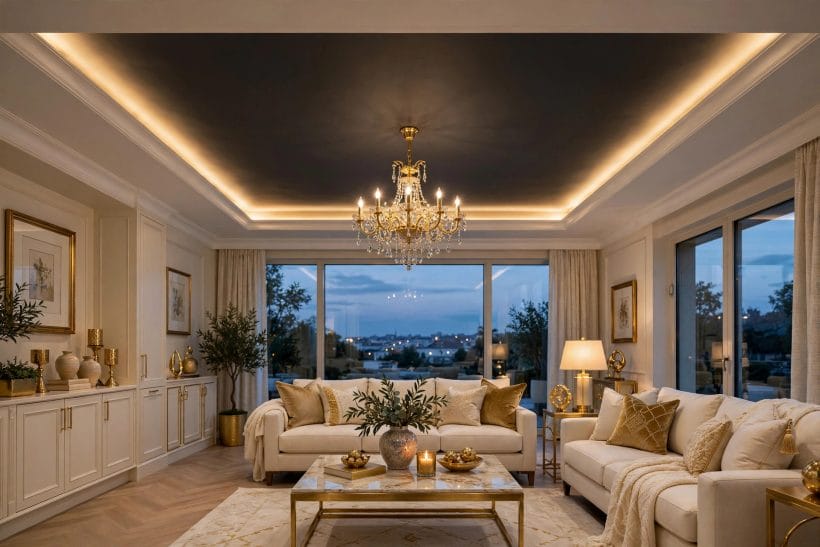
A tray ceiling without a lighting plan is a frame without a picture. The recess exists to hold light — washed up its steps, pooled in its centre, and balanced against the lamps below so the living room glows in layers rather than glaring from a single point.
23. Hide the cove light in the border’s lip
A concealed strip washing the centre field from the step is the tray’s signature light: soft, shadowless and dimmable to a whisper.
24. Centre one pendant or chandelier as the field’s jewel
The raised centre is a natural canopy for a single beautiful fitting over the coffee table.
25. Layer the cove against table lamps, never instead of them
Ceiling light alone flattens faces; lamps alone leave the tray invisible. The living room wants both, on separate dimmers, balanced at the hour of use — architecture above, complexion below.
26. Wash the border with downlights sparingly
A few well-aimed downlights in the border can graze curtains and art. Rows of them cannot — they turn the border into a runway and the tray into an airport. Restraint is the whole skill.
27. Take the cove’s colour temperature warm
Cool light in a cove reads as office or aquarium. Warm-white sources keep the tray in the family of the room’s lamps and firelight, and flatter every colour the fields might carry.
28. Light the step, not the centre, for the subtle effect
Aiming the wash at the step itself models the architecture in light and shadow and leaves the centre mysterious. It is the quieter, more expensive-looking choice, and costs exactly the same.
29. Put the tray’s light on its own scene
One button for evenings — cove low, pendant off, lamps on — beats four switches negotiated nightly. Scene control is what turns a lighting plan into a lighting habit.
30. Avoid visible strips and dotted lines
The cove’s magic is a source you cannot see. Exposed strips and dotted LED lines break the spell and date the room instantly; baffles, lips and plastered channels exist to keep the secret.
31. Borrow daylight honestly
By day the tray should fall quiet: pale fields returning window light, no fittings performing.
32. Dim by zones, not by the whole ceiling
Cove, pendant and border lights on separate dimmers let the ceiling compose itself for reading, for company and for the film. A tray lit all-or-nothing is a chandelier with extra steps; zoned, it is an instrument.
33. Give picture and plant light their own small moment
A single uplight behind a plant or a picture light over the mantel art adds the low, warm pools that make a tray-lit room feel inhabited rather than illuminated. Ceilings frame; small lights furnish.
5. Sofas, Layouts and the Wall the Tray Serves
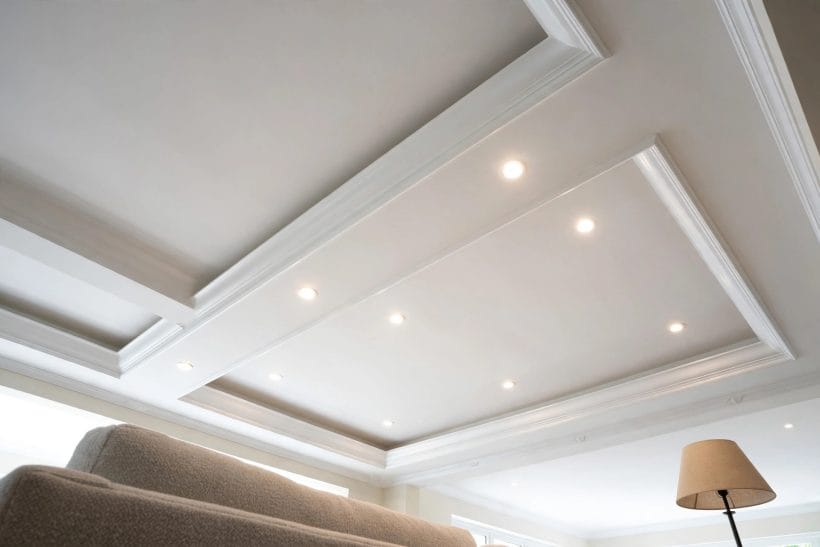
Below a tray, the living room arranges itself in answer: the seating group centred on the field, the main wall composed to be looked at beneath it. This section is the tray’s ground floor — the half of the design that people actually sit in.
34. Centre the seating group on the field, not the room
Where tray and room centres disagree, the furniture obeys the tray.
35. Place the sofa wall opposite the room’s best feature
Fireplace, garden doors or the media wall — the tray crowns whichever wall the sofas face. Compose that wall fully: it is the room’s altarpiece, and the tray is its frame.
36. Hang the television with the tray’s axis in mind
A screen centred under the field, at a height the sofas forgive, keeps the ceiling’s symmetry honest.
37. Let the fireplace wall take a centred composition
Mantel, mirror or art centred, flanking pieces balanced — beneath a tray, asymmetry on the main wall reads as carelessness because the ceiling has announced that this room believes in order.
38. Use tall curtains to join floor and tray
Curtains hung from just under the border, falling full length, stitch the walls to the ceiling and lend the tray its height. Short curtains under a tray cut the room at the knees.
39. Keep tall furniture off the tray’s border walls
Bookcases and armoires that crowd the lowered border shrink its frame and shadow its light. Keep the border walls’ furniture below the step line, or keep it in the room’s centre as the tray’s supporting cast.
40. Anchor the group with a rug inside the field’s footprint
The rug as the field’s earthly twin — slightly smaller than the centre above it — composes the whole vertical sandwich. It is the single most reliable tray-room arrangement there is.
41. Give the coffee table the field’s centre
One table, centred, sized to the seating rather than to the tray. Everything else in the group — lamps, side tables, the ottoman — can breathe asymmetrically around that one centred fact.
42. Plan the reading chair’s escape from symmetry
A single angled chair and its lamp at the group’s edge keep formality human. The tray forgives one rebel; it is the second and third that dissolve the composition.
43. Light the seating, not the ceiling, for conversation
Faces at lamp height, the tray glowing gently above — the balance that makes a formal room sociable. If guests squint or glow orange, the layers are fighting; dim the ceiling first.
44. Leave the bay or the doors their own sub-ceiling
A bay window or glazed doors under the border deserve their own simple treatment — a blind, a sheer, a pelmet line — rather than a share of the tray.
6. The Tray Among Its Ceiling Siblings
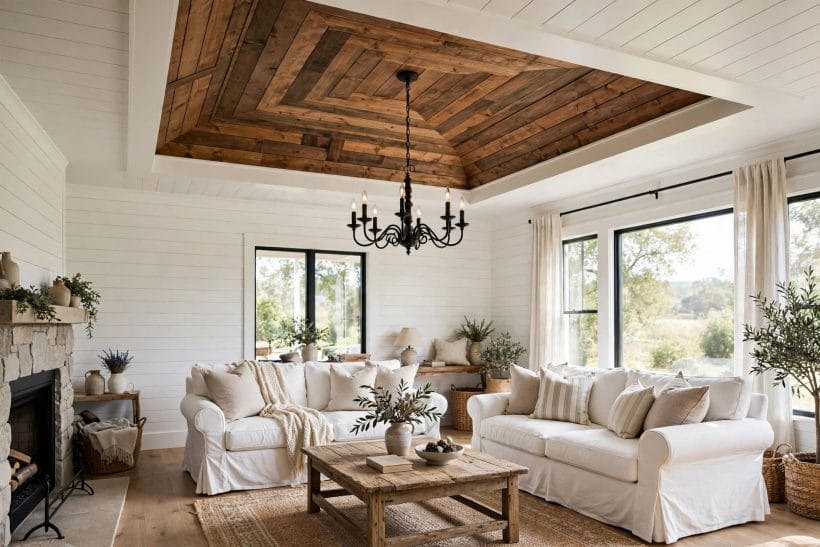
The tray belongs to a family — coffers, vaults, coves and plain house ceilings — and a living room chooses among them by height, by architecture and by temperament. This section keeps the tray honest company: where its siblings do the job better, it says so.
45. Choose coffers where the room wants rhythm
The coffered ceiling living room treatment breaks the field into a grid of beams and panels — busier, more tailored, and better suited to large formal rooms than the tray’s single calm gesture.
46. Take the generic coffered lesson across rooms
The collection’s coffered ceiling ideas cover the treatment whole-house; the living-room tray borrows from it the discipline of proportion — module sizes matched to the room, never to the catalogue.
47. Choose a vault where height itself is the luxury
The rising planes of the vaulted ceiling ideas in this collection give volume the tray cannot — but they demand the roof’s cooperation, where a tray is built within the ceiling you already own.
48. Borrow the cove’s softness for a gentler room
The cove ceiling rounds the wall-to-ceiling junction into one continuous curve of light — the tray’s softer cousin, and sometimes the right answer in a room whose furniture is all curves.
49. Combine one step with shallow coffers, cautiously
A tray whose centre field carries a shallow coffered grid can crown a very large living room. In ordinary rooms the combination shouts; the family resemblance should be a whisper, not a chorus.
50. Respect the plain ceiling where it wins
Some living rooms — very low, very small, or blessed with beams — are better served by a plain, beautifully lit ceiling like those in the house ceiling ideas survey. The tray is a choice, not a tax on every room.
51. Match the ceiling to the house’s own period
A tray in a Georgian-proportioned room speaks the house’s language; the same tray in a low mid-century box argues with it. Ceiling treatments succeed when they seem discovered in the architecture, not pasted onto it.
52. Choose the tray when the ceiling must be built, not found
A vault is discovered in the roof’s shape; a tray is built inside the ceiling already overhead, from board, batten and plaster.
53. Let beams and the tray share a room only with care
Real structural beams crossing a tray’s field divide it rudely; beams within the centre field, aligned with the plan, can enrich it. The difference is whether the beam was invited.
54. Compare the family by upkeep as honestly as by beauty
Coffers present a ledge to every dusting day of the year; vaults ask ladders for their cobwebs; the tray asks one brush along one step.
55. Let one room in the house hold the tray
Trays in every room flatten the gesture into a habit.
7. Curtains, Walls and Proportions Below the Tray
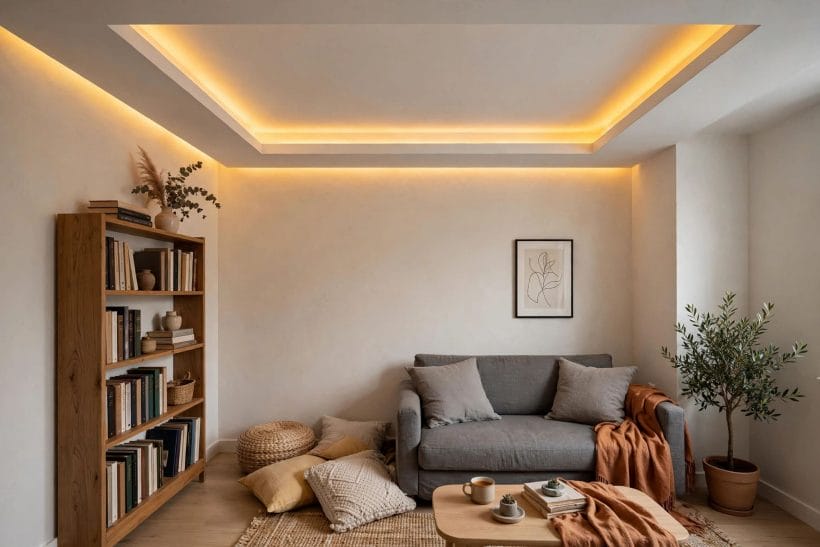
The tray raises the ceiling’s centre; the walls decide whether the room feels raised with it. Heights, hangings and wall treatments below the step either continue the ceiling’s courtesy or contradict it at eye level.
56. Hang curtains from the border, never mid-wall
Tracks or poles set just beneath the lowered border give curtains their full height and the walls their full dignity. A track wandering across the wall’s middle is the tray room’s most common act of self-sabotage.
57. Take wall panelling to a height the tray respects
Picture rails, panelling and wainscot lines should stop in a calm relationship to the step above — echoing its level or ignoring it entirely, never nearly matching it. Almost-aligned lines read as errors, not intentions.
58. Keep the picture line below the border
Art hung into the border crowds the frame the tray is making. A consistent picture line with air above it lets both the paintings and the ceiling keep their composure.
59. Use the border’s shadow as a design material
The step casts a natural shadow line that changes through the day. Pale borders brighten it; deep borders deepen it. Notice it before painting — it is the room’s free, daily artwork.
60. Balance a deep tray with grounded furniture
A dramatic ceiling over slight, leggy furniture unbalances the room’s sandwich. Deep trays want sofas with presence, a serious rug and lamps with weight — mass below answering architecture above.
61. Balance a shallow tray with lighter everything
The gentlest trays suit rooms of lighter furniture and paler moods — the ceiling whispers, the furniture murmurs back. Matching the room’s weight to its ceiling’s is the whole of proportion.
62. Let mirrors borrow the tray’s light
A mirror placed to catch the cove’s glow returns it to the room doubled and warmed. Beneath a tray, mirrors are not vanity; they are the lighting plan’s silent partners.
63. Sound softens under a tray if you let it
The recessed centre can ring slightly in a hard room.
64. Keep the skirting and cornice conversation simple
Where walls meet floor and border meets wall, keep the mouldings’ profiles in one family. Living rooms under trays carry enough geometry overhead without a moulding argument at every junction.
65. Finish the walls in finishes that forgive lamplight
Matte and softly textured wall finishes sit kindly under cove light’s raking glow; shiny walls betray every trowel mark the light finds. The tray lights the walls whether you plan it or not — plan it.
8. Living With and Looking After the Tray
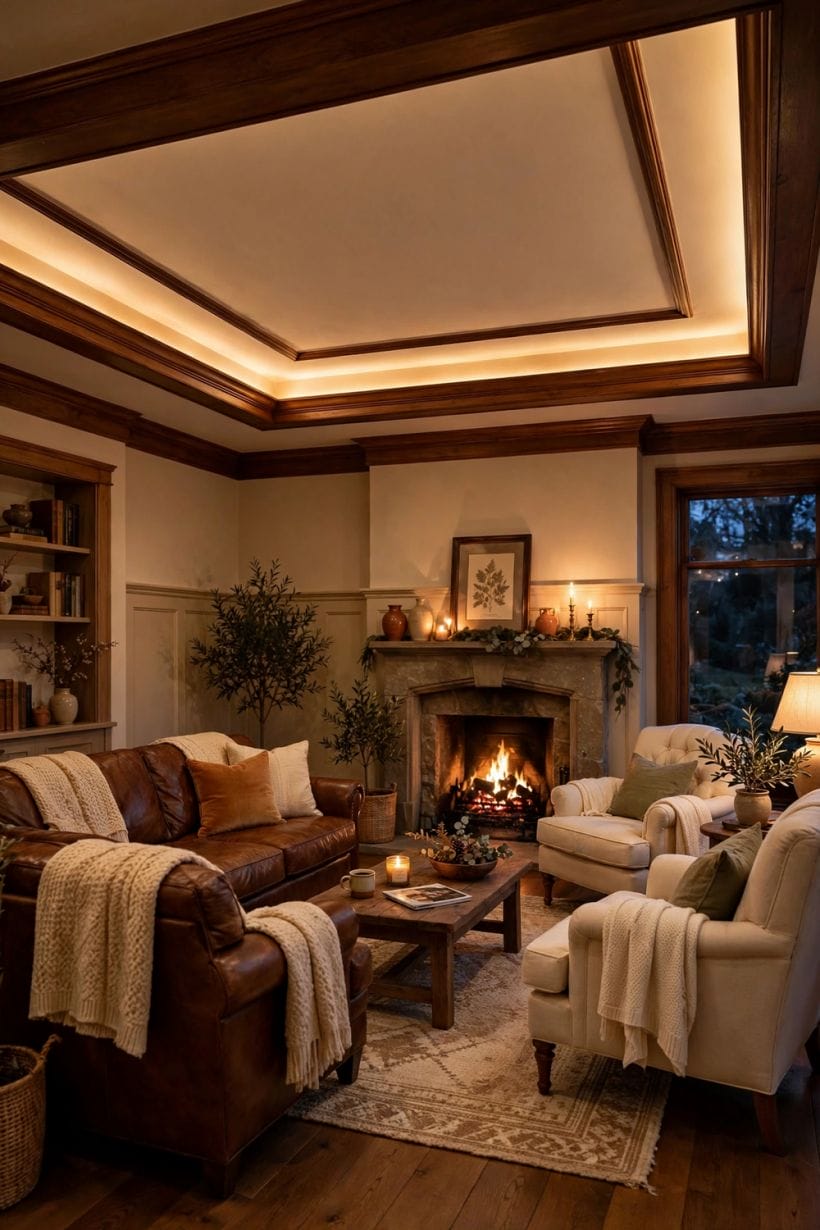
A tray ceiling is not a fit-and-forget feature: its light needs lamps, its fields need dusting’s honesty, and its effect needs the room beneath it kept in rough symmetry. The good news is that all of it is light housekeeping — literally.
66. Dust the step like you mean it
The border’s ledge is a dust shelf by design.
67. Keep spare lamps for the cove from day one
When one section of a concealed strip fails years later, a mismatched replacement shows as a scar of different light. Buying spares with the original installation is the tray owner’s wisest small spend.
68. Repaint fields in the room’s repaint cycle
Ceilings yellow and rooms are repainted beneath them; the tray must join the cycle or slowly become a different, dingier colour than its walls pretend. One ceiling, same schedule, no exceptions.
69. Watch the step for the house’s small movements
Fine cracks at the step’s corners are the house breathing; they fill and paint away in the normal cycle. Anything wider or returning deserves a proper look rather than a fourth coat of optimism.
70. Keep furniture drift on a short leash
The tray’s composition depends on the seating group’s rough symmetry. Chairs wander in real life; a monthly five-minute restoration of the plan keeps the room the ceiling thinks it is.
71. Adjust the scenes with the seasons
Summer evenings want less cove and more lamp; winter wants the full glow by four o’clock. Two seasonal scenes on the dimmer keep the tray working all year instead of being exactly right twice.
72. Let the tray host the year’s ceremonies
A garland at the border’s edge in winter, the best pendant lit for a birthday dinner — the tray is the room’s proscenium. Rooms with ceremonies stay loved, and loved rooms stay maintained.
73. Photograph the ceiling when you change the room
A quick photograph upward before moving furniture or repainting catches clashes of axis and colour while they are still cheap to fix. The tray is half the room’s architecture; consult it like it is.
74. Tell the next tradesperson the tray’s secrets
Where the cove’s driver hides, which circuit the pendant rides, where the border’s access panel sits — a note in the house file saves the next electrician’s guesswork and your ceiling’s plaster.
75. Judge the tray at the sofa, not the door
The door shows the tray’s geometry; the sofa shows its truth. Sit where the room is lived in, look up, and adjust light and colour for that view — it is the only review that counts.
9. Checks and Mistakes: Before the First Purchase or the First Fitting
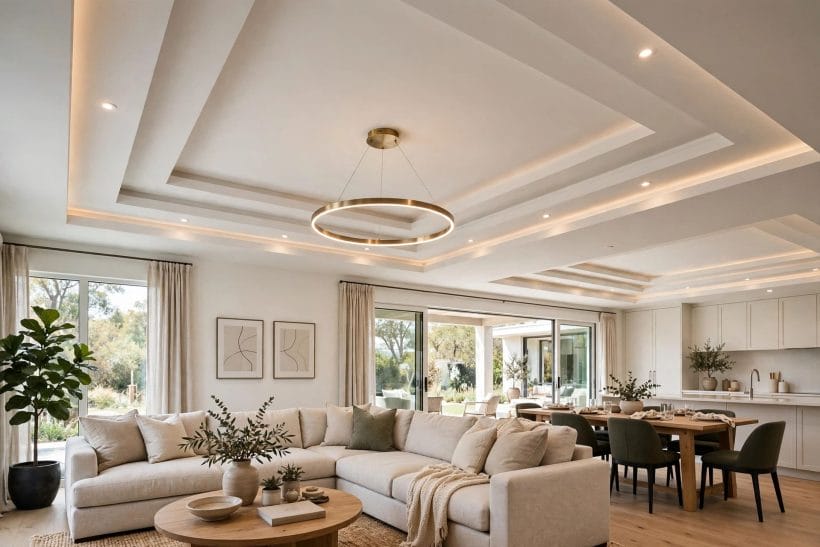
The tray’s classic errors begin at the drawing: a tray centred on the room’s walls instead of on the seating it serves, or sized from a catalogue picture rather than from the room’s own proportions. Both errors are free to avoid at sketch stage and expensive forever after.
The second error is depth by ambition — a deep, double-stepped tray borrowed against a modest ceiling until the border crowds the walls and the room feels upholstered in ceiling. The third is light by afterthought: the tray built, painted, and only then asked where its cove, driver and circuit might live, to the plaster’s sorrow.
Fourth: colour judged at noon. Living rooms are evening rooms, and tray colours chosen under showroom daylight perform their real act under lamplight — test at the hour of use. Fifth: furniture drift, the slow abandonment of the axis the tray announced, until the room below contradicts the ceiling above and neither looks intentional.
And the standing check before any of it: whether the room’s height, the house’s period and the household’s temperament actually call for a tray at all. The generic treatment in this collection’s tray ceiling ideas post covers the feature whole; where the answer is honestly no, a beautifully lit plain ceiling beats a tray installed out of fashion.
10. Costs and Pulling It Together
A living-room tray’s costs gather where its work is: the carpentry and plaster of the step, the electrical run for the cove and pendant, and the repainting of a ceiling now in two or three fields. The materials themselves are humble — board, batten, plaster and paint — which is why the tray remains the most affordable piece of architecture a living room can buy.
The false economies are predictable: skipping the dimmer that makes the cove usable, choosing the pendant by price rather than by scale, and painting the fields in the walls’ leftover white. Each saves little and taxes the room daily. The honest spend is on proportion, light control and one good central fitting.
Pull it together from the sofa outward: profile by the room’s height, colour by its evenings, light in layers, furniture on the axis — and the living room gains the composed, ceremonial calm that is the tray’s whole promise, gathered here under the collection’s living room ideas pillar, within the site’s home design ideas hub, alongside the ceiling’s other families.
Final Considerations
A tray ceiling is a modest piece of architecture with an immodest effect: it tells everyone who enters where the room’s centre is, and how the room intends to behave. In the living room — the house’s ceremonial heart — that announcement is worth making well.
Keep the profile honest, the colour evening-tested, the light layered and the furniture loyal to the axis, and the ceiling will do the rest of the hosting for you.


0 Comments