

A coffered ceiling turns the one surface nobody decorates into the living room’s architecture — a grid of sunken panels overhead that makes an ordinary box of a room feel built, considered and calm.
This survey is the living-room slice of the coffered ceiling: the grid read against sofas, hearths and lamplight in the room that lives under it daily, as one spoke of the living room ideas pillar. The whole-house survey of coffered ceilings — bedrooms, dining rooms, halls and kitchens — belongs to a companion post; here the grid is judged only where people sit beneath it.

1. Coffered Ceiling Living Room Ideas at a Glance
A coffered ceiling is a ceiling organised into a regular grid of recessed panels — the coffers — framed by beams or moulded ribs, so the flat overhead plane gains depth, rhythm and shadow. In a living room its attributes are the grid’s module (how many coffers, how large), the depth of each recess, the material and finish of beams and panels, the way light is placed inside or between the coffers, and the answering geometry below: the rug, the seating island and the hearth wall that the grid quietly organises. It is architecture first and decoration second — which is why it must be planned with the room, not applied to it.
| Question | Short answer |
|---|---|
| What does a coffered ceiling actually do for a living room? | Three things at once. It gives a plain ceiling depth and shadow, so the room gains the architectural weight that crown moulding alone cannot supply. It organises the space below — a well-set grid reads as a map of the seating arrangement under it. And it flatters light: every lamp and window rakes across the recesses and doubles its effect. What it does not do is raise the ceiling; it spends a little height to buy a great deal of presence. |
| How low can a living room ceiling be and still carry coffers? | Shallow coffers are the honest answer for ordinary heights: a modest recess with slim ribs reads clearly from a sofa without pressing on the room, while deep, chunky beams belong to tall rooms that can afford them. The test is proportion, not a number — stand in the room, look up from the main seat, and the grid should feel like a pattern overhead, never like a lid descending. A builder or joiner can confirm what your ceiling structure allows before any design is promised. |
| Should the grid match the room’s shape or the furniture’s? | The furniture’s, whenever the two disagree. The coffers are read from the seats, so a grid centred on the seating island and the hearth wall feels inevitable, while a grid centred on a ceiling whose room is arranged off-axis looks like a mistake in the drawing. Set the module from the rug and the main sofa outward, and let the border coffers absorb the difference at the walls. |
| Painted, stained or two-tone — which finish suits a living room? | Painted grids in the room’s own white family are the calmest and the most forgiving, suiting rooms that change their furnishings often. Stained or natural timber beams bring warmth and suit rooms with timber floors and a hearth. Two-tone work — beams one colour, coffer panels a shade away — sharpens the pattern for rooms whose walls are plain. Choose against the floor and the fireplace first; the ceiling is the third voice in that conversation, not the first. |

2. Reading the Grid: Module, Rhythm and the Room Below
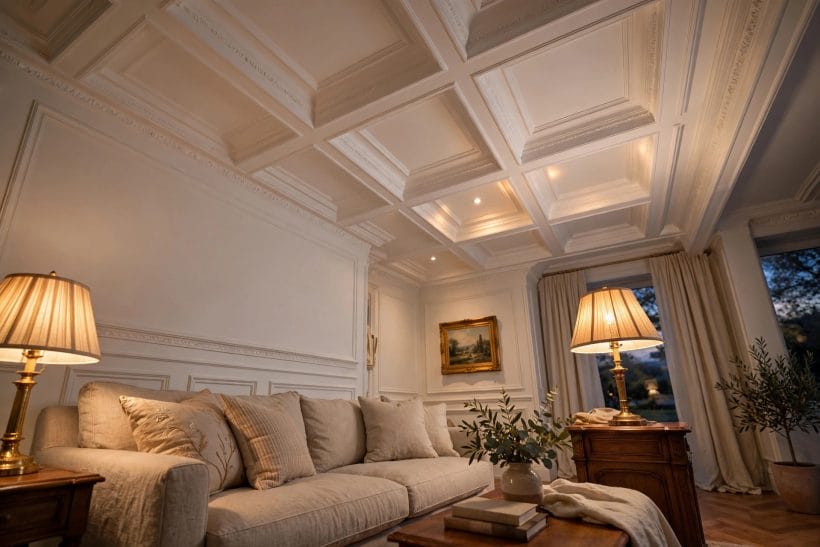
The grid is a plan before it is a pattern. This section reads it against the living room it covers — the same room-first reading the vaulted ceiling living room ideas survey performs for height, applied here to pattern.
1. Centre the grid on the seating, not the ceiling
Measure the room, then ignore its centre if the sofas live elsewhere.
2. Let the largest coffer sit over the conversation
Within an even grid, the central coffer is the room’s chandelier position whether or not a light hangs there.
3. Match the module to the room’s length
Long rooms take elongated grids gracefully: more coffers along the length, fewer across it, so the pattern walks with the room instead of stamping squares onto a corridor.
4. Keep the border coffers honest
Where the grid meets the walls, half-coffers and margins are inevitable. A designed border — a plain margin or a deliberate half-module — reads as a frame; a grid chopped arbitrarily at one wall reads as an error.
5. Count coffers by eye from the main sofa
Drawings flatter grids; sofas tell the truth. Sit where the household actually sits and count what the eye takes in at a glance.
6. Align one axis with the hearth wall
A fireplace gives the room a permanent axis.
7. Let a square room have a square grid
The plainest case is also the most satisfying: a near-square living room, an even grid, a central coffer over a centred rug. When the geometry offers this gift, take it without embellishment.
8. Break the grid only at a real threshold
Where a living room opens to a hall or dining space, the grid may stop — but it should stop like architecture, on a beam line at the opening, not fade mid-coffer.
9. Echo the grid once, quietly, below
One answering rhythm at floor level — a rug border, a tiled hearth, the spacing of a bookcase — marries ceiling to room. More than one echo turns the marriage into a theme.
10. Leave the centre coffer empty on purpose
Not every central coffer wants a pendant. In rooms with low winter sun or a beloved view, an unadorned centre keeps the ceiling serene and the sightlines open.
11. Read the grid in the room’s worst light
A ceiling that sings at noon can glower on a grey afternoon.
3. Depth and Build: Beams, Panels and What the Recess Costs
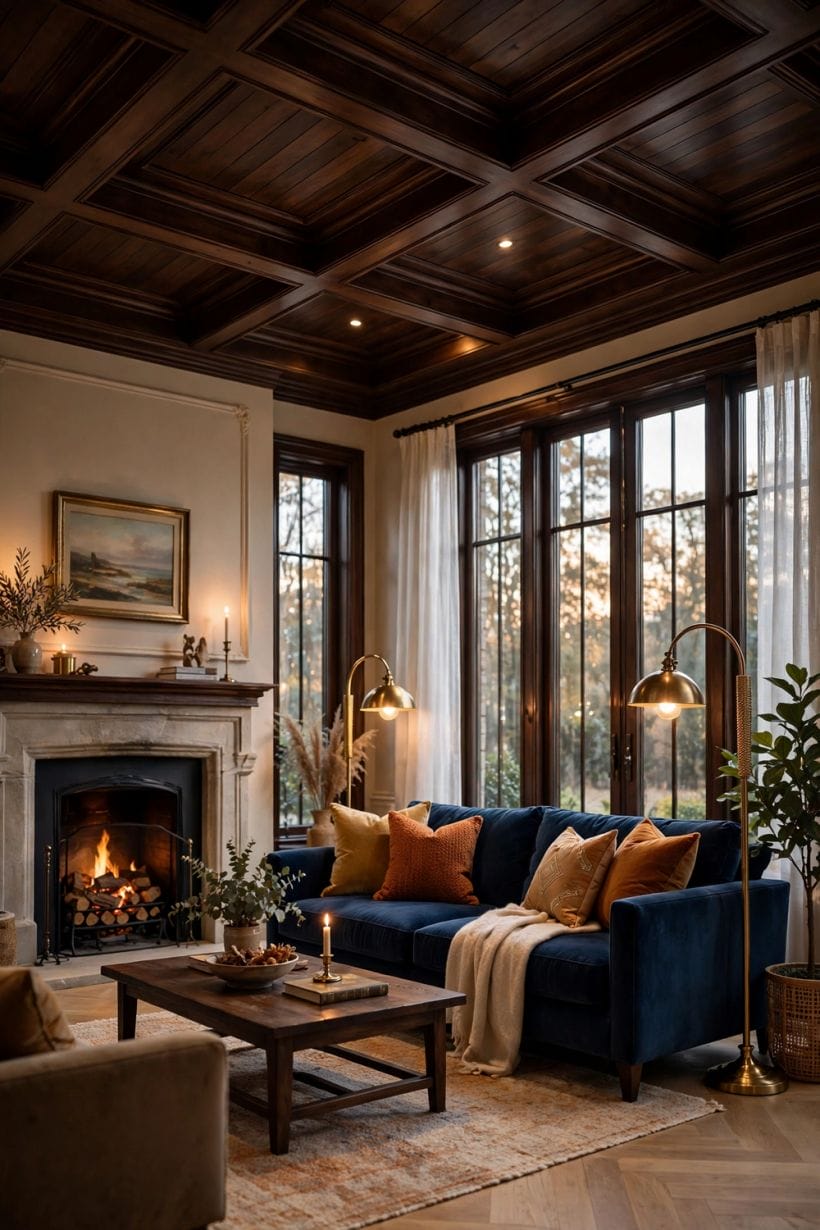
Coffers are carpentry before they are style. Depth, material and construction decide what a grid feels like from below — and all structural questions belong with a builder or joiner working to local rules.
12. Choose shallow coffers for ordinary ceilings
A gentle recess with well-proportioned ribs gives the full pattern — rhythm, shadow, order — while spending the least height.
13. Reserve deep coffers for rooms with height to spare
Deep beams make drama: strong shadow, real architectural weight, a ceiling that behaves like a timber roof. They also lower the visual ceiling decisively.
14. Build the beams as boxes, not solids
Most domestic coffers are formed from hollow boxed beams and applied panels — lighter, kinder to the structure above, and capable of hiding wiring for lights and speakers inside the grid.
15. Carry services inside the grid
The hollow construction is an opportunity: lighting cable, speaker wire and heating controls can travel inside beams to positions a flat ceiling makes awkward.
16. Mind the panel material’s voice
Panels may be plain plasterboard, timber boarding, or moulded detail, and each changes the room’s register. Plain panels keep the pattern architectural; boarded panels add a cottage warmth; ornate moulded centres pull the room toward the formal.
17. Step the moulding, do not stack it
Within each coffer, one stepped moulding profile gives the recess its shadow line. Stacking several profiles shrinks the panel and fusses the pattern, especially in shallow builds.
18. Keep beam widths in proportion to the module
Ribs too narrow disappear from sofa distance; ribs too wide eat the panels and turn the grid into a waffle of beams with holes.
19. Finish the grid before the room is decorated
A coffered ceiling is building work — dust, scaffolding, paint — not a finishing touch. Sequence it before flooring is laid and furniture returns, and protect finished surfaces ruthlessly if the order of works forces otherwise.
20. Ask what the ceiling above can carry
Existing joists, hidden pipes and the floor above all vote on a coffered design.
21. Consider a faux grid where structure forbids the real one
Applied moulding grids and shallow batten patterns can quote the coffered idea on ceilings that cannot take depth — a lighter dialect of the same language.
22. Let one room own the deep build
In a house with several downstairs rooms, the living room is the rightful home of the most ambitious grid, because it is sat in longest. Shallower treatments elsewhere keep the hierarchy legible and the budget sane.
4. Colour and Finish: Paint, Stain and the Two-Tone Grid
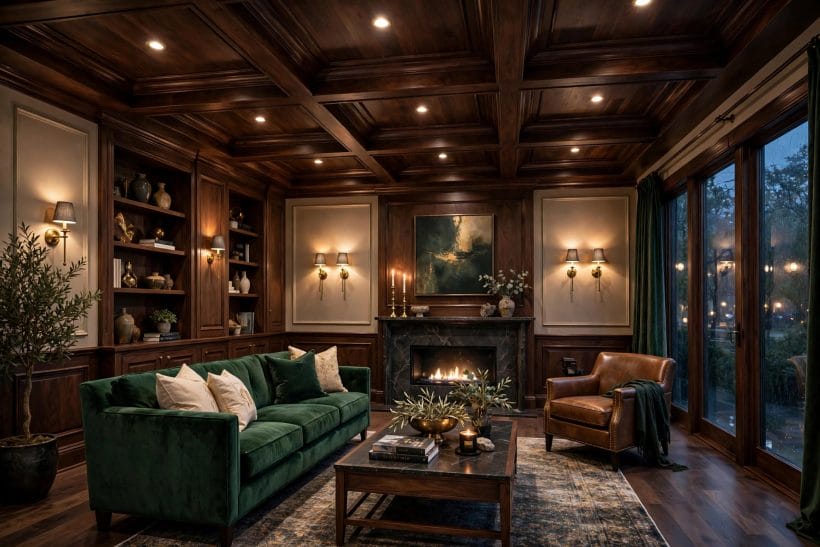
Finish decides whether a grid reads as architecture, furniture or pattern. Each route below is judged against living-room companions — floor, hearth and the room’s textiles.
23. Paint the whole grid in the ceiling’s own white
The classic treatment: beams, panels and mouldings in one white family, so the grid reads purely as light and shadow.
24. Warm the white to match the room’s light
North-facing living rooms turn blue-whites cold; a white with a warm undertone keeps a painted grid companionable in that light. South-facing rooms can take cleaner whites.
25. Stain the beams and paint the panels
The two-material build: timber beams with painted panels above them. It suits rooms with timber floors and a hearth, giving the ceiling the warmth of wood without the weight of a fully timbered lid.
26. Go two-tone with colour in the coffers
Panels painted a soft colour inside white beams — pale sage, washed blue, warm greige — sharpen the pattern and lend the room a decorated ceiling in the old sense.
27. Try the beams in colour and the panels pale
The reverse two-tone: coloured beams drawing the grid over pale panels. It is bolder and more graphic, suiting plain-walled rooms and modern furniture.
28. Take the grid dark for a den-like evening room
A deep-toned grid — ink, forest, oxblood’s quieter cousins — over lamplight makes a living room feel like a library at dusk.
29. Match sheen to depth
Flat and matte paints deepen shadow and forgive surface flaws, which is why they own most grids. A soft sheen on the beams alone can define the ribs in dull light and wipe clean more easily.
30. Carry the wall colour up and over
Painting beams and panels in the wall colour — colour-drenched ceilings — dissolves the boundary between wall and lid and makes the grid a texture rather than a pattern.
31. Let the hearth set the ceiling’s temperature
A stone or brick fireplace brings its own palette. Warm grids flatter cool grey stone; cooler whites calm red brick.
32. Keep one finish for the whole grid
Whatever the scheme, consistency is its discipline: every beam the same treatment, every panel the same. A grid is a repeated unit, and variation reads as accident at ceiling scale.
33. Repaint before you rebuild
An existing grid in the wrong finish is a weekend problem, not a building project. If the carpentry is sound, colour alone can move a ceiling from heavy to light, dated to calm.
5. Light Inside the Grid: Pendants, Recessed Spots and Lamplight

A coffered ceiling is a lighting instrument — its recesses catch, hide and aim light. Plan the light with the grid, and let a qualified electrician do all wiring to local rules.
34. Hang one pendant from the centre coffer
The classical arrangement: a single considered pendant or chandelier occupying the grid’s heart, sized to the coffer it hangs in.
35. Put recessed spots inside the coffers
Small downlights seated in the panels themselves wash the seating below and leave the beams clean. Spacing follows the grid, which is the system’s gift: the pattern decides positions that a flat ceiling leaves to guesswork.
36. Keep spots out of the beams
A beam drilled for downlights is weakened visually even when it is sound structurally — the rib becomes a utility strip. Reserve beams for their silhouette.
37. Use the grid to zone the lighting
Coffers over the reading chair, the hearth and the television wall can carry different circuits, so the room lights in scenes rather than all at once. Zoning is where a grid earns its keep nightly.
38. Add cove light along the beams for evenings
A concealed strip washing up into the coffers gives the ceiling a floating glow after dark and flatters every finish, stained or painted. It is atmosphere light, not task light, and should be dimmable and warm.
39. Let window light rake the grid by day
Daylight crossing coffers at an angle is the ceiling’s best daytime effect — deep shadow in the morning, soft modelling by afternoon.
40. Protect the television corner from downlight glare
Spots inside coffers above a screen wash it out and mirror in it. Keep the screen’s bay on a separate, dimmable circuit or light that corner from lamps instead.
41. Layer lamplight beneath the grid
Table and floor lamps remain the living room’s warmth; the ceiling’s job is pattern and general light. A grid lit only from itself feels like a showroom.
42. Choose bulb colour once, for the whole ceiling
Mixed colour temperatures across a grid look like maintenance failures — one warm spot, one cold, a pendant disagreeing with both. Settle the warmth deliberately, note it, and replace like with like forever.
43. Dim everything the grid carries
Coffers change character with light level more than flat ceilings do: bright, they are pattern; dimmed, they are atmosphere. Dimmers on every circuit the grid holds are not a luxury but the control the design assumes.
44. Clean light into the corners
Grids can leave a room’s edges in relative gloom if all light is central.
6. Furnishing Under the Grid: Sofas, Rugs and the Answering Room
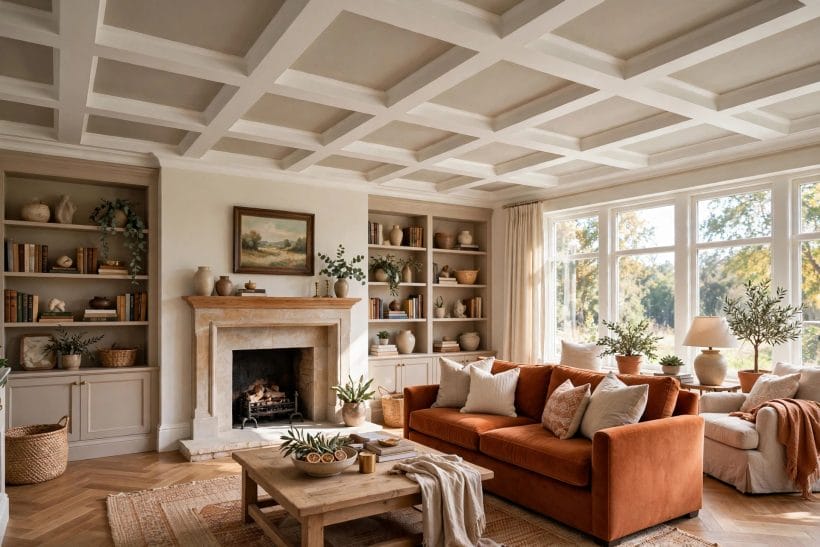
The ceiling sets a rhythm; the room below must answer it without mimicking it. These ideas align furniture with the grid the way the family room ideas collection aligns furniture with daily life.
45. Float the seating island on a rug beneath the grid
A rug that sits comfortably inside the grid’s central bays grounds the conversation group and ties floor to ceiling in one gesture. The rug need not trace the coffers — near-alignment pleases, exact tracing parodies.
46. Keep tall furniture off the grid’s main axes
Bookcases and armoires pushed against walls are fine, but tall pieces standing free under the pattern compete with it.
47. Centre the coffee table, roughly, on a coffer
Roughly is the operative word. A table that sits near a coffer’s centre looks settled; one straddling a beam line at an odd offset looks parked.
48. Hang art for the seats, not the ceiling
Resist aligning picture tops with beam lines at heights nobody views from. Art in a living room is read from sofas and chairs.
49. Let the fireplace wall stay the room’s face
Coffers organise the ceiling, but the hearth should remain the living room’s portrait — the balance the living room with a standard fireplace survey also defends. Dress the chimney breast simply beneath a strong grid; two competing architectures, one overhead and one ahead, exhaust a room.
50. Use low, long storage under patterned ceilings
Long low sideboards and media units echo the grid’s horizontality without touching it, and keep the walls calm between floor and beams. In white living room ideas the same discipline — quiet, low furniture under a treated ceiling — is what stops pale rooms feeling empty.
51. Avoid ceiling-height curtains under a grid
Full-height curtains draw the eye up the walls and into an argument with the beams about where the room ends.
52. Balance a dark grid with pale, plain upholstery
A deep-toned ceiling lowers the room’s centre of gravity; large pale sofas and unpatterned textiles restore the balance and keep the mood den-like rather than cave-like.
53. Balance a white grid with saturated furniture
The reverse discipline: an all-white grid over a pale room needs anchoring colour below — a deep sofa, a real rug, timber with presence. Without it the ceiling’s craft floats unobserved above a room too timid to meet it.
54. Keep the television’s wall quiet
Where a screen shares the room, the grid’s regularity actually helps: a composed ceiling makes a black rectangle on the wall feel like one calm element among ordered others.
55. Let plants stay below the beams
Tall plants reaching into the grid’s border blur its clean geometry and complicate its reading.
7. Small, Low and Open-Plan: The Grid Under Pressure

Not every living room is a tall rectangle. These ideas adapt coffers to the rooms that need persuading — small footprints, modest heights and open plans shared with kitchens and halls.
56. Shrink the module, keep the idea
Small living rooms take small coffers: a finer grid in shallow relief reads as refinement rather than compression. The pattern’s pleasure is rhythm, and rhythm survives scaling.
57. Use a batten grid where height forbids recesses
Surface battens painted into the ceiling give the coffered rhythm with almost no loss of height — the honest dialect for low rooms discussed in the build section.
58. Run the grid over the living zone only
In open-plan spaces, coffers make an excellent ceiling for one zone: the grid begins and ends with the sitting area, defining it as firmly as a rug does below.
59. Stop the grid at the kitchen with a beam
Where the living grid meets a working zone, terminate it on a full beam line at the boundary, deep enough to read as a lintel between worlds.
60. Keep rental rooms to reversible pattern
Adhesive moulding grids and paint-only coffers — panels suggested by two close tones — give tenants the rhythm without the carpentry.
61. Watch headroom at door swings and stairs
In compact rooms the grid’s border can collide with tall door swings, stair bulkheads and the tops of storage walls.
62. Prefer fewer, larger coffers in awkward shapes
L-shaped and bay-windowed living rooms punish fine grids with a litter of cut panels.
63. Let a bay window keep its own ceiling
Bays often have their own lower ceiling line; forcing the main grid into the bay produces cramped fragments.
64. Use the grid to warm a new-build box
Plain new living rooms — flat ceiling, no cornice, no hearth — are the grid’s easiest victories.
65. Pair shallow coffers with picture rails and panelling sparingly
Wall panelling plus coffers plus ornate cornice can over-dress a small room. Choose the ceiling as the room’s one architectural performance and keep the walls simple — a picture rail at most. The hierarchy that makes the transitional living room work — one statement, quietly supported — applies overhead too.
8. Living With It: Sound, Dust and the Long View
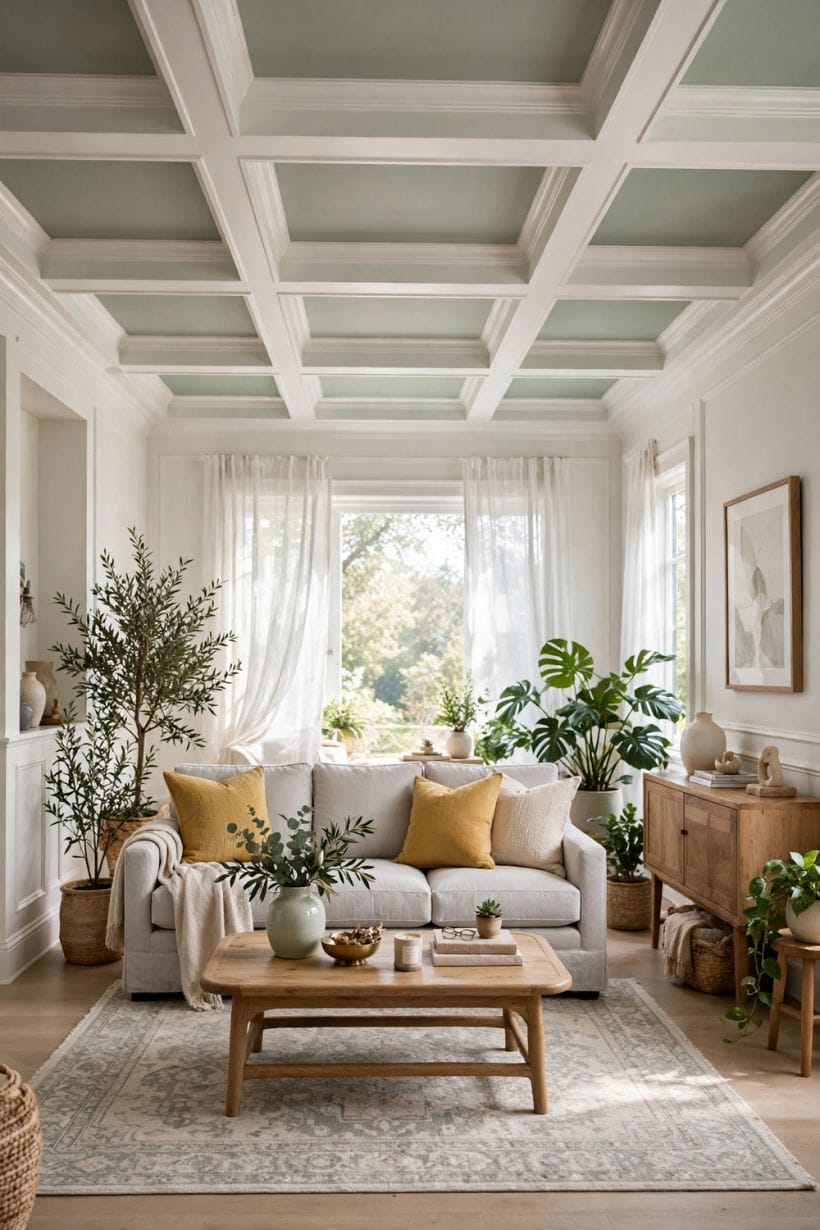
A coffered ceiling is lived under for decades. This closing set of ideas covers the practical companionship — acoustics, cleaning, repainting and the design’s behaviour as the room changes around it.
66. Expect a slightly quieter room
Broken overhead surfaces scatter sound where a flat ceiling reflects it in one sheet, so coffered living rooms often feel a touch calmer in conversation.
67. Plan for dust on the beam ledges
Every horizontal ledge collects dust, and a grid has many. Shallow profiles and matte paint minimise the chore; a long soft brush on cleaning day handles the rest.
68. Keep the paint formula recorded
Ceilings are repainted rarely and matched badly from memory. Record the grid’s paint — brand, colour, sheen — with the house papers, and keep a labelled remnant if storage allows.
69. Design the grid to outlive the furniture
Sofas last a decade; ceilings last generations. Keep the grid’s module, depth and finish more classic than the room’s current furnishings, because it will preside over several generations of them.
70. Let the grid survive a change of room style
A well-proportioned painted grid accepts traditional, transitional and modern furniture in turn, which is its deepest economic virtue.
71. Inspect after any leak before repainting
Water finds grids at their joints and stains along beam lines.
72. Refresh the panels, keep the beams
When a stained-timber grid feels heavy a decade on, painting the panels pale while keeping the beams’ wood transforms the ceiling’s weight at a fraction of rebuilding’s cost.
73. Photograph the services before closing the grid
If wiring or pipework travels inside the beams, photograph every run before the panels close and keep the pictures with the house records.
74. Leave the next owner a drawn plan
A simple sketch of the grid — module, circuits, access points — is a courtesy that costs an hour and saves every future trade a day.
75. Judge the ceiling after a season, not a week
New architecture overhead feels conspicuous for a fortnight and inevitable by the second season. Live under the grid through the room’s ordinary rituals — films, guests, winter evenings — before judging it.
9. Checks and Mistakes: Before the First Purchase or the First Stone

Before any beam is cut, settle the checks that protect the whole project. Confirm the grid’s centre against the seating, not the ceiling’s raw geometry. Confirm the module by eye from the main sofa — in drawing, in a mocked-up bay, or at minimum in a scaled sketch the household has actually sat with. Confirm what the existing ceiling can carry and where its hidden services run, with the builder who will do the work. And confirm the services the grid itself will carry — lighting circuits, speaker runs — before the construction closes over them.
The common mistakes are consistent. A grid centred on the room while the furniture lives elsewhere. Coffers too deep for the ceiling’s height, chosen from photographs of taller rooms. Spots drilled into beams. Mixed bulb colours glowing out of adjacent panels. And the two-tone painted by halves — beams one weekend, panels another, in colours never tested together at full-bay scale. Every one is visible from the sofa for years, and every one was avoidable in an afternoon.
Keep the professional boundaries clear. Structure, wiring and anything touching the floor above belong to qualified trades working to local rules; this survey offers design judgement, not building instruction. A ceiling is the one surface whose failure is never merely cosmetic, and the grid’s beauty is no substitute for the competence that holds it up.
10. Costs and Pulling It Together
Costs follow the build’s honesty: a shallow applied grid in painted softwood or moulding is the modest end; boxed beams with panelled coffers and integrated lighting sit in the middle; deep timber construction with concealed services is the expensive country, priced by joiners per room rather than by any honest general figure. What can be said generally is where the money goes — carpentry hours first, then finishing, then the electrical work the grid makes possible — and that a mocked-up single bay is the cheapest insurance in the whole project.
Pull the room together in this order: grid module set from the seating; depth chosen for the ceiling’s real height; finish chosen against floor and hearth; lighting planned inside the pattern; furniture floated beneath on a rug that roughly answers the grid. The coffered ceiling ideas that succeed share that sequence. Inverted sequences — finish first, furniture wherever — produce ceilings that photograph well and sit badly, which is the one failure a living room cannot afford.
Final Considerations
A coffered ceiling asks a living room a good question: what is all this space for, and can the ceiling help answer it? In the rooms where the answer is conversation, books, a fire and long evenings, the grid earns its carpentry every day — organising the seats, flattering the light, quieting the sound a little, and giving the eye somewhere considered to rest when it lifts from the page.
Build the living-room grid, and leave the rest of the house to its own companion survey: this post has deliberately kept to the one room, because a ceiling judged from a sofa is a different thing from a ceiling judged from a doorway or a dining chair. Within its room, though, let the standard be total — a grid so well centred, so honestly built and so quietly lit that guests stop seeing a ceiling treatment at all, and simply feel that the room was always meant to be exactly this shape.




0 Comments