

Every room has one surface that becomes its altar — where the clock lives, the cards stand, and the candles gather — and in any room with a fire, that surface is the mantel.
These 75 fireplace mantel ideas — a complete survey of fireplace mantels and the surrounds beneath them — walk the fireplace’s crown in order: the mantel defined, the great beam, the masonry surround, the decorated period tradition and the modern line, then the styling of the shelf and the gentle care that keeps it worthy of the fire.
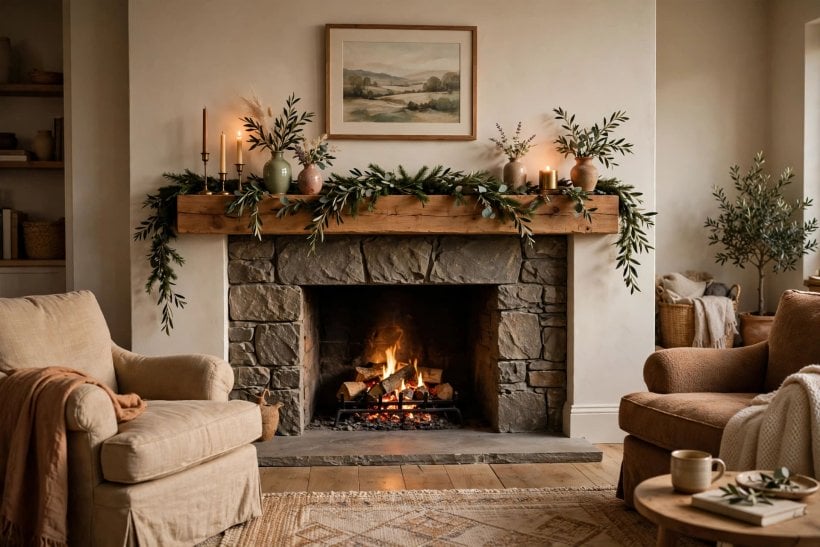
1. Fireplace Mantel Ideas at a Glance
The central entity is the fireplace mantel: the shelf or beam that crowns a fireplace, together with the surround it caps, defined by its attributes — its anatomy (firebox, surround, shelf, breast, hearth), its material family (timber beam, stone, brick, tile, cast iron, marble or plaster), its style allegiance, and the display it carries. Around a working fire, heat is the mantel’s first law, and this post keeps all fire-adjacent guidance general: the fire’s maker and local rules govern anything combustible near the firebox.
| Question | Short answer |
|---|---|
| Mantel or surround — what is the difference? | The surround frames the firebox; the mantel is the shelf or beam that caps it. They are designed as one object but built, and replaced, on different timescales. |
| Beam, stone or iron — which family first? | By the house’s allegiance: beams for rustic rooms, stone and brick for masonry permanence, cast iron and carved timber for period rooms, a single line for modern ones. |
| How deep should the shelf be? | By what it must hold: layered frames and clocks want depth; a line of candles and one leant picture want little. Display decides depth, not habit. |
| What governs anything near the fire? | Heat, always: the fire maker’s guidance and local requirements, checked — this post states the framing generally and invents no clearances. |
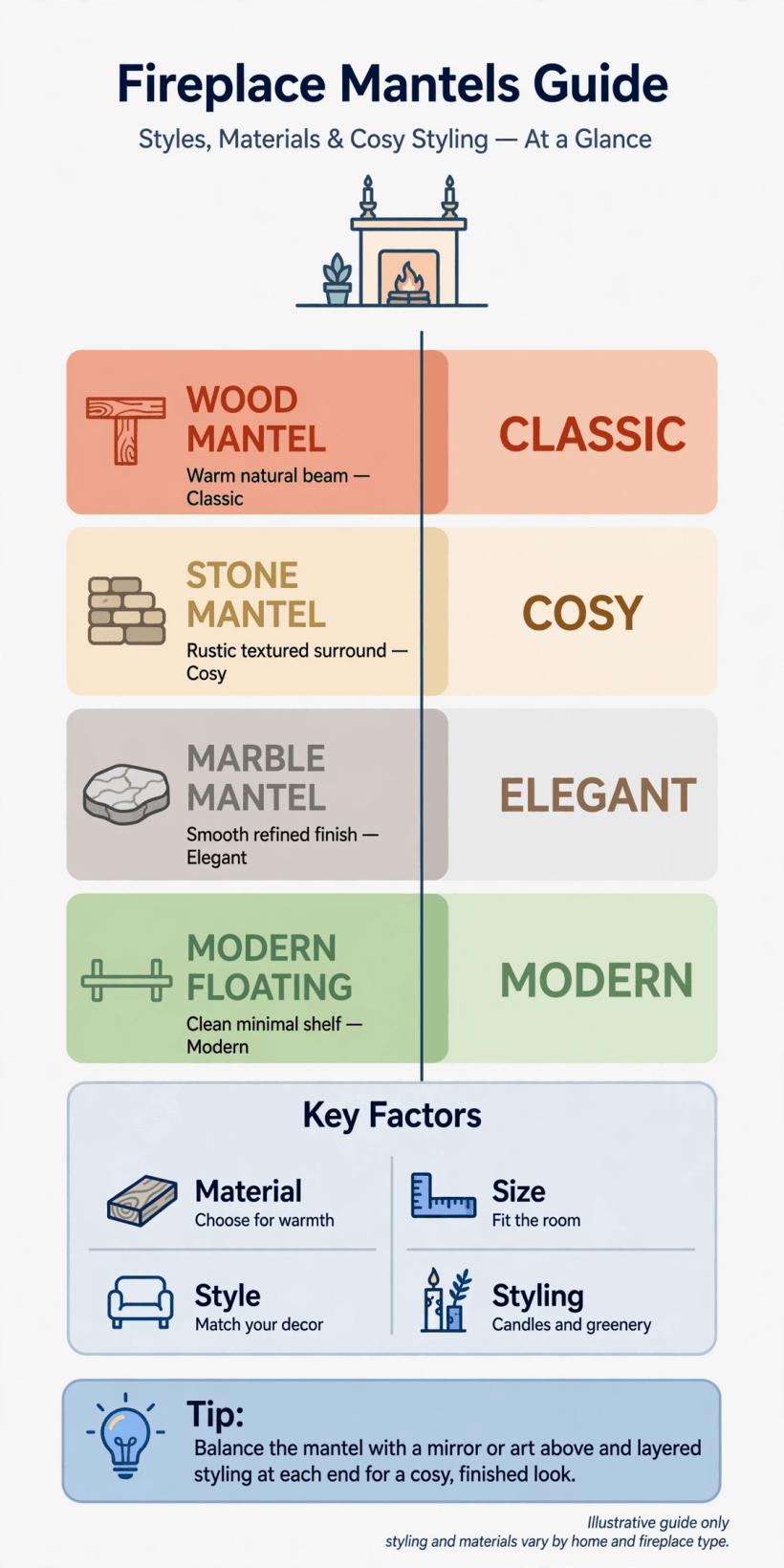
2. The Mantel Defined: Shelf, Beam, Surround and the Room’s Altar
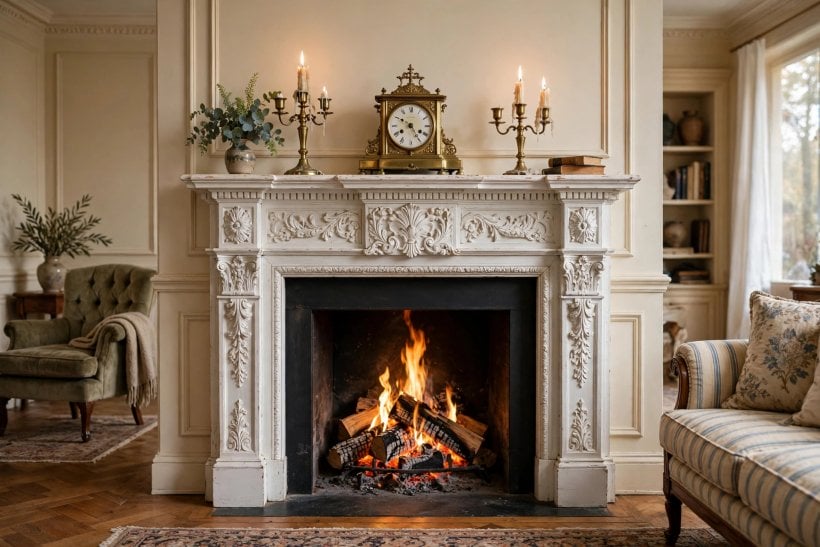
The mantel is the fireplace’s face and the room’s display shelf in one piece of architecture. Where the fireplace living room ideas post composes the whole room around its fire, this post stays on the fireplace’s own crown — the beam or shelf, the surround beneath it, and everything the household arranges on top.
1. Start With the Mantel as the Fireplace’s Crown and the Room’s Altar
No surface in the house is looked at more or used more ceremonially: the mantel holds the clock, the cards, the candles and the family’s small treasures, all above the fire.
2. Learn the Anatomy: Firebox, Surround, Shelf, Breast and Hearth
The firebox holds the fire; the surround frames it; the mantel shelf caps the surround; the chimney breast carries the whole composition up the wall; the hearth grounds it.
3. Let the Mantel’s Job Be Threefold: Frame, Shelf and Shield
The mantel frames the fire’s picture, shelves the room’s display, and shields the wall above from the fire’s rising heat.
4. Respect Heat as the Mantel’s First Material Law
What stands near a working fire lives by heat’s rules, and the maker’s guidance and local requirements govern clearances for anything combustible.
5. Match the Mantel’s Scale to the Breast and the Room
A slight shelf on a great breast looks starved; a monumental beam in a small room looks like a dare.
6. Give the Fireplace One Clear Style Allegiance
Beam-and-brick rusticity, stone formality, cast-iron period detail, plaster modernity: the mantel declares the fireplace’s family.
7. Treat the Shelf’s Depth as a Display Decision
A deep shelf holds clocks, plants and layered frames; a slim shelf holds a line of candles and one picture leant.
8. Let the Surround and the Shelf Be Designed as One Object
The surround’s material and the shelf’s material meet at the fireplace’s most-seen junction. Designed together — stone surround, timber shelf; brick surround, stone shelf — they compose; bought separately on different Saturdays, they usually argue.
9. Keep the Hearth and the Mantel in Conversation
Hearth stone below, shelf above: the fireplace’s floor and crown should share a material accent or a colour temperature. The eye travels the whole breast in one glance, and the composition should survive the journey.
10. Plan the Wall Above as Part of the Mantel
Mirror, picture, clock or deliberate emptiness: the wall above the mantel is the composition’s third act, designed with the shelf, not after it.
11. Remember the Mantel Is Photographed at Every Family Occasion
Birthdays, holidays, the mantelpiece portrait: this shelf is the family’s backdrop for decades.
3. Beam Mantels: Oak, Reclaimed Timber and the Rustic Crown
The beam mantel is the fireplace’s rustic crown: one great piece of timber laid across the breast, carrying the room’s warmth in its grain. These ideas keep to the beam family; the fire it crowns, in its outdoor cousin form, is built step by step in the cluster’s stacked stone fire pit guide.
12. Lay a Single Oak Beam Where the Room Wants Honest Weight
One oak beam, its grain and knots on show, is the rustic mantel’s whole argument: mass, warmth and a shelf in a single gesture.
13. Use Reclaimed Timber for a Beam With a Past
Old beams carry saw marks, nail ghosts and a century’s seasoning no new timber can imitate. Bought from reputable salvage, checked for soundness and treated with respect, they make the mantel the room’s oldest sentence.
14. Float a Beam Without Visible Supports for the Calm Modern-Rustic Look
Hidden fixings let the beam hover on the breast, its weight seemingly suspended — the contemporary rustic detail.
15. Keep a Rough-Sawn Face Where Hands and Light Should Feel Texture
Rough timber catches lamplight in facets and asks to be touched; planed and waxed timber reads calmer and cleans easier.
16. Chamfer or Soften the Beam’s Front Edge Against Foreheads and Dust
A knife-sharp beam edge at head height is a household injury waiting for a tall guest. A gentle chamfer keeps the rustic character, sheds the danger and gives the front face its finished line.
17. Pair the Beam With a Brick Breast for the Farmhouse Formula
Brick below, oak above, a black firebox between: the farmhouse fireplace formula endures because each material does its favourite job. It is the register the fire-pit guide linked above carries outdoors in stone.
18. Let a Dark-Stained Beam Anchor a Pale Room
A deep-stained or scorched beam on a white or limewashed breast gives pale rooms their one dark note of gravity. The contrast does the decorating; the shelf’s styling can then stay almost empty.
19. Run a Slim Beam in Small Rooms Where a Great One Would Crouch Over the Fire
Scale the beam down gracefully for small breasts: slimmer, shorter, set with the same confidence. A modest beam in proportion beats a magnificent one apologising for its size nightly.
20. Cap a Beam With Nothing at All Where the Timber Is the Display
The finest beams earn an empty shelf: grain, one clock, perhaps a single candlestick. Restraint on a great beam is the loudest styling statement in this whole post.
21. Support Long Beams Honestly With Corbels Where the Span Asks
Timber or stone corbels under a long beam’s ends are structure worn proudly, in the fireplace’s oldest tradition. Where the span is real, let the supports show and make them handsome.
22. Wax and Feed Timber Mantels as Furniture, Not as Building
A beam mantel is joinery living over heat: it dries, breathes and appreciates the same feeding as good furniture. Its care belongs in the household’s rhythm, little and often, like the fires beneath it.
4. Stone, Brick and Tile Surrounds: The Mantel’s Masonry Half
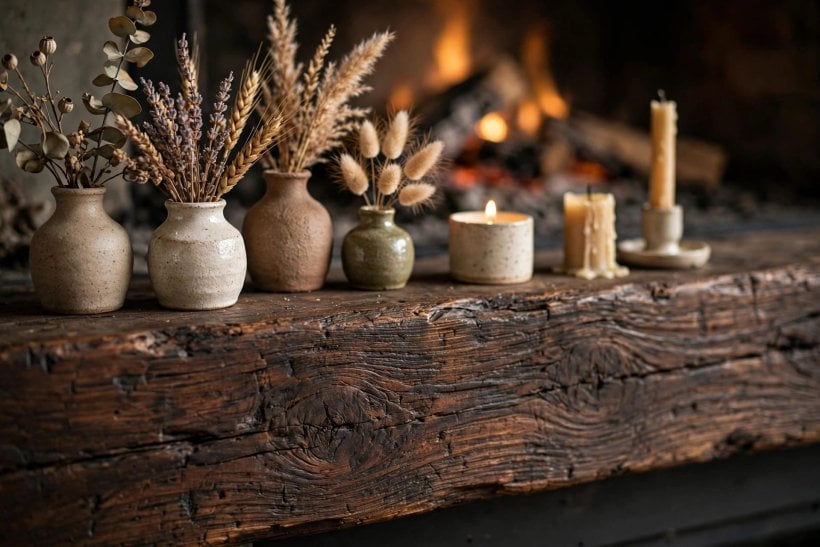
Beneath most shelves stands masonry: the surround that frames the firebox and carries the mantel’s composition. These surrounds are the permanent half of the fireplace — the shelf can change in a day; the surround is a decade’s decision — and they set the terms the room’s wider design, surveyed in the living room ideas pillar, must answer.
23. Frame the Fire in Pale Stone Where the Room Wants Light Formality
Limestone and pale sandstone surrounds lift a fireplace’s face and suit calm, formal rooms.
24. Use Slate Where the Fireplace Should Read Dark, Fine and Modern
Honed slate surrounds give the fire a dark, precise frame that partners both beams and minimal shelves. Slate’s layered nature asks for sound fixing and sealed faces, repaid in decades of composure.
25. Let Exposed Brick Be the Surround Where the Breast Is Already Honest
Many breasts hide sound brick under tired plaster. Revealing, cleaning and pointing it gives the fireplace its original face back — the cheapest grand surround is often the one the house already owns.
26. Build a Brick Surround With a Soldier Course or Arch for Craft Detail
Brick laid with intention — a soldier course across the top, a shallow arch, a herringbone panel in the fireback — turns the commonest material into the fireplace’s craft exhibit.
27. Tile the Surround Where Colour and Pattern Belong at the Fire
Glazed tiles, from Victorian colour to handmade modern squares, give the surround its decorated register. Heat-suitable tiles and adhesives, chosen with the maker’s guidance, are the non-negotiable groundwork beneath the pattern.
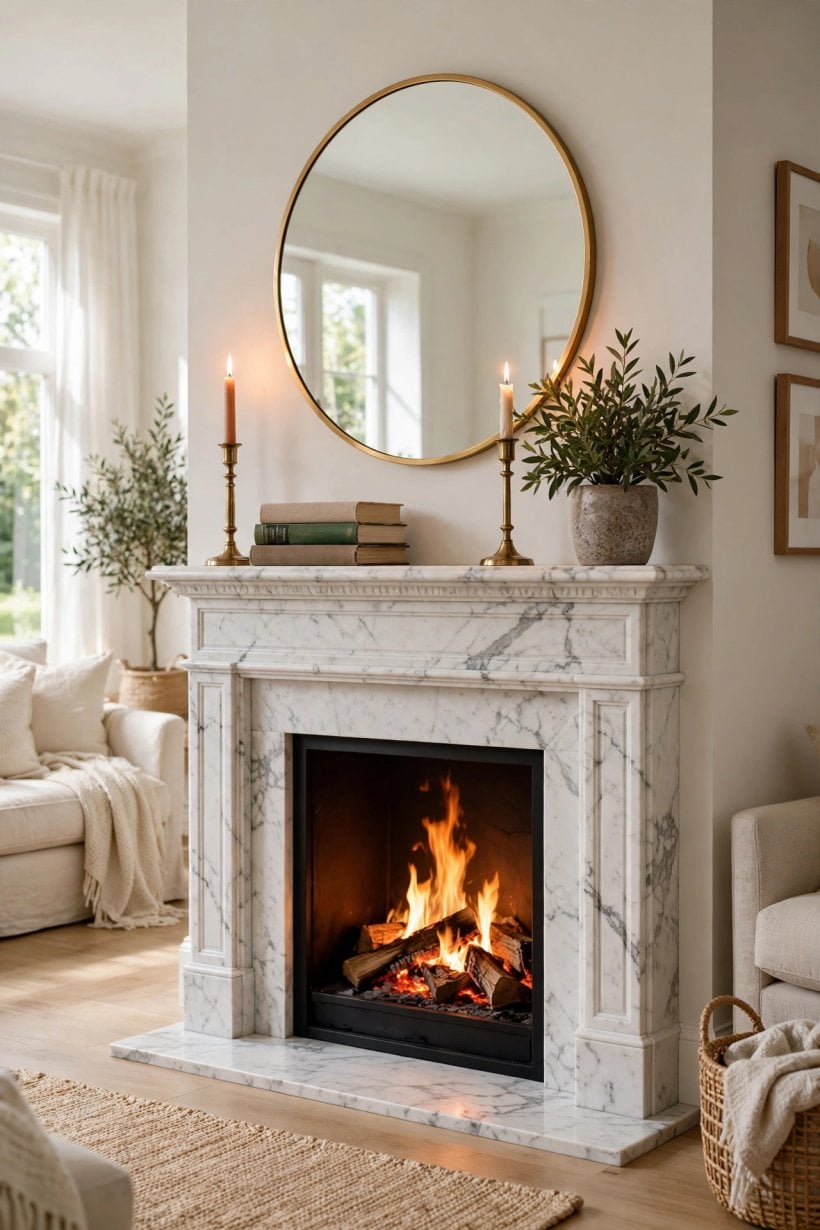
28. Run Marble Where the Room Keeps Formal Hours
Veined marble surrounds are the formal fireplace’s dress uniform: cool, exact and unforgiving of clumsy styling. They suit rooms that entertain formally and shelves styled with the restraint marble demands.
29. Use Cast Stone and Composed Stone for Classical Proportion Without Quarry Prices
Reconstituted stone surrounds reproduce classical mouldings faithfully at friendlier cost and weight. Their honesty is in their making; detailed well and painted or left pale, they serve period rooms kindly.
30. Keep the Surround’s Legs and Frieze in the Fireplace’s Own Proportion
Classical surrounds speak in proportions — leg width to opening, frieze depth to shelf.
31. Let a Plastered, Painted Breast Be the Minimal Surround
Where no surround is wanted, the breast itself, plastered cleanly and painted, frames the firebox by shadow alone. The minimal treatment suits modern shelves and stoves, and throws all attention onto flame and shelf styling.
32. Repoint, Clean and Repair Before Replacing Any Masonry Surround
Soot, tired pointing and one cracked stone are maintenance, not death. Masonry surrounds are the fireplace’s century-scale parts; restoration almost always beats replacement in cost, character and conscience.
33. Match the Hearth Stone to the Surround, or Deliberately Contrast It Once
Hearth and surround in the same stone read as one carved object; a deliberate single contrast — dark hearth, pale surround — reads as design.
5. Period and Cast-Iron Mantels: The Decorated Tradition
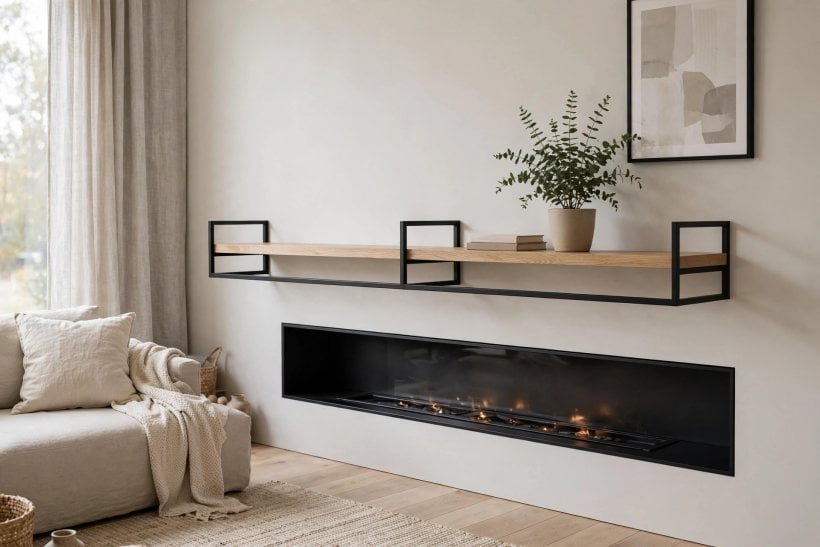
The decorated fireplace has its own long tradition — cast iron, carved timber, tiled inserts — kept here in its lane. Tiny-house versions of the same instinct, scaled to small rooms, are gathered in the corpus’s fireplace interior design ideas for tiny houses.
34. Keep a Cast-Iron Surround Where the House Is Victorian or Edwardian
Cast iron’s fine detail — arches, tiles’ frames, delicate mouldings — is the period fireplace’s signature, cast in thousands of patterns. Restored and blacked, an original iron surround out-charms any reproduction at any price.
35. Frame Tiles in the Iron Insert for the Era’s Colour
The tiled insert, panels of glazed colour flanking the firebox, is the Victorian fireplace’s jewellery.
36. Carve or Choose a Timber Surround in the Classical Mould Where Iron Is Absent
Timber surrounds with pilasters, frieze and moulded shelf carried the classical fireplace into houses that could not cast iron. Painted, they remain the adaptable formal option — their colour can follow the room’s decades.
37. Let an Adam-Style Composition Panel Crown a Refined Room
Delicate classical swags and centre tablets in composition ornament give the mantel its most refined period voice. It suits quiet rooms and restrained styling; a busy shelf beneath it is a category error.
38. Restore Before Reproducing: Period Mantels Reward the Restorer
Soot, paint layers and one broken corbel are a weekend’s archaeology, not a death sentence. Period mantels restored keep their patina and their proportions; reproductions should be reserved for fireplaces genuinely lost.
39. Use a Bedroom-Scale Period Fireplace Kindly, As the Room’s Relic and Shelf
Small cast-iron bedroom fireplaces, often no longer working, make beloved shelves and the room’s historical note. Kept, cleaned and styled lightly, they are heritage doing daily duty as furniture.
40. Match Period Mantels With Period-Scaled Styling
Small clocks, candlesticks, a modest mirror: period shelves were styled at period scale. Modern oversized objects on a Victorian mantel look like giants at a doll’s tea party — charming once, tiring daily.
41. Black-Lead and Polish Iron as the Tradition Intended
Cast iron kept with its traditional black finish glows with a soft, deep lustre no paint imitates. The ritual is short, seasonal and part of the period fireplace’s authentic maintenance rhythm.
42. Let a Marble Chimneypiece Serve the Grand Room Without Apology
In genuinely grand rooms, the carved marble chimneypiece is the house’s state furniture. Its styling rule is courtly restraint: symmetry, height, and very few objects, each earning its audience.
43. Commission Honest Reproduction Where a Lost Fireplace Is Being Returned
Where a room’s fireplace was ripped out in an unkind decade, a faithful reproduction surround restores the room’s centre honestly. Mark the work as new in the household’s records; honesty is part of the craft.
44. Keep the Fireback and Interior Ironwork in the Same Conversation
Firebacks, grates and dogs share the firebox with the surround’s composition. Iron inside and iron outside in the same finish family make the whole fireplace read as one cast intention.
6. Modern and Minimal Mantels: The Shelf as a Line
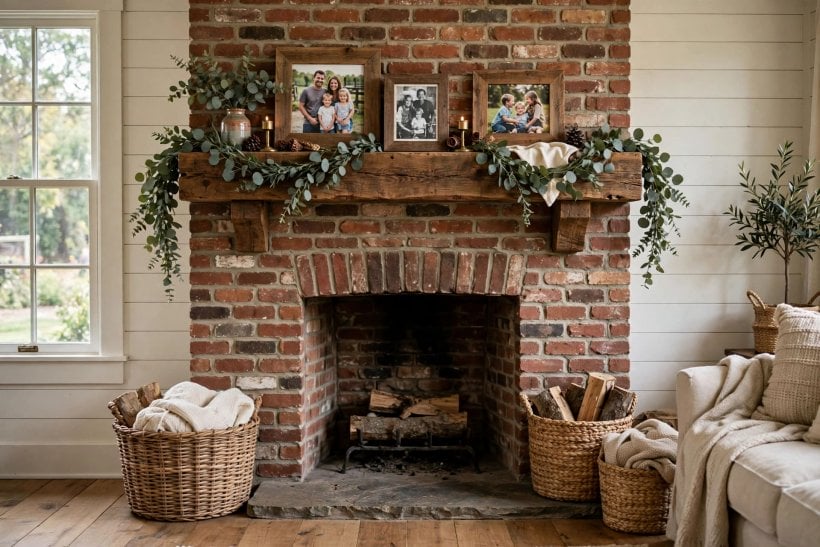
The modern fireplace pares the mantel to its essence: a line, a plane, a shadow gap. These ideas keep the contemporary lane, complementing the room-scale modern treatments in the corpus’s tiny house living room ideas, where small rooms make the same discipline necessary.
45. Float a Single Slim Shelf on a Bare Breast for the Purest Modern Statement
One shelf, nothing beneath it but plaster and shadow: the modern mantel’s haiku. Its courage is proportion — get the shelf’s thickness, depth and height right and the fireplace needs nothing else for a decade.
46. Run a Concrete or Micro-Cement Shelf for Weight Without Ornament
Cast concrete shelves bring mass and a soft industrial calm, partnering plaster breasts and dark fireboxes. Their making is a specialist’s day; their service life is the house’s.
47. Let the Shelf Be the Breast Itself: A Ledge Formed in Plaster
Some modern fireplaces form the mantel as a ledge in the breast’s own plaster, material continuous, line unbroken. It is the most architectural option, decided at build or renovation time, never retrofitted casually.
48. Omit the Shelf Entirely Where the Fire Is a Stove or a Ribbon
Modern stoves and linear fires often want no mantel at all: the appliance is the object, the breast its plinth. A shelf added from habit alone crowds a composition that was complete without it.
49. Use a Blackened Steel Shelf Where Industry Is the Room’s Accent
A slim steel shelf, blackened or powder-coated, caps a modern fireplace with a draughtsman’s line. It pairs with concrete, dark tile and pale plaster alike, and asks only dusting for its decades.
50. Align the Modern Shelf Ruthlessly With the Room’s Other Lines
Modern mantels live or die by alignment: shelf to picture rail heights, television centre lines, shelving runs. The tape measure and the level are this style’s decorative arts, practised before anything is fixed.
51. Keep Modern Styling to Odd Numbers and Generous Emptiness
Three objects, then space: the modern shelf’s styling grammar.
52. Light the Modern Mantel With One Deliberate Source
A picture light, a recessed downlight or the fire’s own glow: modern breasts are lit like galleries, one source, aimed. Competing lamps and fairy lights dissolve the calm the style exists to create.
53. Let a Wide Low Shelf Serve the Wide Modern Firebox
Linear fires want linear mantels: a long low shelf echoing the firebox’s proportions, styled at its ends and empty at its centre. The echo is the decoration; symmetry does the rest.
54. Choose Matte Finishes Where Modern Calm Is the Brief
Matte plaster, honed stone, oiled timber, blackened steel: the modern mantel’s palette refuses shine. Reflections are visual noise in this register, and the fire itself provides all the glitter the composition needs.
55. Remember Minimal Is a Maintenance Style, Not an Absence of One
Bare breasts show every soot trace and scuff; empty shelves show every dust line. The modern mantel’s calm is kept by regular, gentle cleaning — minimalism’s hidden subscription, paid weekly in minutes.
7. Styling the Shelf: Mirrors, Art, Greenery and the Family’s Treasures

Above every mantel in this post stands its second composition: the arrangement on the shelf and the wall above it. This is the stylist’s section — the fire cluster’s outdoor companion, the fire pit ideas post, faces the same arrangement problem around its open-air hearths.
56. Crown the Mantel With a Mirror Where the Room Wants Light and Depth
A mirror above the mantel doubles the firelight and the room, the oldest trick in the fireplace’s book.
57. Lean One Large Picture Rather Than Hanging Many Small Ones
A single generous picture, leant against the wall on the shelf, gives the mantel its gallery calm and changes in a minute when the household’s taste moves.
58. Build the Classic Triangle: Tall, Medium, Low
Candlesticks or a vase at one end, the clock or stack at the other, low objects between: the mantel’s classic composition is a landscape in miniature.
59. Keep Symmetry for Formal Rooms, Asymmetry for Living Ones
Matched pairs flanking a centred mirror suit formal mantels; a weighted, off-centre arrangement suits family rooms. Neither is a rule of taste — they are rules of register, and the room’s register decides.
60. Trail One Plant, and Let It Be the Shelf’s Only Softness
A trailing plant softens the mantel’s architecture like a green waterfall.
61. Layer Frames and Objects in Depth, Not in a Firing Line
Objects arranged at slightly varied depths — frame leant behind, small box before — give the shelf its collected, lived richness. A single rigid row reads as a shop display; depth reads as a home.
62. Give the Clock the Mantel’s Centre Where Tradition Is Loved
The mantel clock is the shelf’s oldest citizen, centred under the mirror, flanked by candlesticks: the composition grandparents recognise. In traditional rooms it remains undefeated, ticking included.
63. Style the Shelf for the Season in Small, Reversible Moves
Greenery and candles in winter, shells or garden flowers in summer: seasonal styling keeps the mantel alive without redecoration. Small moves, honestly stored between seasons, beat annual grand reinventions.
64. Keep Cards and Celebrations in Their Honoured, Temporary Place
Birthday and holiday cards on the mantel are the shelf’s democratic duty — displayed proudly, then retired on schedule. The mantel that never clears its celebrations slowly becomes a noticeboard with a fire under it.
65. Edit Ruthlessly: The Shelf Holds What the Room Loves Most
Every object on the mantel is on the room’s stage, lit by firelight nightly. The edit — few things, each loved, each given air — is the whole secret the styled photographs share and rarely state.
8. Living With the Mantel: Heat Care, Cleaning and the Years
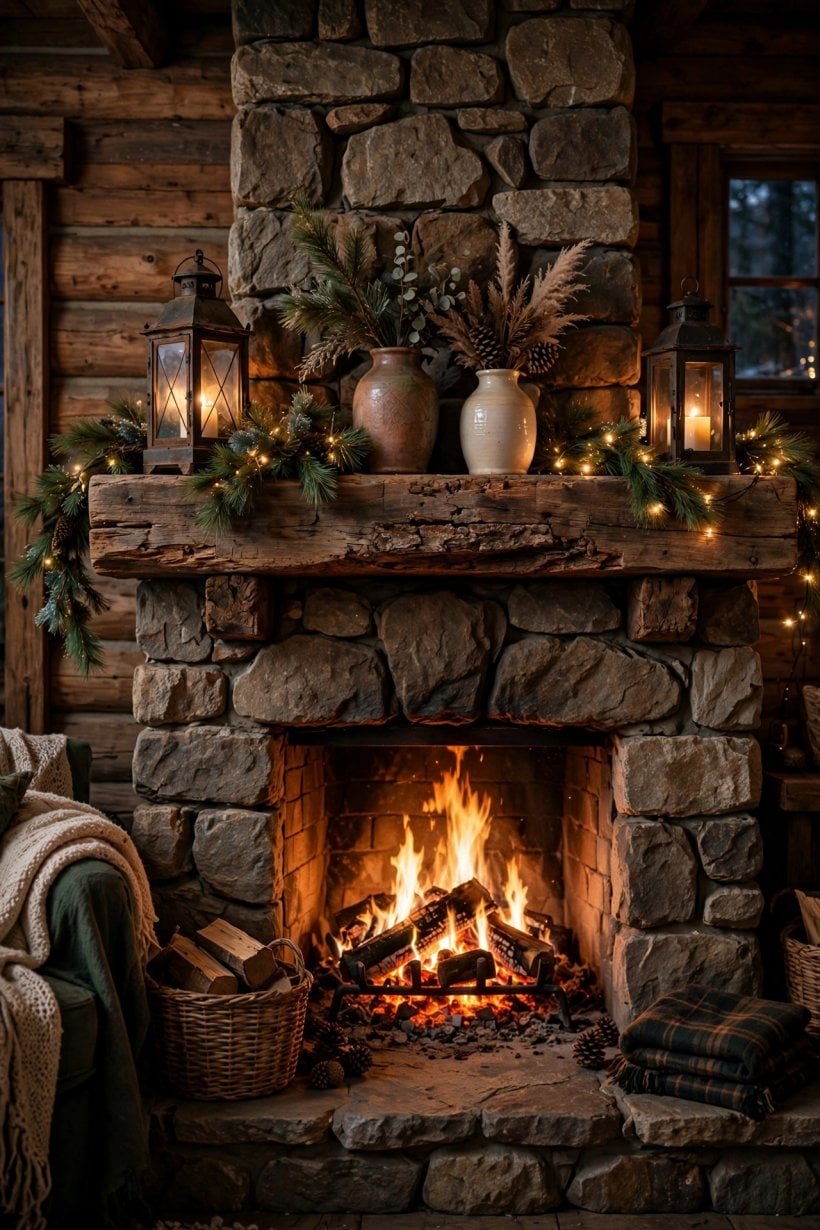
The final ideas are the mantel’s long service: soot, seasons, children and time. Safety throughout stays in this post’s standing frame — general care, with anything touching the fire itself governed by its maker’s guidance and local rules, checked rather than assumed.
66. Expect Soot, and Give the Breast a Finish That Forgives It
Fires breathe faintly into their rooms over years. Finishes that clean kindly — sealed stone, washable paint, waxed timber — keep the breast handsome without heroic scrubbing, and dark surrounds forgive what pale ones confess.
67. Clean Stone and Marble With Their Own Gentle Chemistry
Acidic cleaners etch marble and limestone permanently in a single enthusiastic afternoon. The maker’s or mason’s guidance for each stone, followed exactly, is the difference between cleaning and quiet damage.
68. Feed Timber Shelves and Beams Away From the Fire Season
Wax and oil applied in summer, when the fire is cold and the timber rested, keep beam and shelf nourished. The rhythm matches the fireplace’s own calendar: tend the crown while the fire sleeps.
69. Keep Candles on the Mantel in Holders That Respect the Shelf
Candle wax on stone and timber is a small recurring tax on beautiful shelves. Sound holders, trimmed wicks and candles never left burning unattended — the fire’s household rules apply to its shelf’s small flames too.
70. Fix the Wobble, the Crack and the Loose Shelf at First Notice
Mantels announce their troubles early: a shelf’s slight give, a surround’s opening joint, a corbel’s crack. Small repairs made promptly are joinery; the same faults ignored become the fireplace’s reconstruction.
71. Childproof the Mantel’s Reach as the Household Changes
The shelf’s treasures sit at exactly a climbing child’s ambition height.
72. Sweep the Shelf’s Dust on the Room’s Regular Rhythm
Fireplaces gather the room’s dust and their own ash in a fine grey alliance. A weekly pass with a soft brush keeps stone, timber and objects bright — ten minutes that preserve the whole composition’s dignity.
73. Photograph the Mantel Once a Year, and Believe the Photograph
The annual photograph shows what daily familiarity hides: the slow clutter, the tired finish, the picture hung crooked since spring. The mantel refreshed by its own portrait stays the room’s altar instead of becoming its attic.
74. Let the Mantel Carry the Family’s History Without Becoming Its Museum
One inherited clock, the wedding photograph, the child’s first pottery: the mantel’s honour is carrying a few true things well. Curate the history; do not store it — the shelf is an altar, not an archive.
75. Remember the Point: A Crown Worthy of the Fire Beneath It
Every idea here serves one composition: a fire, framed honestly, crowned with a shelf the room loves to look at and live with.
9. Checks and Mistakes: Before the First Pour or Purchase
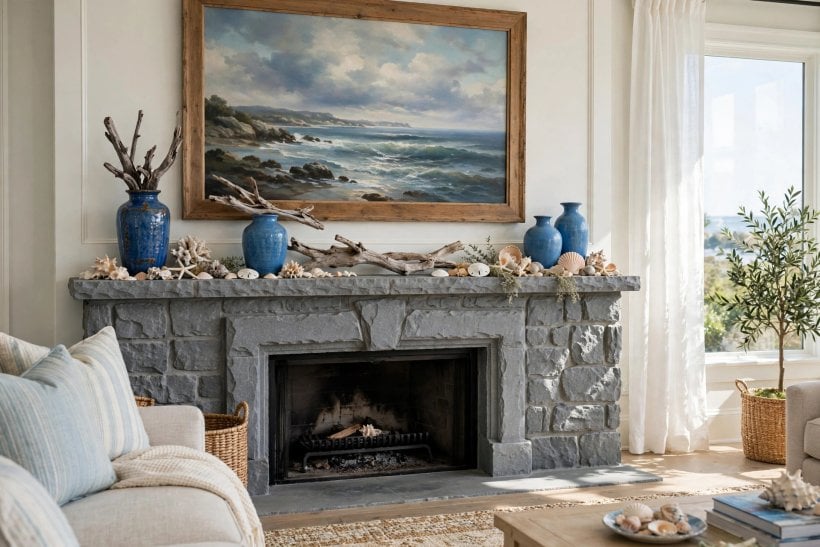
Check the fireplace itself before its crown is designed, because mantels inherit their fire’s facts: whether the fire is working or decorative, its type and its maker’s stated requirements, and the breast’s soundness. Anything combustible near a working firebox is placed under the maker’s guidance and local rules — checked, never guessed from photographs.
Check scale with the tape measure and the room, not the catalogue: breast width, ceiling height, the shelf’s depth against its intended display, and supports engineered for long spans. The mantel that arrives in the wrong proportion cannot be styled into the right one.
The common mistakes are all in this post’s sights: allegiances mixed by accident, period shelves styled at modern scale, acidic cleaners on marble, and styling that never gets edited. Each is avoided by the post’s own order — anatomy, family, material, styling, service — written down before the first purchase.
10. Costs and Pulling It Together
Costs stay qualitative, as fireplace-keeping honestly must: revealing and repairing an existing breast or restoring a period surround is the economical end, its materials mostly already in the house, while quarried stone, carved marble and bespoke cast work are the expensive end, where making and fitting are the price. Spend first on the surround’s soundness and the shelf’s honest construction; they carry the composition for decades after styling has changed a dozen times.
Pull it together in the order this post kept: the mantel defined, the beam, the masonry, the period tradition, the modern line, the styling, the service. Followed in that sequence, these seventy-five ideas become one fireplace crowned as its room deserves.
Final Considerations
The mantel is where a house keeps its treasures above its fire — the two oldest comforts in domestic life, warmth and display, stacked in a single composition. Build the crown honestly, style it with love and restraint, tend it gently, and it will hold the family’s evenings, celebrations and portraits for as long as there are fires to light beneath it.


0 Comments