

White is the bathroom’s oldest colour and still its hardest-working. It shows the light, tells the truth about cleaning, and makes the smallest wet room feel like morning. But white is not one decision — it is a family of temperatures and textures, and a white bathroom succeeds or fails on the warmth arranged inside it.
This page is the white lane of the bathroom’s wide family, whose whole survey lives on the bathroom ideas pillar: every layout, fixture and style is settled there. Here the subject is one colour, completely — choosing the white by the room’s light, tiling in it, furnishing against it, and keeping it white in a house that showers, splashes and lives in it daily.
1. White Bathroom Ideas at a Glance
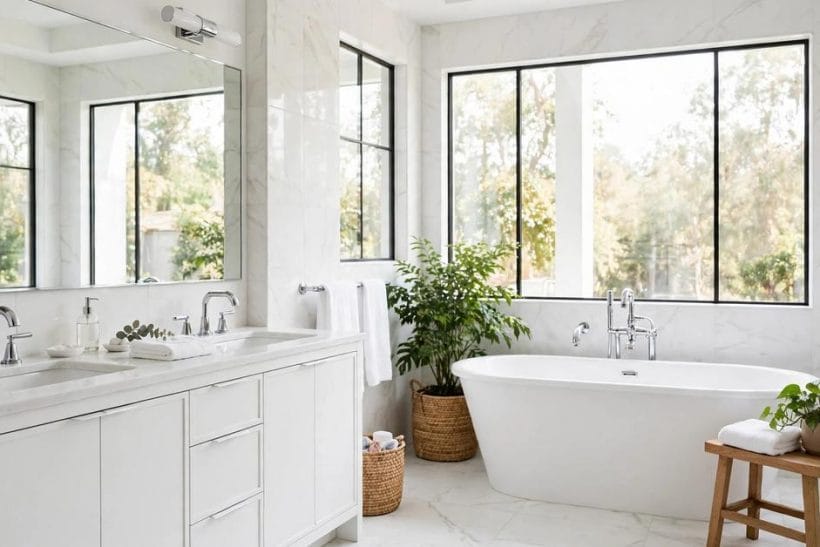
A white bathroom is a bathroom whose surfaces and main fixtures are white and its near relations — chalk, ivory, pale stone, white marble — with warmth and definition supplied by grout lines, metals, timber and texture rather than by colour. Its working parts are the white itself, chosen in warm or cool register for the room’s light; the patterning that grout, bevel and format draw on the pale field; and the one or two guest materials admitted to keep the scheme from sterility. It is the serene, light-collecting member of the bathroom family, kin to the modern bathroom in its calm and to the classic room in its ancestry, and the hardest-working colour a small bathroom can wear.
| Question | Short answer |
|---|---|
| Why does white suit bathrooms so well? | It returns light in rooms that often have little, it shows the dirt honestly — which families count as a feature in a washroom — and it never dates: the white bathroom of a century ago and of this morning are recognisably the same good room. Fixtures, tiles and sanitaryware are also simply made in white more than in any other colour, so the choice is the market’s deepest. |
| Warm white or cool white? | The room’s light decides. North-facing and windowless bathrooms need warm whites — cream in their base — or they read clinical at dawn; bright, sunlit rooms can carry cleaner, cooler whites and marble’s grey veining. Test the tile and the paint together on the wall; whites that agree in the hand can quarrel on the wall. |
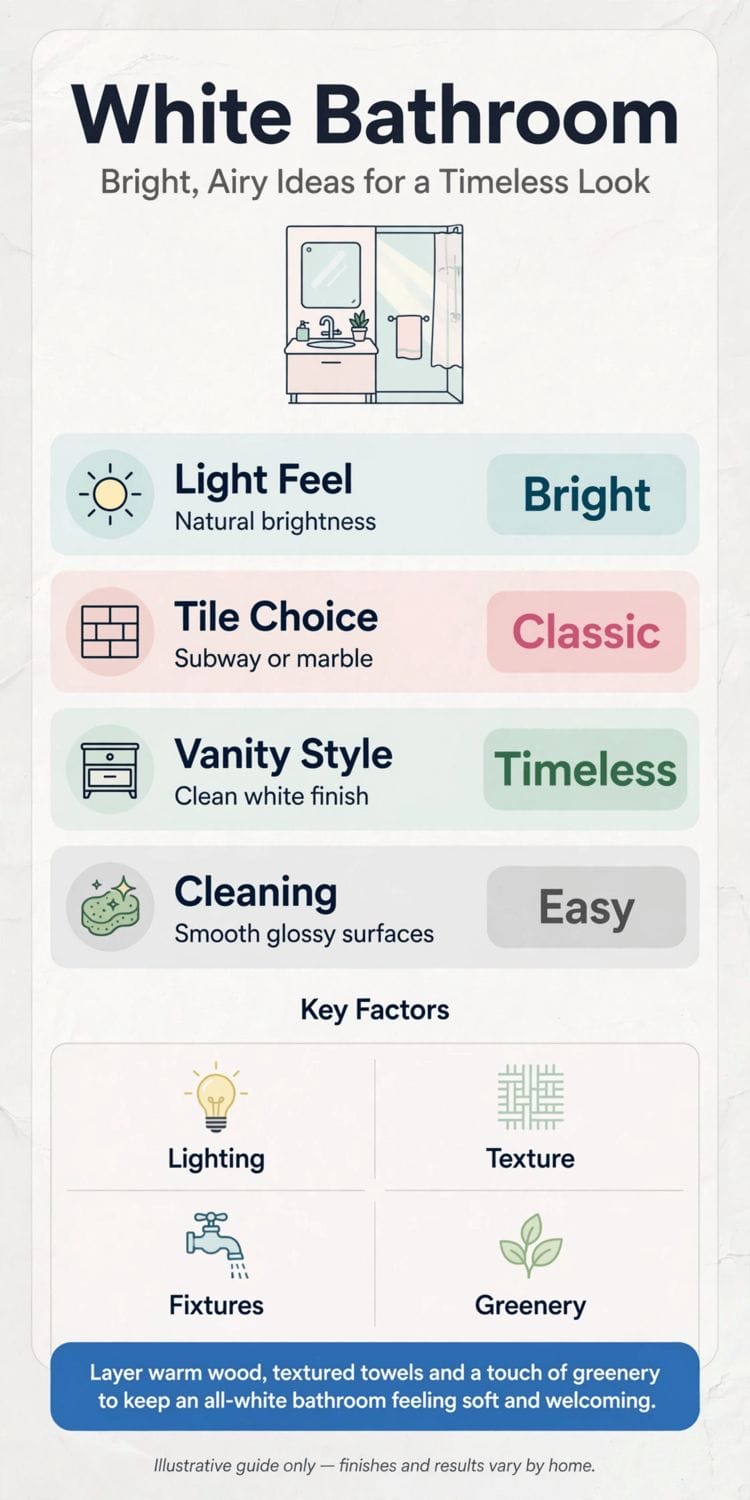
| How do you stop a white bathroom feeling cold or clinical? | Texture, grout and one warm guest. Bevelled or handmade-look tiles give the walls their modelling; a mid-tone grout draws the pattern; timber at the vanity or the bath’s side, woven baskets and a plant supply the warmth. Cold white bathrooms are almost never too white — they are too smooth and too shiny. |
| Is a white bathroom high maintenance? | It asks for honesty rather than hours: white shows the splash and the hair, and rewards the two-minute wipe with a room that always looks kept. The maintenance that matters is structural — sound grout, sealed stone, ventilation that clears the steam — and it is the same in any colour. |
2. Choosing the White: Temperature, Light and the Sample Wall
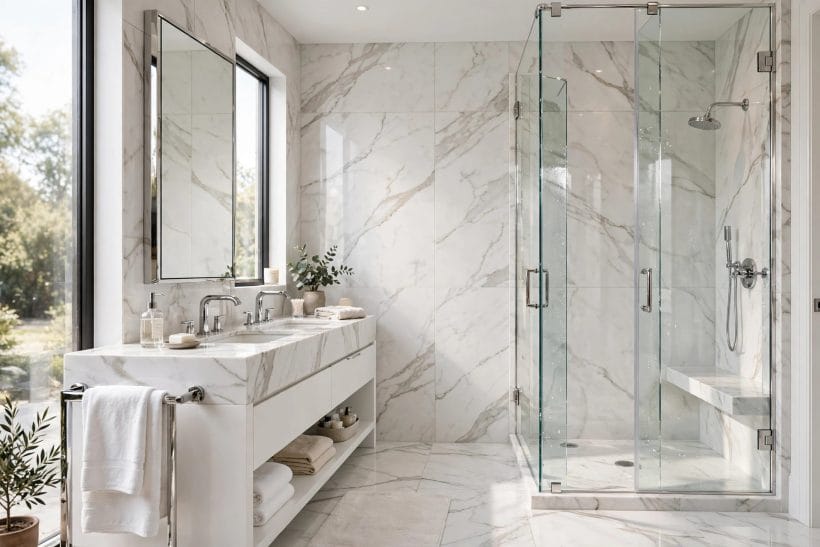
White is a family of hundreds, and the bathroom — small, steamy, often window-poor — is where its members behave most differently. This section chooses the room’s white: by temperature, by the light the room actually has, and by the discipline of the sample wall, before a single tile is ordered.
1. Read the room’s light before the colour card
A bathroom’s light is its dawn light — low, grey, unforgiving — more than its noon.
2. Warm the white for north-facing and windowless rooms
Without sun, cool whites turn the colour of skimmed milk and the room’s occupants turn with them.
3. Let bright rooms carry the cleaner whites
Where a real window pours in light, the cleaner whites and marble’s cool greys stay fresh and luminous.
4. Agree the white across tile, ceramic and paint simultaneously
The tile’s white, the basin’s white and the wall’s white are three different manufactures and will meet on every sight line.
5. Use one white family, in several finishes
Gloss tile, satin paint, matt ceiling, polished ceramic: one white family across the room, its variety supplied by finish and texture rather than by competing tints.
6. Let the floor vote on the white’s temperature
A white room over warm timber or terracotta can carry cooler walls; over grey stone or white tile it needs the warm register or the whole scheme refrigerates.
7. Beware the brilliant optical white in a steamy room
The brightest whites glare under bathroom lighting and make every other white — the towels, the ceramic, the teeth — look faintly tired. The lived-in white is a half-tone kinder and twice as flattering, especially at dawn.
8. Sample at full scale: a board of tiles, not a chip
Whites change with area and grout.
9. Decide the register: spa, classic or country
The same white serves three tempers — the spa’s seamless calm, the classic room’s panelled formality, the country’s soft informality. Naming the register early settles tile format, metals and timber in one decision, as it does in the small bathroom, where the white decision carries even more of the room.
10. Keep a record of the chosen whites
Tile line, paint name, grout colour: kept with the house’s papers. White is the hardest colour to re-match by eye in five years, and the bathroom’s repairs are inevitable; the record turns a patch into an invisibility.
11. Paint the ceiling the calmest white of all
Above the steam and the mirrors, a flat, soft white returns what light there is without an opinion. It is the one surface where the simplest white is the right one — the room’s quiet sky.
3. White Tiles: Formats, Bonds and the Grout That Draws Them
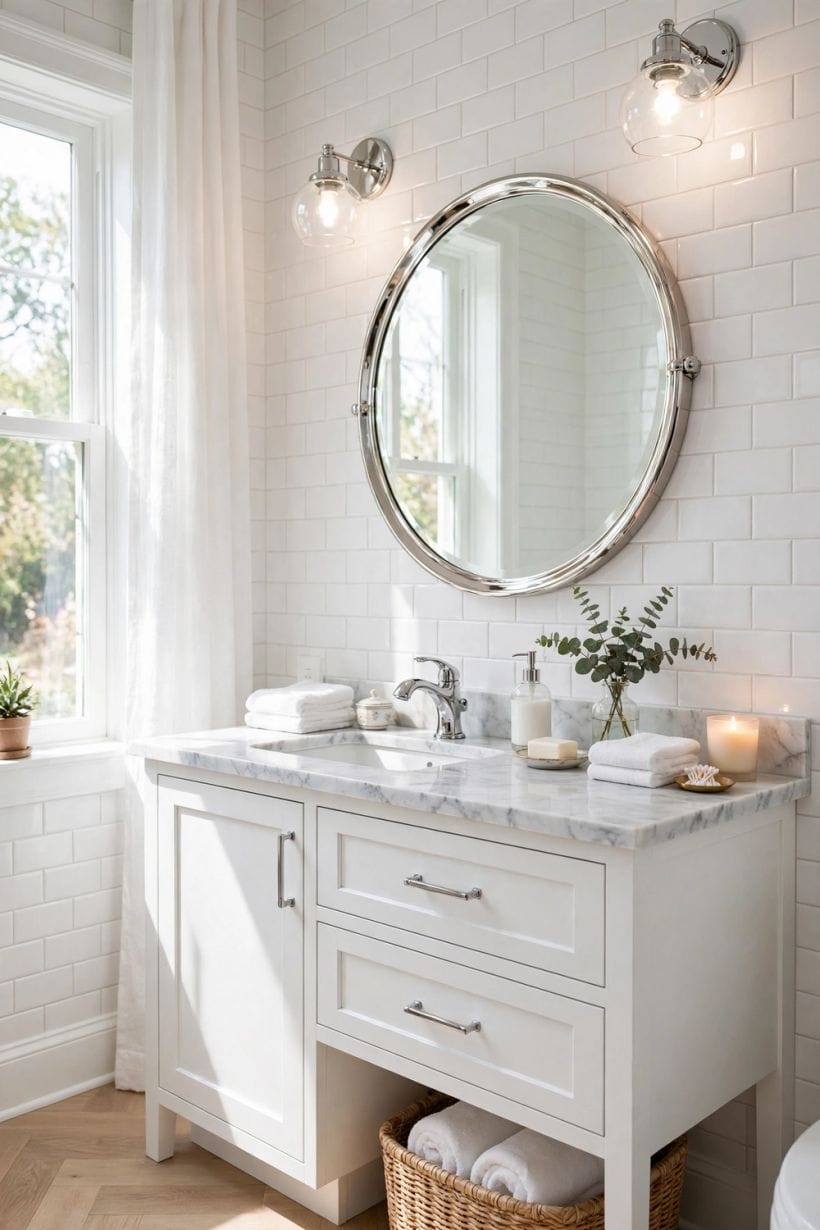
On white walls, pattern is made by format and shadow rather than by colour — the bevel’s edge, the bond’s rhythm, the grout’s line. This section tiles the white bathroom: the classic formats in their registers, the layouts that scale them to the room, and the grout decision that determines whether the wall reads as a field or a drawing.
12. Metro tiles: the white bathroom’s mother tongue
The bevelled metro in brick bond is the default white wall for good reason — its bevels model the light, its bond gives the wall a woven order, and its units repair one at a time.
13. Square tiles laid straight for the quiet field
The plain square, stacked or offset, gives the calmest white wall — the spa register’s choice, where the tile should disappear so the water, stone and light can speak.
14. Herringbone and chevron for the one patterned wall
Where the scheme wants a drawn wall — behind the basin, in the shower — the herringbone in white tile gives pattern without colour, shadow without noise.
15. Large-format white for the seamless modern register
Big porcelain slabs and large tiles minimise grout and maximise calm — the contemporary white bathroom’s field.
16. Handmade-look tiles for the warm, imperfect register
Tiles with undulating faces and soft edges catch the light in ripples — the country and coastal white, where perfection would chill.
17. Mosaics where the floor or niche needs a small scale
Hexagons, penny rounds and small squares in white — the shower floor’s grip, the niche’s finish, the small room’s jewelled field.
18. Choose grout as the drawing ink: pale, mid or dark
Pale grout dissolves the wall into light; dark grout draws every tile and turns the wall into graph paper — bracing in the modern register, busy in a small room; the mid-grey is the working classic, drawing gently and forgiving the years. The ceramic tile bathroom works the same grout arithmetic across colours; on white it is the whole pattern decision.
19. Carry the tile heights with intention
Full height in the shower’s country; to a dado or a picture rail’s line elsewhere, with painted wall above.
20. Let the shower’s tile and the room’s tile be relations
Same tile, different format; same format, different bond: the shower and the room should read as one family in two dialects. Identical everywhere is the hotel corridor’s answer; unrelated is the showroom’s accident.
21. Detail the edges like the room’s jewellery
Tile trims, bullnose edges, the mitred corner, the threshold where tile meets floor: on a white field, every edge is visible and every sloppiness is published.
22. Seal the grout and keep the field’s promise
White grout in the wet zones is sealed on its calendar and the sealant lines renewed before they fail; the field stays white by system, not by scrubbing heroics.
4. Sanitaryware and the Vanity in White
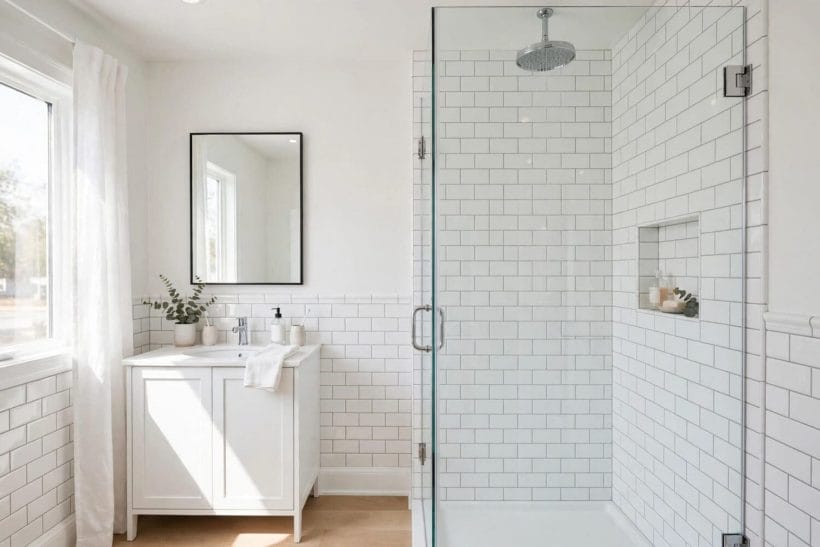
The white bathroom’s fixtures are its furniture — bath, basin, WC and vanity in the colour the industry was built on. This section specifies them: forms that suit the pale scheme, the vanity as the room’s one warm piece of joinery, and storage that keeps the white field uncluttered.
23. The white bath as the room’s sculpture
Freestanding in the middle register, panelled in the classic, inset in the modern: in a white room the bath’s silhouette is the design, its colour a given.
24. Pedestal and console basins for the light footprint
Where the floor should run free, the pedestal and the open console keep the white field continuous and the small room breathing. Their exposure is their elegance; their plumbing is detailed to be seen and specified accordingly.
25. The vanity as the scheme’s warm guest
One piece of timber — or one painted colour — at the vanity gives the white room its hearth: the hand’s warm landing, the eye’s rest.
26. Wall-hung fixtures for the floating field
Wall-hung basins and WCs lift the room’s furniture off its floor, and in the white scheme the floating field of floor beneath them is pure light and easy cleaning.
27. The WC in white, detailed quietly
Close-coupled, back-to-wall or wall-hung — the white room’s WC is chosen for its silhouette’s quietness and its works’ modernity, its flush plate the one small metal signature it’s allowed.
28. Twin basins where the household’s mornings demand them
Two basins in a white scheme double the mirrors, the light and the peace treaty. Their symmetry is the classic register’s gift; in the modern one, a single long trough in white stone serves the same diplomacy.
29. Tops and basins in white stone, ceramic or composite
The vanity’s top in the room’s white family — marble with its veining as the scheme’s only pattern, quartz or ceramic for the shrug-and-wipe households.
30. Storage that keeps the field clear
Mirrored cabinets, vanity drawers with dividers, a tall cupboard where the plan allows: the white bathroom’s serenity is a storage achievement. Bottles colonising the bath’s rim will undo the colour scheme faster than any wrong tile.
31. A seat, a stool, a place for the towel’s wait
The small courtesy — somewhere to sit, to set the clothes, to keep the towel off the floor. In white rooms a timber stool or a woven basket-chair carries the warm register at furniture scale.
32. Mirrors sized to the basins, lit from the sides
The mirror in a white bathroom is a light instrument as much as a glass: generous, at the household’s eye height, flanked by the lamps that make dawn faces kind.
33. Keep the floor’s white field for the feet’s sake
Where the floor is white too, the fixtures’ shadows are the room’s only dark notes, and the effect is a gallery for bathing.
5. Metals and Taps Against White
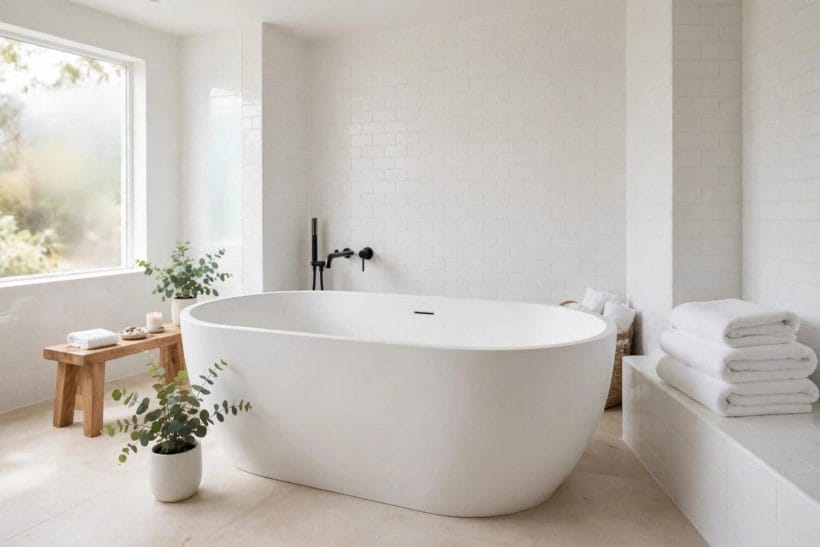
On a white field, the room’s metals are its punctuation — the full stops and exclamation marks of the scheme. This section chooses them: chrome’s classic brightness, black’s modern drawing line, brass’s warmth — and the discipline of keeping one voice throughout.
34. Chrome: the white bathroom’s first language
Chrome and white are the century’s partnership — bright, hygienic in appearance and fact, at home in every register.
35. Black taps for the drawn line
Matt black brassware draws the white room like ink on paper: every tap, rail and frame becomes a line in a drawing.
36. Brushed brass and gold for warmth without colour
Warm metals give the white room its temperature without admitting a colour: the sun, bottled at the touchpoints.
37. Nickel for the soft, traditional light
Polished nickel’s warmer gleam suits the classic and country whites, ageing gently and polishing kindly. It is chrome’s older sibling — chosen where the room’s register predates the motor car and the light should feel like it.
38. One metal, everywhere, without exception
Taps, shower, wastes, towel rail, flush plate, cabinet knobs, the mirror’s frame: one finish.
39. Exposed shower engineering in the period register
The classic white bathroom shows its shower valve and riser proudly in the room’s metal; the modern one conceals the works and shows a single rose and control.
40. Heated towel rails in the same finish
The rail is a radiator wearing the brassware’s clothes; it joins the metal family or it jangles.
41. Let the metal carry the room’s one luxury note
Where the budget concentrates, the taps are the classic place — handled a hundred times a day, seen against the white at eye level.
42. Match the shower frame and screen profiles
The glass screen’s channels and hinges are part of the metal family — black-framed in the drawn register, bright in the classic, frameless where the modern scheme wants the glass to vanish.
43. Specify the finish against the water’s evidence
Hard water signs its name on dark and polished metals alike, in splashes that dry to maps.
44. Keep metals’ maintenance in the decision
Black shows the limescale’s postcards; brass asks its polishing calendar; chrome forgives both. The household’s water and its honest habits are part of the specification — the white room’s metals are touched daily and graded daily.
6. Floors Under a White Scheme
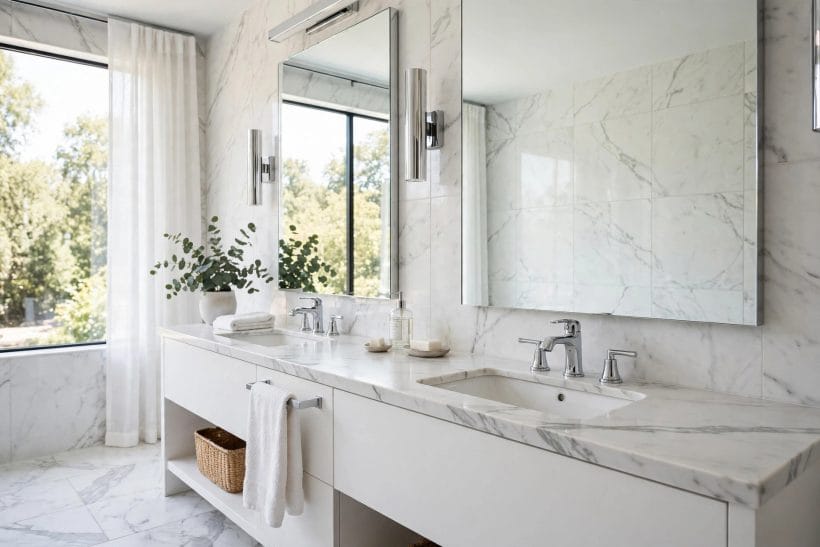
The floor is the white bathroom’s foundation and its biggest temperature decision — the surface the pale scheme stands on, literally and visually. This section floors the room: white’s own options, the warm timber treaty, stone and pattern, and the heating that makes any of them kind at dawn.
45. White tile floors: the gallery underfoot
The all-white field — floor joining walls — is the spa register’s boldest move, its light total and its cleaning honest.
46. Marble floors: the veining as the room’s only pattern
A white marble floor gives the scheme its single permitted drawing — the grey veins — and its cool, centuries-old authority. Sealed on its calendar and heated beneath, it is the classic white bathroom’s floor of record.
47. Timber and timber-look: the warm foundation
Real timber in the dry zones, or the faithful porcelain planks throughout, lay the scheme’s warm ground — the floor as the guest material at the largest scale.
48. Stone and slate for the deep-ground contrast
A dark stone or slate floor under white walls is the drawn register at floor scale: the room gains a ground line, the white gains a foil, and the floor forgives the household’s evidence like no pale surface can.
49. Patterned floors in the classic geometry
Chequerboard, basketweave, octagon-and-dot: the patterned floor is the traditional white bathroom’s carpet, its small geometry sized to the room. Keep the walls’ tile quiet above it — the floor is the pattern budget, spent once.
50. Terrazzo and pale composites for the modern field
Pale terrazzo-look porcelain gives the modern white room a floor with a constellation in it — interest at the grain scale, calm at the room’s.
51. Heat the floor, whatever its material
Underfloor warmth is the white bathroom’s invisible luxury and its practical drying system in one.
52. Mind the thresholds and the level changes
Where the bathroom floor meets the landing, the junction is detailed flush and honest — a stone threshold in the classic manner or a clean modern line.
53. Grout and sealant on the floor: mid tones, kept sound
The floor’s grout in the mid register hides the traffic’s diary while keeping the pattern’s drawing; sealant renewed before it darkens. The white floor’s maintenance is a calendar of small acts, none of them heroic.
54. Choose the floor’s finish for wet feet, not dry shoes
Grip is the floor’s first specification and it is tested wet, barefoot, with soap in the equation.
55. Rugs and mats in natural fibre, washed on rotation
The bath mat and the runner in cotton, linen or woven jute warm the white floor at the standing places and absorb its splashes.
7. Texture, Timber and Warmth: So White Never Chills
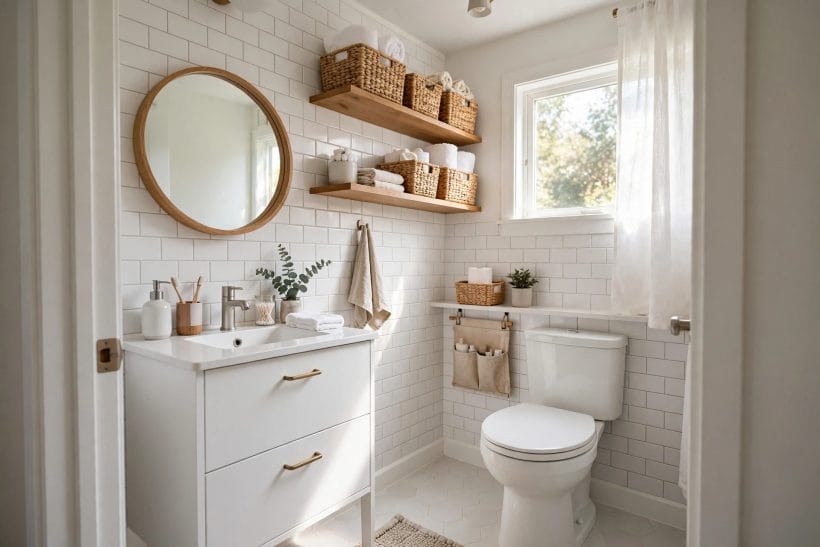
The difference between the serene white bathroom and the sterile one is never the whiteness — it is the texture count. This section warms the scheme: handmade surfaces, timber at the touchpoints, woven and living things, and the editing that keeps the calm from curdling.
56. Count the textures before adding a colour
Bevelled tile, honed stone, woven basket, ribbed glass, matt paint, polished ceramic: a white room with six textures needs no colour at all.
57. Timber at the touchpoints: stool, tray, bath side
The warm material belongs where the hand lands — the bath tray, the stool, the shelf, the vanity already placed.
58. Woven storage as the scheme’s soft architecture
Baskets for towels, laundry and the children’s bath fleet: the woven family stores the white room’s life in its warmest material. Uniform baskets are the scheme’s tidiness; their texture is its upholstery.
59. Plants that like the steam
A fern in the light, a trailing plant on the shelf: the green guest is the white bathroom’s one admitted colour, arriving alive and changing weekly.
60. Linen and cotton in the warm whites
Towels and curtains in the ivory register — never the optical white of the tile — soften the room’s temperature by the exact half-tone the eye wants.
61. Frosted and ribbed glass for the light’s texture
Where privacy glass is needed, the ribbed and fluted textures turn it into a light effect — the window as a waterfall of brightness. It is the modern register’s favourite detail and the small room’s enlarger.
62. Art and the framed print in the quiet register
One framed line drawing, a small marine print, the children’s framed handprint in the family register: on white walls, modest art glows like a window.
63. Candles and the evening register
The white bathroom at candlelight is a different, older room — the tile’s gloss becomes a shimmer, the steam a atmosphere.
64. Keep one old or handmade thing in the room
A worn timber stool, a handmade jug, the inherited mirror: the single storied object keeps the white scheme human and prevents the showroom chill. The white room’s perfection should have exactly one crack in it, chosen.
65. Edit the products to the palette’s discipline
Decant the neon shampoo, corral the bottles into the cabinet, let the surfaces show the room instead of the shopping. The white bathroom’s calm is half storage and half this daily courtesy to the colour scheme.
8. Light, Mirrors and Keeping White White
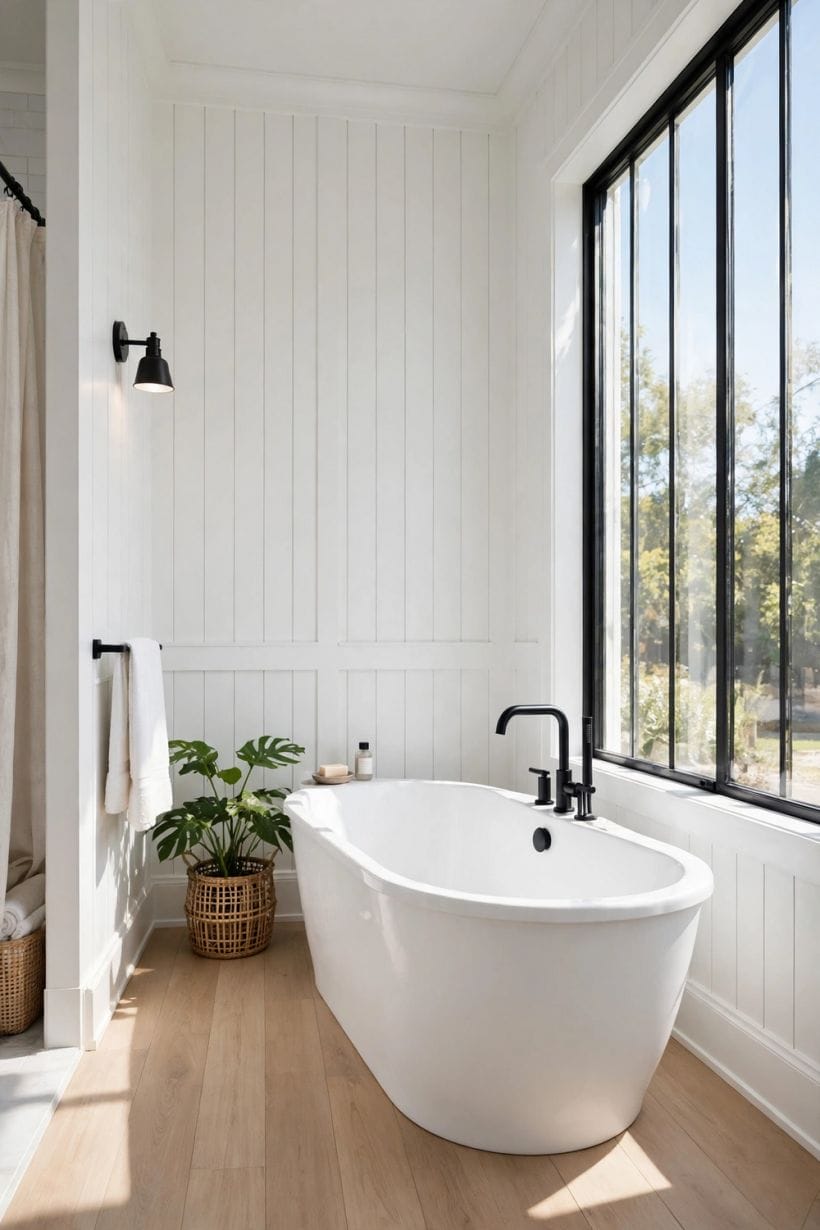
The white bathroom is a light instrument, and its last systems are the ones that keep it bright: layered light for dawn faces, mirrors as amplifiers, ventilation as the scheme’s immune system. This section lights the room and sets the keeping calendar that keeps white’s promise.
66. Layer the light: ambient, mirror, accent
A soft ambient wash, twin lights at the mirror’s sides, and one accent — the niche, the bath’s alcove — on their own switches.
67. Light faces from the sides, never only above
Downlights alone carve shadows into every dawn face; the classic side lights at the mirror are the tradition’s kindness and the modern room’s most useful theft.
68. Use the mirror to spend the window twice
A mirror opposite or beside the window doubles the daylight the scheme lives on.
69. Ventilate like the scheme depends on it
It does: steam is the white bathroom’s weather, and extraction that clears it quietly protects grout, paint, mirrors and lungs in one system. Specify it generously, silence it properly, and let it run past the shower’s end.
70. Keep the cleaning kit small and the rhythm smaller
A squeegee for the glass, a cloth for the splash, the two-minute evening wipe: the white room is kept by rhythm, not by weekend campaigns. The kit lives in the vanity, invisible, like all the room’s administration.
71. Renew sealant and grout on their calendar
The white scheme’s ageing shows first in its joints: sealant lines refreshed before they grey, grout resealed in the wet zones as specified. These are the room’s cheapest renewals and its most visible.
72. Wash the room’s whites separately and well
Towels and mats in their own hot, bright rhythm keep the textiles’ register matched to the tile’s. The household that launders its whites as a system never watches its bathroom slowly change colour.
73. Choose bulbs for the colour the whites were chosen in
Light has a temperature and the white scheme amplifies it: a cold bulb refrigerates the warmest white, a warm one can yellow the cleanest.
74. Give the room a night light with manners
A low, warm light for the midnight visit — at skirting or in the mirror’s frame, on its own switch or a sensor’s courtesy — keeps the white room kind at its most vulnerable hour.
75. Let the room rest bright: the final audit at dawn
Judge the finished white bathroom at its hardest hour — a grey dawn, the lights on, the mirror in use.
9. Checks and Mistakes: Before the First Purchase or the First Stone
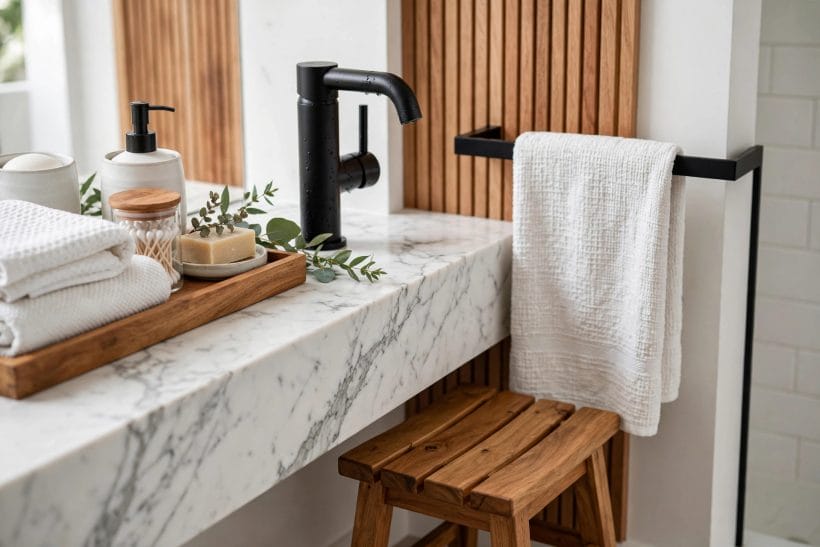
Before the first tile is ordered, walk the checks in order: the whites of tile, ceramic and paint laid together in the room’s dawn light and agreed as one family; the register named — spa, classic or country; one metal chosen for every fitting in the room; the grout tones decided for wall and floor, not defaulted; storage drawn sufficient to clear every surface; and ventilation and floor heating specified while the walls are still open.
The faithful mistakes: five whites quarrelling across tile, basin and paint; the brilliant optical white glaring in a windowless room; chrome beside black beside brass on one pale wall; a floor of polished white in the splash zones; bottles colonising every rim for want of a cabinet; and the extraction fan specified by price, sighing over the grout’s slow surrender. Every one is a system error, not a colour error — the white was fine.
One check is by hand: run a palm across the sample wall of tile, stone, timber and textile. If the hand finds variety everywhere and cold nowhere, the scheme will pass its dawns. The white bathroom is furnished for the skin as much as for the eye.
10. Costs and Pulling It Together
Costs follow the white scheme’s mercy: its staple materials — white tile, white ceramic, chrome — are the market’s deepest and most competitive, and its longevity is total, since the colour cannot date. The money concentrates where it should: in the floor and its heating, the brassware, the mirror’s lighting and any true marble. Spend there, and the room’s refresh in a decade is paint and sealant.
Pulling it together: choose the white by the room’s own light; tile it with format and grout for pattern; set the ware in white and the vanity in warmth; keep one metal; floor it kindly and heat it; texture it until the hand approves; and ventilate it like a system. The bathroom then stands beside the waterproof tiny house bathroom wet bath at the small end and the tiny house bathroom layouts in the family’s shared conviction — that a washroom’s first luxury is light, honestly kept.
Final Considerations
A white bathroom is a house keeping one room at permanent morning. Built with texture, warmed with timber, lit from the sides and ventilated like a system, it becomes the room that makes the whole household feel cleaner than it is — the pale, bright standard the rest of the house is measured against.
Begin with the sample board at dawn. Every decision after that — tile, metal, vanity, plant — is made easily by a household that knows exactly which white its light has chosen.

0 Comments