
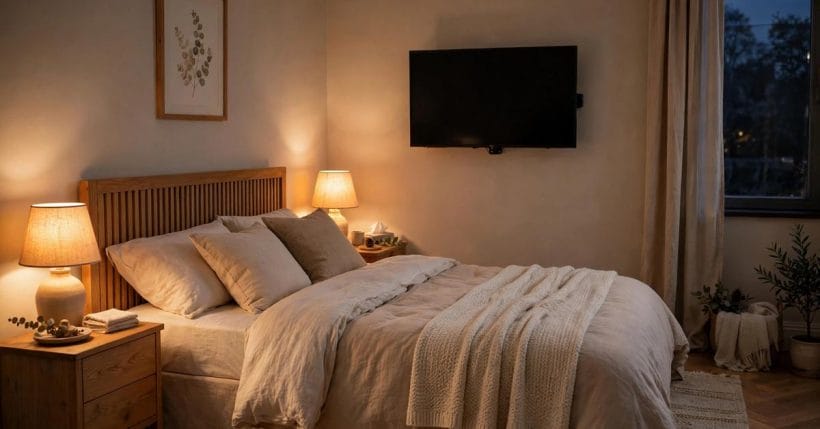
Few bedroom choices divide a household quite like the television. One person pictures lazy mornings and cosy film nights under the covers, while the other pictures glowing screens, tangled cables and restless nights. Both pictures are honest, and both deserve a hearing before a screen goes on the wall.
This guide walks through the whole debate in plain terms: the pleasures, the drawbacks, placement, light, sound and sleep, so you can decide with clear eyes rather than on impulse.
1. The Case For a Bedroom TV
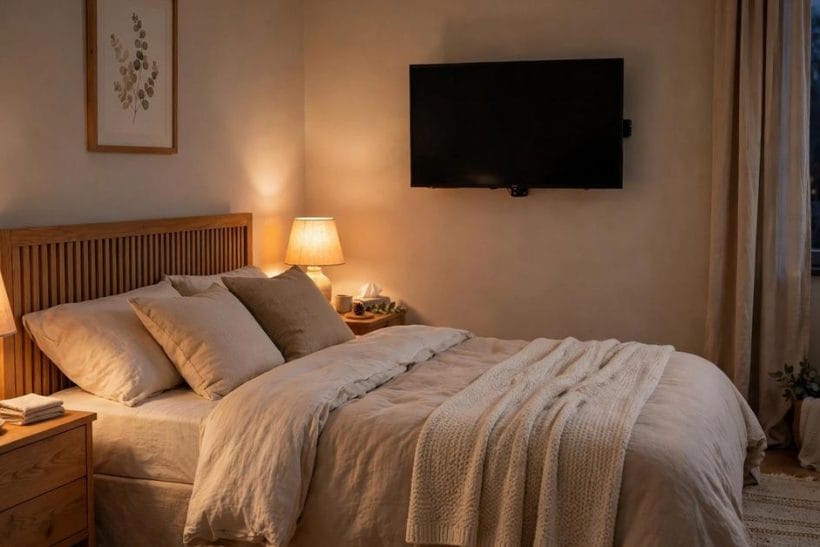
A television in the bedroom turns the room into a private retreat. Couples with different tastes can watch what they like without negotiating over the main living room set, and anyone who likes to unwind with a favourite programme before sleep gets a comfortable place to do it. For people with limited mobility, or for households where the living room doubles as a workspace, a bedroom screen can be a genuine comfort rather than a luxury.
The bedroom also suits quiet, solo viewing. Early risers can catch the morning news without waking the house, night owls can finish a film without taking over shared space, and parents can steal a peaceful hour once children are settled. In a small home, where every room earns its keep, a bedroom television can make the room work harder across the day, as part of a broader approach to tiny bedroom ideas that treat compact rooms as flexible, multi-use spaces.
That is the heart of the tv in bedroom debate: comfort set against calm, and convenience set against rest.
There is a social side too. A film in bed on a rainy evening, a shared series watched together at the end of a long day, or a gentle programme playing while you fold laundry all turn the bedroom from a room used only for sleeping into a room enjoyed across the evening. The key question is never whether a bedroom television can be pleasant. It clearly can be. The question is whether its pleasures outweigh its costs for your household, your room and your sleep.
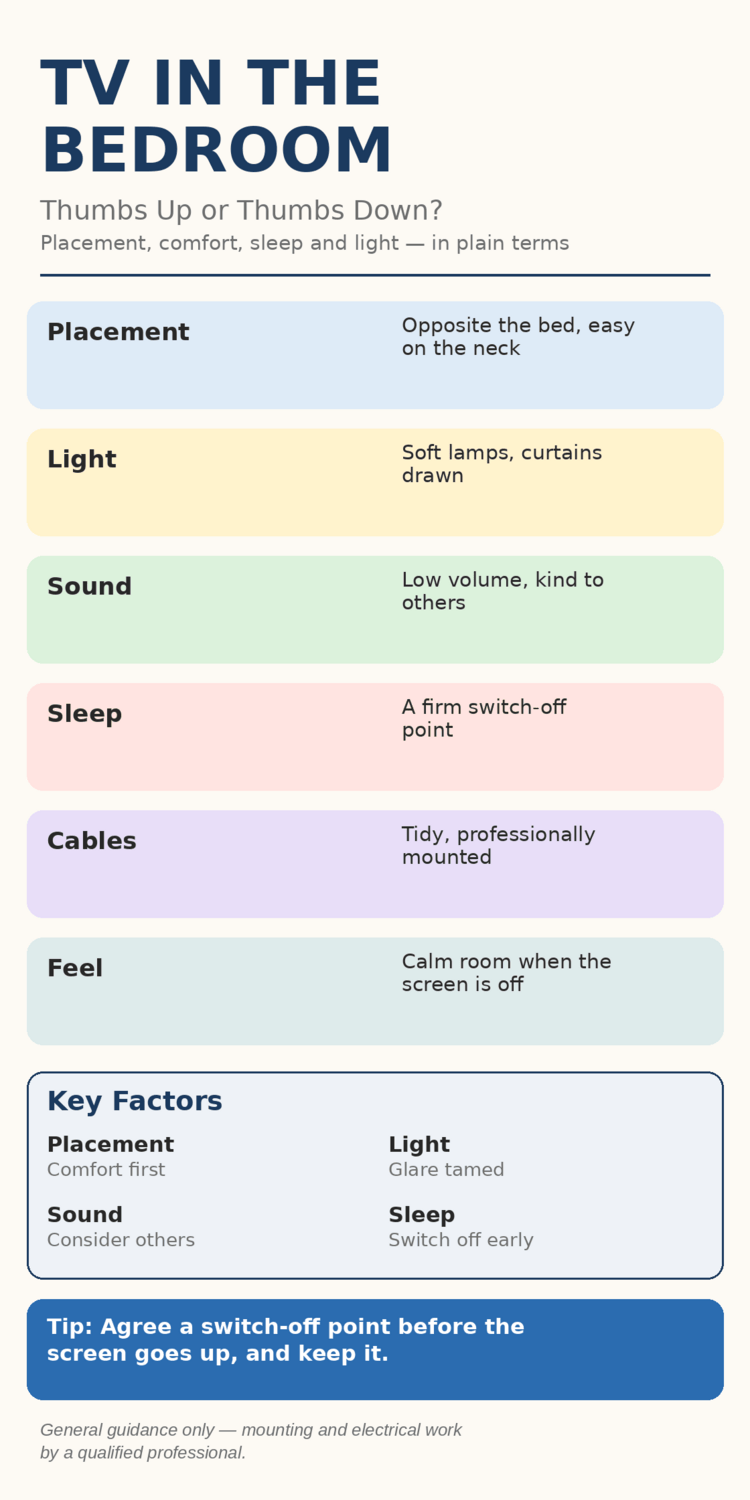
| Question | At a Glance |
|---|---|
| Best for | Private viewing, quiet mornings, cosy evenings, flexible small rooms |
| Watch out for | Glare, late-night viewing, clutter, disturbed sleep |
| Placement | Opposite the bed, at a comfortable eye level, away from direct window glare |
| Light | Soft lamps, dimmable lighting, curtains that tame evening glare |
| Sound | Low volume, clear dialogue, consideration for others nearby |
| Sleep | A firm switch-off point before bed, screens off well before sleep |
| Installation | Mounting and electrical work by a qualified professional only |
2. The Case Against a Bedroom TV
The strongest argument against a bedroom television is about sleep. Bedrooms work best when the body associates them with rest, and a glowing screen can blur that association. Programmes run long, one more episode turns into three, and the bright light and busy storylines keep the mind alert when it should be winding down. Even viewers who fall asleep with the television on often sleep less deeply, waking to dialogue, laughter or sudden loud scenes.
Then there is the room itself. A television is a large dark rectangle that dominates a small wall, and its stand, cables and remote controls add clutter to a room meant to feel calm. Partners can also find themselves at odds: one wants to watch, the other wants to read or sleep, and the compromise pleases neither. In shared homes, sound travels through thin walls and open doors, so one person’s late film becomes another person’s broken night.
There is also the question of what the bedroom loses. Without a screen, the room invites reading, conversation and quiet, and evenings tend to end earlier and more peacefully. Many people who remove a bedroom television report that they read more, talk more and sleep better, even if they miss the convenience at first. The case against is not snobbery about television. It is a practical claim that bedrooms do specific work, rest and closeness, and a screen can crowd that work out.
3. Where to Put It: Placement That Works
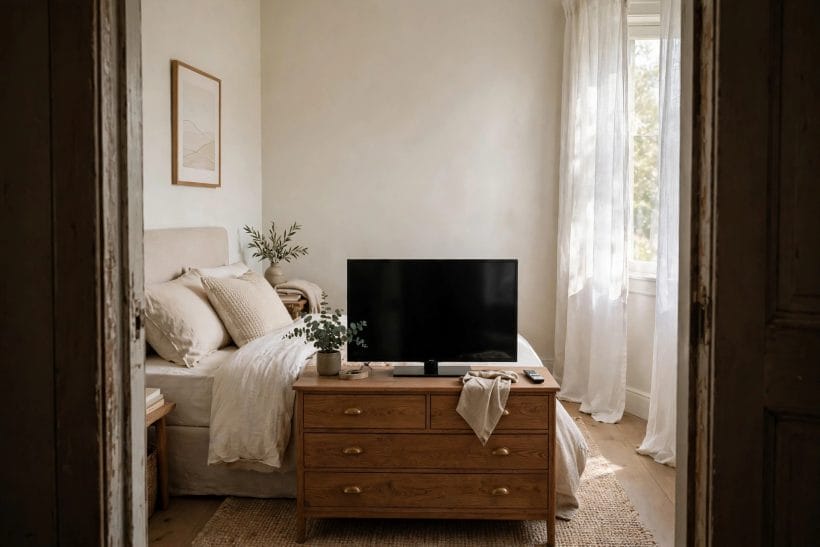
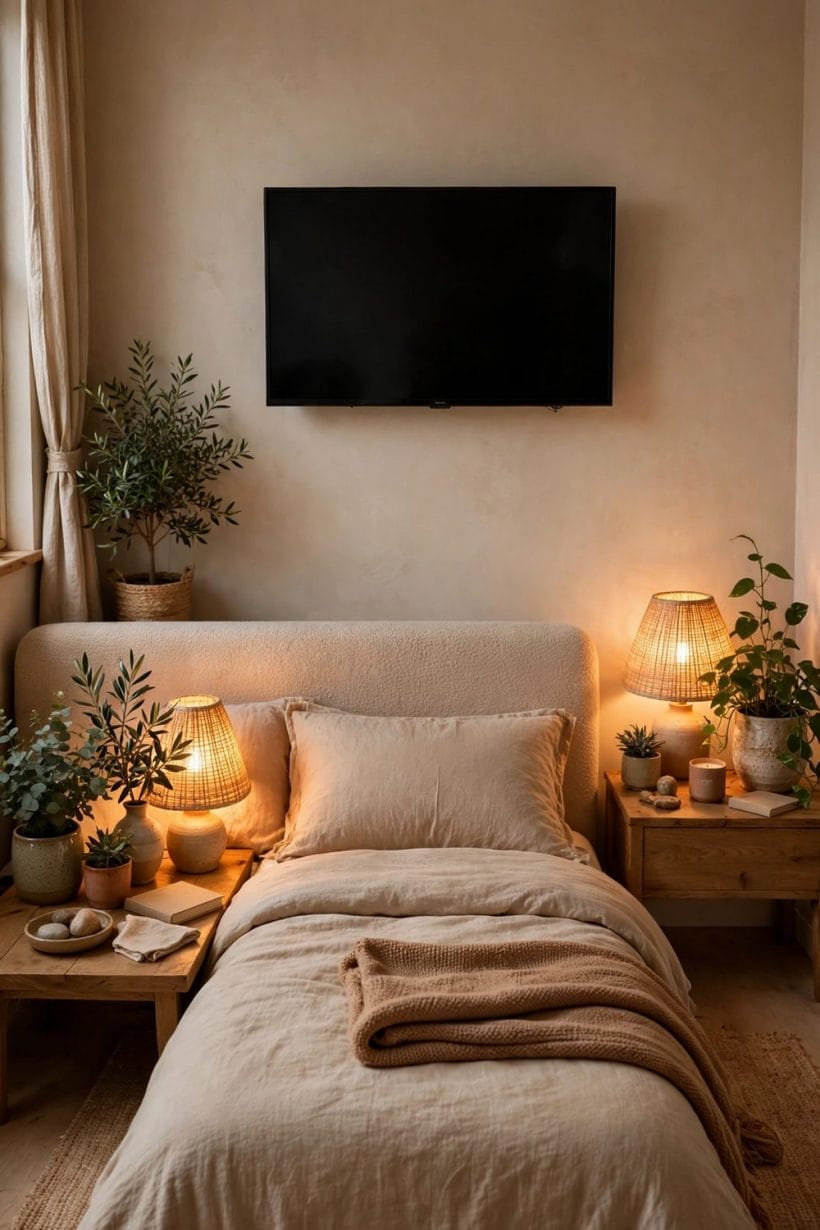
If you do bring a television into the bedroom, placement decides whether it feels like a thoughtful addition or an awkward intrusion. The most natural spot is the wall directly opposite the bed, so viewing means lying or sitting comfortably rather than twisting the neck or propping up pillows at strange angles. A wall mount keeps the floor clear and the screen steady, while a low dresser or chest underneath gives the set a home and hides some of the clutter.
Consider the whole room before fixing anything. Doors, wardrobes and windows all compete for wall space, and a screen placed beside a window will fight glare for much of the day. Think about how the room is used in the morning as well as the evening: a screen that looks fine from the bed may loom over a dressing area or block the view from a chair. Sketching the layout, even roughly, and living with the arrangement in mind for a few days helps avoid a mounting job that has to be undone.
Small rooms need extra care, because every piece of furniture must earn its place, a theme familiar from tiny house bedroom ideas where the bed, storage and any screen share a tight footprint. A screen that folds away behind cabinet doors, or one mounted on a bracket that angles gently toward the bed, can preserve the calm look of the room when the television is off. Whatever the arrangement, mounting and any electrical work belong to a qualified professional, and cables should be routed neatly and safely, never trailing across walkways or tucked under rugs.
4. Viewing Comfort: Angle, Height and Seating
Comfortable viewing starts with the neck. A screen mounted too high forces the head back, while one sitting too low means hunching forward, and both lead to aches over a long film. The comfortable position is the one that lets you watch with the head resting naturally on the pillow, eyes roughly level with the middle of the screen. That usually means mounting lower than people first guess, and testing the position from the bed itself before anything is fixed to the wall.
Seating matters just as much. Watching from a flat pillow is fine for a short programme but tiring across an evening, so a supportive arrangement of pillows, or a wedge cushion kept for viewing, makes a real difference. Some households add a small bench or chair at the foot of the bed for a second viewer, which works well when the room has the space. The aim is a setup that lets everyone watch without fidgeting, shifting or ending the evening with a stiff neck.
Distance is the third piece of the puzzle, and it is governed by the room rather than by any rulebook. In a compact bedroom the bed may sit quite close to the opposite wall, which suits relaxed, casual viewing but can feel intense for fast-moving programmes. If the room feels cramped, that is useful information: it may mean a smaller screen suits the space better, or that the main viewing belongs in a shared room instead. The same balancing act shapes small living room ideas, where seating distance and screen position are planned together rather than left to chance.
5. Light, Glare and the Evening Room
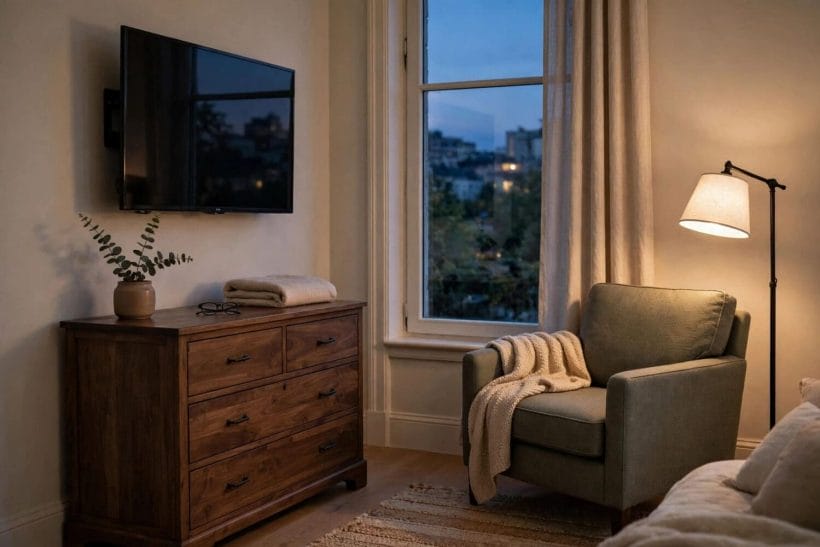
Light decides whether a bedroom television is a pleasure or a squint. Daylight bouncing off the screen washes out the picture, while a bright screen in a dark room strains the eyes and makes the rest of the room feel gloomy by contrast. The happiest arrangement pairs the screen with gentle background light: a soft bedside lamp, a dimmed ceiling light, or a warm glow from a hallway that keeps the room from going fully dark around a bright rectangle.
Windows deserve attention before the screen goes up. A screen facing a window catches reflections for much of the day, and a screen beside a window forces viewers to look past bright daylight. Curtains or blinds that can be drawn in the evening solve most of this, and they double as a sleep aid by darkening the room at night. If the room has a mirror or glossy wardrobe doors opposite the screen, check for reflections from the bed as well, since glare from furniture can be just as distracting as glare from glass.
Evening routines benefit from treating light as part of the viewing setup rather than an afterthought. Dimming the lamps as a film starts, keeping a small light on rather than watching in total darkness, and closing the curtains before switching on all make the picture easier on the eyes. The broader lesson carries into shared spaces too, where tiny living room ideas often pair screens with layered, low lighting so that one bright source never dominates a small room.
6. Sleep and the Wind-Down Question
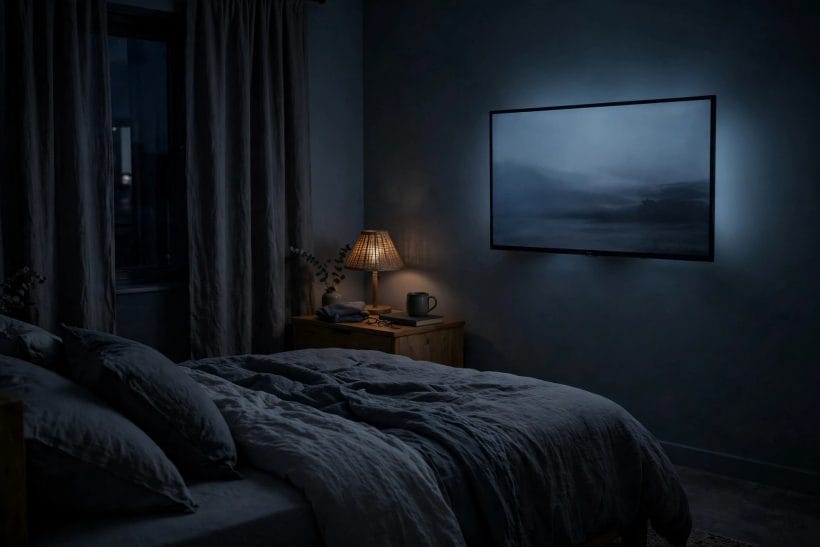
Sleep is where the bedroom television debate is usually won or lost. The honest truth is that screens and sleep pull in opposite directions: programmes are designed to hold attention, while sleep needs attention to loosen. Viewers who watch stimulating drama, news or sport late at night often find their minds still racing when the lights go out, and the habit of falling asleep to a running programme can make it harder to settle without one.
That does not mean every household must ban the bedroom screen. It means the household needs a rule it can actually keep. A fixed switch-off point, well before bedtime, works better than a vague intention to stop soon. Gentle, familiar viewing earlier in the evening is easier on sleep than tense viewing at midnight, and a wind-down routine after the screen goes off, reading, stretching, or a quiet wash and change, helps the body make the shift from viewing to rest.
Partners should agree the rule together, since one person’s late viewing is the other person’s broken sleep. If one partner loves a late programme and the other needs quiet, the shared living room may be the kinder venue, or headphones may bridge the gap for a time. A calm bathroom routine before bed can anchor the wind-down, a point where tiny bathroom ideas show how even a compact room can support a slow, unhurried end to the day. The test is simple: if mornings feel worse since the screen arrived, the screen, or at least its hours, needs to change.
7. Sound Without Waking the House
Sound is the bedroom television’s most social problem. Dialogue that seems quiet to the viewer can travel clearly through a bedroom door, down a hallway and into a child’s room or a neighbour’s flat. Thin walls, hollow doors and hard floors all carry sound further than expected, and late-night viewing magnifies every whisper, laugh track and action scene.
The fixes are mostly about consideration rather than equipment. Keeping the volume low enough that dialogue stays clear without filling the room, choosing programmes with steady sound rather than sudden loud passages, and closing the bedroom door during viewing all help. Headphones or a single earpiece let one partner watch while the other sleeps, though they work best for solo viewing rather than shared films. Soft furnishings, rugs, curtains and upholstered furniture absorb some sound and also make the room feel warmer and quieter overall.
It also helps to ask where shared viewing belongs. In many homes the living room remains the natural place for films and lively programmes, and the bedroom screen suits only quiet, gentle viewing. That division keeps the peace and gives each room a clear role, a balance reflected in farmhouse living room ideas where the shared room is arranged as the household’s main gathering and viewing space. If a bedroom screen regularly disturbs others, that is a sign the arrangement needs rethinking, not a reason to simply turn the volume down and hope.
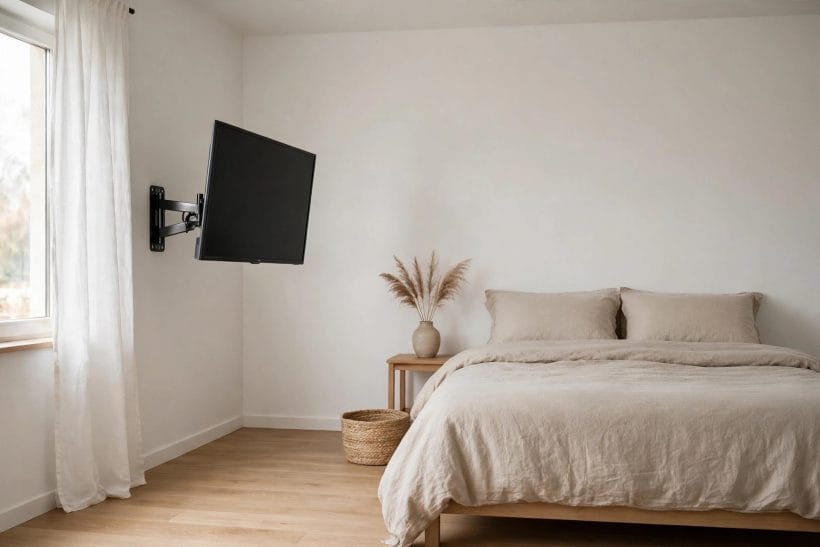
8. Cables, Mounts and a Tidy Wall
A bedroom television brings a trail of practical details: a mount, a power point, cables, a remote control and somewhere to put them all. Done well, the setup looks calm and intentional. Done hastily, it leaves a tangle of wires, a wobbling bracket and a wall full of holes. The difference usually comes down to planning the whole arrangement before drilling anything, and accepting that some walls and some wiring jobs are not do-it-yourself work.
Mounting deserves professional care. Walls vary in what they can hold, power points may not sit where the screen wants to be, and a heavy screen on a weak fixing is a safety risk, especially above a bed. A qualified professional can confirm the wall, the bracket and the cable route, and can advise whether the power point needs moving rather than stretching an extension lead across the room. Cables routed inside trunking or behind furniture look better and remove a tripping hazard, and a small tray or drawer for remotes keeps the bedside table clear.
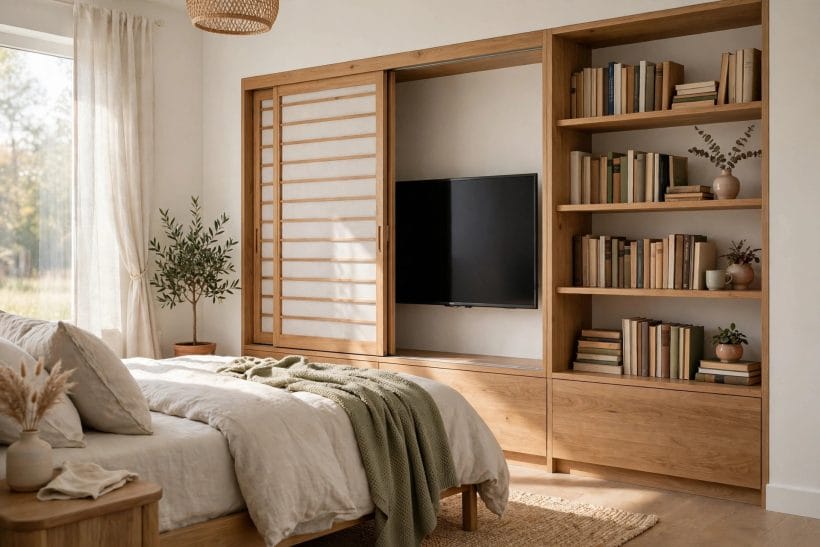
Storage completes the picture. A shallow cabinet, a closed shelf or a pair of sliding doors can hide the screen entirely when it is not in use, which suits households that want the bedroom to look screen-free for most of the day. Even without doors, a tidy arrangement, screen centred, cables hidden, nothing stacked on top of the set, keeps the room feeling restful. The rule of thumb is that the television should disappear visually when it is off, so the bedroom can return to being a bedroom.
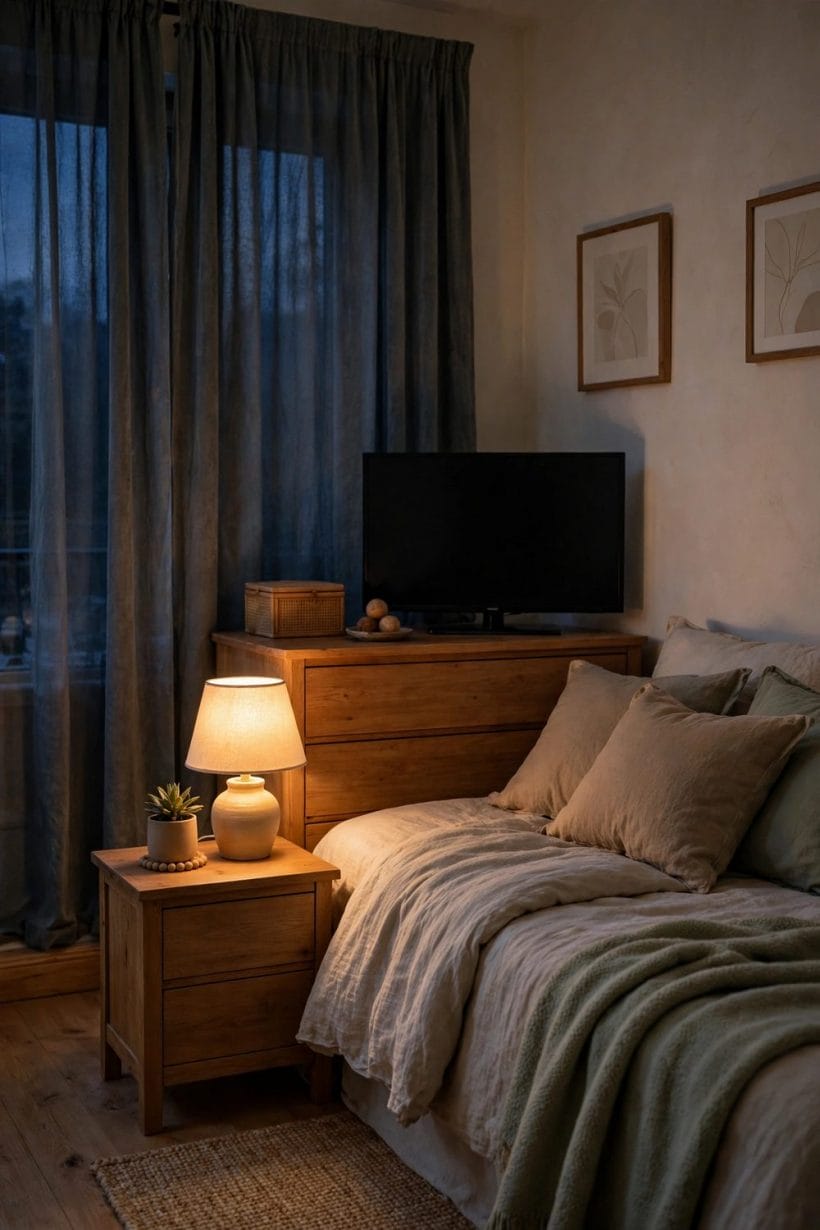
9. When a Bedroom TV Suits Your Household
Some households are natural fits for a bedroom television. Couples who keep different hours, people who work shifts and unwind at odd times, anyone recovering from illness or with limited mobility, and households where the living room is shared with children or housemates all gain real comfort from a private screen. Small homes benefit too, when the bedroom doubles as a personal lounge and the living area cannot serve everyone at once.
The fit depends on honest answers to a few questions. Does anyone in the house sleep lightly or struggle to fall asleep? Does the room have a wall that suits a screen without glare or awkward viewing angles? Is there space for the screen without crowding out storage, dressing space or the bed itself? And can the household agree on hours and volume that respect everyone? If the answers are mostly yes, a bedroom television is likely to be enjoyed rather than regretted, and the room’s layout, including the floor area the furniture occupies, can be planned around it, much as tiny house flooring ideas plan rooms from the floor up so that every piece sits comfortably.
Households with young children need one more consideration: a bedroom screen can become the default evening companion for children who wander in, so agreed hours matter even more. A screen that lives in the parents’ bedroom, used at set times and switched off firmly, models a healthy relationship with viewing. A screen that runs all evening in an open doorway teaches the opposite. The household that thinks these questions through before buying is the household most likely to be happy afterwards.
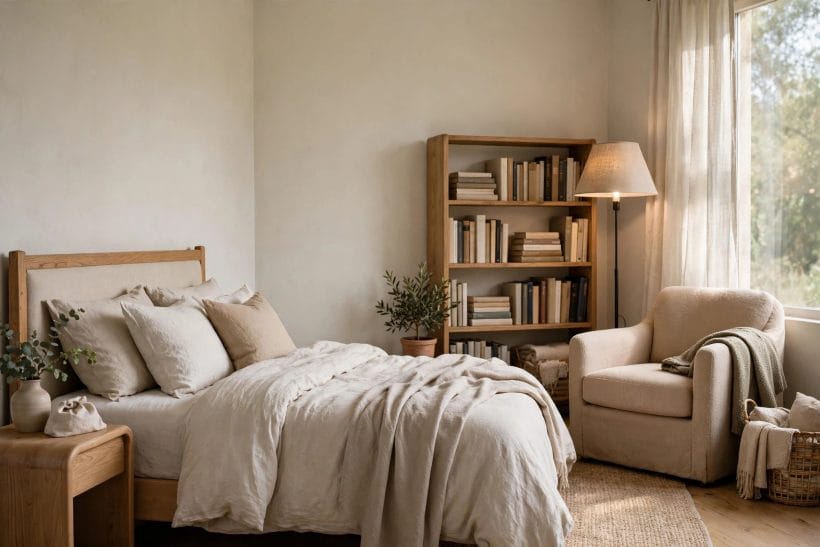
10. Living Without One: The Screen-Free Bedroom
The screen-free bedroom has its own quiet appeal, and it is worth picturing before deciding. Without a television, the room centres on the bed, a chair, a lamp and a shelf of books. Evenings slow down naturally: reading replaces scrolling, conversation replaces background programmes, and the room’s lighting stays soft because nothing demands a bright rectangle on the wall.
Many people find the transition easier than expected. The first week brings a sense of missing something, and then the room’s new rhythm takes over. Sleep often improves, mornings feel clearer, and the bedroom regains its identity as a place of rest rather than another entertainment zone. Couples sometimes find they talk more, and solo dwellers often discover that music, podcasts or an audiobook give the same companionship as a screen without the glare.
Going screen-free does not mean going without pleasure. A good reading lamp, comfortable bedding, a chair by the window and a small speaker for music can make the bedroom feel luxurious in a calmer register. And the choice is not permanent: a household can try a screen-free month and see how it feels, or keep the main viewing in the living room and reserve the bedroom for winding down. The strongest decision is the one made deliberately, after picturing both rooms, rather than the one made by habit or by a sale.
Final Considerations
So, thumbs up or thumbs down? The honest answer is that it depends on the household, the room and the rules around the screen. A bedroom television suits private viewing, flexible hours and small homes, and it fails when it steals sleep, disturbs others or clutters a calm room. Placement, light, sound and a firm switch-off point decide which outcome you get, far more than the screen itself.
Before you commit, test the idea without drilling a single hole. Watch on a portable screen from the bed for a week, notice the glare at different times of day, and ask everyone in the house how their sleep and evenings feel. If the trial leaves mornings worse, or the room feeling crowded, the screen-free bedroom may be the better gift to yourselves. If the trial brings cosy evenings and no broken sleep, mount it properly, keep the cables tidy, agree the hours, and enjoy it. Either way, the bedroom should stay a room that restores you, and the television, if it earns a place there, should serve that purpose rather than compete with it.




0 Comments