
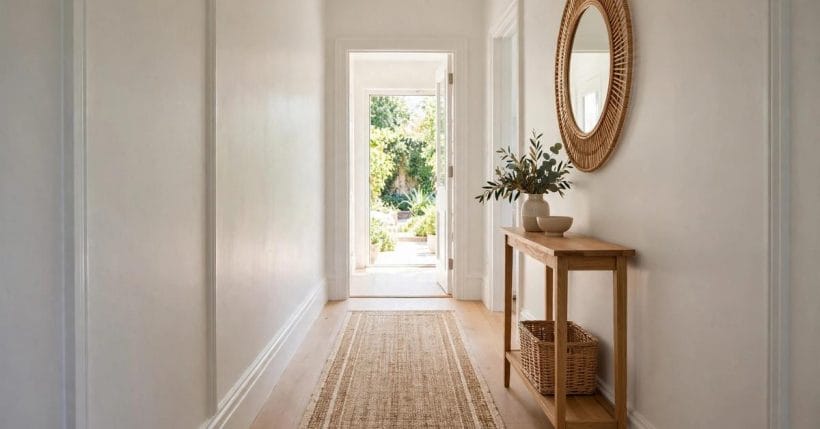
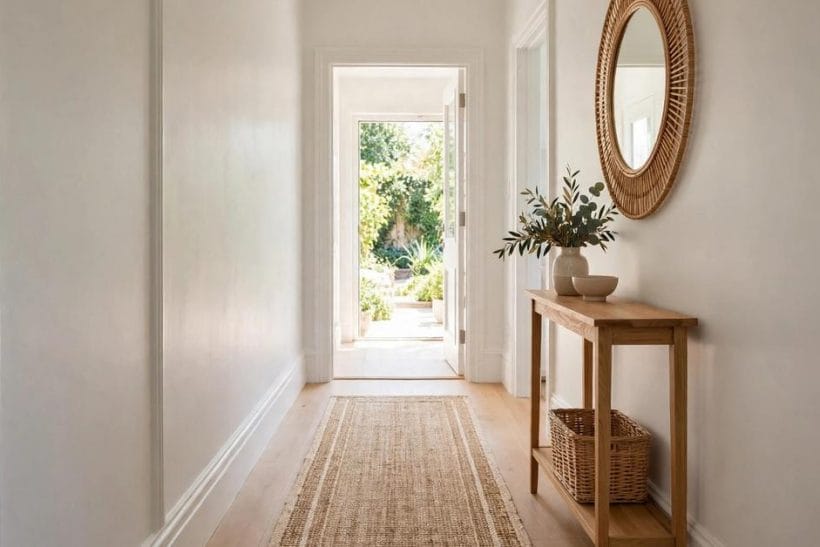
A hallway is the first room a visitor meets and the last room a homeowner thinks about, yet it shapes every journey through the house.
This guide covers the fundamentals that make a hallway work: clear flow, comfortable light, sensible storage and finishes that last, all in general terms you can apply to any home.
1. Start With How the Hallway Is Used
Before choosing a colour, a runner or a piece of furniture, watch how the hallway is actually used. Notice who walks through it, what they carry, where they pause and where they collide with a door, a shoe rack or a pile of bags. A hallway that serves a busy family morning looks different from a quiet passage between bedrooms, and a hallway that welcomes guests needs a different first impression from a back passage that mainly carries laundry and coats. The honest starting point is use, not decoration, because a beautiful hallway that blocks movement will annoy its owners every single day.
Think about the rooms the hallway connects and the times of day it is busiest. Mornings bring coats, bags, shoes and school runs. Evenings bring guests, deliveries and tired feet heading for rest. A hallway also carries sound, light and air between rooms, so a change at one end is felt at the other. When you plan with daily life in mind, the later choices about furniture, lighting and finishes fall into place more easily, and the hallway stops being a leftover strip of floor and starts behaving like a proper part of the home.
One useful habit is to walk the route slowly with fresh eyes, as a guest would. Notice where the eye lands first, where the passage feels dark or cramped, where a door swing steals space and where clutter gathers without anyone deciding to put it there. Those observations matter more than any showroom display, because they describe your home rather than someone else’s. This guide stays in general terms throughout and gives no figures, because the right feel for a hallway depends on the home, the household and the rules that apply where you live, which are always worth checking before building work begins.
| Fundamental | What to look at | A reassuring sign |
|---|---|---|
| Daily use | Who walks through, and when | The route suits mornings, evenings and guests alike |
| Flow | The walking path from end to end | Movement feels natural, with nothing to step around |
| Width feel | How generous the passage feels | People pass comfortably without squeezing past furniture |
| Doors and junctions | Door swings and meeting points | Doors open freely and junctions feel calm |
| Furniture | What stands in the passage | Every piece earns its place and leaves the path clear |
| Storage | Coats, shoes and everyday items | Belongings have a home that does not block the way |
| Light | Daylight and electric light together | The passage feels bright and welcoming at any hour |
| Finishes | Walls, floors and trim | Surfaces look cared for and stand up to daily traffic |
| Character | Colour, art and personal touches | The hallway feels like part of the home, not an afterthought |
| Upkeep | Cleaning and small repairs | The space stays tidy with a routine anyone can keep |

2. Flow First: Keeping the Route Clear and Comfortable
Flow is the single most important quality in a hallway, because a hallway exists to move people from one place to another. A clear route feels calm even when the passage itself is modest, while a cluttered route feels stressful even when the space is generous. Keep the walking path free of anything that forces a sidestep, a squeeze or a pause to move an obstacle. Shoes, bags, toys, parcels and drying laundry all drift into hallways by habit, so flow is less about buying something new and more about deciding, firmly, that the path stays clear.
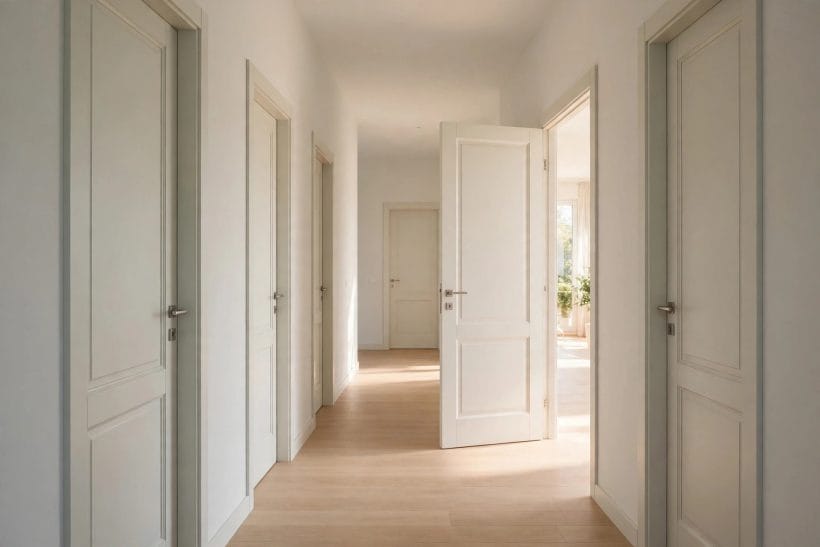
Test flow by walking the route with your hands full, as you would with shopping bags or a laundry basket, and again while chatting with someone walking beside you. Notice where you slow down, where you turn sideways and where you bump a corner or a door handle. Those friction points are the design brief. Sometimes the fix is simply moving a piece of furniture, changing which way a door opens, or giving shoes and coats a proper home near the entrance instead of in the middle of the route. Small changes of this kind often transform how a hallway feels without any building work at all.
Flow also means thinking about the ends of the hallway, not just the middle. A passage that opens awkwardly into a living room, a kitchen or a bedroom will feel wrong even if the middle is clear, because the arrival matters as much as the journey. Give each end a clear purpose, whether that is a view through to a bright room, a welcoming console near the front door, or a calm turn into a quiet bedroom wing. When both ends are considered, the hallway reads as a connected part of the home rather than a tunnel between closed doors.
Finally, remember that flow changes with the household. A home with small children, older relatives, pets or frequent guests needs a more forgiving route than a quiet home for one or two people. Leave room for prams, walking aids, pet beds and the everyday dance of people passing each other. A hallway that works for the busiest, clumsiest moment of the day will feel effortless at every other moment, and that effortlessness is the true sign of good hallway design.
3. Width in General Terms: What Makes a Hallway Feel Generous
People often ask how wide a hallway should be, and the honest answer is that feel matters as much as any single dimension. A hallway feels generous when two people can pass without one pressing against the wall, when a door can open without blocking the route, and when furniture sits against the wall without stealing the walking path. Light, colour, ceiling height and the view at the far end all shape that feeling, so a modest passage with bright walls, a clear view and a light floor can feel far more comfortable than a broader passage that is dark, cluttered or broken up by jutting furniture. Anyone planning a home around residential hallway width should start from that feeling and then check the rules that apply where they live before making structural changes.
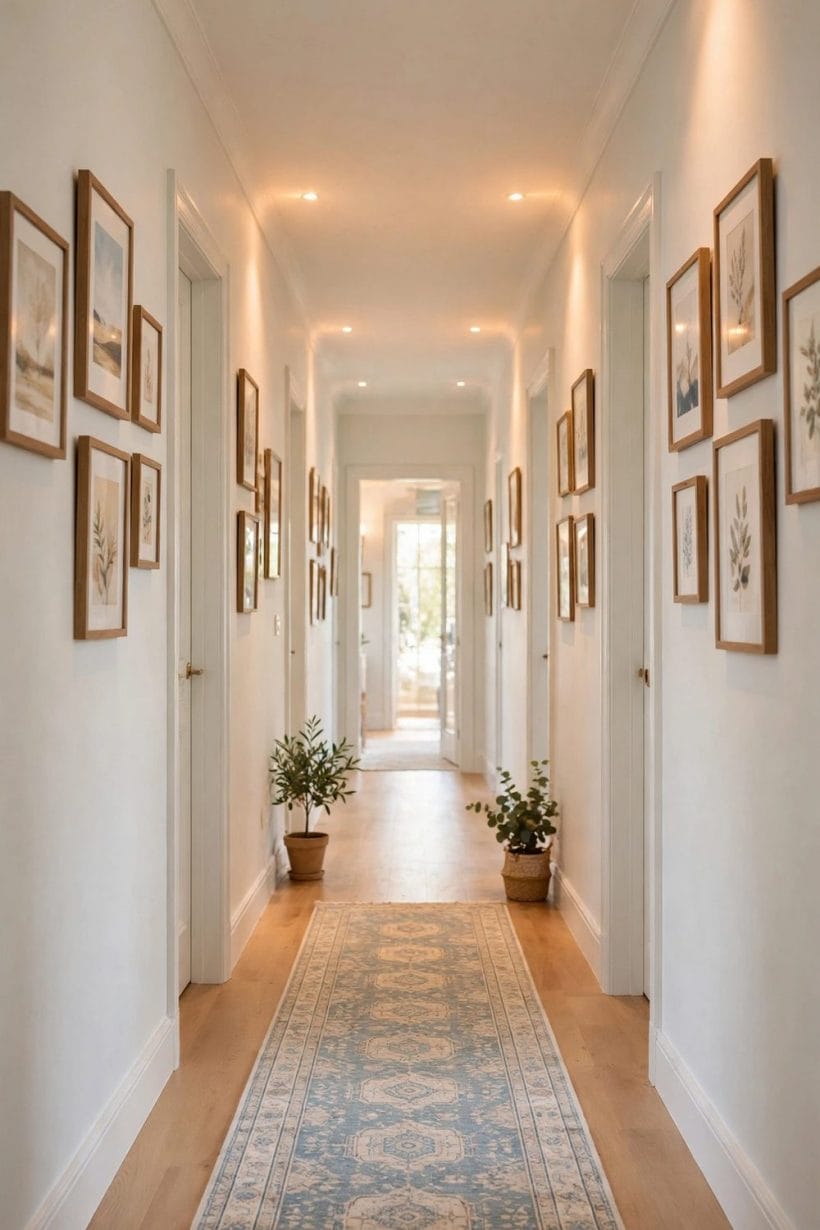
Several quiet factors decide whether a hallway feels generous or cramped. A long, straight view to a bright room or a window at the far end pulls the eye forward and makes the passage feel longer and lighter. A mirror placed with care can borrow light and depth from an adjoining room, while a dark, heavy piece of furniture at the far end can stop the eye and make the whole passage feel shorter. Low, slim furniture that hugs the wall preserves the walking path, while deep furniture, open drawers and protruding hooks all narrow the usable route even when the walls themselves have not moved.
Doors deserve special attention in this picture, because a hallway is defined as much by its doors as by its walls. A door that opens into the passage steals space every time it swings, and a cluster of doors near a junction can turn a calm corner into a collision point. Sliding doors, doors that open into rooms rather than into the passage, and careful placement of handles and hinges can all ease the pressure, but any change to doors or walls should be checked against the rules that apply where you live, and structural work should always be left to a professional. For a closer look at the width question itself, the companion guide to standard vs wide hallways explores how width feels in practice, in general terms, without quoting figures as fact.
When a hallway feels tight, resist the urge to fill it with more things in the hope of distracting from the tightness. Extra furniture, busy patterns and dark colours usually make a narrow passage feel narrower, while a clear path, a light palette and one or two well-chosen focal points make it feel calmer. The goal is not to pretend the hallway is something it is not, but to give it the best version of itself: clear, bright, uncluttered and honest about its size. A hallway that is comfortable to walk through will always feel more generous than one that is merely decorated.
4. Doors, Swings and Junctions
A hallway is a meeting place for doors, and every door is a decision about space. Each door needs room to swing, a handle that does not catch a passer-by, and a clear landing on both sides so that someone stepping out of a room does not step straight into traffic. Junctions where two hallways meet, or where a hallway meets a staircase, deserve the same care, because these are the places where people turn, pause and meet each other. A junction that is treated as leftover space will gather clutter, while a junction that is given a little light, a picture or a clear view will feel intentional and calm.
Walk each door in turn and notice how it behaves. Does it swing into the passage or into the room, and which choice leaves the hallway clearer? Does it open fully against the wall, or does furniture stop it halfway and leave it ajar, narrowing the route? Does the handle catch clothing or bags? These small frictions add up, and fixing them often costs nothing more than moving a hook, shifting a shoe rack or changing a door stop. Where a door genuinely causes trouble, a professional can advise on alternatives, including doors that slide or fold, but the choice should suit the room, the household and the rules that apply where you live.
Think also about privacy and sound at each doorway. A hallway door is the boundary between a shared passage and a private room, so its weight, its fit and its latch all affect how peaceful the rooms feel. A door that closes softly and seals well gives bedrooms and bathrooms a sense of retreat, while a door that rattles or gaps will carry every hallway sound into the room beyond. Small draught and sound improvements, fitted properly, can make a hallway feel more polished without changing its appearance at all.
Junctions benefit from a simple rule: keep them open and give the eye somewhere pleasant to land. A piece of art, a plant or a view through an open doorway can turn a turning point into a moment of calm, while a tall bookcase or a coat stand at a junction will block sightlines and create collisions. If a junction also serves as a storage spot, keep that storage low, shallow and tucked against one wall only, so that people turning the corner can see what is coming and pass each other without hesitation.
5. Furniture That Belongs in a Hallway, and What Does Not
Hallway furniture should serve the passage, not compete with it. The pieces that belong are slim, purposeful and placed against a wall: a narrow console for keys and post, a bench for sitting to put on shoes, a shallow shelf for a few books or a plant, and a mirror that helps with last-minute checks before leaving. Each piece should answer a real daily need, because a hallway has no spare room for furniture that merely fills space. If a piece is never used, or if people walk around it rather than past it comfortably, it does not belong in the hallway, however beautiful it may be in another room.
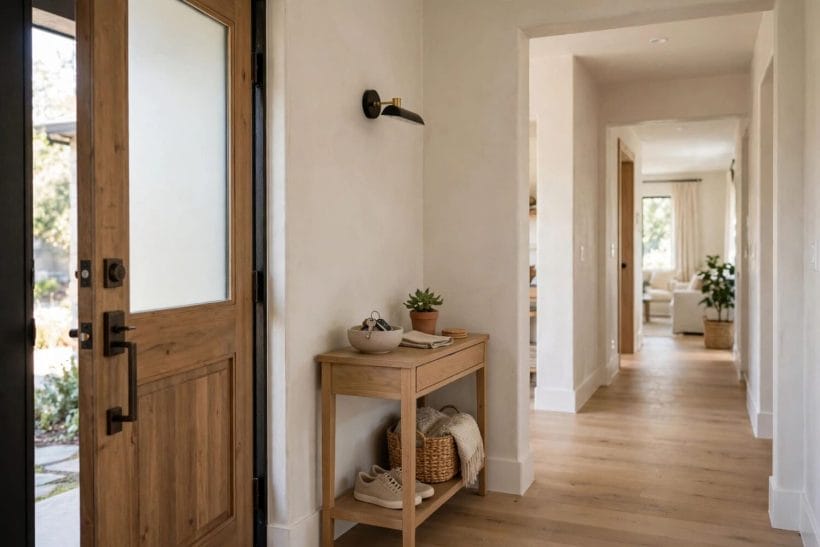
A console table is the classic hallway piece, and it earns its place by catching the small things that otherwise scatter: keys, post, sunglasses and a phone. Choose a slim design with a clear surface and, ideally, a drawer or a lower shelf for the items that should not be on display. Keep the styling light: a small vase, a bowl or a framed photograph is plenty, because a console crowded with ornaments becomes a dust trap and a visual block. Related ideas for slim tables can be found among console table ideas, which show how a narrow table can sit neatly against a wall without dominating a room.
Seating belongs in a hallway only when there is a genuine reason to sit, such as putting on shoes near the entrance or waiting for a lift. A low bench with storage beneath it can serve both purposes, giving shoes and bags a home while offering a perch. Avoid armchairs, deep sofas and anything that invites lingering in the middle of a route, because a hallway is a passage first and a sitting room never. If seating would block the path, skip it entirely and keep the entrance clear, since a clear hallway with no seat is far more useful than a blocked hallway with a handsome chair.
Finally, be ruthless about what creeps into the hallway over time. Delivery boxes, sports equipment, drying racks and outgrown toys all find their way into passages because the hallway is conveniently empty, but each addition narrows the route and dulls the first impression of the home. Give every category of item a proper home elsewhere, and treat the hallway as a no-storage zone for anything that does not serve the passage itself. A hallway that stays clear is a hallway that stays welcoming, and that discipline is worth more than any single piece of furniture.
6. Storage Without Blocking the Way
Storage is the hallway’s greatest temptation and its greatest threat. Done well, it hides coats, shoes and bags and keeps the home tidy. Done badly, it turns a passage into a corridor of cupboards that feels narrower with every door added. The rule is simple: storage should sit flat against the wall, open without blocking the route, and hold only what the hallway genuinely needs. Coats worn daily, shoes worn daily and bags used daily belong near the entrance. Out-of-season coats, spare bedding and rarely used equipment belong elsewhere, however convenient the hallway cupboard may seem.
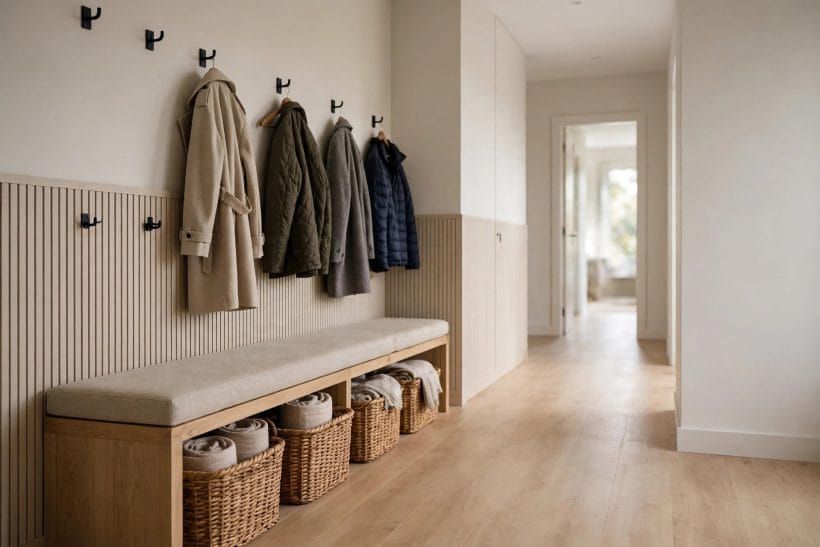
Shallow storage works best in a passage. A slim shoe cabinet with doors that close flush, a row of hooks at a sensible height, and a bench with baskets beneath it can hold a surprising amount without jutting into the walking path. Hooks deserve care: hooks placed too high are useless for children, hooks placed too low catch bags and shoulders, and hooks loaded with heavy coats will droop and clutter the wall. Choose fewer, sturdier hooks and hang only what is used often, rotating seasonal items out of the hallway rather than letting them accumulate.
Closed storage usually beats open storage in a hallway, because open shelves display every stray item and make the passage feel busy even when it is tidy. A cabinet with doors hides the visual noise and protects belongings from dust, while a single open shelf or a small tray can hold the few items that need to be grabbed on the way out. If built-in storage is planned, it should be designed with the whole wall in mind, including skirting, trim and door frames, and any structural change should be checked against local rules and carried out by a professional.
For homes where space is tight everywhere, hallway storage should be judged against the rest of the house, not in isolation. A hallway that absorbs overflow from a crowded living room will soon feel like a storeroom, while a home that treats storage as a whole-house question will keep its passages clear. Ideas for making the most of compact rooms, including small living room ideas, often translate well to hallways, because both settings reward slim furniture, closed storage and a firm rule about what earns its place.
7. Light That Makes a Narrow Space Feel Open
Light transforms a hallway more than any other single change. A bright passage feels wider, safer and more welcoming, while a dark passage feels cramped even when it is generously proportioned. Start with daylight wherever it is available: a glazed door, a borrowed light from an adjoining room, a skylight or a bright room at the far end can all feed light into the passage. Even a small amount of daylight, carefully directed, changes the mood of the whole route, because the eye reads brightness as spaciousness.
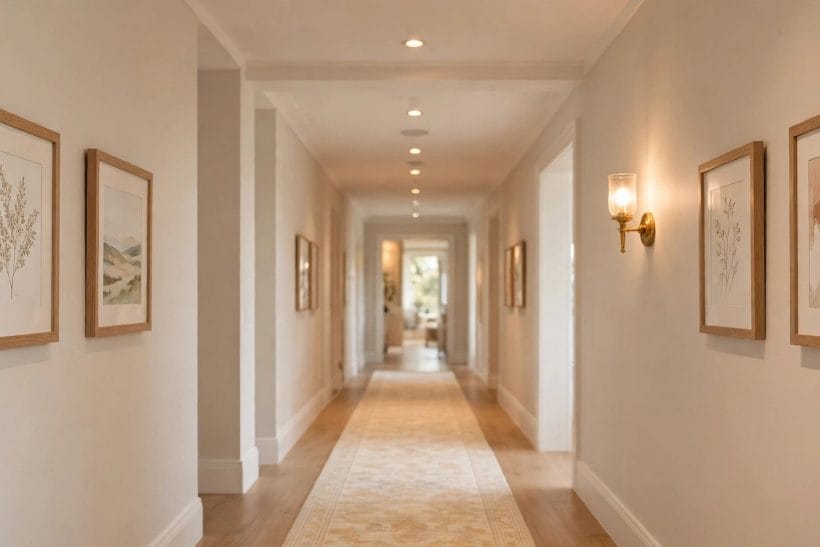
Electric lighting should be layered rather than relying on a single harsh fitting. A row of ceiling lights spaced along the passage gives even coverage, while wall lights or a small lamp near a console can soften the feel and highlight art or trim. Choose warm, comfortable light for a home hallway, and avoid fittings that glare into the eyes or cast hard shadows at head height. Dimmers are a quiet luxury in a hallway, allowing bright light for arrivals and cleaning and softer light for evenings, and any electrical work should be carried out by a qualified professional. Practical guidance on layering light at home can be found among home lighting tips, which cover the same principles of even coverage and comfortable brightness.
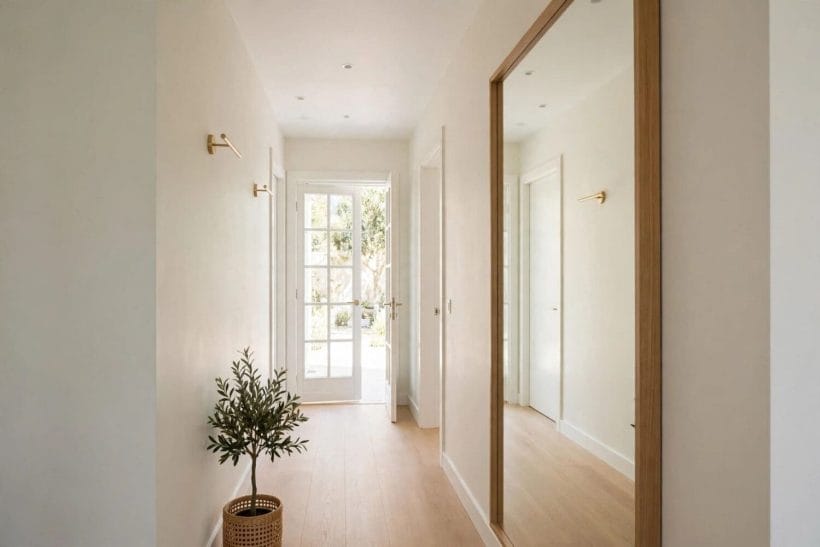
Mirrors and pale surfaces multiply whatever light is available, but they should be used with restraint. One well-placed mirror opposite a light source or at the end of a passage can open up the space beautifully, while a wall of mirrors can feel confusing and cold. Pale walls, a light floor and a light-coloured runner all reflect light gently, whereas dark, glossy surfaces can create glare and show every mark. The aim is a soft, even brightness that lets people see where they are going and feel at ease, not a dazzling display.
Finally, think about light at night. A hallway is used after dark more than any other passage in the home, for late arrivals, bathroom trips and early mornings. A low, warm light left on overnight, or a sensor light that greets movement without blinding sleepy eyes, makes the hallway feel safe and caring. Night lighting should be gentle enough not to disturb sleepers in nearby rooms, yet clear enough to show steps, thresholds and door handles. Getting this balance right is a small kindness that the whole household will notice.
8. Colour, Surfaces and Finishes
Colour in a hallway should calm the eye and connect the rooms it joins, rather than shouting for attention. Because a hallway is seen in passing, often for only a few seconds at a time, it benefits from a restrained palette: one main wall colour, a trim colour that repeats through the home, and one or two accent notes in art, a runner or a plant. A palette borrowed from the adjoining rooms will make the hallway feel like a natural link between them, while a clashing colour will make every doorway feel like a border crossing.
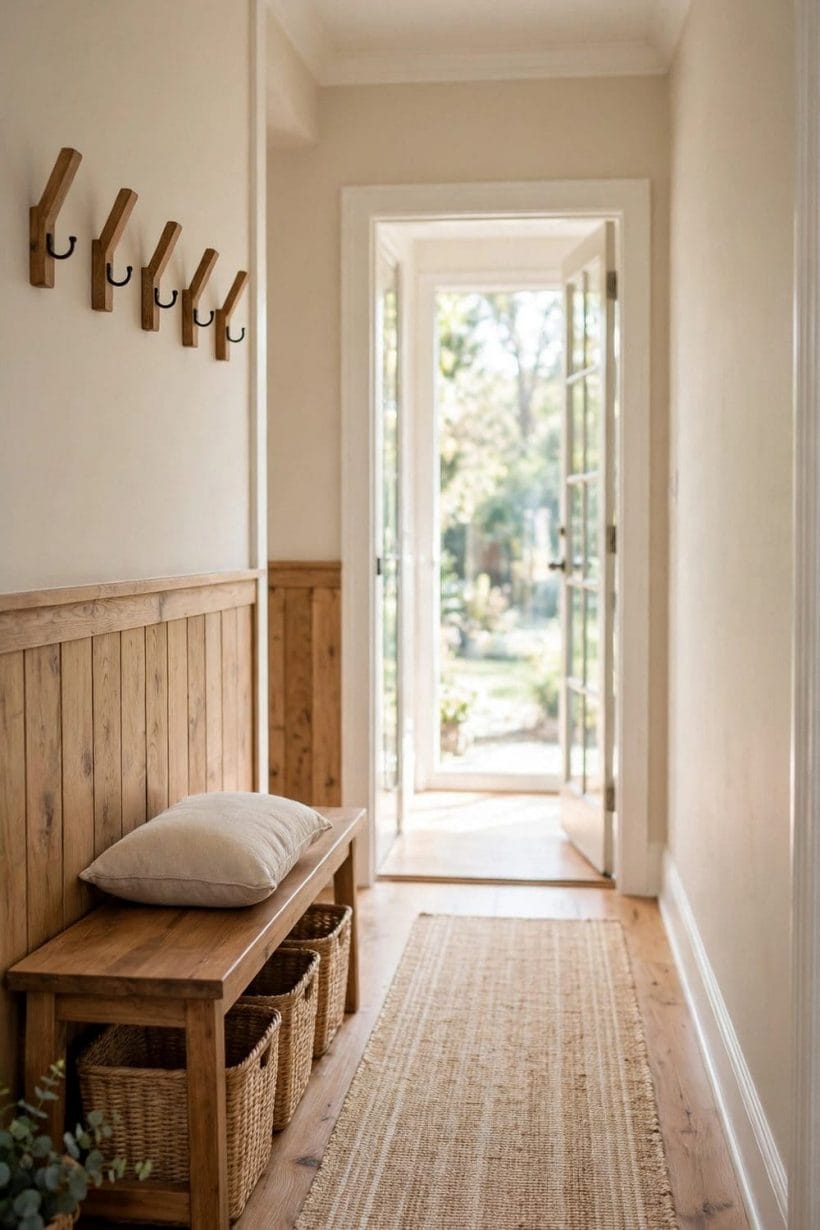
Pale, warm neutrals are a safe and popular choice for hallways because they reflect light and show off woodwork, art and flooring without competing with them. That does not mean a hallway must be white or bland: soft greens, gentle blues, warm greys and muted earth tones can all give a passage character while staying restful. Whatever colour is chosen, test it in the hallway’s own light, at different times of day, because a colour that looks perfect in a bright shop or a sunny living room can look dull or cold in a windowless passage. Paint a generous test patch, live with it for a few days, and judge it in morning, evening and electric light before committing.
Finishes must stand up to daily traffic, because hallway walls and floors take more knocks than any other surfaces in the home. Choose washable wall finishes, durable flooring and trim that can be wiped clean, and protect corners and lower walls where bags, prams and pets cause the most wear. A chair rail, a durable skirting board or a washable lower wall treatment can save endless repainting, and a runner rug can protect a floor while adding warmth and sound softening. When comparing floor options, it helps to read hardwood flooring checks for the practical questions about durability, care and everyday wear that matter most in a busy passage.
Trim and detail deserve attention out of proportion to their size, because in a narrow space the eye is close to every surface. Clean skirting, well-fitted architraves, a straight handrail and tidy door frames all signal care, while chipped paint, loose trim and mismatched handles make even a freshly painted hallway feel tired. Small repairs and a careful repaint of trim alone can refresh a hallway dramatically, and they are among the most rewarding weekend tasks a homeowner can tackle, provided any structural or electrical work is left to a professional.
9. The Entry End: Where the Hallway Meets the Front Door
The entry end of a hallway carries the heaviest load of all, because it is where the outside world meets the home. Coats, shoes, keys, post, parcels and umbrellas all arrive here, and guests form their first impression here, so this end deserves the most thoughtful planning in the whole passage. Give it a clear landing zone: a place to set down bags, a hook or two for coats, a tray or bowl for keys, and a mat that catches dirt before it travels through the house. When these basics have a home, the rest of the hallway stays clear almost by itself.
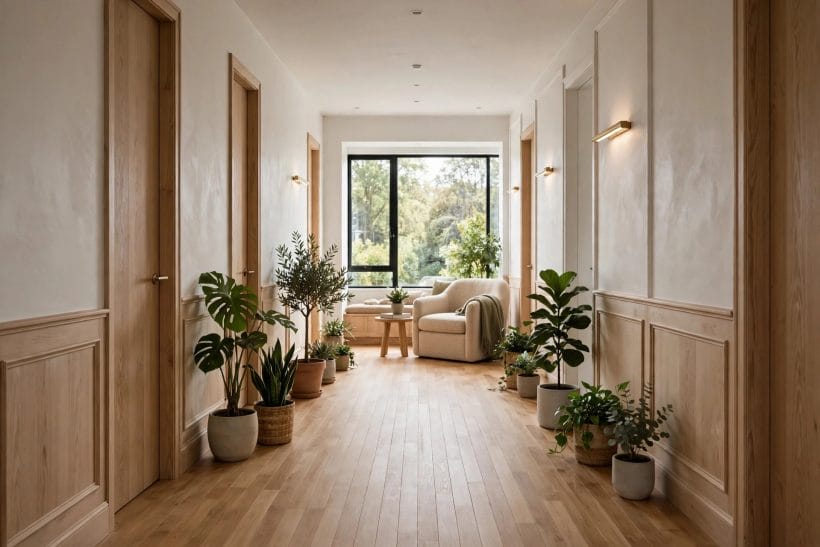
The front door itself shapes the entry experience. Its colour, its hardware, its glazing and the light around it all tell a visitor whether they are welcome, and its draughtproofing and security affect how comfortable the hallway feels in every season. A glazed panel or a sidelight can borrow daylight into the entry, while a solid door gives privacy and quiet. The transition from outside to inside should be gradual: a porch, a covered entry or simply a well-lit threshold helps eyes adjust and gives visitors a moment to arrive, rather than stepping straight from the street into a narrow passage. Related ideas for the outside of that threshold can be found among exterior entryway ideas, which cover the same welcoming principles from the other side of the door.
Keep the entry end honest about the weather and the seasons. A mat that is too small will let mud travel, a shoe tray that overflows will become a tripping hazard, and a coat rail that holds every coat owned will collapse under its own success. Rotate seasonal items, keep a small basket for umbrellas and wet-weather gear, and give parcels a designated spot rather than letting them colonise the passage. These habits sound mundane, but they are what separate a hallway that photographs well from a hallway that lives well.
Finally, give the entry end a personal touch that is not clutter. A single piece of art, a family photograph, a plant that thrives in the available light or a handmade object can make the entrance feel like home without blocking the route. Rotate the display with the seasons if you enjoy it, but keep it to one or two items at a time. An entrance that is calm, clear and personal will welcome guests warmly and will make coming home, at the end of every day, feel like a small pleasure rather than a negotiation with clutter.
10. Small Hallways, Shared Homes and Everyday Living
Small hallways reward the same fundamentals as large ones, applied with even more discipline. In a compact passage, every centimetre of clutter counts, every dark corner matters and every piece of furniture must justify itself twice over. The temptation is to squeeze in more storage, more hooks and more decoration to compensate for the size, but the opposite usually works better: fewer, better-chosen pieces, a lighter palette, a clear path and one focal point at the far end. A small hallway that is clear and bright will feel larger than a small hallway that is full, however well organised that fullness may be.
Shared homes add another layer, because a hallway must serve several people with different routines, belongings and standards of tidiness. Agreeing simple shared rules helps more than any purchase: shoes in one place, coats on assigned hooks, parcels moved promptly, and a shared understanding that the passage is not a personal storeroom. When everyone knows the rules, the hallway stops being a source of friction and becomes a shared success, a space that works because everyone respects it. Children can be given low hooks and a basket of their own, which teaches responsibility while keeping their belongings off the floor.
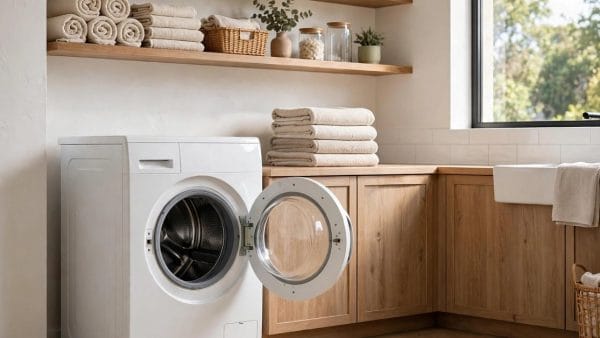
Rooms that open off a hallway should be considered together, because the hallway is the thread that joins them. A laundry room, a bathroom or a bedroom that opens directly onto the passage will affect the hallway’s noise, light and traffic, and the hallway in turn affects how those rooms feel. Keeping the doors to busy rooms in good repair, managing sound and light at thresholds, and giving each room a clear purpose will make the whole home feel more coherent. For a room that often sits just off a hallway, tiny laundry room ideas show how a compact utility space can stay tidy and practical without spilling its clutter into the passage.
Everyday living is the true test of hallway design, because a hallway is used in moments of rush, tiredness and distraction. Design for the worst moment, not the best: the morning when everyone leaves at once, the evening when guests arrive with coats and bags, the night when someone walks half asleep to the bathroom. A hallway that handles those moments gracefully, with a clear path, gentle light and a place for everything, will handle ordinary days effortlessly. That is the quiet achievement of good hallway design, and it is available to any home, regardless of size or budget, through clear choices rather than grand gestures.
Final Considerations
A good hallway is not the grandest room in the home, and it should not try to be. Its virtue is quiet: a clear path, comfortable light, sensible storage, durable finishes and a welcoming entry, all working together so that moving through the home feels easy. Start with how the hallway is used, protect the flow above all else, and let furniture, colour and light serve that flow rather than competing with it. Check the rules that apply where you live before any building work, and leave structural and electrical changes to professionals.
Above all, keep the hallway honest about what it is: a passage that connects the rooms and the people of a home. Treat it with the same care as any other room, give it a regular tidy and a fresh coat of paint when it needs one, and it will repay that care every time someone walks through it. A hallway designed on these fundamentals will not shout for attention, but it will be felt in every comfortable arrival, every easy departure and every calm journey through the home, day after day.

0 Comments