

Two single beds can make a guest room more flexible than one large bed ever will: siblings, friends, grandchildren and travelling couples can all be hosted comfortably, and the room can still work as a study or children’s room between visits. Good twin bed guest room ideas balance that flexibility with warmth, so guests feel expected rather than accommodated as an afterthought.
These 75 ideas are grouped by layout, colour, storage and finishing touches, with the practical details that keep a twin room feeling generous instead of squeezed.
1. At a Glance: Planning a Twin Guest Room
| Decision | Good starting point | Why it matters |
|---|---|---|
| Bed layout | Side by side with a shared table, or an L-shape in small rooms | Layout decides walking space, light and how the room feels on entry |
| Gap between beds | Enough for a shared nightstand and easy bed-making | Too tight feels like a dormitory; too wide wastes the room |
| Colour scheme | One calm base colour with matching bedding on both beds | Matching twins look intentional and restful |
| Lighting | A lamp or wall light for each bed, on separate switches | Guests keep different hours and reading habits |
| Storage | A drawer, hooks and a luggage spot per guest | Guests unpack properly in rooms that give them somewhere to put things |
| Bedding | Layered quilts and spare blankets folded where guests can see them | People sleep at different temperatures and rarely ask for more covers |
| Flexibility | Beds that can be pushed together or fitted with a linking kit | One room can host couples as well as singles |
| Finishing touches | Water glass, charging point, mirror and a small welcome detail | Small provisions are what guests actually remember |
Start by deciding who the room serves most often. A room mainly for grandchildren can lean playful and hard-wearing; a room for adult friends should feel closer to a small hotel room, with reading lights, blackout options and somewhere to charge a phone. Most real guest rooms serve both, at different times, which is why neutral bones with changeable textiles work so well in twin rooms.
Measure before you fall in love with a layout. Two singles, a shared table and comfortable clearance at the foot of each bed need more honest space than a floor plan sketch suggests, and beds that can be reached from three sides are far easier to make neatly every day.
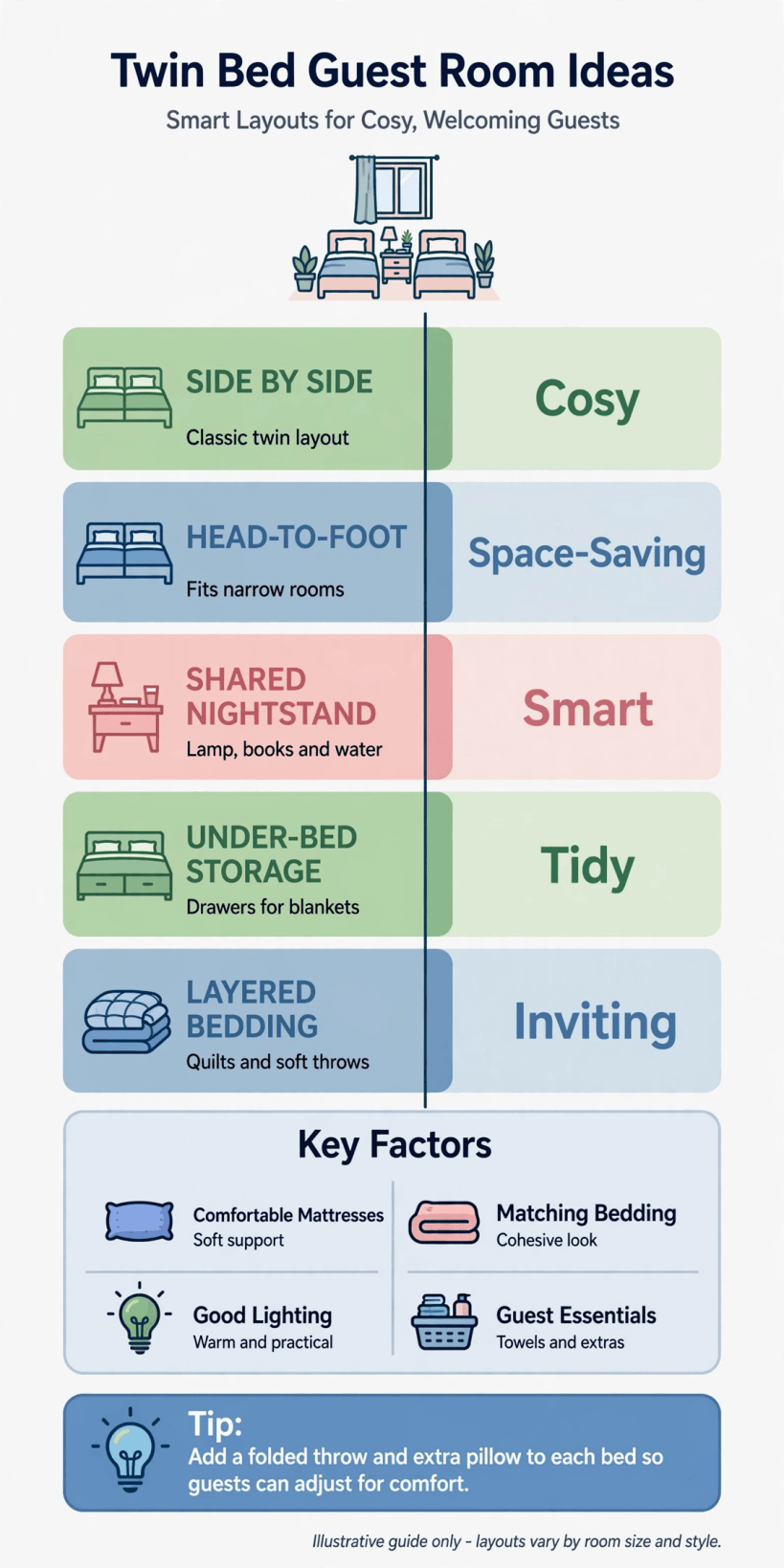
A twin guest room at a glance: layout, colour, lighting and the small provisions that make guests comfortable.
2. Classic Side-by-Side Layouts
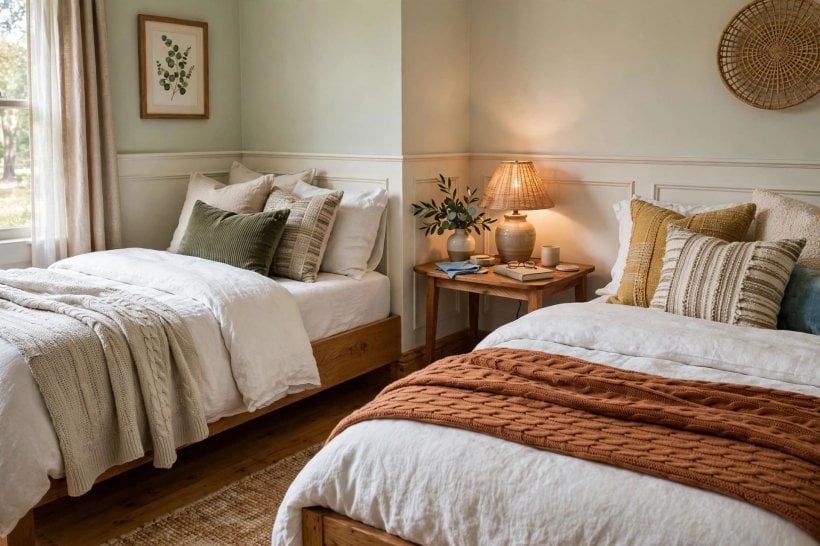
The timeless arrangement places two beds side by side against the same wall, sharing one nightstand between them. Symmetry does the decorating: matching headboards, identical lamps and bedding made up the same way make even a small room look calm and deliberate. Centre the arrangement on the wall, or on a window, so the pair reads as one composition rather than two beds that happen to share a room.
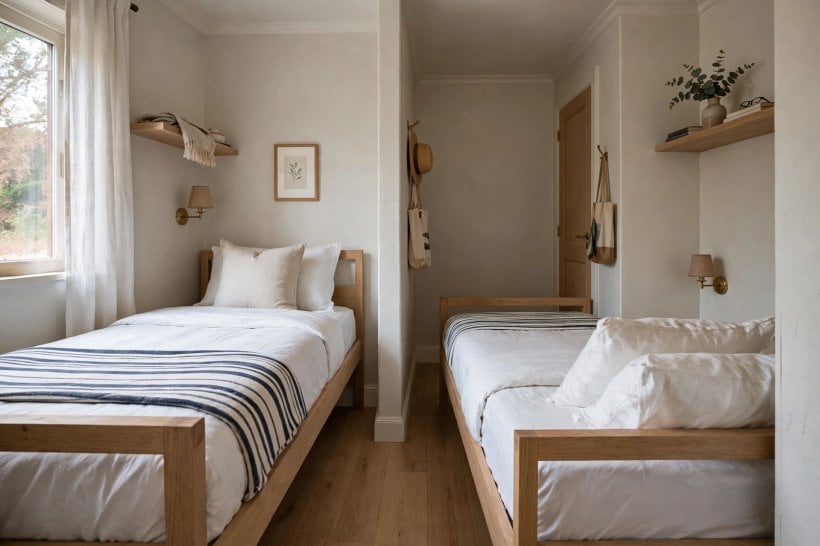
Keep the shared table honest in size. It must hold two lamps or one lamp and two sets of books, glasses and water, without crowding. A wide, low table or a small chest of drawers between the beds often serves better than a dainty pedestal, and gives the room useful storage as a bonus.
In compact homes this layout is a favourite because it leaves the rest of the room free for a chair, a desk or play space, the same kind of clear zoning that makes tiny house living room ideas work: one strong arrangement against one wall, and breathing space everywhere else.
3. L-Shaped and Corner Layouts for Small Rooms
Where a room is small, square or awkwardly shaped, placing the beds along two adjoining walls in an L can free surprising space. One bed runs under the window, the other along the side wall, with a corner table or shared shelf where the headboards meet. This suits children’s sleepovers and box rooms especially well, because the centre of the floor stays open.
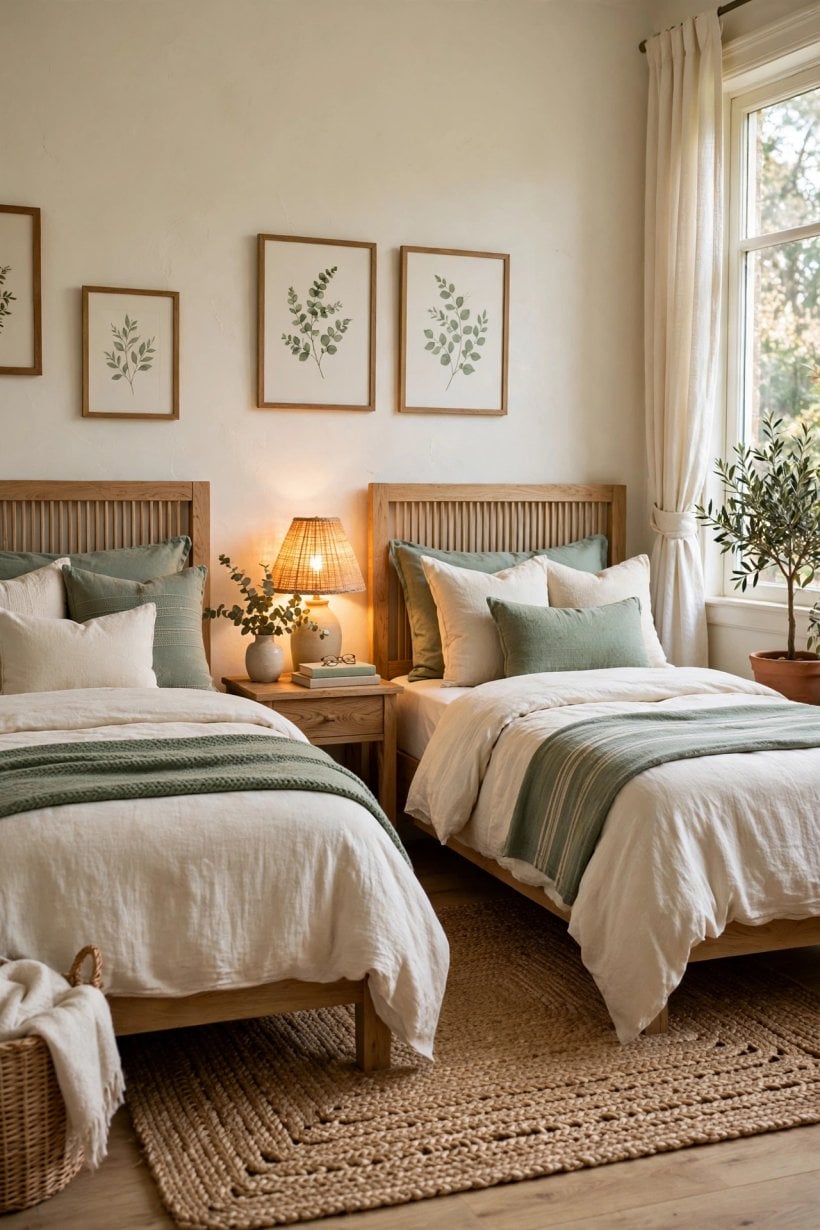
Corner layouts need care with light and warmth. The bed under a window may need a solid headboard, good curtains and a check for draughts, while the inside bed needs its own lamp so it does not become the gloomy option nobody chooses. Matching bedding matters even more here, because the beds are seen from different angles and can quickly look unrelated.
These arrangements are standard practice in small-space planning, as the layouts in tiny house bedroom ideas show: the bed goes where the room’s geometry wants it, and storage and lighting are then built around that honest position instead of fighting it.
4. Beds That Join, Split and Adapt
A guest room earns its keep when it can change its mind. Twins on linking frames, or with a bridging piece and a shared topper, become a generous double for couples, then split again for siblings or friends. Zip-link mattresses are made for exactly this, but even ordinary twins pushed together with a wide topper and double bedding over the top can work for a weekend, provided the heights match and the join is not in the middle of someone’s back.
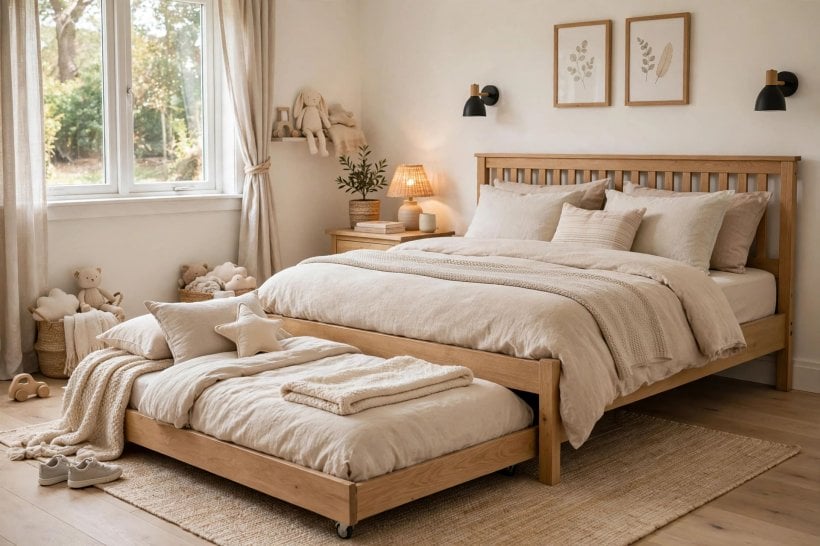
Trundle and daybed arrangements adapt differently: one proper bed plus a roll-out or daybed keeps the room usable as a sitting room or study between guests. That double-duty thinking suits homes where a dedicated guest room is a luxury, an approach shared with bedroom interior design for tiny houses, where almost every room quietly does two jobs.
Whichever system you choose, practise the changeover before guests arrive. If joining the beds takes two people, a torch and strong language, it will not happen cheerfully at short notice, and the room’s flexibility will exist only in theory.
5. Colour Schemes That Keep Twins Calm
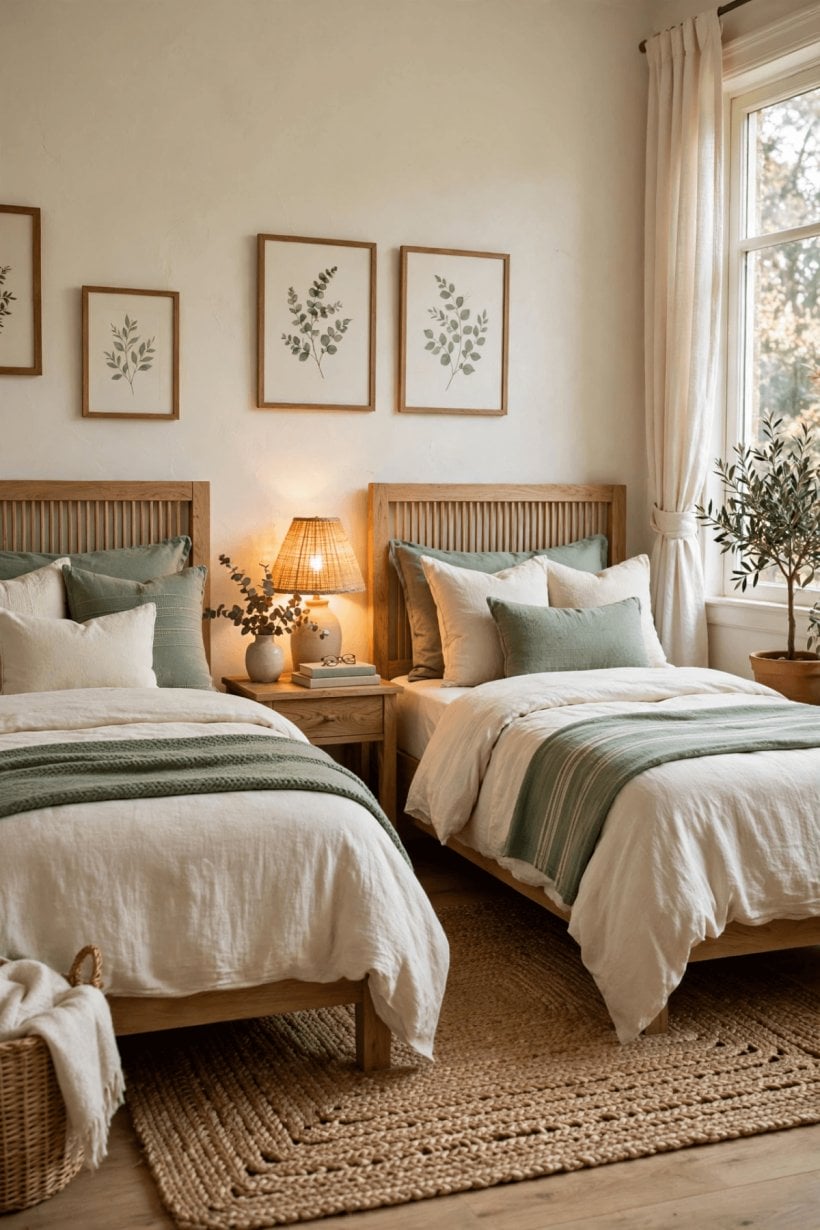
Colour is the cheapest way to make two beds look like a scheme rather than a compromise. A single calm base, soft white, warm grey, pale sage or gentle blue, with the same bedding on both beds, instantly creates order. Add one accent colour in cushions, throws and a picture, and the room can change mood with the seasons for the price of two cushion covers.
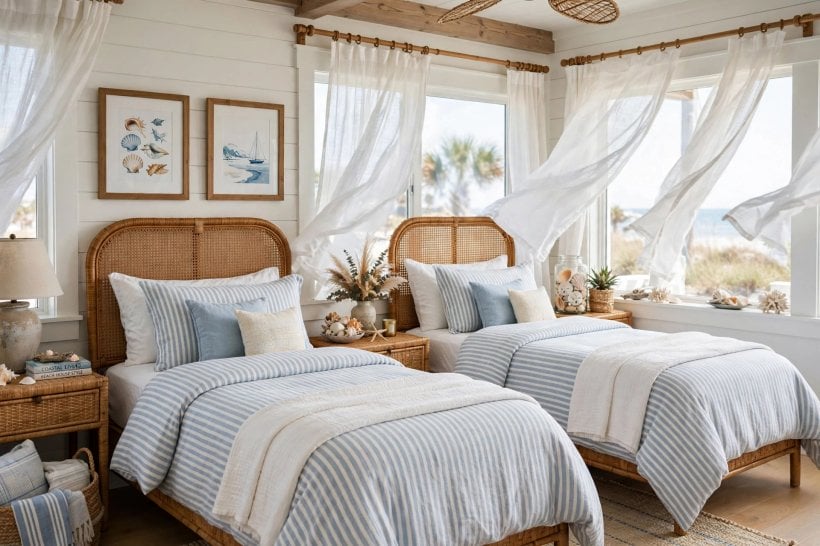
Patterns need a light hand. One pattern, used on both beds, looks tailored; two competing patterns look like a jumble sale. Stripes are the classic twin-room pattern for a reason: they suit children and adults, hide minor creases and pair with almost any colour. Keep the walls quieter than the bedding, or the bedding quieter than the walls, but not both loud.
For bolder households, the confident schemes in colourful tiny house interior features show how strong colour works when it is repeated deliberately: the same deep green on both headboards, the same ochre in both throws. Repetition is what turns colour from accidental to designed in a two-bed room.
6. Headboards, Bedding and Layering
Headboards give twin beds their character. Matching upholstered headboards feel hotel-like and are kind to readers sitting up in bed; wooden headboards suit cottages and can be painted with the room; and a long shared headboard panel behind both beds is a smart modern option that visually joins the pair and protects the wall. Whichever you choose, identical is easier to live with than nearly identical.
Layer bedding the way good hosts do: a fitted sheet, a flat sheet or duvet, a quilt or blanket folded at the foot, and a spare blanket visible in the room. Guests regulate their own temperature with layers and rarely wake you to ask for more. Two pillows per bed, one firmer and one softer, cover most preferences without turning the bed into a pillow shop.
Keep a washable layer in the system. Guest bedding is washed often, sometimes after a single night, so fabrics that launder well and dry quickly will serve you better than delicate showpieces that come out twice a year looking worried.
7. Lighting, Nightstands and Charging Points
Each guest deserves light they control. A lamp per bed, or wall lights on separate switches, means one reader does not keep the other awake, and nobody crosses a dark room to find a switch. Wall lights free the nightstand for books and water, which matters when one table serves two beds. Choose warm bulbs and shades that do not glare at the neighbouring pillow.
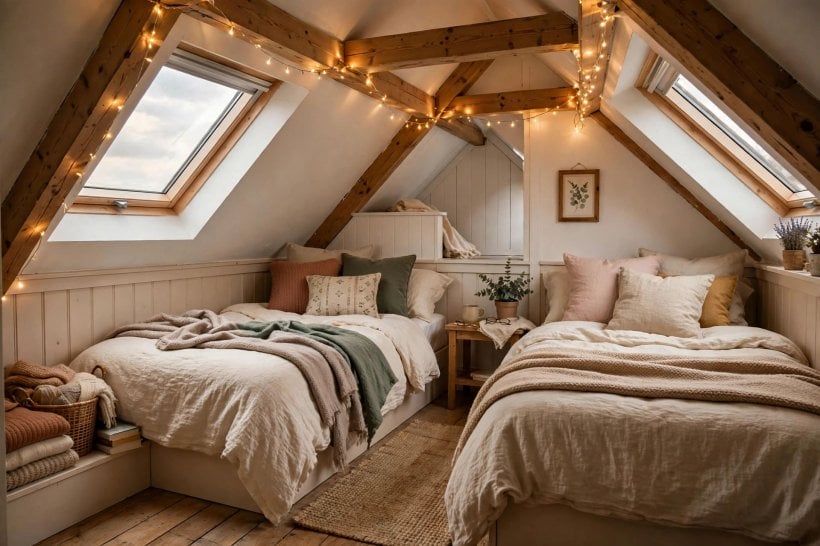
Charging is now a basic provision, not a favour. A socket, extension or charging shelf reachable from each bed, ideally with space for a phone and a watch, will be used by every guest you host. Tuck cables neatly; a tangle on the floor undoes the calm of the whole room.
Think about the ceiling light too. A dimmer or a soft shade helps the room feel welcoming on arrival at night, and a low-level light for the route to the bathroom is the sort of kindness guests mention in thank-you messages, in the same spirit as the practical touches throughout tiny house bathroom ideas.
8. Storage Guests Will Actually Use
Guests unpack in proportion to the storage they are offered. An empty drawer, a few spare hangers, hooks for towels and a flat place for a suitcase transform a stay: clothes leave the bag, the floor clears and the room stays tidy. If the wardrobe is full of your storage, say so cheerfully and provide a luggage rack or a clear chair instead, rather than letting guests discover it.
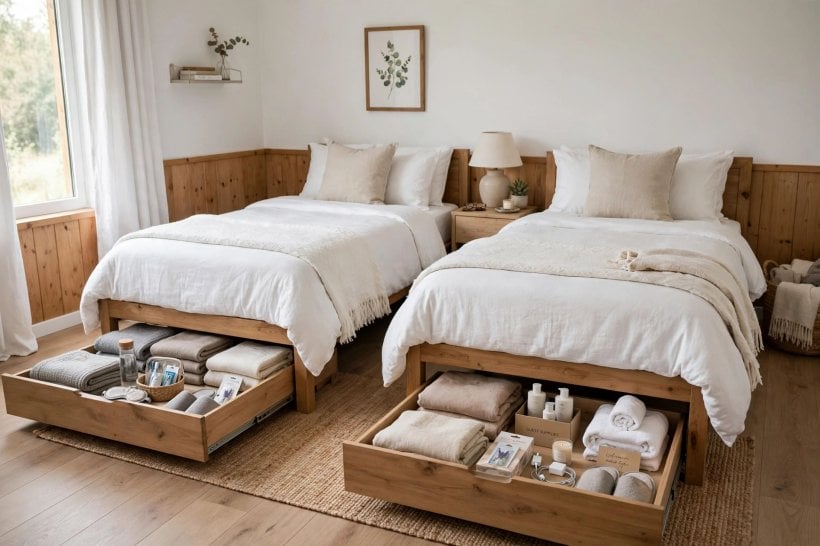
Under-bed space is the twin room’s secret asset. Two beds mean two beds’ worth of storage for spare bedding, seasonal clothes or the room’s own guest supplies, kept in labelled boxes so changeovers are quick. Keep one box purely for hosting: spare towels, the extra blankets and the travel items guests forget, all in one grab-and-go place.
Between visits, resist filling every drawer with household overflow. A guest room that must be excavated before anyone can sleep in it will quietly stop being used, and the beds will become expensive shelving. A little protected emptiness is what keeps the room ready.
9. Guest Comforts and Thoughtful Extras
Comfort lives in small provisions: water and a glass by each bed, a small tray or dish for jewellery and coins, tissues, a mirror with decent light, and a bin. Add a fan or an extra blanket according to season, blackout curtains or liners for light sleepers, and hangers for the clothes guests arrive in. None of this is expensive; all of it says the visit was anticipated.
A few books or magazines suited to short stays, a note with the Wi-Fi password and the house’s morning habits, and a small vase or plant complete the welcome. If children stay often, a box with a nightlight, a couple of toys and bedding they recognise makes the room theirs within minutes.
Keep a short changeover list inside a drawer: strip beds, wash and remake, empty bin, refresh towels, check lamps and chargers, open the window. Hosts who follow a list can turn a twin room around calmly in under an hour, however busy the week, much as the methodical owners in tiny barn house interior features keep multi-use rooms ready without fuss.
Temperature deserves its own check, because guest rooms are often the coldest or warmest room in the house depending on where the heating runs end. Leave clear instructions if the radiator or fan has a trick to it, and make sure windows open and curtains close properly before the season’s first guests. A beautiful room that sleeps too hot or too cold will be remembered for exactly that, and the fix is nearly always a five-minute adjustment rather than new furniture.
10. Making the Room Work Between Guests
Most guest rooms spend more nights empty than occupied, so plan their second life honestly. A twin room can be a children’s room that hosts sleepovers, a study with a desk between the beds’ wall and the window, a sewing or hobby room, or the household’s quiet reading room. Beds made up with daytime throws and cushions read as daybeds, keeping the room inviting rather than shut away.
Choose the second use so it can be cleared in minutes, not hours. A desk on castors, storage in closed boxes and hobbies that live in one cupboard all preserve the room’s real job. The moment the spare room becomes the dumping ground, guests start being put on sofas, and the twins you chose so carefully stop earning their floor space.
Finally, sleep in the room yourself once a year. You will discover the draught, the early light, the lamp that glares and the mattress that needs turning, and you will fix in a weekend what guests were too polite to mention. It is the simplest quality check any host can run, and the readers of how to build your own tiny house would recognise the principle: live in the space, even briefly, and it will tell you the truth about it.
Final Considerations
A good twin guest room is a balance of symmetry and sympathy: two beds that look like a pair, and provisions that treat each guest as an individual with their own light, layers, storage and charging point. Layout comes first, colour calms it, and the extras, water, a mirror, a clear drawer, a note with the password, turn a spare room into a welcome.
Plan the room for the guests you actually host, keep it ready between visits, and test it with a night of your own. Do that, and the twin room quietly becomes the most flexible, appreciated room in the house.
Keep a brief note of what worked after each stay: which bed was chosen first, what was asked for, what ran out. Three lines in a drawer notebook will steadily turn guesswork into knowledge, and each set of guests will find a room that fits them slightly better than the last, without a single major purchase in between.

0 Comments