
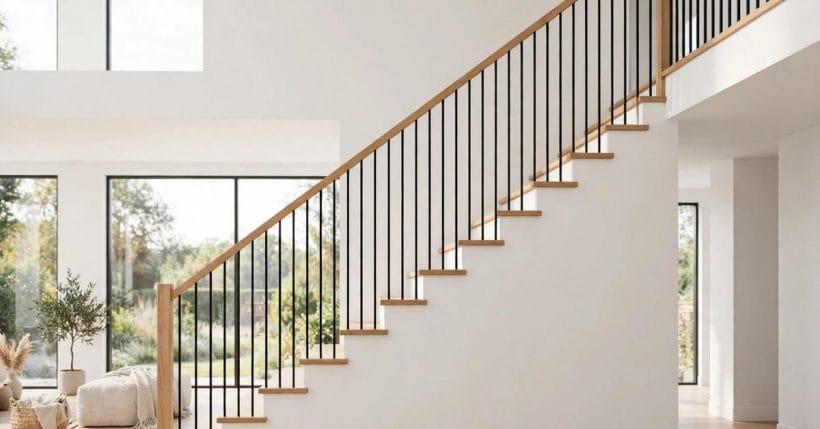
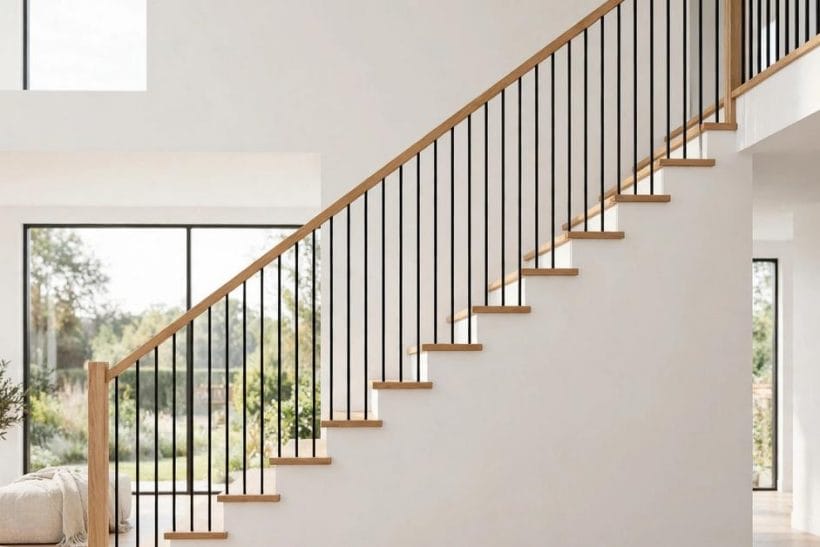
A baluster is the upright that fills the space between the handrail and the stair, and in wrought iron it can carry the whole character of a staircase. If you are looking for a picture of modern and transitional balusters, the difference between the two styles is easy to see once you know what to look for: modern balusters tend to be slim, straight and quiet, while transitional balusters soften that clean line with a scroll, a basket or a gentle twist. This guide stays with the baluster itself, its profiles, its finishes and the way it sits with the handrail and the room around it. For the wider survey of what railings can be made from, see the staircase railing materials survey, which covers the material choice in full; here, iron is the given and the baluster is the subject.
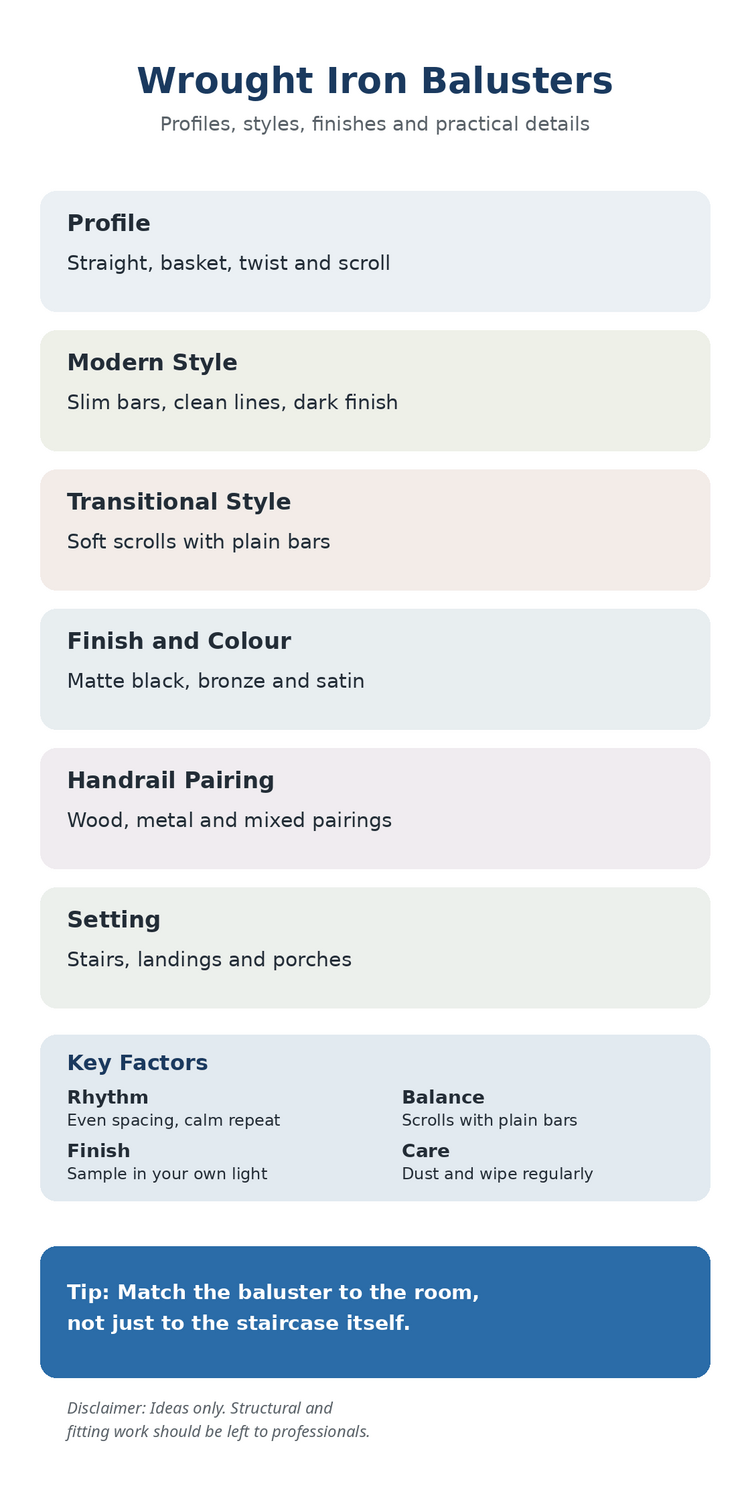
| Item | What it is |
|---|---|
| Straight Bars for a Clean Modern Line | The straight bar is the simplest wrought-iron baluster, and in a modern room that simplicity is the point. |
| Basket Balusters That Add a Quiet Centrepiece | A basket baluster carries a small open cage, usually near its centre, formed from curved iron that loops out and back in. |
| Twisted Balusters for Texture Without Clutter | A twisted baluster turns on itself along part of its length, catching light differently as the eye moves up the flight. |
| Scroll Balusters for a Softer Transitional Look | Scroll balusters carry a curl or an S-shaped flourish, and they are the most traditional of the wrought-iron profiles. |
| Mixing Plain and Patterned Balusters in One Flight | One of the most useful ideas in wrought-iron baluster design is the alternating pattern: plain bars with a patterned baluster, such as a basket or a scroll, at regular intervals. |
1. Straight Bars for a Clean Modern Line
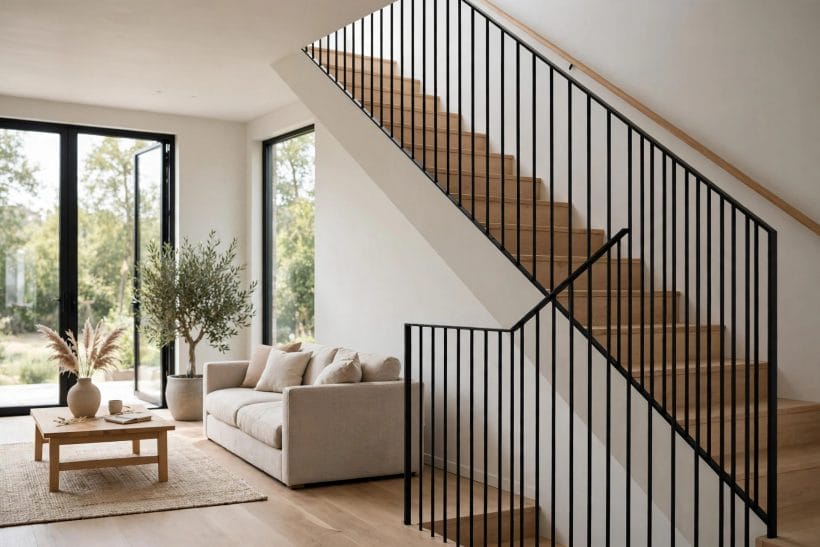
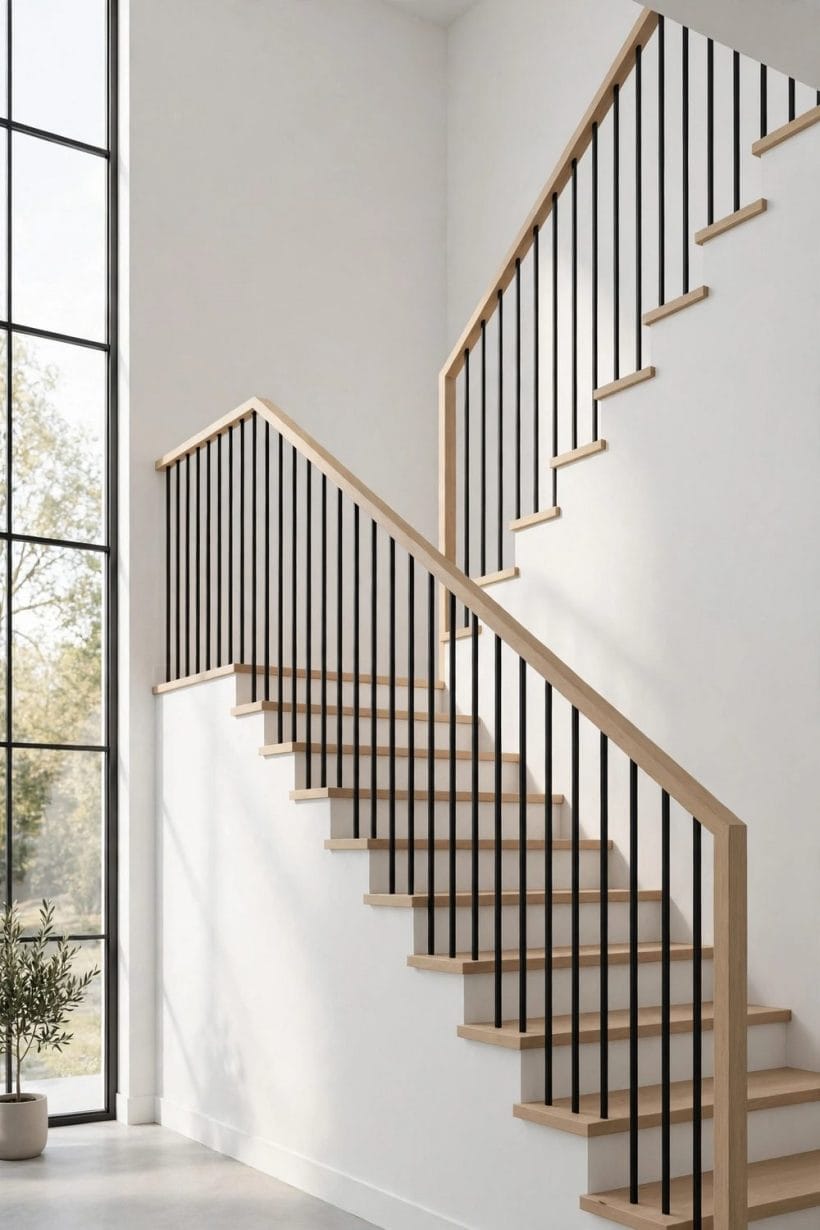
The straight bar is the simplest wrought-iron baluster, and in a modern room that simplicity is the point. A row of slim, evenly spaced bars reads as a calm vertical rhythm rather than as decoration, and it lets light, wall colour and the line of the handrail do the talking. Straight bars suit pale walls and light timber particularly well, because the dark iron stands out just enough to give the staircase definition without pulling attention away from the room.
Spacing is what makes or breaks this look. Bars set at a regular interval along the flight read as intentional and orderly, while uneven gaps catch the eye for the wrong reason. Keep the rhythm consistent from the first step to the landing, and let the same spacing continue around any turn the staircase makes. The finish matters here too: a matte black bar keeps the line quiet, while a satin or lightly brushed finish catches a little more light and feels slightly softer in a bright hallway.
Straight bars also pair naturally with a slim handrail. A chunky rail over delicate bars can feel top-heavy, so a handrail with a modest profile keeps the whole assembly in proportion. Where the staircase runs beside a living space, the openness of straight bars keeps the view through the stair, which suits rooms where the staircase is part of the everyday backdrop rather than a showpiece.
2. Basket Balusters That Add a Quiet Centrepiece
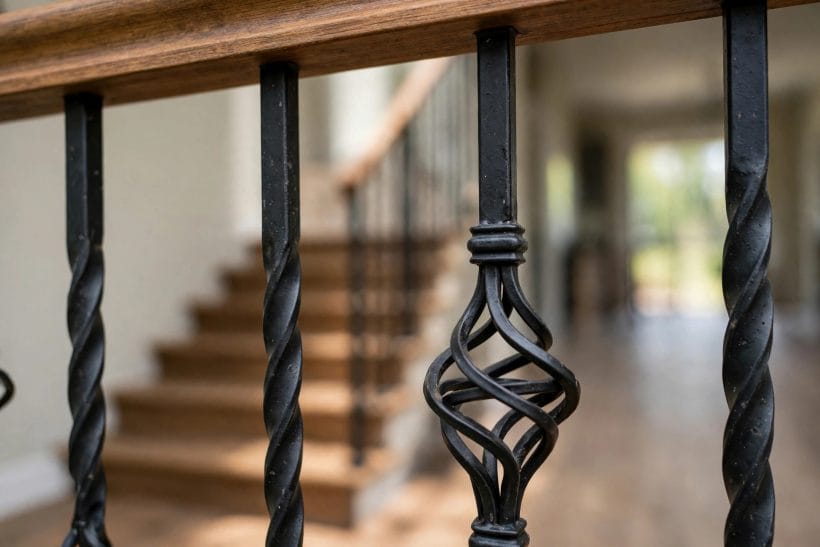
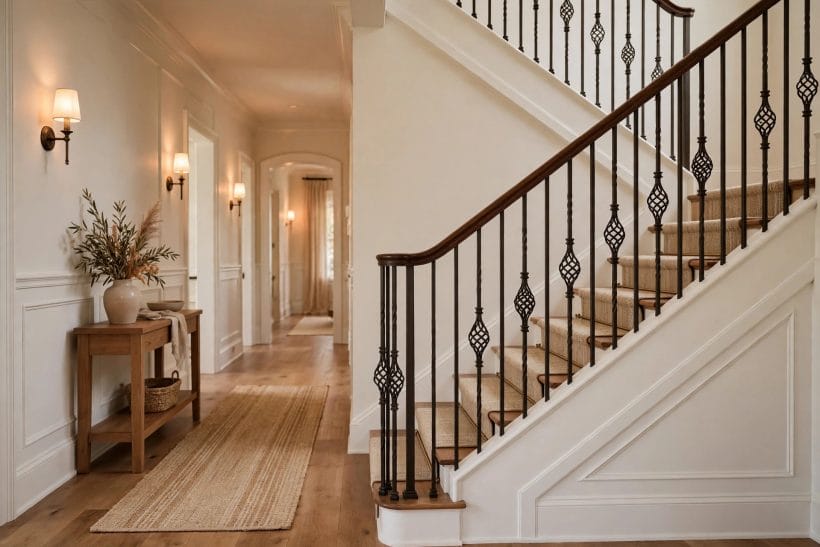
A basket baluster carries a small open cage, usually near its centre, formed from curved iron that loops out and back in. It is one of the most recognisable wrought-iron details, and it gives a staircase a focal point without adding bulk. Used on every baluster, baskets can feel busy; used as an accent among plain bars, a single basket reads as jewellery, a detail discovered on a second look rather than announced at once.
The basket works best where the rest of the staircase is calm. Plain treads, a simple handrail and a muted wall let the basket shape stand out, while a patterned carpet or a heavily detailed newel can compete with it. In transitional rooms, which sit between traditional warmth and modern restraint, the basket is a natural bridge: it carries traditional craft in a form that still feels light and current.
When you look at basket balusters in photographs, notice where the basket sits on the bar. A basket placed at the centre of the baluster gives a balanced, symmetrical feel, while one placed higher or lower changes the rhythm of the whole flight. Consistency matters: whatever height you choose, repeat it along the flight so the eye travels smoothly up the stairs.
3. Twisted Balusters for Texture Without Clutter
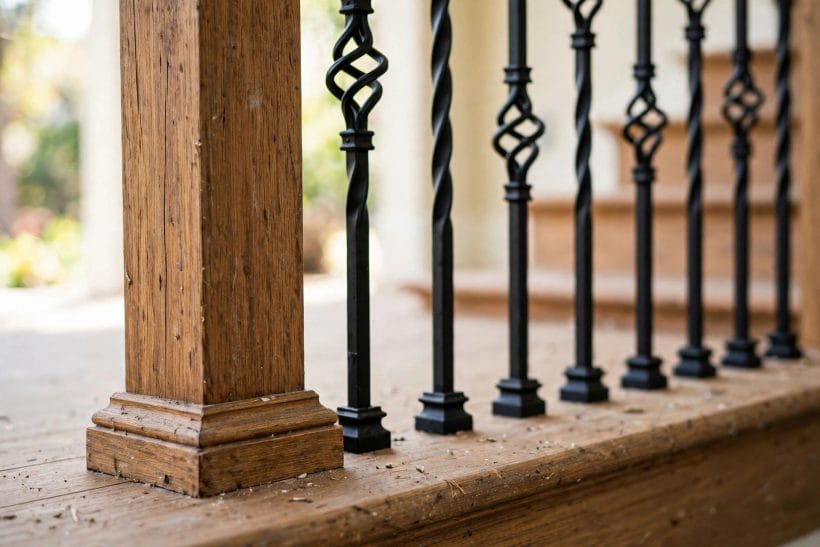
A twisted baluster turns on itself along part of its length, catching light differently as the eye moves up the flight. The twist adds texture and a handmade feel, and it does so without adding width, so a twisted bar still reads as slim from across the room. It is a good choice where a staircase needs a little more interest than a plain bar gives, but where a scroll or a basket would feel too decorative.
Twists come in different characters. A gentle, open twist feels relaxed and suits a transitional hallway, while a tighter twist reads as more formal and detailed. Mixing a twisted baluster with plain bars, in a repeating pattern, keeps the texture from becoming uniform; the plain bars give the eye resting places between the twists, and the flight as a whole feels considered rather than crowded.
Light is the twist’s best friend. In a hallway with a window at the turn of the stair, or with wall lights washing along the flight, the twisted surface picks up highlights and shadows that a smooth bar cannot. If your staircase sits in a dim corner, a twist may lose much of its effect, and a simpler profile with a lighter finish may show up better.
4. Scroll Balusters for a Softer Transitional Look
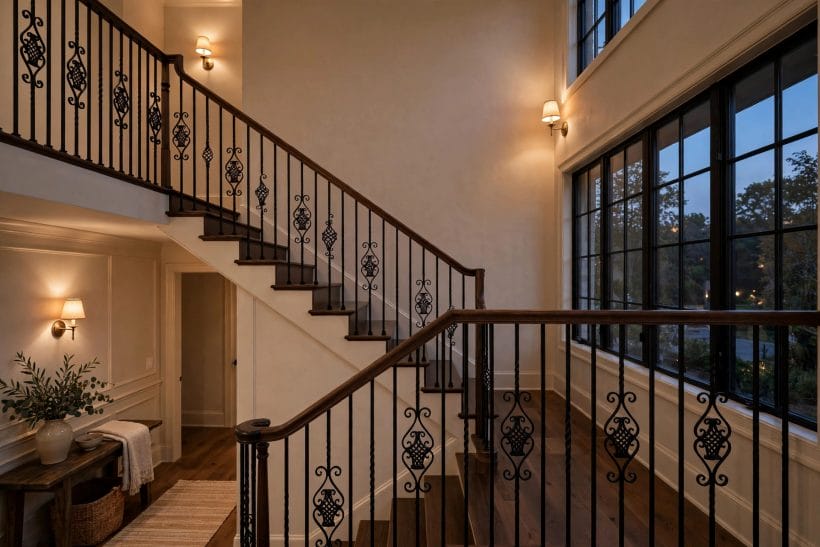
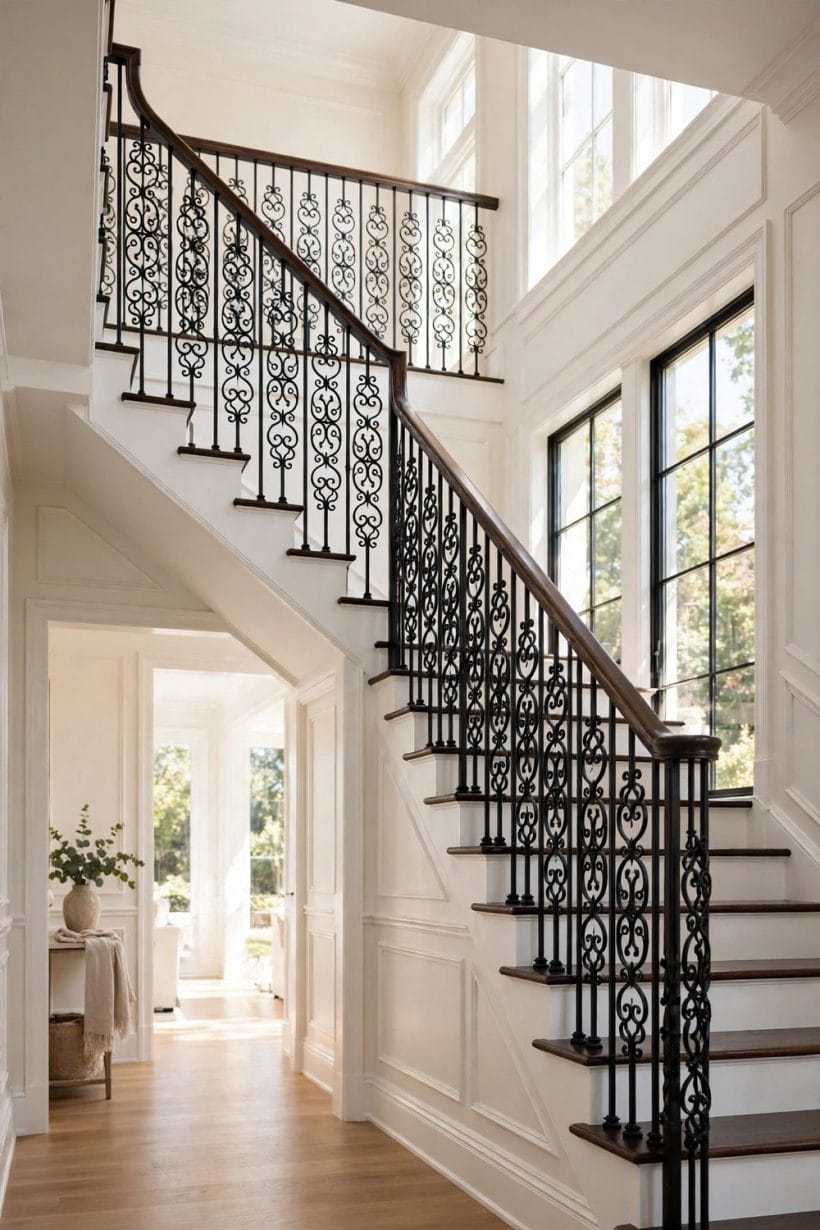
Scroll balusters carry a curl or an S-shaped flourish, and they are the most traditional of the wrought-iron profiles. In a transitional setting, the scroll is usually kept restrained: a single curl, or a scroll paired with plain bars, rather than the dense, ornate ironwork of a fully traditional staircase. That restraint is what keeps the look current instead of period.
The scroll’s curve softens the vertical line of the staircase, which can help in a room with many straight edges, such as a hallway with panelled walls and a rectilinear console. It also pairs well with a dark wood handrail, where the warmth of the timber answers the curve of the iron. For more on iron railings in general, the wrought iron railing guide looks at the railing as a whole, while this guide keeps its attention on the baluster.
When scrolls are used on a porch or an exterior stair, the same restraint applies, with one extra consideration: the ironwork is exposed to weather, so the finish and its upkeep matter more than they do indoors. A scroll that looks graceful in a hallway photograph should be judged outdoors by how its curves shed water and how easily they can be wiped down, not only by how they look on a fine day.
5. Mixing Plain and Patterned Balusters in One Flight
One of the most useful ideas in wrought-iron baluster design is the alternating pattern: plain bars with a patterned baluster, such as a basket or a scroll, at regular intervals. A common rhythm places one patterned baluster among several plain ones, which gives the flight a beat, a repeated moment of detail that the eye follows upward. The pattern should be regular enough to feel deliberate, and the patterned baluster should be the same design each time it appears.
Alternation is also a practical way to handle a long flight. A full run of patterned balusters can feel heavy over many steps, while a full run of plain bars can feel flat. The mixed rhythm splits the difference, and it lets a homeowner enjoy a decorative detail without committing the whole staircase to it. Photographs of transitional staircases often show this balance at work: the patterned balusters read as accents, and the plain bars keep the flight calm.
Before settling on a pattern, look at it from the bottom of the stairs, from the top, and from any room that faces the staircase. A rhythm that looks good from one angle can feel crowded from another, especially where a landing turns the flight. The best test is to stand where you will actually see the staircase every day, and to judge the pattern from there rather than from a close-up photograph alone.
6. Finishes and Colours That Set the Mood
Matte black is the default finish for wrought-iron balusters, and for good reason: it reads as neutral, it suits both modern and transitional rooms, and it lets the profile of the baluster, rather than its colour, carry the design. But black is not the only honest choice. Oil-rubbed bronze brings warmth and suits timber handrails and warm wall colours, while a satin or pewter-toned finish lightens the iron and works well in bright, pale rooms where black might feel stark.
The finish should be judged in the light of the room it will live in, not only in a showroom or a photograph. A finish that looks soft under shop lighting can read darker in a north-facing hallway, and a finish that looks dramatic in a photograph can feel heavy beside a light timber floor. Take a sample home, hold it against the handrail and the wall colour, and look at it in morning and evening light before deciding.
Colour also affects how the balusters relate to the rest of the metalwork in the home. Door handles, light fittings and picture frames do not need to match the balusters exactly, but a shared family of tones, warm with warm or cool with cool, keeps the home feeling coherent. The metal staircase ideas guide shows how iron sits among other metals on the stair, which can help when the balusters must sit comfortably beside steel, brass or timber details.
7. Handrails That Let the Balusters Lead
The handrail is the baluster’s partner, and the best pairings are the ones where neither partner shouts. A slim, simple handrail lets a patterned baluster take the lead, while a more substantial timber rail can anchor a run of plain bars and give the hand something warm to hold. The handrail’s material also sets the temperature of the whole staircase: timber warms iron, metal keeps it cool and contemporary, and a mixed pairing, such as a timber rail over iron balusters, is the classic transitional compromise.
Profile matters as much as material. A rounded rail feels different in the hand from a flat or rectangular one, and the grip of the rail is a daily, physical experience, not only a visual one. When choosing, hold the rail as you would while climbing the stairs, and notice whether its shape suits the way your hand naturally closes. A rail that looks elegant in a photograph but feels awkward to hold will disappoint every day.
Continuity is the other handrail rule worth keeping. A rail that runs unbroken along the flight, and around the landing where the staircase turns, feels safe and looks resolved. Breaks, joints and changes of material at awkward points interrupt both the look and the grip. The stair railing ideas collection gathers many handrail and baluster combinations, and it is worth browsing there for pairings before settling on your own.
8. Newel Posts and Landings as the Frame
Newel posts anchor the ends of a run of balusters, and they frame the baluster design much as a picture frame frames a print. A newel that is too ornate can overshadow delicate balusters, while one that is too slight can leave a run of patterned balusters feeling unanchored. In transitional rooms, a newel with a simple cap and a clean post profile usually strikes the right balance, giving the eye a stopping point without competing with the ironwork.
Landings deserve the same attention. Where a staircase turns, the balusters continue along the landing edge, and the rhythm established on the flight should carry through the turn. A landing is also where the balusters are seen closest, from the rooms that open onto it, so details that read as texture from below, such as a twist or a basket, become clearly visible here. Judge your chosen profile at landing distance, not only from the foot of the stairs.
In a compact home, the landing and the space beneath the stair work hard. The tiny house staircase interior guide shows how staircases sit within small footprints, and the under-stair storage ideas show how the space below can be put to use. In both cases, the balusters remain the visible face of the staircase, so their profile should suit the room they face, not only the stair they guard.
9. Porch and Outdoor Balusters in Iron
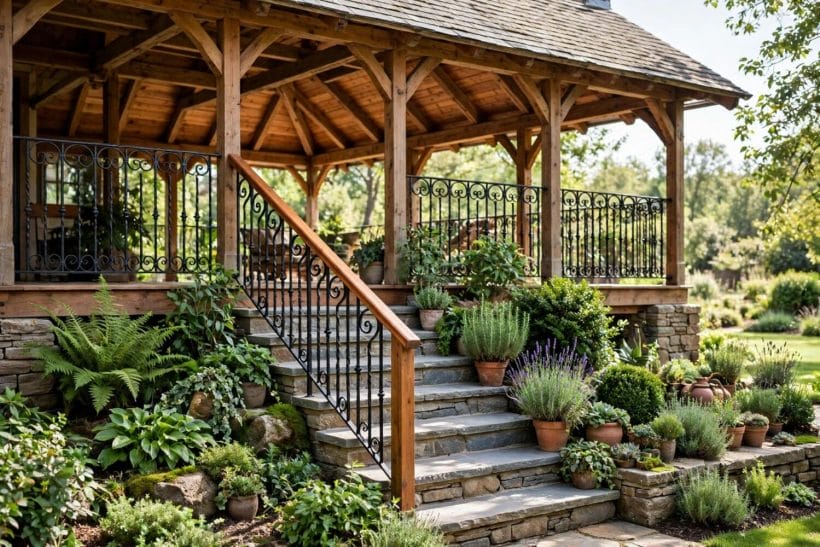
On a porch or an exterior stair, wrought-iron balusters earn their keep in a different way. Outdoors, the balusters frame the entrance and set the tone for the whole front of the home, and they are seen against planting, stone and sky rather than against interior walls. Scroll-topped balusters suit a covered porch particularly well, because their curves echo the relaxed, welcoming character of outdoor living, while straight bars suit a crisp, contemporary entrance.
Outdoor ironwork also has to live with the weather. Rain, sun and seasonal change all act on the finish, so outdoor balusters need a finish chosen for exposure and a routine of checking and wiping down that indoor balusters rarely need. Curves and baskets that look lovely indoors can trap moisture outdoors, so an outdoor profile should be judged by how easily it can be kept clean and dry, as well as by how it looks.
The porch balustrade should also relate to the rest of the entrance: the steps, the handrail, the door and the planting beside the path. A baluster design that suits the interior staircase may feel out of place on the porch if the porch itself has a different character, so judge the outdoor balusters against the front of the home as a whole, and let the entrance, rather than the interior, lead the choice.
10. Care, Checks and Knowing When to Call a Professional
Wrought-iron balusters ask little in return for their durability, but a small routine keeps them looking their best. Dust the bars regularly, wipe them with a soft cloth, and check the finish for wear, especially where hands touch the rail and where outdoor iron meets the weather. A finish that is wearing thin is easier to deal with early, before the iron beneath is exposed for long.
Checks should also cover how firmly each baluster sits. A baluster that moves, a rail that flexes, or a newel that has loosened is a sign to stop using the staircase as normal and to bring in a qualified professional. Balusters are part of the guarding of a staircase, and their strength and spacing are matters of safety, not only of appearance. Any structural or fitting work, including replacing balusters, fixing rails or altering a guard, belongs to qualified professionals, and local building rules should be checked in general terms before any change is made.
It is worth keeping this distinction clear throughout a baluster project: choosing profiles, finishes and rhythms is a design decision a homeowner can enjoy, while fitting, fixing and structural change are professional work. Keeping the two apart protects both the look of the staircase and the people who use it every day.
Final Considerations
A wrought-iron baluster earns its place by doing two jobs at once: guarding the stair and giving it character. The modern end of the range does that character work quietly, with slim straight bars and dark finishes, while the transitional end softens the same iron with baskets, twists and restrained scrolls. The best choice for a given home is the one that suits the room the staircase stands in, the handrail it sits beneath, and the light that falls on it through the day. The general staircase ideas collection sets this baluster choice within the staircase as a whole.
When you compare photographs, look past the staircase as a whole and study the balusters themselves: their profile, their rhythm, their finish and the way they meet the rail and the tread. A picture of modern and transitional balusters is most useful when it is read this way, detail by detail, rather than admired as a single scene. Take the profiles you like, test their finishes in your own light, keep their rhythm consistent along the flight, and leave the fitting and any structural work to qualified professionals. Chosen that way, a set of wrought-iron balusters will look considered on the day it is finished and will still look right years later.

0 Comments