

Grey-speckled granite worktops were everywhere for a while, and few stones sum up that era like Luna Pearl. If you are choosing it today — or living with it already — the useful question is not whether strangers call it dated, but whether it suits your cabinets, your light and the way you actually use your kitchen.
This guide stays neutral: what the stone looks like, what it pairs with, what it asks of you, and the checks to make before you commit.
1. Luna Pearl Granite at a Glance: Questions and Answers
| Question | Short answer | What to check |
|---|---|---|
| What does it look like? | A light grey-white base with fine grey, beige and darker speckling | See a full slab, not just a palm-sized sample — see section 9 |
| Do people still choose it? | Yes, though tastes vary by region, room style and fashion cycle | Judge it in your room’s light, not by trend labels — section 6 |
| What cabinets suit it? | White, grey, navy and warm wood tones all pair with it differently | Test door samples against the slab — section 4 |
| Is it practical day to day? | Like other granites it rewards sealing, prompt wiping and sensible care | Read the upkeep notes in section 7 |
| Where does the cost sit? | It is often positioned among the more accessible granites, but quotes vary locally | Compare full installed quotes — section 8 |
| What is the biggest buying mistake? | Choosing from a tiny sample when the pattern varies across a slab | View and reserve the actual slab you will receive |
Those six answers frame everything that follows. Luna pearl granite is neither a guaranteed classic nor a guaranteed regret; it is a light, busy, forgiving pattern whose success depends on context — the cabinet colour beside it, the light above it and the household around it. Trend conversations tend to flatten those details into a yes-or-no verdict, which is why this guide avoids one. Read the sections that match your situation, handle a real slab under your own lighting if you possibly can, and let the room in front of you outvote opinions gathered from photographs of other people’s kitchens.
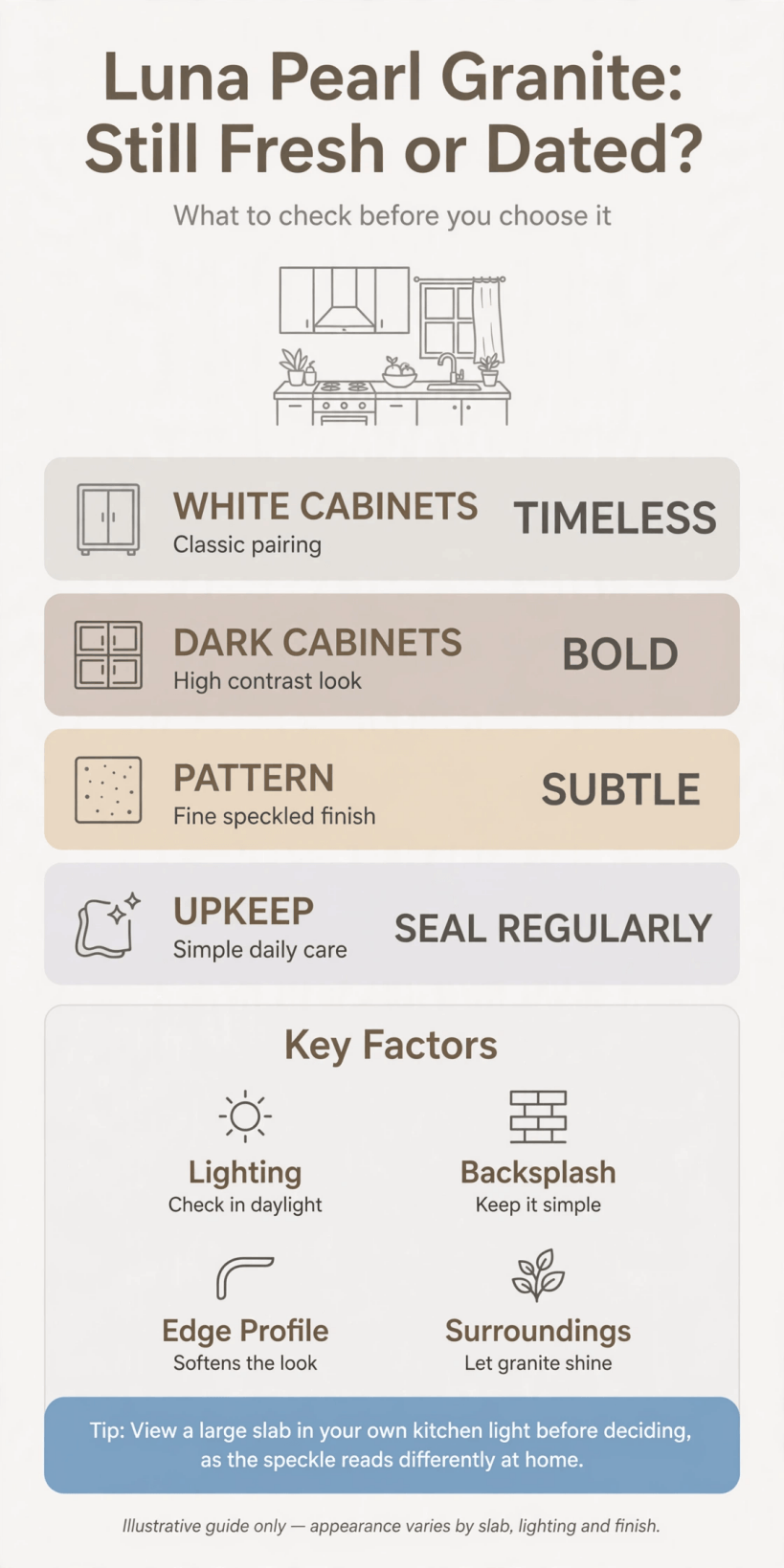
The decision at a glance — appearance, pairings, upkeep and buying checks for this speckled grey stone.
2. What Luna Pearl Actually Looks Like
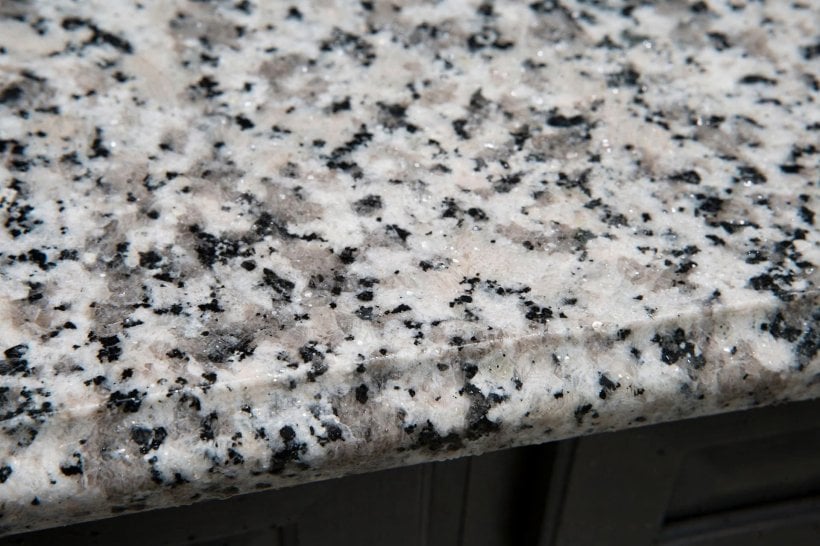
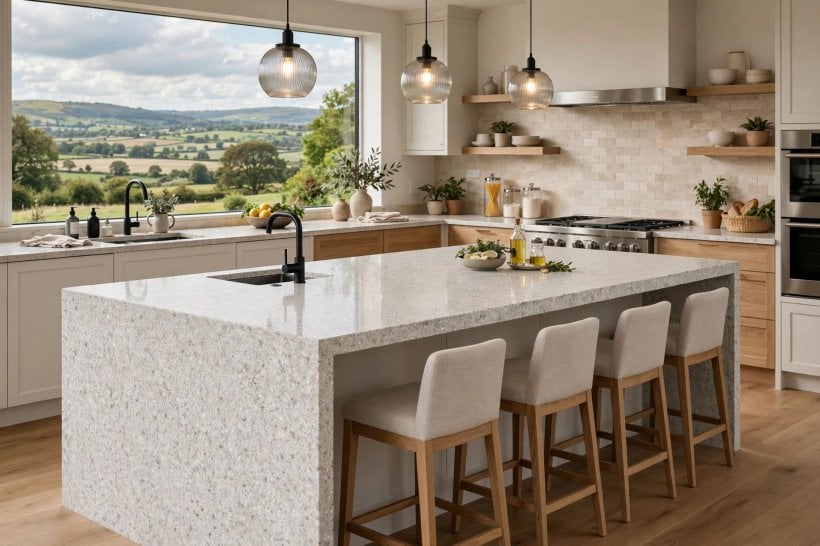
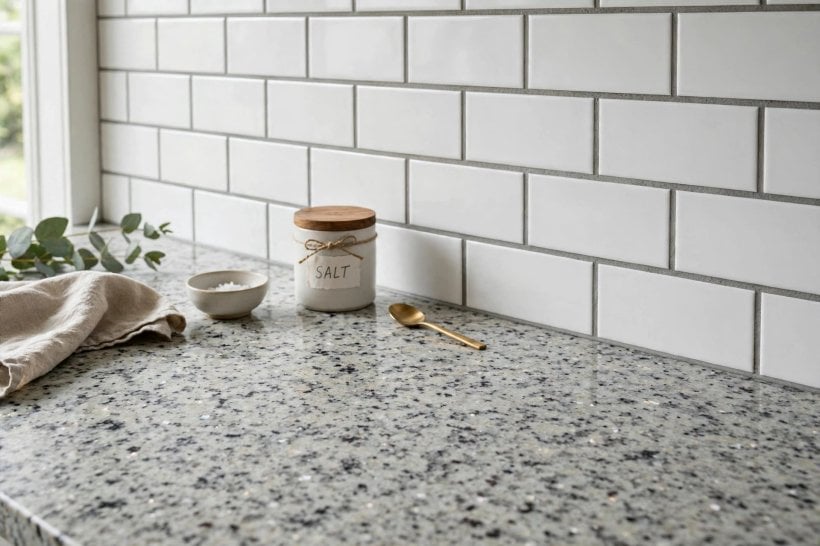
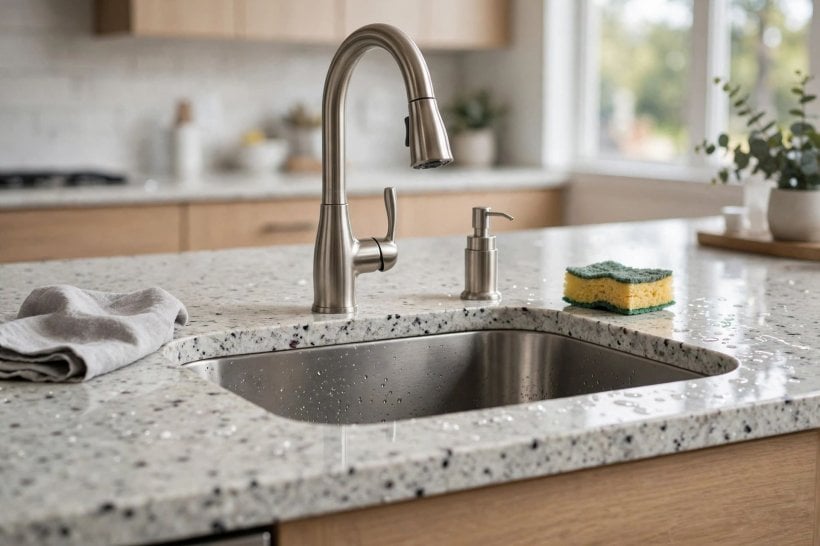
Seen up close, the pattern is a fine, even speckle: a pale grey-white background scattered with mid-grey, soft beige and occasional darker flecks, without the sweeping veins of marble-look stones. From across a room it reads as a calm light grey, which is both its strength and the root of the debate about it. Supporters like that it does not shout; critics say the fine, uniform speckle can feel flat next to bolder, more dramatic stones. Both reactions are about taste, not quality, and either could be yours.
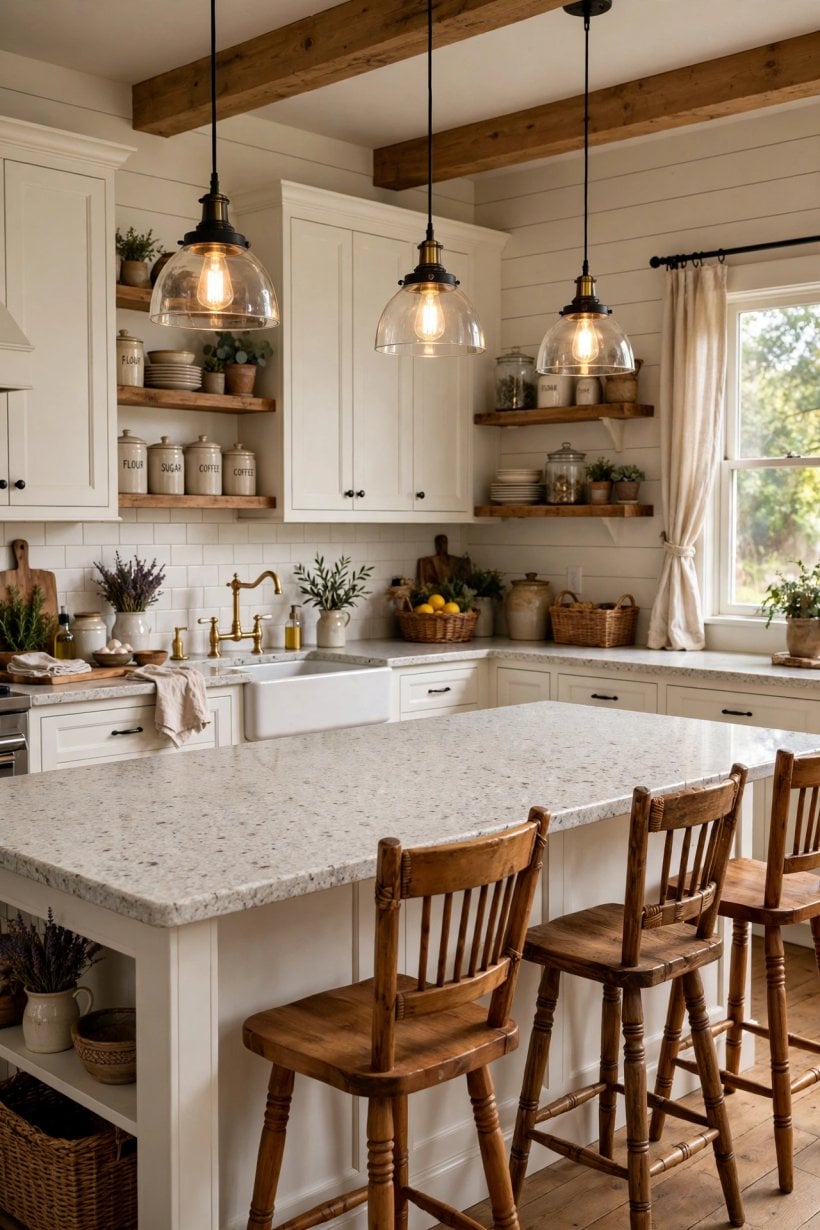
Because the pattern is small-scale and busy, it hides crumbs, water spots and everyday marks better than a plain pale surface — one reason it earned a place in so many hard-working family kitchens and in compact ones planned along the lines of tiny house bathroom ideas, where every surface has to forgive daily use. The trade-off is visual energy: in a room that already has patterned tile, busy flooring and open shelving full of colour, a speckled worktop adds one more texture competing for attention. In a simpler room, that same speckle is often exactly the interest the scheme needed.
3. Why People Ask Whether It Is Dated
The question exists because this style of granite was a default choice during a long period when speckled grey worktops were fitted in huge numbers of kitchens, and anything fitted everywhere eventually gets labelled with its era. Fashion in kitchens also moves in clear cycles: when dramatic veining and warm tones are in favour, cool fine speckles look like the past; when calm, light surfaces return, the same stone reads as fresh again. Knowing this history helps you hear the word “dated” for what it usually is — a statement about cycles, not about the stone in your hand.
It is also worth separating the stone from its usual staging. Luna Pearl photographed with dated cabinets, old-fashioned hardware and yellow lighting inherits all of those judgements; the same slab with plain modern cabinets, simple handles and good light is judged entirely differently. Before deciding anything, mentally redress the rooms you see online, or better, look at the stone beside the finishes you actually own. Rooms styled with the confidence shown in colourful tiny house interior ideas demonstrate the principle well: a supposedly quiet surface can look deliberate and current the moment the colours around it are chosen on purpose rather than inherited by accident.
4. Pairing It With Cabinets: Colours That Help
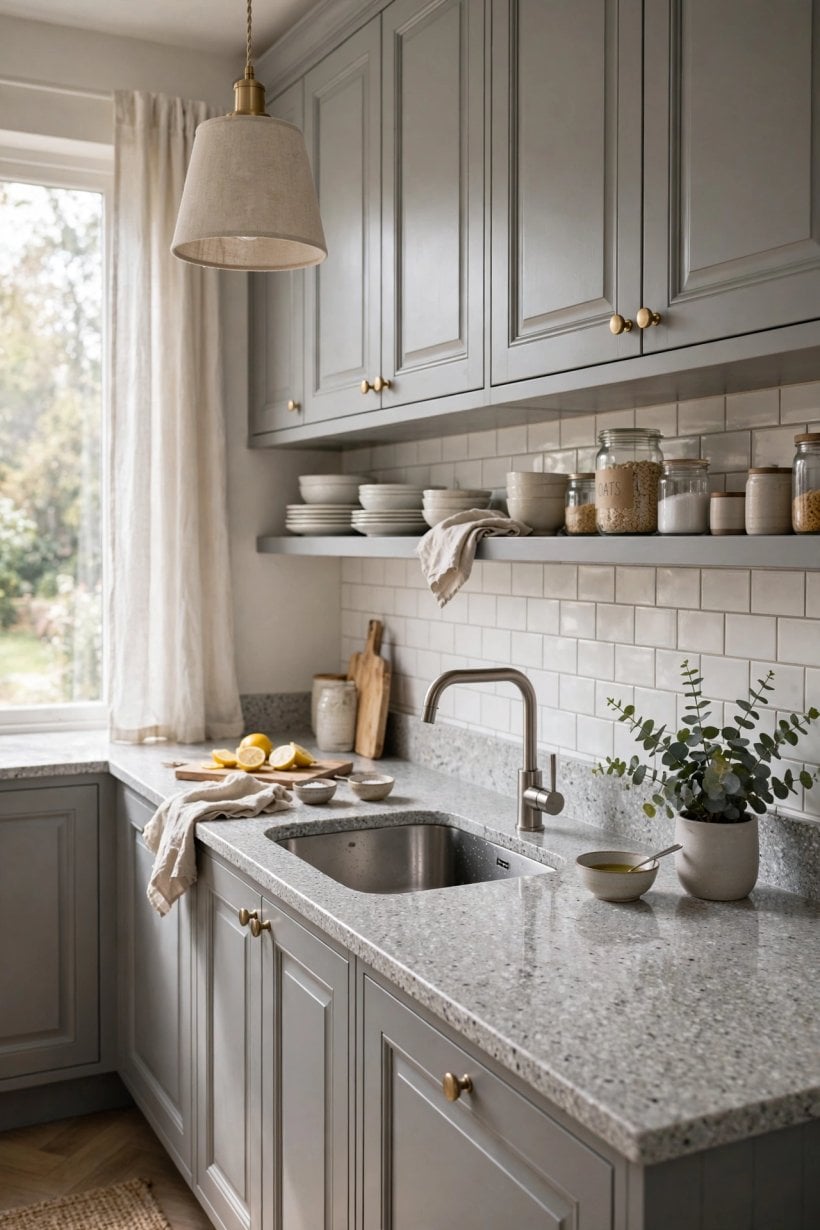
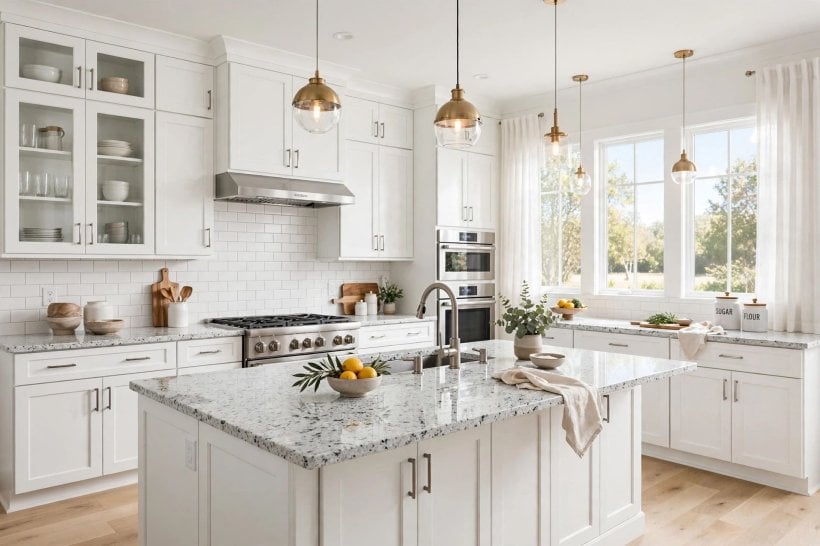
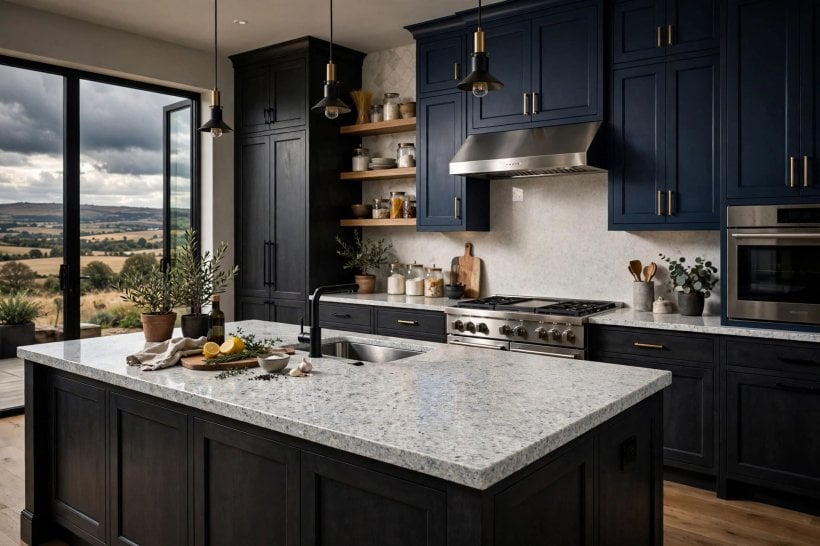
White cabinets are the classic partner and still the easiest: the worktop’s grey speckle stops the pairing looking stark, while the white keeps the speckle from dominating. Soft grey cabinets create a layered, tone-on-tone scheme that feels calm but needs a contrast somewhere — a darker floor, warm wood open shelves or black handles — to stop it drifting into blandness. Deep navy or blue cabinetry makes the pale stone look crisper by contrast and is a common way people refresh the combination without changing the worktop at all.
Warm woods deserve an honest test, because the stone’s beige flecks can either harmonise beautifully or clash with orange-toned timber, depending on the exact slab and the exact wood. Take a cabinet door to the slab yard, not the other way round. If you are keeping existing cabinets and wondering whether the stone flatters them, that single trip answers the question better than any opinion column. Painters planning a small open-plan space, like the kitchens that flow into sitting areas in tiny house living room ideas, should also check the pairing from the sofa: a worktop is seen from across the room far more often than it is seen from the cooker.
5. Floors, Walls and Backsplashes Around It
A busy worktop usually wants quiet neighbours. Plain floor tiles, straightforward wood-look flooring or a simple large-format tile let the speckle do its work without a pattern fight, while strongly figured floors tend to compete with it inch by inch. If your floor is already bold, that does not rule the stone out — but it raises the stakes on seeing the two together at full scale, ideally with the actual floor tile laid against the actual slab rather than a memory of either.
For the backsplash zone, the same logic applies. A plain tile in a soft white or gentle grey, or a short upstand of the granite itself with painted wall above, keeps the eye moving calmly; a heavily patterned splashback stacked directly on a speckled worktop is the combination most likely to feel restless. Wall colour can quietly steer the whole impression warmer or cooler: warm whites and soft greiges flatter the stone’s beige flecks, while blue-greys sharpen its cooler side. The welcoming, texture-led schemes in tiny barn house interior ideas make the same point in another dialect — natural surfaces look their best when one of them leads and the rest support, never when all of them compete at the same volume.
6. Light, Room Size and How the Stone Behaves
Light changes this stone more than most. In bright, cool daylight its greys read clean and silvery; under warm evening lighting the beige notes come forward and the surface feels softer and creamier. North-facing rooms push it cooler still, which some people love and some find chilly alongside white cabinets. None of this is a flaw — it simply means a sample judged at midday in a showroom is only half judged. Take the sample home, or at minimum view the slab outdoors and under the yard’s interior lights, and imagine both moods in your kitchen.
Room size matters in the opposite way to what many expect. A light worktop generally helps a small kitchen feel open, and the fine pattern stops large unbroken runs from showing every mark; but in a very large kitchen with long runs and a big island, the uniform speckle can look repetitive unless you break it up with a contrasting island surface, wood chopping blocks or deliberate styling zones. If you are planning a compact home from scratch, the measurement discipline in bedroom interior design for tiny houses applies just as much in the kitchen: surfaces earn their place by working in the real dimensions and the real light of the room, not in a brochure.
7. Practicalities: Sealing, Stains and Daily Life
Granite is a natural stone, and like other granites this one is typically sealed and benefits from that seal being maintained as the supplier recommends. Ask your fabricator, in plain terms, how often they advise resealing for a kitchen used like yours, which products they supply or approve, and what the early signs of a tired seal look like — water no longer beading and sitting darker on the surface is the classic household clue. Get the answer in writing with your care paperwork rather than relying on a showroom conversation.
Day to day, the pattern is on your side: the speckle disguises crumbs, light splashes and the general confetti of family cooking far better than a plain surface would. Sensible habits still apply to any stone — wipe spills that are acidic or strongly coloured rather than leaving them to sit, use boards for chopping and trivets for very hot pans, and clean with products intended for natural stone instead of harsh chemicals. Households that cook constantly and households that mostly reheat will stress a worktop very differently, so be honest about which one you are. A stone chosen for the life you actually live will look “current” to you for as long as it serves that life well.
8. What It Costs, and What Changes the Quote
Luna Pearl has commonly been sold among the more affordable granite options, but “affordable for granite” still covers a wide spread of final bills, and local quotes vary with slab supply, region and the fabricator’s workload. What you actually pay is driven less by the stone’s name than by the shape of your kitchen: total worktop area, number of cut-outs for sinks and hobs, edge profile, upstands or full-height splashbacks, templating, delivery access and installation. Two kitchens choosing the identical slab can receive very different quotes for entirely ordinary reasons.
Compare quotes on a like-for-like written scope: stone, thickness, edge, cut-outs, sealing, templating, fitting and waste removal all listed. Ask whether remnants could cover a small run, a utility space or a matching windowsill, since offcut pricing can soften a bill. And weigh the quote against the whole project rather than in isolation — as anyone budgeting a build along the lines of how to build your own tiny house learns quickly, the cheapest line item is not always the cheapest decision once fitting, finishing and longevity are counted. A mid-priced stone fitted beautifully will satisfy longer than a bargain fitted roughly.
9. Seeing Slabs and Choosing Your Actual Piece
Natural stone varies. One slab may lean whiter and quieter, the next greyer with stronger dark flecks, and a palm-sized sample cannot tell you which character your kitchen will receive. The single most protective step you can take is to view the full slab — or clear, full-slab photographs of the exact piece — before fabrication, and to have the slab you approve reserved in your name. While you are there, check the areas that will become your sink run and your island, because pattern density and any natural markings will land differently on each part of the layout.
Ask how seams will be placed and whether the pattern will be matched across joins, look at the slab’s edges for anything that concerns you, and photograph the approved slab with its identifying label for your records. If you are buying for a bathroom vanity or a smaller surface instead of a kitchen, remnants of a slab you already like can be an economical and visually consistent route. Treat slab selection as the enjoyable part of the process rather than a formality: it is the moment a generic product name becomes your particular piece of stone, with its own balance of grey, white and warmth that no trend discussion can capture.
10. Comparing Alternatives and Questions To Ask
One more check is worth making before any decision hardens: borrow the largest sample you can and live with it on the worktop for a few days. Prop it where the new surface will sit, cook beside it, wipe it, spill on it deliberately, and look at it first thing in the morning and last thing at night. Few surfaces survive that honest test unchanged in your estimation — some grow on you, others quietly rule themselves out — and either outcome is valuable, because it comes from your own kitchen rather than from a showroom or a stranger’s opinion. Decisions made that way rarely need revisiting, whichever stone they land on.
If you are hesitating, compare like with like. Other light granites offer similar speckle in warmer or cooler directions; quartz versions give a more uniform pattern with different care requirements; and pale solid surfaces remove speckle altogether for a quieter look. Lay your shortlist out against the same cabinet sample, the same floor tile and the same questions: How busy is it? How does it behave in your light? What care does it ask? What does the full installed quote say? Judged side by side on your own criteria, the right answer usually stops feeling like a fashion gamble at all.
Bring fabricators a short written list: Is the price for the exact slab I viewed? How are seams handled? What sealing is included and what maintenance do you recommend? What is templated, what is the lead time, and what happens if I spot a problem on delivery day? Clear written answers protect both sides. And if you already own this stone and simply wondered whether to keep it, apply the same test in reverse: if it is sound, suits your cabinets and serves your cooking, the strongest reason to change it would be your own taste — which is allowed to be the final word, in either direction.
Final Considerations
So, is luna pearl granite outdated? This guide deliberately leaves that verdict with you, because the honest answer depends on your room, your light, your cabinets and your eye — not on a label. What can be said plainly is this: it is a light, forgiving, well-understood stone that still earns its place when the slab is chosen carefully and the pairing is deliberate. Check those things properly, and whichever way you decide, you will be deciding from evidence instead of fashion.

0 Comments