

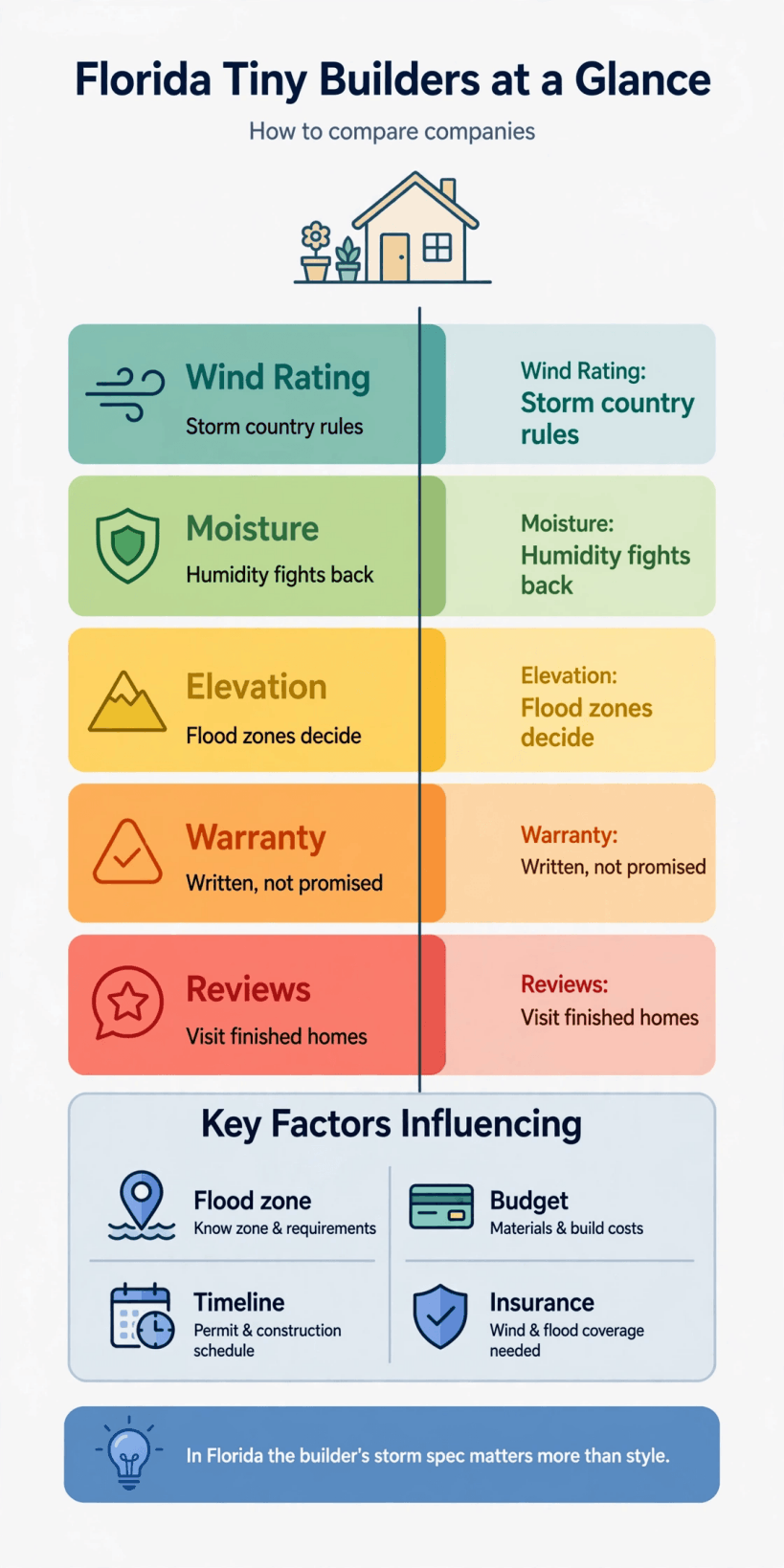
Florida is the state where a tiny house specification stops being a brochure and starts being a weather decision. Heat, humidity, salt air, sudden storms and standing water all test a small home harder than the same home would be tested almost anywhere else. This guide compares the best tiny house builders in Florida by the method that actually protects a buyer — not by inventing company names, prices or star ratings, but by comparing the builder types you will really meet, the Florida criteria that separate a careful build from a risky one, and the questions that reveal the difference before any deposit changes hands.
The framing is honest: the comparison runs across fifteen slots — five common builder types, each checked against three Florida tests of wind and storm specification, moisture detailing, and paperwork that insurers and counties accept. A slot might be a certified factory builder, a local custom shop, a kit and plan seller, a foundation or ADU specialist, or a shell builder who hands you the finishing work. Score every real company on your shortlist against the same slots and weak answers stand out quickly, long before a storm season does the scoring for you.
| Builder type | What they suit | What to verify |
|---|---|---|
| Certified factory builder | Buyers who want inspected, repeatable builds with documents insurers recognise | Wind specification in writing, inspection stages, written warranty terms |
| Local custom shop | Coastal or inland one-off designs and buyers who want to visit during the build | Finished Florida homes you can inspect, moisture detailing, build schedule |
| Kit and plan seller | Confident DIY buyers with time, tools and a dry place to build | What is included, what is not, and who carries design and wind-load responsibility |
| Foundation and ADU specialist | Permanent backyard homes where elevation and permitting decide everything | Flood-zone experience, foundation specification, utility connections |
| Shell builder | Buyers who want a weather-tight shell and will finish the interior themselves | A written definition of shell, sealed openings, corrosion-resistant fixings |
1. Certified Factory Builders and Florida Wind Specification
A certified factory builder works to a documented standard, with third-party inspection at the stages where quality is decided — framing, electrical and plumbing — before the walls close and hide the evidence. In Florida, ask the follow-up question other states make optional: what wind specification is this home built and documented to meet, and where is that written? Genuine answers name the standard, the inspecting body and the paperwork that travels with the home. Vague phrases about being hurricane-ready or built strong are marketing, not specification, and a careful builder will show documents without being asked twice.
The payoff is practical. Certified, well-documented builds are easier to finance, easier to place, and far easier to insure — a serious consideration in Florida, as section nine explains. The trade-off is flexibility: factory builders protect their certification by limiting structural changes, so deep customisation may be refused or priced firmly. Before comparing quotes, read what RVIA certification means for a tiny house, then ask whether the certification and the wind documentation cover the exact model, roof and openings you are ordering, because a certificate for a different configuration protects nobody.
2. Local Custom Shops, Coastal and Inland
A local custom shop builds one home at a time, and in Florida that local knowledge is the product. A shop that has delivered homes to the coast knows what salt air does to fasteners, hinges, exterior lights and trailer steel within a few seasons; an inland shop knows heat, afternoon storms and the termite pressure that never sleeps. Ask which Florida conditions the shop builds for most, and then ask to walk through a finished home at least a year old in a similar setting. A year of Florida weather reveals more than any showroom: seals, flashing, ventilation and finishes have all been honestly tested by then.
The trade-offs are capacity and consistency. Small shops carry waiting lists, and quality depends on who is on the tools that month, so ask who physically builds the home, what is subcontracted, and how hidden work is photographed before it is covered. When a custom quote looks high beside factory or DIY prices, weigh it against the true cost of tiny houses, prefab vs DIY — a price that includes storm specification, delivery, elevation work and warranty support is not comparable to a bare shell price, and in Florida the missing items are exactly the expensive ones.
3. Kit, Plan and Shell Builders in a Humid Climate
Kit sellers, plan sellers and shell builders sit at the affordable end of the market because they hand much of the work — and in Florida, much of the weather risk — to you. A plan is drawings and responsibility: you source materials and carry mistakes. A kit adds bundled materials but rarely includes the trailer, appliances, interior finishing or delivery. A shell gives you a framed, weather-tight structure, although the definition of weather-tight deserves written precision in a state where rain arrives horizontally.
The Florida trap is storage and timing. Materials and part-finished work stored outdoors in humid air absorb moisture, grow mould and warp before they are ever installed, so price in covered storage and a realistic build window, not just materials. Ask who carries responsibility for wind-load design in the plans, and compare routes using our guide to DIY-friendly tiny house plans before assuming the saving is real. Buyers who cost this route honestly — fixings rated for coastal air, sealed openings, the labour of finishing — often choose it for the satisfaction of building, not for a saving that evaporates in the first wet season.
4. Wind and Storm Specification: Roof Ties, Anchoring and Openings
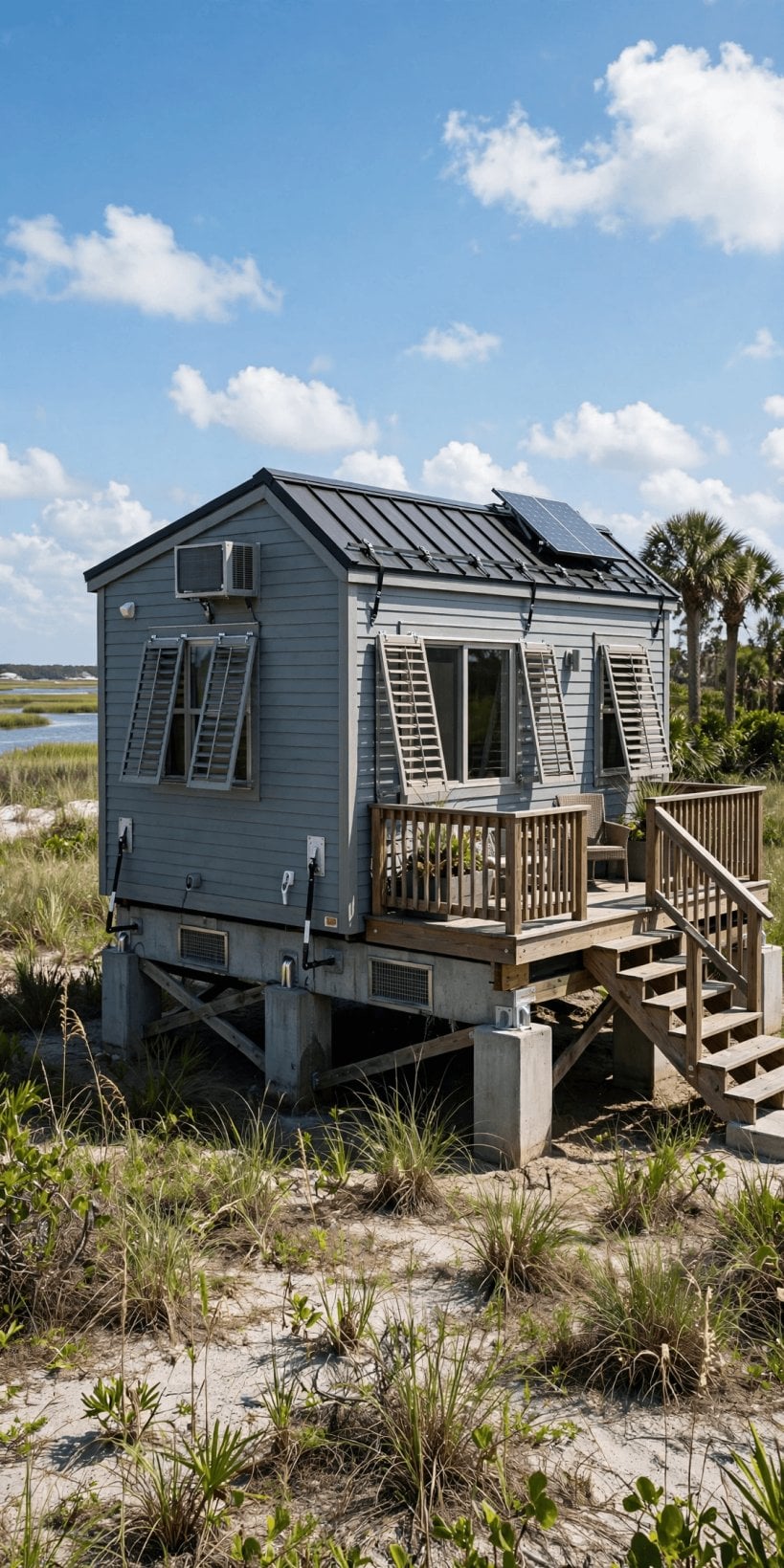
This is the section Florida buyers cannot skim. Wind does not test a tiny house evenly; it tries to lift the roof, rack the walls and pull the whole structure off its trailer or piers. Ask every builder for the load path in plain language: how the roof is tied to the walls, the walls to the floor, and the floor to the trailer or foundation, in one continuous chain. Hurricane ties, straps and properly rated anchors are not upgrades in Florida — they are the structure — and the answers belong in the written specification, with fixing schedules you could hand to an inspector or an insurer.
Openings are the weak points. Ask how windows and doors are rated and fastened, whether shutters or impact protection are offered, and how roof edges, vents and penetrations are sealed against driven rain. A home that will travel also meets wind at highway speed, and the forces involved are explained in our guide to tiny house wind resistance and aerodynamic towing. Finally, ask how the home is anchored once sited: a storm specification that ends at the factory gate is only half a specification, and the other half is decided by what happens on your land.
5. Moisture, Humidity and Mould Detailing in Florida Builds
Florida’s second enemy works slowly. Warm, humid air finds every cold surface and every unsealed joint, and a tiny house gives it little volume to dilute into. Cooking, showering and breathing load the interior air with moisture daily, so ask each builder how the home breathes: what ventilation is fitted, how the bathroom extracts, and how condensation on windows and within wall cavities is controlled. The principles in our guide to tiny house ventilation, HRV, ERV and mould will help you recognise a serious answer.
Then inspect the detailing choices. Ask about sealed sill plates and corners, flashing around every opening, materials that tolerate damp in the bathroom, and whether interior linings can dry if moisture ever gets in. Mould-resistant is a claim; a ventilation rate, a sealed wet area and a builder who can explain the drying path are evidence. On a visit to a finished Florida home, use your nose and your eyes: musty smells, swollen trim, rusting fixings and peeling paint near the floor line are the humidity report card, written in a language no brochure can spin.
6. Flood Zones, Elevation and Where the Home Sits
In much of Florida the most important building decision is not the house but its height above the ground. Ask every builder and every site adviser the same questions: is the land in a flood zone, what elevation is required or wise, and how will the home be set — piers, blocks, stem walls or a trailer left in place — so that water passes, drains and dries rather than ponds against the floor. Electrical gear, tanks and connections belong above the waterline too, and a builder with Florida siting experience raises these points before you do.
Elevation changes everyday life as well: steps, ramps, decking and utility runs all follow from the set height, and insurance and county paperwork may both depend on it. Our guide to how to prepare land for a tiny house covers the groundwork sequence, from access to drainage. Get the siting plan in writing, including who supplies the piers or blocks, who levels and anchors the home, and who returns if it settles. A beautiful build set too low in the wrong place is a problem no warranty language can dry out afterwards.
7. Contracts, Payment Stages and Storm-Season Scheduling
The contract is where a good Florida builder becomes easy to identify. It should name the exact specification — including the wind and moisture details from sections four and five — the total price, the exclusions, and a payment schedule tied to visible milestones rather than dates alone: deposit, frame complete, weather-tight, fit-out, delivery. You should never be far ahead of the value of work you could point to. Change orders should be priced and signed before the work happens, because verbal changes are where budgets quietly double.
Florida adds a calendar problem. Ask how the builder schedules around storm season: what happens to a delivery window if a storm threatens, who decides to delay, who pays for the reschedule, and where a finished home waits if your site is not ready. Ask also who owns materials paid for in advance and in whose name the title paperwork will be issued. Read the cancellation clause before you need it. Professional builders expect these questions and answer them in writing; sellers who prefer everything friendly and unwritten are telling you, early and clearly, how a dispute with them would go.
8. Written Warranties and Salt-Air Aftercare in Florida
A warranty is only as good as its written text. Ask for a sample before you pay a deposit and read what it actually covers: structure, roof and weatherproofing, plumbing and electrical systems, and the appliances, which usually carry their own manufacturers’ terms passed through the builder. Note the period for each part and the claim process, then ask the Florida question — who physically does warranty work, and how far away are they? A promise serviced from another state means waiting, shipping the home, or finding a local contractor the builder will actually pay.
Salt air writes its own exclusions. Ask what the warranty says about corrosion, and what the builder specifies to slow it: galvanised or stainless fixings in exposed places, protected trailer steel, sealed end grain and exterior finishes chosen for coastal exposure. Then ask about aftercare in the ordinary sense — manuals for every appliance, paint and material codes, a labelled panel, and a named contact for the first year. In Florida’s climate small maintenance done early — resealing a joint, touching up a scratch before rust starts — is worth more than any warranty argument later, and good builders explain that rhythm honestly instead of promising a maintenance-free home.
9. Insurance Reality for Florida Tiny Houses
Florida insurance is where optimism goes to be corrected, so involve it early — before the deposit, not after the delivery. Whether a tiny house can be insured, as what, and at what cost depends on its certification, its wind documentation, how it is sited and anchored, and whether it sits on wheels or a foundation. Ask each builder what documentation they supply for insurers, and then take that paperwork to an insurer or broker and ask whether it is enough. A builder whose homes are routinely insured in Florida will know exactly which documents matter.
Our guide to tiny house insurance for wheels vs foundation explains why the two routes behave so differently. Be honest with yourself about the answers you get: if a home can only be insured in limited ways, that fact changes what it is worth and where it can live, and it belongs in the buying decision, not in a later surprise. Builders who raise insurance themselves, early and without being pushed, are demonstrating the habit that matters most in this market — they deal in the Florida that exists, not the one in the brochure.
10. Red Flags When Comparing Florida Tiny House Builders
Some warnings repeat across every builder type. Large cash deposits with no contract, or contracts in a different name from the business you visited, should end the conversation. So should a refusal to show a finished home, share the warranty text, or put the wind specification in writing. Claims of being hurricane-proof deserve special suspicion: honest builders talk about ratings, documents and limits, because they know no small structure is proof against every storm, and they would rather explain that than sell you a slogan.
Watch for the quieter flags too. Quotes with no mention of elevation, anchoring or delivery to your actual site; specifications that say standard without defining it; corrosion dismissed as a non-issue on the coast; delivery promised in the middle of storm season with no weather clause. Distance and weather magnify every one of these risks, because fixing a problem is hardest exactly when Florida is at its wettest and busiest. None of these flags requires expertise to spot — only the willingness to slow down, ask ordinary questions in writing, and believe the quality of the answers you receive.
Final Considerations
Florida rewards the buyer who treats specification as the main event. Certified factory builds suit buyers who value inspected consistency and insurer-friendly paperwork. Local custom shops suit buyers who want Florida detailing decided by people who live with Florida weather. Kits, plans and shells suit hands-on buyers who cost storage, labour and corrosion protection honestly. Foundations and elevation decide more outcomes than finishes ever will. Score the fifteen comparison slots, insist on the wind specification, the warranty and the contract in writing, and check insurability before the deposit. Do those unglamorous things and the builder you choose has been tested the way Florida will test the home itself: on evidence, in writing, before the weather arrives.


0 Comments