

A tray ceiling is the one bedroom upgrade you experience lying down: a recessed panel of ceiling above the bed that lifts the room’s centre, washes it with hidden light, and turns the last view of the day into the calmest one.
This collection works through tray ceilings for bedrooms only — the shapes, the cove lighting, the colours painted inside the tray, the beams and double steps — and how each choice changes the way the room rests.
1. Tray Ceiling Bedrooms at a Glance
A tray ceiling steps the centre of the ceiling upward, like an inverted tray, and in a bedroom that recess belongs over the bed: it marks the sleeping zone, adds height exactly where the room is used horizontally, and gives light a hidden shelf to glow from. This post owns the bedroom slice: the living-room treatment lives in tray ceiling living room ideas, the wider ceiling survey in ceiling designs, and the bedroom as a whole in bedroom ideas. Here, everything serves the tray.
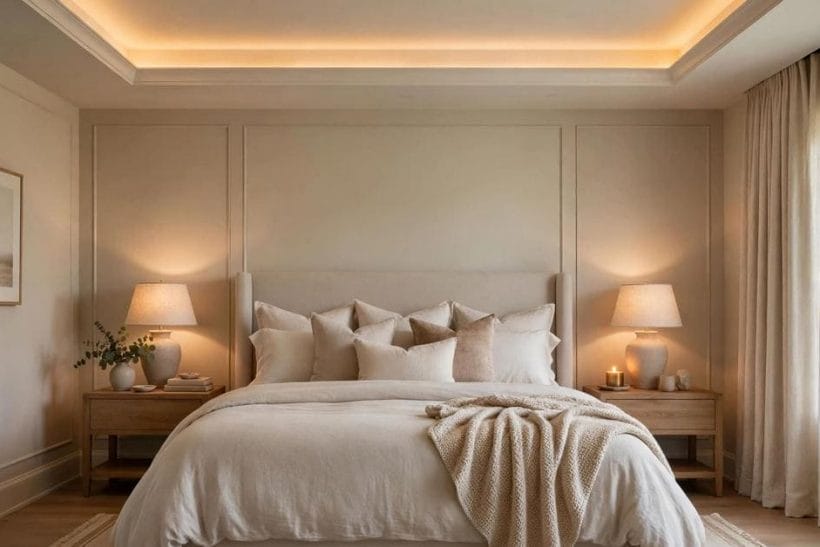
The feature bedroom shows the idea at its most restful: a shallow single tray washed with warm cove light, an upholstered bed centred beneath it, panelled cream walls, linen curtains at a garden window. No chandelier, no contrast colour — nothing to look at but light and proportion. The families below run from that baseline towards beams, colour and grandeur, and all end at the same test: does the ceiling help the room sleep?
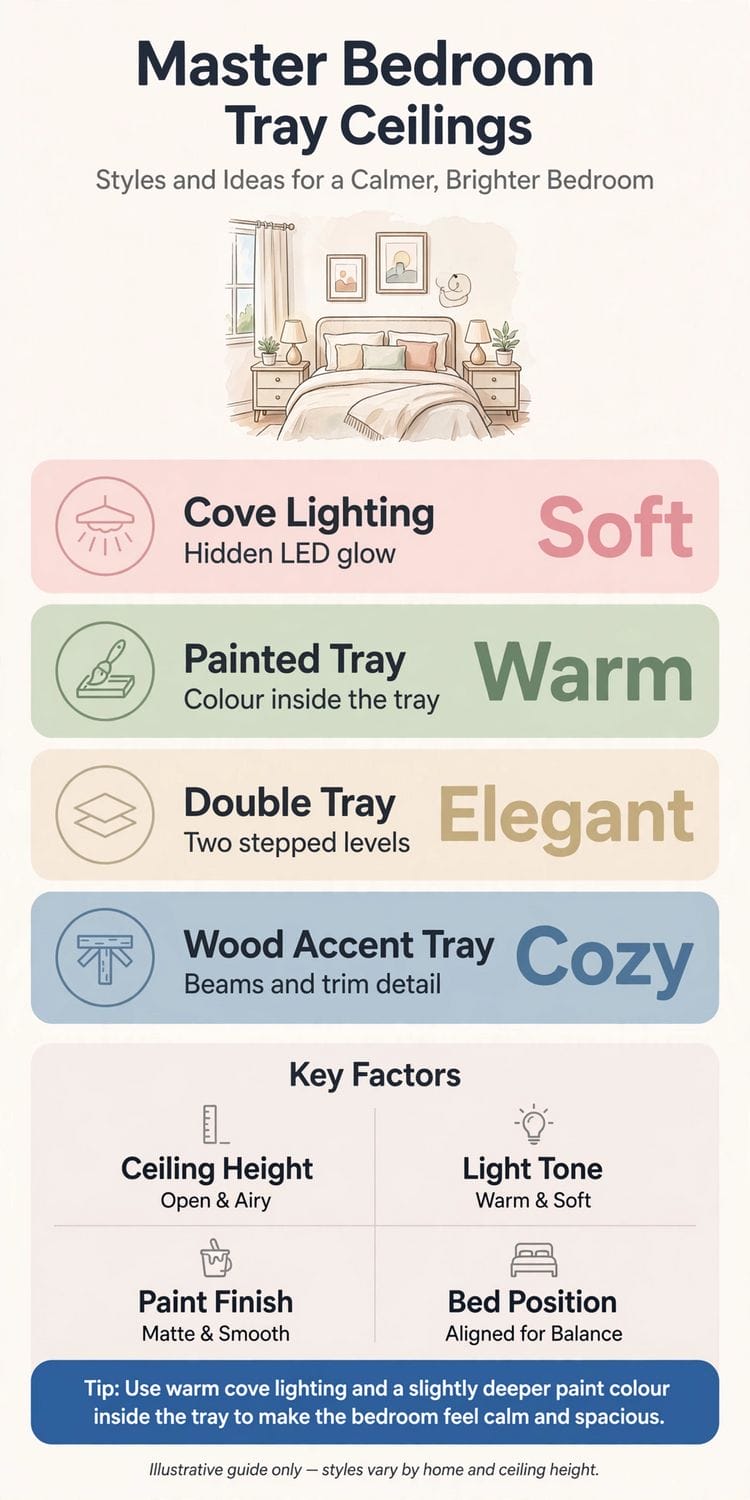
| Tray family | Character |
|---|---|
| Classic single tray | One clean step, crown moulding, white or cream — the timeless bedroom tray |
| Cove-lit tray | Hidden light washing the recess — the tray as a lamp |
| Painted tray | Colour inside the recess, from sage to blush to deep night tones |
| Wood-accent tray | Beams or timber lining inside the step — warmth overhead |
| Double tray | Two stepped levels — the formal, hotel-grade version |
2. Classic Single Trays and Crown Moulding
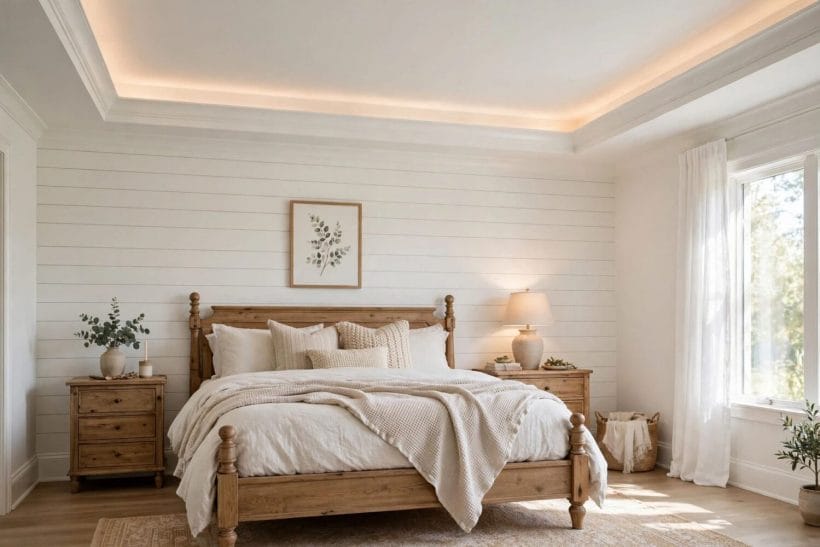
The single tray — one step up, a clean perimeter, a run of crown moulding — is the form most bedrooms need. The gallery room runs it in all-white over a shiplap wall and a wooden spindle bed: architecture quiet enough to disappear, which in a bedroom is praise.
1. The all-white tray
White walls, white tray, white mouldings: the recess reads through shadow alone, deepening and softening as the day moves. It is the safest tray here, suiting rented, resale-conscious and simply cautious bedrooms alike.
2. Crown moulding as the frame
A generous crown profile where the tray’s step meets the ceiling field frames the recess like a picture. Traditional bedrooms should spend here rather than on extra steps: one beautiful moulding line flatters every bed placed beneath it.
3. A shallow tray for standard ceilings
A tray does not need to be deep to work. A shallow recess with a crisp step changes the ceiling’s whole read — the eye registers a centre, height and intention — while asking little of the room’s existing height.
4. Tray edges aligned to the bed
Centre the tray on the bed, not just the room: when the bed sits squarely inside the tray’s footprint, the composition locks. The gallery bed sits dead centre in its white tray, and the room’s calm is mostly that alignment.
5. Cream and ivory for warmth
Where pure white reads cold in northern light, cream and ivory trays keep the classic form and warm it by a degree. Pair with cream bedding and natural wood, as the feature bedroom does, and the ceiling joins the room’s palette.
6. Picture-frame wall panelling below
Wall panelling beneath a tray ceiling gives the room a top and bottom frame of the same carpentry language. The feature room’s panelled walls and moulded ceiling step are one system — the bed simply sleeps inside the joinery.
7. Shiplap walls, classic tray
The gallery pairing — horizontal shiplap walls under a formal stepped tray — mixes farmhouse and classic in one room. The tray keeps the ceiling tailored while the walls stay relaxed, a balance cottage and coastal bedrooms wear well.
8. No light fitting at all
A classic tray with cove light only — no central pendant, no chandelier — leaves the recess empty and serene. In small or low bedrooms this is often the most luxurious choice: the ceiling becomes pure lit architecture.
3. Cove Lighting and the Hidden Glow
The tray’s shelf is a gift to lighting: a concealed strip in the step washes the recess with indirect glow no bare bulb can imitate. The feature room belongs to this family — its whole evening mood is cove light on cream plaster.
9. Warm white cove light
Warm-toned cove light is the bedroom default: it mimics lamplight and candlelight, flatters skin and bedding, and tells the body the day is ending. Cool white overhead is for kitchens and clinics; a sleeping room wants the glow of the feature photograph.
10. Dimmers are not optional
Cove light on a dimmer is two lights in one — bright enough to dress by at full power, a nightlight’s whisper at the bottom. Fit the dimmer when the tray is built; retrofitting regret is the commonest tray story told.
11. Cove on the long sides only
Running the hidden light along the two long edges of the tray, rather than all four, lengthens the room and keeps the glow off the pillows at the head end. A subtle asymmetry that long, narrow bedrooms benefit from most.
12. Double cove: tray plus perimeter
A second concealed run at the ceiling’s outer edge — where ceiling meets wall — layers the glow: the tray floats, the walls wash, and the whole ceiling seems lit from nowhere. It is the hotel effect, and it scales down to ordinary bedrooms gracefully.
13. Cove light as the only light
In a small bedroom, cove plus two low bedside lamps can be the entire lighting scheme — no centre light at all. The room never suffers a bulb in the eyeline of a person lying in bed, which is the tray ceiling’s founding comfort.
14. Colour-changing strips, used once
Smart strips can wash a tray in any colour; bedrooms mostly need one extra: a deep amber for the last hour of the evening. Set the scene, save it, and let the novelty colours go — restraint is what makes the glow feel designed.
15. Cove behind the headboard wall
Extend the idea down: a hidden strip behind a panelled or upstand headboard wall echoes the tray’s glow at pillow level. The two washes — ceiling and wall — bracket the bed in light that never shines in anyone’s eyes.
16. Morning light from the tray
On a timer, cove light can rise gently before the alarm — the tray as a dawn simulator. It suits bedrooms with blackout curtains, where the ceiling must do the waking the windows were hired to prevent.
4. Wood-Accent Trays and Beams
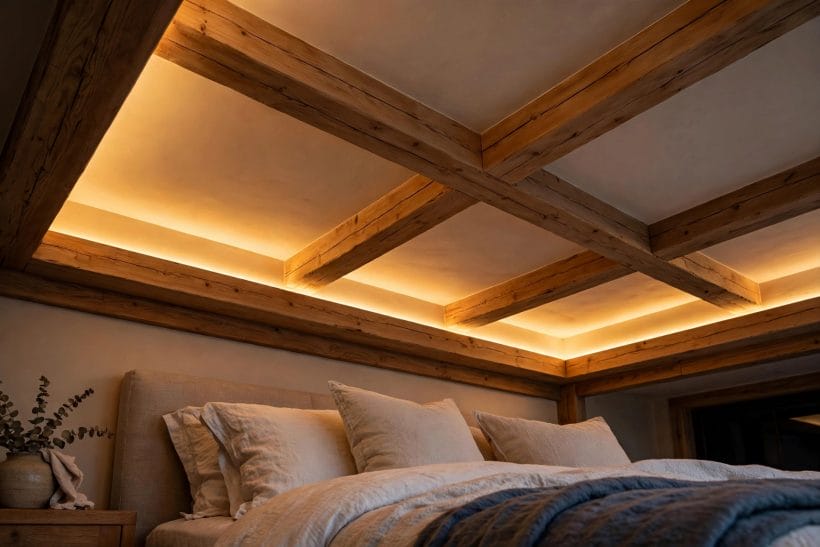
Timber inside the tray reverses the usual recipe: instead of disappearing into white, the recess becomes the room’s warmest surface. The gallery ceiling — heavy crossed beams with cove light glowing between them — is the rustic-luxe end of the family.
17. Crossed beams in the tray
Beams laid across the recess in both directions make a coffered-tray hybrid with real presence. Keep them chunky and few, as the gallery does — thin battens read as clutter overhead, where four honest timbers read as structure.
18. Beams along the length
Parallel beams running the tray’s length stretch a short bedroom and lead the eye to the window wall. In a room that sleeps facing the garden, beams become the ceiling’s way of pointing at the view.
19. Timber-lined tray field
Lining the tray’s field with tongue-and-groove or veneer makes the recess a wooden canopy over the bed. Match or deliberately contrast the floor’s tone; a near-miss between two woods is the one outcome to avoid.
20. White beams, coloured field
Paint the beams white and the field between them a soft colour, and the tray gains a tailored, almost textile pattern. It suits traditional rooms that want the beam idea without the lodge association.
21. Faux beams for real ceilings
Hollow faux beams weigh little and fix to a tray ceiling without structural work — the honest shortcut where the look, not the engineering, is what the room needs. In the recess they read as carpentry, and nobody sleeps worse for the secret.
22. Dark beams, pale everything
Dark-stained beams inside a white tray give a pale bedroom its one strong note, repeated in a bed frame or a door. The contrast belongs high in the room, where it can be dramatic without darkening the sleeping zone itself.
23. Beam ends into the step
Where beams meet the tray’s step, let them run into it rather than stopping short: the carpentry reads as one built object. The gallery ceiling’s beams disappear into the lit step on every side, which is why it looks constructed rather than decorated.
24. Rustic tray, refined bedding
The gallery room balances its rugged ceiling with plain linen and a calm bed — the formula for beams in a main bedroom. Rustic above, restful below: if both go rough, the room is a cabin; if the bed stays serene, it is a retreat.
5. Painted Trays: Colour Inside the Recess
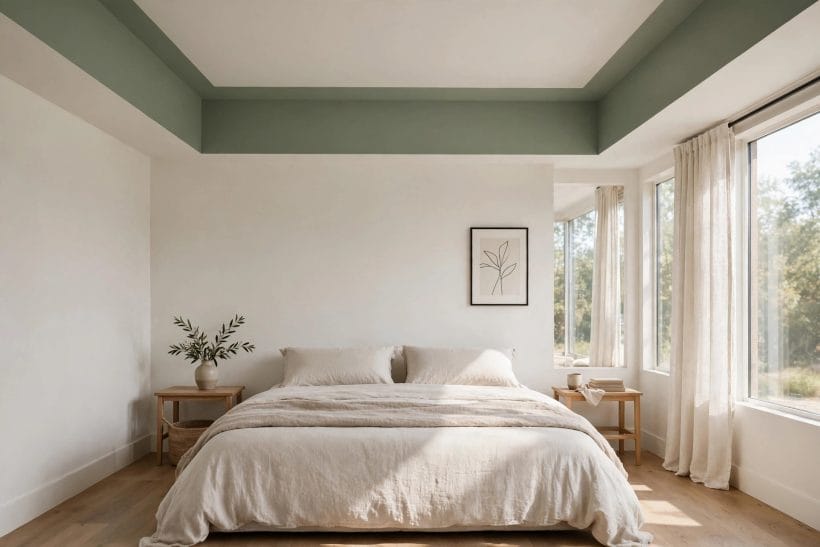
Painting the tray’s step and field is the cheapest transformation in this collection — the gallery room’s sage-green tray turns a plain white bedroom into a designed one for the price of a tin of paint. The rule is the infographic’s tip: a slightly deeper tone inside the tray than on the walls.
25. Sage green, the modern neutral
Sage on the tray’s step, white on the field, white walls below: the gallery formula. Green overhead reads as foliage and sky at once, pairs with every wood tone, and has become the painted tray’s signature colour for good reason.
26. One shade deeper than the walls
The reliable method: take the wall colour one or two shades deeper inside the tray. The ceiling joins the scheme with emphasis, nothing clashes, and the recess gains the depth that makes visitors ask what changed.
27. Blue trays for sleep
Soft blues inside the tray borrow the sky the ceiling replaced. Pale blue fields with white steps suit coastal and classic bedrooms; the colour’s restful reputation is, for once, a design claim a bedroom can use without apology.
28. Deep navy for drama overhead
A navy or ink tray field turns the recess into a night sky panel — dramatic in a large room, and gloriously cocooning with warm cove light tracing its edge. Borrow the confidence from bedroom with black walls ideas: dark bedroom surfaces succeed when the bedding stays light.
29. Colour on the step only
Paint just the tray’s vertical step and leave the field white: a ribbon of colour floating at ceiling height. It is the cautious version of the painted tray and the easiest to reverse — one face of the recess, repainted in an afternoon.
30. Colour on the field only
The opposite emphasis — colour in the flat field, white steps — reads as a coloured ceiling panel held in a white frame. Bolder than step-only colour at the same paint cost, and the version that photographs like a boutique hotel.
31. Matching the tray to the bedding
Pull the tray’s colour from the room’s textiles — a cushion, a throw, the curtain’s stripe — and the ceiling joins the conversation the bedding started. The match should be tonal rather than exact; ceilings darken every colour by a shade of shadow.
32. Two-tone trays in double schemes
Where the tray has two steps, paint them in two tones of one colour — deeper on the lower step, paler in the field — and the architecture gains a gradient. It is the painted answer to the double tray, achievable without a carpenter.
6. Double Trays and Stepped Levels
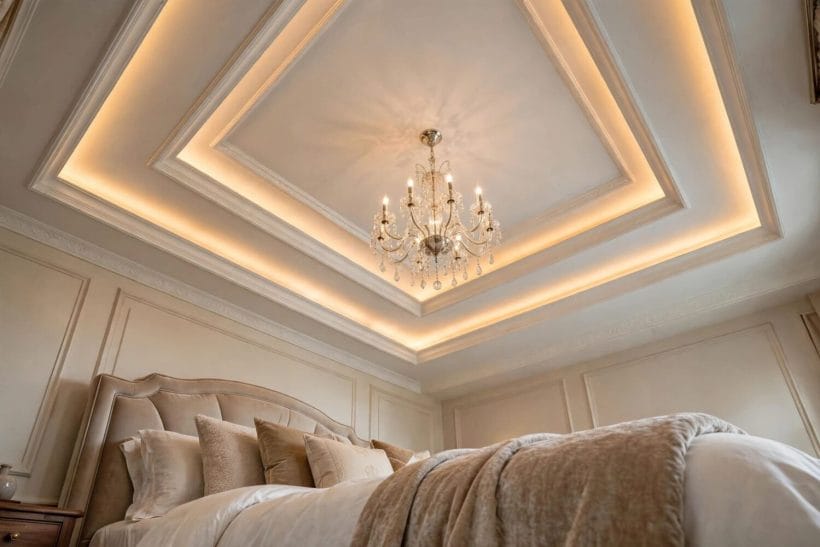
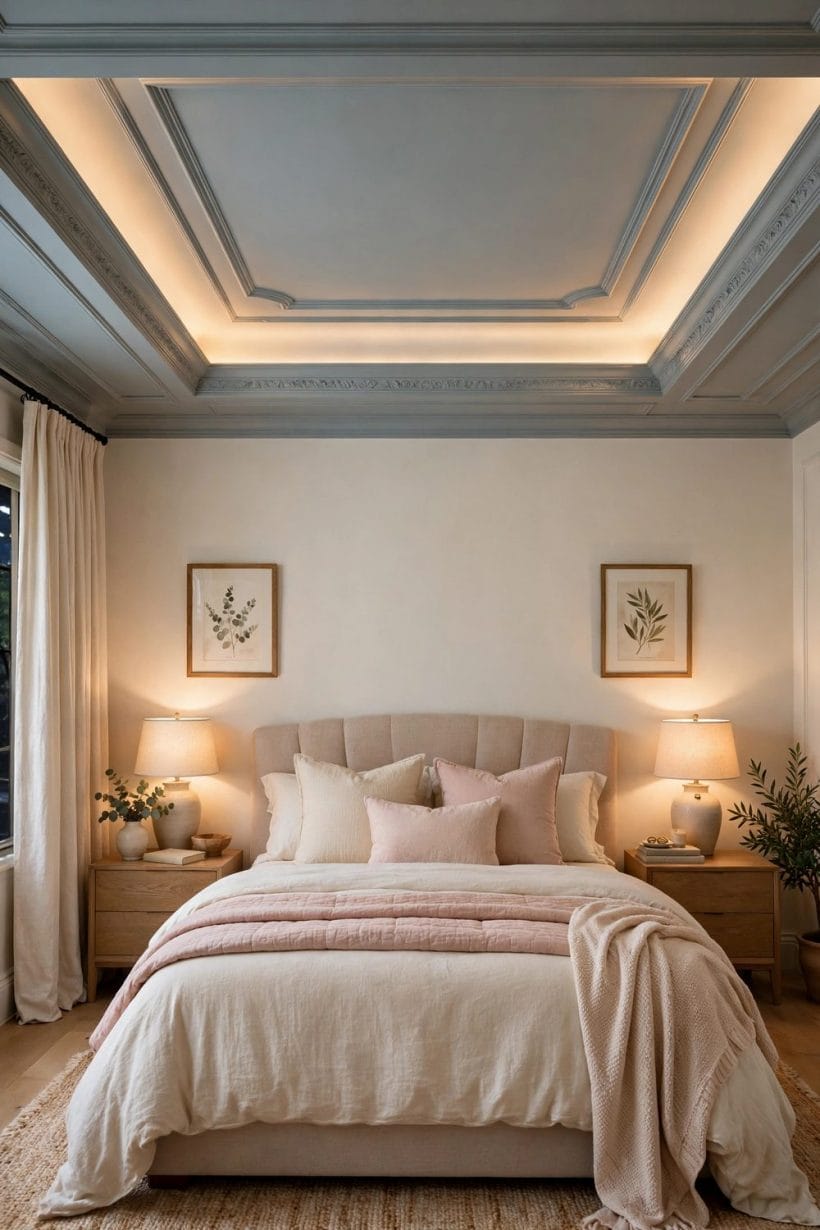
Two steps instead of one: the double tray is the family’s formal register, and the gallery room — concentric lit steps rising to a crystal chandelier — shows its full ceremonial dress.
33. The classic double step
Two even steps, mouldings on both, everything white: formality without fuss. The double step earns its keep in larger bedrooms where a single shallow tray would read as a crack in the ceiling rather than a design.
34. Cove light in both steps
A light run hidden in each step doubles the glow’s architecture — two luminous rectangles, one inside the other. The gallery ceiling’s layered light is the effect: the eye climbs the steps without knowing why.
35. Chandelier at the centre
A double tray gives a chandelier its proper stage: centred in the highest field, framed by the steps. Keep the fitting’s scale generous — a small chandelier in a grand tray looks lost, not delicate.
36. Asymmetric modern double tray
Contemporary rooms can offset the second step — shifted towards the window or the bed’s head — for a tray with direction. The asymmetry suits long rooms and beds placed off-centre, where a symmetrical tray would argue with the furniture.
37. Double tray, one step painted
Paint the lower step’s face in a soft colour and leave the upper field white: the double tray gains a horizon line. It is the most architectural use of paint in this collection, and the one guests photograph.
38. Wide shallow steps for low rooms
Where height is short, two wide, shallow steps read richer than one deep one and steal less air. The proportions matter more than the depth: generous horizontal ledges, minimal vertical rise.
39. Tray within a tray over the bed
In a very large bedroom, a smaller second tray centred over the bed, inside a first tray serving the whole room, gives the sleeping zone its own ceiling within the ceiling. Sitting and dressing zones keep the outer tray; the bed gets the inner sanctum.
40. Hotel discipline: symmetry everywhere
The double tray’s natural partner is a symmetrical room: centred bed, matched nightstands, matched lamps, as the gallery arranges them. Formality overhead asks for order below, and the combination is why hotel bedrooms feel calm before a single cushion is straightened.
7. Evening Light: Lamps, Dimmers and the Dusk Test
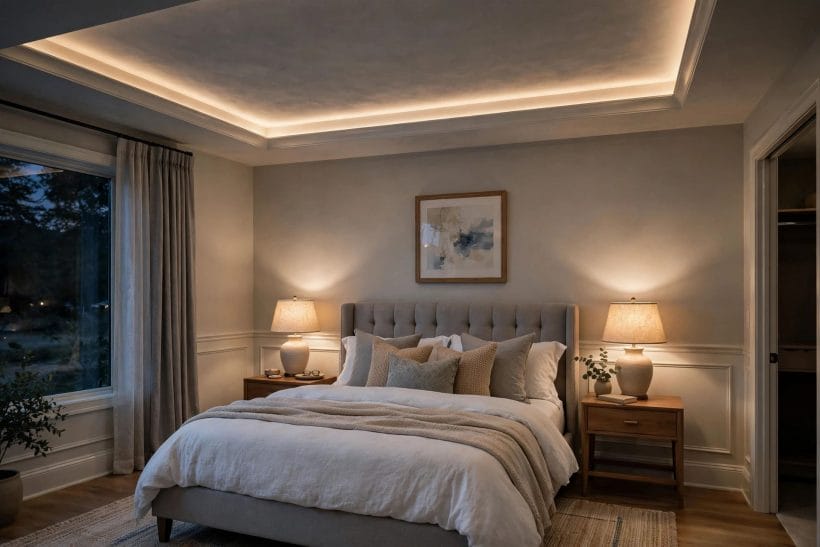
A tray ceiling is judged at night. The gallery bedroom — grey walls, tufted bed, lamps lit, tray glowing in a darkening room — is the dusk test every tray here must pass: light layered low and high, nothing glaring, everything warm.
41. Three layers, always
Cove light above, lamp light at pillow height, one low accent — a candle, a lit alcove. Three layers let the room be bright, soft or nearly dark without ever being flat, and the tray supplies the layer flat ceilings cannot.
42. Bedside lamps matched to the tray’s tone
Lamps and cove light should share a warmth: mixed temperatures — amber lamps under a cool tray — make a room feel accidentally lit. The gallery’s lamps and cove glow in the same register, which is most of its evening magic.
43. Reading light that respects the tray
Wall-mounted reading lights at the bed keep books lit without washing the whole ceiling. The tray stays a glow, not a floodlight, and a sleeping partner stays asleep — the household diplomacy of lighting.
44. The blackout-and-tray combination
With blackout curtains closed, the tray’s glow is the room’s only weather. Bedrooms on bright streets or shift-work schedules gain the most: the ceiling decides when evening is, whatever the window says.
45. Grey and greige rooms glow warm
The gallery room’s grey walls take warm cove light like a compliment — cool surfaces need warm light to stay restful. If the bedroom’s palette runs grey, the tray’s light tone is not a detail; it is the room’s whole temperature.
46. Wainscoting and tray: the dusk frame
Wall wainscoting below and a lit tray above frame the bed in lit architecture at dusk, as the gallery shows. The middle band — the bed itself — sits in the calmest zone, which is where a bedroom’s design should spend its effort.
47. Switches where hands fall
Tray light, lamps and reading lights should all switch from the bed. A ceiling this considered deserves controls that need no barefoot expedition — two-way switching at door and bedside is the unglamorous detail that makes the luxury real.
48. Candles under a lit tray
The oldest and newest lights agree: candlelight at the nightstand — the feature room keeps one — echoes the cove glow at miniature scale. Layers again: flame, lamp, tray, each warmer and higher than the last.
8. Small Bedrooms and Low Ceilings
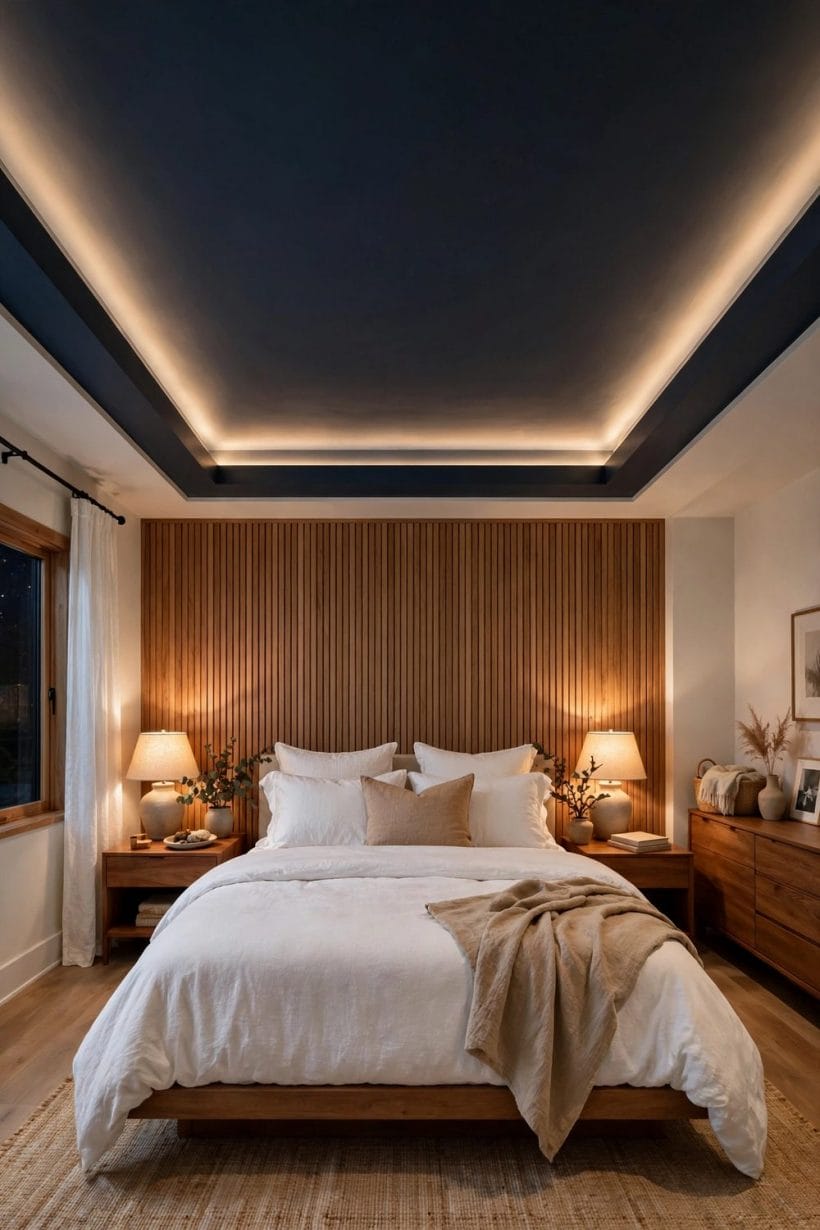
A tray in a small bedroom sounds like a theft of height; built shallow and lit well, it is the opposite — the recess reads as headroom gained, and the glow enlarges what the tape measure denies. The colour confidence is the same as in yellow bedroom ideas: bright rooms forgive bold ceilings.
49. The shallow tray, honestly shallow
One shallow step, minimal moulding, light in the step: the small-room tray. Depth is not what makes a tray read — the shadow line and the glow are, and both survive at a fraction of the grand versions’ rise.
50. Tray smaller than the room
Scale the tray to the bed zone rather than the whole ceiling in a small room: a recess the size of a generous rug, centred on the bed, leaves a plain border that makes the room feel larger by contrast.
51. White on white for air
In low rooms the painted tray goes pale or goes home: white tray, white walls, warm light. The recess becomes a brightness the room borrows all day, not a lid it wears.
52. Skip the chandelier
Nothing hangs from a small bedroom’s tray. The fitting would sit in the eyeline of everyone entering and crowd the recess it was meant to crown — cove light alone keeps the little tray feeling like sky.
53. Mirrors under a lit tray
A mirror opposite the window bounces daylight and the tray’s evening glow around a small room. The ceiling’s light does double duty, and the room’s calm doubles with it.
54. Bed low, tray high
A low platform bed increases the distance to the tray and exaggerates the recess’s height gift. In a small room the pairing — bed near the floor, ceiling stepped away from it — manufactures volume from proportion alone.
55. One colour, floor to tray
Colour-drenching a small bedroom — walls, trim and tray in one soft tone — erases the lines where surfaces meet, and the tray becomes a gentle shadow rather than a border. The room reads as one calm volume with a lit secret overhead.
56. Guest rooms earn a tray too
A small guest bedroom with a shallow cove-lit tray feels like a boutique stay rather than a spare room. Guests remember the glow above the bed long after they forget the street the house was on.
9. Soft Colour Trays: Blush, Pastel and Pattern
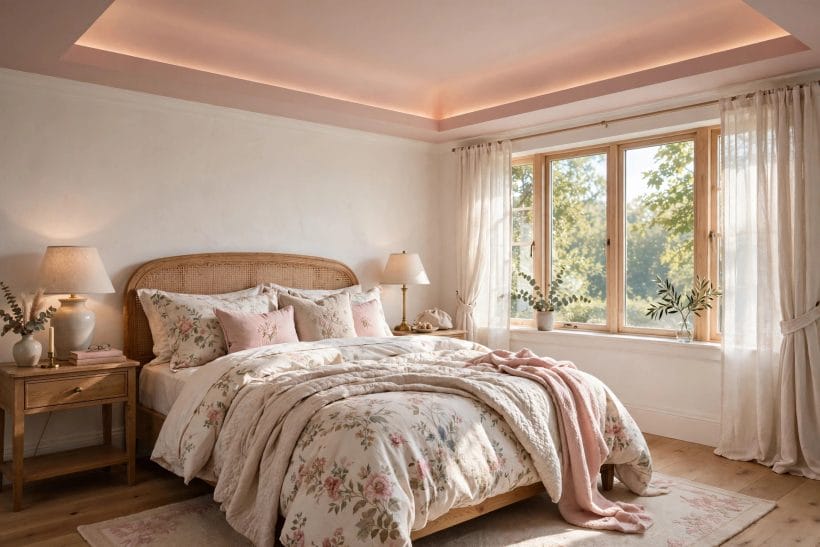
The gallery bedroom — blush-pink tray field, floral bedding, rattan headboard — is the painted family’s romantic branch: colour in the tray as the room’s softest statement, repeated in textiles rather than walls.
57. Blush pink in the field
Blush overhead flatters every skin tone it lights and warms white walls without a single coloured cushion. The gallery tray keeps its steps white, so the pink reads as a panel of evening sky held in a frame.
58. Floral bedding under a plain tray
Where the bedding brings the pattern — roses, sprigs, garden prints — the tray can stay plain and let the bed bloom. Pattern below, calm above is the romantic room’s reliable division of labour.
59. Pastel steps, white field
The gentlest colour move in this collection: the tray’s step washed in a pastel — blush, powder blue, pale sage — with the field left white. It tints the cove light as it passes, which no wall colour can do.
60. Wallpaper in the tray field
A subtle paper — tone-on-tone botanical, a small star print, grasscloth — inside the tray field makes the recess worth studying from the pillow. Keep the pattern quiet; it is read at length, every night.
61. Rattan and natural textures below
The gallery’s rattan headboard under its pink tray shows the natural-texture pairing: woven, wooden and linen surfaces keep a coloured tray feeling grown-up rather than sweet. Texture is pastel’s maturity.
62. Matching the tray to the view
In a garden-facing room, pull the tray’s colour from outside — leaf green, blossom pink, sky blue — and the ceiling joins the window’s picture. The gallery room’s pink echoes its flowering garden without copying a single plant.
63. Colour trays in children’s rooms
A child’s tray in a soft colour, its cove light on a timer, is a ceiling that helps with bedtime: the glow dims, the colour darkens, the room itself says sleep. Stars belong in the field, where small astronomers can count them.
64. Seasonal trays: lit, not painted
Keep the paint permanent and let the light perform the seasons — warmer in winter, brighter in spring, via the dimmer and the smart scenes. The tray’s colour stays the room’s signature while its mood follows the year.
65. Vintage rooms and picture rails
In older houses, run the tray’s lower step at the height of the original picture rail and the new ceiling architecture shakes hands with the old. Painted in a period soft tone, the tray looks less installed than discovered.
66. The romantic test
Judge a soft-colour tray from the bed, at dusk, lamps on: the colour should read as atmosphere, not as paint. If the ceiling feels like the last light of a good day, the blush, sage or blue has done its work.
10. Planning, Fitting and Practical Care
The practical close: how a tray gets planned, what to confirm before it is built, and how it is looked after — the discipline behind every ceiling above, and the bedroom’s share of the wider craft in ceiling designs and french country bedroom schemes alike.
67. Start from the bed’s position
Fix the bed’s wall and centreline first; the tray is drawn around it. Moving a bed after the ceiling is built strands the recess over the wrong furniture, and no lighting scene can argue with geometry.
68. Confirm the ceiling’s structure
A tray is built down from the existing ceiling or up into a void, and which one the house allows decides its depth. A builder’s look above the plaster, before designs harden, is the cheapest step in the project.
69. Plan the light before the plaster
Cove light needs its shelf, power and driver access designed into the step, not carved into a finished one. Electricians before plasterers, dimmers specified with their strips — the sequencing is the craft.
70. Access panels stay invisible
Light drivers and junctions need occasional access; plan a discreet hatch in the tray’s step or a nearby cupboard route at build time. A ceiling that must be cut open to change a driver is a design debt coming due.
71. Painting a tray: edges first
Trays are painted step by step — the vertical faces catch light differently from the field, and cutting in cleanly at each level is most of the job. Matte and eggshell finishes hide the ceiling’s small sins; gloss overhead advertises them.
72. Dust lives on the ledges
The tray’s steps collect dust where walls never do. A long-handled soft brush a few times a year keeps the ledges — and the cove glow — clean; neglected steps grey the light before they grey the paint.
73. Repainting on the room’s schedule
When the bedroom is next decorated, repaint the tray in the same session so its white is the walls’ white’s contemporary. Ceilings drift yellow a half-tone a decade; synchronised painting keeps the recess reading as architecture, not archaeology.
74. Small cracks at the step are normal
Hairline cracks where tray meets ceiling are the house breathing, not the tray failing — fill and paint them at decorating time. Cracks that grow, sagging lines or a step that sounds hollow to a knock are the ones to show a builder promptly.
75. The lying-down test
Judge every tray decision — depth, colour, light, fitting — from the bed, at the hours the bed is used. It is the only ceiling designed to be looked at lying down; if it is calm, warm and quietly lit from that angle, it has done its whole job.
Final Considerations
A bedroom tray succeeds on alignment and light: the recess centred on the bed, the glow hidden and warm, the colour a shade the room already loves. Choose the family first — classic, cove-lit, painted, beamed or double — confirm structure and wiring before the plaster, and judge the result from the pillow at dusk. Built that way, the tray becomes the room’s way of saying goodnight.




0 Comments