
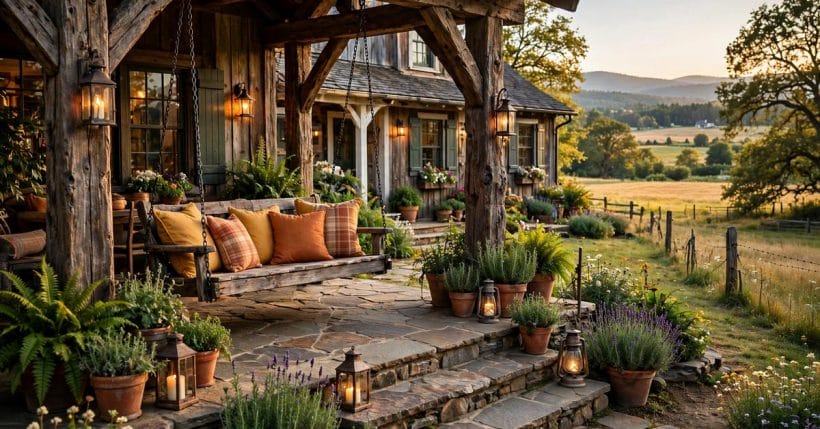
A rustic porch is built from honest materials and unhurried hours: heavy timber, rough stone, a swing that creaks softly, and cushions that have faded a little in the sun. It is the room a country house wears outside.
These rustic porch ideas run from the swing to the stonework — furniture, lighting, plants and the small welcoming details that make a porch the most loved seat at home.
1. The Rustic Porch at a Glance
Within the wider porch ideas collection, this post owns the rustic style: porches built and dressed in natural, weather-honest materials — timber with its grain and knots showing, stone underfoot, iron and lantern light, textiles in earthy checks and warm solids. Rustic is not a synonym for rough: the best rustic porches are carefully made and deliberately simple, which is a harder trick than it looks. Where the railing-led front treatments live in their own collection, everything here stays with the full porch — its structure, its seats and its evenings.
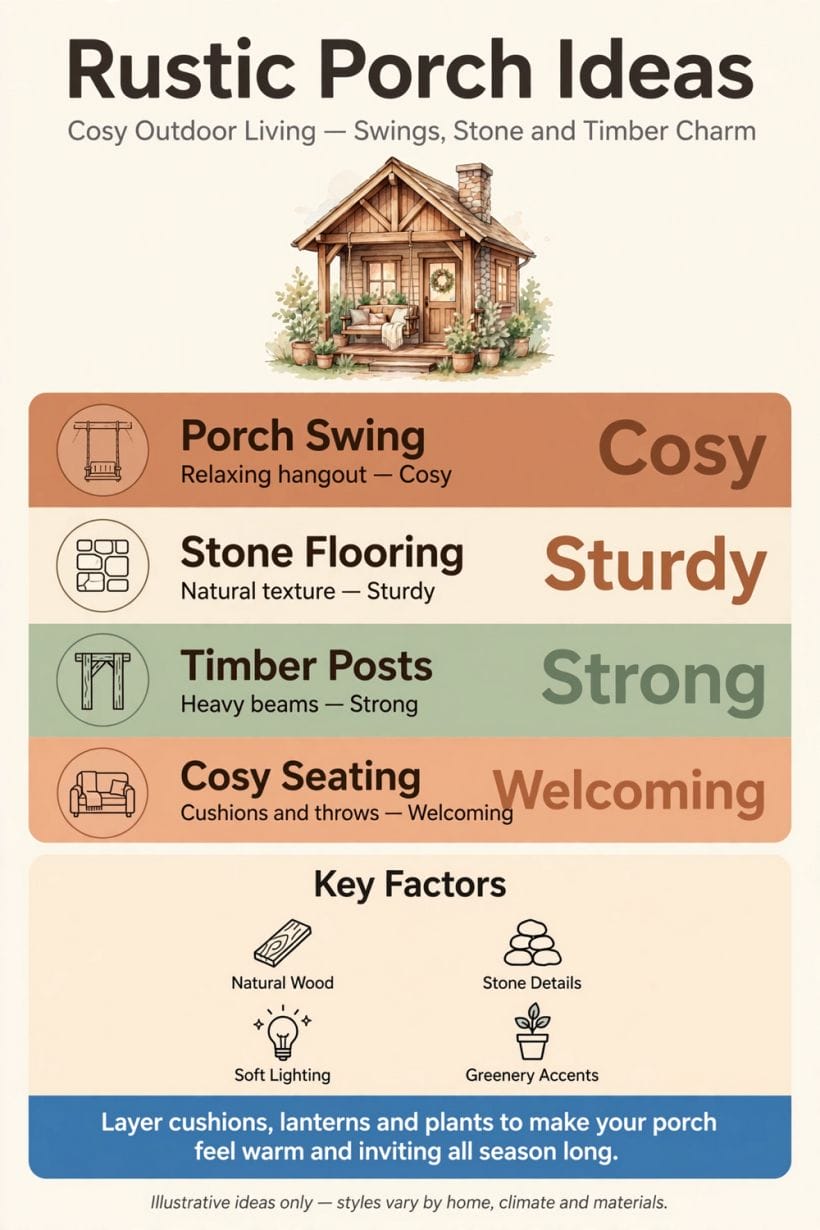
The formula repeats through all seventy-five ideas: a strong timber structure, a floor with texture, somewhere wonderful to sit, light that glows rather than glares, and greenery in terracotta. Change any one element and the porch still reads rustic; keep all five and it becomes the place the whole household migrates to at the end of the day.
| Element | The rustic treatment |
|---|---|
| Structure | Heavy timber posts, visible braces, stone piers |
| Floor | Flagstone, brick, or wide weathered boards |
| Seating | A swing first, then rockers, benches and wicker |
| Lighting | Lanterns, sconces and string lights — warm, never harsh |
| Textiles | Checks, stripes and warm solids in natural fibres |
| Greenery | Terracotta pots, ferns, herbs and climbing plants |
2. Porch Swings and Hanging Seats
1. The classic timber swing
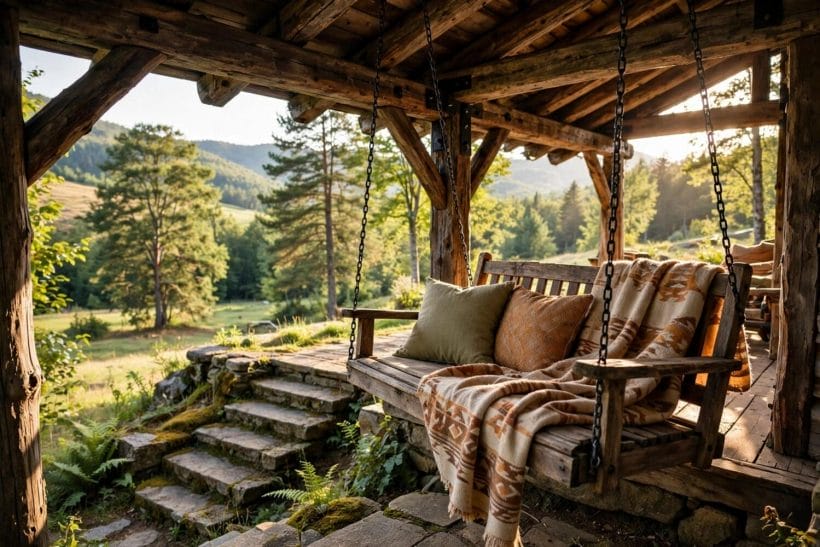
The first gallery’s swing is the rustic porch in one object: heavy slatted timber, iron chains, room for three, and a view worth sitting still for. A swing sets the porch’s tempo — everything else on it slows to match, which is precisely the point of the room.
2. Cushions in warm checks
Dress the swing in cushions the colours of the landscape — ochre, rust, sage, cream — with one checked or striped pattern to carry the country register. Outdoor fabrics have earned their keep here; sun and sudden rain are the swing’s daily weather.
3. A throw for the evening swing
The patterned blanket folded over the swing’s back is both styling and service: porches cool quickly after sunset, and a wool or heavy cotton throw extends the swing’s hours into the evening. Choose one that can live outdoors without fuss.
4. Chains, not ropes, for the classic look
Iron chains give the traditional swing its slight, sociable creak and its farmhouse silhouette. Ropes read coastal, chains read country — and the fixings into the joists above matter more than either: a swing is only as rustic as its bolts are strong.
5. The daybed swing
Widen the swing to a hanging daybed and the porch gains a nap with a view. Dressed with a mattress cushion and a pile of pillows, it becomes the most contested seat on the property — plan the porch’s other seating for the people who lose.
6. A swing at the porch’s end
Hang the swing across the porch’s end rather than along its front and it gains a room of its own — a swinging alcove facing down the garden. The end position also keeps the walkway to the door clear, which the front-hung swing never quite manages.
7. Two single hanging chairs
Where a full swing overwhelms a small porch, a pair of hanging chairs keeps the motion and loses the bulk. They suit conversation better than a shared swing — each sitter with their own gentle sway — and they photograph as pure porch romance.
8. The swing’s side table
Every swing needs a stump, a crate or a small iron table within arm’s reach for the coffee and the book. It is the smallest furniture decision on the porch and the one most felt: a swing without a table is a beautiful inconvenience.
3. Textiles: Cushions, Throws and Rugs

9. Earth-tone cushion palettes
Rustic textiles borrow the fields and woods: rust, mustard, olive, cream, faded red. Mixed as solids with one check or stripe, they look gathered over years rather than bought in an afternoon — the effect every rustic room is quietly aiming for.
10. Grain-sack stripes
The woven stripe of old grain sacks — on cushions, a runner, a bench pad — is the rustic porch’s signature pattern. It is humble, graphic and endlessly combinable, and it suits timber and stone without competing with either.
11. An outdoor rug in natural weave
A jute-look or woven outdoor rug under the seating softens stone, defines the sitting zone, and takes the chill off bare feet in the morning. Choose flat weaves that dry fast; the porch floor will get wet, and the rug must forgive it.
12. Layered throws for real evenings
Keep a basket of throws by the door — wool for autumn, cotton for summer — and the porch stays in use long past the season’s official end. Layering textiles is the styling move that is also a genuine comfort strategy, which is the best kind.
13. Cushion storage in a deck box
A timber deck box doubles as a side table and swallows the cushions when storms threaten. On a rustic porch it should look like furniture, not equipment: slatted wood, iron hinges, and a lid that can hold a tray of drinks in fair weather.
14. Seat pads on hard benches
Timber benches are beautiful and unforgiving; a tied-on seat pad in a checked cotton makes them sittable for a whole conversation. Pads also introduce the palette at seat height, where the eye reads the porch’s scheme most directly.
15. Curtains of canvas or linen
A canvas curtain at the porch’s sunny end — on a rod or a rope — gives shade, privacy and a soft wall that moves in the breeze. In natural, undyed tones it belongs entirely to the rustic register, and it is how front porch ideas handle a west-facing glare without building anything permanent.
16. Faded is a finish
Sun-bleached cushions and a rug worn soft are not failures on a rustic porch; they are its patina, the textile equivalent of weathered timber. Replace what rots, keep what merely fades — the distinction is the whole aesthetic in one sentence.
4. Stone Floors and Steps
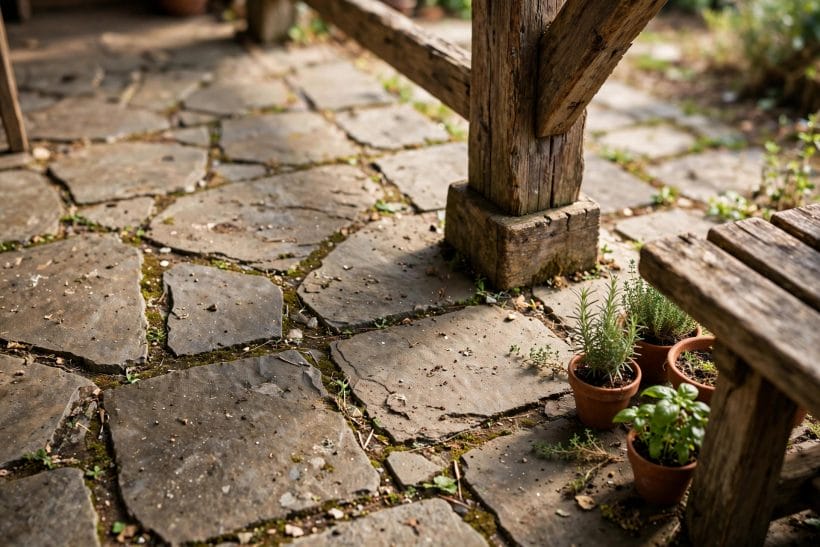
17. Flagstone underfoot
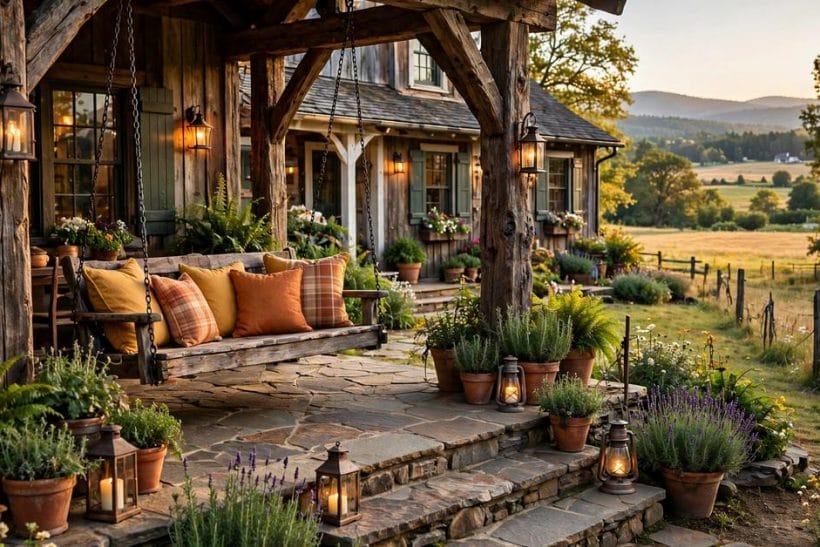
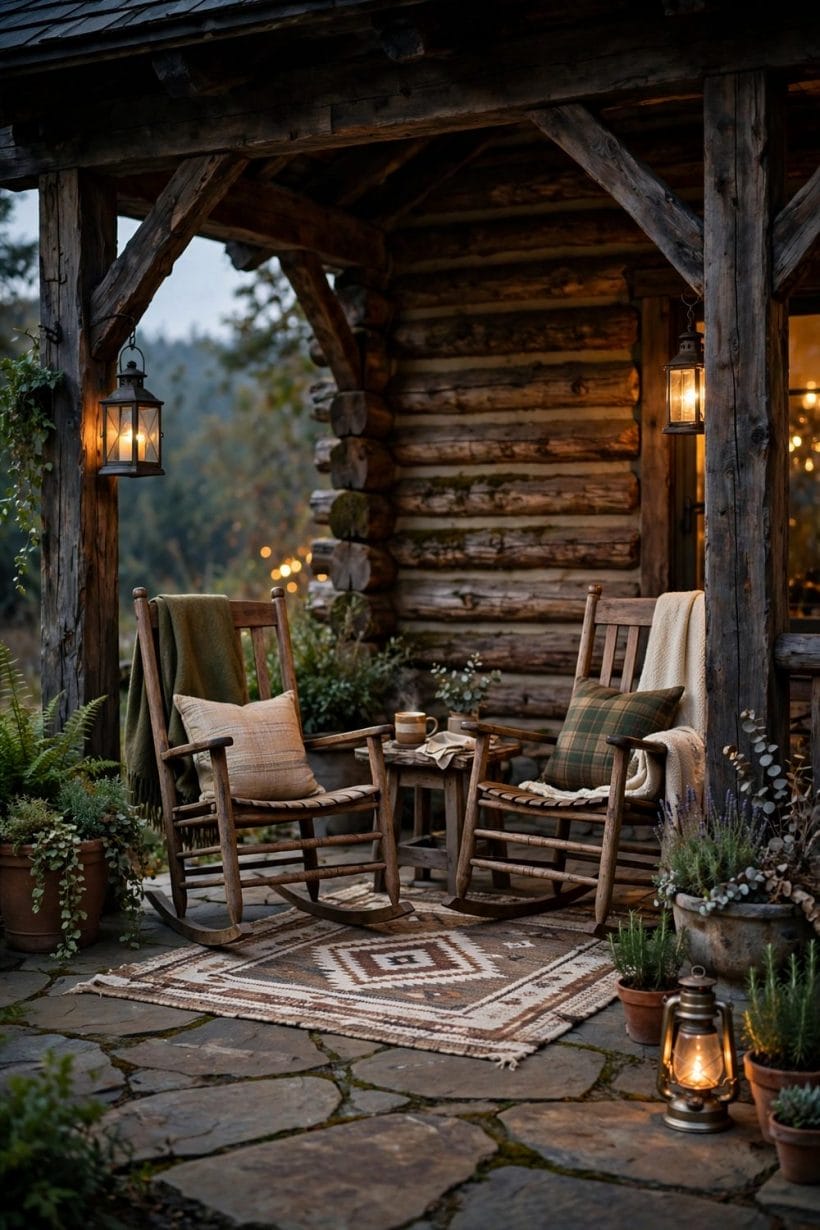
The second gallery’s floor — big, irregular flagstones with soft joints — is the rustic porch’s foundation statement. Stone stays cool in summer, shrugs at mud and weather, and gives every timber post a worthy base. It is the floor the style was invented on.
18. Stone piers for the posts
Raising each timber post on a low stone pier lifts the wood clear of standing water and gives the porch its grounded, built-forever look. The detail reads beautifully in the second gallery’s close-up: post, stone base, herbs at the foot — structure as decoration.
19. Brick floors for warmth
Where stone is scarce, brick laid in a herringbone or basket pattern gives a warmer-toned rustic floor with forgiving texture. Old brick, or new brick with an old face, pairs with timber as naturally as stone does and costs the porch nothing in character.
20. Wide weathered boards
A boarded porch floor in wide, silvered planks is the mountain-and-lake version of rustic. Left to weather honestly, the grey timber floor needs no stain and no apology — just a yearly check for the board that has begun to soften.
21. Stone steps with soft edges
Rough-hewn stone steps, slightly uneven and generously deep, continue the floor’s story to the garden. Plant their edges with herbs and low flowers, as the feature photograph does, and the boundary between porch and landscape disappears into green.
22. Gravel at the porch’s edge
A band of gravel where the porch meets the garden drains the drip line, crunches pleasantly underfoot, and gives potted plants a natural standing ground. It is the unbuilt border that makes the built porch look settled into its site.
23. Moss and thyme in the joints
Letting low green things colonise the flagstone joints — moss in shade, creeping thyme in sun — softens new stonework into old in a single season. On a rustic porch this is not neglect; it is the gardening of the floor itself.
24. A stone hearth corner
Where the porch is deep enough, a small stone fireplace or a fire-bowl corner extends its season into the cold months. Even unused in summer, the stone mass anchors the seating arrangement — the porch’s furniture naturally gathers toward it, indoors or out.
5. Timber Posts, Beams and Braces
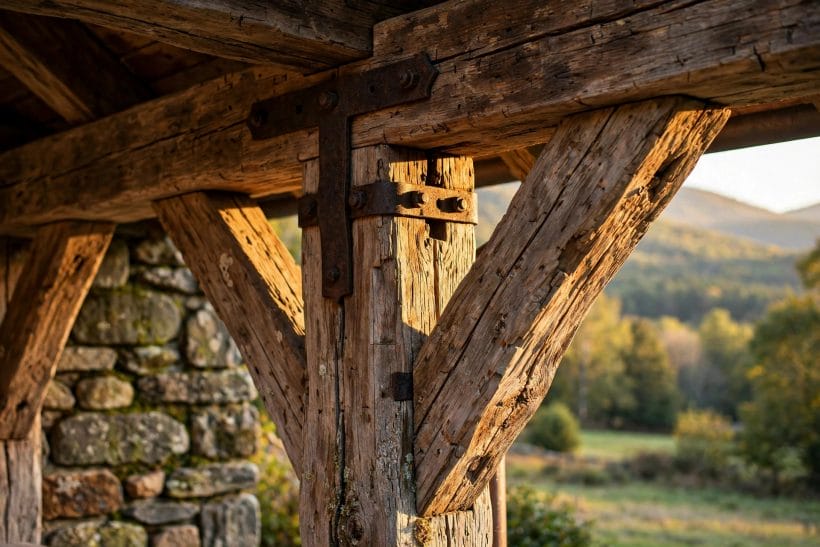
25. Posts with presence
Rustic posts are thick — thick enough to read as structure from the road. The third gallery’s hand-hewn post, adze marks and all, shows the ideal: timber that looks grown and worked, not milled and hidden. Slender posts belong to other styles; here, mass is the message.
26. Knee braces at the corners
The diagonal braces where post meets beam are the rustic porch’s signature joinery — structural, beautiful, and visible from every seat. Curved or chamfered braces soften the engineering into craft; leave the bolts and plates honest, in black iron.
27. Exposed rafters overhead
Under a rustic porch roof, the rafters and boards stay visible: the ceiling is the structure, often in a warmer stain than the posts. String lights and hanging plants take to exposed rafters as if they were designed for them — in a sense, they were.
28. Rough-sawn and reclaimed timber
Saw marks, nail holes and old paint ghosts in reclaimed beams give a new porch instant ancestry. Source honestly and check reclaimed timber for treatment history; the look is worth the diligence, and no new material fakes age half as well.
29. Timber cladding on the house wall
Board-and-batten or horizontal weatherboard on the wall behind the porch completes the cabin register — the feature photograph’s shutters and boards are the composed version. The porch then reads as part of the house’s body, not a structure leaned against it.
30. Iron brackets and hardware
Black iron strap hinges, brackets and tie plates are the rustic porch’s jewellery — functional first, decorative by honesty. Keep the metal family consistent from the swing chains to the door latch, and the whole structure reads as one blacksmith’s afternoon.
31. A beam for the house name or number
The front beam is the traditional place for a carved number, a routed name or a hanging sign. It is the porch’s handshake with the road — a small, permanent piece of lettering that makes the house findable and the porch unmistakably someone’s.
32. Shutters in a muted colour
Board shutters in sage, slate or faded black frame the porch’s windows and echo its timber. Working shutters earn their place in storm country; fixed ones earn theirs purely as composition — either way, the deep colour against pale walls is the farmhouse accent.
33. Letting the wood silver
Untreated cedar and oak weather to a silver-grey that many rustic porches choose deliberately: no staining schedule, no peeling, just a slow, even fade. It is the lowest-maintenance finish in this post and, beside stone and greenery, one of the most beautiful — the same honesty the rustic cabin interior ideas prize indoors.
6. Rocking Chairs and Slow Seating
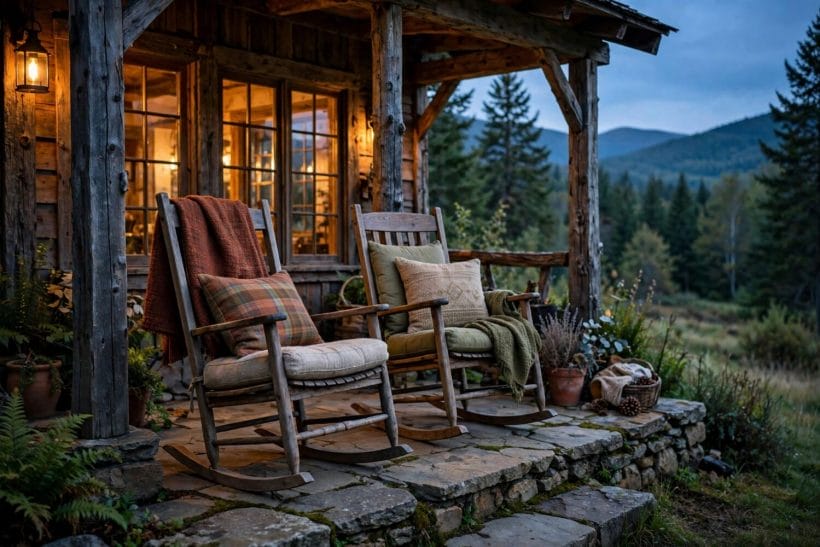
34. A pair of rockers facing the view
The fourth gallery’s two rockers, cushioned and blanketed at dusk, are the porch’s conversation seats. A pair invites company; a single rocker invites contemplation. Wooden rockers with wide arms — room for a cup on the arm itself — are the traditional, correct shape.
35. The bench along the wall
A long, plain bench against the house wall seats the overflow at gatherings and holds plants, baskets and parcels the rest of the time. Benches are the porch’s most flexible citizens: seating, table, shelf and stage in one honest length of timber.
36. Wicker and rattan in natural tones
Woven chairs soften the timber-and-stone palette with texture, as the evening gallery shows. Natural wicker belongs under a roof’s protection; where the porch is open, woven-look outdoor materials keep the texture and lose the weather anxiety.
37. Adirondack chairs on the wide porch
Deep, sloped Adirondacks are the rustic porch’s loungers — built for long sits and long views. In weathered wood or a deep green paint they sit happily at the porch’s end, angled toward each other and the garden in permanent conversation.
38. A glider for the gentle-hearted
The glider bench gives the swing’s motion without the chains, the porch swing’s sociability on a frame that stays put. For households with small children or uncertain joists, the glider is the swing’s sensible sibling — and it rocks nobody’s drink.
39. Seating arranged for talk
Angle the chairs toward each other, not toward the road: porches seat people in conversation first and in audience second. The test is simple — from every seat, another face should be easier to see than the view is, however lovely the view.
40. A small table between every two seats
Drinks, books and spectacles need landings. A stump stool, an iron café table or a wooden crate between each pair of seats is the porch’s hospitality infrastructure — unglamorous, essential, and the detail guests unconsciously rate the whole porch by.
41. The porch as outdoor room
Furnish the porch as a room — seating grouped on a rug, a lamp’s glow, a table dressed — and it stops being a passage to the door. That shift, from corridor to destination, is the whole ambition of the rustic porch; the evenings in the front porch railing ideas collection begin from the same furnished-porch principle.
7. Lighting: Lanterns, Strings and Sconces
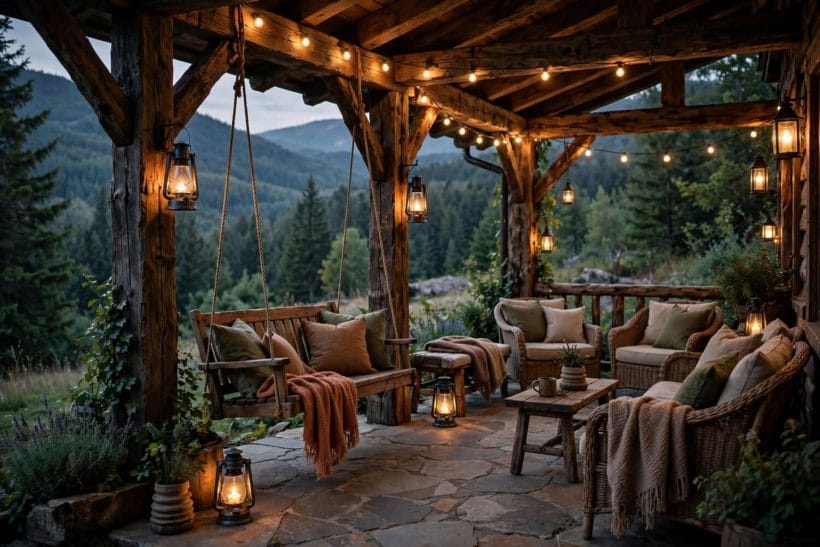
42. Lanterns at the steps
A lantern on each side of the steps — candle or LED — marks the porch’s threshold with a pool of welcome. The fifth gallery’s evening scene runs on exactly this light: low, warm and multiple, never a single bright source glaring from above.
43. String lights in the rafters
Festoon strings looped along the beams give the porch its evening ceiling of small suns. Warm-white bulbs only, please — the rustic porch at night should look lit by fireflies and good decisions, not by a fairground. Leave them up all season; they are the roof’s jewellery.
44. Wall sconces by the door
A lantern-style sconce either side of the front door is the porch’s permanent lighting — the rest is atmosphere. Black iron, seeded or clear glass, and a warm bulb: the fitting should look as if the house was built around it.
45. Candles in hurricane jars
Real flame belongs on the rustic porch, protected in glass hurricanes against the breeze. Group them on the table and the steps where their light pools on stone and timber — the materials themselves seem to remember being lit this way.
46. A hanging pendant over the seating
Where the porch roof is high, a single iron-and-glass pendant over the main seats gives the arrangement a centre and a pool of reading light. Hang it low enough to feel intimate, high enough to clear the tallest guest’s stories.
47. Solar stakes along the path
The porch’s light should reach a little way into the garden: low solar lanterns along the path stitch the porch to the landscape and bring guests safely up the steps. Choose warm-toned lights so the garden and the porch speak the same colour of light.
48. No overhead glare, ever
The rustic porch’s one lighting law: nothing bright overhead. Bare bulbs and security floods kill the mood the lanterns built. If a bright light must exist for safety, put it on a motion sensor at the porch’s edge and let the evenings belong to the warm lights.
8. Plants, Pots and Greenery
49. Terracotta, the porch’s pot
Terracotta is to the rustic porch what brass is to the kitchen: the material that always belongs. Its clay warmth suits stone and timber, it ages into moss and mineral bloom, and a cluster of weathered pots at the steps is half the feature photograph’s charm.
50. Ferns in the shade
The shaded porch is fern country — Boston ferns in hanging baskets and big pots of mixed green at the posts. Ferns forgive low light, love the porch’s humidity, and give the soft, feathery texture that stone and timber ask for as a counterpoint.
51. Herbs by the door
Lavender, rosemary and thyme in pots near the door scent every arrival and departure — brush the lavender as you pass and the porch greets you properly. Herbs also earn their keep in the kitchen, which makes them the porch’s most defensible planting.
52. A climber on the post
One climbing rose, jasmine or honeysuckle trained up a post ties the porch to the garden vertically. Give it a discreet wire or trellis and two seasons of patience; after that the structure disappears pleasantly into leaf and flower each summer.
53. Window boxes on the rail
Boxes of geraniums, trailing ivy and herbs along the porch edge bring the garden up to sitting height. From inside the house they frame the view in flowers; from the road they are the porch’s smile. Keep the boxes timber to match the structure.
54. Seasonal pots by the steps
Rotate the step pots with the year — spring bulbs, summer geraniums, autumn grasses and berries, winter evergreens with cones. The porch then keeps a calendar, and the house’s entrance never wears last season’s clothes into the next.
55. A small tree in a big pot
An olive, a dwarf maple or a bay in a substantial pot gives the porch a piece of vertical architecture in green. It marks the corner, shades a seat, and — unlike planting in the ground — can be rearranged when the furniture changes its mind.
56. Hanging baskets at head height
Baskets hung between the posts at just above head height float flowers in the porch’s air without costing floor space. Keep them where a watering can reaches without a ladder, or they will quietly die of good intentions by midsummer.
57. The wild edge
Let the garden lean in: lavender spilling at the steps, grasses against the piers, a rose escaping its training. The rustic porch should look gathered by the landscape rather than defended from it — the feature image’s flower-edged steps are the whole philosophy in one detail.
9. The Screened Rustic Porch
58. Screens in timber frames
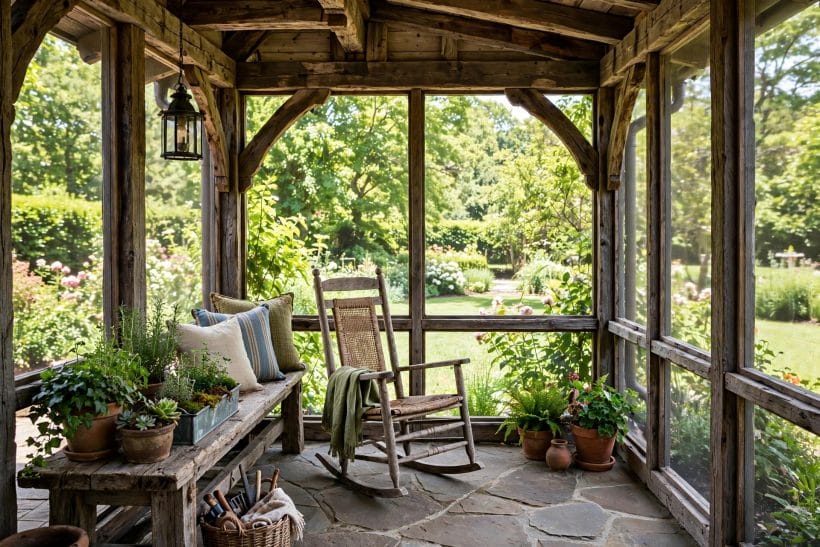
The sixth gallery screens its porch the rustic way: fine mesh in honest timber frames, the garden visible and the insects theoretical. Screening a rustic porch does not dilute the style — the frames become part of the joinery, and the room gains whole evenings.
59. A screen door that slaps
The wooden screen door with its spring and its soft slap is the screened porch’s soundtrack. Fit a proper latch and a handle at hand height; the door will be opened a thousand times a summer, often with both hands full of lemonade.
60. Dining on the screened porch
A table on the screened porch eats outdoors without eating with the insects — the strongest argument the screens make. Dress it simply: a runner, lanterns, the garden on every side. Summer dinners migrate here and rarely return indoors.
61. A daybed behind the screens
The screened porch is the house’s best nap room: a daybed or a deep bench with cushions, a throw, and the sound of the garden arriving without its bite. Afternoon readers and overnight guests in kind climates both claim it, in that order.
62. Fans for the still evenings
A ceiling fan in the porch roof keeps screened evenings comfortable and the insects discouraged — moving air is the screened porch’s second defence. Choose a fan with a timber or rusted finish so the fitting belongs to the structure it cools.
63. Half-walls under the screens
Building the lower portion as a timber half-wall, with screens above, protects the mesh from chair backs, dogs and weather, and gives the porch a ledge for plants and drinks. It is the traditional construction, and tradition here is simply experience that worked.
64. Blinds for the low sun
Simple roll blinds of canvas or bamboo inside the screens handle the evening glare that turns a west porch into an oven. Rolled up, they disappear into the beam; dropped, they give the golden hour without the squint — the screened cousin of the screened in porch ideas collection’s own shading solutions.
65. The porch bed swing, screened edition
Inside screens, the hanging daybed becomes a sleeping porch — the old farmhouse institution, revived. With the insects outside and the night air inside, it is the best bed in the house for half the year in many climates, and the most argued-over.
66. Keeping screens rustic
Bronze or charcoal mesh reads softer than bright aluminium, and timber frames painted to match the posts make the screens disappear into the architecture. The style survives screening easily — what it cannot survive is plastic, so keep the porch’s materials honest to the last fitting.
10. Building and Caring for a Rustic Porch
67. Start with the structure’s bones
Posts, floor and roof in honest materials will carry any amount of styling; weak bones carry none. If the budget forces a sequence, spend on the timber and stone first and let the cushions arrive over seasons — the porch will look intentional at every stage.
68. Drainage is destiny
A porch floor that sheds water away from the house, posts lifted on piers, and a drip edge that works: these unphotogenic details decide whether the porch is charming in twenty years or rotten in five. Rustic materials forgive weather; they do not forgive standing water.
69. Timber care, lightly done
Oiled finishes want a fresh coat every year or two; silvered timber wants only an inspection. Either way, the annual walk-around — checking post bases, brace bolts and the boards that take the weather — is the porch’s whole maintenance religion, briefly practised.
70. Stone needs almost nothing
Flagstone and brick ask for a sweep, an occasional wash, and the repointing of a joint now and then. That is the deep appeal of the rustic palette: the more permanent the material, the less it asks — the porch ages at the speed of its softest parts.
71. Storing the soft things
Cushions and throws last twice as long with a dry home in bad weather — the deck box, a bench with a hinged seat, or a hook rail just inside the door. The rustic look tolerates faded; it does not tolerate mildewed, and storage is the difference.
72. Scale the porch to the house
A porch deep enough for a swing and a walkway, posts sized to the house’s height, a roof pitched with the main roof’s manners: proportion is what separates the farmhouse porch from the deck with ambitions. The calmer sunroom alternative in the small sunroom ideas collection solves the same need in glass where a porch cannot fit.
73. Build for the evenings
Judge every plan at dusk: where will the lanterns stand, which seats catch the last light, where does the sunset land? Porches earn their love after working hours; a design that plans its evenings will be loved in daylight automatically.
74. Add it over years
The best rustic porches look accumulated — a chair from here, a table from there, pots of three ages. Resist completing yours in a single purchase. The swing and the stone this year; the rockers find you later. Patina cannot be ordered, only allowed.
75. The welcome test
Judge the finished porch from the garden path: does it look like the house is expecting someone it likes? Timber, stone, a lit lantern and a seat that invites — when a stranger slows down to admire it and a friend heads straight for the swing, the porch has passed.
Final Considerations
A rustic porch is a structure before it is a style: heavy timber honestly joined, stone or brick underfoot, and a roof that keeps the weather honest. Dress it with a swing, seats arranged for talk, warm low light and terracotta full of green, and it becomes what it has always been in country houses — the room where the day is started with coffee and ended with the lanterns lit. Build the bones well, add the soft things slowly, and let the sun and the seasons do the finishing.


0 Comments