

A beautiful parcel with no water rights is not a homestead — it is an expensive view. Buyers fall for land the way they fall for houses, and this heartbreak costs more: the failed well, the shaded hollow, the zoning letter that arrives after the money has moved. This guide replaces the romance with arithmetic — one 100-point score every parcel must earn before you sign.
1. Where to Buy Land for Eco-Living at a Glance
Where to buy land for eco-living is decided less by scenery than by six measurable systems: water, sun, soil, law, access and price. The scoring framework in this guide weights them the way self-sufficiency actually ranks them — water first and heaviest at 25 points, because nothing substitutes for it; sun and soil at 20 each, because they are the energy and the food; legal freedom at 15, because it is the permission everything else stands on; and access and price at 10 each, because they decide livability and terms. Every category is scored against the same anchors, from the best case the original framework names down to the failure case, so two parcels in different counties can be compared honestly on one sheet. The table below is the whole system at a glance; the sections after it take each category apart in turn.
| Attribute | Detail |
|---|---|
| The Total | 100 points across six weighted categories — one score for every parcel, comparable anywhere |
| Water — 25 Points | Well potential, surface water, rainfall catchment and water quality; a reliable well plus surface water scores 25, hauling water scores 5 |
| Sun and Energy — 20 Points | Solar exposure, wind and woodlot; full sun plus a woodlot scores 20, deep north-slope shade scores 5 |
| Soil and Growing — 20 Points | Soil type, growing season, topography and existing pasture or orchard; deep loam with a long season scores 20, thin rocky steep ground scores 5 |
| Legal and Zoning — 15 Points | Zoning, CCRs and HOA restrictions, water-rights doctrine and the agricultural tax exemption; unrestricted agricultural zoning scores 15, an HOA with minimums scores 3 |
| Access and Community — 10 Points | Year-round road, distance to services, internet connectivity and neighbours; a good road, town within reach and a signal score 10, landlocked with no signal scores 2 |
| Price and Terms — 10 Points | Per-acre price against regional comps, owner financing and carrying costs; a fair price with terms scores 10, overpriced and cash-only scores 3 |
| The Water Standard | A well yield of 5 gpm is the stated minimum; 30″+ of annual rainfall makes roof catchment a real supply |
| The Growing Standard | 120+ frost-free days and 6″+ of topsoil mark land that can feed a household |
| The Buy Threshold | 70 points or more out of 100 to buy — below the bar, keep looking |
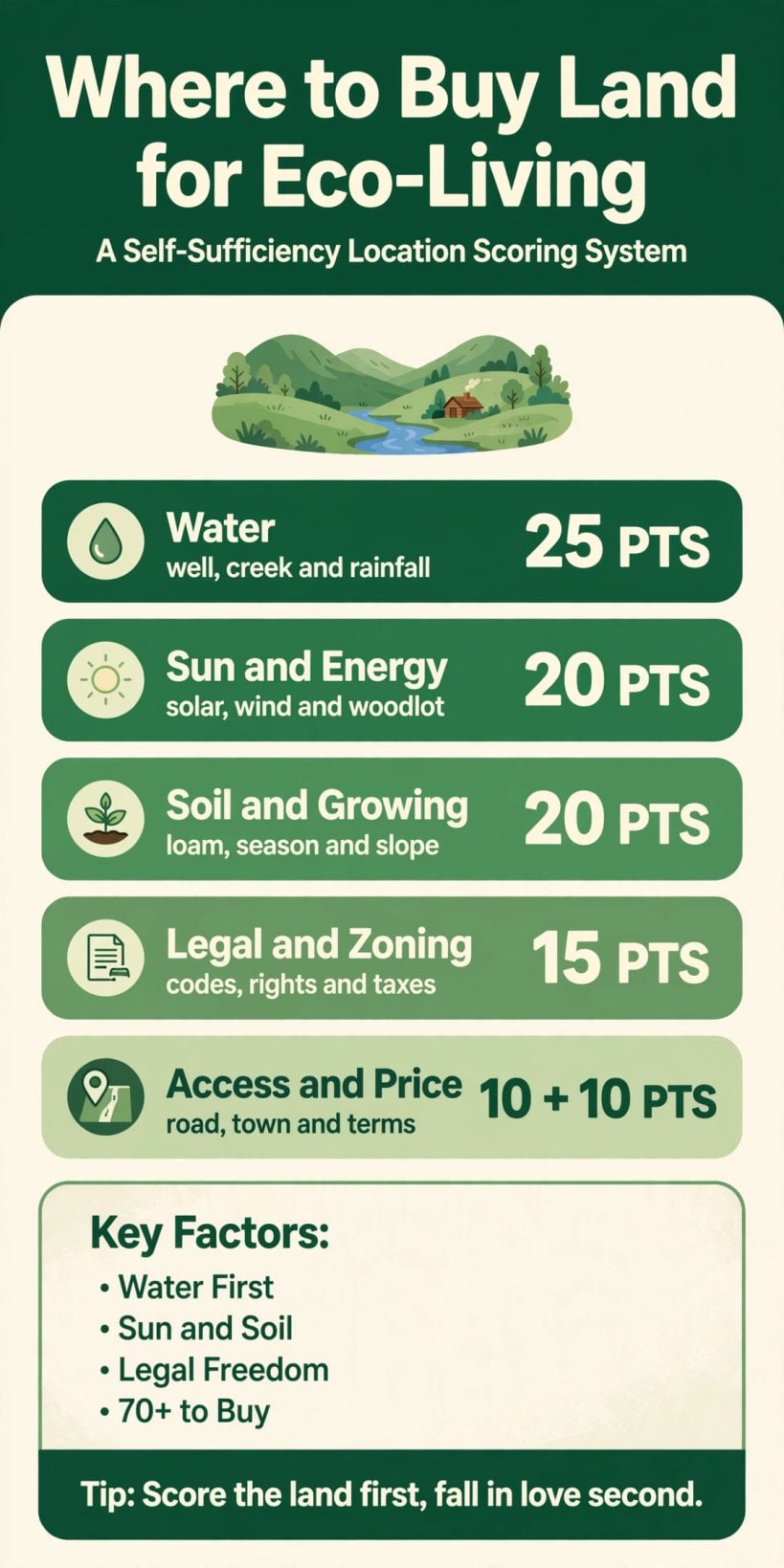
Twenty-five of the hundred points ride on water alone — the weighting is the whole argument of the system on one card.
Read the weights as a dependency chain, not a menu. Legal freedom is worthless without water; a long growing season cannot rescue a landlocked parcel you cannot reach in February; cheap acres are expensive when the well must be hauled to. That is why the system is scored whole: a parcel is only as strong as its weakest category, and the total exists to expose the weakness before the purchase does. Score in order and let the failures show early — the total usually says what your gut was trying not to hear.
2. Water: The 25-Point Category
Water carries a quarter of the entire score because it is the one attribute that cannot be engineered around after the purchase. The category reads four sources in turn. First, well potential: the aquifer beneath the parcel, read through the driller’s logs for the area — the depth wells nearby were drilled to, the yield they produce and the quality they report. Those logs turn a guess into a known, and the framework’s stated floor is a 5 gpm minimum yield: below it, a household supply is a hope rather than a system. Second, surface water: a creek or spring with year-round flow, which opens the gravity-fed option — water moving to the house site without a pump — and triggers the water rights check, because flowing water on the land is not automatically water you may use.
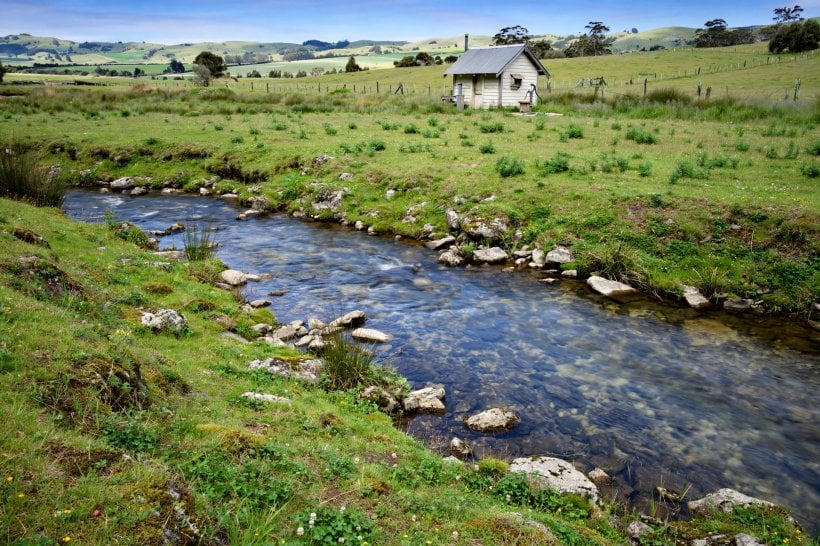
Third, rainfall: the catchment. The framework’s benchmark is 30″+ of annual rainfall, the level where the rainwater math starts to work — a roof collecting into tanks becomes a genuine supply rather than a supplement, which is why the sizing method in the rainwater harvesting and tank sizing guide matters at scoring time, not after the move. Fourth, quality: the test, taken from neighbouring wells’ reports — the minerals, the contaminants — with a filtration budget allowed for whatever the reports show. The scoring anchor states the spread plainly: a reliable well plus surface water earns the full 25; a parcel where water must be hauled earns 5. Twenty points of the hundred turn on this one category, which is exactly the proportion water will occupy in your life on the land.
3. Sun and Energy: The 20-Point Category
Energy independence starts with the site’s gifts, and this category inventories them. Solar exposure comes first: an unshaded southern exposure with a working array site, verified rather than assumed — the framework names the solar pathfinder’s reading as the instrument, because a slope that looks sunny in a summer visit can sit in shadow through the winter months that decide an off-grid power budget. Wind is the second gift: a ridge with consistent 10+ mph wind is the turbine supplement, the exposed position that lets a small turbine carry the hours and seasons when the array is idle. The third gift is the woodlot: 2+ acres of manageable forest, scored as the renewable heat source — a woodlot that can be harvested sustainably is a heating system that replants itself, and it belongs in the energy column rather than the scenery column.

The trade-off between the first two gifts is developed in the solar vs wind for the homestead comparison, and it is a scoring question before it is an equipment question: a parcel strong in one gift can forgive weakness in the other, but a parcel weak in all three has no energy story at all. The anchors mark the extremes — full sun plus a woodlot scores the full 20; deep north-slope shade scores 5. Between them, score what the site actually gives: partial southern exposure with a small woodlot is a middling energy parcel no matter how the listing photographs it, and the score should say so.
4. Soil and Growing: The 20-Point Category
The soil category is where the food comes from, and it is scored on evidence you can hold in your hand. Soil type first: the loam, tested with the jar test — a sample shaken in water and settled into its sand, silt and clay bands, so the balance is read rather than guessed — together with the drainage the layers imply and the 6″+ of topsoil the framework sets as the depth worth having. Growing season second: the frost dates, with 120+ days as the benchmark season and the zone behind it, read alongside the potential for season extension, because a site whose structure stretches the season effectively grows in a longer one. Topography third: the gentle south slope is the stated ideal, because it stacks drainage, sun and air flow in one landform — and its opposite number is named just as clearly, the frost pocket, the low still hollow where cold air pools and settles on the garden, to be avoided rather than planted.
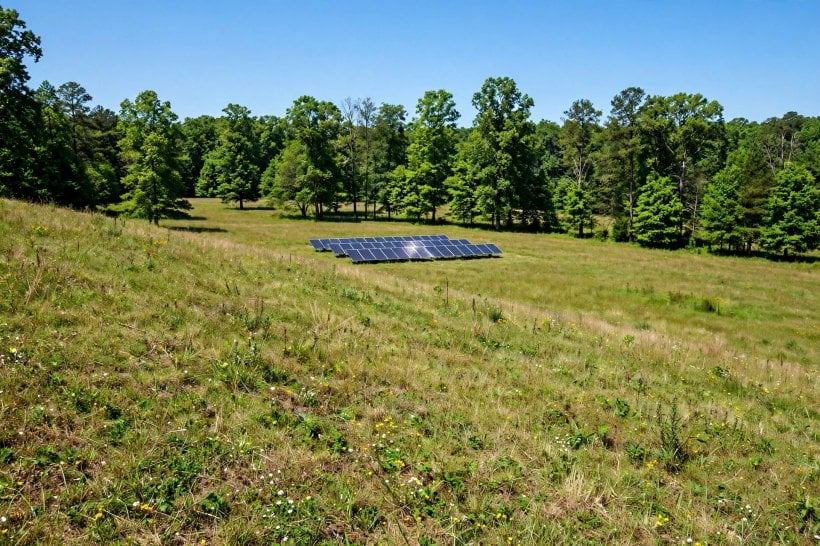
Existing condition is the fourth read: cleared pasture or an established orchard is a head start — growing space and established fertility you do not have to build — while raw forest floor is years of work before the first real harvest. Feeding the soil you do have is its own discipline, covered in the composting chemistry guide, but no compost programme manufactures topsoil depth or frost-free days on a purchase timescale. The anchors again: deep loam with a long season scores 20; thin, rocky, steep ground scores 5 — land that will grow a view and very little else.
5. Legal and Zoning: The 15-Point Category
Every physical virtue in the earlier categories is conditional on permission, and this category reads the paper before the purchase. Zoning first: agricultural or residential classification, and the specific question the framework puts at the top of the code check — are tiny houses allowed? The answer lives in the local code, and the method for working through unconventional structures is laid out in the building codes for eco-structures guide; a parcel whose zoning quietly forbids your dwelling type is not a bargain at any price. Restrictions second: the CCRs and HOA fine print — minimum square footage rules and aesthetic rules are named as the deal-breakers they are, because a minimum-size clause is a tiny-house prohibition wearing paperwork.

Water rights are the third legal read, and the framework names the doctrine split directly: prior appropriation versus riparian rights — the western complexity that decides whether the creek in the water category is an asset or a decoration. Rainfall has a legal side too, state by state, in the legality of collecting rainwater guide. Taxes close the category: the agricultural exemption, the farm-use assessment, is quantified in the original at an 80% tax cut for land that qualifies — a carrying-cost difference that compounds every year you hold the parcel. The anchors: unrestricted agricultural zoning scores 15; an HOA with minimums scores 3, and a 3 in this column should end most conversations regardless of the total.
6. Access and Community: The 10-Point Category
Access is the livability category — the one that describes not the land’s potential but your ordinary Tuesday on it. The road comes first: year-round, maintained access, judged by the winter reality rather than the dry-season drive in, and including the easement’s legality where the route crosses someone else’s land — an informal track that a neighbour can close is not access, whatever the listing calls it. Distance second: the services radius, benchmarked at 30 min to town — the run for supplies and for medical care — with the isolation premium named honestly: remoteness is not free, it is paid in time and fuel on every trip, forever.
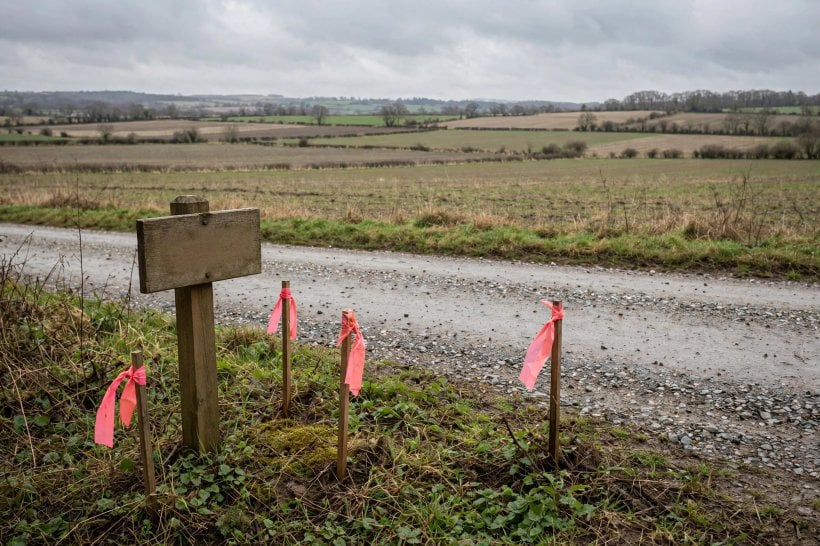
Internet is the third read, and the framework notes that Starlink changed the math: connectivity is no longer decided by the last mile of cable, which makes remote-work viability a real scoring input rather than a reason to reject every rural parcel — the options are worked through in the off-grid internet guide. Neighbours close the category: like-minded people nearby are scored as infrastructure — tool-sharing, help in an emergency, the intangible that no purchase adds later. The anchors: a good road, town within reach and connectivity score 10; landlocked with no signal scores 2 — and landlocked is the one score in the system that no later spending fully repairs.
7. Price and Terms: The 10-Point Category
Price is deliberately the smallest category, because a cheap parcel that fails on water is the most expensive land of all — but within its 10 points it is scored rigorously. Price per acre first: the regional comps, the per-acre reality of the area, improvement-adjusted — a parcel with a well, a road and cleared pasture is not comparable to raw acres at the headline figure, and the comps have to be corrected for what each parcel actually carries. Terms second: owner financing, the land contract, is named as the bank-free path, with the 10% down tradition as its customary shape — terms decide whether a fairly priced parcel is actually buyable by the person scoring it.
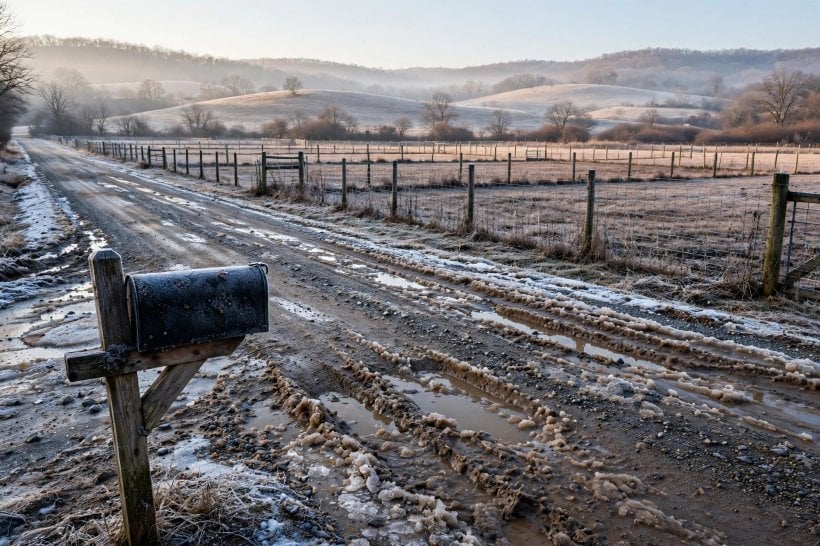
Carrying costs third: the taxes and insurance, the annual nut — the recurring figure that decides the sustainability of holding the land while you build, improve and wait for systems to mature. It is where this category shakes hands with the wider money picture in the homesteading economics guide: the purchase price is paid once, but the annual nut is paid every year until the dream is finished. The anchors: a fair price with workable terms scores 10; overpriced and cash-only scores 3. And the framework’s closing note on the category is the system’s philosophy in one line — the 100-point total is what makes comparisons honest, because price is only ever one column of six.
8. Using the System: Score Three Parcels, Not One
The framework is a comparison instrument, and it only works comparatively. The practice rule is explicit: score 3+ parcels. A single parcel scored alone produces a number with nothing to judge it against; three parcels on one spreadsheet produce a ranking, and the ranking is where the numbers defeat the romance — the beautiful parcel’s weak water score sits in the same column as the plainer parcel’s strong one, and the best score wins on evidence rather than feelings. Build the spreadsheet with the six categories as rows and the parcels as columns, fill it from evidence gathered the same way for each — driller’s logs, jar tests, code checks, comp sheets — and let missing evidence score as the risk it is instead of the benefit of the doubt.
The discipline matters most at the moment of enthusiasm. Every input in the earlier sections was chosen because it can be gathered before the purchase, cheaply, by the buyer: logs and reports are requested, tests are run on site visits, codes are read at the county office or online, neighbours are talked to. Nothing in the system requires owning the land to score it. That is the entire point of scoring first — the framework moves every discoverable disappointment to the free side of the transaction, where it costs an afternoon instead of a down payment.
9. The Field Tests: February, Neighbours and Thirty Days
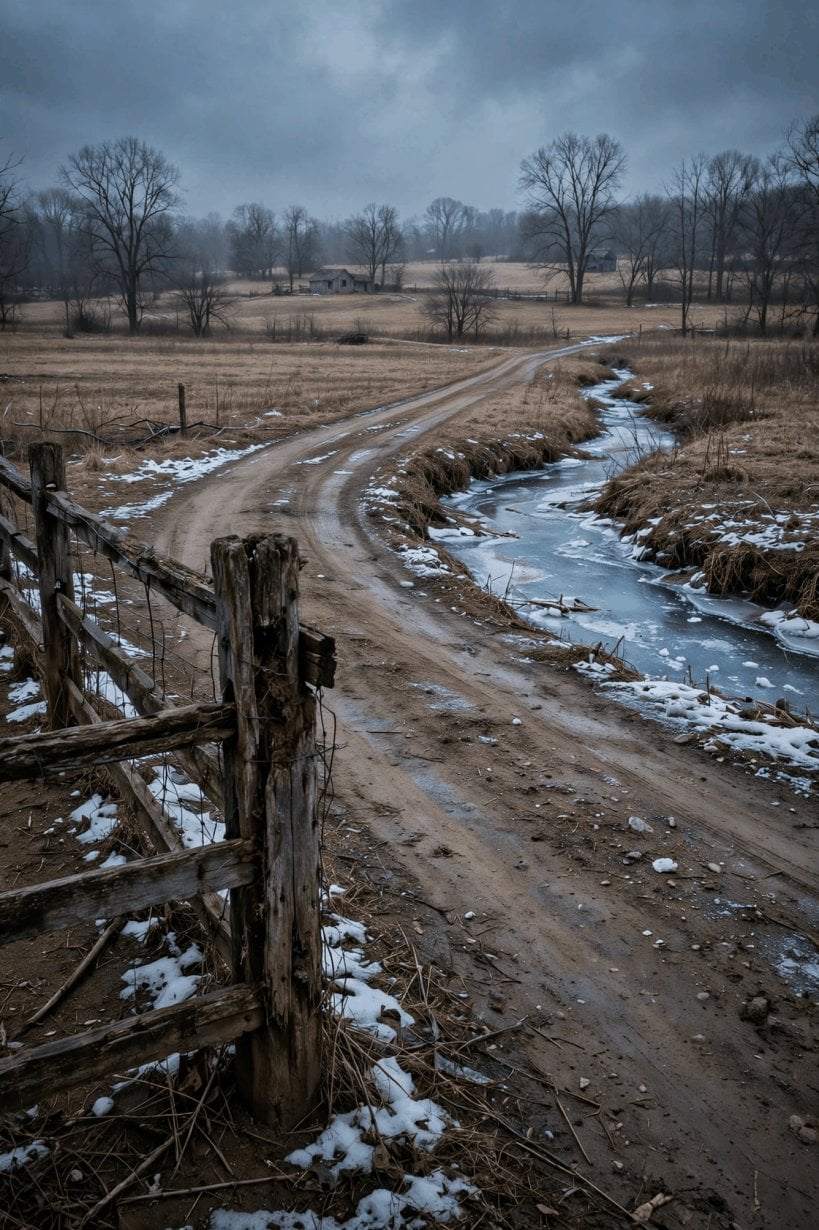
Three field disciplines close the practice. First, visit in the worst season: the February test. Mud, cold and access are the land’s truth; the summer visit lies — the creek at its lowest, the road at its worst, the slope in its winter shadow and the woodlot’s real heating burden all show themselves in the worst month, and a parcel that scores well in February will not ambush you later. Second, talk to the neighbours: the intelligence — well depths on the adjoining parcels, the road politics, the history of the land itself — is free due diligence, offered by the people with the least reason to sell you anything.
Third, sleep on it: the 30-day rule. The framework’s reasoning is blunt — land urgency is manufactured. The good parcel waits; the rushed buy regrets. A listing’s pressure to decide this week is a sales instrument, not information, and thirty days is time enough for the February visit, the neighbour conversations, the code check and the second, colder look at the spreadsheet. Run all three disciplines on every finalist parcel, and the score that survives them is a number you can sign against.
10. The Threshold: 70 to Buy, and the Red Flags That End It Early
The system resolves to one threshold: 70+ to buy. Below the bar, keep looking — the land is the foundation, and a foundation scored in the sixties will tax every system built on it for as long as you own it. The threshold is not a claim that a 71 is perfect; it is a claim that the weaknesses remaining above 70 are the kind money and work can fix, while the weaknesses below it include the kind they cannot. Read the total together with the category floors, because the framework’s own anchors name the red flags that should kill a deal before the total is even tallied: water at the haul-it-in floor of 5, legal at the HOA-and-minimums floor of 3, access at the landlocked floor of 2, price at the overpriced cash-only floor of 3. Any single floor score is a veto wearing a number.
Region frames all of it — the same scoring sheet reads differently in a wet eastern county and an arid western one, which is why the doctrine check and the rainfall benchmark sit inside the categories rather than beside them; the geographic side of the decision is explored in the where to move for climate resilience analysis. Score the parcel in front of you, in its own county, against its own comps and its own aquifer — the system’s honesty comes from local evidence, and its 70 means the same thing everywhere precisely because everything beneath it was measured locally.
Final Considerations
Weight water heaviest — 25 points, the irreplaceable — then sun and soil at 20 each, the energy and the food; law at 15, the permission; access and price at 10 each, the livability and the terms. Score three parcels on one sheet, visit the finalist in February, take the neighbours’ intelligence seriously, give the decision its thirty days, and buy only above 70. The scored land becomes the homestead; the unscored land becomes the lesson. Score the land first, and fall in love second — in that order, the love tends to last.




3 Comments