
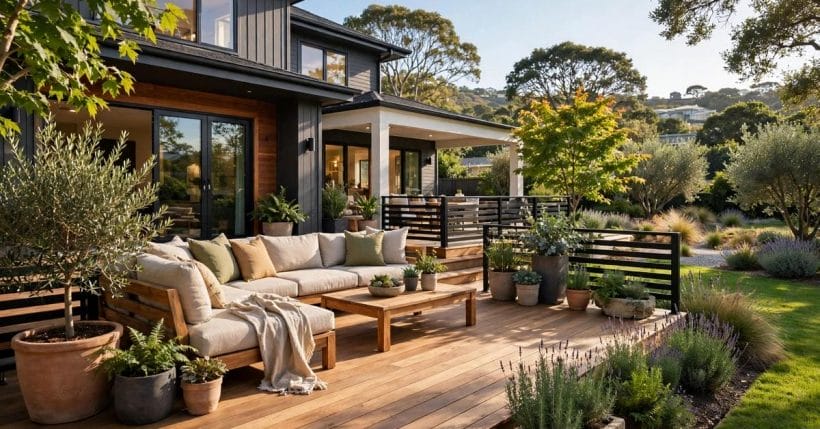
Two neighbours build decks that look the same from the street, and one pays half as much again as the other. The difference is rarely luck and never mystery: it is size, material, height and ground, decided in that order, long before anyone asks what a deck costs.
This guide is the honest version of a deck cost estimator: not a calculator pretending to know your plot, but the drivers that move every real quote, stated in general terms, and the questions that make quotes comparable.
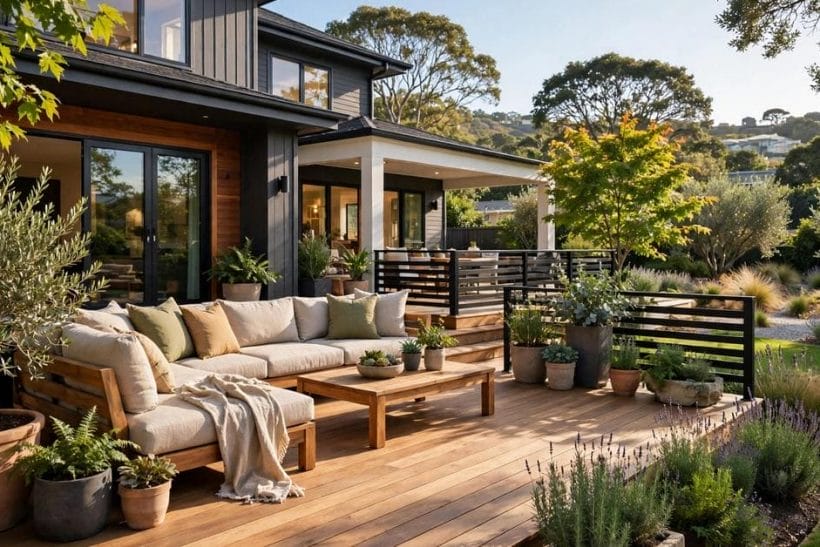
1. Cost to Build a Deck at a Glance
The central entity is the new deck: a raised or ground-level platform whose cost attributes are its footprint, its material family, its height and structure, its stairs and railings, the ground it stands on, and its finish. Any estimate of the cost to build a deck that ignores one of those is not estimating; it is guessing with arithmetic. The deck also belongs to the wider outdoor platform family gathered in our patio ideas collection — read the drivers below first, and any range, from any source, will start to make sense.
| Driver | What to know | Effect |
|---|---|---|
| Deck Size | Footprint and layout | Biggest impact |
| Material | Timber or composite | Premium feel |
| Height | Ground level or raised | More structure |
| Stairs | Access and safety | Moderate |
| Railing | Style and code | Adds detail |
| Finish | Stain, lighting, extras | Final touch |
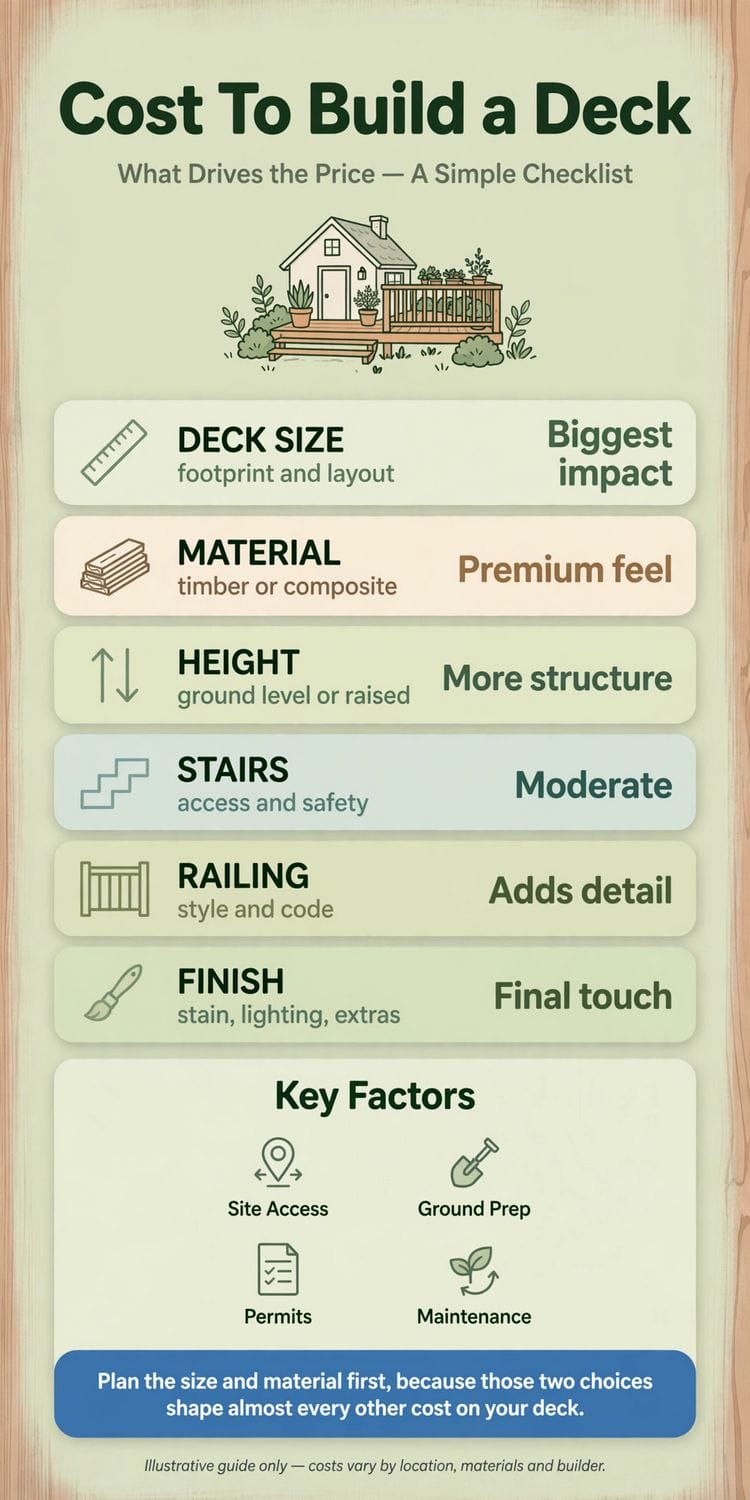
Plan the size and material first, because those two choices shape almost every other cost on your deck. Four further factors sit behind the table: site access, ground preparation, permits and maintenance — each capable of moving a quote on its own, each covered in the sections that follow.
A word on method before the drivers begin: this guide states ranges only in general terms — lower end, upper end, the expensive direction — because deck prices move with region, season and specification too fast for any printed figure to stay honest. What does not move is the structure of the bill, and that is what a buyer actually needs.
2. What Decides the Total in the First Place
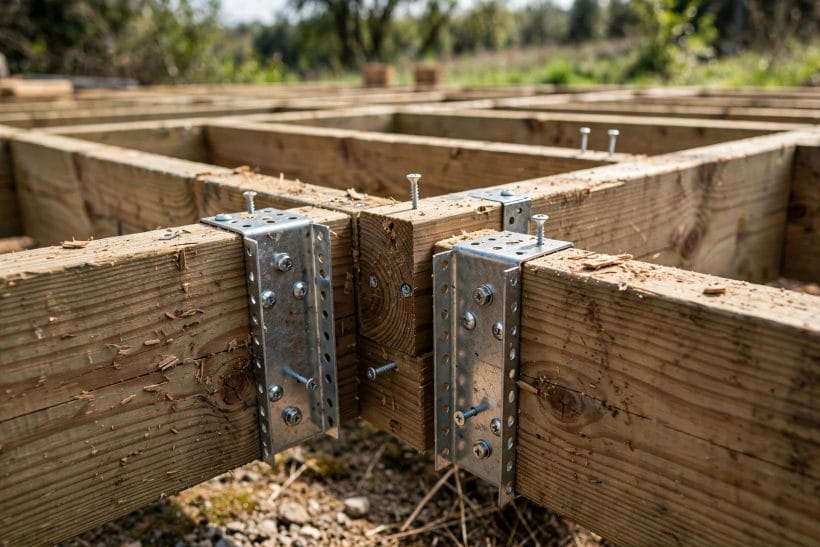
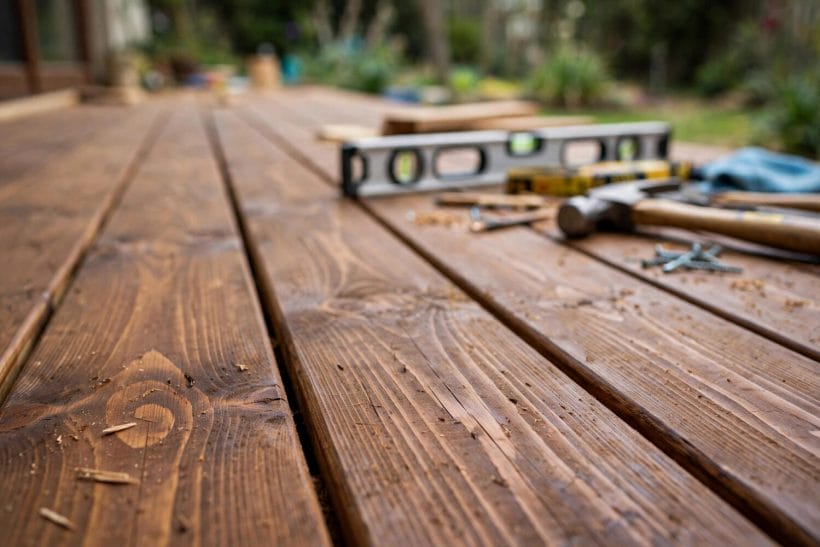
Every deck quote is the same sum wearing different clothes: materials, the labour to assemble them, the structure underneath that nobody sees in the photographs, the paperwork around the build, and the finishing that everybody sees. The framing in this photograph is the honest middle of that sum — the beams, posts and fixings that carry the platform are real material and real hours, and they scale with everything the sections below describe.
Three habits make quotes comparable. First, insist every quote describes the same deck — same footprint, same height, same material, same stairs and railing — because a cheaper quote for a lesser deck is not cheaper. Second, ask what is excluded: ground works, waste removal, permit fees and finish coats are the classic absentees. Third, ask who carries the risk of surprises in the ground, because decks stand on the one part of a garden nobody has surveyed.
It also helps to know what this guide is not. It gives no per-measurement prices and no calculator, because the honest drivers below will tell you which side of a range your deck belongs on — and a local builder’s itemised quote will do the rest. Decks are designed and built to local rules by people who can see the ground; structure, footings and fixings are stated generally throughout, and anything load-bearing belongs with a professional designer or builder and your local building control.
3. Size and Shape: The First Cost Driver
Size is the multiplier everything else is multiplied by. A deck twice the footprint takes roughly twice the boards — but more than twice the framing in awkward shapes, and the shape is where size quietly turns expensive. Rectangles are economical: long straight runs, few cuts, standard lengths. Curves, angles, notches around trees and bays, and split levels each add cutting, waste and framing hours out of proportion to the area they add.

Shape also decides how the deck is used, which decides whether it was worth building. A platform sized for a table and chairs is a different purchase from one sized for a table, chairs, planters, a bench and the party that overflows onto all of them — and our deck built-in bench ideas show how seating built into the footprint can serve a smaller deck better than furniture crowds a larger one. The cheapest square metre of deck is the one you never build because the layout was thought through first.
One more size effect hides below ground: bigger and higher decks need more substantial foundations, and foundations are priced by the hole, not by the square metre. That is section 5’s story — but it begins here, with a tape measure and an honest conversation about how the deck will actually be used on an ordinary Tuesday, not just at its first barbecue.
4. Material Families: Timber and Composite
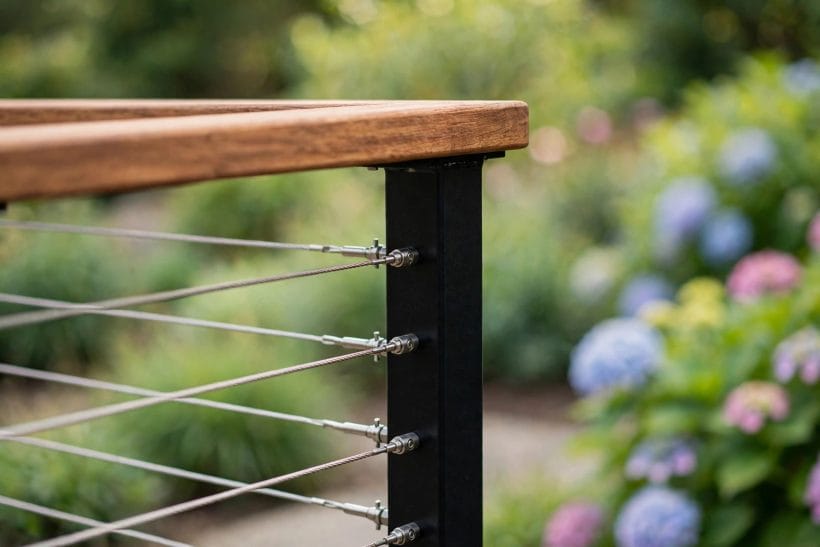
The platform’s surface is the second great driver, and it comes in two families. Timber — from everyday treated softwood through durable hardwoods — is the traditional material: warm, repairable board by board, and the lower-priced entry point in most markets, with its cost made back instead in upkeep, since timber asks for regular cleaning and re-finishing to keep its looks and its lifespan. The cable-railed deck in this photograph wears the family well.
Composite boards — wood fibre and plastic combined — are the premium-feel alternative: higher material cost, colour that runs through the board, and a care routine closer to washing than refinishing. Composites vary widely between ranges in cap construction, fade behaviour and warranty terms, all stated by their makers and all worth comparing in the maker’s own words rather than a showroom’s. Hidden-fixings systems, picture-frame borders and breaker boards add detail and labour to either family.
Beneath both sits the frame, usually treated timber whatever the surface, and the frame’s specification — timber grade, protection against ground moisture, metal fixings suited to outdoor use — is a cost line worth reading in any quote. A premium surface over a minimal frame is a mismatch quotes sometimes hide; the frame is the part you cannot upgrade later without lifting the deck you paid for.
5. Height, Footings and Structure
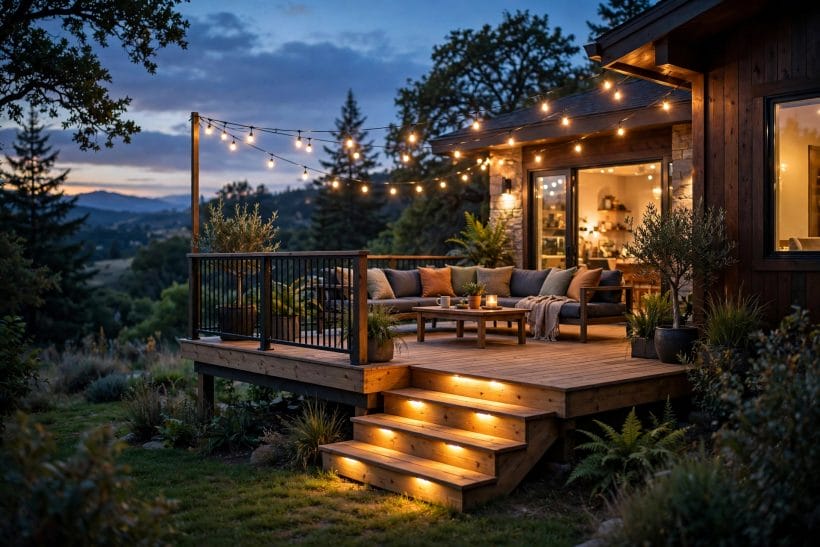
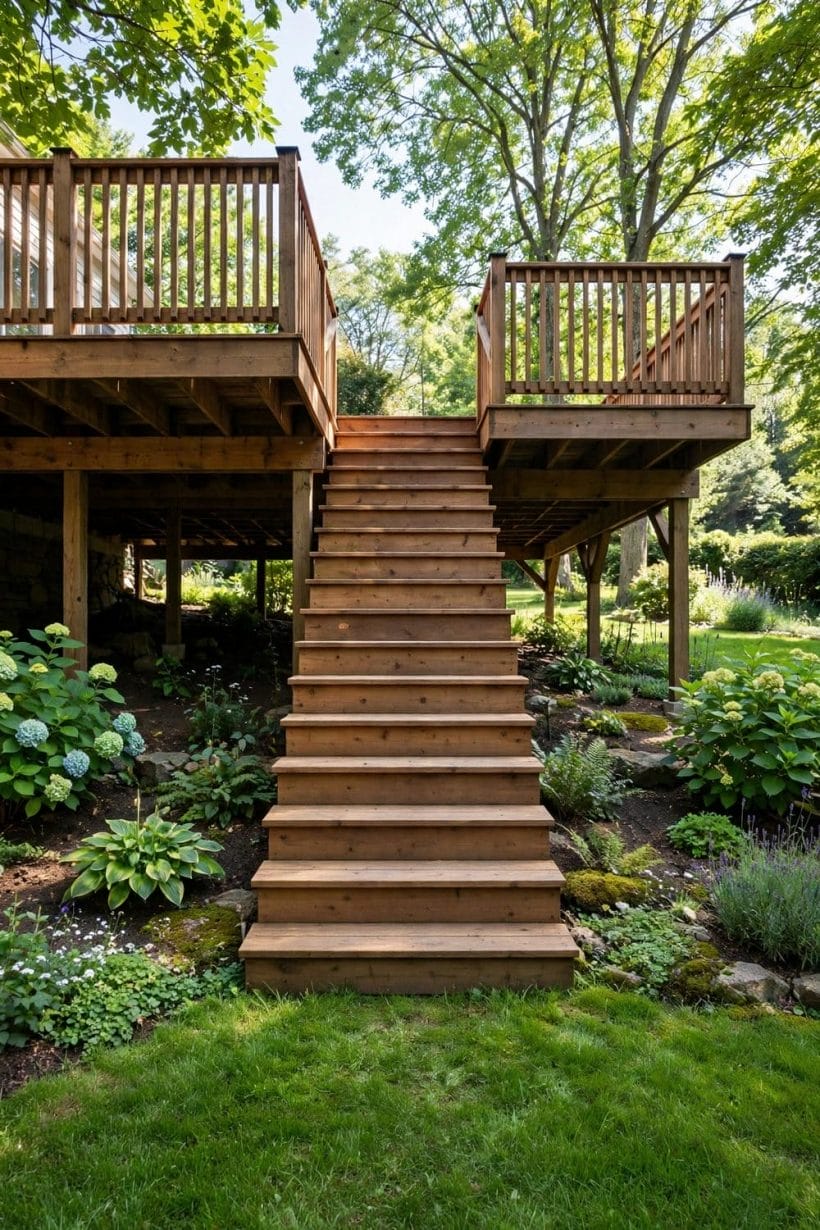
Height is the driver that turns a platform into a structure. A ground-level deck rests close to the soil on modest supports; a raised deck needs posts, bracing, deeper and more substantial footings, and a design that accounts for the loads and the lateral forces a platform in the air must handle. Every step up in height adds material, digging and professional design time — and at the upper end, as this tall stair shows, the access structure alone becomes a project within the project.
Ground conditions ride along with height. Level, dry, accessible ground is the economical starting point; slopes, clay that moves, high water tables, tree roots and buried services all add work, and the only honest way to price them is after someone has looked — which is why reputable quotes for raised decks often follow a site visit rather than precede one. Our ground level deck ideas show what the low end of the height range can achieve when the ground cooperates.
The discipline for this whole section is deliberately general: footing depths, post sizes, spans and bracing are governed by local building codes and by the specific design, and they belong to a professional designer, structural guidance and your local building control — never to rules of thumb copied from a webpage, this one included. Budget-wise, treat height as a deliberate purchase: views, level access from an upstairs room, or storage beneath are all legitimate reasons to buy structure — as long as the structure is in the quote from the start.
6. Stairs and Railings
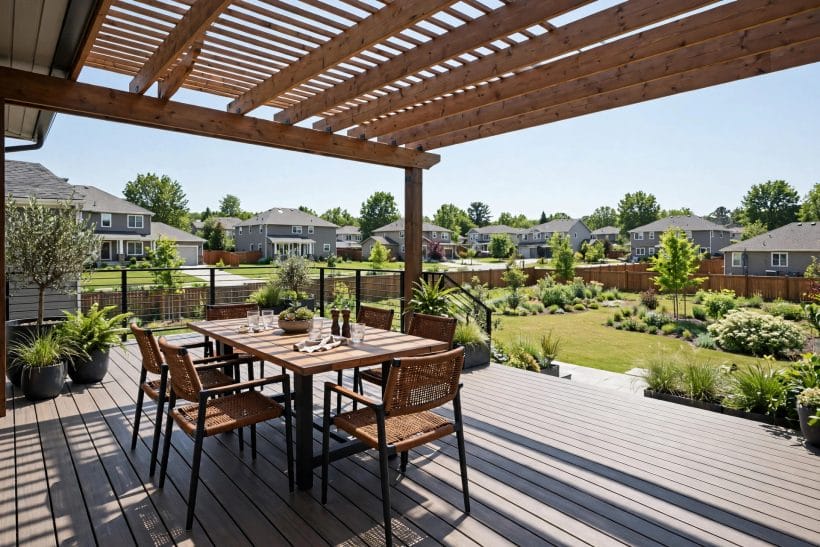
Stairs and railings are the moderate driver that finishes a deck’s safety and its looks, and both are priced by the detail. A stair is a small structure of its own — stringers, treads, a handrail where rules require one — and wide, shallow, garden-friendly stairs cost more than steep ship’s-ladder economy, while landings and turns add framing again. The railing in this pergola deck photograph shows the other half: a simple timber balustrade is the economical pattern; metal, cable and glass systems climb in price with their materials and fixings.
Railings are also where local rules speak most plainly: heights, gaps and climbability are code matters in most places, stated generally here as check-your-local-code, and a railing that fails inspection is the most expensive railing of all. Our deck railing ideas survey the styles — timber, cable, metal, glass and composite — with the design consequences of each, and they are worth reading before the quote stage, because changing railing systems mid-build is a change order nobody enjoys paying for.
Where the deck is low and the local rules allow it, some designs skip railings altogether and spend the money on a wide step edge instead — a legitimate design and budget choice at ground level. At any real height, the railing is not an optional extra to be trimmed from an over-budget quote; it is part of the structure’s safety, and the honest savings live in simpler styles, not in absence.
7. Ground, Access and Site Preparation
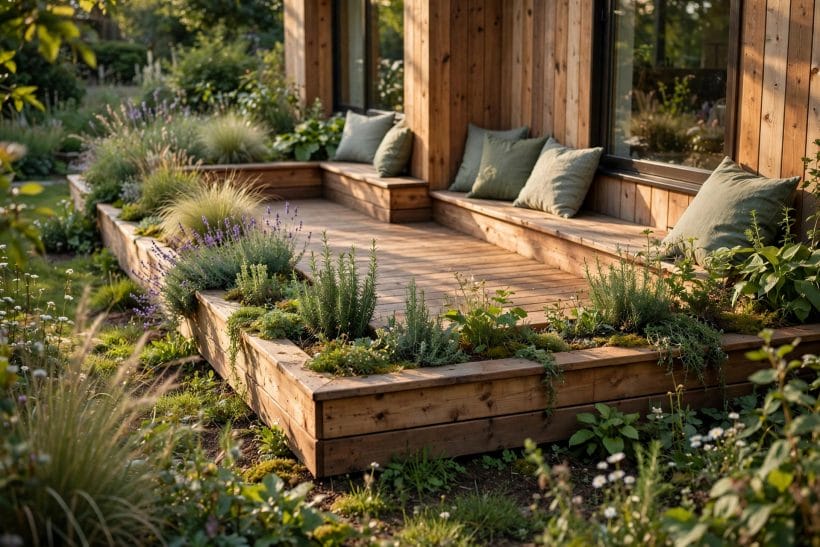
Before the first board, the site itself sends a bill. Clearing and levelling, removing an old structure or a concrete slab, disposing of spoil, and protecting planting all take time, and time is the currency labour is paid in. The low garden deck in this photograph sits in prepared ground — that calm finish is the product of the unglamorous work priced here.
Access is the quiet multiplier. A garden reached through the house, down a narrow side path, or across a slope will slow every delivery and every barrow of concrete, and builders price what they can see: awkward access appears in quotes as labour, because that is what it is. Materials delivered to the kerb still have to travel the last and hardest yards on someone’s shoulder.
Drainage and ground moisture belong in this section too. Ground that sheds water away from the house and does not pond under the deck protects the frame’s lifespan, and modest grading or a gravel bed at build time is cheaper than any remedy later. Our backyard landscaping ideas cover the planting and grading side of the same ground. None of this is visible in the finished photographs — which is precisely why it is under-budgeted, and why good quotes itemise it.
8. Permits, Professionals and the Costs Around the Build
Around the build itself sits a ring of smaller costs that decide whether the project runs cleanly. Many decks need a permit or must meet local building rules — size, height and distance from boundaries are the usual triggers, stated generally — and permit fees, drawings and inspections are real if modest lines in the budget. The tall flight in this photograph is exactly the kind of structure local rules exist for.
Professional input scales with the deck. A simple ground-level platform is within the scope of straightforward builder quotes; a raised or multi-level deck earns its keep from a designer’s drawings and, where the structure demands it, an engineer’s input — fees that buy down risk on the most expensive part of the project to get wrong. Electrical work for deck lighting and any plumbing for outdoor kitchens sit in the same ring: licensed trades, permit territory, and never a place for improvised savings.
Then there are the costs of the process itself: waste removal and skips, temporary protection for the garden and the house, and the household’s own time in decisions and supervision. None is large alone; together they are why experienced builders’ quotes carry a contingency line, and why a buyer comparing quotes should ask plainly what contingency each builder has included — a quote with none is not leaner, just quieter about the same risks.
9. Finish, Lighting and Extras
The final touch is the finish — and the extras that gather once a deck exists. Timber finishes range from oils and stains that deepen the grain, as in this close view of finished boards, to paints that change the colour story entirely; composite surfaces skip most of it, which is part of their premium. Finishing is also a recurring cost for timber: products, preparation and a day of work on a cycle of years, and the honest lifetime comparison between the material families includes those cycles.
Lighting is the extra with the best manners: step lights, post caps and soft washes make a deck usable after dark and safer on its stairs, at a cost that depends on whether wiring was planned before the boards went down — retrofitting light into a finished deck costs more than planning it into the build. Sockets, speakers and heating follow the same rule. Our pool ideas and hot tub patios collections show where deck budgets meet their neighbours — and a spa on a deck is a structural conversation for section 5’s professionals, never an afterthought, because filled water is heavy and decks must be designed for it.
Shade and shelter — pergolas, screens, planters — complete the extras list. Each is modest alone and cumulative together, which is the natural history of deck budgets: the platform is priced first and the life on it is priced forever after. Deciding the must-haves before the build, and letting the rest arrive over seasons, is the oldest and best budgeting advice in this whole guide.
10. What Raises the Cost, What Lowers It: Pulling It Together
Raise the total: a bigger footprint, an interesting shape, a premium surface, height with its structure, tall or turning stairs, a detailed railing system, difficult ground, poor access, wired and lit extras, and a finish specification that asks for perfection. Every item on that list is a legitimate purchase — decks are bought for decades — but each should be bought deliberately, with its price visible, rather than discovered in an invoice.
Lower the total: a footprint matched to real use, a rectangular layout, ground level instead of raised where the site allows, a standard material range honestly specified, simple stairs, a plain code-compliant railing, clear access, and extras phased over time. Notice what is not on this list: thinner structure, skipped permits, unsealed timber or unpriced ground. The savings that matter are design decisions, not omissions.
The method, one last time: fix the size and material first; walk the drivers in order — shape, height and structure, stairs and railing, ground and access, permits and professionals, finish and extras; collect itemised local quotes against the same description of the same deck; and ask every quoter the three questions from section 2 about exclusions, ground risk and contingency. Do that, and the number you finally accept will be a price you chose, not a surprise you met.
Final Considerations
A deck’s cost is not a number to be looked up but a structure to be understood: size and material at the foundation of the bill, height and ground as its honest variables, stairs, railings, permits and finish as the detail that separates a platform from a pleasure. This guide has deliberately printed no figures — your region, your ground and your specification own those — but with the drivers in hand, every local quote becomes readable, comparable and negotiable. Build the deck the drivers describe, at the size your Tuesdays need, and it will earn its cost back in evenings for years.

0 Comments