
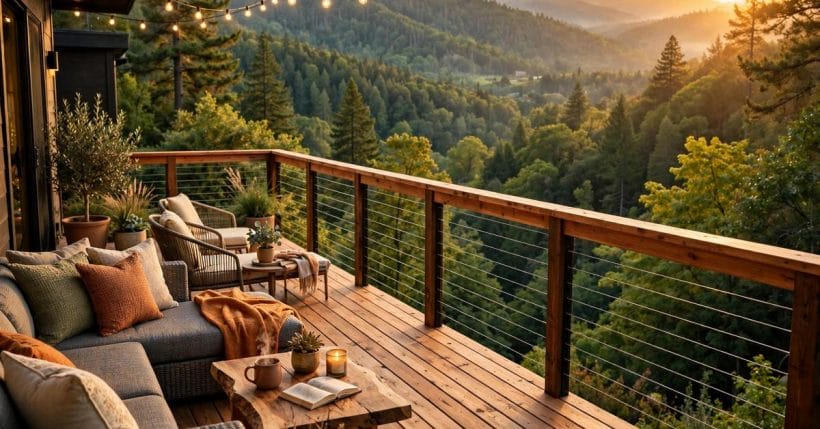
A deck railing is the hardest-working edge in the garden: it guards the drop, frames the view and sets the style of the whole outdoor room in a single line. Choose it well and the deck feels finished; choose it carelessly and even a beautiful deck looks like a platform waiting for an accident report.
This collection gathers 75 deck railing ideas by material and mood — timber balusters, cable, black metal, glass and composite — with the safety questions kept in plain sight throughout. Guard heights, gaps and fixings are set by local code and are stated here in general terms only; your local figures rule, and structural fixing belongs to professionals.
1. Deck Railings at a Glance
Every railing in this collection belongs to one of five families. The deck ideas cluster treats the railing as part of the deck’s architecture rather than an afterthought bolted on at the end, and that is the right order of thinking: decide the family first, then the details. A railing is also the one deck element a guest touches, leans on and judges at close range, so its finish matters as much as its silhouette.
| Family | Character | What it means |
|---|---|---|
| Wood Balusters | Classic Warmth | Sturdy |
| Cable Rail | Modern Open View | Sleek |
| Black Metal | Bold Contrast | Durable |
| Glass Panel | Unobstructed View | Clear |
| Composite | Low Maintenance | Easy |
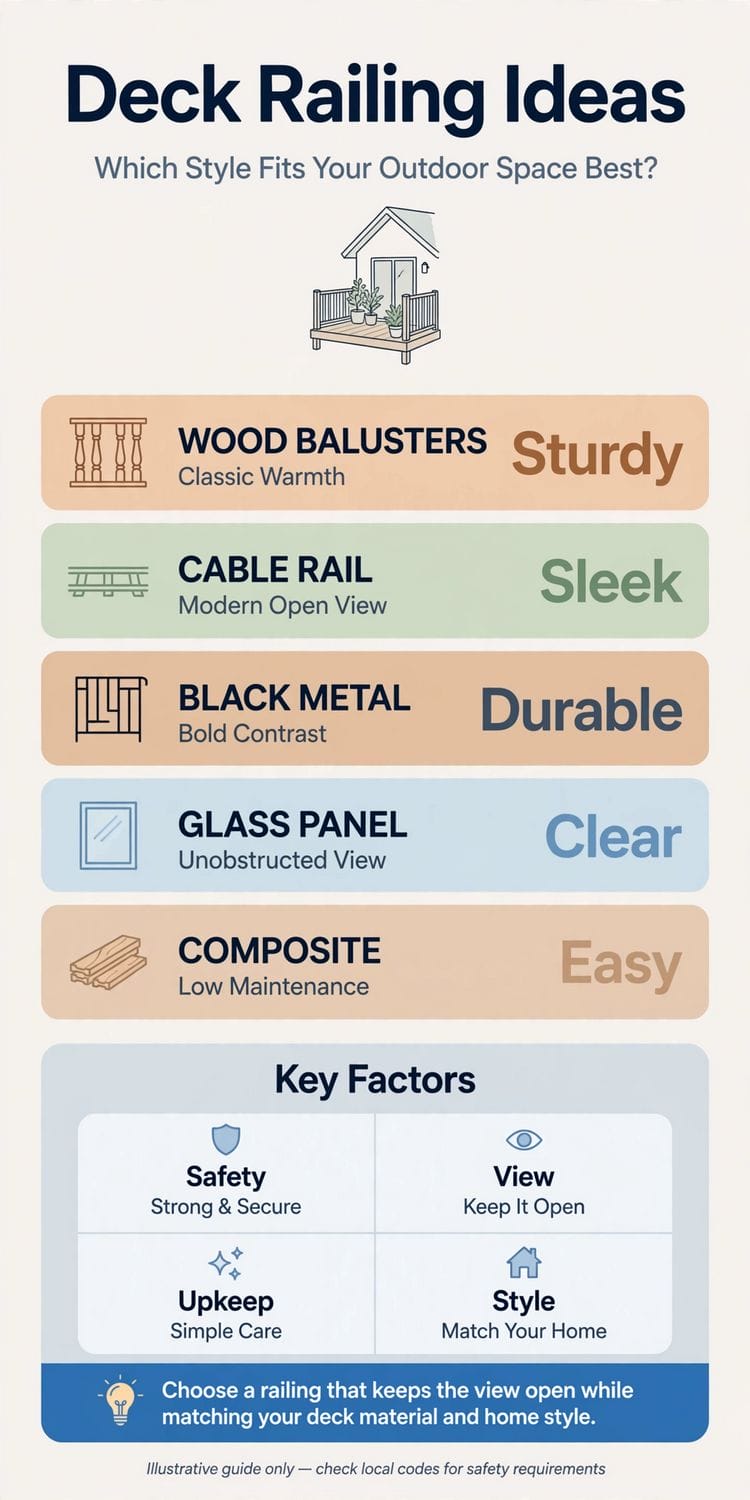
Four factors decide between the families: safety, because a guard rail is a safety device before it is a decoration; view, because the wrong infill can fence in a landscape you paid to look at; upkeep, because materials weather very differently; and style, because the railing should match the house it hangs from. The sections that follow take the families in turn, then the mixes, the sites, the details and the code questions that finish the job.
2. Timber and Wood Balusters
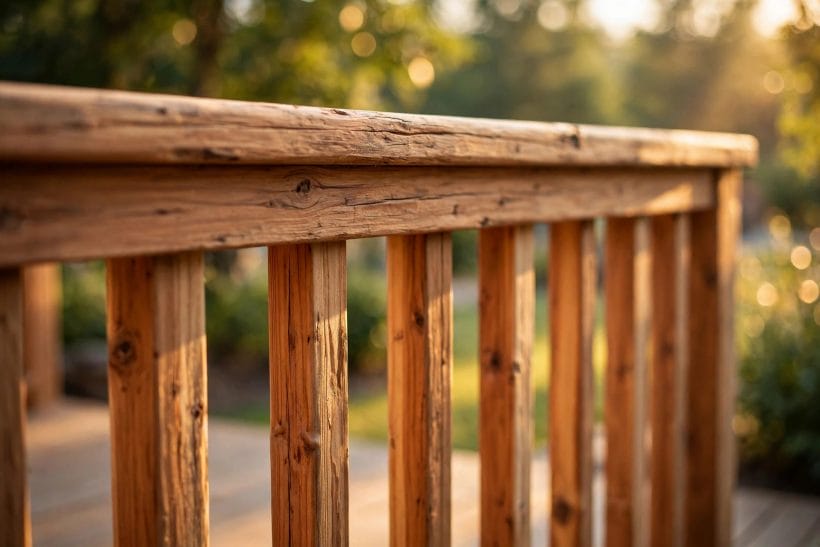
Timber is the original deck railing and still the warmest: it suits the deck boards, takes stain or paint, and can be built in profiles from farmhouse-simple to turned and traditional. Its honest cost is maintenance — wood outdoors asks for regular care — but for many gardens that ritual is part of the pleasure.
1. Classic Turned Balusters
Turned spindles under a broad top rail give a deck the manners of a veranda. The profile suits older houses and traditional gardens, and it reads as craftsmanship from across the lawn. Keep the turning simple — dust and weather punish fussy detail outdoors.
2. Square Timber Balusters
Square-section balusters are the modern timber classic: clean lines, easy to replace one at a time, and happy in stain or paint. Even spacing does the decorative work, so measure the rhythm carefully and let repetition be the ornament.
3. Chunky Posts, Simple Rails
Oversized posts with plain rails between them give a deck a sturdy, lodge-like frame. The heft suits large decks and rural settings, and the simple infill keeps the cost of the drama down. Finish with a flat cap wide enough to hold a drink.
4. Rustic Split-Rail Deck Edge
Rough-sawn or split rails carry a cabin or country deck’s story better than any milled profile. The texture hides weather gracefully, which is the rustic bargain: the railing looks more itself every year instead of less.
5. Cedar Balusters, Broad Top Rail
Cedar’s natural resistance to rot makes it the thinking person’s softwood for railings. Left silvered or oiled warm, it pairs with almost any decking. A broad top rail in the same timber gives forearms and coffee cups a proper landing.
6. Dark-Stained Timber Contrast
Staining the railing darker than the deck boards outlines the deck’s shape like ink around a drawing. It is a decorator’s trick that costs one tin of stain, and it makes pale furniture and planting glow against the frame.
7. Painted White Wood Balusters
White painted balusters borrow the language of porches and picket fences, brightening shady decks and suiting coastal and cottage houses. Paint is a commitment to repaint, but no finish lifts a north-facing deck like it.
8. Horizontal Timber Rails
Wide horizontal boards as infill give a timber deck a calm, modern-rustic rhythm and a measure of wind shelter. Run the boards with small shadow gaps so the wall of wood still breathes and the view keeps a pulse.
3. Cable Rail: The Open View
Cable rail trades solid infill for tensioned stainless lines, and the view walks straight through it. It is the railing of view decks, hillside sites and modern houses, and it asks for precise, professional tensioning and hardware — this is engineering wearing jewellery’s clothes, so have it fitted properly.
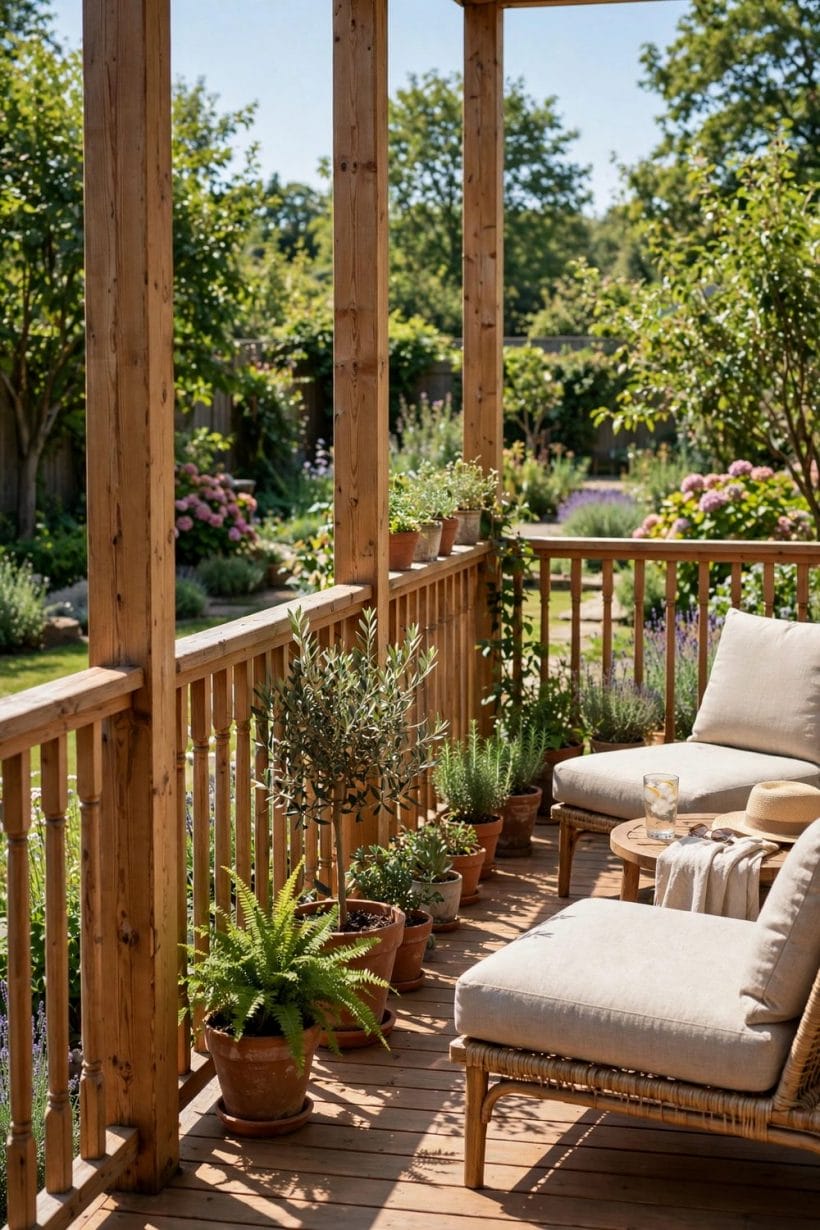
9. Horizontal Cable, Timber Posts
The friendliest cable scheme pairs warm timber posts with fine steel lines: structure you can see, infill you almost cannot. It suits the feature deck above and most houses that are neither starkly modern nor determinedly traditional.
10. Cable with Black Metal Posts
Black posts make the cable grid read as a deliberate drawing against the view. The combination is the contemporary standard for new decks, and it disappears against evening light better than any other scheme here.
11. Cable on a View Deck
Where the view is the entire point — water, valley, skyline — cable is the default answer. Sit down on the deck furniture before choosing: the lines should fall below seated eye level in effect, dissolving into the distance.
12. Cable with a Wide Timber Handrail
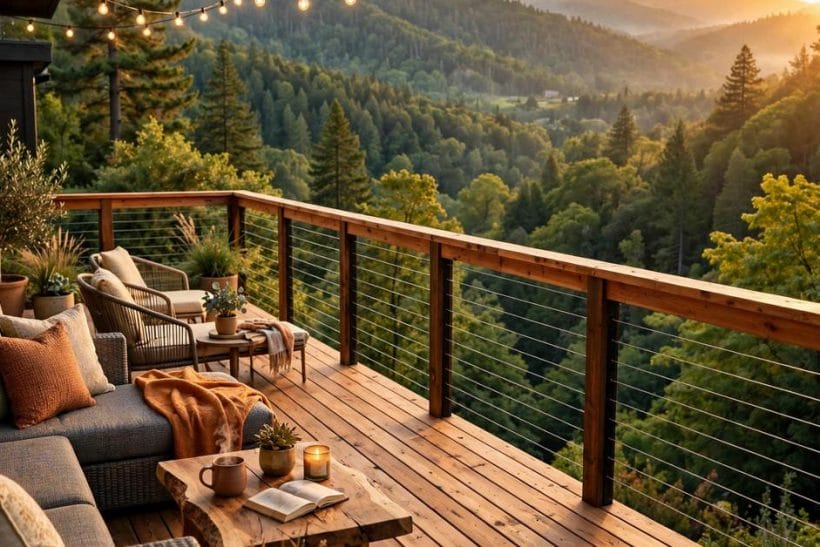
A generous timber handrail warms cable’s coolness and gives the hand something welcoming. The contrast of materials is the design: industry below the wrist, craft above it. This is the scheme in the feature photograph, and it flatters almost everything.
13. Slim Cable on a Small Deck
Small decks cannot spare visual weight, and cable asks for none. A fine-lined rail keeps a compact terrace feeling open to the garden instead of caged, which can be the difference between a deck that is used and one that is not.
14. Cable Around a Raised Terrace
Raised terraces need guarding on several sides, and repeating one cable system around every edge keeps the architecture calm. Corners are where cable earns its keep — resolved neatly, they make the whole terrace feel designed rather than fenced.
15. Cable with a Matched Gate
Where steps or a gate interrupt the rail, carrying the same cable pattern through the gate keeps the line unbroken. Gates on decks get heavy use, so hardware quality matters more here than anywhere else in the system.
16. Cable and Wood on a Hillside Deck
Hillside decks stack levels and drops, and cable handles the changing heights without visual bulk. Timber framing keeps it domestic where pure steel might feel like a viewing platform. Professional design is essential on steep sites.
4. Black Metal and Steel Rails
Metal railings bring slimness and strength: thin balusters, wide spans between posts, and a finish that shrugs off weather. Black is the fashionable colour because it recedes against planting and frames views like the border of a photograph, but the family is wider than one colour.
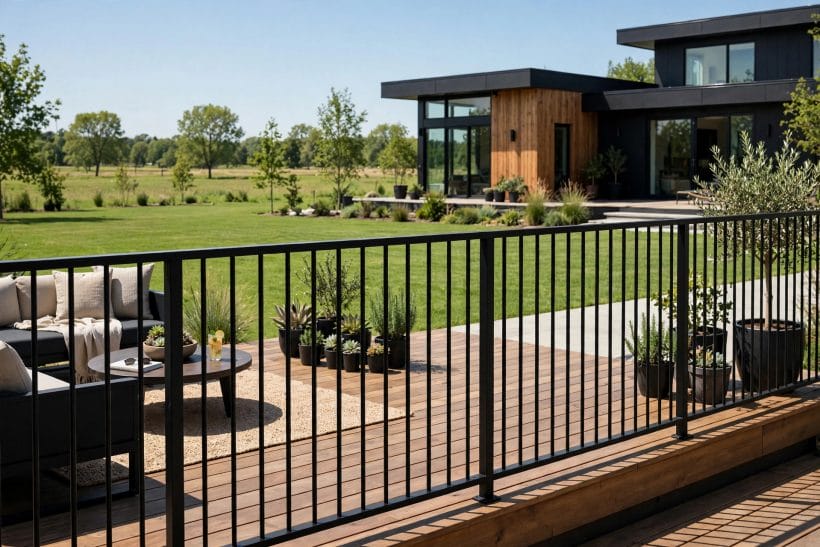
17. Black Aluminium Balusters
Aluminium balusters in black are light, rust-proof and slender enough to nearly vanish. They are the low-maintenance way to get the black-rail look, and they pair happily with both timber and composite decks.
18. Slim Black Steel Pickets
Steel pickets, as on the deck in this photograph, draw a crisp vertical rhythm that suits modern architecture. The spacing does the styling, so keep it metronome-regular; irregular pickets read as damage rather than design.
19. Horizontal Metal Bars
Horizontal bars echo cable’s openness with a sturdier, more architectural feel. They suit urban decks and roof terraces, and they give climbing plants a tempting ladder — a feature or a fault depending on the planting plan.
20. Bronze-Toned Metal
Bronze and dark-brown metals soften black’s contrast for houses in brick, stone or warm timber. The railing still recedes, but it harmonises instead of striking a pose, which many traditional exteriors prefer.
21. Metal Rail, Wood Top Rail
A timber top rail over metal infill is the handshake between the metal and wood families: cool strength below, warmth at the hand. It is also a forgiving scheme to retrofit onto an existing deck whose posts are sound.
22. Industrial Pipe-Style Rail
Exposed fittings and pipe sections give a deck a workshop honesty that suits converted and contemporary homes. Keep the detailing consistent — mixed hardware styles are what make this look read as improvised rather than industrial.
23. Minimal Flat-Bar Metal
Flat-bar balusters turn edge-on to the view, appearing and disappearing as you move. The effect is quietly luxurious and the cleaning is trivial, which is a combination worth paying for on a deck you use daily.
24. Metal Painted to Match the House
A railing painted the colour of the house’s trim or cladding knits deck and building into one composition. It is the decorator’s choice for additions that must not look added, and it works in any colour the house already wears.
5. Railings for Views and Difficult Sites
Sites write railing briefs of their own: the lake that must not be fenced out, the slope that drops away, the planting that deserves framing. The lake deck in this photograph makes the point — the furniture faces the water, and the railing’s job is to guard without interrupting the conversation.
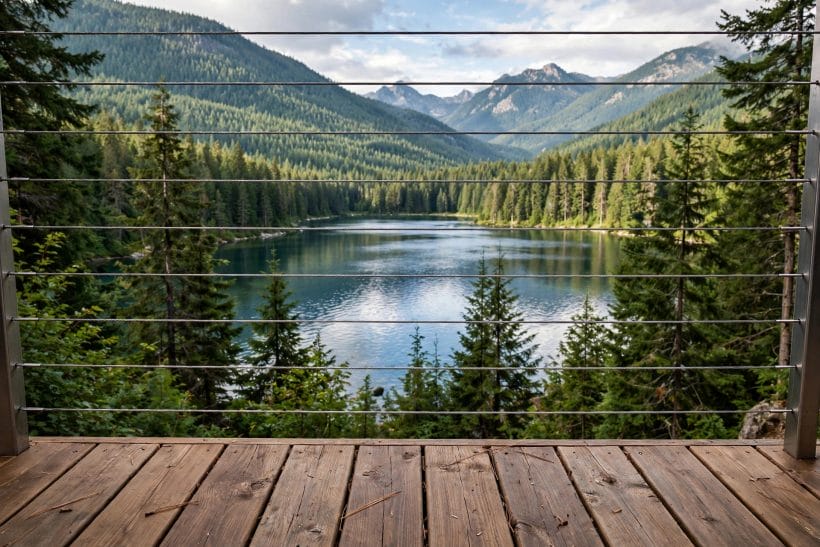
25. Railings That Keep a Lake View
For water views, the hierarchy is glass, then cable, then slim metal — anything the eye can pass through or over. Sit in the deck chairs and sight along the proposed top-rail line before committing; views are judged seated, not standing.
26. Hillside Deck Rails
Decks on slopes carry different drops on different sides, and the railing must answer each one. Stepped or raked rails that follow the land look intentional; a single level line fighting the slope never does.
27. Forest-View Cable
Among trees, cable’s fine lines harmonise with trunks and branches where solid infill would wall the woods out. The feature deck uses exactly this logic, and the forest becomes the room’s fourth wall.
28. Low-Profile Rails for Scenery
Where the drop is modest and the local code allows a lower guard, a restrained railing keeps scenery in charge. What the code allows is answered by your building authority — never by the view, however persuasive it is.
29. Wraparound Deck Rails
A wraparound deck changes aspect with every step, and the railing should change register just as smoothly: open toward views, more sheltered toward exposure. One continuous top rail ties the changing infills together.
30. Rails on a Sloped Garden Deck
Garden decks on gentle slopes can step the railing down in bays that follow the planting, the way farmhouse landscaping ideas step beds down a bank. The steps become places for pots and lanterns, and the guard disappears into the garden’s own rhythm.
31. Sunset-Facing Terrace Rails
West-facing decks earn their evenings, and glass or cable keeps the sunset uncut. A wide timber drink rail earns its place here too — the sunset hour is precisely when it is full of glasses.
32. Rails That Frame, Not Block
Posts placed to coincide with view divisions — between trees, either side of a vista, against a stone landscaping feature — turn a guard into a picture frame. It costs nothing but forethought at the setting-out stage, and it is the mark of a designed deck.
6. Mixed Materials: Each Doing Its Best Job
Few real decks are purist. Mixing lets timber warm the hand, metal slim the infill, glass open the view and composite shrug off the weather — each material where it is strongest. The sunset terrace in this photograph shows the principle: glass for the panorama, dark framing for the architecture.
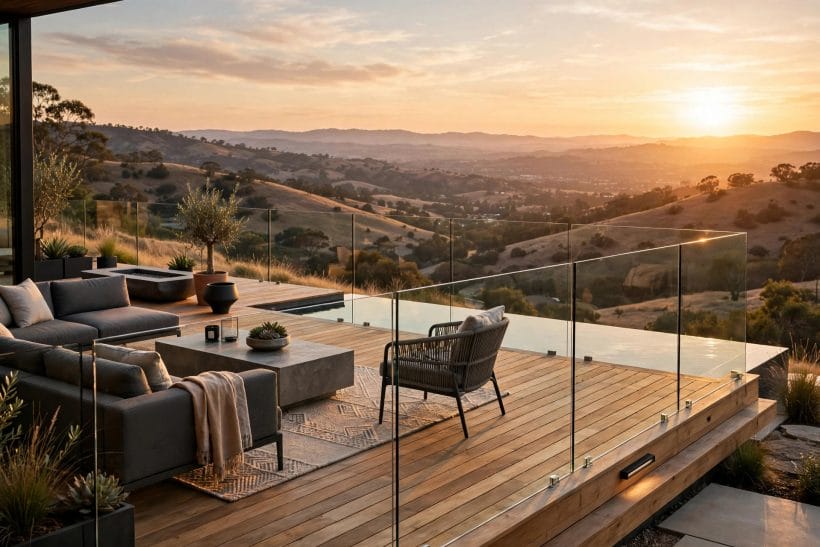
33. Metal and Glass
Posts and rails in metal with glass between them give structure to the view and sparkle at the edges. It is the most architectural mix here, and the one most at home on new-build houses and terraces like this one.
34. Wood and Cable
The feature scheme, promoted to a principle: timber where the hand and eye rest, cable where the view passes. Mixed honestly, neither material pretends to be the other, and the deck gains both warmth and openness.
35. Composite Rails, Aluminium Balusters
The industry’s current sweet spot: a warm composite outline over slim black aluminium balusters, with almost no upkeep. If a catalogue photograph shows a perfect family deck, it is usually this combination.
36. Glass with a Timber Handrail
A timber handrail over glass warms the scheme and gives the hand a cue where the barrier runs — a kindness to guests at dusk, and a handsome line of wood floating in the view.
37. Two-Tone Painted Mix
Carrying the house’s two trim colours through a mixed railing — dark posts, pale infill, or the reverse — knits deck, railing and building into one palette. It is the decorator’s shortcut to a designed look.
38. Cable with Black Posts and Timber Rail
Three materials, three jobs: black posts for the drawing, cable for the view, timber for the hand. The scheme suits houses between styles, which is most houses, and it weathers gracefully in all its parts.
39. Stone or Brick Piers with Rail Between
Masonry piers at the corners with railing bays between them give a deck the permanence of a terrace wall at a fraction of the enclosure. The piers double as plinths for lanterns and pots.
40. Bamboo and Timber Screens as Rail
On sheltered, low decks in mild gardens, woven or slatted screens can serve as the guard where code allows, bringing a soft, planted boundary. Treat this as the exception that proves the rule — most decks need a structural rail.
41. One Top Rail Across Every Mix
Whatever mixes below it, run a single continuous top rail — same material, same profile — around the whole deck. Continuity at hand height is what makes a mixture read as a design instead of a compromise.
7. Composite Railings: The Easy Life
Composite promises the timber look with a fraction of the upkeep, and for family decks ruled by weather, children and dogs, that promise is the whole argument. The grey-and-white family deck in this photograph is the type specimen: hose it down, and the maintenance meeting is over.
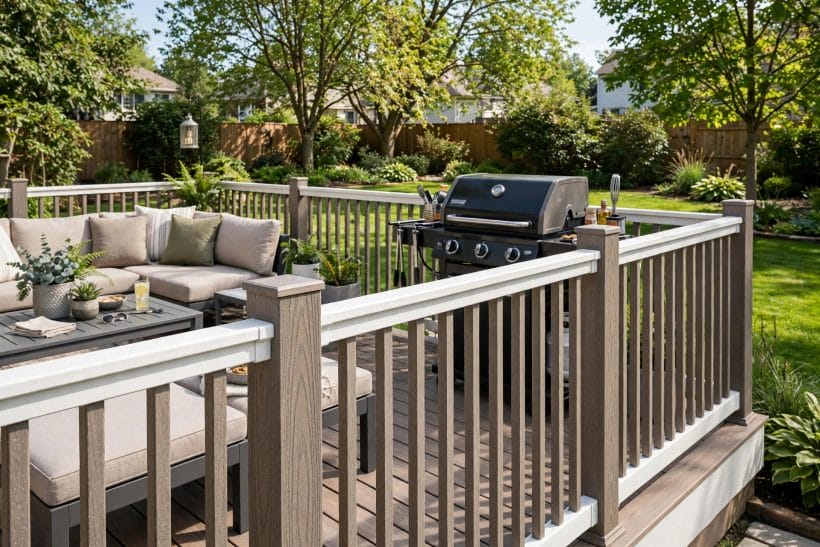
42. Composite Balusters in White
White composite balusters give the porch look without the repainting cycle. They brighten shady decks like painted wood, but the colour is in the material rather than on it, so chips and knocks do not show as wounds.
43. Two-Tone Composite Rails
A darker top rail over pale balusters — or the reverse — borrows the painted-timber trick in a material that holds its colour. Two-tone schemes also disguise the joint between an original deck and a later extension.
44. The Composite Drink Rail
The wide flat top rail translates perfectly into composite, where it will not warp, split or demand varnish. On a family deck it becomes homework desk, buffet and bar in the course of one Saturday.
45. Composite in Earthy Tones
Browns and greys drawn from the garden palette let a composite rail sit quietly among planting. Modern composites have shed the plastic look of early generations; judged in daylight among leaves, they pass as timber’s calmer cousin.
46. The Forgiving Family Rail
For decks that host football, muddy paws and weather, the kindest railing is the one that forgives: composite or aluminium, no splinters, no peeling, nothing to re-tension. Choose forgiveness over finery and the deck stays loved.
47. Composite Posts with Sleeve Caps
Post sleeves and caps in matching composite finish the system neatly and protect the vulnerable end grain of the structure beneath. The capped post is also the natural home for a lantern or a planter.
48. Composite on a Budget Deck
Where the budget concentrates on boards and structure, a simple composite rail kit keeps the finish consistent without a joiner’s bill. Simple profiles age best; spend the savings on the top rail’s width.
49. Composite Beside the Grill
Cooking decks ask railings to tolerate heat splash, grease and constant traffic at one corner. Composite’s wipe-clean indifference, as around this barbecue deck, is worth more there than any amount of character.
8. Glass Panels: Nothing Between You and the View
Glass is the maximum-view railing: a sheet of near-nothing that stops wind as well as falls. The dusk terrace in this photograph shows its other gift — at evening it reflects lamplight like water while the view beyond stays open. It asks for regular cleaning and quality hardware, and both are professional territory.
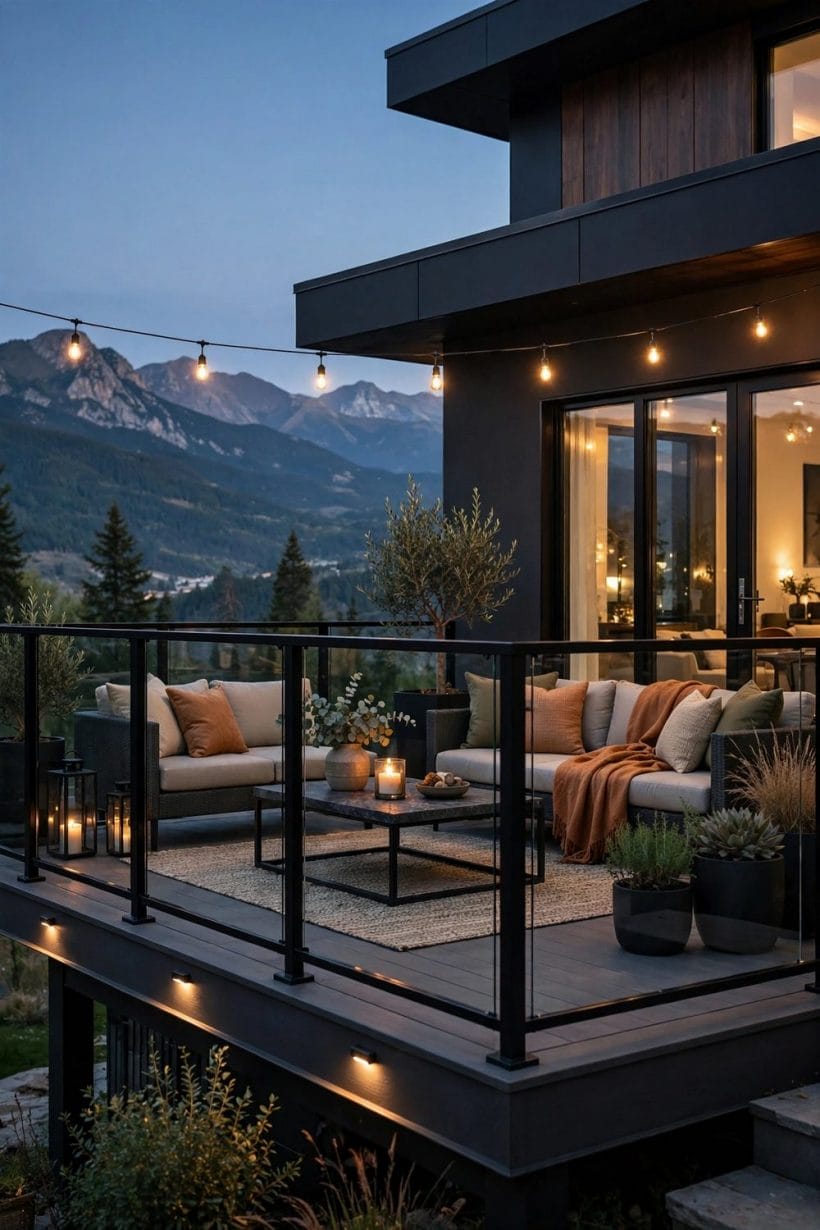
50. Frameless Glass Panels
Panels held by minimal clamps or a base channel all but disappear, leaving the deck floating in its view. This is a professional system from end to end — glass specification, fixing and alignment are not amateur territory.
51. Framed Glass Panels
A slim dark frame around each panel, as here, gives glass a drawn edge that suits houses wanting definition to the boundary. The frame is also forgiving: it hides the panel edges where chips and seals live.
52. Frosted Glass for Privacy
Frosted or obscured panels guard a deck that is overlooked, trading the view out for calm within. Use it on the overlooked side only and keep clear glass where the outlook deserves it.
53. Glass Corners for Wraparound Views
Where a deck turns a corner toward the view, carefully jointed glass corners keep the panorama unbroken. The detail is expensive in hardware and worth it exactly where the view bends.
54. Glass on a Rooftop Deck
Rooftop decks live in wind, and glass is the only railing that shelters while it guards. The combination of a clear barrier and a calmer terrace extends the hours a roof deck earns its keep.
55. Tinted Glass Panels
A gentle tint calms glare on sun-beaten decks and adds privacy by day. Check the tint against the view’s colours — water and foliage survive tinting gracefully, while pale skies can turn theatrical.
56. Glass with Metal Posts
Slender posts between panels add rhythm and make the system read as architecture rather than aquarium. It is the glass scheme most at home on traditional houses trying glass for the first time.
57. Glass as a Windbreak First
On exposed coastal and hilltop decks, choose glass for shelter and let the view be the bonus. A guarded, calm terrace gets used in months when an open-railed deck stands empty — usage is the truest measure of a railing.
9. Details That Finish a Railing
Railings are judged at touching distance, and the details in this section are the ones hands and eyes actually meet: the top rail’s width, the caps, the lights, the gate that matches. The garden deck in this photograph shows the drink rail doing its evening duty.
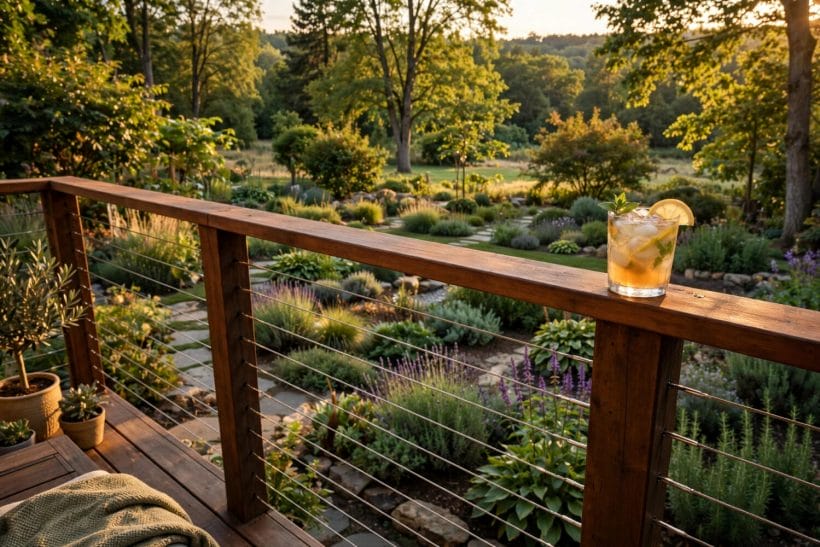
58. The Drink Rail, Properly Wide
A flat, extra-wide top rail turns the railing into furniture: cups, books, elbows and laptops all land there. It is the single most-used detail on any deck that has one, and it costs nothing but a wider board.
59. Post Caps That Finish the Line
Caps protect post tops from the weather that rots them and give the railing its full stops. Metal caps on timber posts are the classic punctuation; matching composite caps keep an easy-care system honest.
60. Post-Cap Lights
Small lights in or on the post caps mark the deck’s edge after dark and wash the railing in a low glow. Keep them warm-toned and few — the aim is a boundary you can sense, not a runway.
61. Under-Rail Lighting
Light fitted beneath the handrail pools on the deck boards and turns the railing into the terrace’s lamp. Wiring belongs to a qualified electrician, like all the fixed lighting around a porch, and the effect repays the professionalism.
62. Gates Matched to the Railing
A gate that repeats the railing’s infill — cable through cable, balusters through balusters — keeps the boundary calm at its busiest point. Match the modern gate ideas discipline: same materials, same rhythm, serious hardware.
63. Stair Rails That Match the Deck
Where deck steps descend, the stair rail should be the deck railing’s sibling, not a stranger. The wooden garden gate ideas make the same point at the garden’s edge: one material language, everywhere the boundary runs.
64. Handrail Profiles the Hand Likes
Round the top rail’s edges, keep it splinter-free and size it for a real grip. A handrail is a tool as much as a trim piece; on steps and slopes it will be asked to work.
65. Newel Posts with Presence
Slightly grander posts at corners, gates and stair heads organise the whole system visually. They are the railing’s capital letters — use them sparingly and the sentence reads clearly.
66. Planters on the Rail
Shallow planters riding the top rail soften the boundary with herbs and trailing flowers. Keep them on the deck side, light in soil, and out of the handrail’s grip zone.
10. Safety, Codes and What Things Cost
This closing section is the conscience of the collection. A deck railing is a guard that people — including other people’s children — will lean on, and its rules are written in local building codes rather than in taste. Everything here is stated generally; the figures belong to your local code and its inspectors.
67. Guard or Decoration: Know the Difference
A railing that guards a drop is a safety device with legal requirements; a low edge trim on a ground-level deck may be pure decoration. The first question of any railing project is which of the two you are building — and most raised decks are building the first.
68. Height Is Set by Local Code
Codes prescribe a minimum guard height measured from the deck surface, and the figure varies by place and by the height of the drop. It is never a matter of proportion or preference, so take the number from your local code and build to it.
69. Gaps and Openings, in General Terms
Codes also limit the size of openings in a guard so that a small child cannot pass through or become trapped. The exact dimension is local, but the principle is universal: design the infill’s rhythm from the code’s limit, not from aesthetics alone.
70. Strength and Fixing to Structure
A guard must resist the lean and shove of real people, which means its posts belong to the deck’s structure, not to its surface boards. Fixing design is structural work — have it designed or at least approved by a professional.
71. Gates, Steps and Pool-Adjacent Decks
Decks near pools, and gates on deck stairs, often carry extra rules — self-closing gates and latching requirements are common examples. These are exactly the details local codes spell out, so ask before the hardware is bought.
72. Maintenance by Material
Timber asks for periodic coating, cable for occasional tension checks by its installer, metal for a wash and a watch for chips, glass for cleaning, composite for little more than soap and water. Price the railing’s decade, not its day.
73. When to Call a Professional
Glass systems, cable tensioning, structural posts and any guard on a high or steep deck belong to professionals. A confident DIY hand can handle simple baluster work on a low deck — the wisdom is in knowing which deck you have.
74. What Drives the Cost
Length, corners, gates and material move the price more than infill pattern does. Glass and engineered cable sit at the top in general terms, timber and aluminium kits lower, and labour follows complexity — get the whole run priced, not a per-metre guess.
75. Replacing a Tired Railing
A sound deck with a rotten or wobbly railing is a common and hopeful starting point. Keep the deck, replace the guard to current code, and choose the new family for the next decade’s maintenance, not the last one’s habits.
Final Considerations
Choose the family for your view and your appetite for upkeep, detail it like furniture, and build the guard to your local code with professional help where the system demands it. Done that way, the railing stops being the deck’s fence and becomes its frame — the line the whole garden is seen from. For the ground it stands in, the wider deck ideas collection is the natural next read.



0 Comments