
1. Enclosures at a Glance
Every garden has a working corner it would rather not look at: the bins, the compost heap, the humming outdoor unit. This article gathers twelve enclosure ideas — four for bins, four for compost, four for the AC unit — built on one principle that outranks all styling: an enclosure screens for the eye, never against the machine or the heap, so airflow and access come before looks in every design below. Siting and rules are stated in general terms throughout, because both are decided locally.
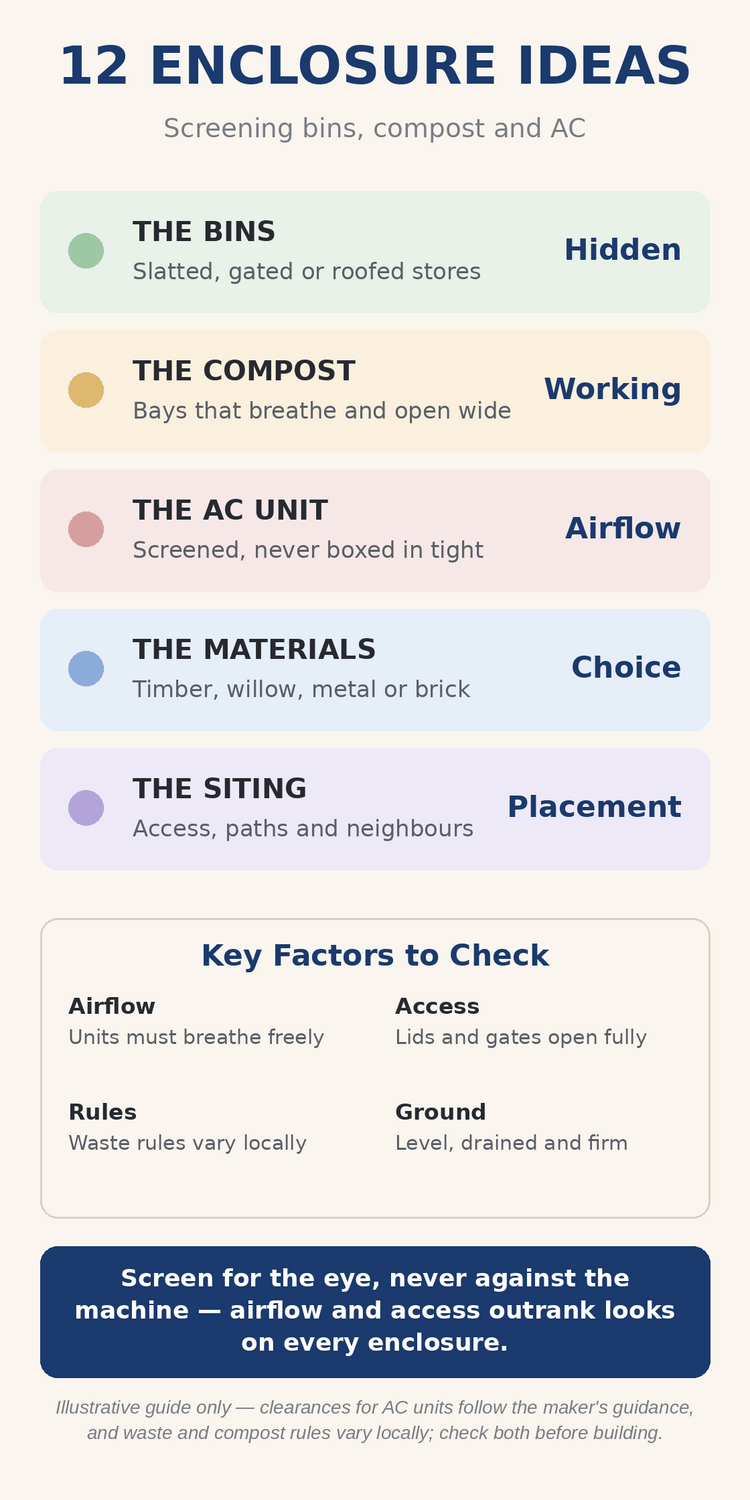
| Part | What It Covers | Why It Matters |
|---|---|---|
| THE BINS | Slatted, gated or roofed stores | Hidden |
| THE COMPOST | Bays that breathe and open wide | Working |
| THE AC UNIT | Screened, never boxed in tight | Airflow |
| THE MATERIALS | Timber, willow, metal or brick | Choice |
| THE SITING | Access, paths and neighbours | Placement |
Screen for the eye, never against the machine — airflow and access outrank looks on every enclosure.
A note on the count, since the title makes a promise: there are exactly twelve enclosures here, numbered one to twelve, and the rest of the post — materials, siting, rules, upkeep — is the advice that makes any of them work. A good trash enclosure is invisible twice over: it hides the working corner, and it never makes the work harder. Keep both invisibilities in mind as the test of every idea.
2. Bin Enclosures That Hide the Everyday
Bins are the most-seen and least-loved objects in the front garden, and the enclosure that serves them is a store first and a screen second: it must open fully, swallow the bins’ lids at their highest, and let a full bin roll out on collection day without a wrestling match. Storage thinking of the same practical kind fills the 55-gallon drums guide, where containers earn their place by being honestly assessed before they come home.
1. The Slatted Timber Bin Store
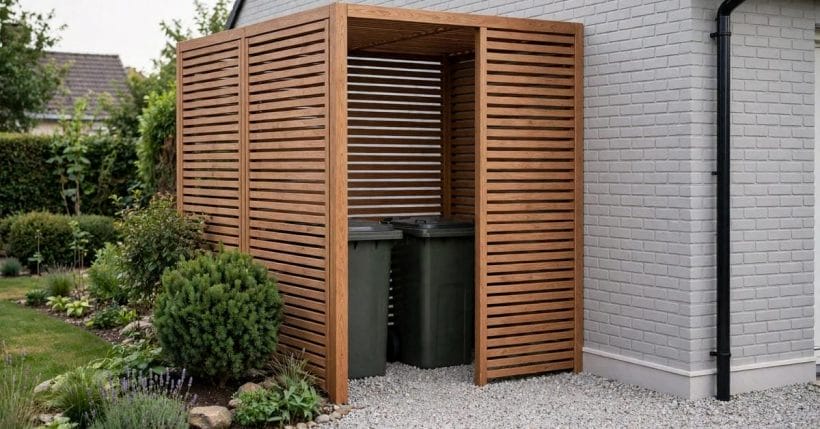
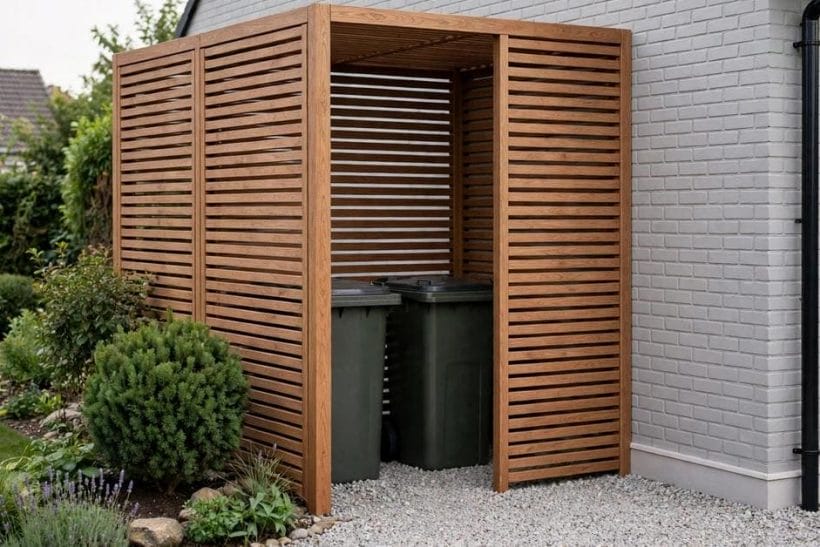
The classic: horizontal or vertical slats on a framed store, a lid or doors on the front, bins in a row inside. The gaps between slats keep air moving and smells from settling, and the timber face reads as garden furniture rather than municipal equipment.
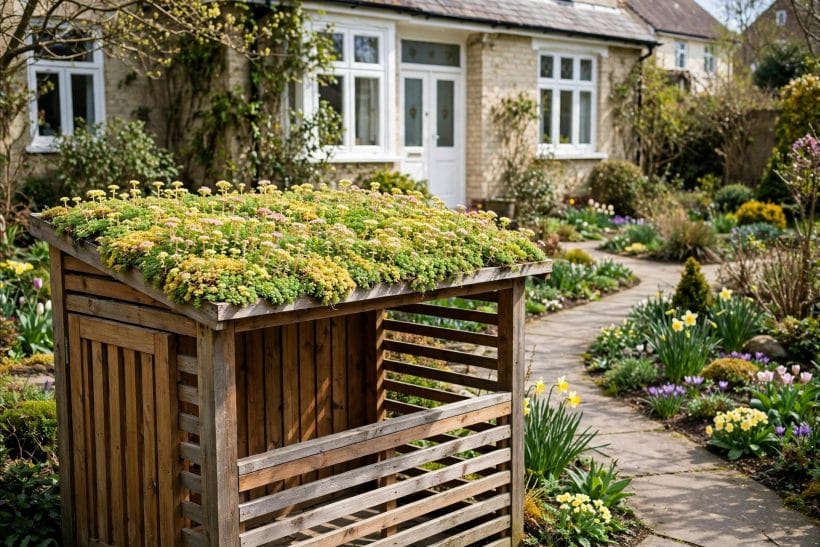
2. The Green-Roof Bin Store
A bin store whose roof is planted — low sedum or hardy groundcover in a shallow tray. The roof turns the store’s most visible surface, the one seen from upstairs windows, into a scrap of garden, and it is the strongest disguise a front-garden store can wear.
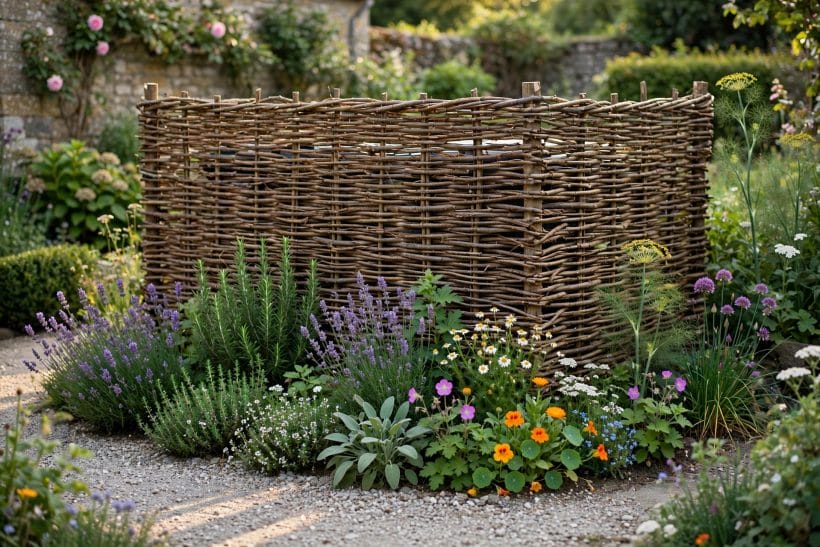
3. The Hurdle-Screened Bin Bay
Woven willow or hazel hurdles on posts, forming a soft bay the bins stand inside. Nothing here is a building — the hurdles are panels, replaceable one at a time — and the cottage texture hides modern plastic better than any other material in this list.
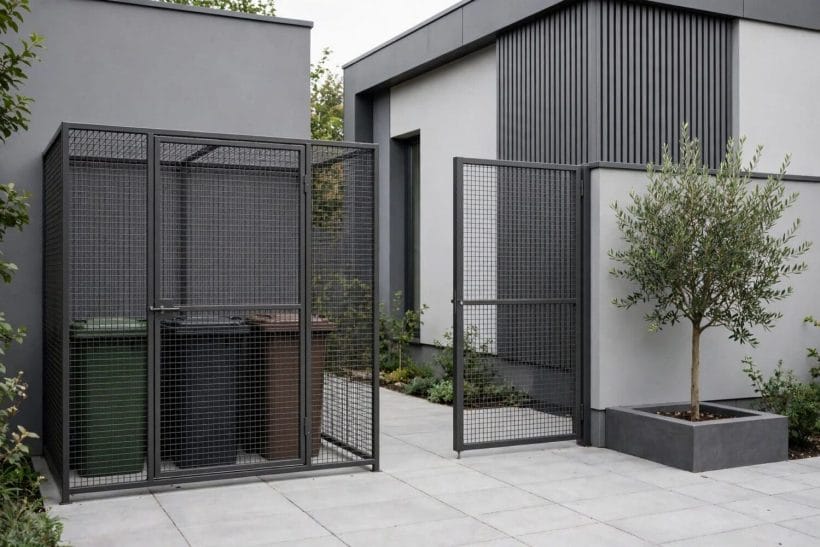
4. The Metal-Mesh Enclosure
A framed mesh enclosure with a gate, for households that want the bins visibly secure and the enclosure itself nearly invisible. Mesh keeps maximum airflow, shrugs off weather, and suits contemporary houses where timber would fight the architecture.
3. Compost Enclosures That Work With the Heap
A compost heap is a process, not an object, and its enclosure is a workstation: bays that breathe, fronts that open for turning and emptying, and room for the barrow. The process itself — what rots, what does not, and why — is laid out in composting 101; this section builds the furniture around it.
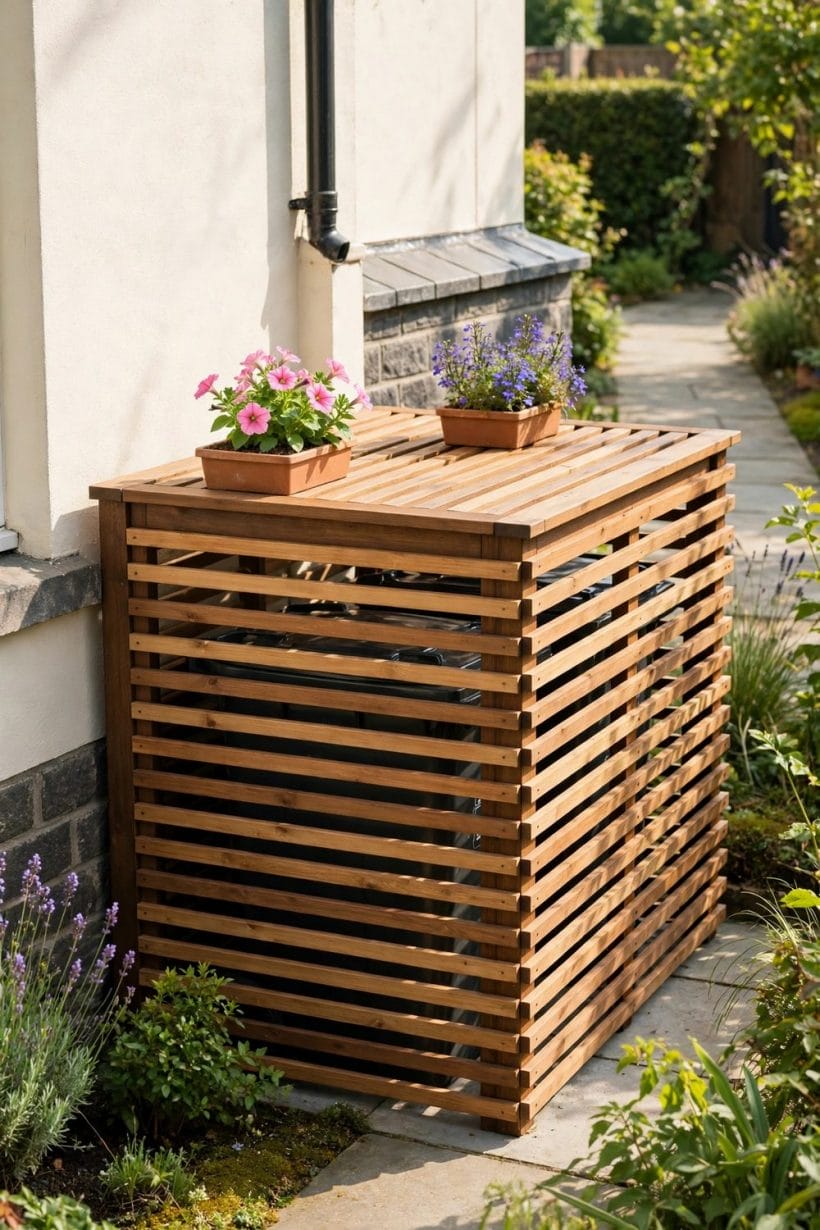
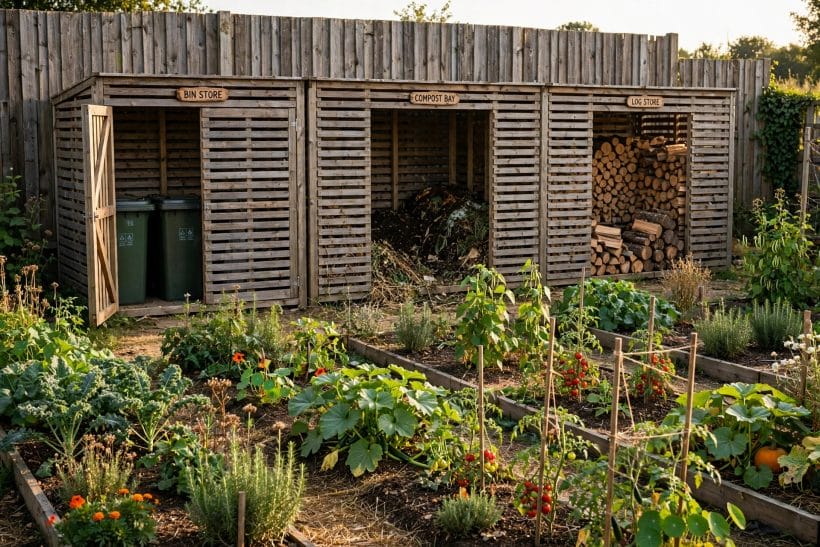
5. The Three-Bay Timber Composter
The working standard: three bays in a row — one filling, one rotting, one ready — with slatted fronts that lift out board by board as the level falls. Nothing about it is decorative, and a vegetable garden finds it beautiful anyway.
6. The Slatted Bin With a Lift-Up Lid
A single lidded bin for smaller gardens: the lid keeps rain from waterlogging the heap and heat from escaping it, and hinges up to stay open while both hands are busy with the fork. One bin, honestly managed, beats three neglected ones.
7. The Wire-Mesh Compost Cage
A cylinder or square of sturdy mesh, the heap visible through it and air reaching every side. It is the cheapest real composter in this article and the easiest to move — unpeg it, lift it off, and the finished heap stands revealed, ready for the barrow.
8. The Brick Compost Bay
Built bays in brick, for the garden that wants its working corner permanent: warm walls the heap appreciates, a face that matches the house, and a structure that will outlast every timber rival here. It asks the most commitment — site it once, site it right.
4. Screening the AC Unit, Without Suffocating It
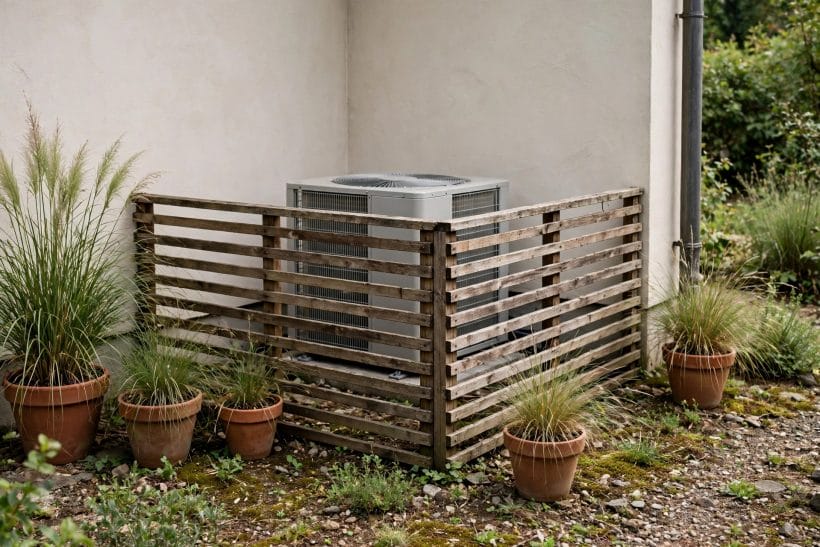
The outdoor unit of an air-conditioning system is the one enclosure subject with a hard rule: the machine moves air for a living, pulling it in and pushing it out, and anything that chokes that flow makes it work harder, louder and worse. Every screen below is therefore a screen around the unit, never a box against it — open on top, spaced from the sides by at least the maker’s stated clearance, and removable or gated for servicing. How the units themselves work is covered in the tiny house air conditioning guide; this section is purely about hiding one kindly.
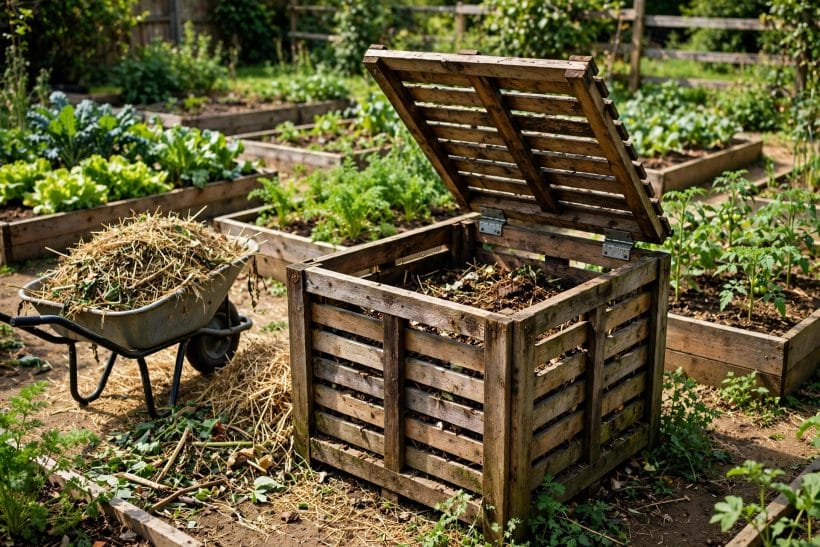
9. The Slatted Screen Panel
A single slatted panel — or two in an L — standing off the unit on the side the garden sees. Slats break the sightline while passing air freely, and a panel that lifts off its posts in one piece makes the serviceman’s visit a non-event.
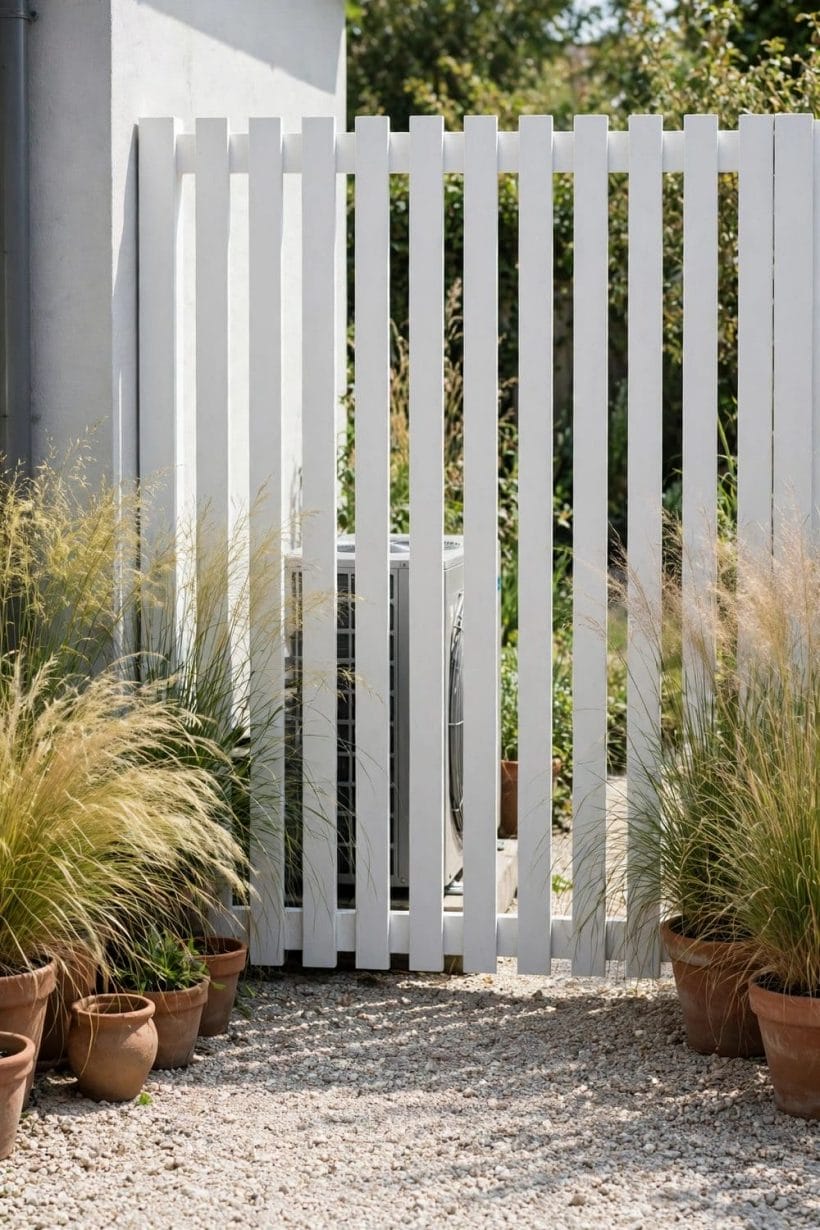
10. The Planter Screen
Tall planters with grasses or loose shrubs, arranged as a green screen the unit breathes behind. The softest screen in this article and the easiest to adjust — a planter can be rolled aside for access and rolled back by hand.
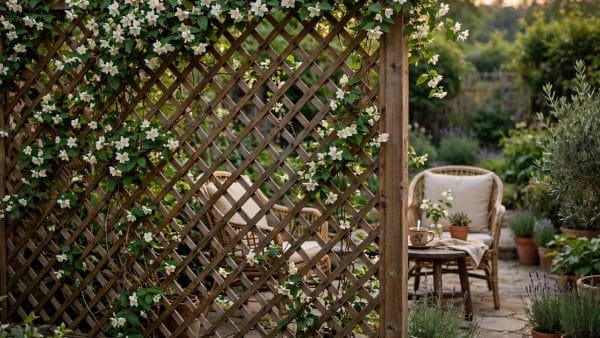
11. The Lattice Screen
Lattice panels around the unit carry climbers lightly and keep the grid’s airflow honest; the same lattice family, used as a fence line, fills the lattice fencing collection. Keep growth trimmed off the unit itself, and the screen ages into the garden like any trellis.
12. The Louvred Cabinet Screen
A purpose-built louvred surround, its angled blades aimed at sightlines rather than at the machine: it hides the unit from the patio’s angle while its every surface breathes. The most finished-looking of the four — and the one to check most carefully against the maker’s clearance guidance before building.
5. Materials: Timber, Willow, Metal and Brick
Material choice is where an enclosure joins the garden’s story or starts a new one. Timber is the mediator: stained, it can lean cottage or contemporary, it is repairable board by board, and it weathers to grey if neglected — gracefully, but visibly. Willow and hazel hurdles are the softest voice and the shortest life, traded happily by gardens that value texture over permanence.
Metal — mesh, louvre or frame — is the honest modern material: thin, strong, nearly maintenance-free, and cold in character unless planting warms it. Brick is the opposite bargain: the warmest and most permanent, the slowest to build, and the only material here that becomes part of the property rather than an object in the garden. Choose by the life you want the enclosure to have: hurdles for a season’s experiment, timber for the decade, brick for good.
Colour and finish ride on the material choice. Timber takes stain or paint and can be tied to the house’s trim or the fence’s tone, which is how a working corner gets absorbed into a garden’s palette instead of sitting outside it. Willow weaves its own colours and asks for none. Metal can be had in muted, garden-friendly finishes that disappear behind planting within a season. Brick needs no finish at all — its honesty is the finish — and it is the one material whose look improves at the same slow rate as the garden around it matures.
6. Siting: Paths, Access and the Neighbours
Site an enclosure by its journeys. Bins travel to the kerb; compost travels to the beds; the AC unit is visited by its owner rarely and its serviceman occasionally — each route wants a path that stays passable in winter mud, and gates that open against the direction of travel, not into it. The strip of garden these journeys usually cross is planned in the side yard landscaping collection, where the working side of a house gets designed rather than endured.
Then site it by the neighbours’ windows as well as your own: the enclosure you never see may be the centrepiece of someone else’s view, and a green roof or a planted face costs little goodwill insurance. Ground matters underneath everything — level, drained and firm, because a store that leans and a bay that floods will be hated by autumn whatever they looked like in spring.
Height is a siting decision too, and it is made from the chair, not the tape measure: the enclosure only needs to interrupt the sightlines that actually reach it — from the patio seats, from the kitchen window, from the pavement. A store screened from every real viewpoint can be lower than an anxious guess would build it, and lower enclosures are kinder to light, cheaper in material, and less likely to argue with any local expectations about front-garden structures. Sit where the garden is used, look at the corner, and let your own eyes set the top edge.
7. Lids, Gates and Getting Things In and Out
Access is where enclosures quietly succeed or fail, and it is tested at the worst moments: a bin lid that must open inside its store, a compost front that must come away when the bay is full and heavy, a screen panel that must move when the engineer calls. Design each opening for the full, awkward, real version of its job — lids at full height, barrows at full load, panels at full arm’s reach.
The storage buildings that get this right at larger scale fill the garden shed ideas collection, and the lesson scales down intact: an enclosure is a door with walls attached, not walls with a door regretted later. Hinges that lift off, gates that stay where they are put, lids that prop themselves — these small mechanics are the difference between a working corner that works and one that is worked around.
One access case deserves its own sentence because it is the one enclosures get wrong most: the full bin on collection morning, heavy, in the rain, in a hurry. If that journey involves a step, a tight turn, a gate that must be held, or a lid that must be ducked, the enclosure has failed at its only non-negotiable job — however handsome it looks at Sunday lunch. Walk the collection route with the bin before the design is finished, and let the worst morning of the year approve the plan.
8. Rules, Waste and the Local Picture
Stated plainly and generally: what may stand in a front garden, how waste must be stored, and where compost may sit are all matters local rules speak to, and they vary — by council, by district, by the terms of a lease or a homeowners’ association. Some areas care about structures forward of the house line; some set expectations for bin storage; a few speak to compost near boundaries. None of it is onerous, and all of it is cheaper to check before building than after a letter arrives.
The same local picture governs the AC unit’s own placement rules and clearances, which begin with the maker’s guidance and may be added to by local code — another reason every screen in this article is built to move. Enclosures in the other working material, metal, are gathered in the metal sheds collection for anyone scaling these ideas up.
Wildlife belongs in the local picture as well. A compost bay that is open by design will be visited — that is compost working as compost should — while food-waste bins are the ones to keep properly shut and latched, for the neighbours’ sake as much as the garden’s. Hedgehogs, birds and the occasional fox all read an enclosure differently from its owner; building with that audience in mind — gaps where harmless passage is welcome, none where it is not — costs nothing at the design stage.
9. Upkeep Through the Seasons
Upkeep is light but seasonal. Timber wants its finish renewed on a rhythm and its feet kept clear of leaf litter, which holds the damp that rots; hurdles want an honest eye each spring, because a hurdle’s failure is gradual and then sudden. Mesh and louvre ask only a wash and a check of their fixings.
The contents have seasons too: compost bays want turning room kept clear ahead of the spring emptying, bins want their store swept before summer does its work on smells, and the AC screen wants its climbers and grasses cut back before they reach for the unit — growth is the one maintenance debt every green screen accrues, and it is paid in minutes when paid on time.
Winter writes the last page of the upkeep calendar: timber stores stand in the wettest ground of the year, so autumn’s leaf-clearing around their feet is repaid in spring; lids and gates move stiffly in frost and want their hinges eased before they are forced; and the AC screen earns a check that nothing — stored pots, stacked chairs, a season of climber growth — has crept into the unit’s breathing room while nobody was watching. The enclosure that is walked round four times a year never becomes a project.
10. Before You Build: The Checks
The short routine that closes every enclosure decision. Check the airflow first: for the AC unit, the maker’s stated clearances honoured on every side and above, the screen open, spaced and removable. Check the access: lids, gates and fronts performing their full, awkward jobs on paper before they must in fact. Check the ground: level, drained, firm.
Then check the local picture — front-garden structures, waste storage, boundary planting — against the rules where you live, and check the view from the neighbours’ side as honestly as from your own. An enclosure that passes those checks disappears twice over, exactly as it should: out of sight, and out of the way.
Final Considerations
Twelve enclosures, one principle: the working corner of a garden deserves the same design respect as the showy one, and it repays that respect by vanishing. Screen the bins kindly, house the compost like the workstation it is, and hide the AC unit the way you would hide anything that breathes for a living — loosely, at a distance, with the door left open. Build to those rules and the corner stops being the part of the garden you apologise for — it becomes the part visitors assume was always tidy, which is the highest compliment a working corner can earn.


0 Comments